
EMOSFET The EMOSFET or enhancement MOSFET can operate
- Slides: 6
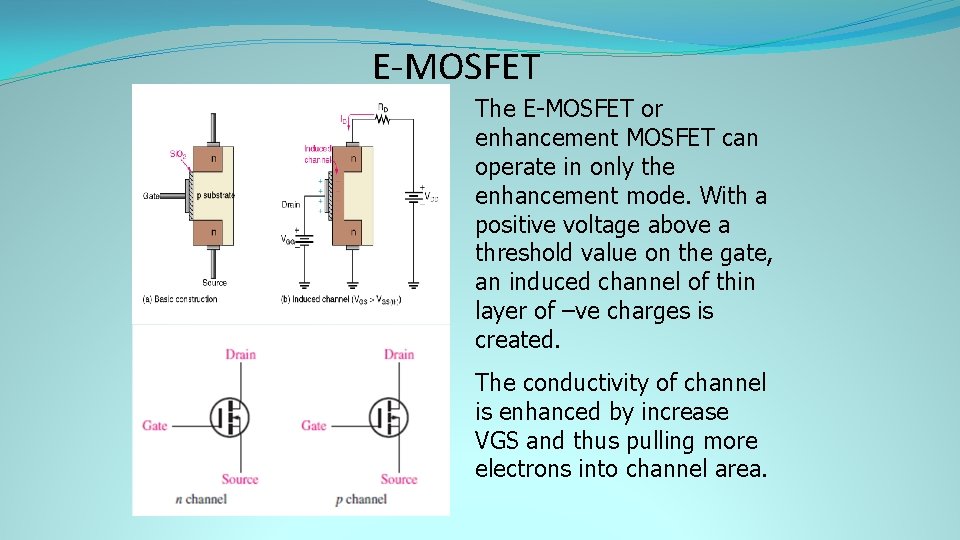
E-MOSFET The E-MOSFET or enhancement MOSFET can operate in only the enhancement mode. With a positive voltage above a threshold value on the gate, an induced channel of thin layer of –ve charges is created. The conductivity of channel is enhanced by increase VGS and thus pulling more electrons into channel area.
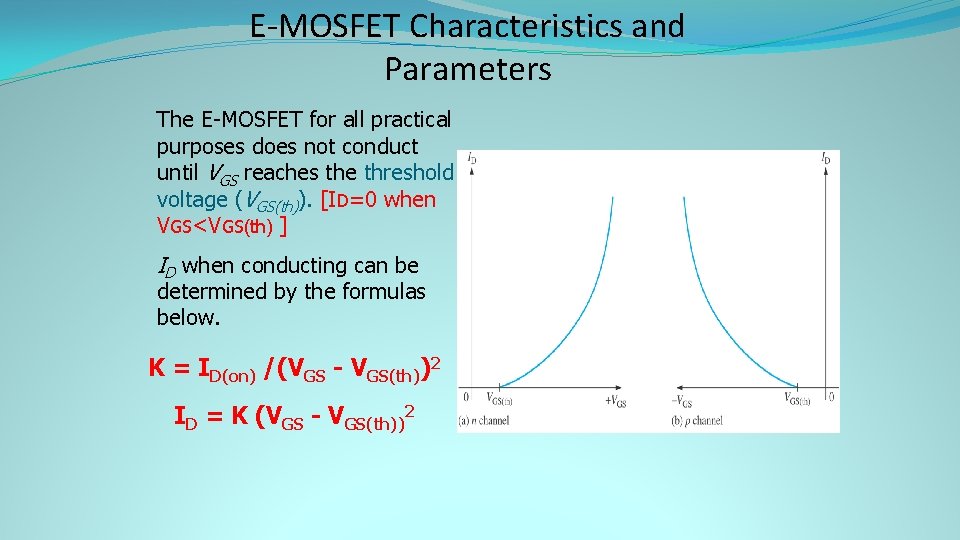
E-MOSFET Characteristics and Parameters The E-MOSFET for all practical purposes does not conduct until VGS reaches the threshold voltage (VGS(th)). [ID=0 when VGS<VGS(th) ] ID when conducting can be determined by the formulas below. K = ID(on) /(VGS - VGS(th))2 ID = K (VGS - VGS(th))2
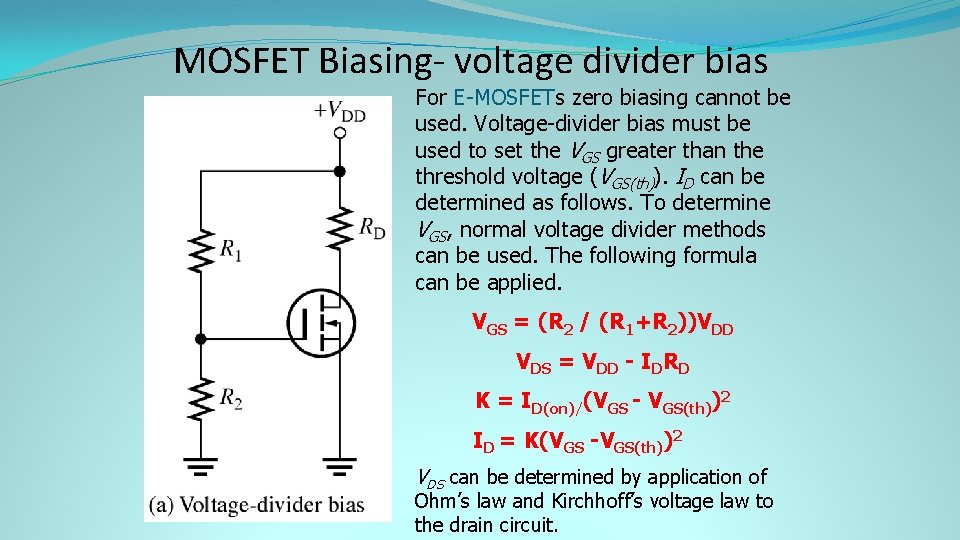
MOSFET Biasing- voltage divider bias For E-MOSFETs zero biasing cannot be used. Voltage-divider bias must be used to set the VGS greater than the threshold voltage (VGS(th)). ID can be determined as follows. To determine VGS, normal voltage divider methods can be used. The following formula can be applied. VGS = (R 2 / (R 1+R 2))VDD VDS = VDD - IDRD K = ID(on)/(VGS - VGS(th))2 ID = K(VGS -VGS(th))2 VDS can be determined by application of Ohm’s law and Kirchhoff’s voltage law to the drain circuit.
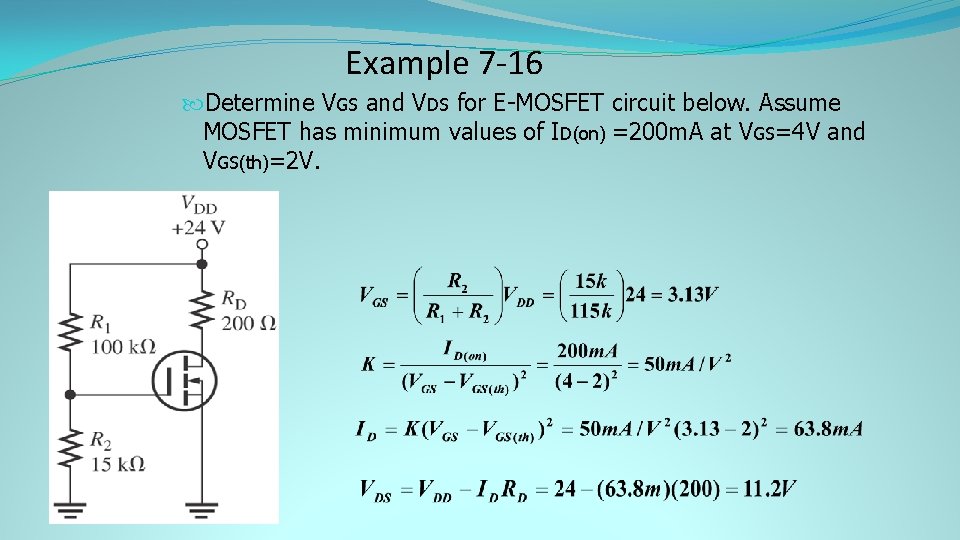
Example 7 -16 Determine VGS and VDS for E-MOSFET circuit below. Assume MOSFET has minimum values of ID(on) =200 m. A at VGS=4 V and VGS(th)=2 V.
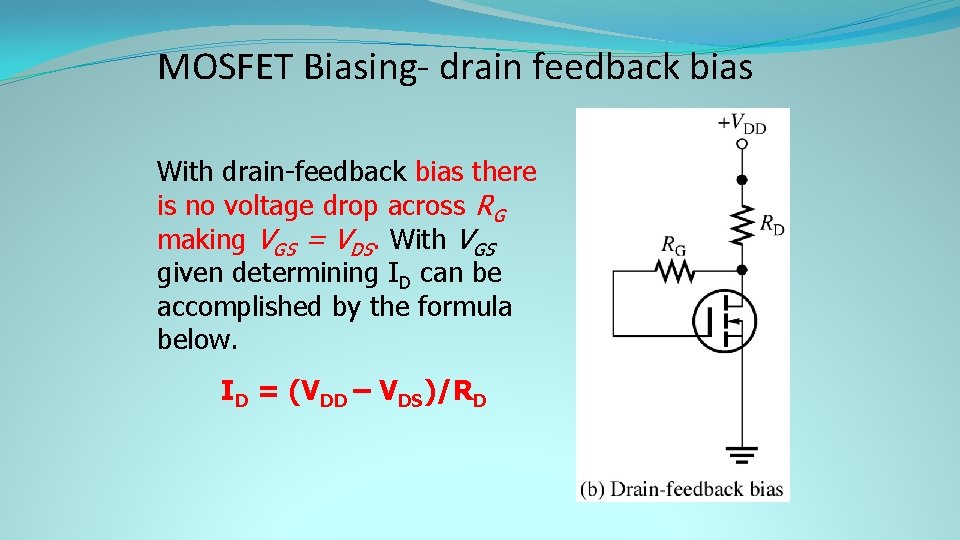
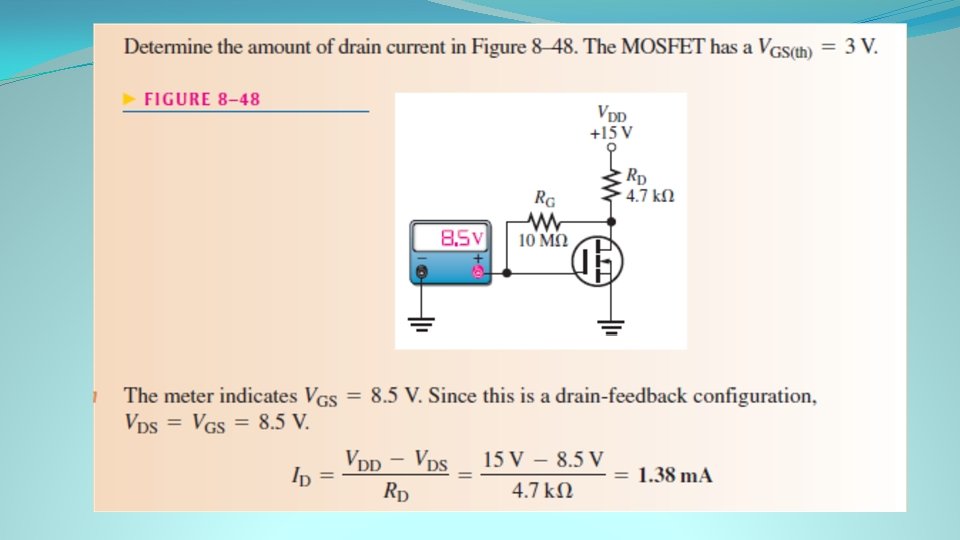
MOSFET Biasing- drain feedback bias With drain-feedback bias there is no voltage drop across RG making VGS = VDS. With VGS given determining ID can be accomplished by the formula below. ID = (VDD – VDS)/RD