
Emmanuel LEVINAS 19056 1995 Professor KALDIS Byron Moral
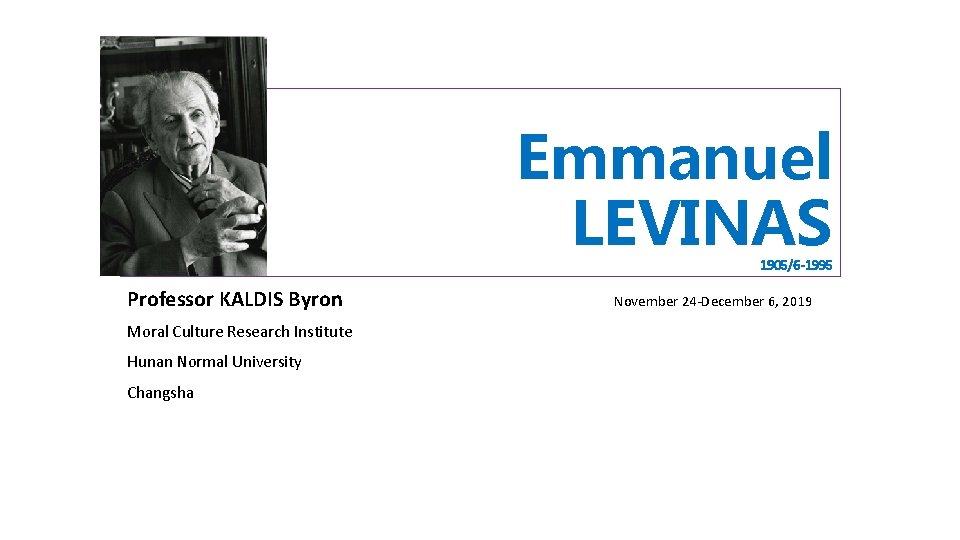
Emmanuel LEVINAS 1905/6 -1995 Professor KALDIS Byron Moral Culture Research Institute Hunan Normal University Changsha November 24 -December 6, 2019
§ Levinas: Ethics as First Philosophy phenomenological description of the experience of encountering the other face-to-face intersubjective responsibility ethical critique of ontology

• Levinas’ style and approach
Life & Works: • • 1905/1906 Lithuania (Russia) – 1995 France Lithuanian-born, French-Jewish Philosopher Nazism & War Prisoner Phenomenology, Existentialism, Ethics, Ontology, Jewish Philosophy, Talmudic Studies • Studied under Husserl (and first translator) • also influence of Heidegger • M. Blanchot • Bergson • 1948: Time and the Other • 1961: Totality and Infinity: an essay on exteriority • 1974: Otherwise than Being or Beyond Essence • 1982: Ethics and Infinity • 1984: “Ethics as First Philosophy”
• PHENOMENOLOGY • Husserl: ‘back to the things themselves’ • EXISTENTIALISM • Existence prior to Essence

Structure of Totality & Infinity • I. the existence of the self; • II. the relation to the other; • III. the reversal of ethics and ontology
T & I: thinking open to the Other • Systematic attack on Western Ontology and its totalizing conception of being • (influenced very much by Plato and Descartes) • The face The Other • • The Other cannot be captured within a systematized concept The Other is infinity The face [of the Other] is not physical. It is a moment of infinity that cannot be captured • The relation with the Other is and ethical relation • It is there even before I am self-conscious of the other • Hence: The Ethical Responsibility for the Other
T&I: infinite being Since infinity in Levinas’ view is perceived by us as a revelation of the Other, and more specifically is located in the face of the other, consciousness for Levinas is not first and foremost the practice of reducing and representing existence for ourselves, but is initially a moral event that recognizes and welcomes the already established and inexhaustible other.
Τ&Ι • Against Husserl’s too intellectualist conception of an ego that cognizes islef and the other • Against Heidegger’s Dasein which again reduces the other to my Dasein and my anxiety and care T&I is as much about the other as it is about subjectivity/the self For Levinas: The relation to the other has two viewpoints: On the one, there is the ‘face of the other’, which is the unique experience of the other human being who calls my existence into question and judges me. But on the other, there must also be a self that is capable of being questioned.
![TOTALITY & INFINITY • “Morality” & “War” [Heraclitus] • Duped by an illusion (morality)?](http://slidetodoc.com/presentation_image_h2/c658e10b4c17818e01ed90e03803d045/image-10.jpg "TOTALITY & INFINITY • “Morality” & “War” [Heraclitus] • Duped by an illusion (morality)?")
TOTALITY & INFINITY • “Morality” & “War” [Heraclitus] • Duped by an illusion (morality)? And sustained by a permanent reality (war)? • “Infinite” is not mathematical infinite • Descaartes’ proof of God as perfection • Experience of things and experience of the other through Cartesian ‘idea’/concept • Experience is larger that the totalizing concept • Like in “God” my idea and the experience do not much, so is the case with the face of the other in ethical encounter • The face of the other exceeds and resists my idea-concept of it
• So how can I experience the irreducibility of the singularity of the other without making them part of my world (like Heidegger’s Dasein) • So, How are we to think of a self that is neither like Husserl’s ego nor Heidegger’s Dasein, obsessed but which is open to the experience of the other as other, but at the same time does not reduce this experience to its own reflection upon it? This, for Levinas, the idea of infinity. There can be an experience of the other that is not reducible to an idea of having that experience, where my experience of answering to the demands of the other overflows my idea of it, just as for Descartes the reality of God (his perfection) exceeds any definition.
“Totality” • ‘Totalizing” : when the whole absorbs the identity of parts and majkes the same • E. g. categories / taxonomy • The opposite of totality = the other in her/his singularity • Speech as direct speaking • So, inverse relation: truth (the what-is or how things are understood to be) rests on justice (ethics) => ethics is primary
“Face” • ‘infinitely foreign’ • The concretization of infinity • Because thought is brought into relation with what goes beyond its capacity (as with Descartes’ God-concept) it is a special encounter • Levinas calls this situation the ‘welcome of the face’. • So the face ethically stands for Levinas’ philosophy in the way it is perceived to resist possession or utilization • It invites and obliges me to take on a responsibility that transcends knowledge.
Truth and Justice • Reversal • It is ethics not ontology that is the foundation of all knowledge as an activity • Levinas goes beyond Heidegger’s existentialism whereby my embodied existence precedes abstract cognition • For Levinas, it is my encounter with the other and the corresponding responsibility that comes first and grounds knowledge and everything else
• Because knowledge is not solitary reflection (as in Western philosophy – a meditation) but a social encounter with the other, it is this ethical relation with the other that gives birth to knowledge • Because the other appears unfathomable, I begin to need to know the other – not through concepts! Because that would be going back to classical ontology • But through ethics: the other imposes a demand on me • We are not equal as in classical western political freedom = all the same • So, what comes first is not objectivity and reason – but ethics on which the former depend
• The ultimate condition of knowledge, for Levinas, is not a selfreflection on my self and its cognitive capacities (e. g. Kant) by means of which I then cognize/know the outside world by means of imposing concepts on it, but the demand the other places upon me • Knowledge does not start with my self and its building a truth, but from the other • So, unlike Kant (Critique of Reason) it is not a matter of self-critique as reflection and contemplation. • Levinas reinterprets it ethically as interrogation and an appeal that comes to me from outside rather than from within. I do not know the other, for then they would just be part of the known world I already possess, I “welcome the other” (ethical stance).
How do I know the Other? • Not through classical cognition • But through cognition (seeing) but through speech (= the other demands an answer from me) • In speaking – as a form of knowledge for Levinas – to/with the other, there is truth involved • Not in the classic sense: as correspondence of statements to reality • But as a demand to justify as truthful my activity of speaking • So, there is an intimate connection between the speaking as an activity implicated in knowing – when I encounter the other – and justice TRUTH and JUSTICE are connected (and are foundational) at the ethical encounter with the other
Politics and freedom • Reversal of Freedom and its place in ethics • Unlike the Existentialists • The other is not a fact or obstacle to my freedom that I ought to recognize in order to become myself (that we are not enemies but mutual subjects) • In classical political theory: freedom is consciousness of no limits/obstacles = theoretical self-reflection • For Levinas, consciousness of my limits does not begin with theoretical reflection (political philosophy etc) but with the encounter with the other who demands recognition of those limits from me = so the beginning of knowledge as ethics/politics
Freedom and Morality • So: Moral Commands/Injunction is not a theoretical constraint on my freedom – Not an imposition by a powerful opponent – Not a selfreflection into morality and self-curtailing freedom – Not running against an obstacle that is the other “DO NOT KILL!” • ! but it is concretely experienced as the other’s vulnerability and powerlessness • ‘Morality begins when freedom, instead of being justified by itself, feels itself to be arbitrary and violent’
• Community – Society based on sincerity • Therefore the ethical relation is foundational here, too • Sincerity as the basis of all knowledge • (as a kind of utterance truthfully in which the other exists
Summary of the argument • Start with the separated subject, the concrete existing self. • This subject moves outside of itself to the other. • This movement does not beging by itself but through the demand the other makes on me. • INFINTE = That the self can be called into question by the other that transcends it • The infinite is not an idea. It is not a definition of the other, as though the other were similar to the Cartesian “God” which is proved to exist through supposedly necessarily logical steps
• The infinite is not thought but experienced. • This is what Levinas means when he says that the infinite is produced, and ‘society accomplishes it concretely’ (p. 102). • Though the other and the self are in a relation, this relation is not a unity. • ‘The same and the other at the same time maintain themselves in relationship and absolve themselves from this relation, remain absolutely separated’
- Slides: 22