
EML 4550 Engineering Design Methods The Design Process
- Slides: 36
EML 4550 - Engineering Design Methods The Design Process Phases of the design process, work breakdown structure, design in teams, organizational structures Hyman: Chapters 1 and 2 Smith: Chapter 1 + Chapter 6 (first section) Ulrich and Eppinger: Chapters 1 and 2 Dym and Little: Chapters 1 and 2 EML 4550 2007 1 -03 -1
Design (ABET definition) n Engineering design is the process of devising a system, component, or process to meet desired needs. It is a decision-making process (sometimes iterative), in which the basic sciences and mathematics, and engineering sciences are applied to convert resources optimally to meet a stated objective. Among the fundamental elements of the design process are the establishment of objectives and criteria, synthesis, analysis, construction, testing, and evaluation (Note: a design project) EML 4550 2007 2
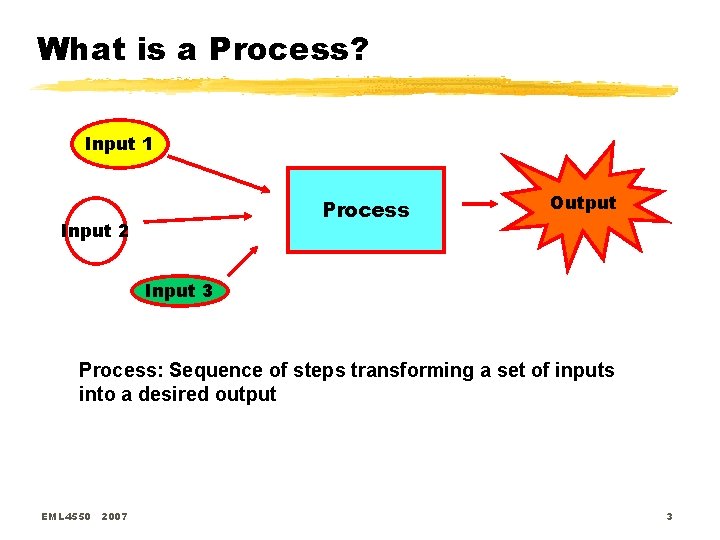
What is a Process? Input 1 Process Input 2 Output Input 3 Process: Sequence of steps transforming a set of inputs into a desired output EML 4550 2007 3
Engineering design as a process n Engineering design implies a ‘methodology’ (sequence of steps) n Desired Characteristics: l Creativity l Quality assurance l Coordination l Planning l Management l Improvement (CI) EML 4550 2007 4
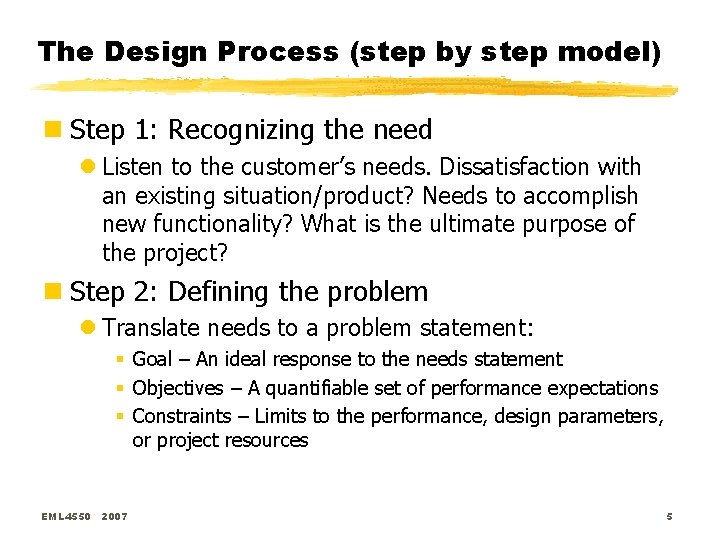
The Design Process (step by step model) n Step 1: Recognizing the need l Listen to the customer’s needs. Dissatisfaction with an existing situation/product? Needs to accomplish new functionality? What is the ultimate purpose of the project? n Step 2: Defining the problem l Translate needs to a problem statement: § Goal – An ideal response to the needs statement § Objectives – A quantifiable set of performance expectations § Constraints – Limits to the performance, design parameters, or project resources EML 4550 2007 5
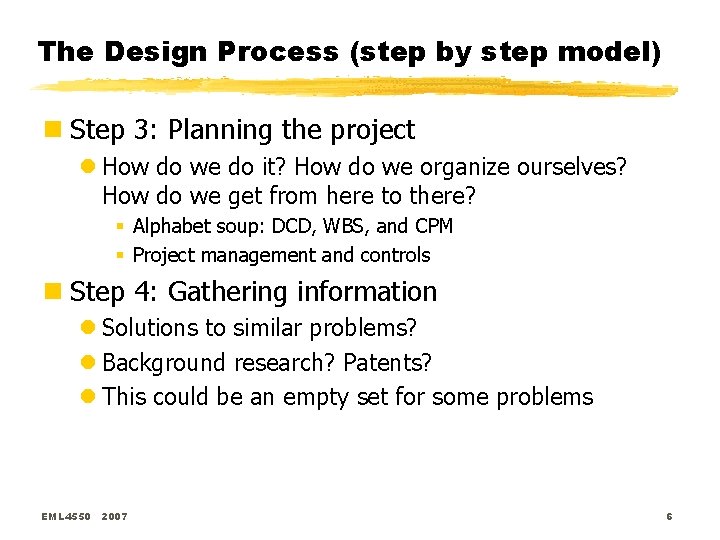
The Design Process (step by step model) n Step 3: Planning the project l How do we do it? How do we organize ourselves? How do we get from here to there? § Alphabet soup: DCD, WBS, and CPM § Project management and controls n Step 4: Gathering information l Solutions to similar problems? l Background research? Patents? l This could be an empty set for some problems EML 4550 2007 6
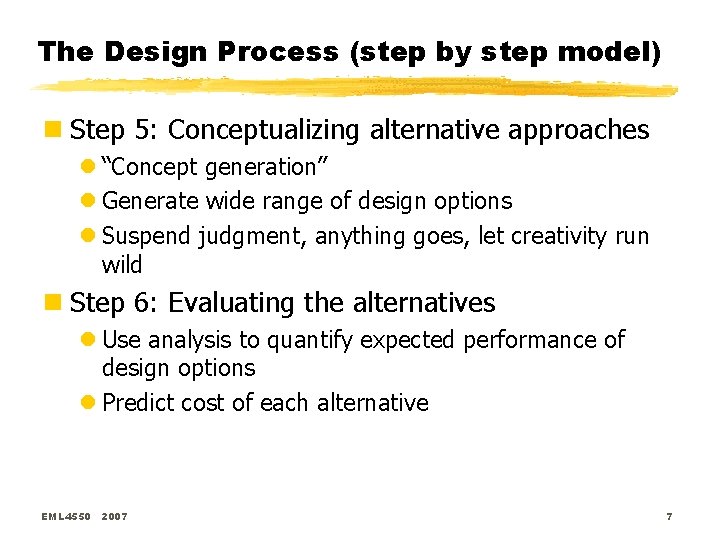
The Design Process (step by step model) n Step 5: Conceptualizing alternative approaches l “Concept generation” l Generate wide range of design options l Suspend judgment, anything goes, let creativity run wild n Step 6: Evaluating the alternatives l Use analysis to quantify expected performance of design options l Predict cost of each alternative EML 4550 2007 7
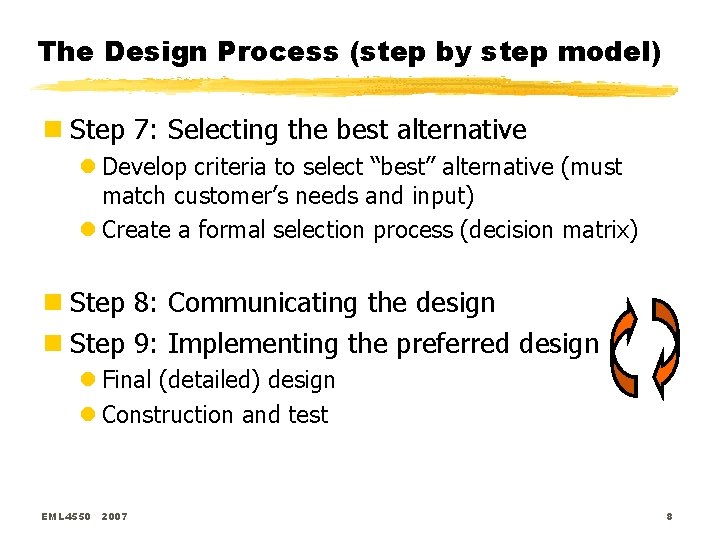
The Design Process (step by step model) n Step 7: Selecting the best alternative l Develop criteria to select “best” alternative (must match customer’s needs and input) l Create a formal selection process (decision matrix) n Step 8: Communicating the design n Step 9: Implementing the preferred design l Final (detailed) design l Construction and test EML 4550 2007 8
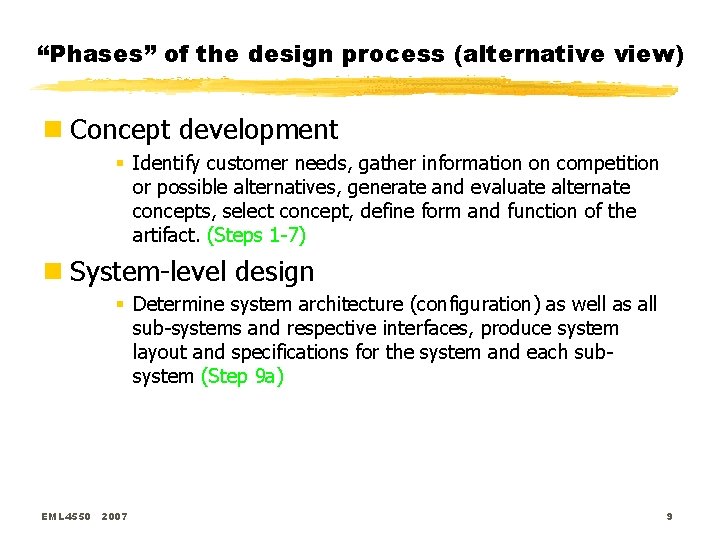
“Phases” of the design process (alternative view) n Concept development § Identify customer needs, gather information on competition or possible alternatives, generate and evaluate alternate concepts, select concept, define form and function of the artifact. (Steps 1 -7) n System-level design § Determine system architecture (configuration) as well as all sub-systems and respective interfaces, produce system layout and specifications for the system and each subsystem (Step 9 a) EML 4550 2007 9
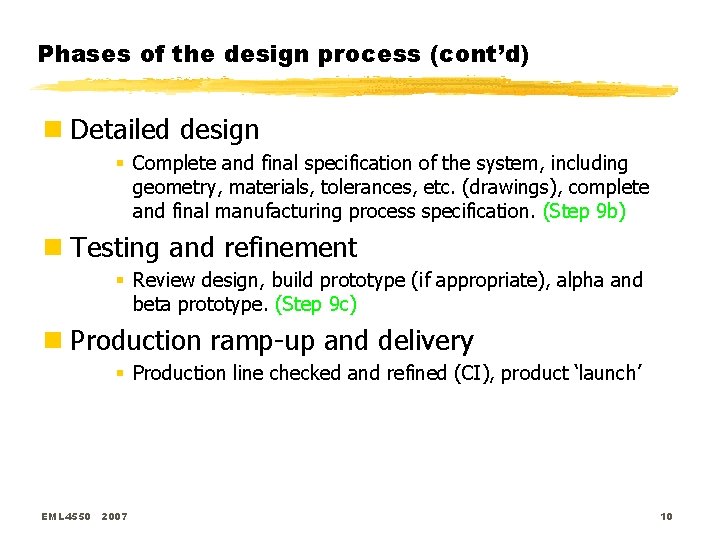
Phases of the design process (cont’d) n Detailed design § Complete and final specification of the system, including geometry, materials, tolerances, etc. (drawings), complete and final manufacturing process specification. (Step 9 b) n Testing and refinement § Review design, build prototype (if appropriate), alpha and beta prototype. (Step 9 c) n Production ramp-up and delivery § Production line checked and refined (CI), product ‘launch’ EML 4550 2007 10
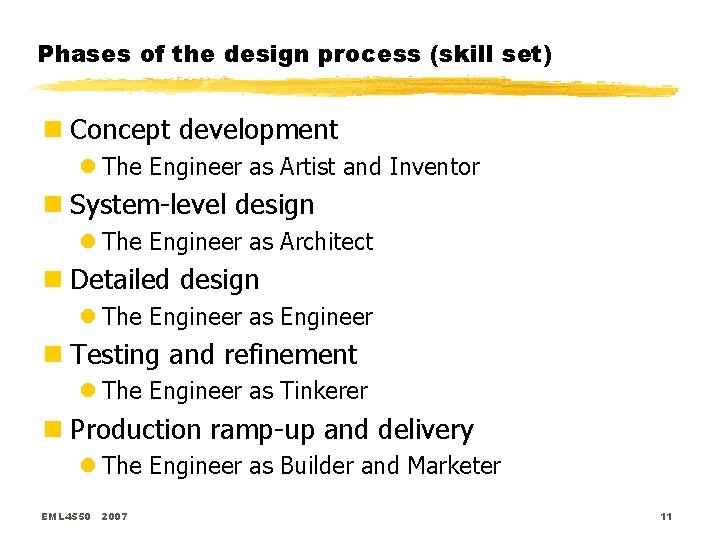
Phases of the design process (skill set) n Concept development l The Engineer as Artist and Inventor n System-level design l The Engineer as Architect n Detailed design l The Engineer as Engineer n Testing and refinement l The Engineer as Tinkerer n Production ramp-up and delivery l The Engineer as Builder and Marketer EML 4550 2007 11
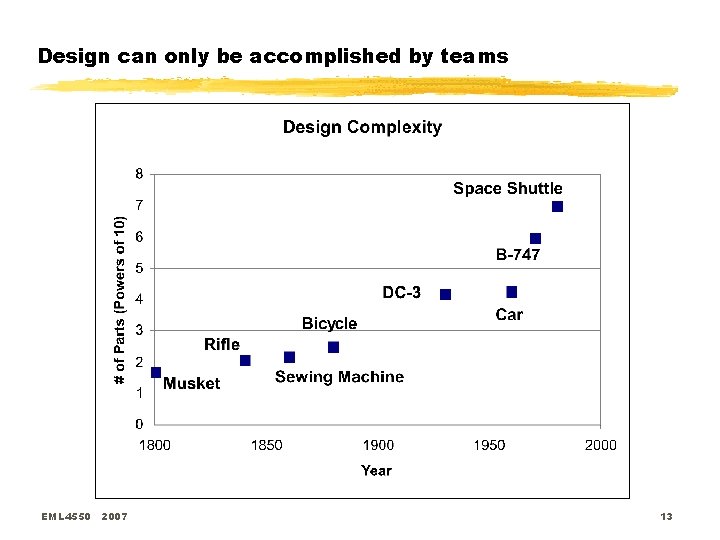
Design can only be accomplished by teams EML 4550 2007 13
The Design Process is a Team Activity n Almost all engineering systems of interest today are too complex to be designed by an individual n High degree of interdisciplinary content n Engineers must conduct design in a team setting n Team organization and dynamics become a major part of engineering design EML 4550 2007 14
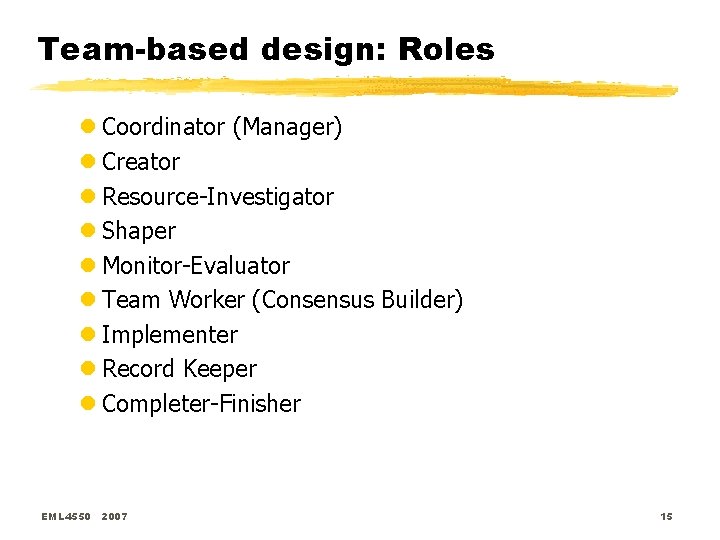
Team-based design: Roles l Coordinator (Manager) l Creator l Resource-Investigator l Shaper l Monitor-Evaluator l Team Worker (Consensus Builder) l Implementer l Record Keeper l Completer-Finisher EML 4550 2007 15
Team based design: Guidelines n Keep the Team Productive l All members understand the purpose l All members feel the project is exciting l The goals are clear, simple, realistic, and measurable l The approach is clear and agreed upon n Achieve balance of skills in team roles n Establish clear rules of behavior n Set a few immediate performance-oriented goals and tasks (one-day-at-a-time) n COMMUNICATE! SPEND TIME TOGETHER! EML 4550 2007 16
Design Project: What is a Project? l Dictionary: A combination of human and non-human resources pulled together in a temporary organization to achieve a specified purpose l A non-routine series of tasks directed towards a goal l Characteristics: § § § EML 4550 2007 Definable purpose and established goals Cost, schedule, and performance requirements Multiple resources across organizational lines One-time activity, and temporary (beginning and end) Element of risk (some uncertainty as of the outcome) Process of phases, a life-cycle 17
Managing Design Projects n All design activities are done in teams n All design activities are done within a project n Managing a project: Management is the process of achieving organizational goals by engaging in the four major functions of planning, organizing, leading, and controlling EML 4550 2007 18
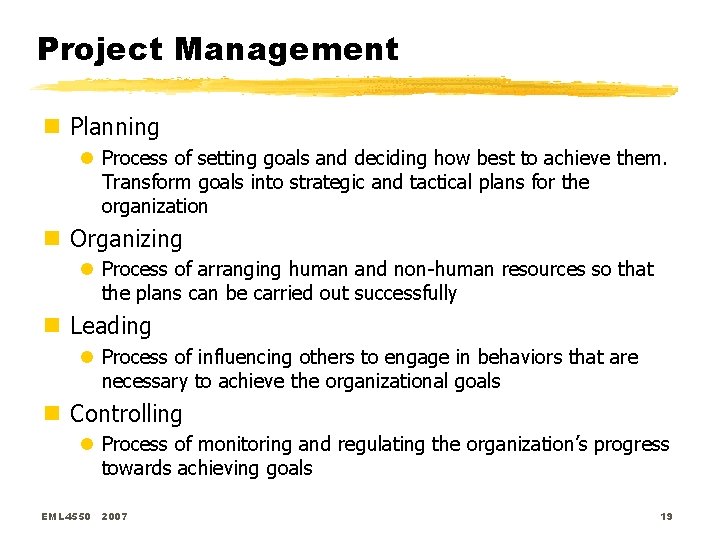
Project Management n Planning l Process of setting goals and deciding how best to achieve them. Transform goals into strategic and tactical plans for the organization n Organizing l Process of arranging human and non-human resources so that the plans can be carried out successfully n Leading l Process of influencing others to engage in behaviors that are necessary to achieve the organizational goals n Controlling l Process of monitoring and regulating the organization’s progress towards achieving goals EML 4550 2007 19
The Design Process (step by step model) n Step 3: Planning the project l How do we do it? How do we organize ourselves? How do we get from here to there? § Alphabet soup: DCD, WBS, and CPM § Project management and controls n Step 4: Gathering information l Solutions to similar problems? l Background research? Patents? l This could be an empty set for some problems A VERY concise introduction to systems engineering and project management EML 4550 2007 20
Systems Engineering n Complex systems are better understood and managed if broken down into pieces. n Principle behind “systems engineering”: Break it Down! n Break system down into sub-systems so that design activities and tracking become manageable. EML 4550 2007 21
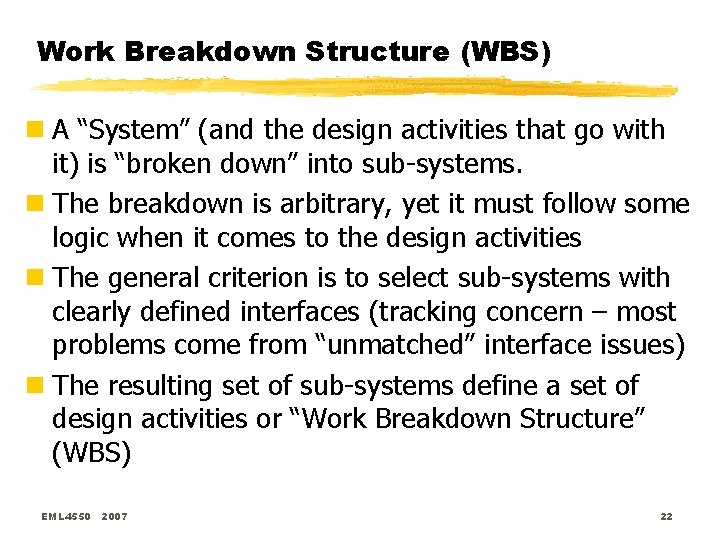
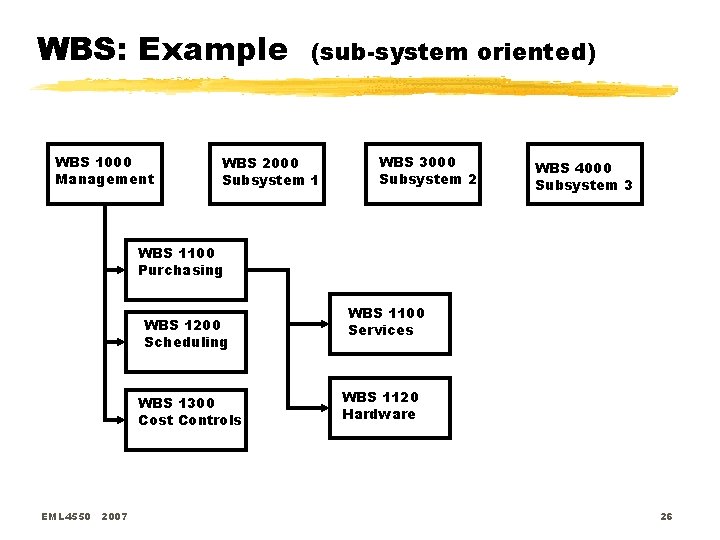
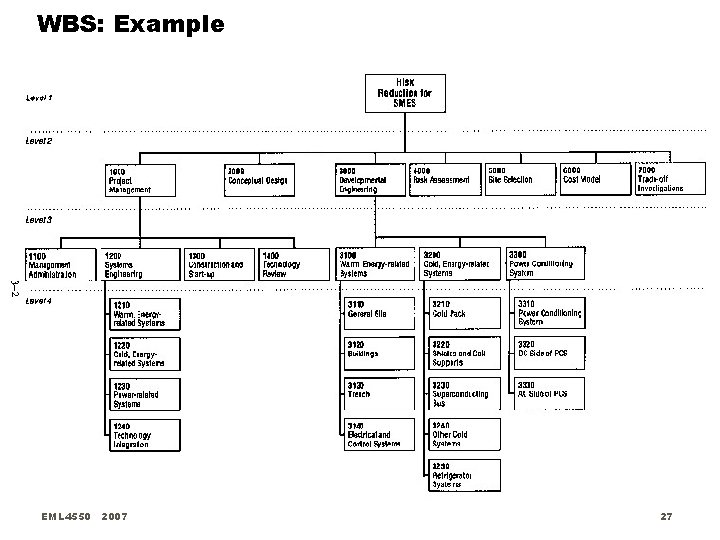
Work Breakdown Structure (WBS) n A “System” (and the design activities that go with it) is “broken down” into sub-systems. n The breakdown is arbitrary, yet it must follow some logic when it comes to the design activities n The general criterion is to select sub-systems with clearly defined interfaces (tracking concern – most problems come from “unmatched” interface issues) n The resulting set of sub-systems define a set of design activities or “Work Breakdown Structure” (WBS) EML 4550 2007 22
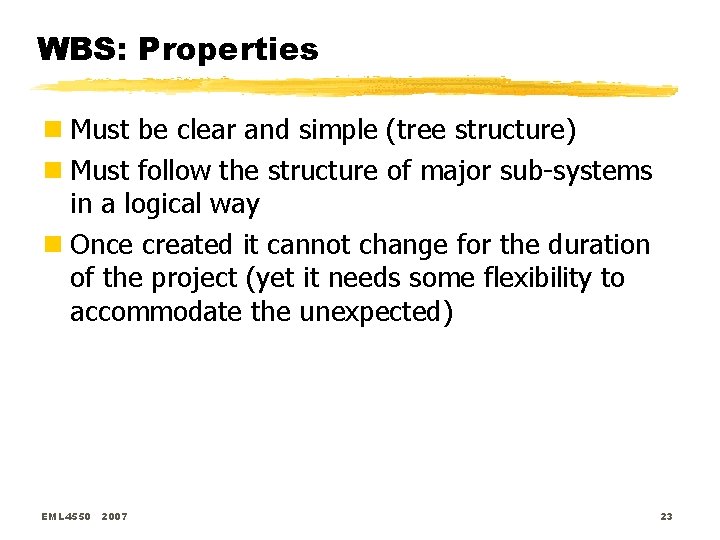
WBS: Properties n Must be clear and simple (tree structure) n Must follow the structure of major sub-systems in a logical way n Once created it cannot change for the duration of the project (yet it needs some flexibility to accommodate the unexpected) EML 4550 2007 23
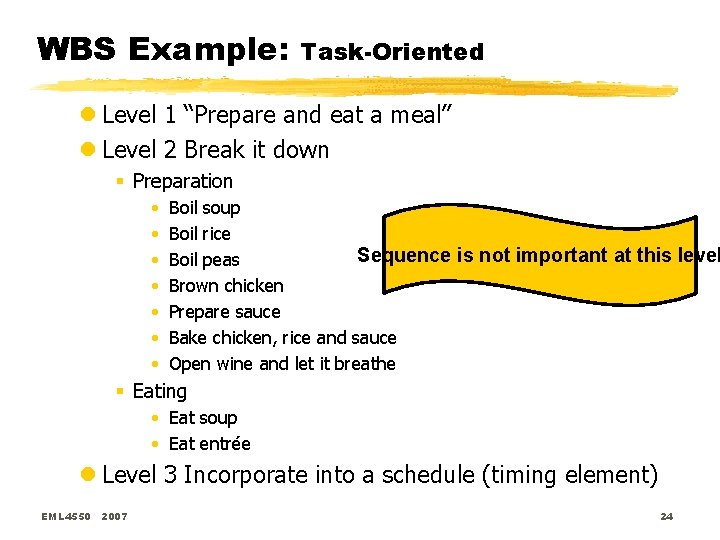
WBS Example: Task-Oriented l Level 1 “Prepare and eat a meal” l Level 2 Break it down § Preparation • • Boil soup Boil rice Sequence is not important at this level Boil peas Brown chicken Prepare sauce Bake chicken, rice and sauce Open wine and let it breathe § Eating • Eat soup • Eat entrée l Level 3 Incorporate into a schedule (timing element) EML 4550 2007 24
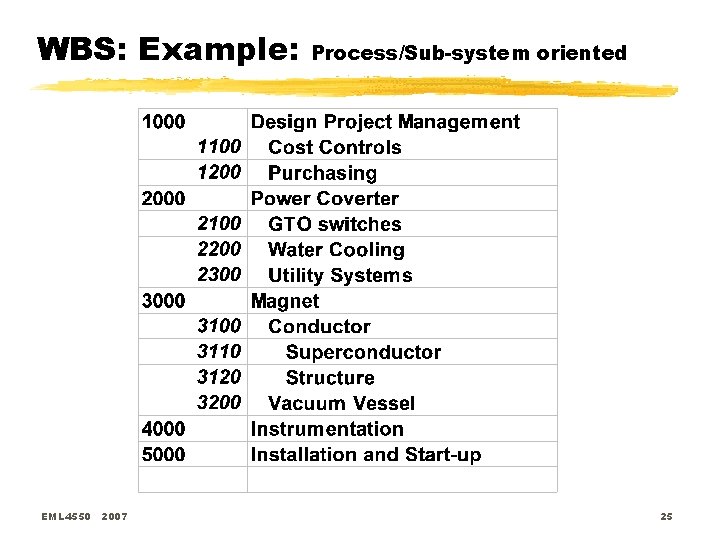
WBS: Example: EML 4550 2007 Process/Sub-system oriented 25
WBS: Example WBS 1000 Management (sub-system oriented) WBS 2000 Subsystem 1 WBS 3000 Subsystem 2 WBS 4000 Subsystem 3 WBS 1100 Purchasing WBS 1200 Scheduling WBS 1300 Cost Controls EML 4550 2007 WBS 1100 Services WBS 1120 Hardware 26
WBS: Example EML 4550 2007 27
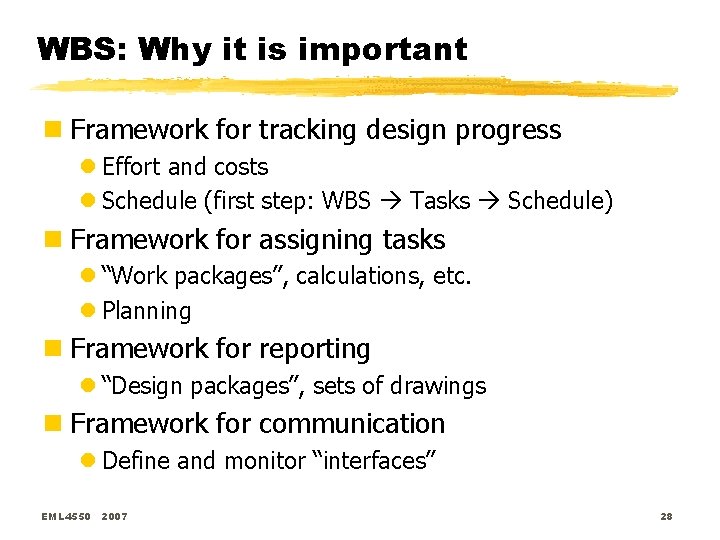
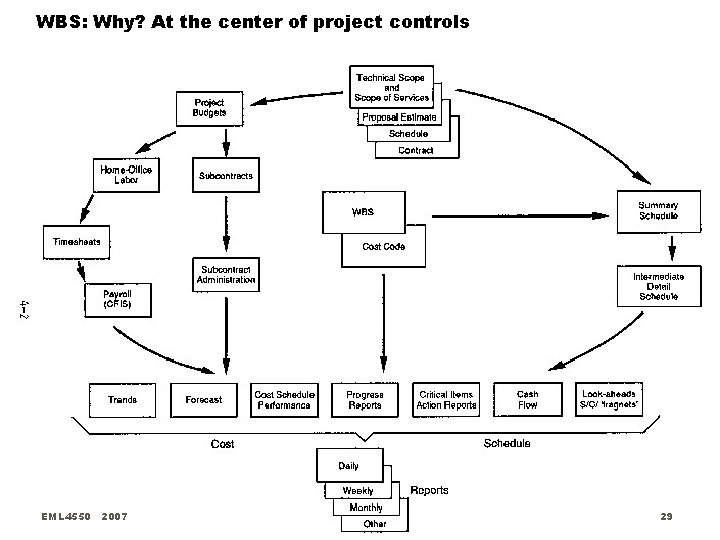
WBS: Why it is important n Framework for tracking design progress l Effort and costs l Schedule (first step: WBS Tasks Schedule) n Framework for assigning tasks l “Work packages”, calculations, etc. l Planning n Framework for reporting l “Design packages”, sets of drawings n Framework for communication l Define and monitor “interfaces” EML 4550 2007 28
WBS: Why? At the center of project controls EML 4550 2007 29
What is an Interface? Any piece of data that needs to go from one sub-system to another in order to proceed with a proper design defines an interface EML 4550 2007 30
Systems Integration The art and science of keeping track of interfaces during the design process n In a large design project system integration is a major part of the effort n “Complexity” of a project is proportional to the number and extent of interfaces n Most “problems” in a design originate in system integration and not in individual work packages (i. e. , when work packages are not properly coordinated) EML 4550 2007 31
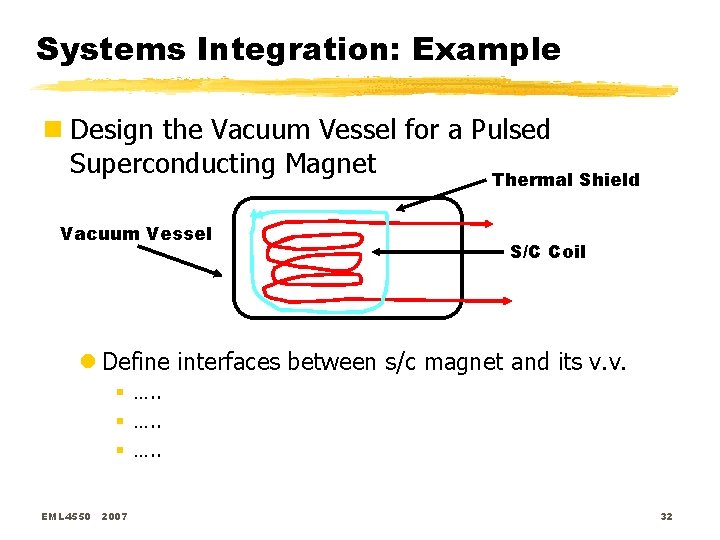
Systems Integration: Example n Design the Vacuum Vessel for a Pulsed Superconducting Magnet Thermal Shield Vacuum Vessel S/C Coil l Define interfaces between s/c magnet and its v. v. § …. . EML 4550 2007 32
Management: Organizations n Success of any project rests on the adequacy of the organization that supports it n Companies spend a great deal of effort to device efficient (‘lean and mean’) organizations n Projects: l Reside within organization l Accountable l Independent l Goal-driven l Transient in nature EML 4550 2007 33
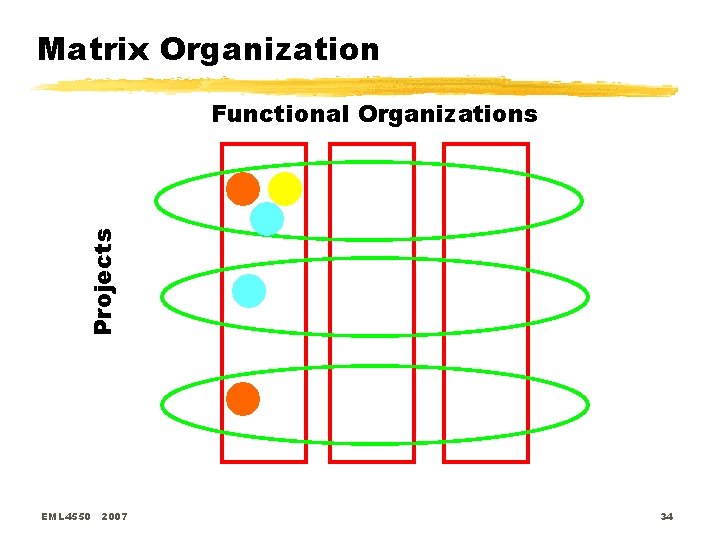
Matrix Organization Projects Functional Organizations EML 4550 2007 34
Matrix Organization n Each person has ‘two bosses’ n Each person ‘wears two hats’ n Success hinges on rapid deployment of ‘project teams’ (reconfiguration) n Success hinges on flexibility n Success hinges on worker’s ability to ‘juggle’ multiple projects (prioritize, plan, manage time) EML 4550 2007 35
Matrix Organization n Functional Org l Fosters specialization and development l Repository of ‘skills’ l ‘Placement’ of workers l Bureaucracy n Project Org l Optimal allocation of resources l Objective-driven, fast-paced (Client-driven) l Quick evaluation of concepts, trade-offs l Difficulty of people staying ‘sharp’ l Difficulty in capturing ‘lessons-learned’ (memory) EML 4550 2007 36
Implications to Design Project n Understand the design process to implement in your own project n Team formation (team building to come) n Engage in management of your own project: planning, organizing, leading, controlling l Prepare WBS l Prepare schedule l Stick to WBS and schedule on all reporting! n Understand system interfaces on your design EML 4550 2007 37