
EML 4550 Engineering Design Methods EngineeringEconomics Introduction Project
- Slides: 28
EML 4550 - Engineering Design Methods Engineering-Economics Introduction, Project Economics Ulrich and Eppinger: Chapter 11 EML 4550 2007 1
Engineering-Economics n Design under ‘constraints’ l Physical (materials, environment, fits, laws of physics) l Economic ($ to design, $ to produce, $ to operate) n Dealing with the combination of technical and cost constraints is engineering-economics EML 4550 -- 2007
Engineering-Economics (Cont’d) n Project economics l How much should we spend on design? l How big will the market be? n Product economics l What is the initial cost of the product l What are the operational costs of the product l What is the product’s life-cycle cost? n Same questions but asked from the manufacturer and customer perspectives EML 4550 -- 2007
Project Economics n How much effort (time and $) should a company spend developing a product? n What tools are used to determine the optimum level of development expenditures? n What type of analysis and reports are needed to convince management to proceed with a development project? EML 4550 -- 2007
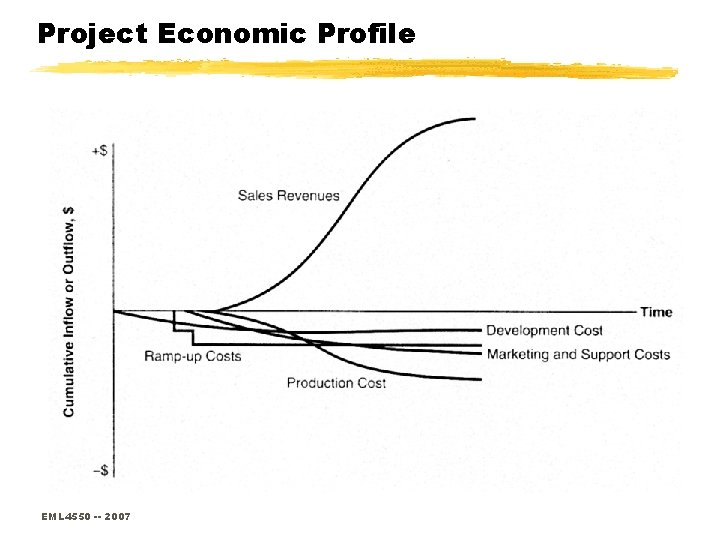
Project Economic Profile EML 4550 -- 2007
Project Economics: Quantitative Analysis n Project cash flows span a product lifetime (sometimes many years) n How do we compare an expenditure ‘today’ to an income ‘tomorrow’? n Concept of ‘Net Present Value’ (NPV) EML 4550 -- 2007
NPV Analysis - Observations n What interest rate to use? l Discount rate or hurdle rate l Must be higher than opportunity lost by company by investing in this project as opposed to something else § § Must be higher than prevailing interest rates Low growth industries – 10% Typical for the 90 s (bull market) – 20% Aggressive growth (venture capital) - ~50% n Connection to prevailing interest rates as set by Federal Reserve? EML 4550 -- 2007
Project Economics: Methodology n Build a ‘base-case’ financial model n Perform sensitivity analysis to understand the importance of the different assumptions of the model n Use the sensitivity analysis to understand trade-offs n Consider impact of ‘qualitative’ factors not covered on the financial model Will work through an example EML 4550 -- 2007
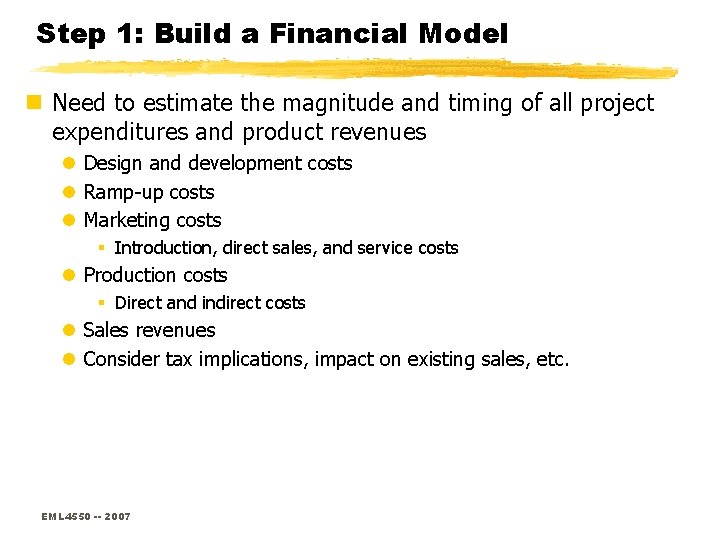
Step 1: Build a Financial Model n Need to estimate the magnitude and timing of all project expenditures and product revenues l Design and development costs l Ramp-up costs l Marketing costs § Introduction, direct sales, and service costs l Production costs § Direct and indirect costs l Sales revenues l Consider tax implications, impact on existing sales, etc. EML 4550 -- 2007
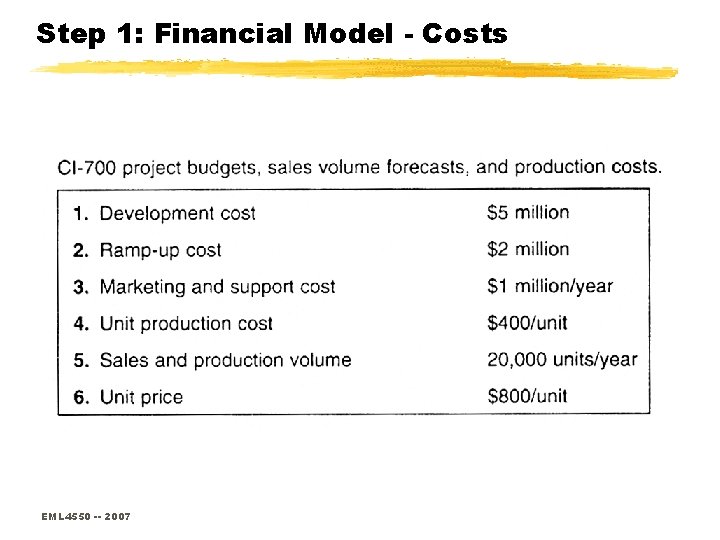
Step 1: Financial Model - Costs EML 4550 -- 2007
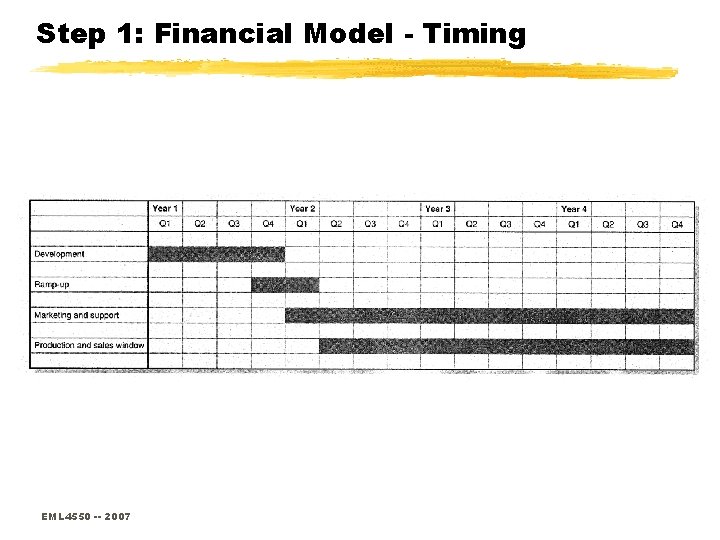
Step 1: Financial Model - Timing EML 4550 -- 2007
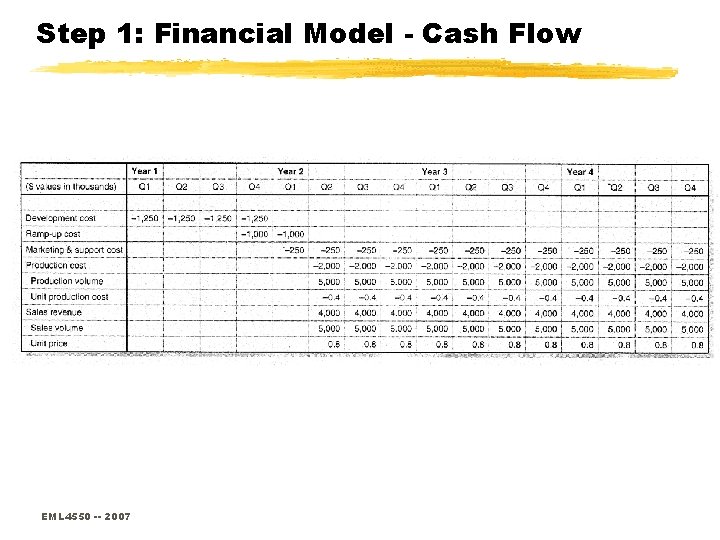
Step 1: Financial Model - Cash Flow EML 4550 -- 2007
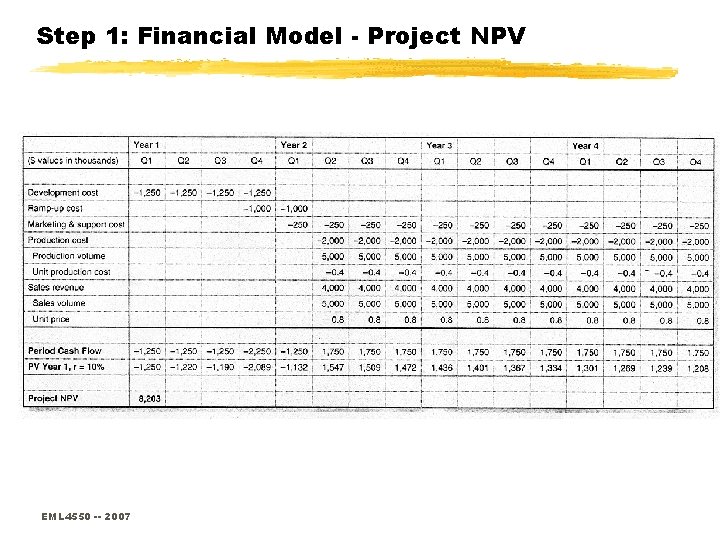
Step 1: Financial Model - Project NPV EML 4550 -- 2007
Step 1: Financial Model - Conclusions n The project NPV is positive n Management can quantify NPV and weigh it against risk, or compare with other potential projects to reach a go/no go decision n Management needs answers to ‘what if’ scenarios before committing to a project Sensitivity Analysis EML 4550 -- 2007
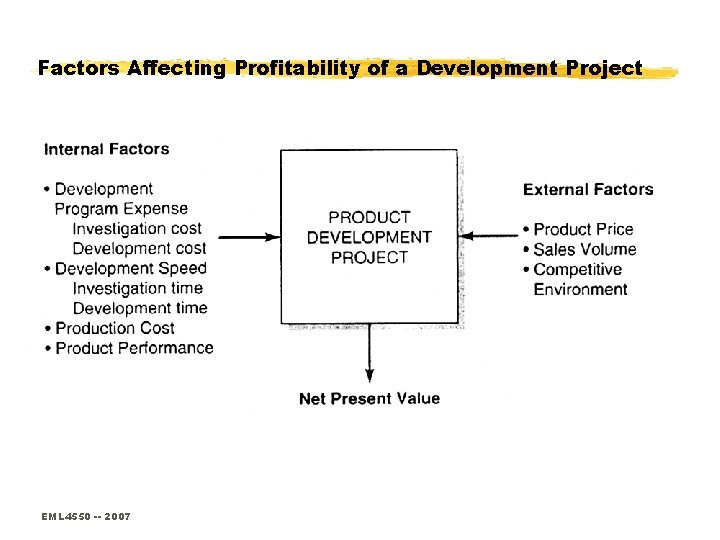
Factors Affecting Profitability of a Development Project EML 4550 -- 2007
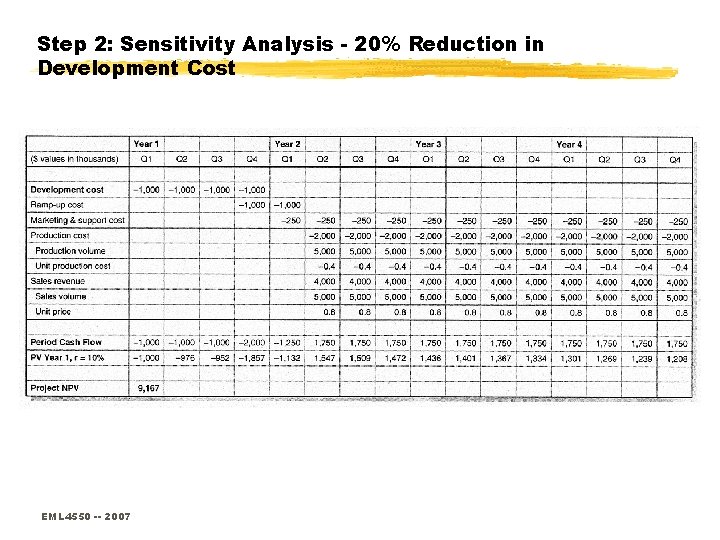
Step 2: Sensitivity Analysis - 20% Reduction in Development Cost EML 4550 -- 2007
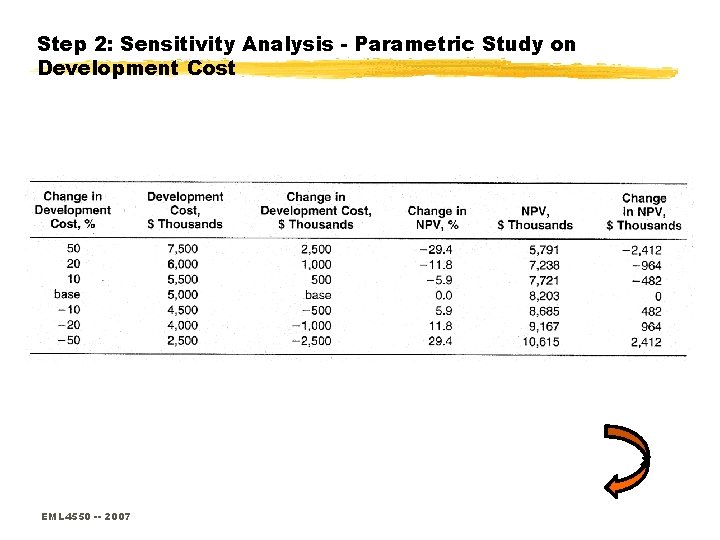
Step 2: Sensitivity Analysis - Parametric Study on Development Cost EML 4550 -- 2007
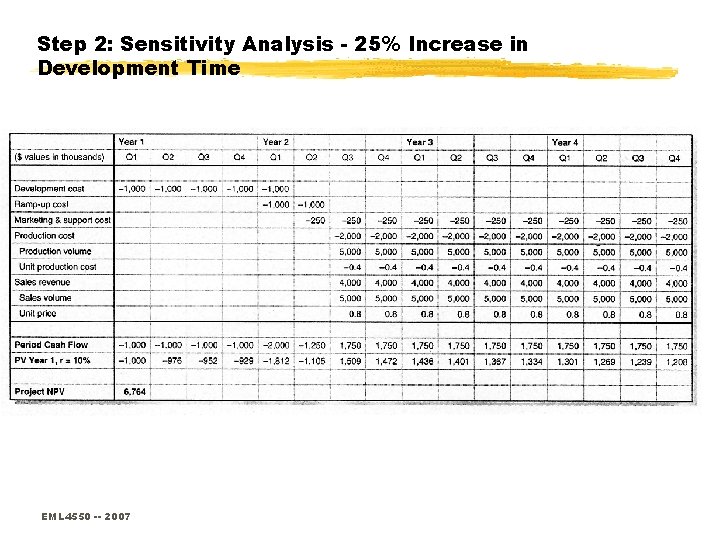
Step 2: Sensitivity Analysis - 25% Increase in Development Time EML 4550 -- 2007
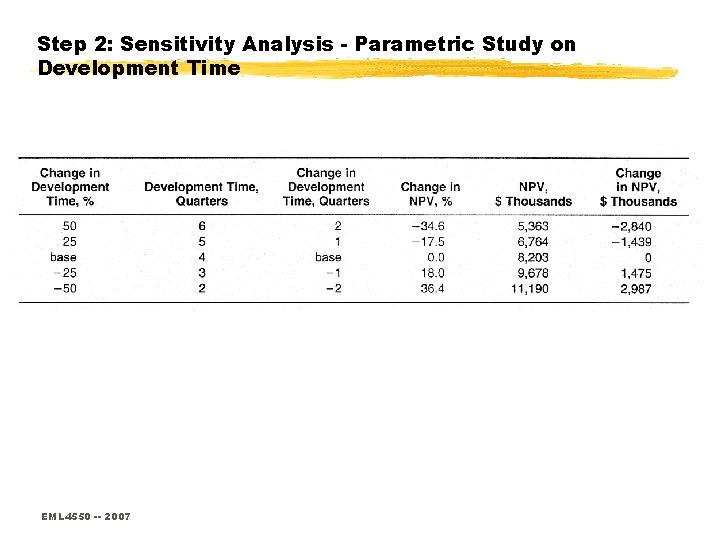
Step 2: Sensitivity Analysis - Parametric Study on Development Time EML 4550 -- 2007
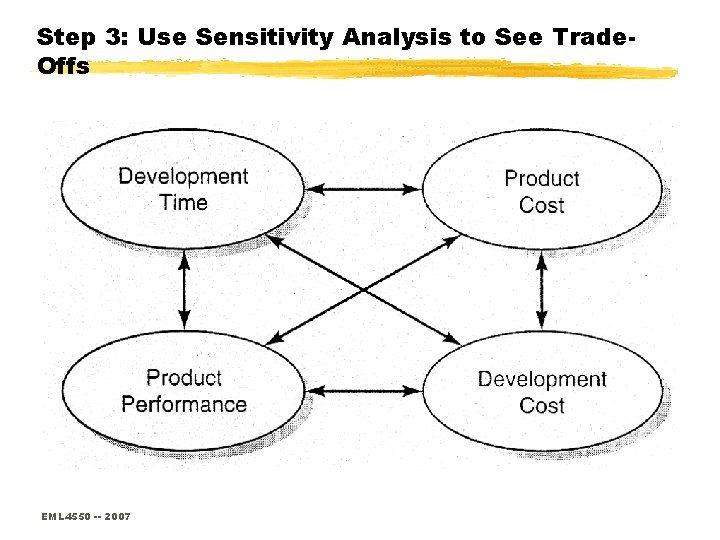
Step 3: Use Sensitivity Analysis to See Trade. Offs EML 4550 -- 2007
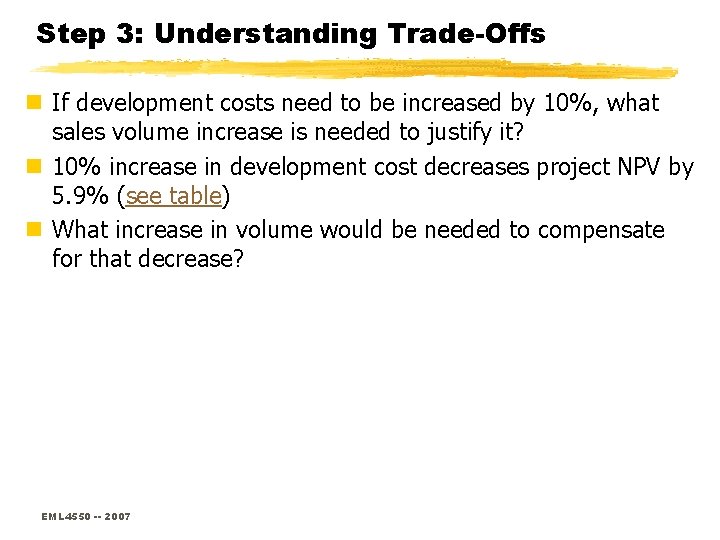
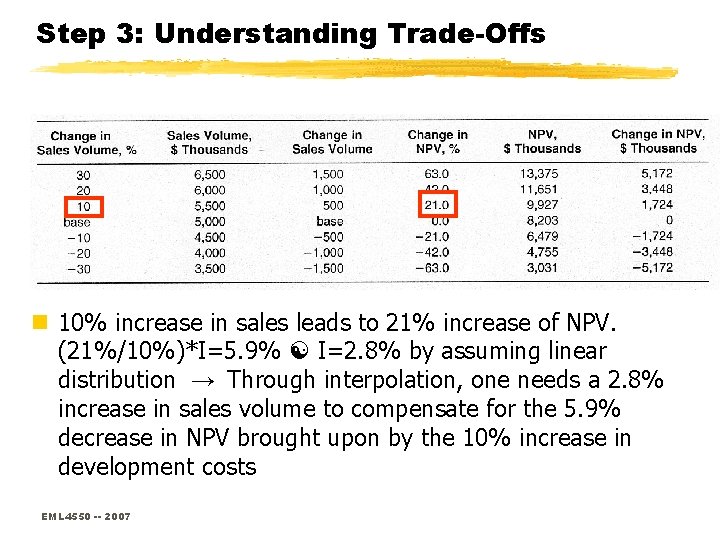
Step 3: Understanding Trade-Offs n If development costs need to be increased by 10%, what sales volume increase is needed to justify it? n 10% increase in development cost decreases project NPV by 5. 9% (see table) n What increase in volume would be needed to compensate for that decrease? EML 4550 -- 2007
Step 3: Understanding Trade-Offs n 10% increase in sales leads to 21% increase of NPV. (21%/10%)*I=5. 9% I=2. 8% by assuming linear distribution → Through interpolation, one needs a 2. 8% increase in sales volume to compensate for the 5. 9% decrease in NPV brought upon by the 10% increase in development costs EML 4550 -- 2007
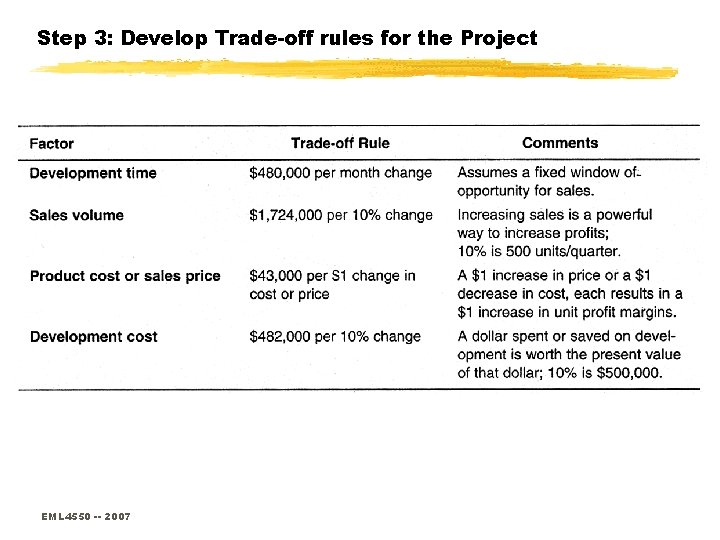
Step 3: Develop Trade-off rules for the Project EML 4550 -- 2007
Limitations of Quantitative Analysis n Focuses only on measurable quantities, neglects the ‘intangible’, and encourages investment only on those things that we ‘know how to measure’ n It depends entirely on the validity of assumptions and estimates that may be wrong n Bureaucracy and over-management may stifle the development project EML 4550 -- 2007
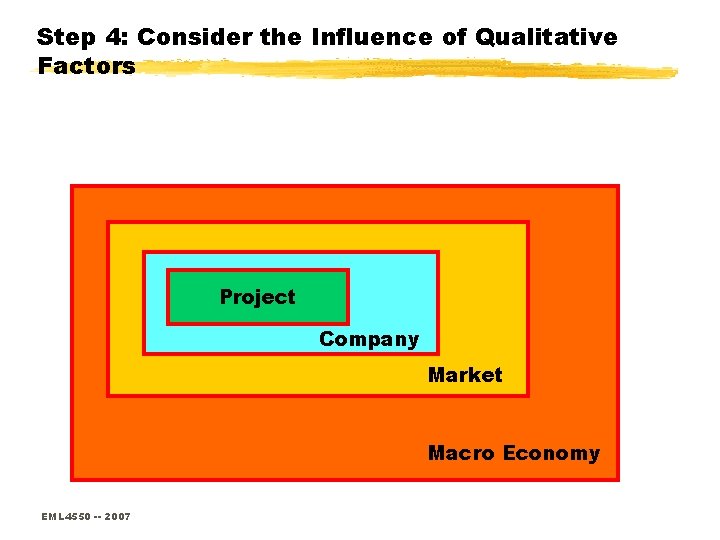
Step 4: Consider the Influence of Qualitative Factors Project Company Market Macro Economy EML 4550 -- 2007
Project Interactions with the Company n Externalities l Failure of other project l Learning from other projects or from this project (‘unpriced’ advantage) n Strategic Fit l Technology advantage l Corporate image l Expansion plan EML 4550 -- 2007
Project Interactions with the Market n Competitors l Type and timing n Customers l Shifting taste l Substitute products n Suppliers l Value chain impact l Non-compete EML 4550 -- 2007
Project Interactions with the Macro Economy n Major economic shifts l l l Interest rates Stock market Trade Recession Globalization n Government regulations l Regulatory impediments l Regulatory opportunities n Social Trends l Environmental concerns/Global warming EML 4550 -- 2007