
Emissions of Air Pollutants and Emission Control Technologies
- Slides: 39
Emissions of Air Pollutants and Emission Control Technologies • Sources of air pollution • Emission inventories • Emission control technologies
Primary and Secondary Pollutants • Primary pollutants: they are emitted directly into the atmosphere – Nitrogen oxides (NOx, i. e. , NO and NO 2), sulfur dioxide (SO 2), volatile organic compounds (VOC, for example, formaldehyde, benzene), etc. • Secondary pollutants: they are formed in the atmosphere via chemical reactions – Ozone (O 3) formed from NOx and VOC, nitrogen dioxide (NO 2), formaldehyde (HCHO), sulfuric acid (H 2 SO 4), nitric acid (HNO 3), etc.
Processes Leading to Emissions of Air Pollutants formed during combustion - from air constituents - from substances present in the fuel and emitted during combustion possibly under an oxidized form Pollutants emitted by volatilization Pollutants emitted via mechanical processes Pollutants produced via natural processes and emitted via natural or anthropogenic processes
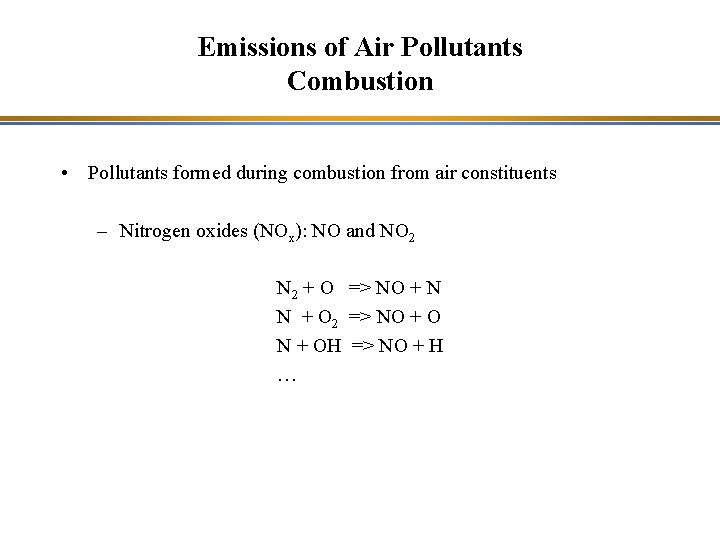
Emissions of Air Pollutants Combustion • Pollutants formed during combustion from air constituents – Nitrogen oxides (NOx): NO and NO 2 N 2 + O => NO + N N + O 2 => NO + O N + OH => NO + H …
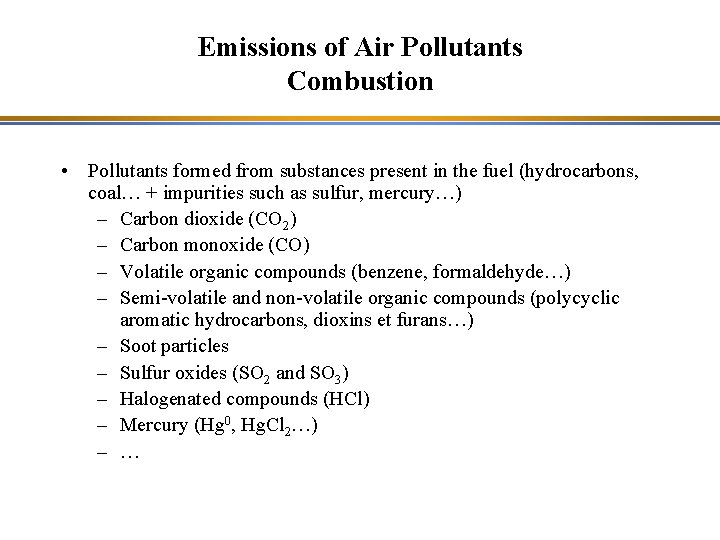
Emissions of Air Pollutants Combustion • Pollutants formed from substances present in the fuel (hydrocarbons, coal… + impurities such as sulfur, mercury…) – Carbon dioxide (CO 2) – Carbon monoxide (CO) – Volatile organic compounds (benzene, formaldehyde…) – Semi-volatile and non-volatile organic compounds (polycyclic aromatic hydrocarbons, dioxins et furans…) – Soot particles – Sulfur oxides (SO 2 and SO 3) – Halogenated compounds (HCl) – Mercury (Hg 0, Hg. Cl 2…) – …
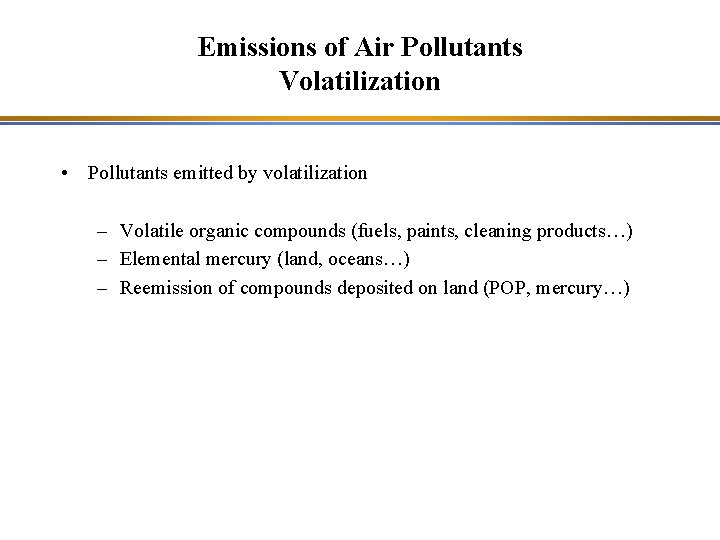
Emissions of Air Pollutants Volatilization • Pollutants emitted by volatilization – Volatile organic compounds (fuels, paints, cleaning products…) – Elemental mercury (land, oceans…) – Reemission of compounds deposited on land (POP, mercury…)
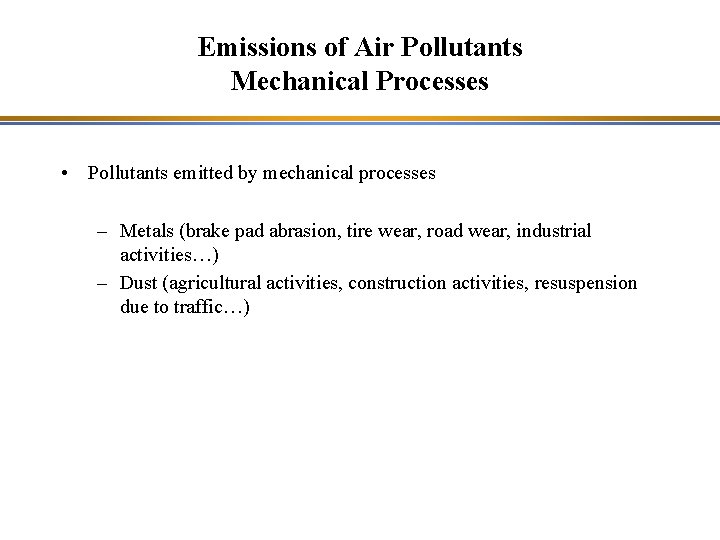
Emissions of Air Pollutants Mechanical Processes • Pollutants emitted by mechanical processes – Metals (brake pad abrasion, tire wear, road wear, industrial activities…) – Dust (agricultural activities, construction activities, resuspension due to traffic…)
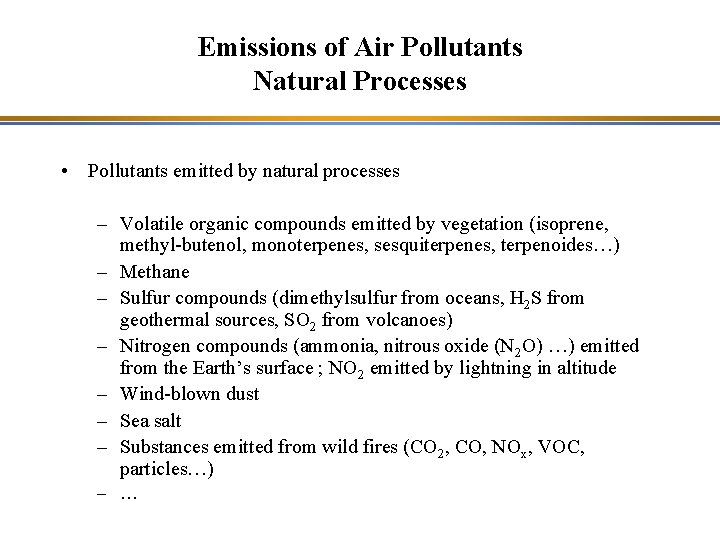
Emissions of Air Pollutants Natural Processes • Pollutants emitted by natural processes – Volatile organic compounds emitted by vegetation (isoprene, methyl-butenol, monoterpenes, sesquiterpenes, terpenoides…) – Methane – Sulfur compounds (dimethylsulfur from oceans, H 2 S from geothermal sources, SO 2 from volcanoes) – Nitrogen compounds (ammonia, nitrous oxide (N 2 O) …) emitted from the Earth’s surface ; NO 2 emitted by lightning in altitude – Wind-blown dust – Sea salt – Substances emitted from wild fires (CO 2, CO, NOx, VOC, particles…) – …
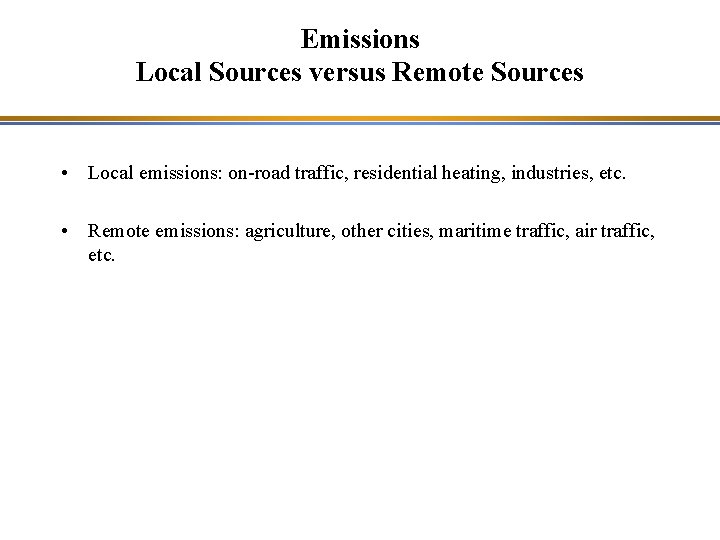
Emissions Local Sources versus Remote Sources • Local emissions: on-road traffic, residential heating, industries, etc. • Remote emissions: agriculture, other cities, maritime traffic, air traffic, etc.
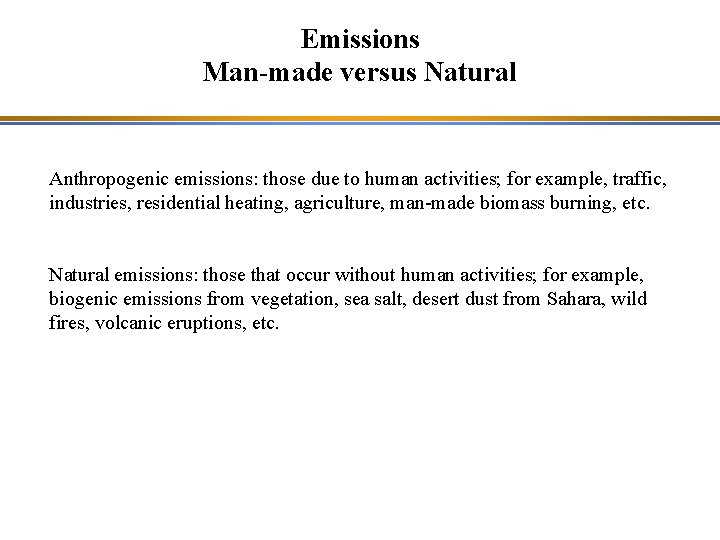
Emissions Man-made versus Natural Anthropogenic emissions: those due to human activities; for example, traffic, industries, residential heating, agriculture, man-made biomass burning, etc. Natural emissions: those that occur without human activities; for example, biogenic emissions from vegetation, sea salt, desert dust from Sahara, wild fires, volcanic eruptions, etc.
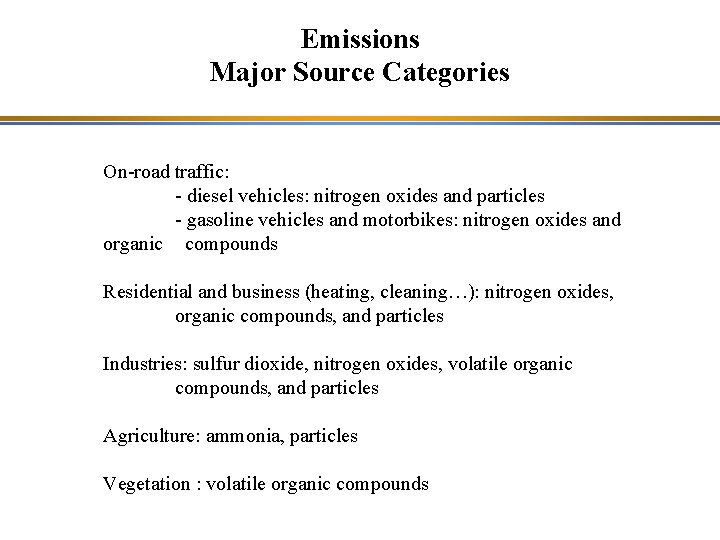
Emissions Major Source Categories On-road traffic: - diesel vehicles: nitrogen oxides and particles - gasoline vehicles and motorbikes: nitrogen oxides and organic compounds Residential and business (heating, cleaning…): nitrogen oxides, organic compounds, and particles Industries: sulfur dioxide, nitrogen oxides, volatile organic compounds, and particles Agriculture: ammonia, particles Vegetation : volatile organic compounds
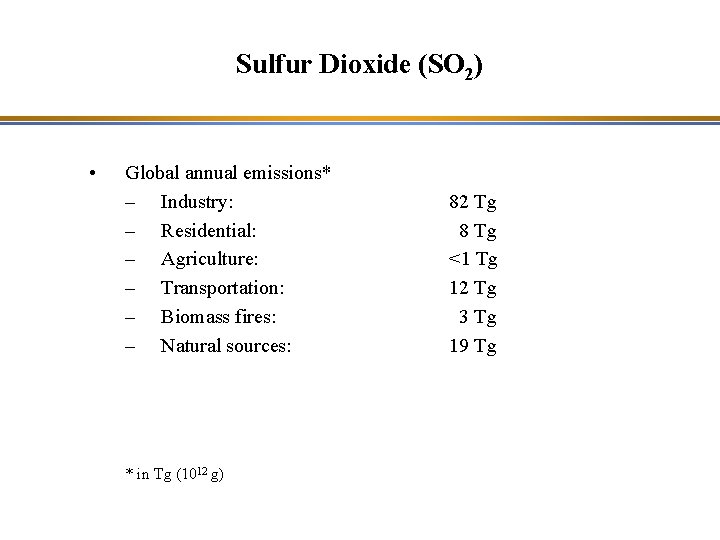
Sulfur Dioxide (SO 2) • Global annual emissions* – Industry: – Residential: – Agriculture: – Transportation: – Biomass fires: – Natural sources: * in Tg (1012 g) 82 Tg 8 Tg <1 Tg 12 Tg 3 Tg 19 Tg
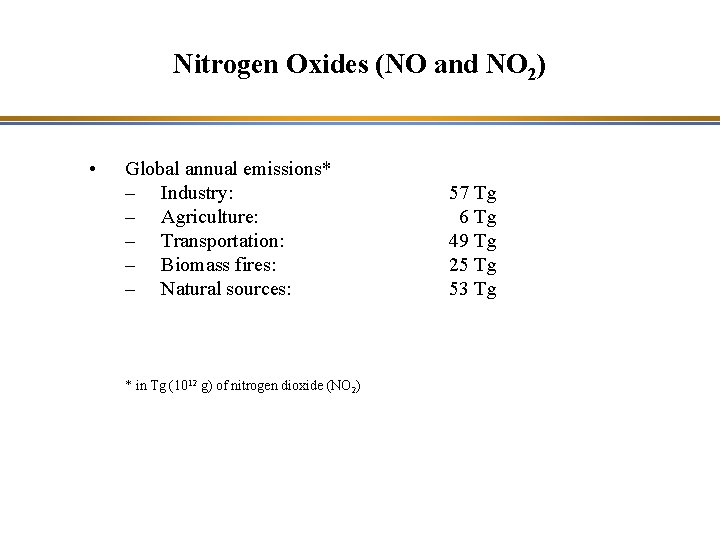
Nitrogen Oxides (NO and NO 2) • Global annual emissions* – Industry: – Agriculture: – Transportation: – Biomass fires: – Natural sources: * in Tg (1012 g) of nitrogen dioxide (NO 2) 57 Tg 6 Tg 49 Tg 25 Tg 53 Tg
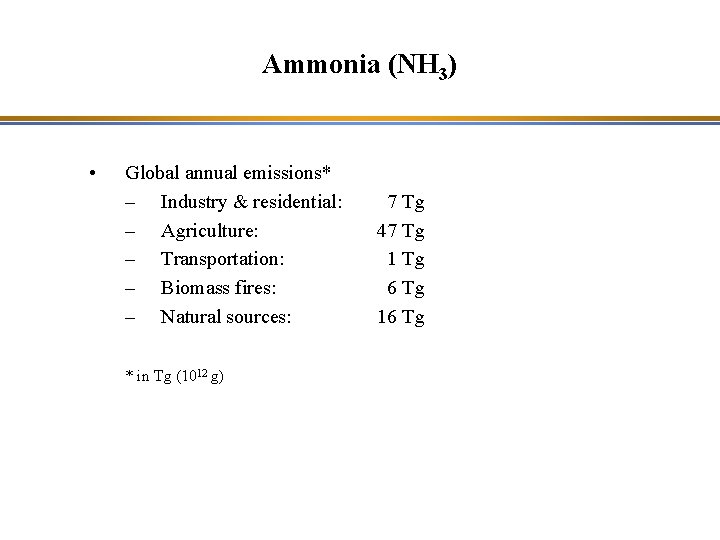
Ammonia (NH 3) • Global annual emissions* – Industry & residential: – Agriculture: – Transportation: – Biomass fires: – Natural sources: * in Tg (1012 g) 7 Tg 47 Tg 1 Tg 6 Tg 16 Tg
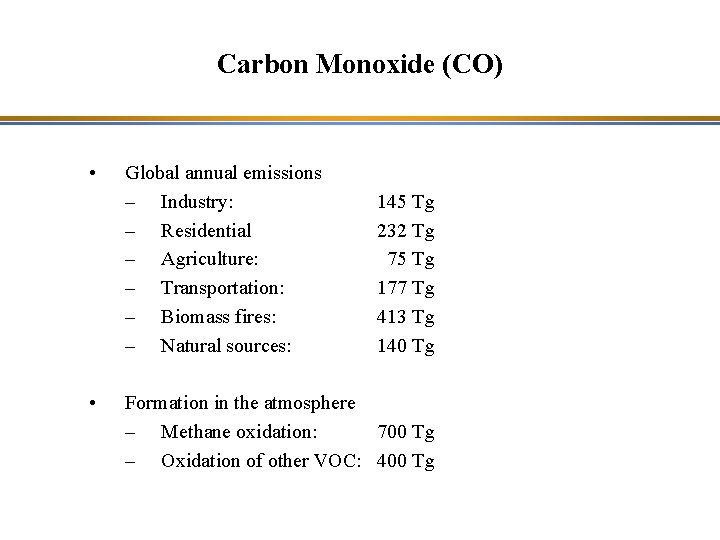
Carbon Monoxide (CO) • • Global annual emissions – Industry: – Residential – Agriculture: – Transportation: – Biomass fires: – Natural sources: 145 Tg 232 Tg 75 Tg 177 Tg 413 Tg 140 Tg Formation in the atmosphere – Methane oxidation: 700 Tg – Oxidation of other VOC: 400 Tg
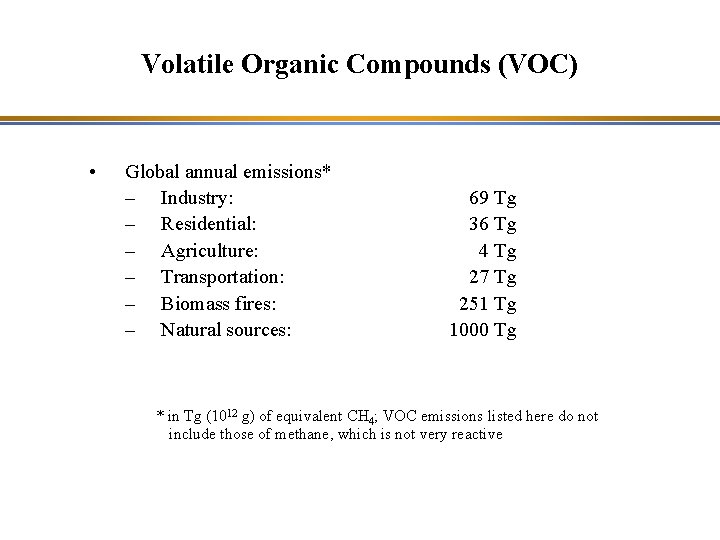
Volatile Organic Compounds (VOC) • Global annual emissions* – Industry: – Residential: – Agriculture: – Transportation: – Biomass fires: – Natural sources: 69 Tg 36 Tg 4 Tg 27 Tg 251 Tg 1000 Tg * in Tg (1012 g) of equivalent CH 4; VOC emissions listed here do not include those of methane, which is not very reactive
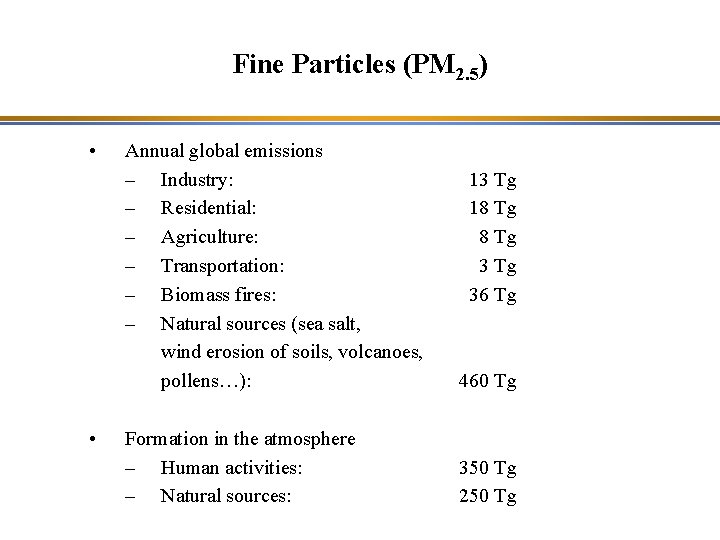
Fine Particles (PM 2. 5) • • Annual global emissions – Industry: – Residential: – Agriculture: – Transportation: – Biomass fires: – Natural sources (sea salt, wind erosion of soils, volcanoes, pollens…): 460 Tg Formation in the atmosphere – Human activities: – Natural sources: 350 Tg 250 Tg 13 Tg 18 Tg 36 Tg
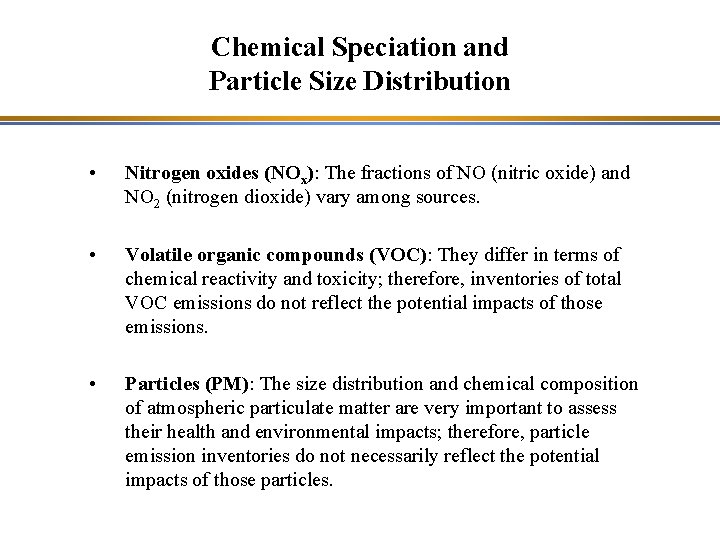
Chemical Speciation and Particle Size Distribution • Nitrogen oxides (NOx): The fractions of NO (nitric oxide) and NO 2 (nitrogen dioxide) vary among sources. • Volatile organic compounds (VOC): They differ in terms of chemical reactivity and toxicity; therefore, inventories of total VOC emissions do not reflect the potential impacts of those emissions. • Particles (PM): The size distribution and chemical composition of atmospheric particulate matter are very important to assess their health and environmental impacts; therefore, particle emission inventories do not necessarily reflect the potential impacts of those particles.
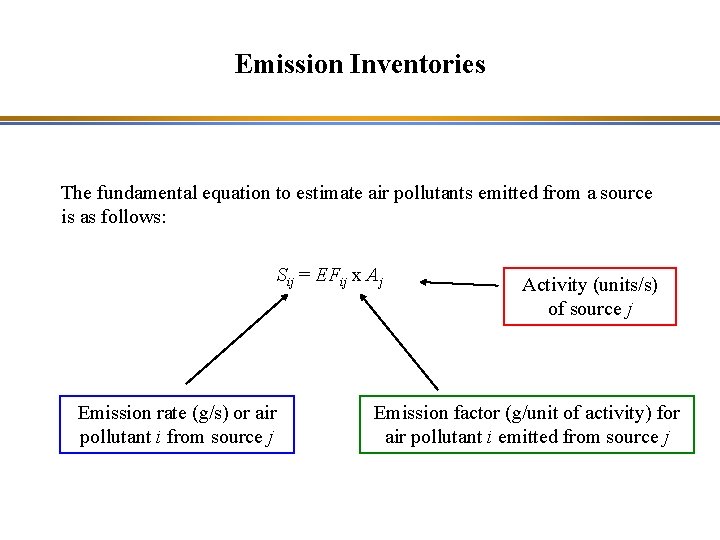
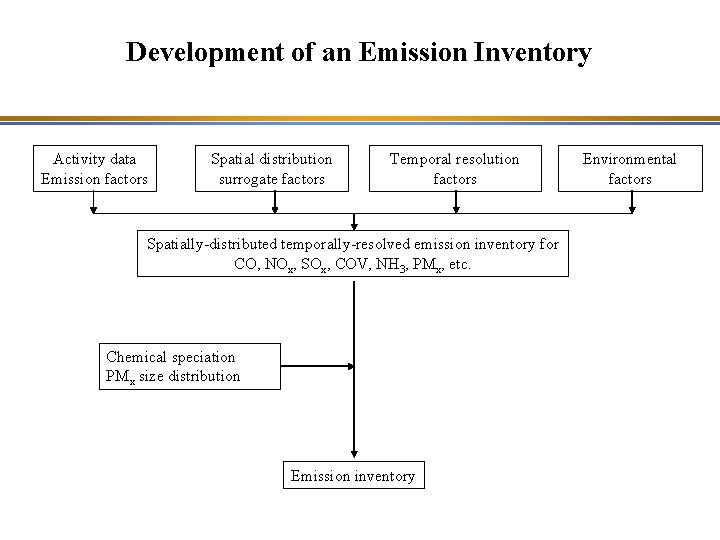
Emission Inventories The fundamental equation to estimate air pollutants emitted from a source is as follows: Sij = EFij x Aj Emission rate (g/s) or air pollutant i from source j Activity (units/s) of source j Emission factor (g/unit of activity) for air pollutant i emitted from source j
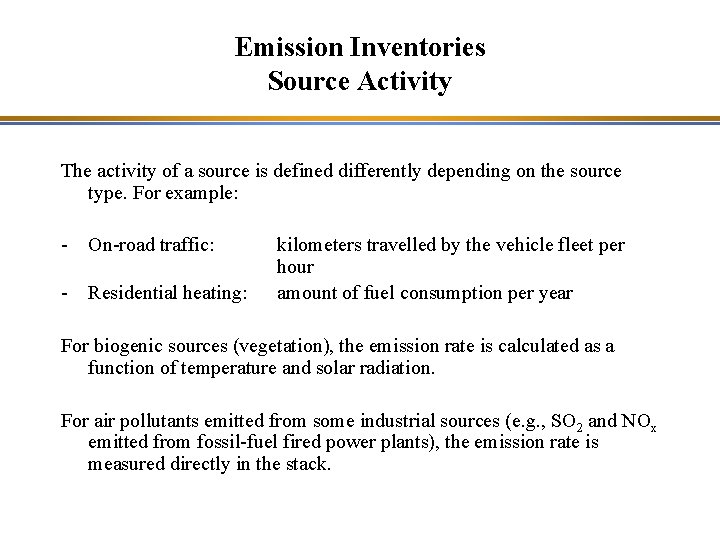
Emission Inventories Source Activity The activity of a source is defined differently depending on the source type. For example: - On-road traffic: - Residential heating: kilometers travelled by the vehicle fleet per hour amount of fuel consumption per year For biogenic sources (vegetation), the emission rate is calculated as a function of temperature and solar radiation. For air pollutants emitted from some industrial sources (e. g. , SO 2 and NOx emitted from fossil-fuel fired power plants), the emission rate is measured directly in the stack.
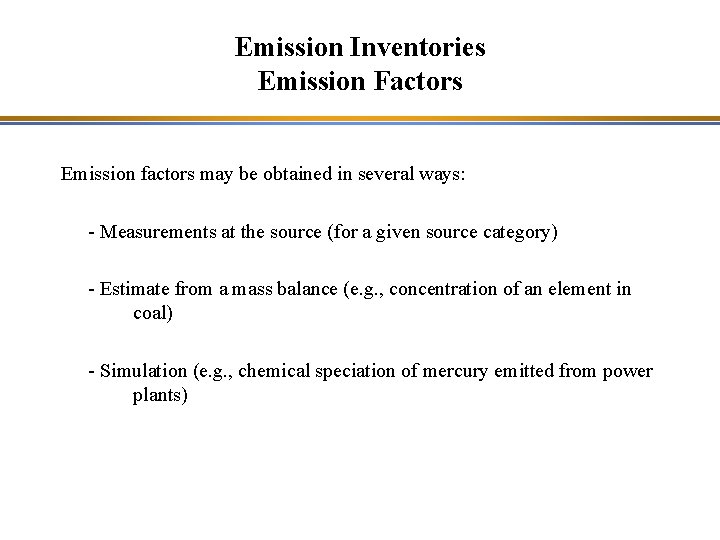
Emission Inventories Emission Factors Emission factors may be obtained in several ways: - Measurements at the source (for a given source category) - Estimate from a mass balance (e. g. , concentration of an element in coal) - Simulation (e. g. , chemical speciation of mercury emitted from power plants)
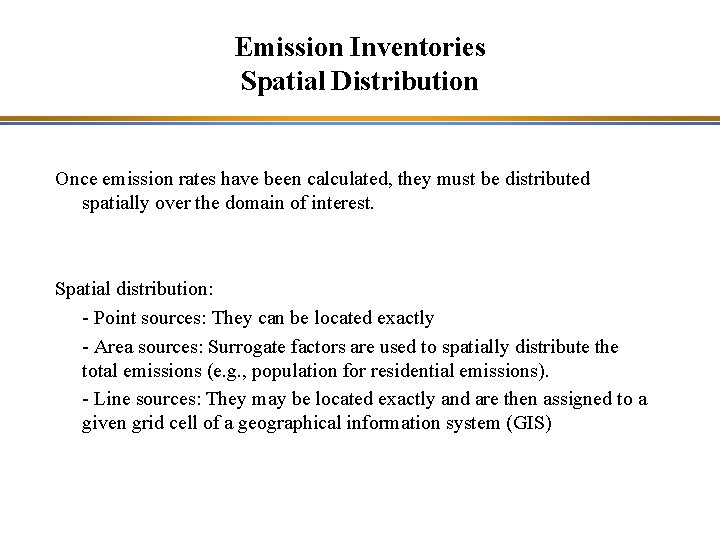
Emission Inventories Spatial Distribution Once emission rates have been calculated, they must be distributed spatially over the domain of interest. Spatial distribution: - Point sources: They can be located exactly - Area sources: Surrogate factors are used to spatially distribute the total emissions (e. g. , population for residential emissions). - Line sources: They may be located exactly and are then assigned to a given grid cell of a geographical information system (GIS)
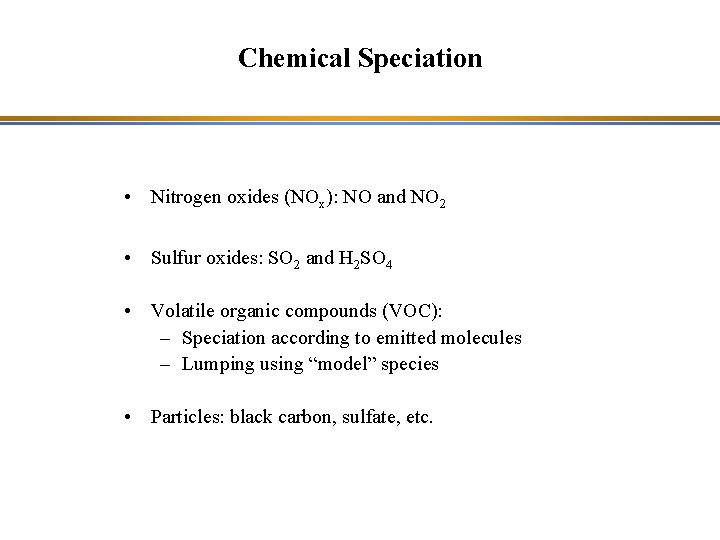
Chemical Speciation • Nitrogen oxides (NOx): NO and NO 2 • Sulfur oxides: SO 2 and H 2 SO 4 • Volatile organic compounds (VOC): – Speciation according to emitted molecules – Lumping using “model” species • Particles: black carbon, sulfate, etc.
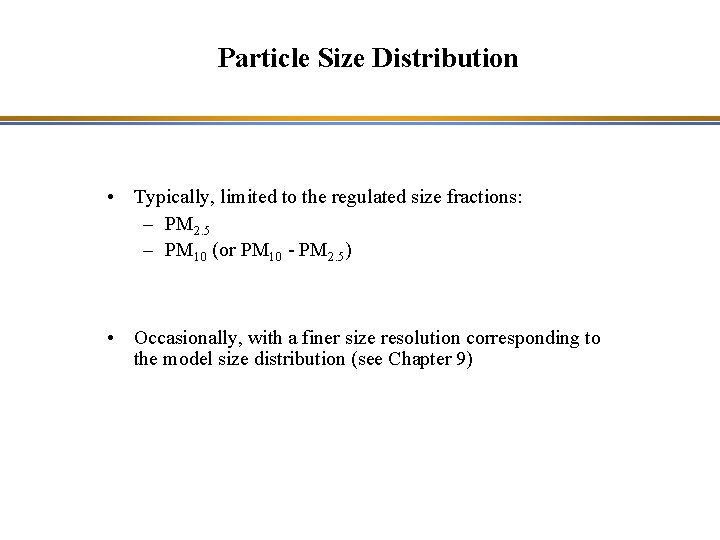
Particle Size Distribution • Typically, limited to the regulated size fractions: – PM 2. 5 – PM 10 (or PM 10 - PM 2. 5) • Occasionally, with a finer size resolution corresponding to the model size distribution (see Chapter 9)
Development of an Emission Inventory Activity data Emission factors Spatial distribution surrogate factors Temporal resolution factors Spatially-distributed temporally-resolved emission inventory for CO, NOx, SOx, COV, NH 3, PMx, etc. Chemical speciation PMx size distribution Emission inventory Environmental factors
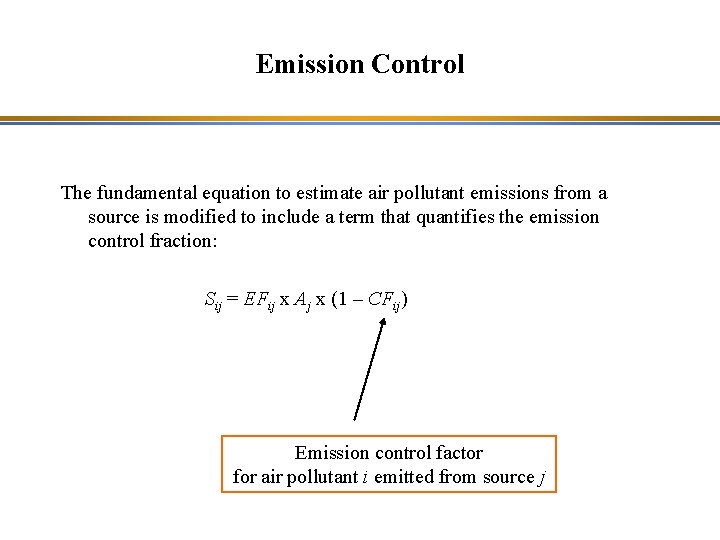
Emission Control The fundamental equation to estimate air pollutant emissions from a source is modified to include a term that quantifies the emission control fraction: Sij = EFij x Aj x (1 – CFij) Emission control factor for air pollutant i emitted from source j
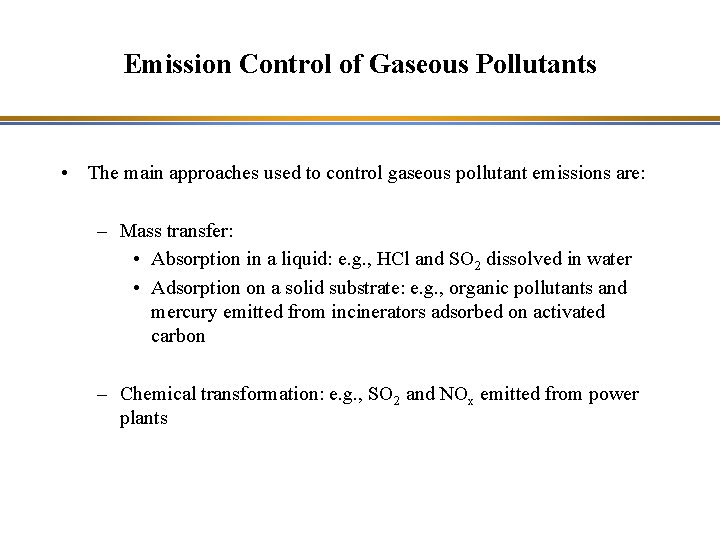
Emission Control of Gaseous Pollutants • The main approaches used to control gaseous pollutant emissions are: – Mass transfer: • Absorption in a liquid: e. g. , HCl and SO 2 dissolved in water • Adsorption on a solid substrate: e. g. , organic pollutants and mercury emitted from incinerators adsorbed on activated carbon – Chemical transformation: e. g. , SO 2 and NOx emitted from power plants
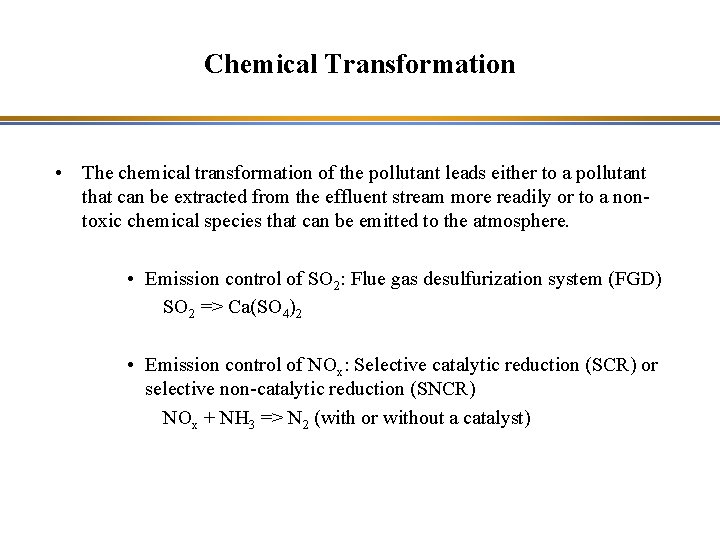
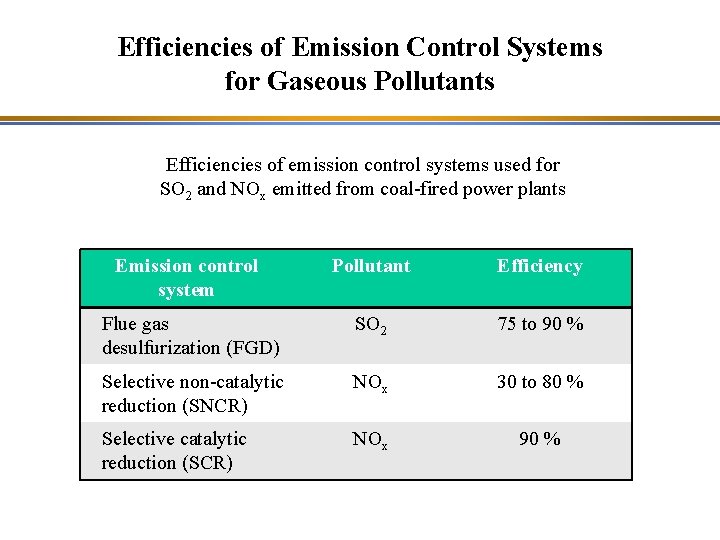
Chemical Transformation • The chemical transformation of the pollutant leads either to a pollutant that can be extracted from the effluent stream more readily or to a nontoxic chemical species that can be emitted to the atmosphere. • Emission control of SO 2: Flue gas desulfurization system (FGD) SO 2 => Ca(SO 4)2 • Emission control of NOx: Selective catalytic reduction (SCR) or selective non-catalytic reduction (SNCR) NOx + NH 3 => N 2 (with or without a catalyst)
Efficiencies of Emission Control Systems for Gaseous Pollutants Efficiencies of emission control systems used for SO 2 and NOx emitted from coal-fired power plants Emission control system Pollutant Efficiency Flue gas desulfurization (FGD) SO 2 75 to 90 % Selective non-catalytic reduction (SNCR) NOx 30 to 80 % Selective catalytic reduction (SCR) NOx 90 %
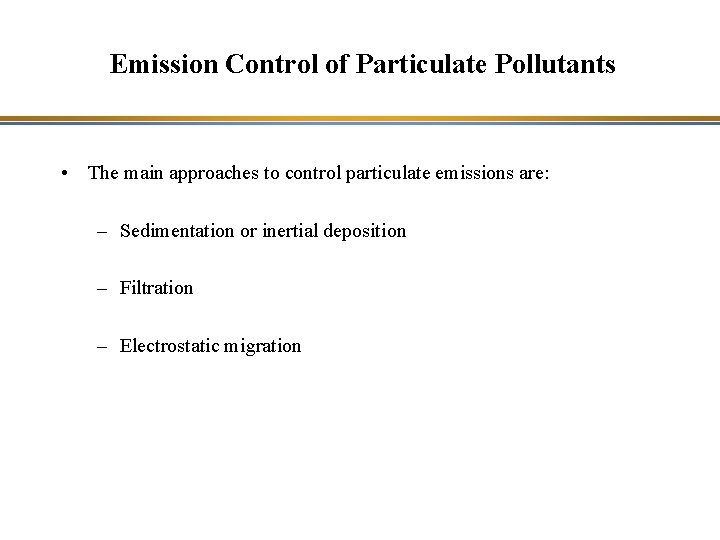
Emission Control of Particulate Pollutants • The main approaches to control particulate emissions are: – Sedimentation or inertial deposition – Filtration – Electrostatic migration
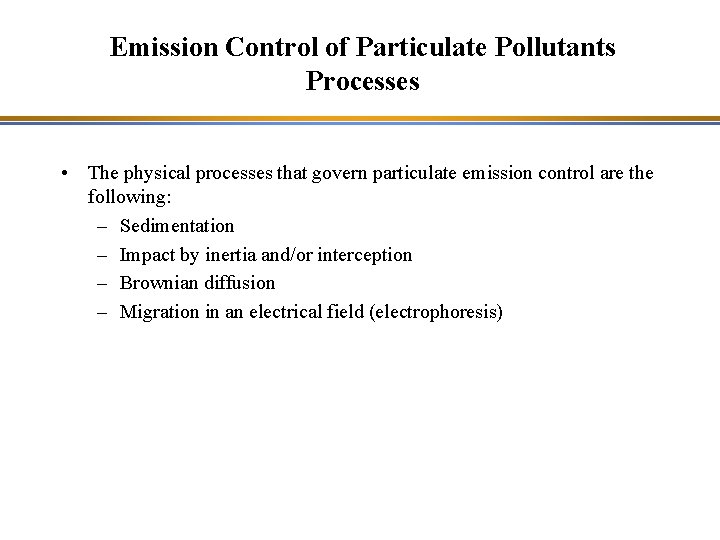
Emission Control of Particulate Pollutants Processes • The physical processes that govern particulate emission control are the following: – Sedimentation – Impact by inertia and/or interception – Brownian diffusion – Migration in an electrical field (electrophoresis)
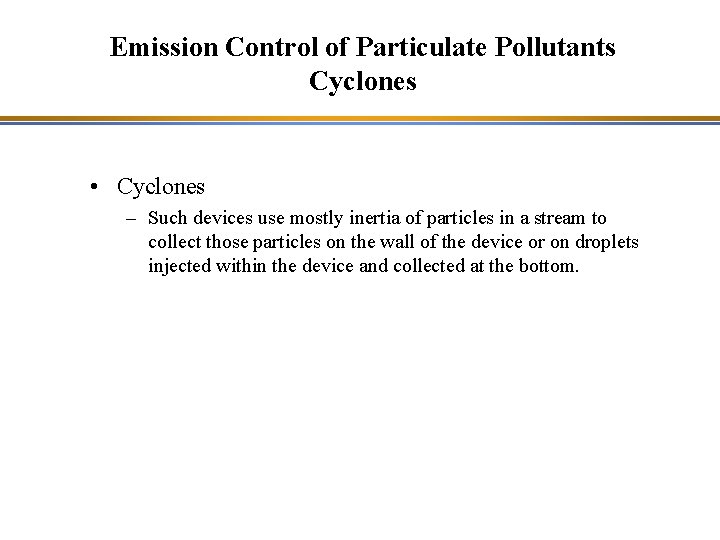
Emission Control of Particulate Pollutants Cyclones • Cyclones – Such devices use mostly inertia of particles in a stream to collect those particles on the wall of the device or on droplets injected within the device and collected at the bottom.
Emission Control of Particulate Pollutants Electrostatic Precipitators (ESP) • Electrostatic precipitators – An electrical discharge is sent in the effluent to charge particles electrically. – The charged particles migrate toward the system walls, which act as electrodes (electrophoresis). – The system is shaken regularly so that the particles collected on the walls fall at the bottom of the device.
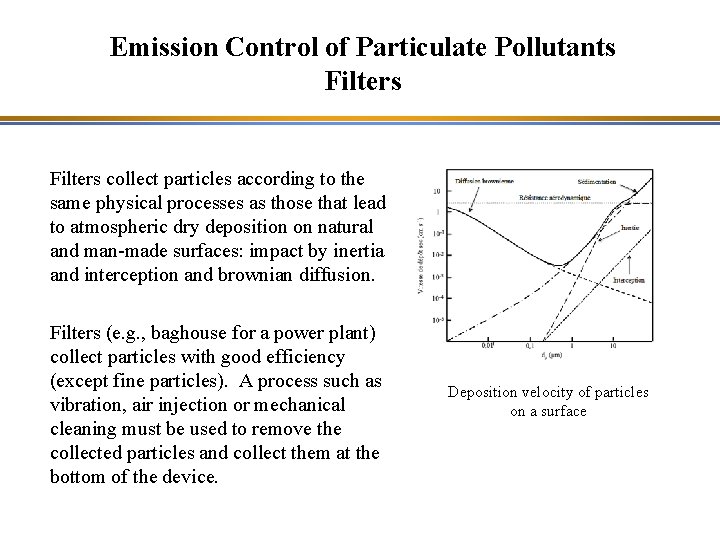
Emission Control of Particulate Pollutants Filters collect particles according to the same physical processes as those that lead to atmospheric dry deposition on natural and man-made surfaces: impact by inertia and interception and brownian diffusion. Filters (e. g. , baghouse for a power plant) collect particles with good efficiency (except fine particles). A process such as vibration, air injection or mechanical cleaning must be used to remove the collected particles and collect them at the bottom of the device. Deposition velocity of particles on a surface
Emission Control of Vehicle Exhaust Regulated Pollutants • • • Carbon monoxide (CO) Lead (Pb) Sulfur dioxide (SO 2) Nitrogen oxides (NOx) Volatile organic compounds (VOC), including formaldehyde (HCHO) in the U. S. and benzene (C 6 H 6) in Europe • Particulate matter (PM) in terms of mass and, in Europe, number
Emission Control of Vehicle Exhaust Regulation of Content in Fuel • Lead (Pb) was used as tetraethyl lead to reduce knocking in engines. It was banned from fuels and replaced by organic compounds. • Sulfur (S) content in fuels is now regulated for on-road vehicles: – 10 ppm for gasoline and 15 ppm for diesel in the U. S. – 10 ppm for both gasoline and diesel in France
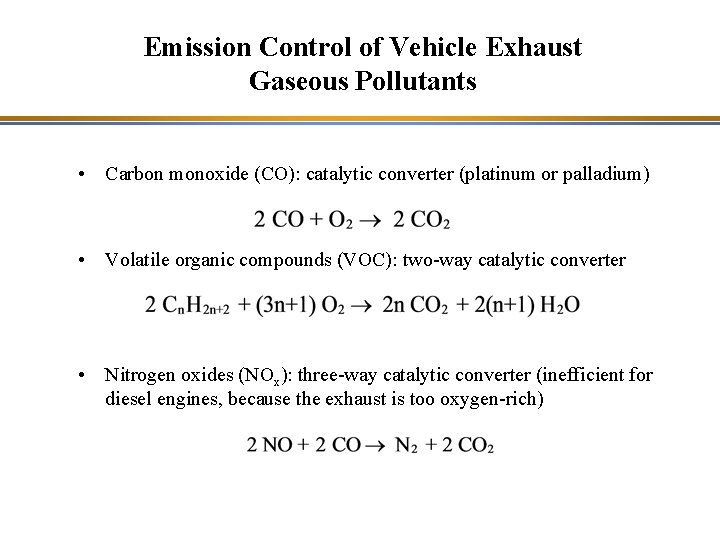
Emission Control of Vehicle Exhaust Gaseous Pollutants • Carbon monoxide (CO): catalytic converter (platinum or palladium) • Volatile organic compounds (VOC): two-way catalytic converter • Nitrogen oxides (NOx): three-way catalytic converter (inefficient for diesel engines, because the exhaust is too oxygen-rich)
Emission Control of Vehicle Exhaust Gaseous Pollutants • Nitrogen oxides (NOx): For diesel engines, several approaches are used. – Exhaust gas recirculation (EGR): The recirculation of exhaust gases into the combustion chamber lowers the oxygen content and temperature, thereby lowering NOx formation. However, it may decrease engine performance and increase PM formation. – NOx trap: NOx are trapped and converted to N 2 when a fuel-rich exhaust is used to regenerate the system. Several catalysts are used e. g. , (platinum, barium, and rhodium). The efficiency is about 70 % within a temperature range of about 17 to 35 °C; much less outside this temperature range. – Selective catalytic reduction (SCR): Urea (NH 2)2 C=O) is used to convert NOx to N 2 using a catalyst (e. g. , vanadium oxide). The efficiency is about 90 %; it is more costly than the NOx trap.
Emission Control of Vehicle Exhaust Particulate Pollutants • Diesel particle filter (DPF): The DPF collects the particles, but it must be regenerated from time to prevent clogging. Regeneration may be active (incineration at high temperature) or passive (incineration at a lower temperature using a catalyst or a gaseous oxidant) • Continuous regeneration trap (CRT): Passive regeneration occurs by (1) converting NO to NO 2 (the gaseous oxidant) and (2) oxidizing carbonaceous PM to CO 2 on a catalyst. Active regeneration is needed from time to time. NO 2 emissions increase. • Additivated DPF: The catalyst is added in the fuel and O 2 is the gaseous oxidant. Active regeneration is needed from time to time. There is no increase in NO 2 exhaust.