
Emission Factor Database EFDB IPCC NGGIP Side Event
Emission Factor Database (EFDB) IPCC NGGIP Side Event at UNFCCC-SB 20 17 June 2004, 13: 00 -15: 00 Kiyoto Tanabe Programme Officer, Technical Support Unit IPCC National Greenhouse Gas Inventories Programme
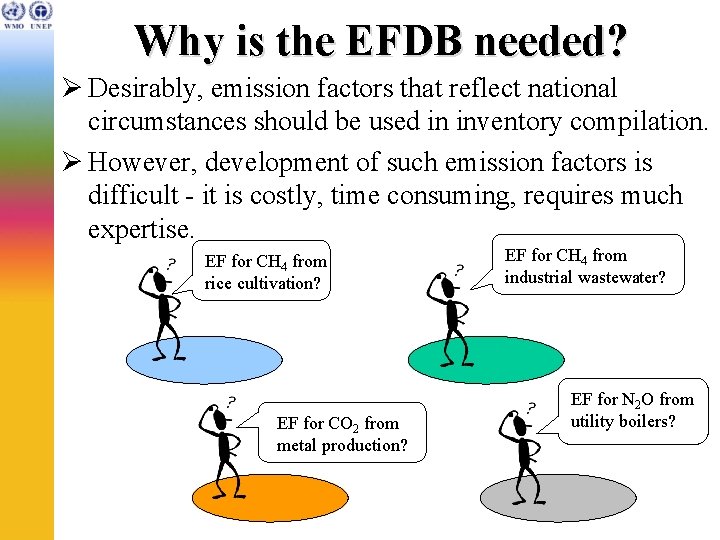
Why is the EFDB needed? Ø Desirably, emission factors that reflect national circumstances should be used in inventory compilation. Ø However, development of such emission factors is difficult - it is costly, time consuming, requires much expertise. EF for CH 4 from rice cultivation? EF for CO 2 from metal production? EF for CH 4 from industrial wastewater? EF for N 2 O from utility boilers?
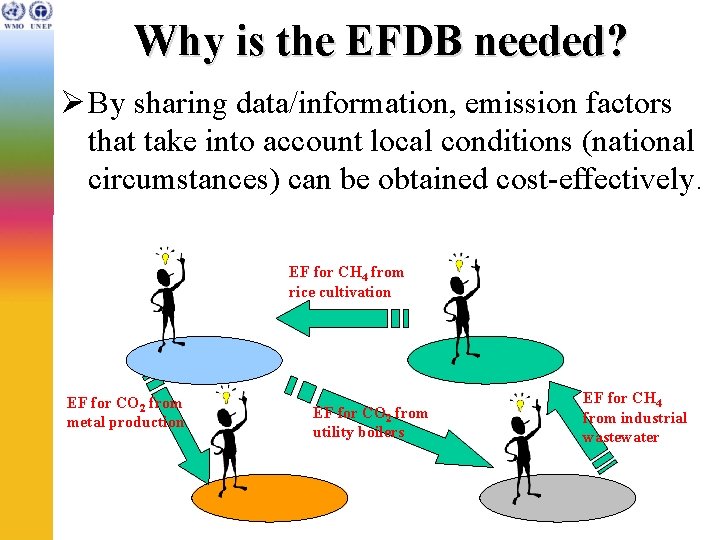
Why is the EFDB needed? Ø By sharing data/information, emission factors that take into account local conditions (national circumstances) can be obtained cost-effectively. EF for CH 4 from rice cultivation? rice cultivation EF for CH 4 from industrial wastewater? Similar practices and similar climate Using similar EF for CO 2 from reducing agent metal production in metal production EF EFfor for. CO CO from 22 EF for CO from 2 utilityboilers metal production? for. NCH EFEFfor 2 O 4 from boilers? industrial utility wastewater
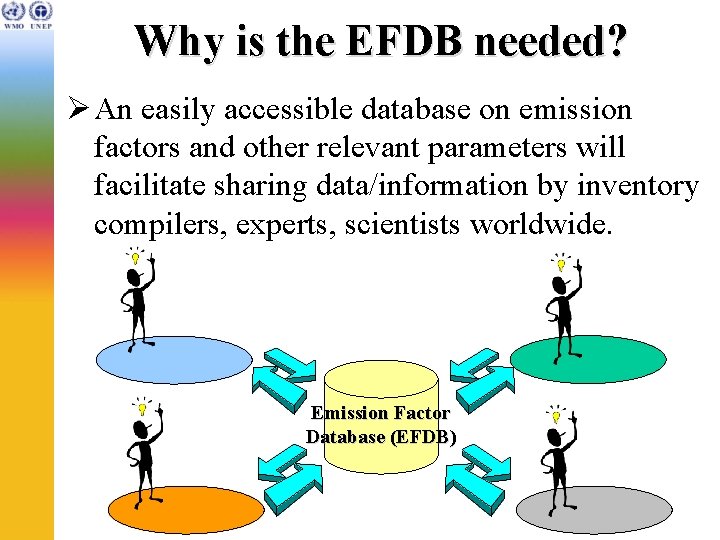
Why is the EFDB needed? Ø An easily accessible database on emission factors and other relevant parameters will facilitate sharing data/information by inventory compilers, experts, scientists worldwide. Emission Factor Database (EFDB)
EFDB is expected to serve as. . . Ø Library of well documented emission factors and other parameters which üEvolves dynamically through contributions of new data from researchers, scientists, industry. . . üProvides a wide variety of emission factors and other parameters with background documentation or technical references so that users can select and use appropriate data on their own responsibility. Ø Communication platform for distribution and commenting on new research and measurement data
Data contained in EFDB Ø At present, EFDB contains only the IPCC default data and the data from CORINAIR 94. Ø New data are being provided by the global scientific and inventory society. Ø New data will be evaluated for acceptance by EFDB Editorial Board according to the following criteria. üEFDB should assist countries in producing inventories that are neither over- nor underestimates so far as can be judged and in which uncertainties are reduced as far as practicable. üTo this end, the data to be included should be…
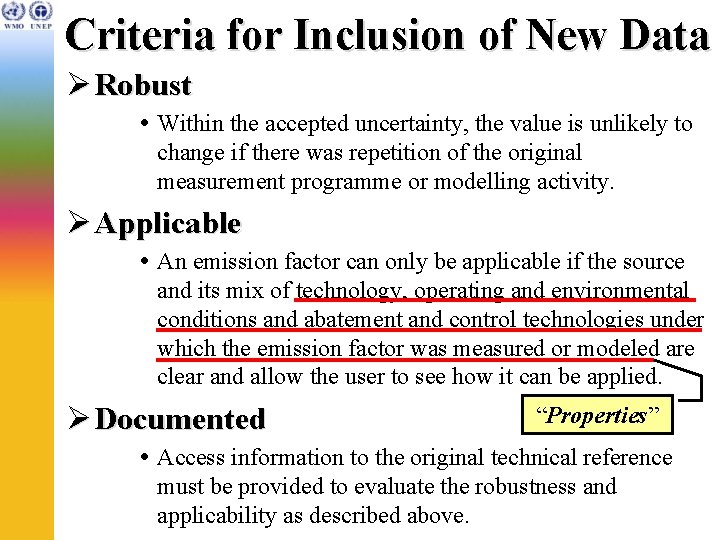
Criteria for Inclusion of New Data Ø Robust Within the accepted uncertainty, the value is unlikely to change if there was repetition of the original measurement programme or modelling activity. Ø Applicable An emission factor can only be applicable if the source and its mix of technology, operating and environmental conditions and abatement and control technologies under which the emission factor was measured or modeled are clear and allow the user to see how it can be applied. Ø Documented “Properties” Access information to the original technical reference must be provided to evaluate the robustness and applicability as described above.
Possible Benefits to Data Providers Ø Making your emission factors or related information available to the EFDB will benefit you and your research institute, because it will üPromote your own research results/publications, results/publications since references to relevant publications will be contained in the dataset. üInvolve you in ongoing IPCC activities. Submission of your own research results to this database may give you opportunities to make contributions to IPCC Methodology Reports (e. g. , 2006 IPCC Guidelines) even in the case you are not a designated author of those reports.
Procedure for Data Proposals Ø EFDB is open to any relevant data proposals. Ø You can submit your data proposals on line. 1) Contact the Technical Support Unit (TSU) by e-mail <ipcc-efdb@iges. or. jp>. ipcc-efdb@iges. or. jp 2) TSU will register you as a data provider, and give you ID & password and other technical support. 3) Input your data following the guidance given in the EFDB User Manual for Web Application. 4) EFDB Editorial Board will evaluate whether the proposed new data are acceptable. When accepted. . . 5) The data will be imported into EFDB and disseminated to the world via Internet and CDROM
How to Access the EFDB Ø Two different applications are available. üWeb application For all users to carry out on-line search For data providers to submit new emission factors or other parameters üCDROM application For all users, in particular for those who have difficulty with Internet connection, to carry out off-line search Ø The web application is the core of this system. New data will be made available in the Web application first.
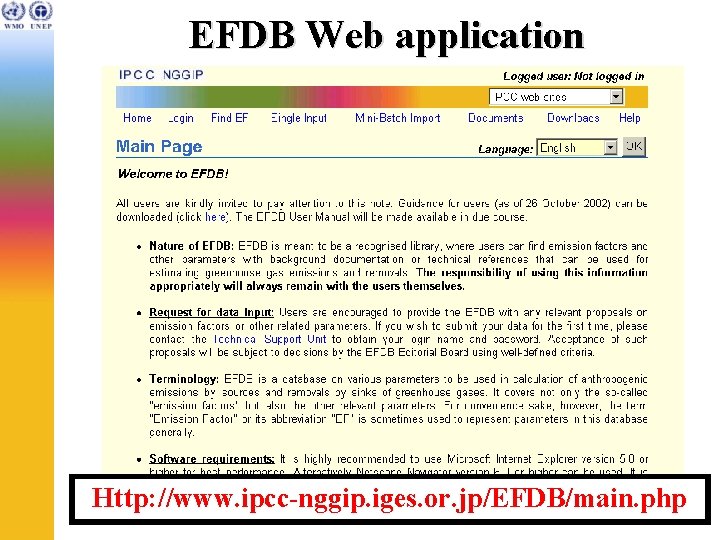
EFDB Web application Http: //www. ipcc-nggip. iges. or. jp/EFDB/main. php
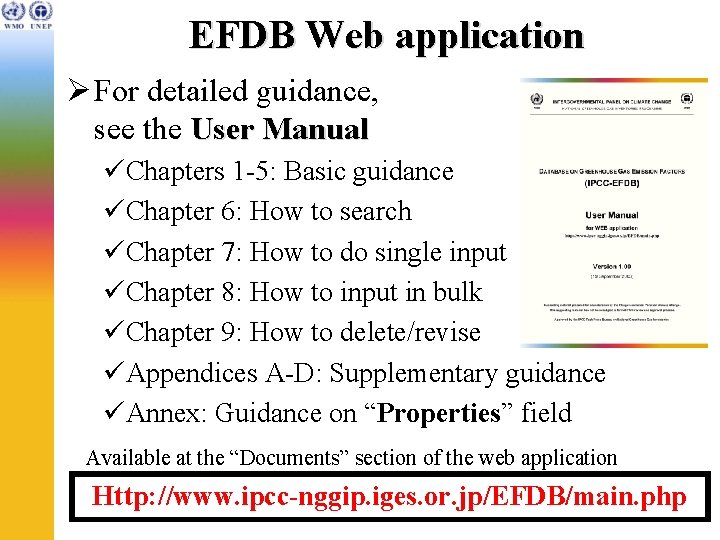
EFDB Web application Ø For detailed guidance, see the User Manual üChapters 1 -5: Basic guidance üChapter 6: How to search üChapter 7: How to do single input üChapter 8: How to input in bulk üChapter 9: How to delete/revise üAppendices A-D: Supplementary guidance üAnnex: Guidance on “Properties” field Available at the “Documents” section of the web application Http: //www. ipcc-nggip. iges. or. jp/EFDB/main. php
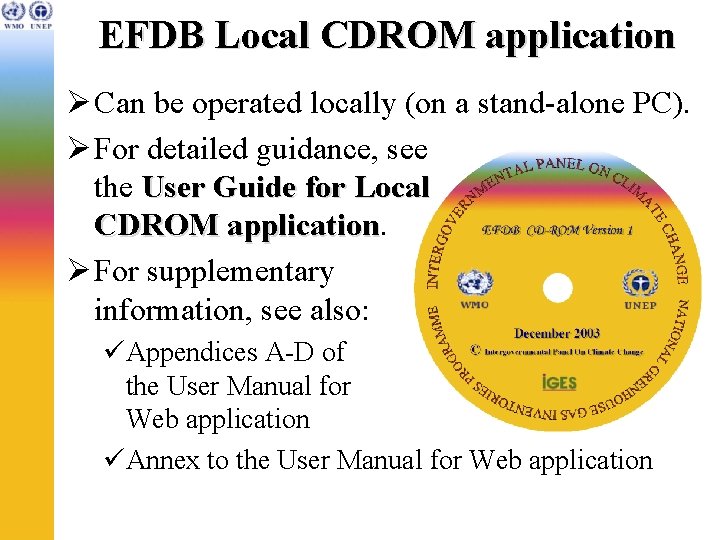
EFDB Local CDROM application Ø Can be operated locally (on a stand-alone PC). Ø For detailed guidance, see the User Guide for Local CDROM application Ø For supplementary information, see also: üAppendices A-D of the User Manual for Web application üAnnex to the User Manual for Web application
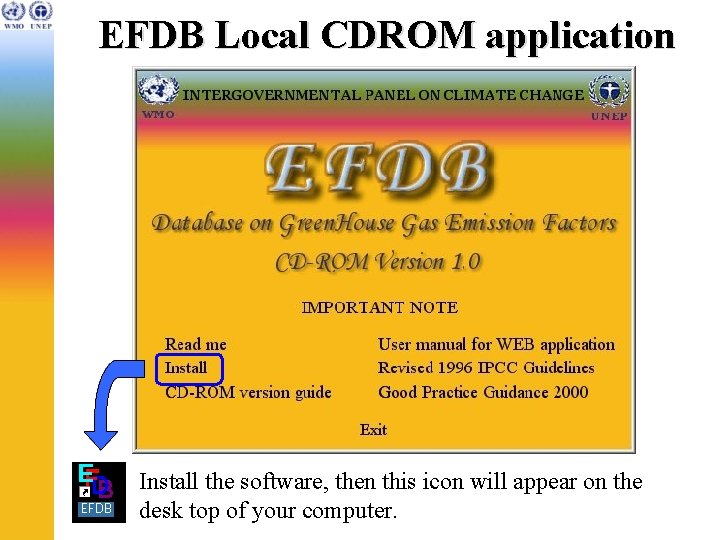
EFDB Local CDROM application Install the software, then this icon will appear on the desk top of your computer.
EFDB Local CDROM application Ø EFDB Local CDROM application works with MS Access MDB file, which contains the copy of the on-line web database. Ø The latest MDB file will be made available üThrough the Internet: At the "Downloads" section of the web application; and/or üIn the form of CD-ROM: Will be distributed annually or biannually, possibly on the occasion of sessions of SBSTA or COP.
Ø Success – depending on input from the global scientific and inventory society üEFDB is open to any relevant data proposals. üIf you have your own data on emission factors, please contact the Technical Support Unit (TSU) by e-mail <ipcc-efdb@iges. or. jp>. ipcc-efdb@iges. or. jp Ø Continuous improvement on the content and functionality – Users’ feedback will be quite important Ø Your involvement is highly appreciated!!
- Slides: 17