
Emission Control Systems 1 Vehicle Pollution Sources 3


- Slides: 26
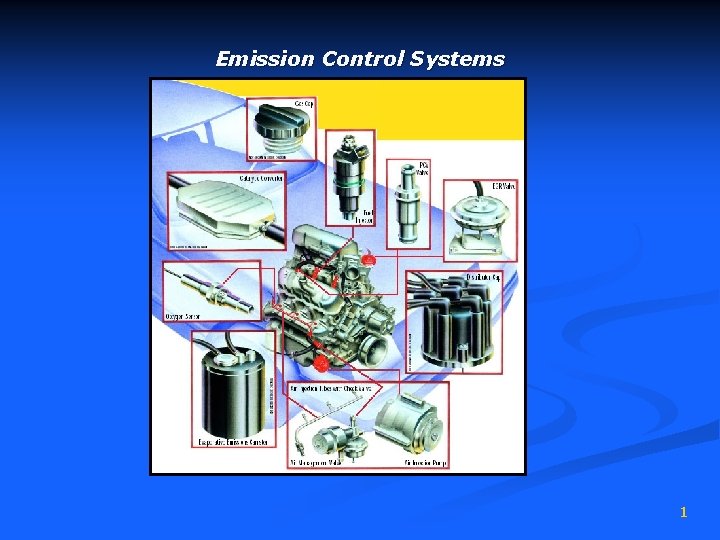
Emission Control Systems 1
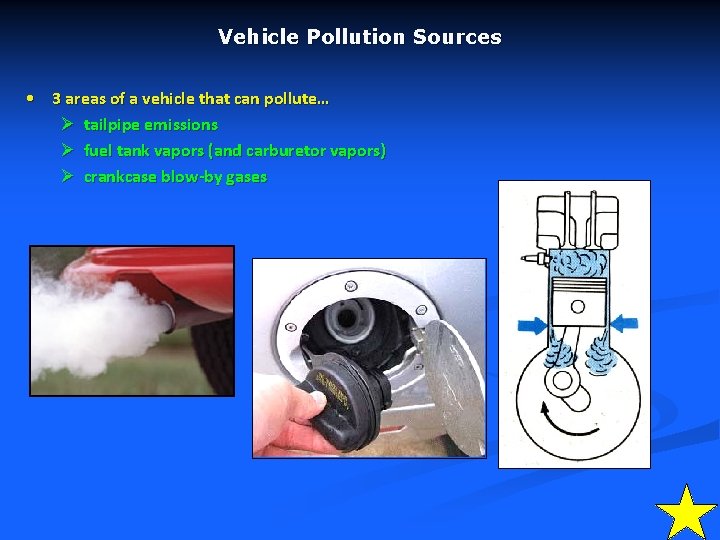
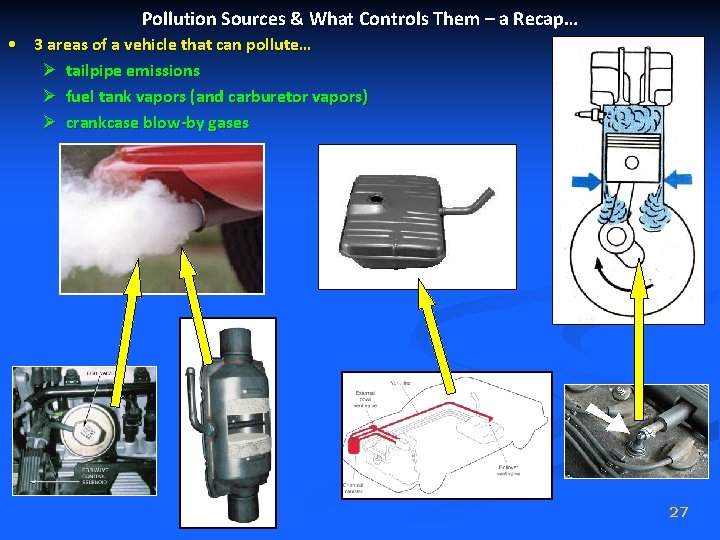
Vehicle Pollution Sources • 3 areas of a vehicle that can pollute… Ø tailpipe emissions Ø fuel tank vapors (and carburetor vapors) Ø crankcase blow-by gases 2
Major Engine Pollutants 1) hydrocarbons: produced when some or all of the fuel does not get burned during combustion, or from raw gasoline vapors Ø tailpipe emission Ø fuel tank & carburetor emission 2) carbon monoxide: produced when there is insufficient oxygen to support combustion Ø tailpipe emission 3) oxides of nitrogen: produced when combustion temperatures exceed 1400°C / 2500°F Ø tailpipe emission 3
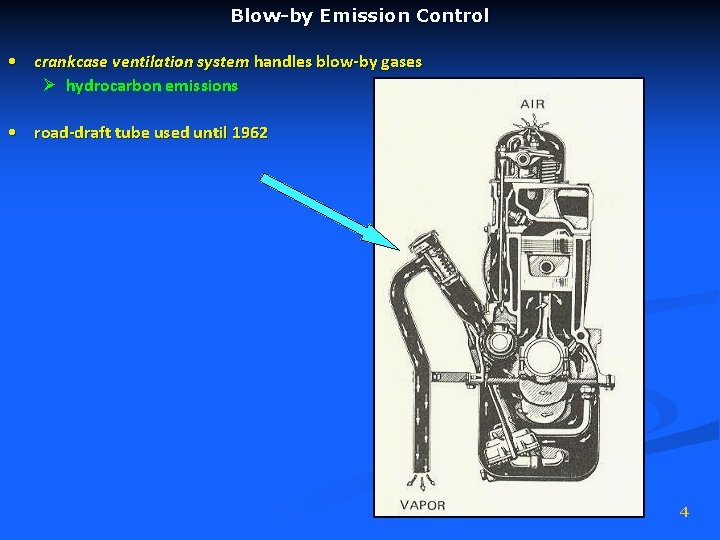
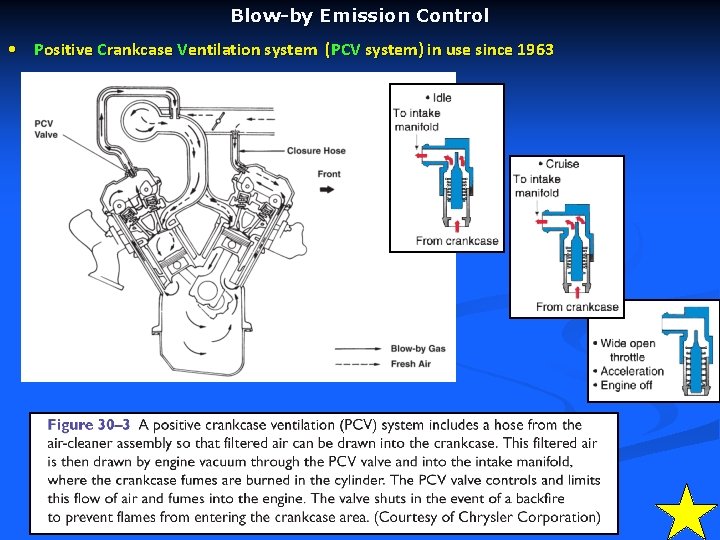
Blow-by Emission Control • crankcase ventilation system handles blow-by gases Ø hydrocarbon emissions • road-draft tube used until 1962 4
Blow-by Emission Control • Positive Crankcase Ventilation system (PCV system) in use since 1963 5
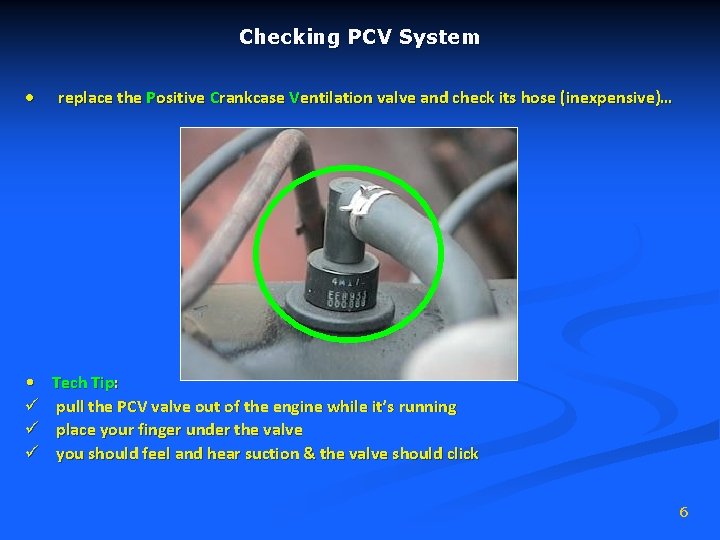
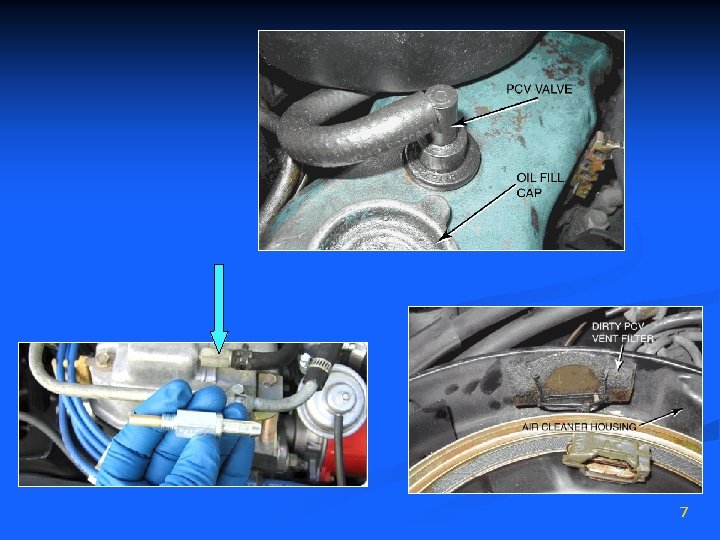
Checking PCV System • • ü ü ü replace the Positive Crankcase Ventilation valve and check its hose (inexpensive)… Tech Tip: pull the PCV valve out of the engine while it’s running place your finger under the valve you should feel and hear suction & the valve should click 6
7
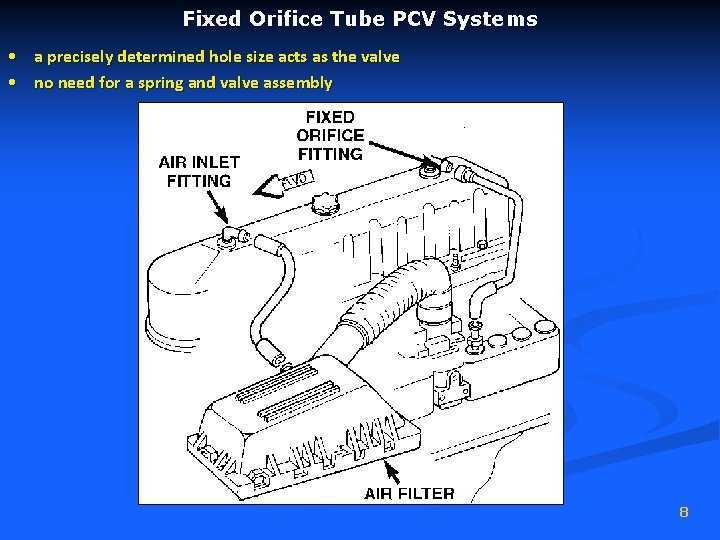
Fixed Orifice Tube PCV Systems • a precisely determined hole size acts as the valve • no need for a spring and valve assembly 8
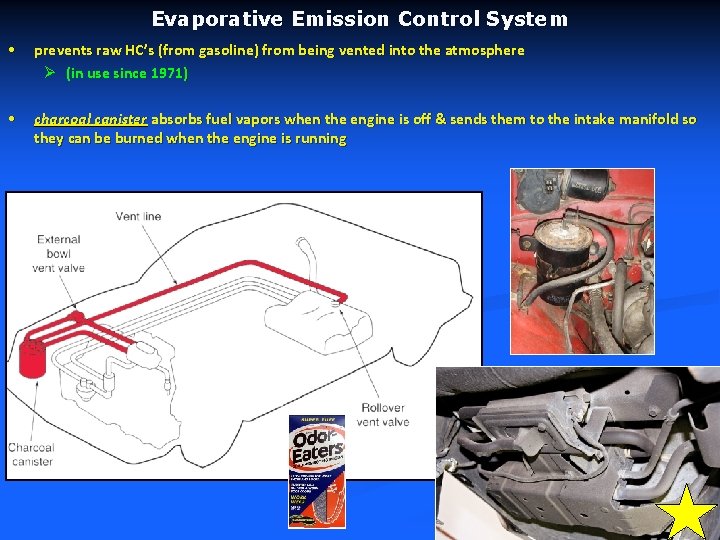
Evaporative Emission Control System • prevents raw HC’s (from gasoline) from being vented into the atmosphere Ø (in use since 1971) • charcoal canister absorbs fuel vapors when the engine is off & sends them to the intake manifold so they can be burned when the engine is running 9
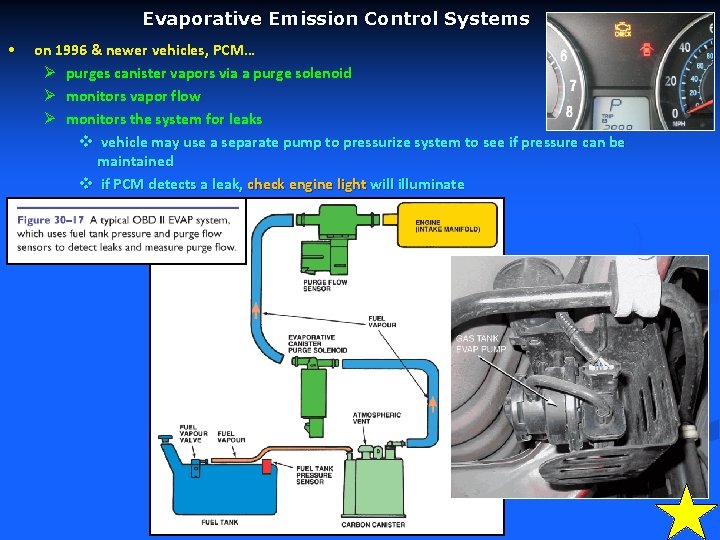
Evaporative Emission Control Systems • on 1996 & newer vehicles, PCM… Ø purges canister vapors via a purge solenoid Ø monitors vapor flow Ø monitors the system for leaks v vehicle may use a separate pump to pressurize system to see if pressure can be maintained v if PCM detects a leak, check engine light will illuminate 10
12
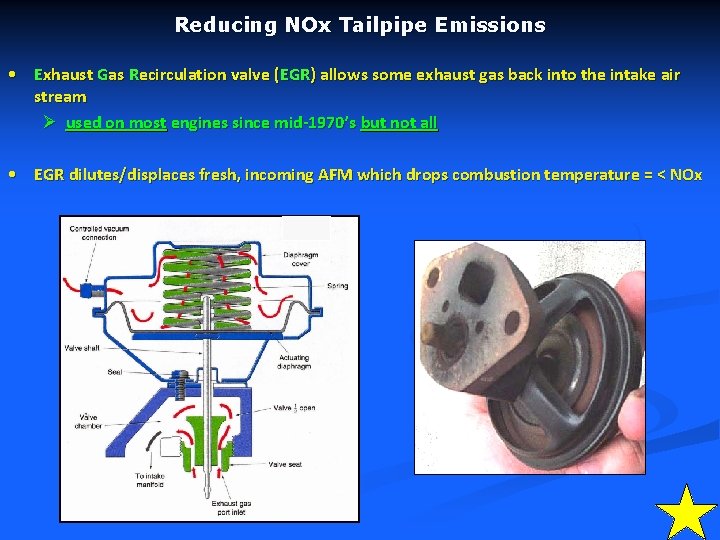
Reducing NOx Tailpipe Emissions • Exhaust Gas Recirculation valve (EGR) allows some exhaust gas back into the intake air stream Ø used on most engines since mid-1970’s but not all • EGR dilutes/displaces fresh, incoming AFM which drops combustion temperature = < NOx 13
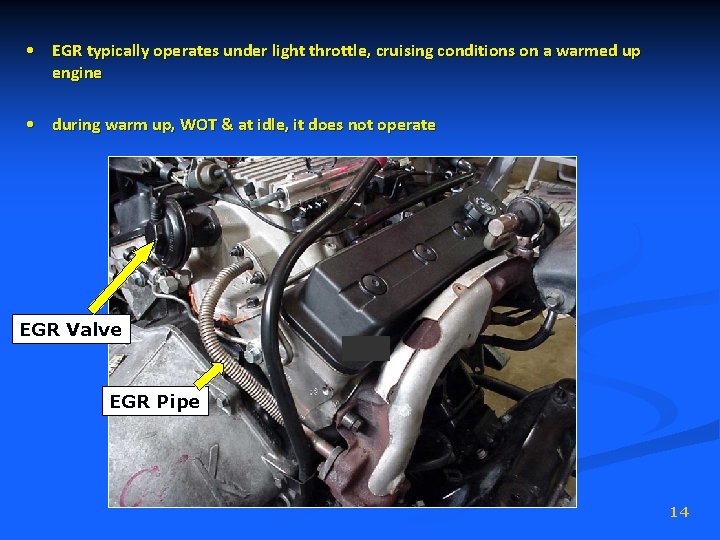
• EGR typically operates under light throttle, cruising conditions on a warmed up engine • during warm up, WOT & at idle, it does not operate EGR Valve EGR Pipe 14
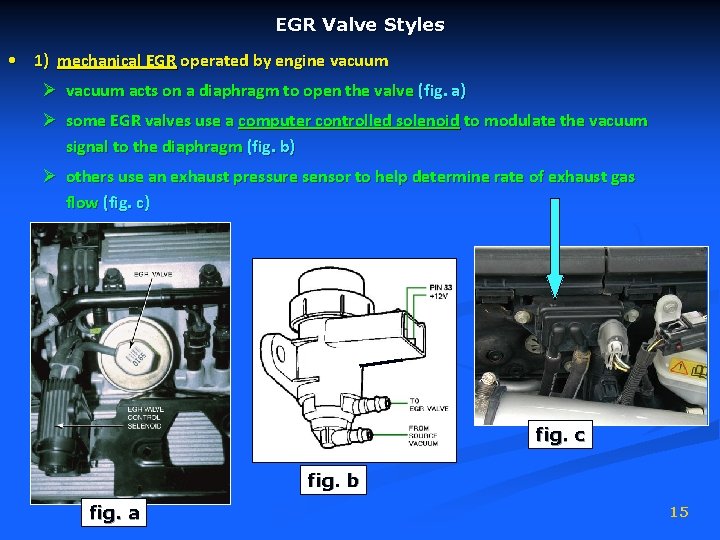
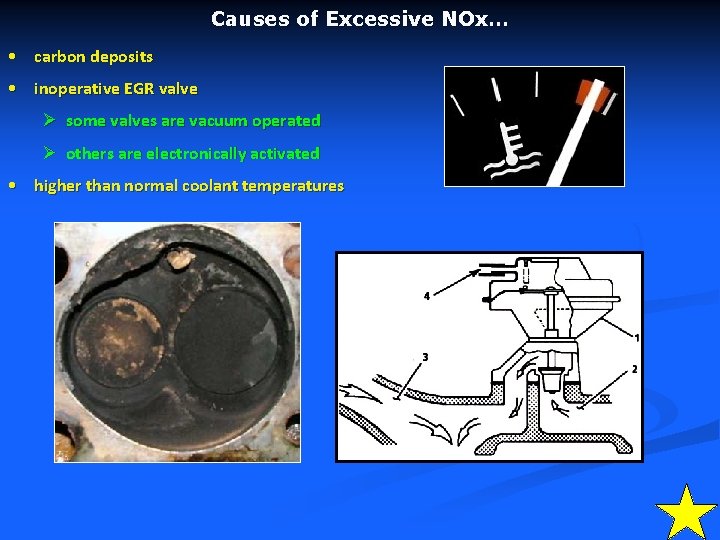
EGR Valve Styles • 1) mechanical EGR operated by engine vacuum Ø vacuum acts on a diaphragm to open the valve (fig. a) Ø some EGR valves use a computer controlled solenoid to modulate the vacuum signal to the diaphragm (fig. b) Ø others use an exhaust pressure sensor to help determine rate of exhaust gas flow (fig. c) fig. c fig. b fig. a 15
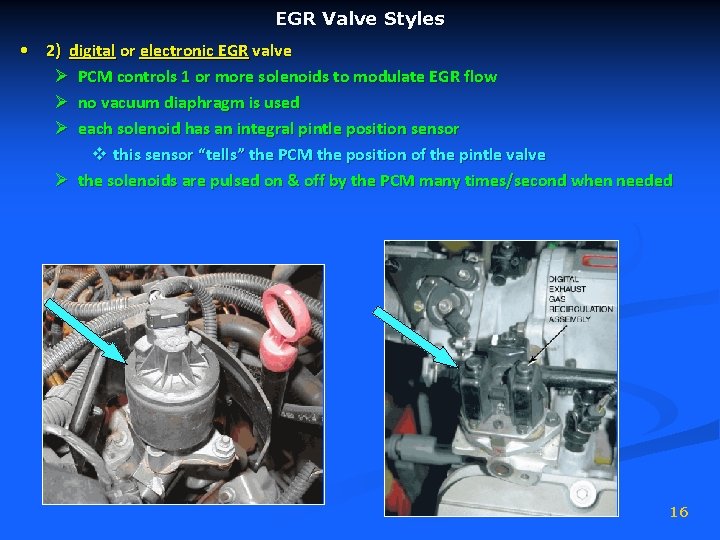
EGR Valve Styles • 2) digital or electronic EGR valve Ø PCM controls 1 or more solenoids to modulate EGR flow Ø no vacuum diaphragm is used Ø each solenoid has an integral pintle position sensor v this sensor “tells” the PCM the position of the pintle valve Ø the solenoids are pulsed on & off by the PCM many times/second when needed 16
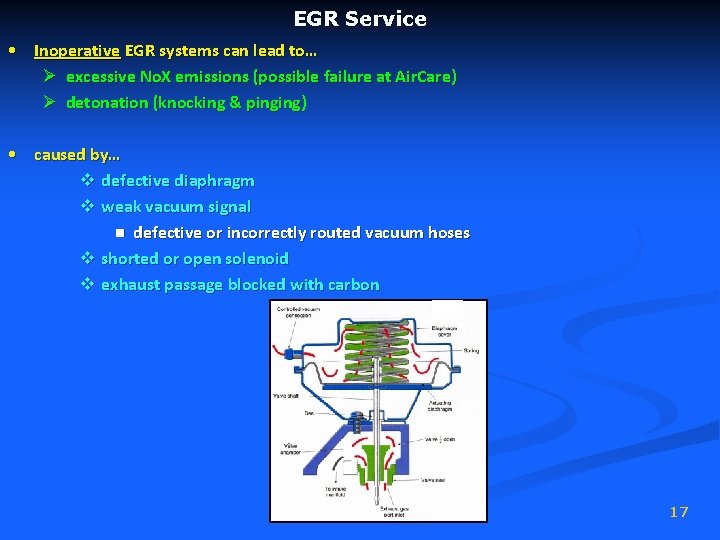
EGR Service • Inoperative EGR systems can lead to… Ø excessive No. X emissions (possible failure at Air. Care) Ø detonation (knocking & pinging) • caused by… v defective diaphragm v weak vacuum signal n defective or incorrectly routed vacuum hoses v shorted or open solenoid v exhaust passage blocked with carbon 17
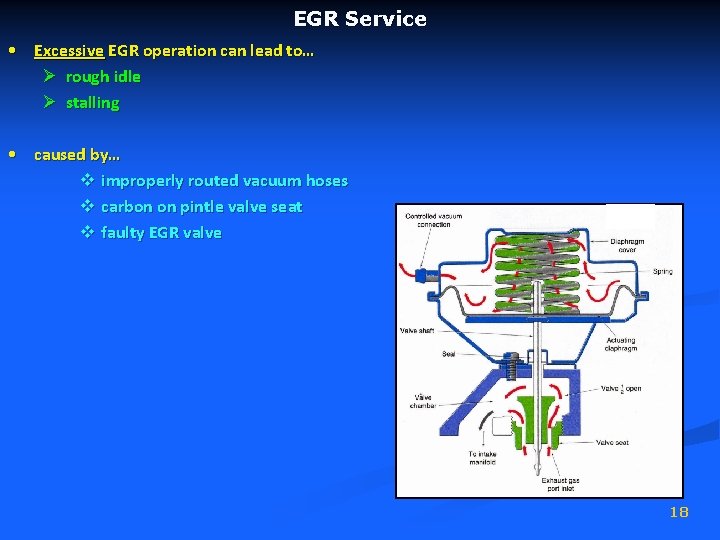
EGR Service • Excessive EGR operation can lead to… Ø rough idle Ø stalling • caused by… v improperly routed vacuum hoses v carbon on pintle valve seat v faulty EGR valve 18
19
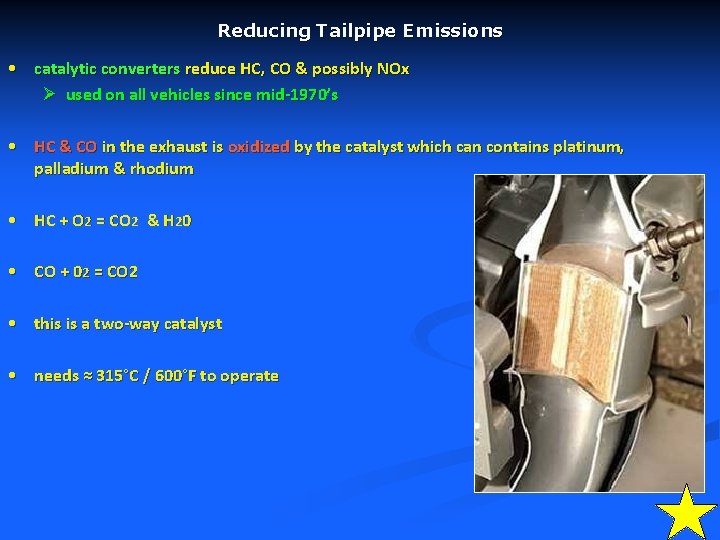
Reducing Tailpipe Emissions • catalytic converters reduce HC, CO & possibly NOx Ø used on all vehicles since mid-1970’s • HC & CO in the exhaust is oxidized by the catalyst which can contains platinum, palladium & rhodium • HC + O 2 = CO 2 & H 20 • CO + 02 = CO 2 • this is a two-way catalyst • needs ≈ 315°C / 600°F to operate 20
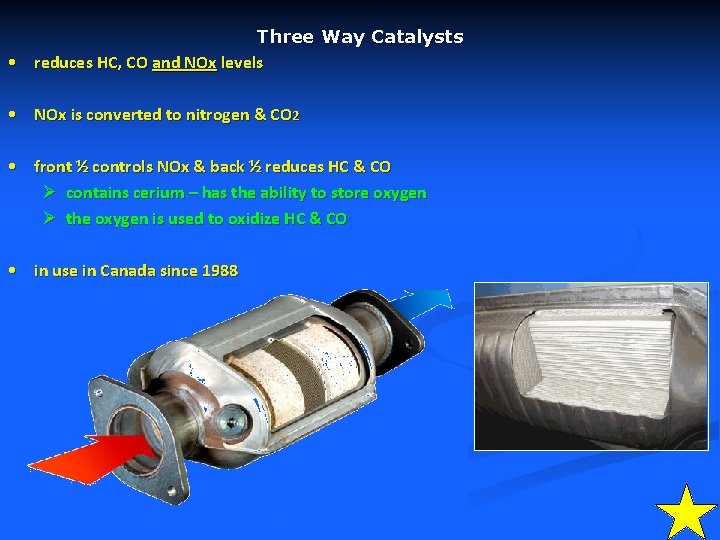
Three Way Catalysts • reduces HC, CO and NOx levels • NOx is converted to nitrogen & CO 2 • front ½ controls NOx & back ½ reduces HC & CO Ø contains cerium – has the ability to store oxygen Ø the oxygen is used to oxidize HC & CO • in use in Canada since 1988 21
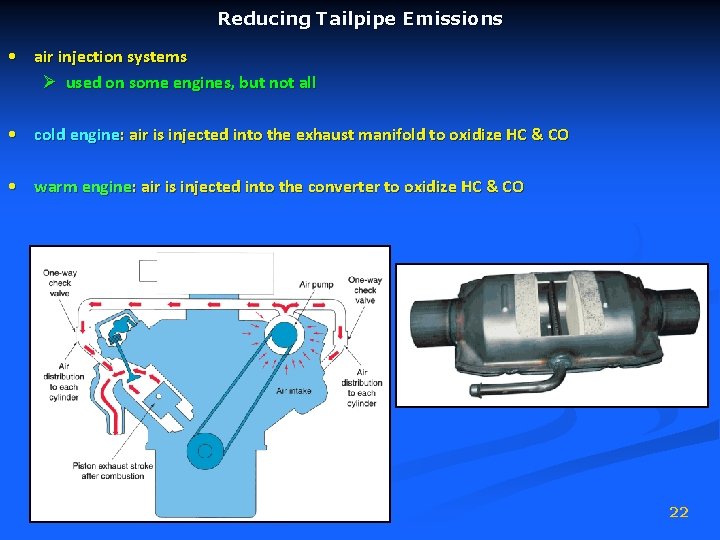
Reducing Tailpipe Emissions • air injection systems Ø used on some engines, but not all • cold engine: air is injected into the exhaust manifold to oxidize HC & CO • warm engine: air is injected into the converter to oxidize HC & CO 22
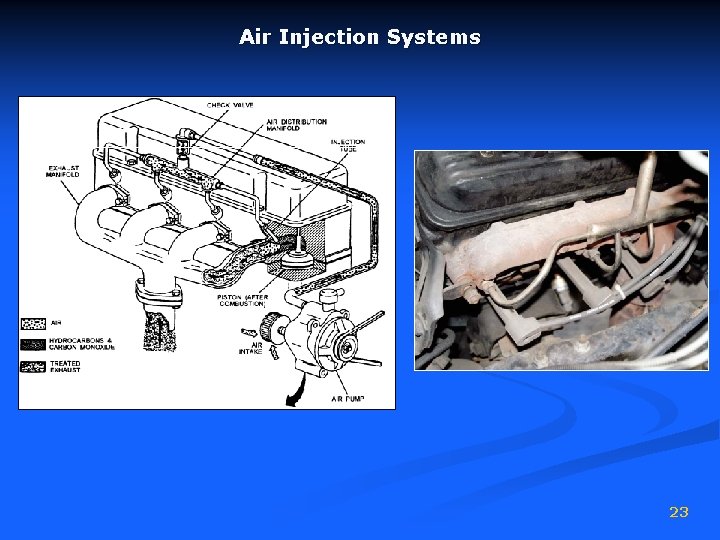
Air Injection Systems 23
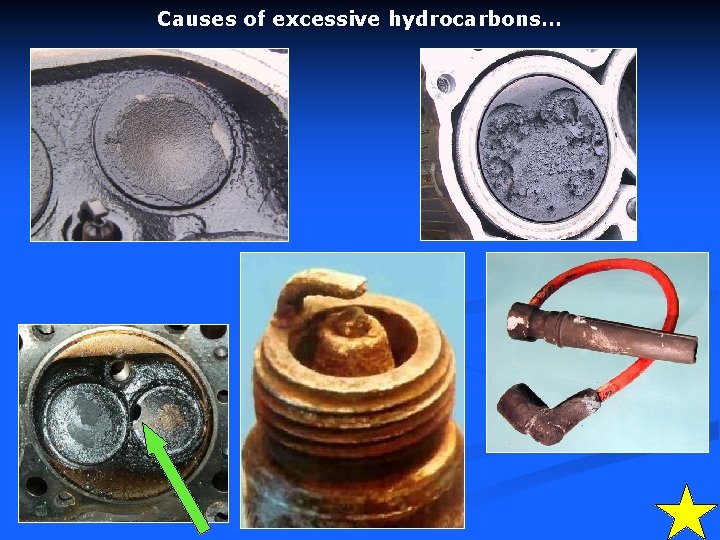
Causes of excessive hydrocarbons… 24
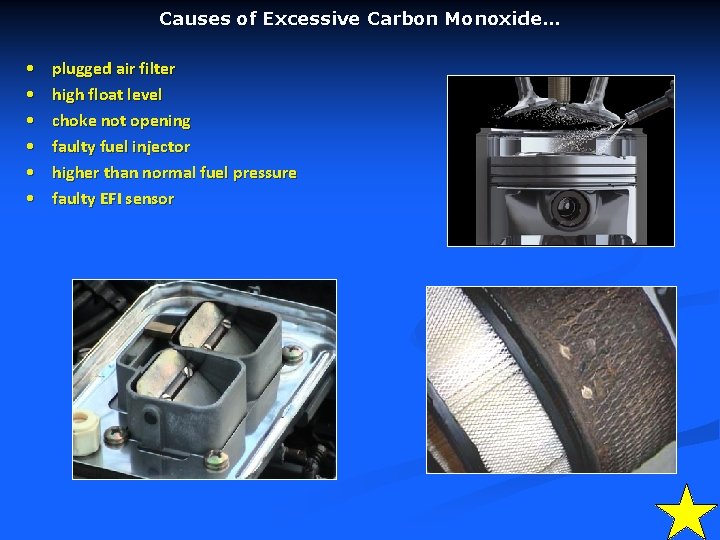
Causes of Excessive Carbon Monoxide… • • • plugged air filter high float level choke not opening faulty fuel injector higher than normal fuel pressure faulty EFI sensor 25
Causes of Excessive NOx… • carbon deposits • inoperative EGR valve Ø some valves are vacuum operated Ø others are electronically activated • higher than normal coolant temperatures 26
Pollution Sources & What Controls Them – a Recap… • 3 areas of a vehicle that can pollute… Ø tailpipe emissions Ø fuel tank vapors (and carburetor vapors) Ø crankcase blow-by gases 27