
Emirates GBC Technical Workshop Sustainable Management of Health
Emirates. GBC Technical Workshop Sustainable Management of Health Care Waste Nadia Ibrahim FARNEK Head of Consultancy 25 Feb 2020
Agenda q Health Care Waste : Global & Middle East Statistics q Treatment Systems Review q Sustainable Management of Healthcare Waste – Challenges & Opportunities q Best Approach q Recycling of HCW – A Case Study

STATISTICS
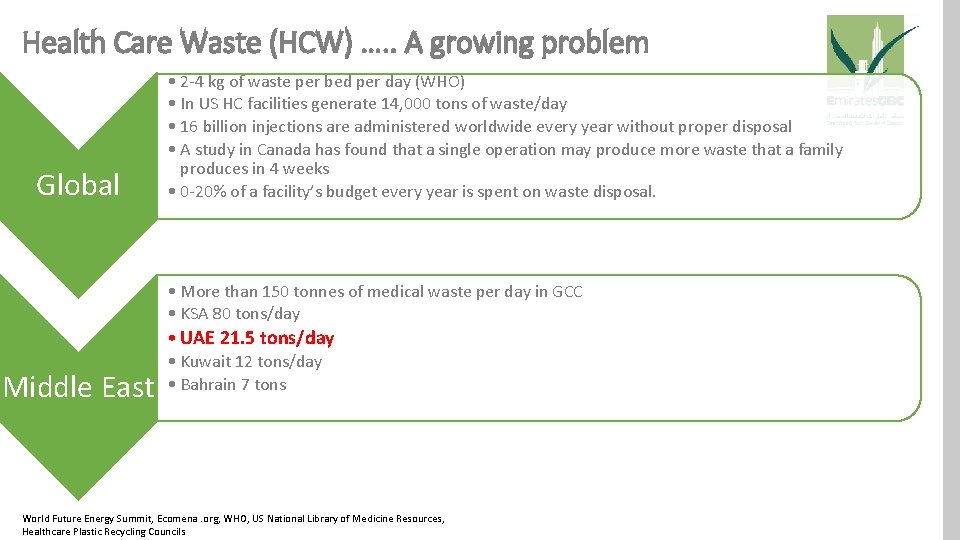
Health Care Waste (HCW) …. . A growing problem Global • 2 -4 kg of waste per bed per day (WHO) • In US HC facilities generate 14, 000 tons of waste/day • 16 billion injections are administered worldwide every year without proper disposal • A study in Canada has found that a single operation may produce more waste that a family produces in 4 weeks • 0 -20% of a facility’s budget every year is spent on waste disposal. • More than 150 tonnes of medical waste per day in GCC • KSA 80 tons/day • UAE 21. 5 tons/day Middle East • Kuwait 12 tons/day • Bahrain 7 tons World Future Energy Summit, Ecomena. org, WHO, US National Library of Medicine Resources, Healthcare Plastic Recycling Councils
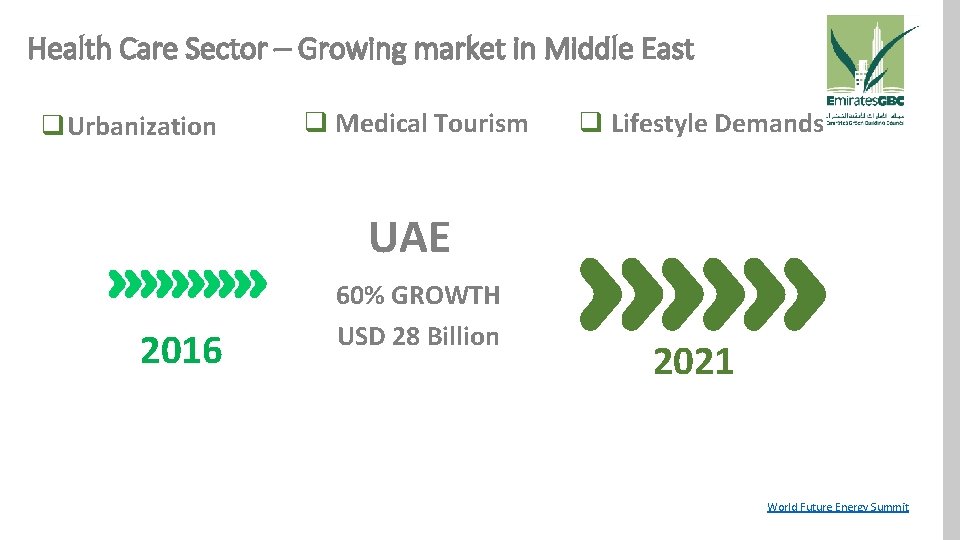
Health Care Sector – Growing market in Middle East q. Urbanization q Medical Tourism q Lifestyle Demands UAE 2016 60% GROWTH USD 28 Billion 2021 World Future Energy Summit
TREATMENT SYSTEMS
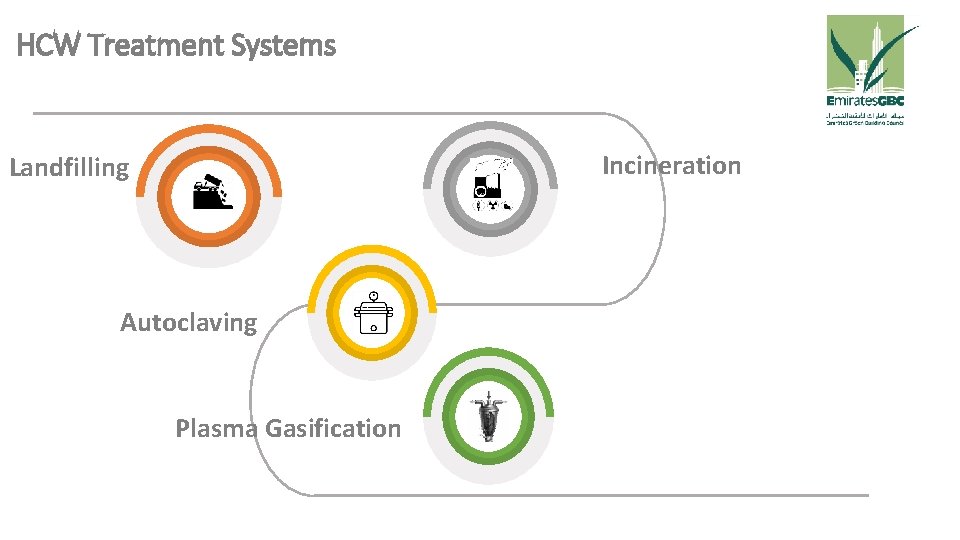
HCW Treatment Systems Incineration Landfilling Autoclaving Plasma Gasification
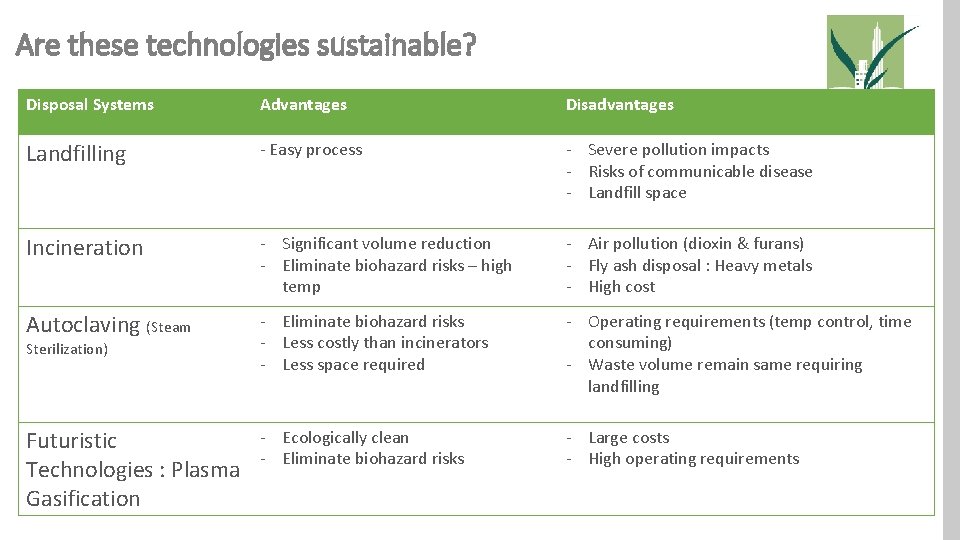
Are these technologies sustainable? Disposal Systems Advantages Disadvantages Landfilling - Easy process - Severe pollution impacts - Risks of communicable disease - Landfill space Incineration - Significant volume reduction - Eliminate biohazard risks – high temp - Air pollution (dioxin & furans) - Fly ash disposal : Heavy metals - High cost Autoclaving (Steam - Eliminate biohazard risks - Less costly than incinerators - Less space required - Operating requirements (temp control, time consuming) - Waste volume remain same requiring landfilling Futuristic Technologies : Plasma Gasification - Ecologically clean - Eliminate biohazard risks - Large costs - High operating requirements Sterilization)
SUSTAINABLE MANAGEMENT OF HCW – Challenges & Opportunities
Challenges q Social Stigma : Everything coming out a healthcare facility is hazardous or risky? Will it create environmental & health risks if recycled? Health care cleaning staff is concerned about internal segregation. q Waste contractor support: Reluctance by recycling companies to accept wastes from healthcare facilities : Are they actually segregated? Will our staff be at risk? Is the waste that is treated after autoclaving is safe to handle and recycled? q Recycling Infrastructure: No separate infrastructure in many Material Recovery Facilities for handling medical waste separately q Cross Contamination: Recycling bins from medical waste are not fully trustable as there might be infectious contamination so it ends may be as medical waste. q Lack of awareness from healthcare staff on various waste types & their segregation methodology q Material Quality Treatment technology that keep the recyclable quality intact is not much available in UAE & other parts of middle east q Convenience: Segregation is costly & time consuming, its easy to dispose as general waste q Legal Barriers: Disposal requirements, health & safety requirements
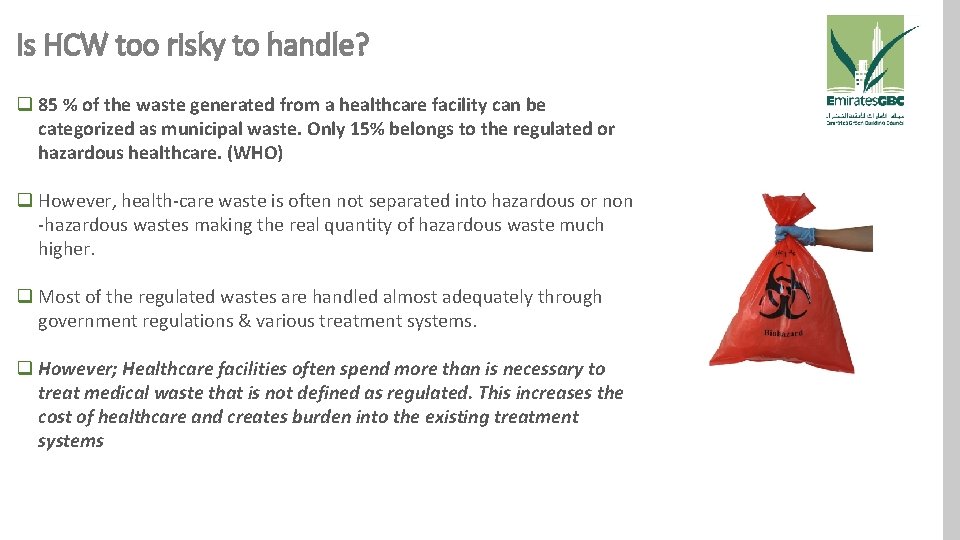
Is HCW too risky to handle? q 85 % of the waste generated from a healthcare facility can be categorized as municipal waste. Only 15% belongs to the regulated or hazardous healthcare. (WHO) q However, health-care waste is often not separated into hazardous or non -hazardous wastes making the real quantity of hazardous waste much higher. q Most of the regulated wastes are handled almost adequately through government regulations & various treatment systems. q However; Healthcare facilities often spend more than is necessary to treat medical waste that is not defined as regulated. This increases the cost of healthcare and creates burden into the existing treatment systems
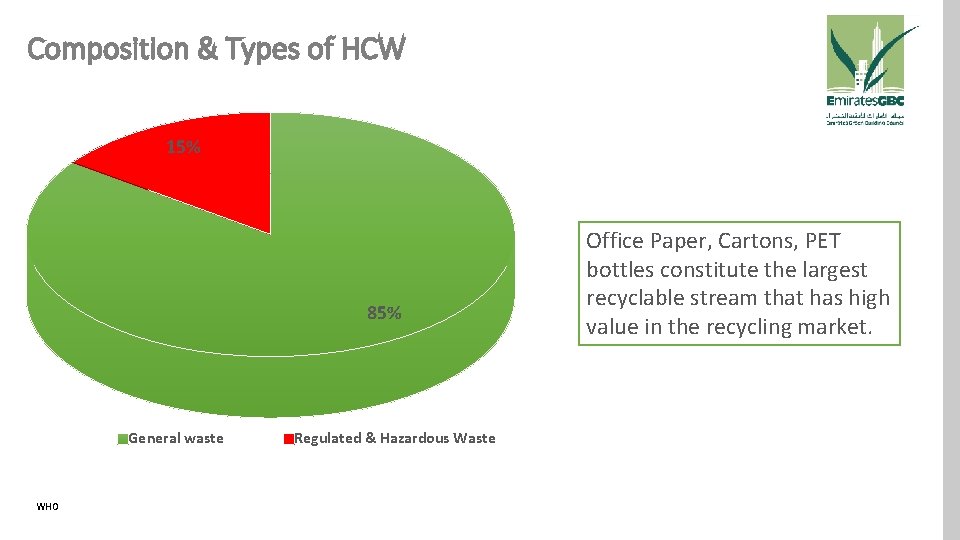
Composition & Types of HCW 15% 85% General waste WHO Regulated & Hazardous Waste Office Paper, Cartons, PET bottles constitute the largest recyclable stream that has high value in the recycling market.
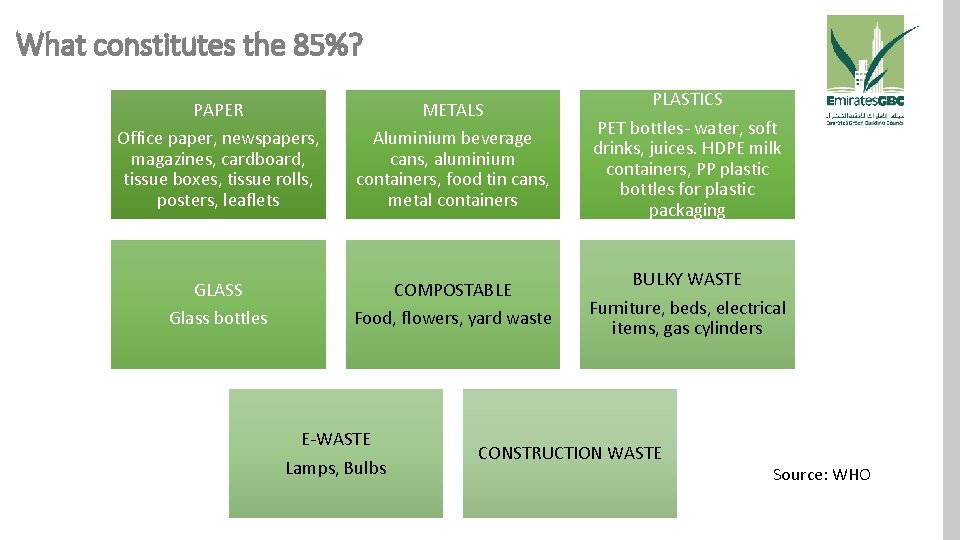
What constitutes the 85%? PAPER METALS Office paper, newspapers, magazines, cardboard, tissue boxes, tissue rolls, posters, leaflets Aluminium beverage cans, aluminium containers, food tin cans, metal containers GLASS Glass bottles COMPOSTABLE Food, flowers, yard waste E-WASTE Lamps, Bulbs PLASTICS PET bottles- water, soft drinks, juices. HDPE milk containers, PP plastic bottles for plastic packaging BULKY WASTE Furniture, beds, electrical items, gas cylinders CONSTRUCTION WASTE Source: WHO
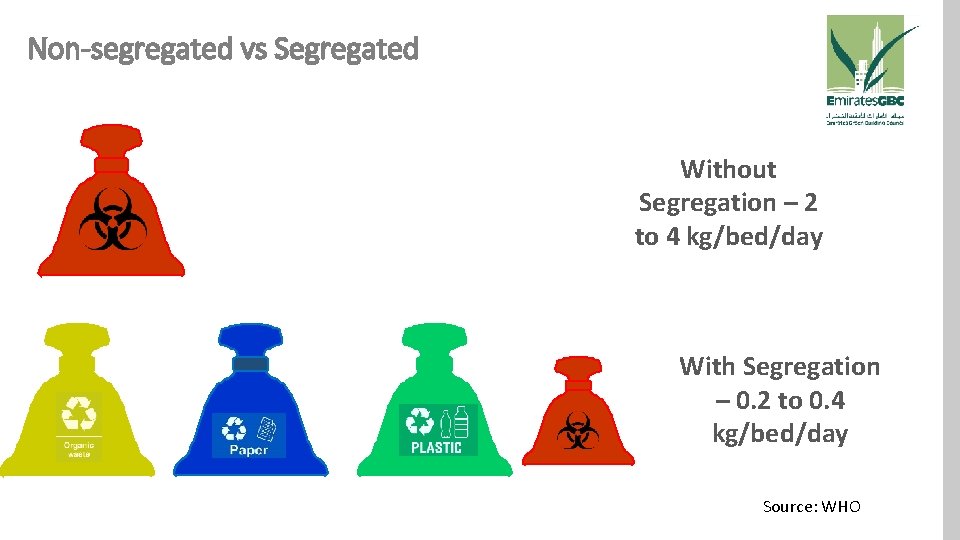
Non-segregated vs Segregated Without Segregation – 2 to 4 kg/bed/day With Segregation – 0. 2 to 0. 4 kg/bed/day Source: WHO
BEST APPROACH
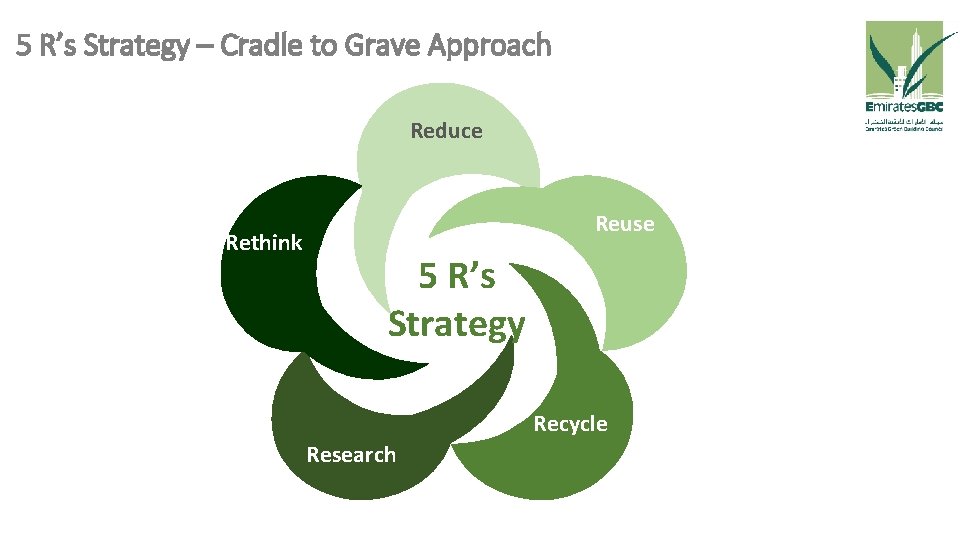
5 R’s Strategy – Cradle to Grave Approach Reduce Rethink Reuse 5 R’s Strategy Recycle Research
Waste Minimization – The Key q Sustainable Purchasing : Packaging minimization policy, bulk packaging, eco friendly or compostable packaging, supplier take back policy q Minimizing plastic packaging : (E. g. : Blue sterile wraps (Polypropylene) for surgical instruments which is one of the most biggest contributor; as per Practice Green Health estimates that 255 million pounds is disposed each year. This can be replaced by metal cases or a separate recycling process for blue wrap is set up as they are made of high quality recyclable polypropylene. q Proper Segregation: Placing color coding bins to segregate different waste types – help reduce the % of infectious waste & increase non-hazardous waste that can be recycled. q Single use containers replaced with durable containers
Is Reuse possible? q What is required is more effective sterilization procedures rather than disposable equipment. q Reuse saves money & also reduce packaging & clinical waste q Wherever considered safe to use, single use items should be replaced by reusable items. Reuse: Developing vs Developed Countries In developing countries reuse is a more a cost savings measure; however safety is compromised In developed countries, it is systematically regulated e. g. in US it is regulated by US Food & Drug Administration
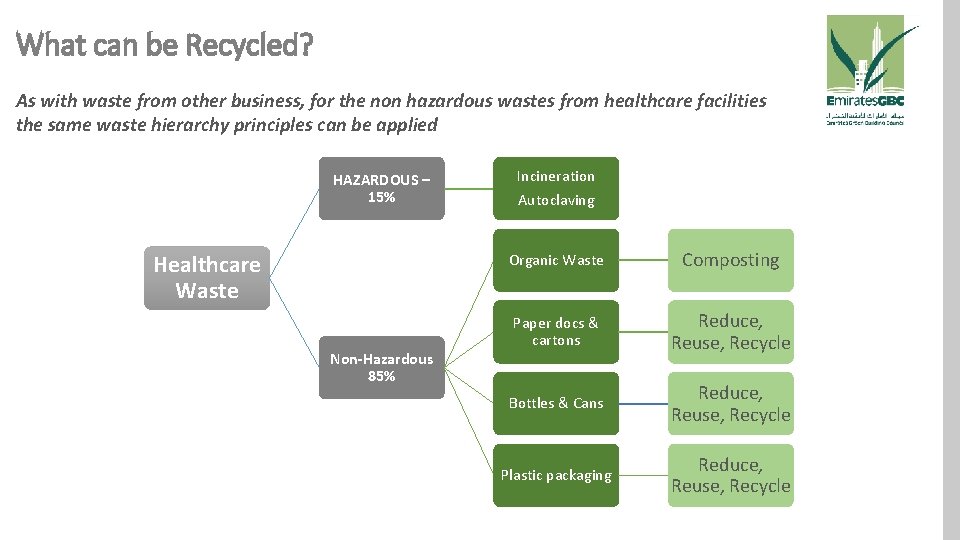
What can be Recycled? As with waste from other business, for the non hazardous wastes from healthcare facilities the same waste hierarchy principles can be applied HAZARDOUS – 15% Healthcare Waste Non-Hazardous 85% Incineration Autoclaving Organic Waste Composting Paper docs & cartons Reduce, Reuse, Recycle Bottles & Cans Reduce, Reuse, Recycle Plastic packaging Reduce, Reuse, Recycle
Setting Up an Integrated HCW Management Systems 1. Conduct a Waste Audit: Understand what is generated & from where, what type of bins & other facilities are required. 2. Seek support from your Waste Contractor : Can the segregated waste be recycled & not taken to landfill. 3. Sustainable Supply Chain: Control of what is coming to reduce, reuse & divert from landfill. 4. Facilities & Equipment: Color coded bins, compactors, composting. 5. Train, Train & Aware: Engage staff & Visitors REDUCE, REUSE & RECYCLE
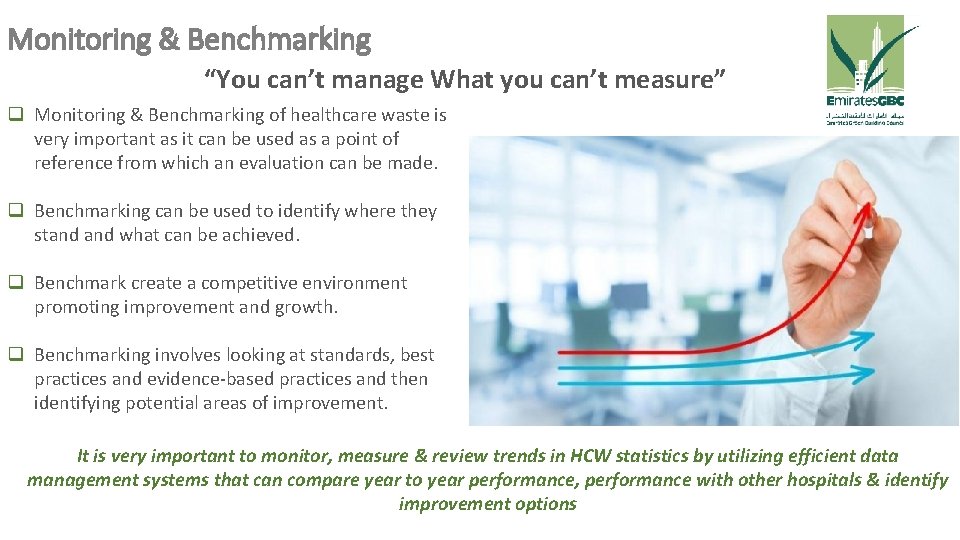
Monitoring & Benchmarking “You can’t manage What you can’t measure” q Monitoring & Benchmarking of healthcare waste is very important as it can be used as a point of reference from which an evaluation can be made. q Benchmarking can be used to identify where they stand what can be achieved. q Benchmark create a competitive environment promoting improvement and growth. q Benchmarking involves looking at standards, best practices and evidence-based practices and then identifying potential areas of improvement. It is very important to monitor, measure & review trends in HCW statistics by utilizing efficient data management systems that can compare year to year performance, performance with other hospitals & identify improvement options
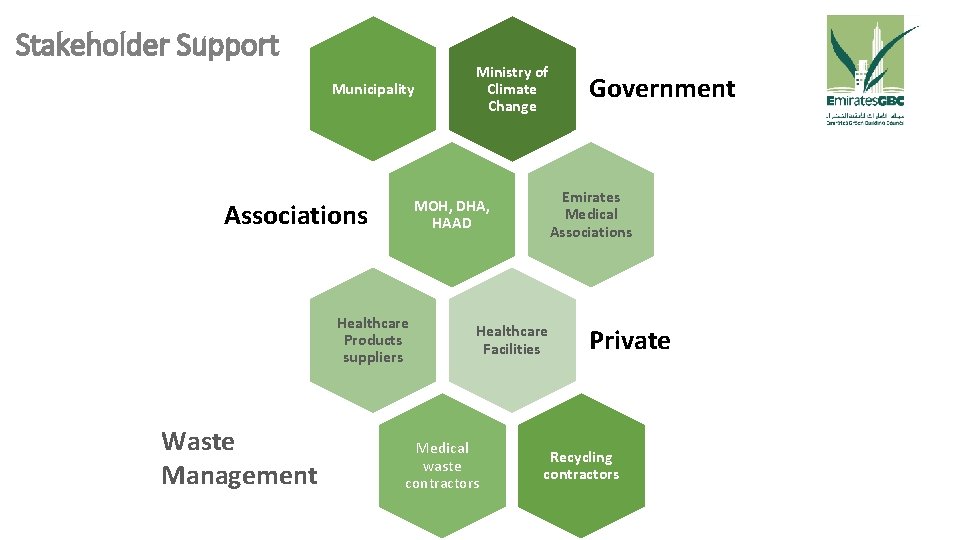
Stakeholder Support Municipality Healthcare Products suppliers Healthcare Facilities Medical waste contractors Government Emirates Medical Associations MOH, DHA, HAAD Associations Waste Management Ministry of Climate Change Private Recycling contractors
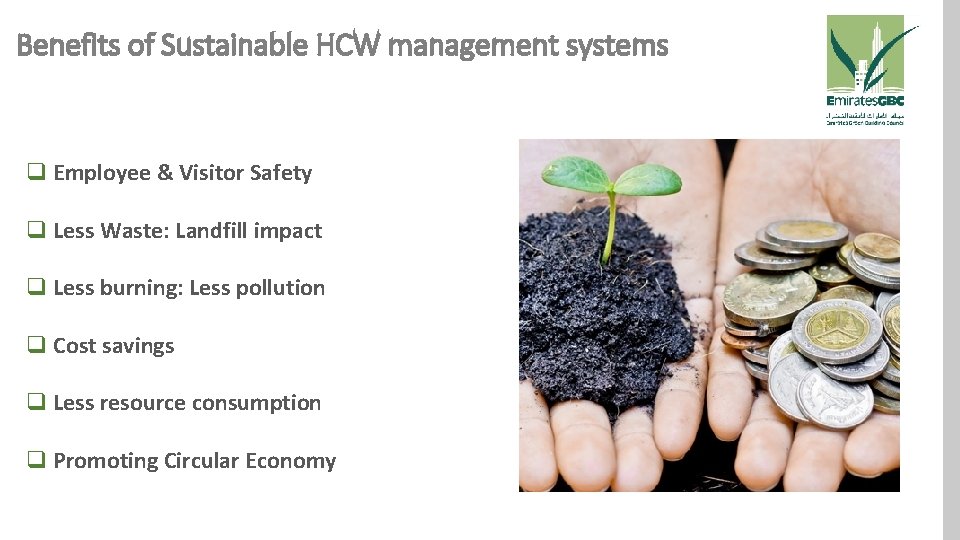
Benefits of Sustainable HCW management systems q Employee & Visitor Safety q Less Waste: Landfill impact q Less burning: Less pollution q Cost savings q Less resource consumption q Promoting Circular Economy
CASE STUDY
Plastic Waste Recycling: A case study by RISE Research Institutes of Sweden q 3 types of plastic products were chosen for the study: Polyethylene (PE) used in aprons, Polypropylene(PP) used in medicine cups and syringes & PVC used in gloves q The materials were subject to hydrothermal method & an ionization method q After pre treatment the items were evaluated for color change, stability & alteration of chemical structure q The various plastics were intact except with a minor plasticizer loss in the PVC samples q Repurposing of this plastics were checked in recycling trials – PP material was used for production of 100% recycled floor tiles while PVC was used for flooring with 20% recycled content. The results show that pretreatment and recycling is beneficial from a climate perspective, even with assumed material losses and assumed quality reduction of the recycled materials.
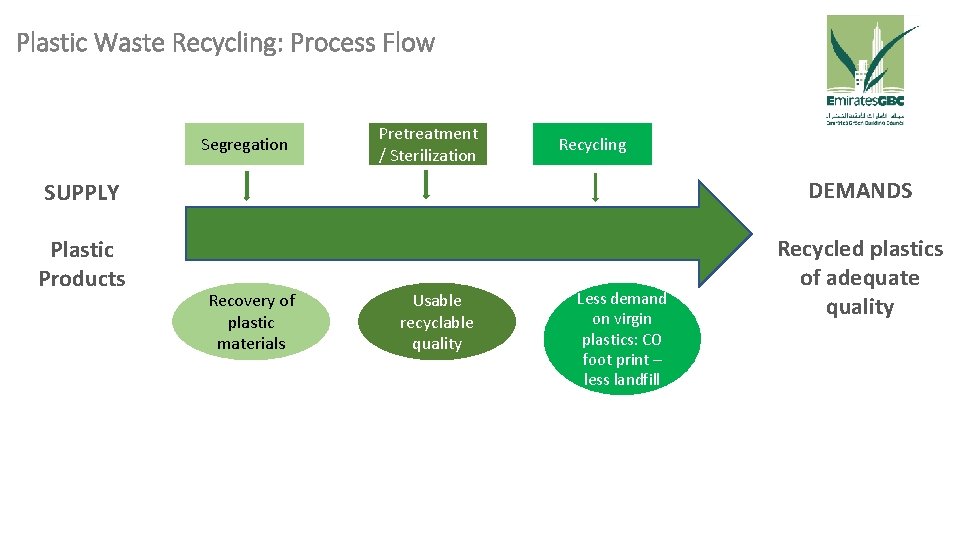
Plastic Waste Recycling: Process Flow Segregation Pretreatment / Sterilization Recycling SUPPLY DEMANDS Plastic Products Recycled plastics of adequate quality Recovery of plastic materials Usable recyclable quality Less demand on virgin plastics: CO foot print – less landfill
Although the main mission of the hospital is to promote human health, it cannot be assumed as an island apart from its urban environment. This philosophy has a significant impact on the future hospital ideas and priorities: Promoting and advancing the health and well-being of all individuals and people wherever against the environment in a responsible manner.
Let’s Discuss q Is incineration the ultimate solution for healthcare waste management? q Social stigma against 3 R’s in Medical Waste Management q Is government intervention required for guiding hospitals in adopting waste reduction & segregation strategies? q Are our existing waste recycling contractors & facilities ready to accept and segregate nonhazardous waste from healthcare sectors?

Thank You
- Slides: 29