
Emerging Transcriptomic Databases and Their Use in Gene
Emerging Transcriptomic Databases and Their Use in Gene Expression Profiling Carlos M. Hernandez-Garcia Department of Horticulture and Crop Science, OARDC/The Ohio State University, 1680 Madison Ave. , Wooster, OH 44691, USA hernandez-garcia. 1@buckeyemail. osu. edu
Main purposes of this tutorial q Provide an updated list of plant gene-expression databases and related resources q Provide step-by-step instructions to generate gene expression profiles q Review considerations relevant to the use of gene expression databases q Use web-based tools for visualization of transcriptomic data
Background q Expression databases hosting microarray -derived data have been fundamental to study gene expression in many plants; however, this technology is biased toward known RNAs used to generate the probes in the chips. q With the advent of next-generation sequencing (RNA-Seq), global RNA analysis (transcriptome) is becoming routine for many plant species. q RNA-Seq is a powerful tool not only to validate gene annotation but also to unravel quantitative gene expression for all sets of genes transcribed in a sample. q The vast amount of information generated using RNA-Seq technology allows the generation of databases that capture a wider snapshoot of the transcriptome, including absolute numbers of transcripts for most of the genes in the genome.
Biological rationale for RNA-Seq Next-generation sequencing technologies such as Solexa, Illumina, and 454 can be applied to transcriptome sequencing. These technologies detect short reads of RNA present in biological samples, including coding and non-coding RNA. These reads are short, but long enough to be aligned uniquely to genes lying on a reference genome. Thus, reads can be assigned to their respective gene. Further information on next-generation sequencing for plant breeders can be accessed at http: //www. extension. org/article/32489
Specific objective: Demonstrate how transcript profiles can be generated for two sets of soybean candidate genes. Two different transcriptomic databases from soybean will be used for more consistency (Soybase and Transcriptome Atlas). Rationale: We are interested in soybean seed-specific promoters. As gene expression is largely regulated by promoters, one approach is to first identify genes playing a major role in determining seed composition (e. g. oil content, fatty acid, etc. ). Goal: Examine how putative seed specific genes are transcribed in various tissues and seeds at different developmental stages using databases of RNA-Seq experiments.
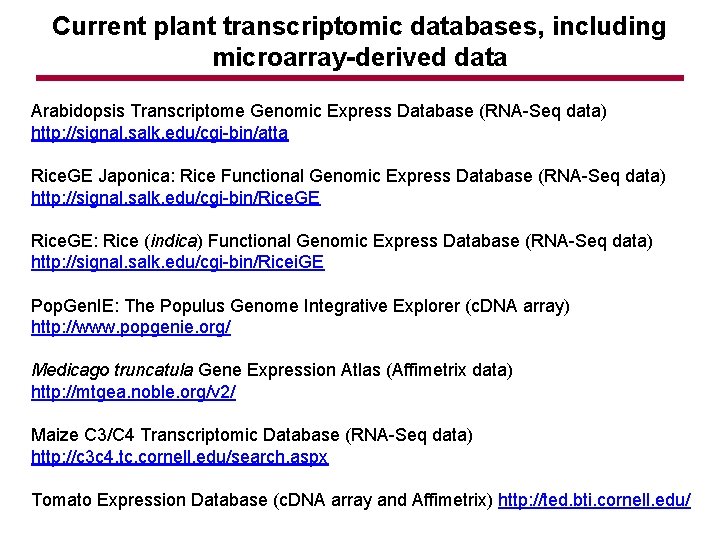
Current plant transcriptomic databases, including microarray-derived data Arabidopsis Transcriptome Genomic Express Database (RNA-Seq data) http: //signal. salk. edu/cgi-bin/atta Rice. GE Japonica: Rice Functional Genomic Express Database (RNA-Seq data) http: //signal. salk. edu/cgi-bin/Rice. GE: Rice (indica) Functional Genomic Express Database (RNA-Seq data) http: //signal. salk. edu/cgi-bin/Ricei. GE Pop. Gen. IE: The Populus Genome Integrative Explorer (c. DNA array) http: //www. popgenie. org/ Medicago truncatula Gene Expression Atlas (Affimetrix data) http: //mtgea. noble. org/v 2/ Maize C 3/C 4 Transcriptomic Database (RNA-Seq data) http: //c 3 c 4. tc. cornell. edu/search. aspx Tomato Expression Database (c. DNA array and Affimetrix) http: //ted. bti. cornell. edu/
Generating expression profiles for two sets of soybean genes For this tutorial, two sets of soybean genes will be used as examples of how to build expression profiles using transcript databases. The first set was identified in the soybean genome by Dr. Robert Bouchard* using the N -terminal amino acid sequences for reported proteins found in seeds (Vodkin and Raikhel 1986; Kalinski et al. 1989; Natarajan et al. 2007). We named this group SEED genes. The second group of genes, identified by Dr. Leah Mc. Hale*, contains candidate genes mapping to known fatty acid regions. These genes are therefore predicted to be involved in fatty acid biosynthesis and were termed for these tutorial FAB (Fatty Acid Biosynthesis) genes. Promoters from both set of genes are being validated by Dr. John Finer* with the aim of isolating soybean seed specific promoters. Transcript profiles for these genes may predict tissue-specific expression driven by their promoters. More information about validation of promoters from these and other sets of soybean genes is available at http: //www. oardc. ohiostate. edu/SURE/ *The Ohio State University/OARDC
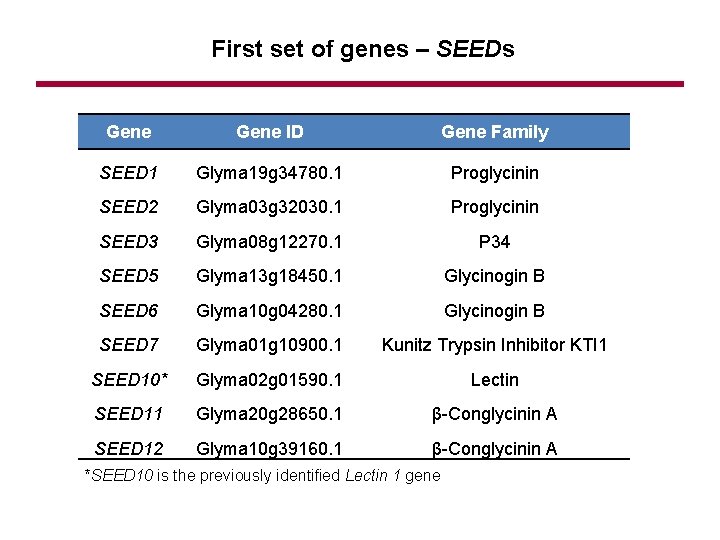
First set of genes – SEEDs Gene ID Gene Family SEED 1 Glyma 19 g 34780. 1 Proglycinin SEED 2 Glyma 03 g 32030. 1 Proglycinin SEED 3 Glyma 08 g 12270. 1 P 34 SEED 5 Glyma 13 g 18450. 1 Glycinogin B SEED 6 Glyma 10 g 04280. 1 Glycinogin B SEED 7 Glyma 01 g 10900. 1 Kunitz Trypsin Inhibitor KTI 1 SEED 10* Glyma 02 g 01590. 1 Lectin SEED 11 Glyma 20 g 28650. 1 β-Conglycinin A SEED 12 Glyma 10 g 39160. 1 β-Conglycinin A *SEED 10 is the previously identified Lectin 1 gene
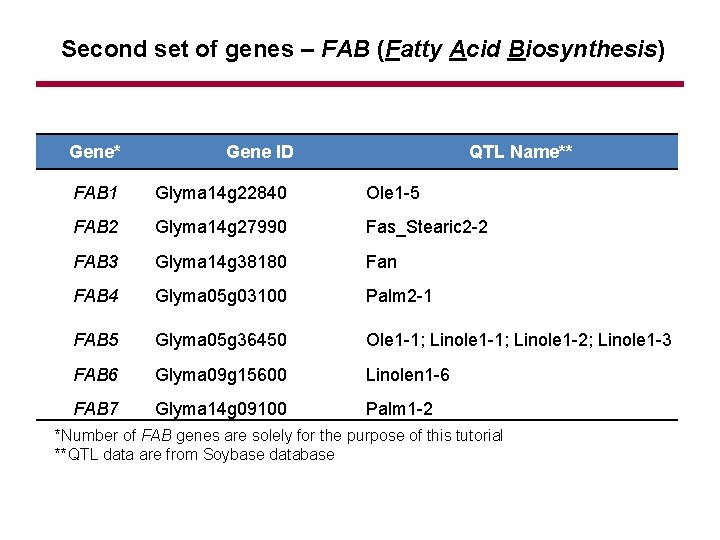
Second set of genes – FAB (Fatty Acid Biosynthesis) Gene* Gene ID QTL Name** FAB 1 Glyma 14 g 22840 Ole 1 -5 FAB 2 Glyma 14 g 27990 Fas_Stearic 2 -2 FAB 3 Glyma 14 g 38180 Fan FAB 4 Glyma 05 g 03100 Palm 2 -1 FAB 5 Glyma 05 g 36450 Ole 1 -1; Linole 1 -2; Linole 1 -3 FAB 6 Glyma 09 g 15600 Linolen 1 -6 FAB 7 Glyma 14 g 09100 Palm 1 -2 *Number of FAB genes are solely for the purpose of this tutorial **QTL data are from Soybase database
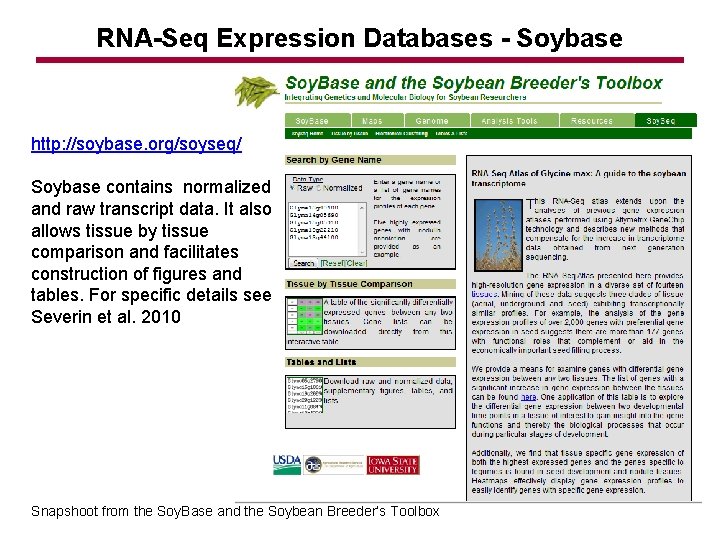
RNA-Seq Expression Databases - Soybase http: //soybase. org/soyseq/ Soybase contains normalized and raw transcript data. It also allows tissue by tissue comparison and facilitates construction of figures and tables. For specific details see Severin et al. 2010 Snapshoot from the Soy. Base and the Soybean Breeder’s Toolbox

RNA-Seq Expression Databases – Transcriptome Atlas http: //digbio. missouri. edu/soybean_atlas/ The Transcriptome Atlas allows retrieval of information by gene ID, Blast, or domain searching. You can also download normalized and raw data. For specific details see Libault et al. 2010
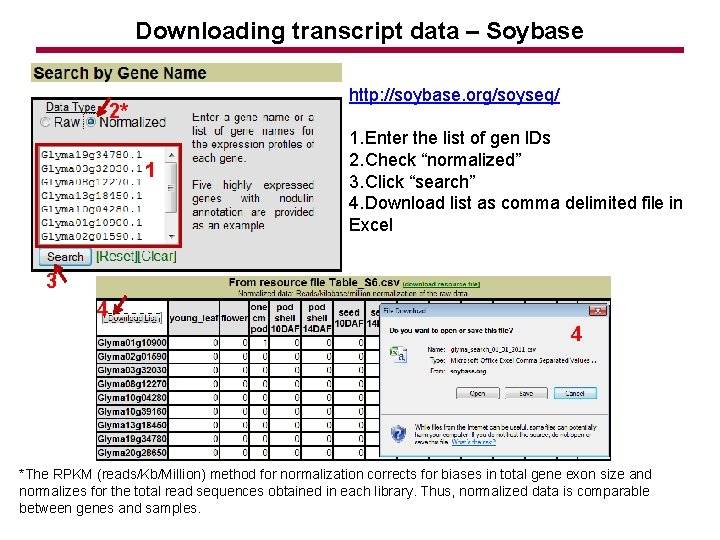
Downloading transcript data – Soybase http: //soybase. org/soyseq/ 2* 1 1. Enter the list of gen IDs 2. Check “normalized” 3. Click “search” 4. Download list as comma delimited file in Excel 3 4 4 *The RPKM (reads/Kb/Million) method for normalization corrects for biases in total gene exon size and normalizes for the total read sequences obtained in each library. Thus, normalized data is comparable between genes and samples.
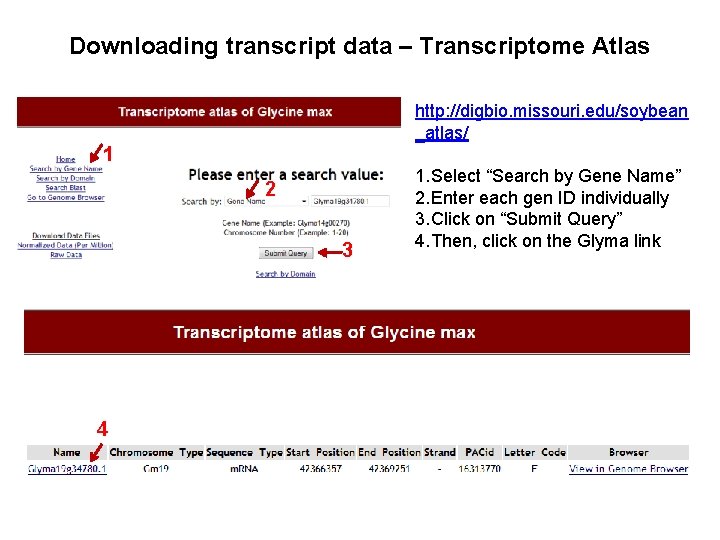
Downloading transcript data – Transcriptome Atlas http: //digbio. missouri. edu/soybean _atlas/ 1 2 3 4 1. Select “Search by Gene Name” 2. Enter each gen ID individually 3. Click on “Submit Query” 4. Then, click on the Glyma link
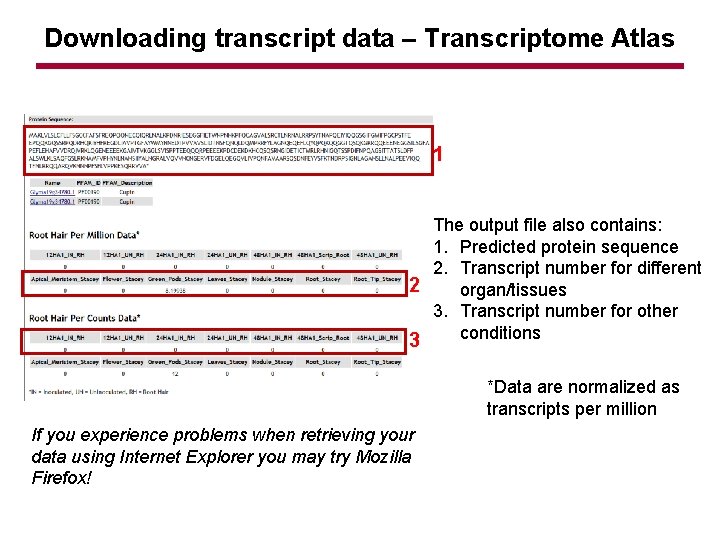
Downloading transcript data – Transcriptome Atlas 1 The output file also contains: 1. Predicted protein sequence 2. Transcript number for different 2 organ/tissues 3. Transcript number for other conditions 3 *Data are normalized as transcripts per million If you experience problems when retrieving your data using Internet Explorer you may try Mozilla Firefox!
Data Analysis To determine seed-specificity for each set of genes, transcript data from the two transcriptomic databases were grouped into two categories: developing seeds and other tissues.
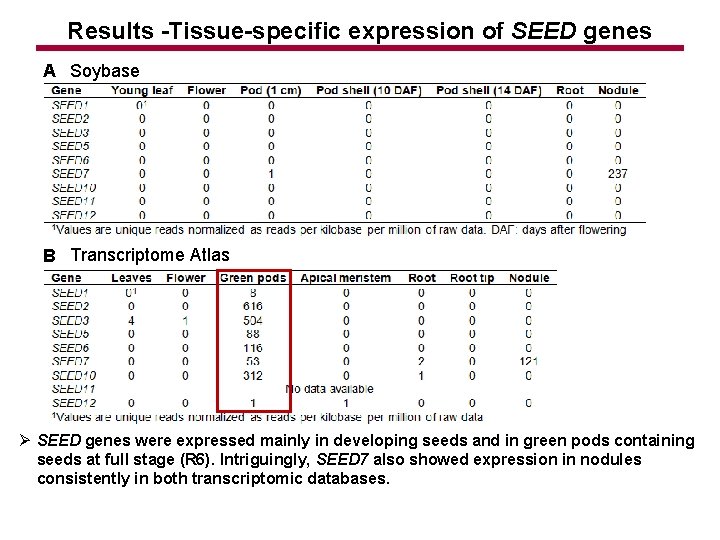
Results -Tissue-specific expression of SEED genes A Soybase B Transcriptome Atlas Ø SEED genes were expressed mainly in developing seeds and in green pods containing seeds at full stage (R 6). Intriguingly, SEED 7 also showed expression in nodules consistently in both transcriptomic databases.
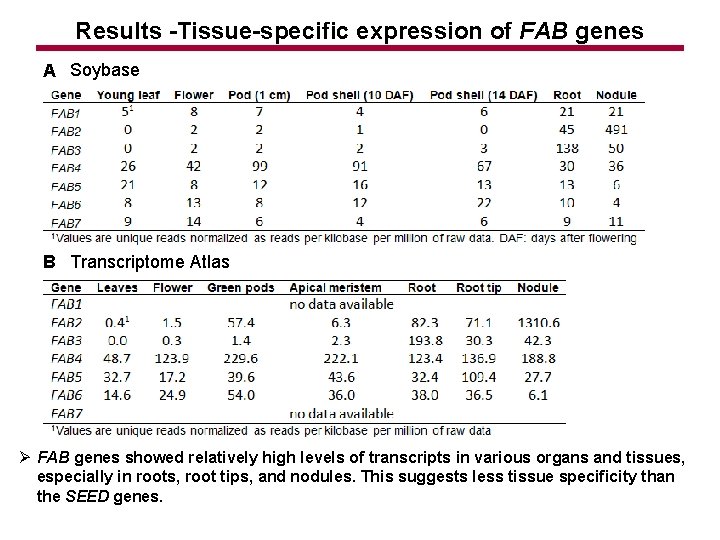
Results -Tissue-specific expression of FAB genes A Soybase B Transcriptome Atlas Ø FAB genes showed relatively high levels of transcripts in various organs and tissues, especially in roots, root tips, and nodules. This suggests less tissue specificity than the SEED genes.
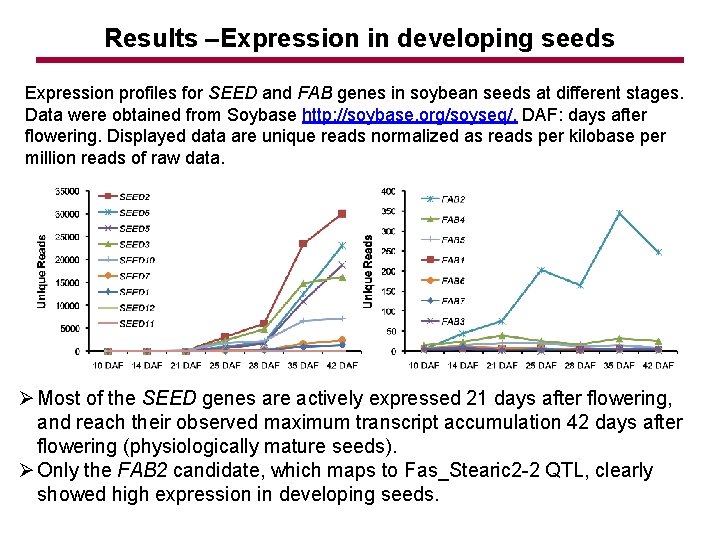
Results –Expression in developing seeds Expression profiles for SEED and FAB genes in soybean seeds at different stages. Data were obtained from Soybase http: //soybase. org/soyseq/. DAF: days after flowering. Displayed data are unique reads normalized as reads per kilobase per million reads of raw data. Ø Most of the SEED genes are actively expressed 21 days after flowering, and reach their observed maximum transcript accumulation 42 days after flowering (physiologically mature seeds). Ø Only the FAB 2 candidate, which maps to Fas_Stearic 2 -2 QTL, clearly showed high expression in developing seeds.
Use of web-based tools for visualization of transcriptomic data With the delivery of transcriptomic databases, different webbased resources are emerging for data visualization. These tools include electronic Northerns (e-Northerns) and e. FP (electronic Fluorescent Pictographs) browsers to cluster genes based on expression intensity, and to draw temporal and spatial expression, respectively. In this tutorial, we use an e. FP browser to analyze the temporal and spatial expression for both set of genes.
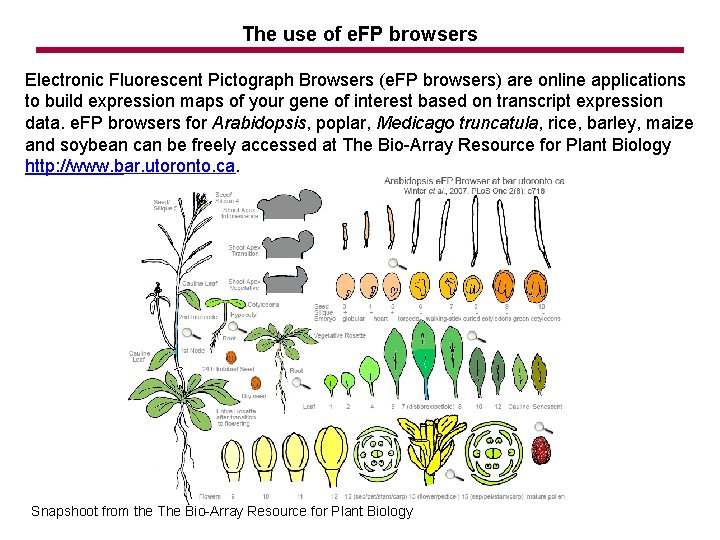
The use of e. FP browsers Electronic Fluorescent Pictograph Browsers (e. FP browsers) are online applications to build expression maps of your gene of interest based on transcript expression data. e. FP browsers for Arabidopsis, poplar, Medicago truncatula, rice, barley, maize and soybean can be freely accessed at The Bio-Array Resource for Plant Biology http: //www. bar. utoronto. ca. Snapshoot from the The Bio-Array Resource for Plant Biology
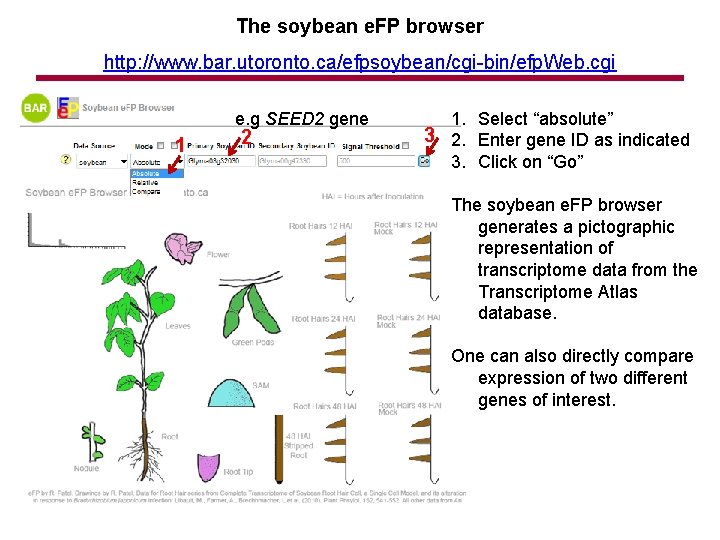
The soybean e. FP browser http: //www. bar. utoronto. ca/efpsoybean/cgi-bin/efp. Web. cgi e. g SEED 2 gene 1 2 1. Select “absolute” 3 2. Enter gene ID as indicated 3. Click on “Go” The soybean e. FP browser generates a pictographic representation of transcriptome data from the Transcriptome Atlas database. One can also directly compare expression of two different genes of interest.
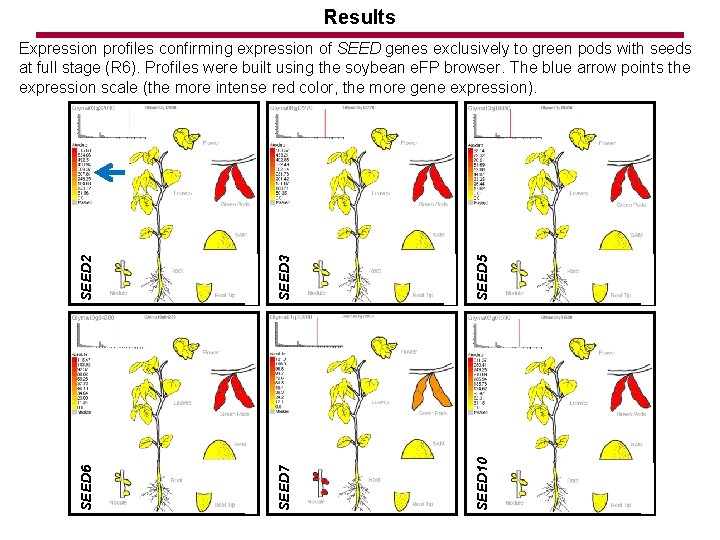
Results SEED 2 SEED 3 SEED 5 SEED 6 SEED 7 SEED 10 Expression profiles confirming expression of SEED genes exclusively to green pods with seeds at full stage (R 6). Profiles were built using the soybean e. FP browser. The blue arrow points the expression scale (the more intense red color, the more gene expression).
Conclusions q Consistent results for SEED and FAB genes were obtained from both databases (Soybase and Transcriptome Atlas). q SEED genes were expressed almost exclusively in developing seeds from medium to late developmental stages. Conversely, FAB genes showed less seedspecificity and higher levels in other organs and tissues including roots, root tips and nodules. q The candidate FAB 2 gene showed high levels of transcripts in developing seeds. This suggests that this gene may have a major effect on the Fas-Stearic 2 -2 QTL. q The SEEDS may be potential sources of seed-specific promoters in soybean. q Databases based on RNA-Seq technology are a powerful source of gene expression data.
References Cited Kalinski, A. , J. M. Weisman, B. F. Mathews, and M. Herman. 1989. Molecular cloning of a protein associated with soybean seed oil bodies that is similar to thiol proteases of the papain family. Journal of Biological Chemistry 265: 13843 -13848. Libault, M, A. Farmer, T. Joshi, K. Takahashi, R. J. Langley, L. D. Franklin, J. He, D. Xu, G. May, and G. Stacey. 2010. An integrated transcriptome atlas of the crop model (Glycine max) and its use in comparative analyses in plants. Plant Journal 63: 86 -99. (Available online at: http: //dx. doi. org/10. 1111/j. 1365313 X. 2010. 04222. x) (verified 21 July 2011). Natarajan, S. S. , C. Xu, H. Bae, T. J. Caperna, and W. Garrett. 2007. Determination of optimal protein quantity required to identify abundant and less abundant soybean seed proteins by 2 D-PAGE and MS. Plant Molecular Biology Report 25: 55 -62. Severin, A. , J. Woody, Y. –T. Bolon, B. Joseph, B. Diers, A. Farmer, G. Muehlbauer, R. Nelson, D. Grant, J. Specht, M. Graham, S. Cannon, G. May, C. Vance, and R. Shoemaker. 2010. RNA-Seq Atlas of Glycine max: A guide to the soybean transcriptome. BMC Plant Biology 10: 160. (Available online at: http: //dx. doi. org/doi: 10. 1186/1471 -2229 -10 -160) (verified 21 July 2011). Vodkin, L. O. , and N. V. Raikhel. 1986. Soybean lectin and related proteins in seeds and roots of Le+ and Le− soybean varieties. Plant Physiology 81: 558– 565.
![External Links Arabidopsis Transcriptome Genomic Express Database [Online]. Salk Institute Genomic Analysis Laboratory. Available](http://slidetodoc.com/presentation_image_h/2432da4dcda5ae6f83ba11ce0395bd43/image-25.jpg "External Links Arabidopsis Transcriptome Genomic Express Database [Online]. Salk Institute Genomic Analysis Laboratory. Available")
External Links Arabidopsis Transcriptome Genomic Express Database [Online]. Salk Institute Genomic Analysis Laboratory. Available at: http: //signal. salk. edu/cgibin/atta (verified 21 July 2011). The Bio-Array Resource for Plant Biology [Online]. University of Toronto. Available at: http: //www. bar. utoronto. ca (verified 26 July 2011). Maize C 3/C 4 Transcriptomic Database [Online]. Cornell University. Available at: http: //c 3 c 4. tc. cornell. edu/search. aspx (verified 26 July 2011). Medicago truncatula Gene Expression Atlas [Online]. The Samuel Roberts Noble Foundation. Available at: http: //mtgea. noble. org/v 2/ (verified 21 July 2011). Next Generation Sequencing for Plant Breeders [Online]. The Plant Breeding and Genomics Community, e. Xtension. Available at: http: //www. extension. org/article/32489 (verified 26 July 2011). Pop. Gen. IE: The Populus Genome Integrative Explorer [Online]. Popgenie. org. Available at: http: //www. popgenie. org/ (26 July 2011). Rice. GE Japonica: Rice Functional Genomic Express Database [Online]. Salk Institute Genomic Analysis Laboratory. Available at: http: //signal. salk. edu/cgi-bin/Rice. GE (verified 21 July 2011). Rice. GE: Rice (indica) Functional Genomic Express Database [Online]. Salk Institute Genomic Analysis Laboratory. Available at: http: //signal. salk. edu/cgi-bin/Ricei. GE (verified 21 July 2011). RNA-Seq Atlas of Glycine max [Online]. Soybase and the Soybean Breeder’s Toolbox. Available at: http: //soybase. org/soyseq/ (verified 26 July 2011). Soybean Upstream Regulatory Element (SURE) Database [Online]. The Ohio State University, OARDC. Available at: http: //www. oardc. ohiostate. edu/SURE/ (verified 26 July 2011). Soybean e. FP Browser [Online]. The Bio-Array Resource for Plant Biology, University of Toronto. Available at: http: //www. bar. utoronto. ca/efpsoybean/cgi -bin/efp. Web. cgi (verified 26 July 2011). Tomato Expression Database (TED) [Online]. Boyce Thompson Institute for Plant Research, Cornell University. Available at: http: //ted. bti. cornell. edu/ (verified 26 July 2011). Transcriptome Atlas of Glycine max [Online]. Digital Biology Laboratory, University of Missouri. Available at: http: //digbio. missouri. edu/soybean_atlas/ (verified 26 July 2011).
Acknowledgements The author would like to thank Dr. David Francis, Heather Merk and Jose Zambrano for reviewing this tutorial and providing helpful suggestions. The author also thanks Drs. Robert Bouchard and Leah Mc. Hale for identification of SEED and FAB genes, respectively. Promoter analysis of SEED and FAB genes is being conducted in the laboratory of Dr. John J. finer (Department of Horticulture and Crop Science, The Ohio State University/OARDC). The author is funded by a Graduate Associateship from the Department of Horticulture and Crop Science, The Ohio State University, and partial support from CONACYT, Mexico.
- Slides: 26