
Emerging therapies in IBD Dr Arash Assadsangabi Consultant
Emerging therapies in IBD Dr Arash Assadsangabi Consultant Gastroenterologist Salford Royal Hospital
Background • IBD: idiopathic, chronic conditions with an inflammatory gut response to unidentified triggers • Interplay of over-exaggerated immune response to an otherwise normal microbial gut flora, genetic susceptibility and various environmental factors
Epidemiology • Most common in Northern Europe and North America: prevalence of 400/100, 000 in the UK • Low incidence in southern Europe, Asia and most developing countries • Global rise in the incidence rate of IBD in children in both developed and developing nations • Men and women affected similarly • Bimodal age of presentation: second and third decades of life followed by sixth decade Rubin et al. Alimentary pharmacology & therapeutics. 2000; 14(12): 1553 -9. Loftus EV, Jr. Gastroenterology. 2004; 126(6): 1504 -17. Andres et al. Gastroenterology clinics of North America. 1999; 28(2): 255 -81, vii.
Conventional therapies • • Steroid EEN 5 -ASA Immunosuppressant therapies – AZA/6 MP – MTX – Cyclosporine/Tacrolimus • Anti-TNF
• Vast progress in our understanding of the etiology and pathogenesis of IBD in the past 2 decades • 30% of patients primarily unresponsive to anti -TNF • One third eventually lose response to the drug • Need for other more efficient and safer therapeutic options Coskun M, et al. Trends Pharmacol Sci. 2017; 38: 127– 42. Sokol H, et al. Curr Opin Gastroenterol. 2014; 30: 378– 84. Baert F, et al. N Engl J Med. 2003; 348: 601– 8.
Personalised therapy • • Treat smarter (aggressive vs indolent) Treat deeper (mucosal healing) Treat earlier Treat to target and more effectively (personalised treatment, goal with the pt, TDM)
• Risk stratification – Aggressive (clinical factors, endoscopy, serology) • Early biologics/combination – Indolent (limited extent, mild activity)
Possible predictors • Clinical parameters associated with more severe disease course: – CD: • • younger age at diagnosis Smoking early steroid requirement extensive proximal small bowel, colonic or perianal disease – UC: • • • younger age at diagnosis extensive colitis at presentation Deep ulcers Steroid requiring disease/hospitalisation High CRP/ESR Loly et al. Scandinavian Journal of gastroenterology. 2008. Beaugerie et al. Gastroenterology. 2006. Oostenbrug et al. European Journal of Gastroenterology and Hepatology. 2006. Moon et al. Journal of Gastroenterology and Hepatology. 2014.
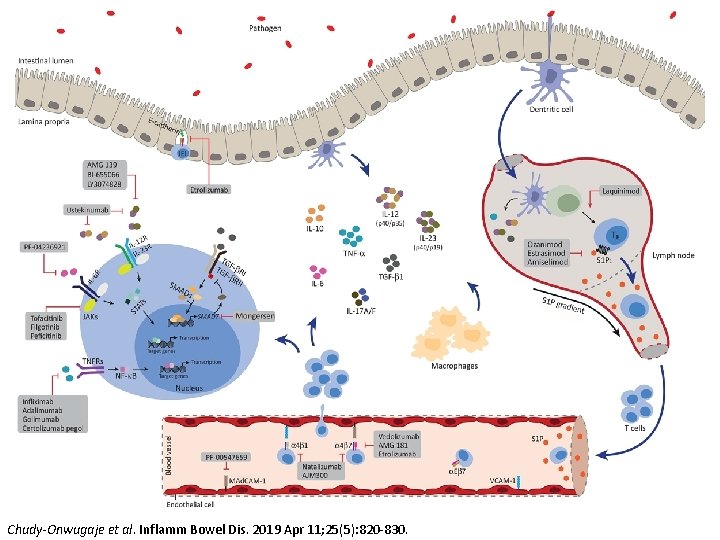
Chudy-Onwugaje et al. Inflamm Bowel Dis. 2019 Apr 11; 25(5): 820 -830.
Novel corticosteroids • Beclomethasone dipropionate (Clipper) • Budesonide – Two formulations • p. H-dependent release • An extended release tablet (MMX) • • Budesonide MMX Budesonide foam Favourable safety profile Longer-term data beyond 8 weeks remain unavailable Van Asche et al. Am J Gastroenterol 2015; 110: 708– 715 Lichtenstein GR, et al. J Crohns Colitis. 2015; 9: 738– 46. Rubin DT, et al. Dig Dis Sci. 2015; 60: 3408– 17.
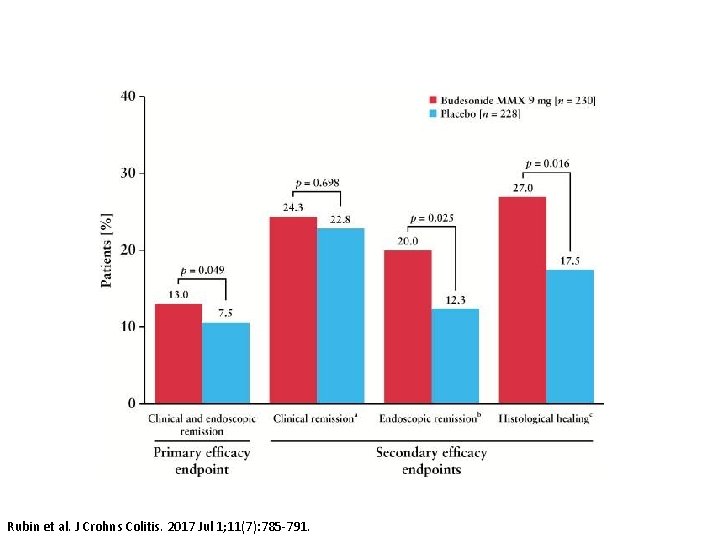
Rubin et al. J Crohns Colitis. 2017 Jul 1; 11(7): 785 -791.
• Vedolizumab – Selective adhesion molecule inhibitor – Ab to a 4 b 7 integrin – Effective in induction and remission in UC (GEMINI -1) and CD (GEMINI-2) – More effective in anti-TNF naïve – One case of PML in undiagnosed HIV pt with IBD
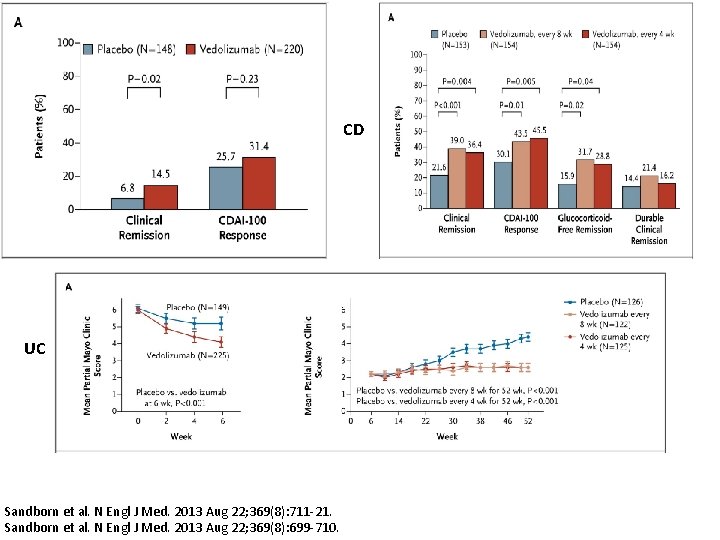
CD UC Sandborn et al. N Engl J Med. 2013 Aug 22; 369(8): 711 -21. Sandborn et al. N Engl J Med. 2013 Aug 22; 369(8): 699 -710.
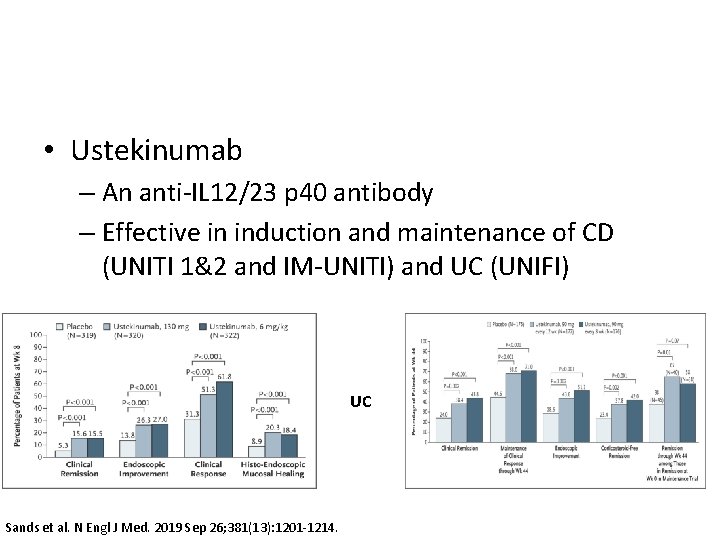
• Ustekinumab – An anti-IL 12/23 p 40 antibody – Effective in induction and maintenance of CD (UNITI 1&2 and IM-UNITI) and UC (UNIFI) UC Sands et al. N Engl J Med. 2019 Sep 26; 381(13): 1201 -1214.
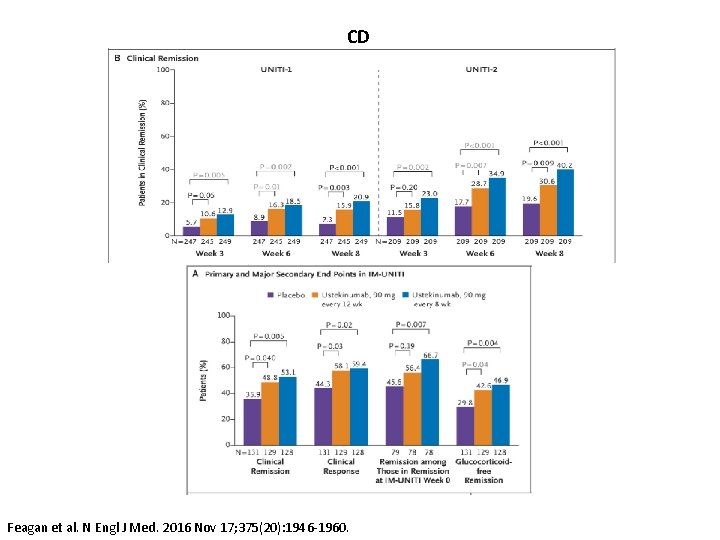
CD Feagan et al. N Engl J Med. 2016 Nov 17; 375(20): 1946 -1960.
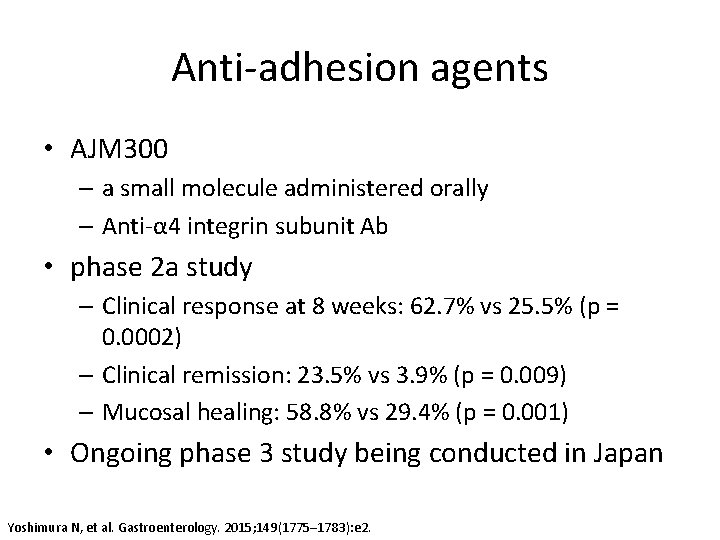
Anti-adhesion agents • AJM 300 – a small molecule administered orally – Anti-α 4 integrin subunit Ab • phase 2 a study – Clinical response at 8 weeks: 62. 7% vs 25. 5% (p = 0. 0002) – Clinical remission: 23. 5% vs 3. 9% (p = 0. 009) – Mucosal healing: 58. 8% vs 29. 4% (p = 0. 001) • Ongoing phase 3 study being conducted in Japan Yoshimura N, et al. Gastroenterology. 2015; 149(1775– 1783): e 2.
• Abrilumab – Ab against α 4β 7 heterodimer • Phase 2 b clinical trials with preliminary data • 249 pts with Mod-to-Severe CD (78% anti-TNF exposed) • At week 12: Not reached statistical significance Pan WJ, et al. Br J Clin Pharmacol. 2014; 78: 1315– 33. Sandborn WJ, et al. Gastroenterology. 2017; 152; S 598. Sandborn WJ, et al. Gastroenterology. 2017; 152; S 198.
• Etrolizumab – Ab against β 7 subunit and hence blocks both a 4 b 7 and αEβ 7 integrins in the intestine – 300 pts with Mod-to-Severe CD (73% anti-TNF exposed) – Week 14: Statistically significant clinical remission and endoscopic improvement outcome Rutgeerts PJ, et al. Gut. 2013; 62: 1122– 30. Vermeire S, et al. Lancet. 2014; 384: 309– 18. Feagan BG, et al. Gastroenterology. 2017; 152: S 600.
• PF-00547659 – Anti-MAd. CAM Ig. G 2 Ab • The TURANDOT study (phase 2) – 357 moderate to- severe UC patients – 57% had previously failed anti-TNF – Remission rates at week 12 were significantly higher in three of four active treatment groups compared to the placebo group Vermeire S, et al. Gut. 2011; 60: 1068– 75. Vermeire S, et al. Lancet. 2017; 390: 135– 44. Sandborn WJ, et al. Gut. 2018; 67: 1824– 35.
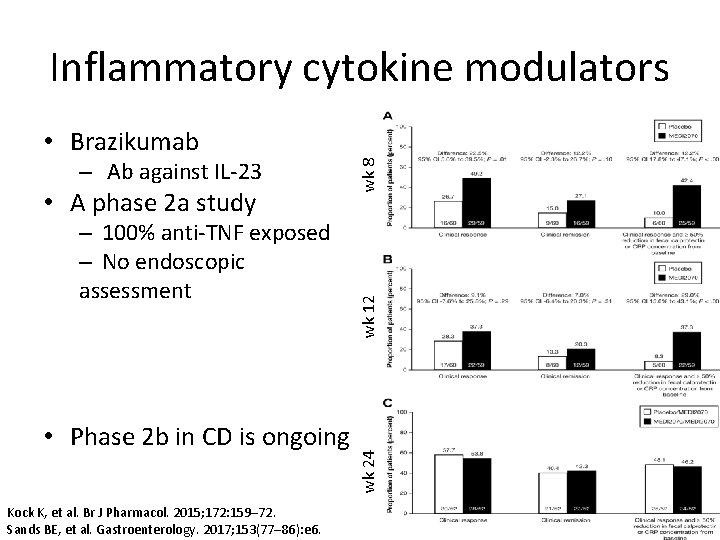
Inflammatory cytokine modulators – 100% anti-TNF exposed – No endoscopic assessment • Phase 2 b in CD is ongoing Kock K, et al. Br J Pharmacol. 2015; 172: 159– 72. Sands BE, et al. Gastroenterology. 2017; 153(77– 86): e 6. wk 12 • A phase 2 a study wk 24 – Ab against IL-23 wk 8 • Brazikumab
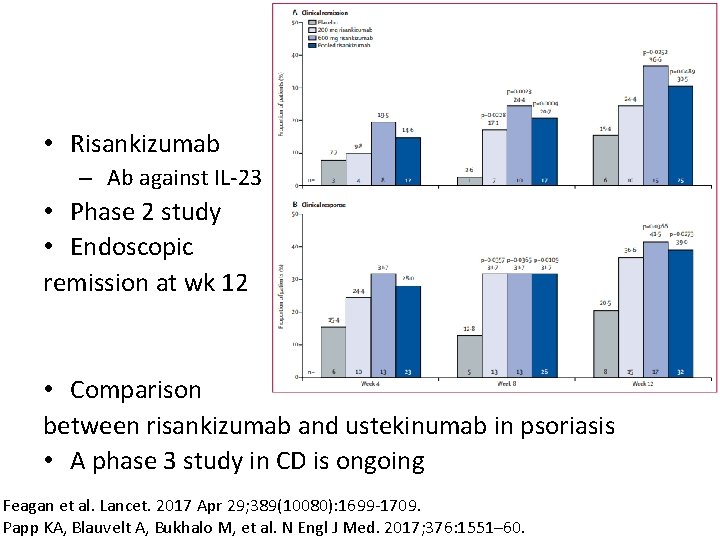
• Risankizumab – Ab against IL-23 • Phase 2 study • Endoscopic remission at wk 12 • Comparison between risankizumab and ustekinumab in psoriasis • A phase 3 study in CD is ongoing Feagan et al. Lancet. 2017 Apr 29; 389(10080): 1699 -1709. Papp KA, Blauvelt A, Bukhalo M, et al. N Engl J Med. 2017; 376: 1551– 60.
Intra-cellular signalling • Tofacitinib – Pan-JAK (JAK 1 and JAK 3) – Effective for induction and maintenance of remission in UC both in anti-TNF experienced and naïve – Side effects: Infection (UTI, Herpes Zoster, LRTI), lymphoma, non-melanoma skin cancer, lipid elevation, thromboembolism (10 mg BD), lymphopaenia Fleischmann R, et al. N Engl J Med. 2012; 367: 495– 507. van Vollenhoven RF, et al. N Engl J Med. 2012; 367: 508– 19. Sandborn WJ, et al. N Engl J Med. 2017; 376: 1723– 36 Cohen SB, et al. Ann Rheum Dis. 2017; 76: 1253– 62.
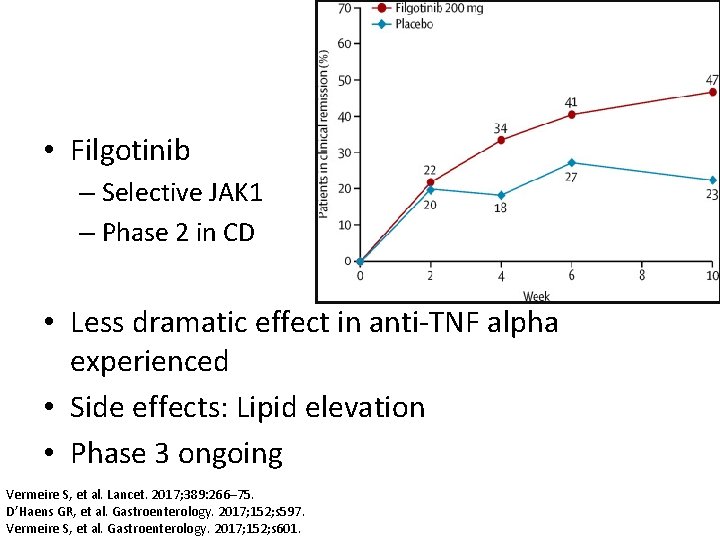
• Filgotinib – Selective JAK 1 – Phase 2 in CD • Less dramatic effect in anti-TNF alpha experienced • Side effects: Lipid elevation • Phase 3 ongoing Vermeire S, et al. Lancet. 2017; 389: 266– 75. D’Haens GR, et al. Gastroenterology. 2017; 152; s 597. Vermeire S, et al. Gastroenterology. 2017; 152; s 601.
• Upadacitinib – selective JAK 1 inhibitor – phase 2 study in CD with 180 pts Mod-to-Severe CD – 96% anti-TNF exposed – Week 16: Statistically significant outcome on clinical remission and response as well as endoscopic remission achieved • Phase 3 is ongoing Sandborn WJ, et al. Gastroenterology. 2017; 152; s 1308– 9.
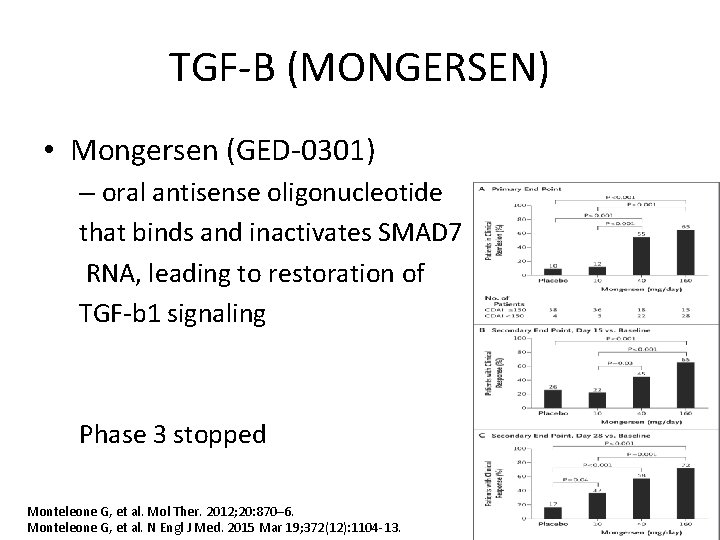
TGF-B (MONGERSEN) • Mongersen (GED-0301) – oral antisense oligonucleotide that binds and inactivates SMAD 7 RNA, leading to restoration of TGF-b 1 signaling Phase 3 stopped Monteleone G, et al. Mol Ther. 2012; 20: 870– 6. Monteleone G, et al. N Engl J Med. 2015 Mar 19; 372(12): 1104 -13.
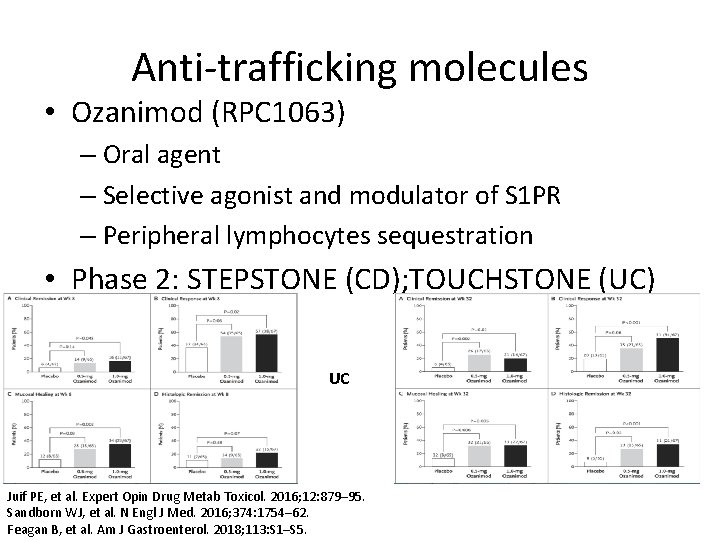
Anti-trafficking molecules • Ozanimod (RPC 1063) – Oral agent – Selective agonist and modulator of S 1 PR – Peripheral lymphocytes sequestration • Phase 2: STEPSTONE (CD); TOUCHSTONE (UC) UC Juif PE, et al. Expert Opin Drug Metab Toxicol. 2016; 12: 879– 95. Sandborn WJ, et al. N Engl J Med. 2016; 374: 1754– 62. Feagan B, et al. Am J Gastroenterol. 2018; 113: S 1–S 5.
Other treatments • Toll-like receptors (TLR) – DIMS 0150 • An oligonucleotide: agonist to TLR-9 • Stimulate intestinal mucosal healing • Topical agent, intended as an add-on therapy in colitis. – Phase 3 COLLECT study in steroid-refractory modto-severe UC – ? improved sensitisation to steroids Lee J, et al. Nat Cell Biol. 2006; 8: 1327– 36. Atreya R, et al. J Crohns Colitis. 2016; 10: 1294– 302. Atreya R, et al. Gastroenterology. 2016; 150(4): S 773.
• Phosphatidylcholine (PC) – Component of colonic mucus – A modified release oral form of PC (LT-02) in UC • Higher clinical response and hx of remission • currently in phase 3 trial Ehehalt R, et al. Scand J Gastroenterol. 2004; 39: 737– 42. Dial EJ, et al. Shock. 2008; 30: 729– 33. Karner M, et al. Am J Gastroenterol. 2014; 109: 1041– 51.
• Apremilast – A phosphodiesterase 4 (PDE 4) inhibitor – PDE 4 catalyses the breakdown of c. AMP – Increases in intracellular c. AMP due to PDE 4 inhibition downregulates the immune response – approved for use in psoriasis – A phase 2 study in UC – Improved in clinical response, endoscopy, biomarkers, and mucosal healing Fertig BA, et al. J Cardiovasc Dev Dis. 2018; 5(1): 8. Papp K, et al. J Am Acad Dermatol. 2015; 73: 37– 49. Danese S, et al. J Crohn’s Colitis. 2018; 12(supplement 1): S 004 -S 005.
Gut microbiome manipulation • Gut microbiota alterations and the immune response of the gut mucosa • The cause and effect relationship is not entirely understood • Meta-analysis (53 studies, total 661 IBD pts undergoing FMT): clinical remission – 36% of UC patients (↑ if more frequent FMT or via lower GIT – 50. 5% of CD patients – 21. 5% of pouchitis Paramsothy S, et al. J Crohns Colitis. 2017; 11: 1180– 99. Rossen NG, et al. Gastroenterology. 2015; 149(110– 118): e 4.
• An RCT assessing efficacy of FMT in patients with active mild-to moderate UC – Weekly FMT or placebo via retention enema for 6 weeks – Clinical and endoscopic remission • Nine pts (24%) vs 2 controls (5%) – Clinical response • 39% (15/38) of pts vs 24% (9/37) of placebo • A study assessing the effect of intense FMT in severe UC – A primary endpoint of steroid-free clinical remission and endoscopic remission or response: in 11/41 (27%) with FMT versus 3/40 (8%) in placebo (p = 0. 02) • More RCT needed Moayyedi P, et al. Gastroenterology. 2015; 149(102– 109): e 6. Paramsothy S, et al. Lancet. 2017; 389: 1218– 28.
Conclusion • Various therapies are under development for IBD. • As therapy options increase, the main challenge is personalisation of a given treatment to each patient. • Many therapies should become available if supported by the results of current clinical trials.
- Slides: 32