
EMERGING SECURITY MECHANISMS FOR MEDICAL CYBER PHYSICAL SYSTEMS
EMERGING SECURITY MECHANISMS FOR MEDICAL CYBER PHYSICAL SYSTEMS Ovunc Kocabas, Tolga Soyata, and Mehmet K. Aktas
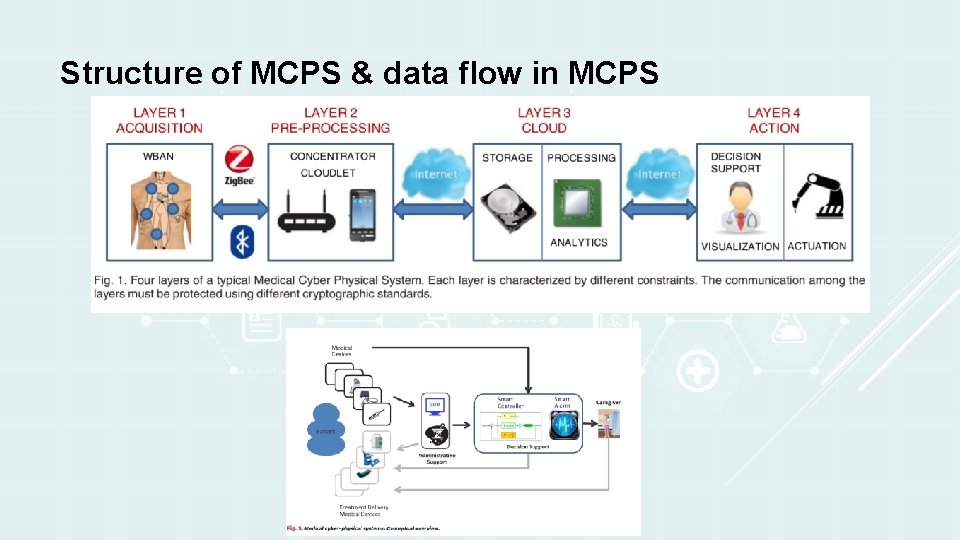
Structure of MCPS & data flow in MCPS
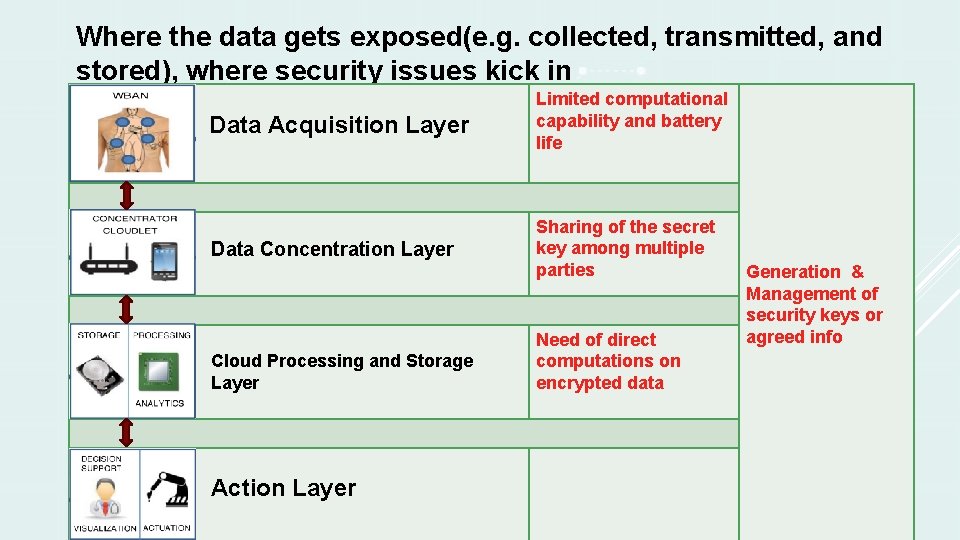
Where the data gets exposed(e. g. collected, transmitted, and stored), where security issues kick in Data Acquisition Layer Limited computational capability and battery life Data Concentration Layer Sharing of the secret key among multiple parties Cloud Processing and Storage Layer Action Layer Need of direct computations on encrypted data Generation & Management of security keys or agreed info
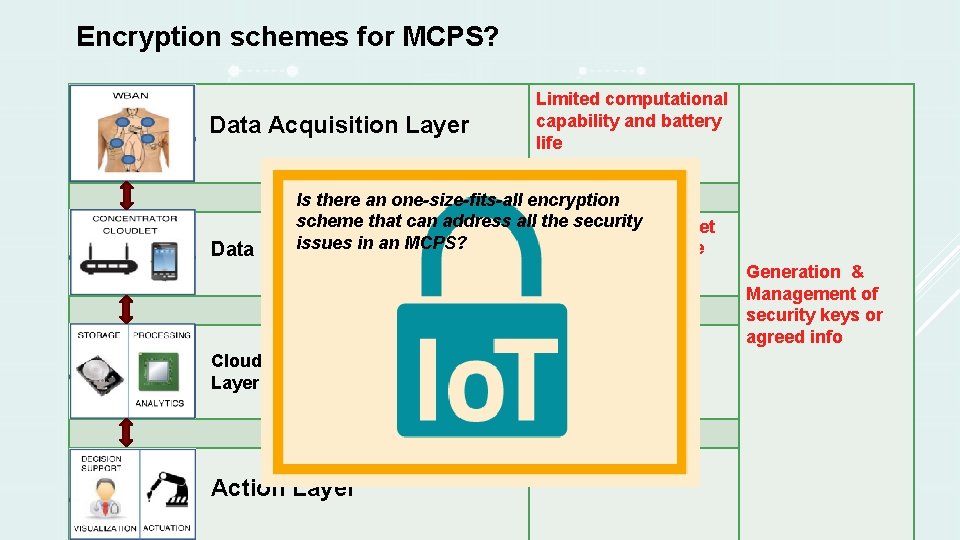
Encryption schemes for MCPS? Data Acquisition Layer Limited computational capability and battery life Is there an one-size-fits-all encryption scheme that can address all. Sharing the security of the secret issues in an Layer MCPS? key among multiple Data Concentration parties Cloud Processing and Storage Layer Action Layer Need of direct computations on encrypted data Generation & Management of security keys or agreed info
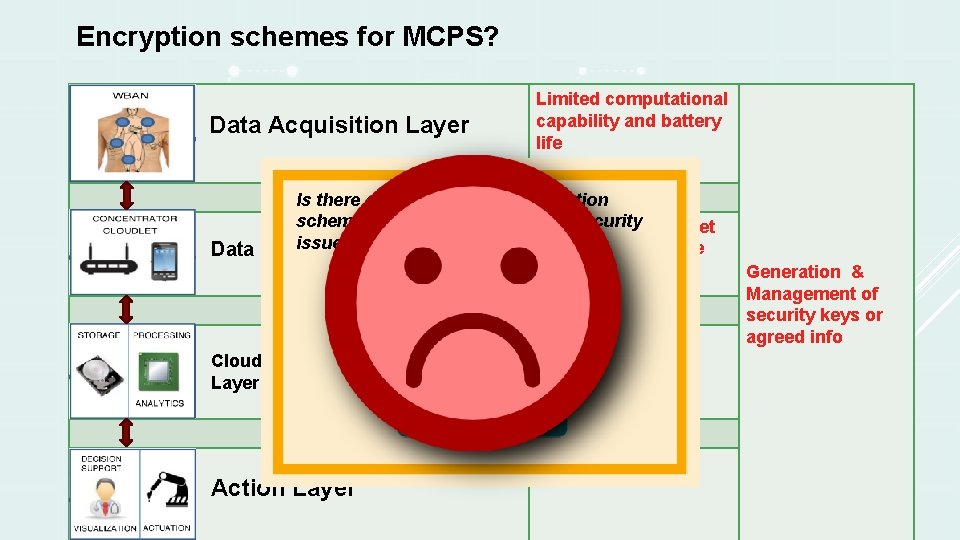
Encryption schemes for MCPS? Data Acquisition Layer Limited computational capability and battery life Is there a one-size-fits-all encryption scheme that can address all. Sharing the security of the secret issues in an Layer MCPS? key among multiple Data Concentration parties Cloud Processing and Storage Layer Action Layer Need of direct computations on encrypted data Generation & Management of security keys or agreed info
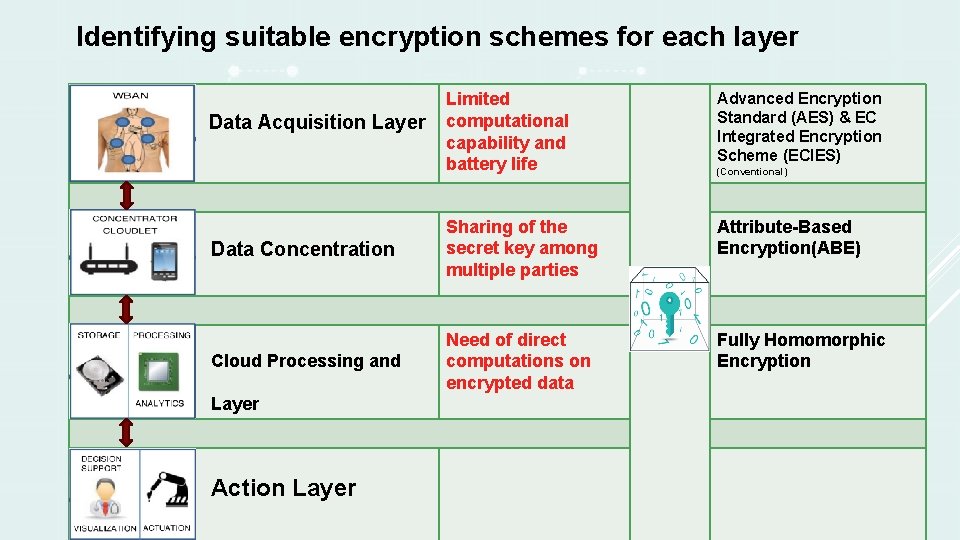
Identifying suitable encryption schemes for each layer Limited computational capability and battery life Advanced Encryption Standard (AES) & EC Integrated Encryption Scheme (ECIES) Data Concentration Attribute-Based Encryption(ABE) Layer Sharing of the secret key among multiple parties Cloud Processing and Fully Homomorphic Encryption Storage Need of direct computations on encrypted data Data Acquisition Layer Action Layer (Conventional)
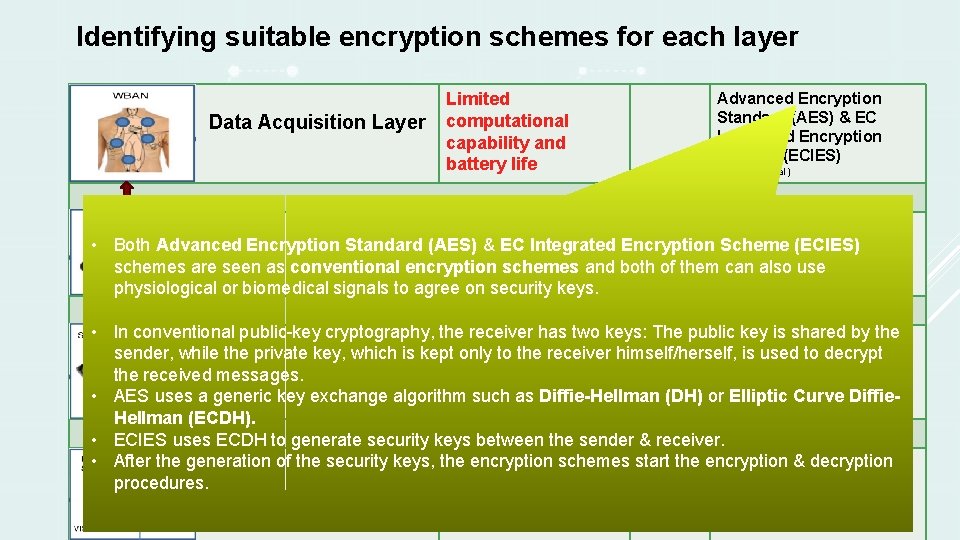
Identifying suitable encryption schemes for each layer Data Acquisition Layer Limited computational capability and battery life Advanced Encryption Standard (AES) & EC Integrated Encryption Scheme (ECIES) (Conventional) Sharing of the Attribute-Based • Both Advanced Standard (AES) & EC Scheme (ECIES) secret key. Integrated among Encryption(ABE) Data. Encryption Concentration schemes are seen as conventional encryption schemes multiple parties and both of them can also use Layer physiological or biomedical signals to agree on security keys. • In conventional public-key cryptography, the receiver has two keys: The public key. Homomorphic is shared by the Need of direct Fully sender, while. Cloud the private key, which only to the receiver is used to decrypt Processing and is keptcomputations on himself/herself, Encryption the received messages. Storage encrypted data • AES uses a Layer generic key exchange algorithm such as Diffie-Hellman (DH) or Elliptic Curve Diffie. Hellman (ECDH). • ECIES uses ECDH to generate security keys between the sender & receiver. • After the generation of the security keys, the encryption schemes start the encryption & decryption procedures. Action Layer

Identifying suitable encryption schemes for each layer Data Acquisition Layer Data Concentration Layer Limited computational capability and battery life Advanced Encryption Standard (AES) & EC Integrated Encryption Scheme (ECIES) Sharing of the secret key among multiple parties Attribute-Based Encryption(ABE) (Conventional) • Attribute-based encryption (ABE) is a public-key that enables secure sharing by Need ofencryption direct Fullydata Homomorphic multiple receivers. The data is encrypted an access policy (i. e. , attributes). Cloud Processing and using computations on based on credentials Encryption Only the receivers whose credentials satisfyencrypted the accessdata policy can access data. Storage I. Ciphertext-Policy Layer ABE (CP-ABE): Private key of an user is associated with user credentials. Ciphertexts specify an access policy and only users whose credentials satisfy the policy requirements can decrypt them. II. Key-Policy ABE (KP-ABE): In KP-ABE, the access policy is encoded into the receivers’ private key and a ciphertext is labeled with a set of attributes. KP-ABE schemes place the access policy on Action Layer the private key of the receivers and the attributes are associated with the ciphertexts.
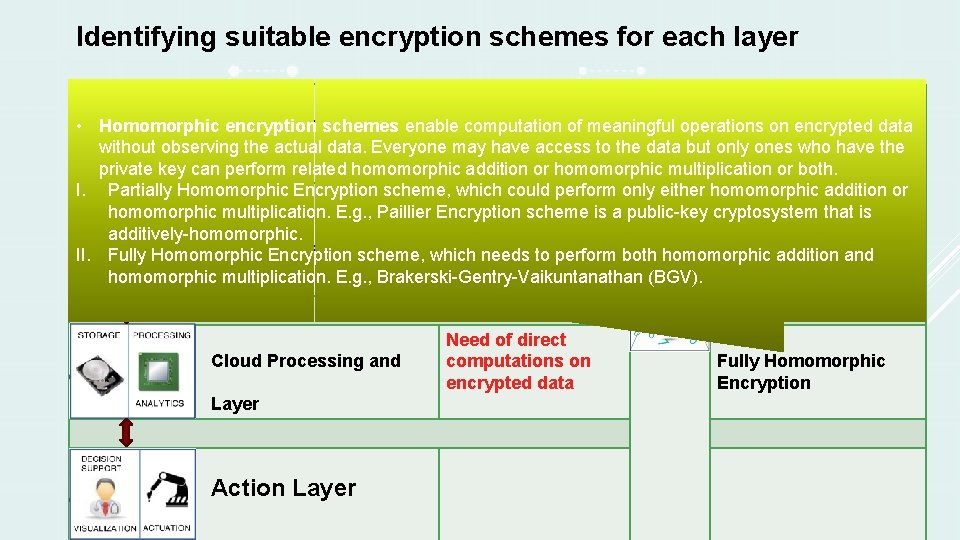
Identifying suitable encryption schemes for each layer Advanced Encryption Limited Standard (AES) & EC computational Data Acquisition Layer • Homomorphic encryption schemes enable computation of meaningful operations on encrypted data Integrated Encryption without observing the actual data. Everyonecapability may have and access to the data but only ones who have the Scheme (ECIES) battery lifeor homomorphic multiplication private key can perform related homomorphic addition or both. (Conventional) I. Partially Homomorphic Encryption scheme, which could perform only either homomorphic addition or homomorphic multiplication. E. g. , Paillier Encryption scheme is a public-key cryptosystem that is Sharing of the Attribute-Based additively-homomorphic. secret key to among Encryption(ABE) Data Concentration II. Fully Homomorphic Encryption scheme, which needs perform both homomorphic addition and multiple parties Layer homomorphic multiplication. E. g. , Brakerski-Gentry-Vaikuntanathan (BGV). Cloud Processing and Storage Layer Action Layer Need of direct computations on encrypted data Fully Homomorphic Encryption
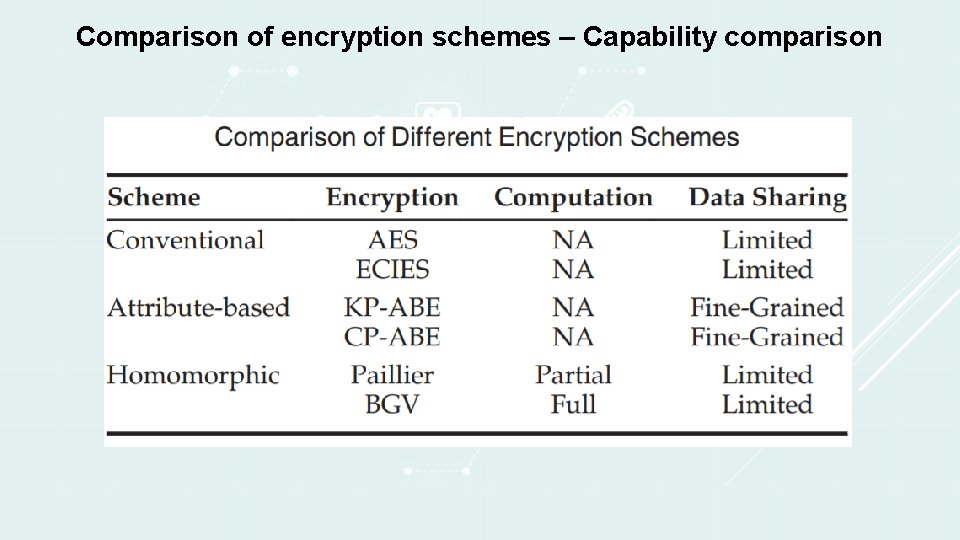
Comparison of encryption schemes – Capability comparison
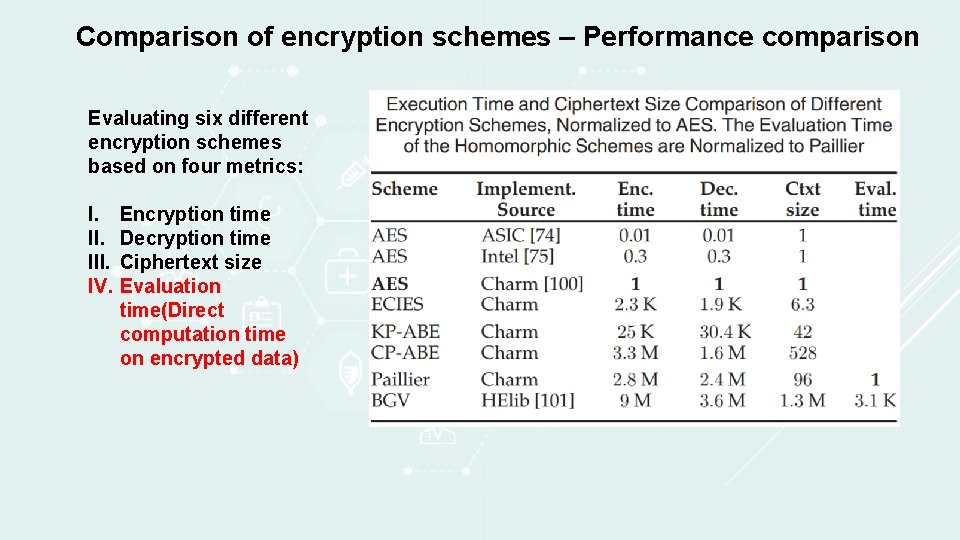
Comparison of encryption schemes – Performance comparison Evaluating six different encryption schemes based on four metrics: I. III. IV. Encryption time Decryption time Ciphertext size Evaluation time(Direct computation time on encrypted data)
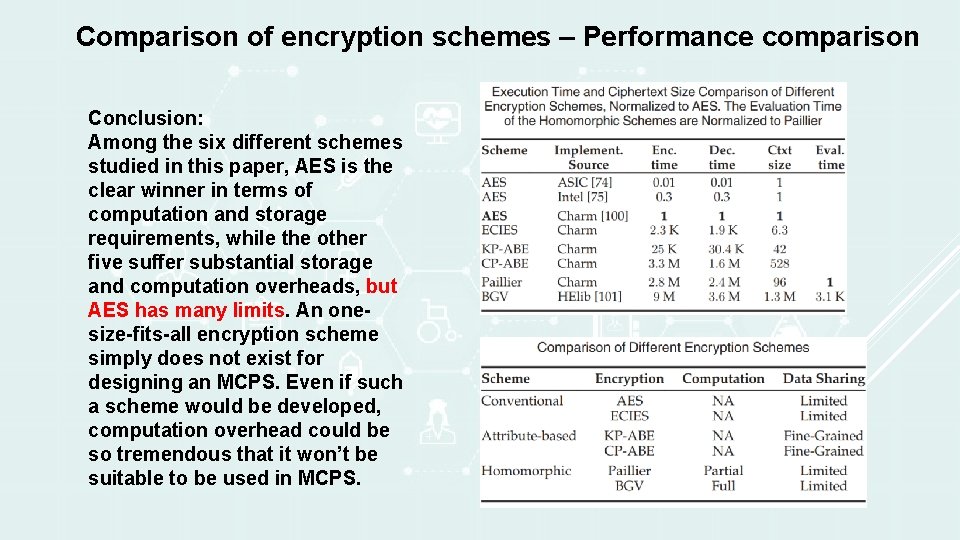
Comparison of encryption schemes – Performance comparison Conclusion: Among the six different schemes studied in this paper, AES is the clear winner in terms of computation and storage requirements, while the other five suffer substantial storage and computation overheads, but AES has many limits. An onesize-fits-all encryption scheme simply does not exist for designing an MCPS. Even if such a scheme would be developed, computation overhead could be so tremendous that it won’t be suitable to be used in MCPS.

Thank You
- Slides: 13