
Emerging Issues in Migration Policies Implications for Data
- Slides: 15
Emerging Issues in Migration Policies: Implications for Data Requirements Bela Hovy, Chief Migration Section Population Division Department for Economic and Social Affairs United Nations, New York http: //www. unmigration. org http: //www. unpopulation. org
Presentation overview 1. 2. 3. 4. Policy framework Emerging issues and implications for data collection Examples Conclusions
Resolution on International Migration and Development Commission on Population and Development, April 2006 n n n Set up or strengthen institutions and mechanisms for data collection and analysis to provide timely, reliable and disaggregated migration data Provide assistance to developing countries Enhance cooperation between international organizations in collection and processing of data on migration and migrants
High-level Dialogue on International Migration and Development United Nations General Assembly, 14 -15 September 2006 n SG Report on International Migration and Development (90 pages) • Comprehensive overview • Forum on Migration and Development n Other preparatory activities n Outcome: • Migration policies based on sound evidence • Enhanced availability, quality and timeliness of migration data and information
Resolution on international migration and development General Assembly, 2 nd committee, 1 December 2006 n n Development (MDGs) and human rights dimensions Global Forum on Migration and Development, Belgium, 2007 Global Migration Group (GMG) 63 rd session: options for HLD follow-up
Before “emerging issues”: Three basic questions 1. 2. 3. How many international migrants? How many international migrant women, children? Where are the international migrants coming from?
Transnational communities n From diaspora to transnational communities (TNCs) n Economic and political interests Ø Definition and measurement issues • Defining TNCs (stock) • Defining national population • Counting citizens or native born abroad
Return and circular migration n Potential for development (China, India) Ø Definition and measurement issues • Definition of “return” (flow) • Definition of “circulation” (flow) • Measuring immigrating and emigrating citizens • Not just “short term” and “long term”
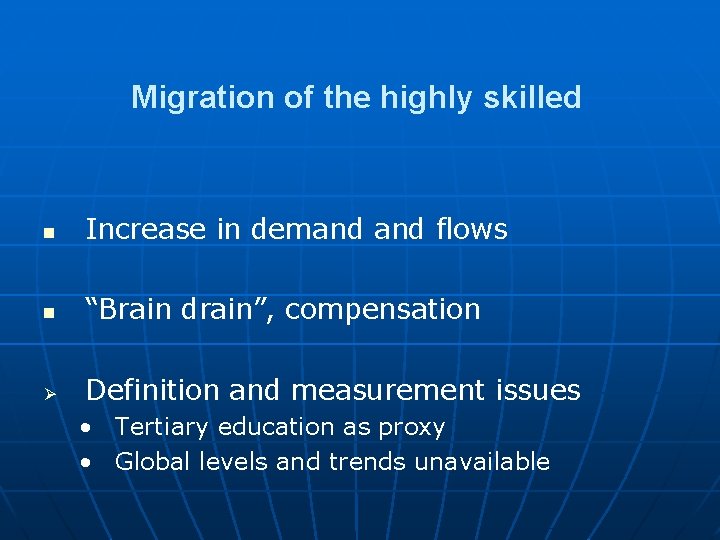
Migration of the highly skilled n Increase in demand flows n “Brain drain”, compensation Ø Definition and measurement issues • Tertiary education as proxy • Global levels and trends unavailable
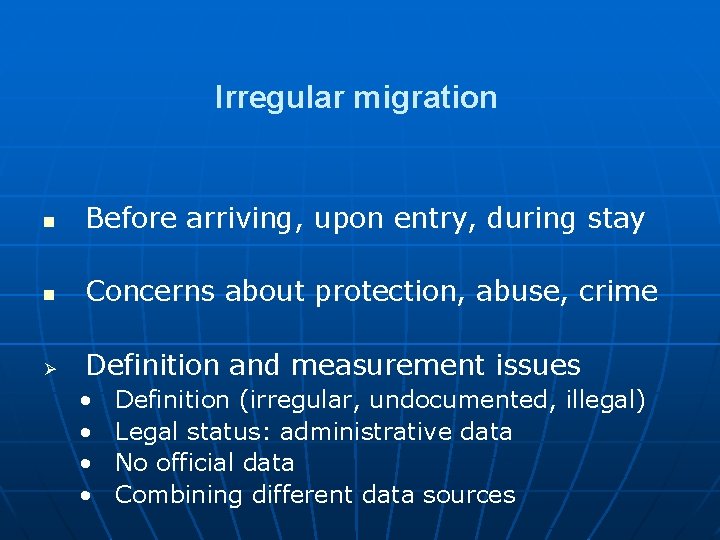
Irregular migration n Before arriving, upon entry, during stay n Concerns about protection, abuse, crime Ø Definition and measurement issues • • Definition (irregular, undocumented, illegal) Legal status: administrative data No official data Combining different data sources
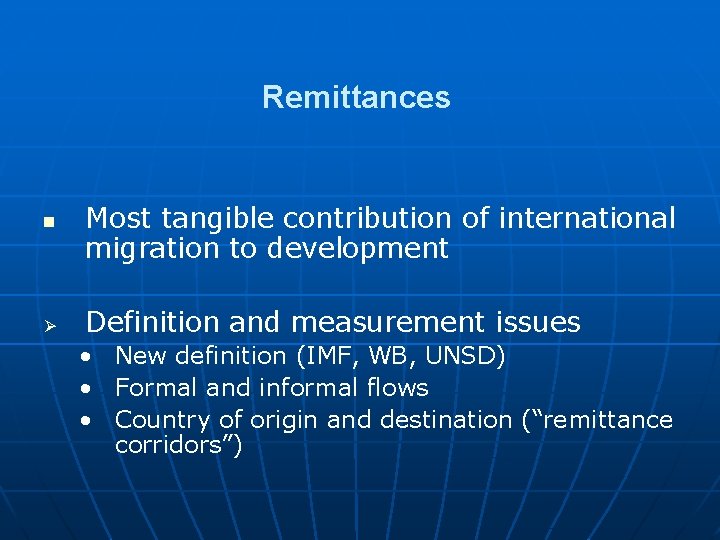
Remittances n Ø Most tangible contribution of international migration to development Definition and measurement issues • New definition (IMF, WB, UNSD) • Formal and informal flows • Country of origin and destination (“remittance corridors”)
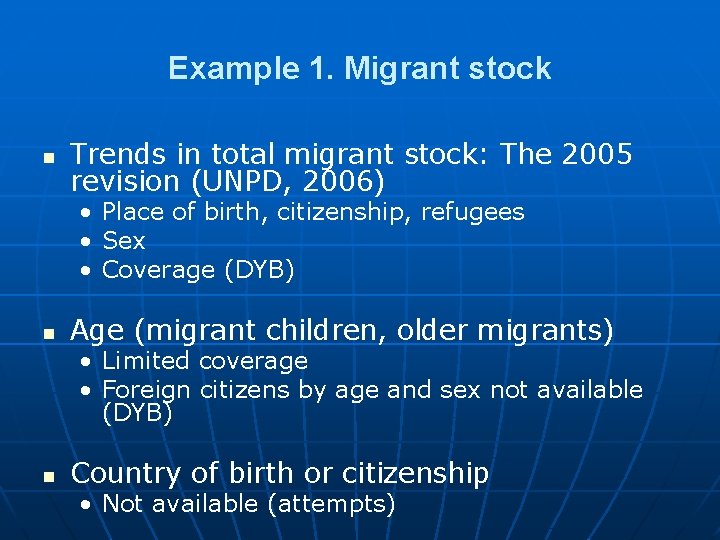
Example 1. Migrant stock n Trends in total migrant stock: The 2005 revision (UNPD, 2006) • Place of birth, citizenship, refugees • Sex • Coverage (DYB) n Age (migrant children, older migrants) • Limited coverage • Foreign citizens by age and sex not available (DYB) n Country of birth or citizenship • Not available (attempts)
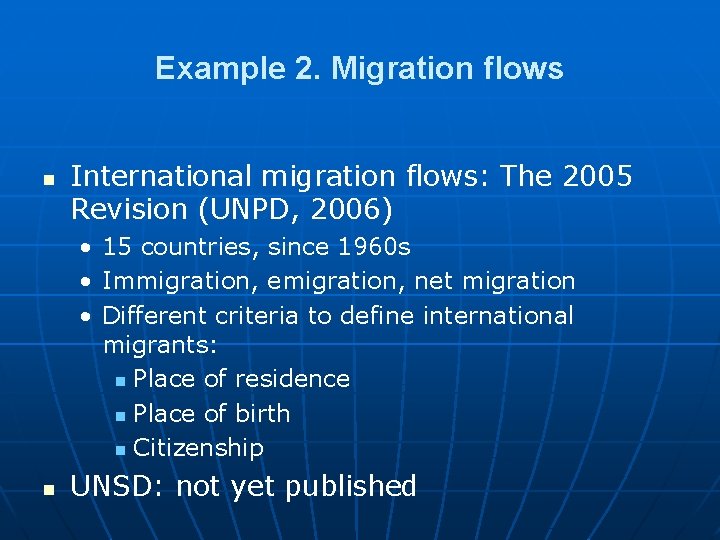
Example 2. Migration flows n International migration flows: The 2005 Revision (UNPD, 2006) • 15 countries, since 1960 s • Immigration, emigration, net migration • Different criteria to define international migrants: n Place of residence n Place of birth n Citizenship n UNSD: not yet published
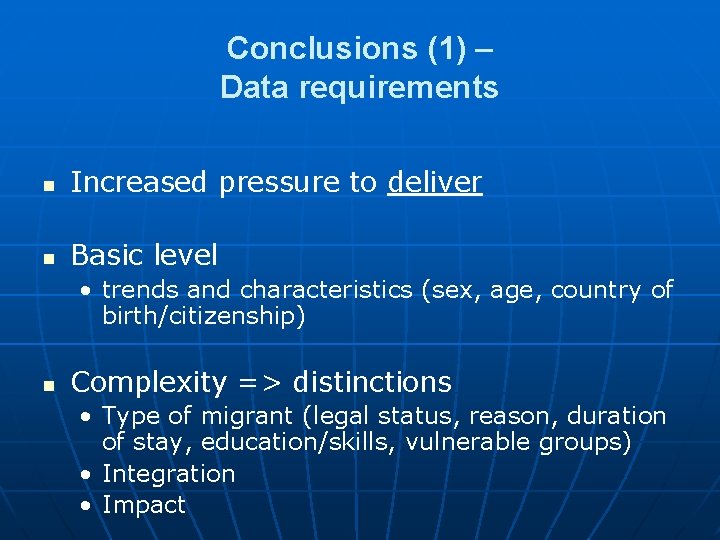
Conclusions (1) – Data requirements n Increased pressure to deliver n Basic level • trends and characteristics (sex, age, country of birth/citizenship) n Complexity => distinctions • Type of migrant (legal status, reason, duration of stay, education/skills, vulnerable groups) • Integration • Impact
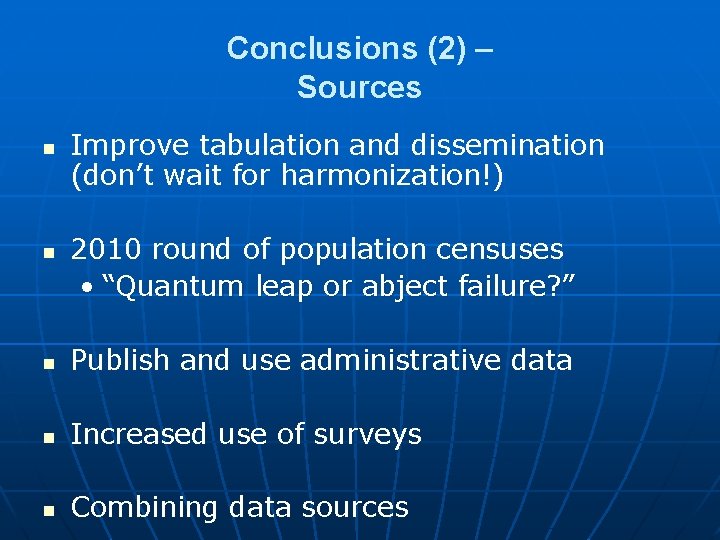
Conclusions (2) – Sources n n Improve tabulation and dissemination (don’t wait for harmonization!) 2010 round of population censuses • “Quantum leap or abject failure? ” n Publish and use administrative data n Increased use of surveys n Combining data sources