
Emerging Issues in Illicit Financial Flows TradeBased Money

Emerging Issues in Illicit Financial Flows: Trade-Based Money Laundering Corrosive Effects • Undermining the legitimate economy Ø Stimulates demand for imported goods , competing with high-cost domestic industrial production. Ø Drown out lawful business in emerging markets (e. g. large appliances) Ø Pricing the licit economy out by artificially inflation prices (e. g. housing) Ø Front companies, offering services and products below cost Ø Lack of transparency, instability of drug money, policy makers receiving misleading information • Generates corruption and crime • Loss of tax revenue (evasion of the customary fees and taxes paid by law-abiding importers, e. g. bank fees, sales taxes, importation taxes)
Emerging Issues in Illicit Financial Flows: Trade-Based Money Laundering Trade Based Money Laundering (TBML) used in multiple ways, to include, but not limited to: - Cross-border transfer / laundering of illicit proceeds, done so in the form of value, i. e. commercial merchandise, e. g. Black Market Peso Exchange - Cross border transfer of the proceeds of corruption and commercial tax evasion, “capital flight”, done so by means of trade mispricing, i. e. trade fraud Depriving developing countries of much needed (perhaps desperately needed) tax base
Emerging Issues in Illicit Financial Flows: Trade-Based Money Laundering “Training, Organizing and Equipping” - The United States and other partner nations do a marvelous job at "training, organizing, equipping" the military services, and the security agencies (i. e. Police, Federal Level Criminal Investigators, Customs Officers, Prosecutors, and Personnel operating Correctional Facilities) of developing nations. - Following that, it should be (needs to be) the responsibility of the respective countries to fund the yearly budgets of their military services and security agencies. Needed is an adequate tax base, from which the yearly budgets of these agencies can be funded.
Emerging Issues in Illicit Financial Flows: Trade-Based Money Laundering Beyond the “Training, Organizing and Equipping” Adequate tax base required, providing funding for: - Salaries enabling the recruitment of the best, the brightest, and most ethical personnel (emphasis on quality over quantity) and to retain them - Salaries allowing for personnel to adequately feed their families, to provide medicine / medical care when needed, to afford housing in safe / secure neighborhoods, and to be able to travel safely and securely to and from work - Protection should they (and perhaps their families) be threatened for doing their jobs and doing them well - Aggressive, all out investigation, apprehension, prosecution, and confinement of those identified as being involved in threats, assaults, or killings of security agency personnel
Emerging Issues in Illicit Financial Flows: Trade-Based Money Laundering Beyond the “Training, Organizing and Equipping” Adequate tax base required, providing funding enabling the agencies to: - Maintain the facilities and equipment provided by the United States and other donor countries. E. g. Vehicles, donated to an investigative agency, sitting inoperable in a fenced in area, due to a lack of maintenance and/or spare parts.
Emerging Issues in Illicit Financial Flows: Trade-Based Money Laundering Beyond the “Training, Organizing and Equipping” ? ? ? Poor Countries, Unable to Afford ? ? ?
Emerging Issues in Illicit Financial Flows: Trade-Based Money Laundering Central America’s “Northern Triangle” Guatemala • Massive customs fraud network known as “La Línea” (The Line). ” (Foreign Policy. com. 26 Jun 2015) “ …criminal network that took bribes in exchange for reduced customs duties, making millions off the foregone government revenue. ” (The Tico Times, 25 Apr 2015) • “A winnowing tax base”. “First quarter of 2015, Guatemala’s internal revenue service reported a $22. 8 million shortfall. As a result, three of the country’s major hospitals ground to a halt this year after running out of food and medical supplies. ” “A gasoline shortage prevented police agents from attending emergency calls”. “La Linea network was pocketing $260, 000 a week while the country’s schools, hospitals, and police stations languished” FP. com, 26 Jun 2015
Emerging Issues in Illicit Financial Flows: Trade-Based Money Laundering Central America’s “Northern Triangle” Honduras – Year 2011 • Minister of Finance Héctor Guillen and the head of the Executive Directorate for Revenue (DEI), Enrique Castellón confirmed that “ 34 major companies in Honduras reported total sales revenues of Lps 18 billion (US$945 million) in 2011 but paid no taxes”. ” (Honduras Weekly. com, 12 Jun 2012) “ … the Honduran government lost approximately Lps 250 million (US$13 million) [in 2011] because of these firms. ” • “[Mr. Castellón] stated that the government has decided to put a ‘stop to the bleeding’ because ‘this is unjust to the country and to the people who regularly pay their taxes”. (Honduras Weekly. com, 12 Jun 2012)
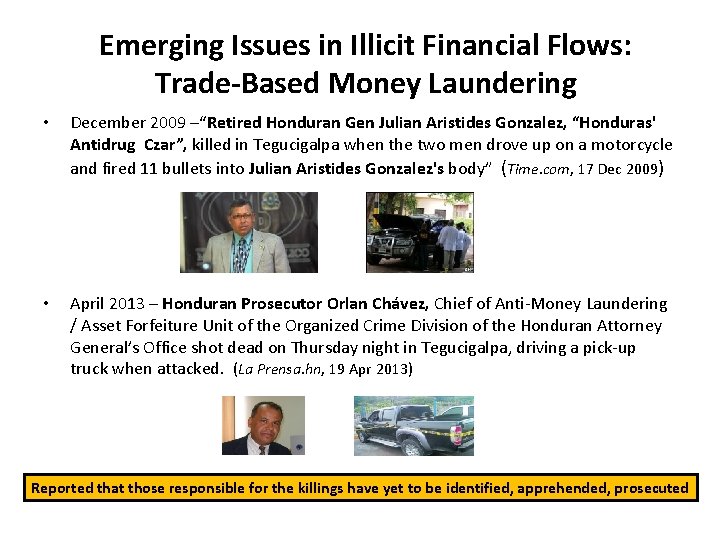
Emerging Issues in Illicit Financial Flows: Trade-Based Money Laundering • December 2009 –“Retired Honduran Gen Julian Aristides Gonzalez, “Honduras' Antidrug Czar”, killed in Tegucigalpa when the two men drove up on a motorcycle and fired 11 bullets into Julian Aristides Gonzalez's body” (Time. com, 17 Dec 2009) • April 2013 – Honduran Prosecutor Orlan Chávez, Chief of Anti-Money Laundering / Asset Forfeiture Unit of the Organized Crime Division of the Honduran Attorney General’s Office shot dead on Thursday night in Tegucigalpa, driving a pick-up truck when attacked. (La Prensa. hn, 19 Apr 2013) Reported that those responsible for the killings have yet to be identified, apprehended, prosecuted

Emerging Issues in Illicit Financial Flows: Trade-Based Money Laundering Actioning Trade-Based Money Laundering • Concur with GFI's recommendation on developing countries "boosting [their] Customs enforcement” • Further recommended: - Creation of Offices of Investigation (or, Criminal Investigative Divisions) dedicated solely to the investigation of Customs Fraud (i. e. trade fraud) and Trade Based Money Laundering - Preferably “stand alone” agencies, and if not, within their Customs Services - Staffed by quality criminal investigators (quality over quantity) - Provided with the "tools" necessary to effectively conduct such investigations
- Slides: 10