
Emerging FFR NonWireBased and QFR technology Hector M
Emerging FFR Non-Wire-Based and QFR technology Hector M. Garcia-Garcia, MD, Ph. D March 6 rd, 2018

Disclosures I have no relevant financial relationships
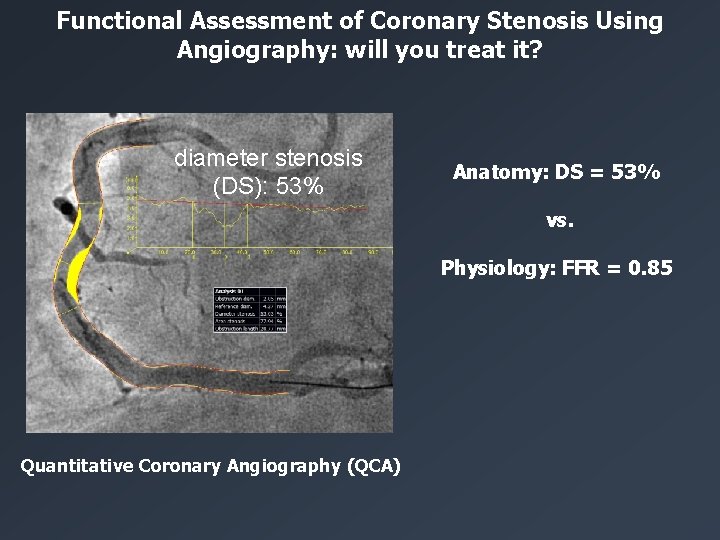
Functional Assessment of Coronary Stenosis Using Angiography: will you treat it? diameter stenosis (DS): 53% Anatomy: DS = 53% vs. Physiology: FFR = 0. 85 Quantitative Coronary Angiography (QCA)
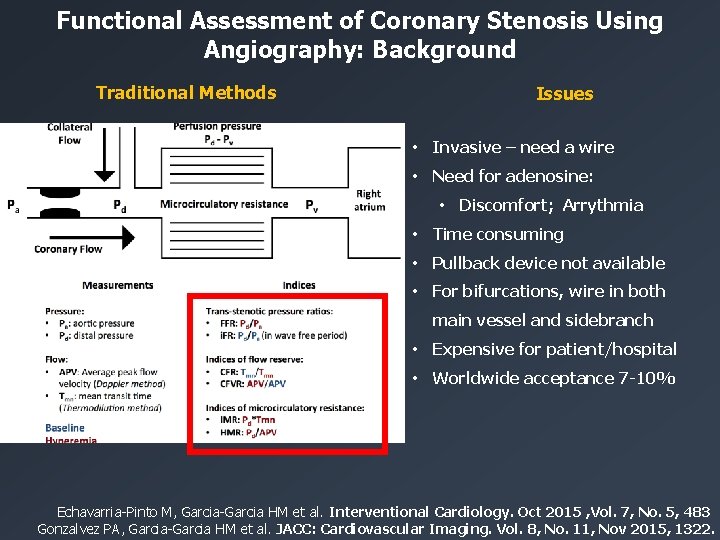
Functional Assessment of Coronary Stenosis Using Angiography: Background Traditional Methods Issues • Invasive – need a wire • Need for adenosine: • Discomfort; Arrythmia • Time consuming • Pullback device not available • For bifurcations, wire in both main vessel and sidebranch • Expensive for patient/hospital • Worldwide acceptance 7 -10% Echavarria-Pinto M, Garcia-Garcia HM et al. Interventional Cardiology. Oct 2015 , Vol. 7, No. 5, 483 Gonzalvez PA, Garcia-Garcia HM et al. JACC: Cardiovascular Imaging. Vol. 8, No. 11, Nov 2015, 1322.
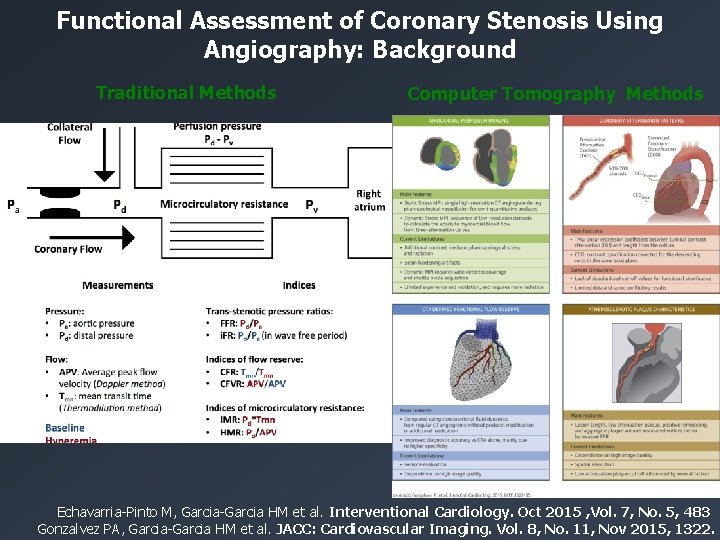
Functional Assessment of Coronary Stenosis Using Angiography: Background Traditional Methods Computer Tomography Methods Echavarria-Pinto M, Garcia-Garcia HM et al. Interventional Cardiology. Oct 2015 , Vol. 7, No. 5, 483 Gonzalvez PA, Garcia-Garcia HM et al. JACC: Cardiovascular Imaging. Vol. 8, No. 11, Nov 2015, 1322.
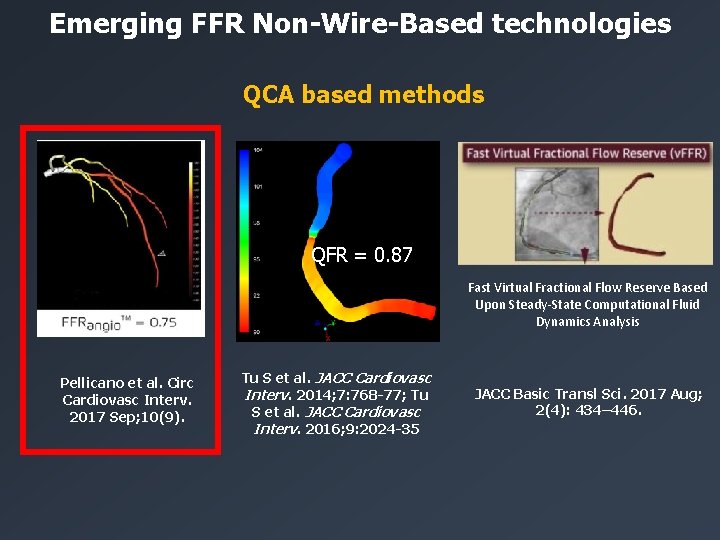
Emerging FFR Non-Wire-Based technologies QCA based methods QFR = 0. 87 Fast Virtual Fractional Flow Reserve Based Upon Steady-State Computational Fluid Dynamics Analysis Pellicano et al. Circ Cardiovasc Interv. 2017 Sep; 10(9). Tu S et al. JACC Cardiovasc Interv. 2014; 7: 768 -77; Tu S et al. JACC Cardiovasc Interv. 2016; 9: 2024 -35 JACC Basic Transl Sci. 2017 Aug; 2(4): 434– 446.

FFRangio - Validation Study of Image-Based Fractional Flow Reserve During Coronary Angiography. Right or left coronary system reconstruction and analysis. The reconstruction is based on the known geometry of ≥ 3 projections from single-plane angiograms and uses epipolar ray tracing. Pellicano et al. Circ Cardiovasc Interv. 2017 Sep; 10(9).
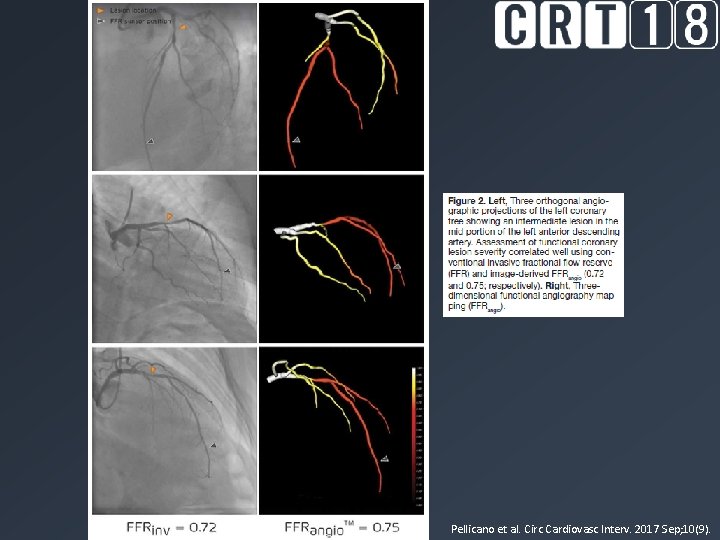
Pellicano et al. Circ Cardiovasc Interv. 2017 Sep; 10(9).
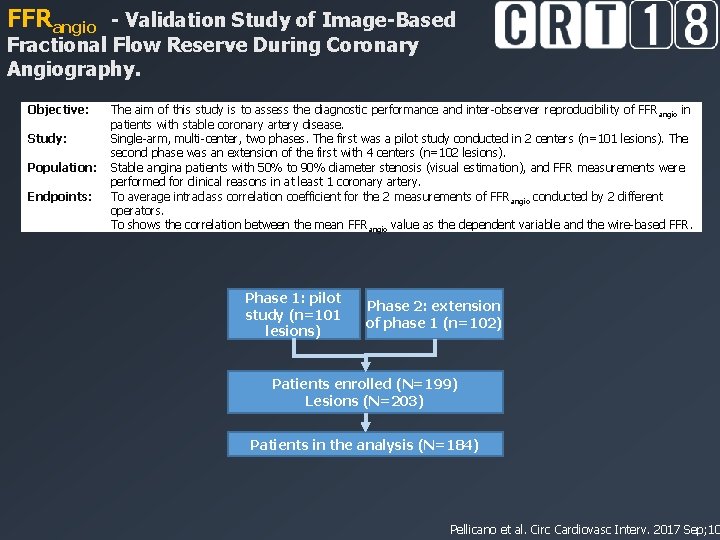
FFRangio - Validation Study of Image-Based Fractional Flow Reserve During Coronary Angiography. Objective: Study: Population: Endpoints: The aim of this study is to assess the diagnostic performance and inter-observer reproducibility of FFRangio in patients with stable coronary artery disease. Single-arm, multi-center, two phases. The first was a pilot study conducted in 2 centers (n=101 lesions). The second phase was an extension of the first with 4 centers (n=102 lesions). Stable angina patients with 50% to 90% diameter stenosis (visual estimation), and FFR measurements were performed for clinical reasons in at least 1 coronary artery. To average intraclass correlation coefficient for the 2 measurements of FFRangio conducted by 2 different operators. To shows the correlation between the mean FFRangio value as the dependent variable and the wire-based FFR. Phase 1: pilot study (n=101 lesions) Phase 2: extension of phase 1 (n=102) Patients enrolled (N=199) Lesions (N=203) Patients in the analysis (N=184) Pellicano et al. Circ Cardiovasc Interv. 2017 Sep; 10
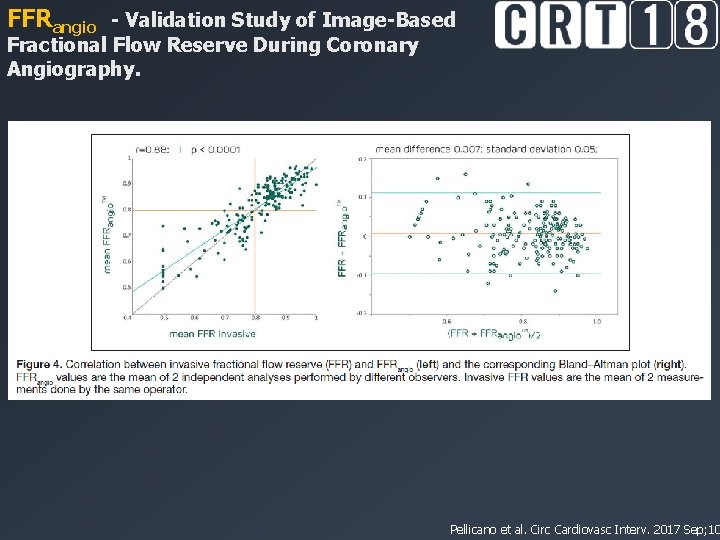
FFRangio - Validation Study of Image-Based Fractional Flow Reserve During Coronary Angiography. Pellicano et al. Circ Cardiovasc Interv. 2017 Sep; 10
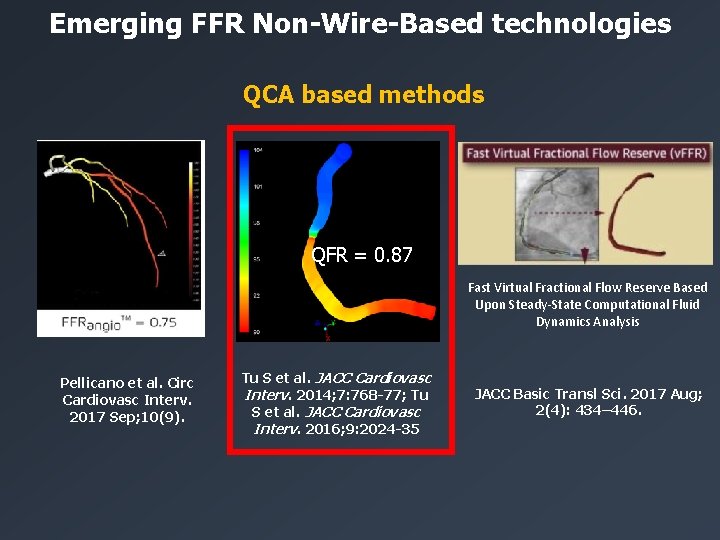
Emerging FFR Non-Wire-Based technologies QCA based methods QFR = 0. 87 Fast Virtual Fractional Flow Reserve Based Upon Steady-State Computational Fluid Dynamics Analysis Pellicano et al. Circ Cardiovasc Interv. 2017 Sep; 10(9). Tu S et al. JACC Cardiovasc Interv. 2014; 7: 768 -77; Tu S et al. JACC Cardiovasc Interv. 2016; 9: 2024 -35 JACC Basic Transl Sci. 2017 Aug; 2(4): 434– 446.

Quantitative Flow Ratio (QFR) One-stop shop? Standard Angiogram Data Transmission System Two image runs with angle difference ≥ 25° 3 D Reconstruction Modified Frame Count Angio. Plus System QFR Patient-specific volumetric flow rate + QFR = 0. 87 Without Inducing Hyperemia Tu S et al. JACC Cardiovasc Interv. 2014; 7: 768 -77; Tu S et al. JACC Cardiovasc Interv. 2016; 9: 2024 -35
Quantitative Flow Ratio Study Results – FAVOR I

Quantitative Flow Ratio Study Results FFRQCA versus FFR FN FP Difference: 0. 00 ± 0. 06 (p = 0. 541) Tu et al. JACC Cardiovasc Interv 2014, 7: 768 -777
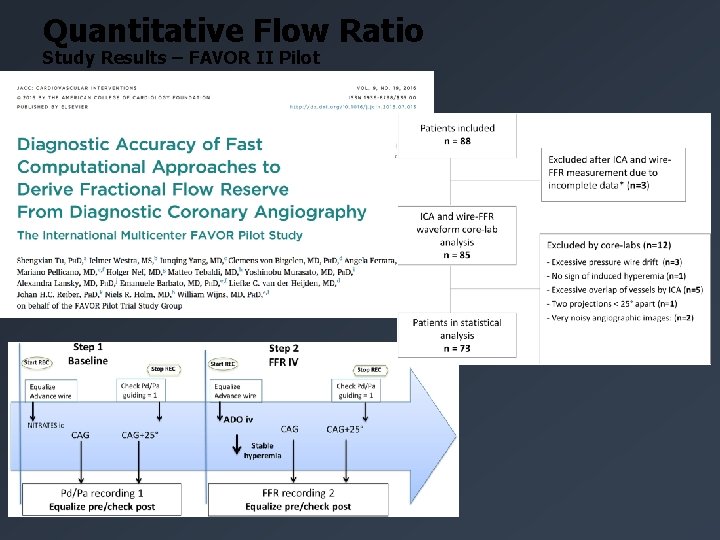
Quantitative Flow Ratio Study Results – FAVOR II Pilot

Functional Assessment of Coronary Stenosis Using Angiography: Background 1. f. QFR: a fixed empiric hyperemic flow velocity (HFV) of 0. 35 m/s that was derived from previous FFR studies was used for computation. 2. c. QFR: frame count (FC) analysis was performed, without pharmacologically induced hyperemia, to derived the HFV. 3. a. QFR: FC analysis was performed during hyperemia, induced by intravenous administration of adenosine or adenosine triphosphate. The “real” HFVs were derived and the software calculated 2 new QFR pullbacks. Flow velocity is segment length in 3 D QCA divided by dye flow time from FC. Tu S et al. JACC: Cardiovascular Interventions. Vol 9, Issue 19, 10 Oct 2016, 2024– 2035
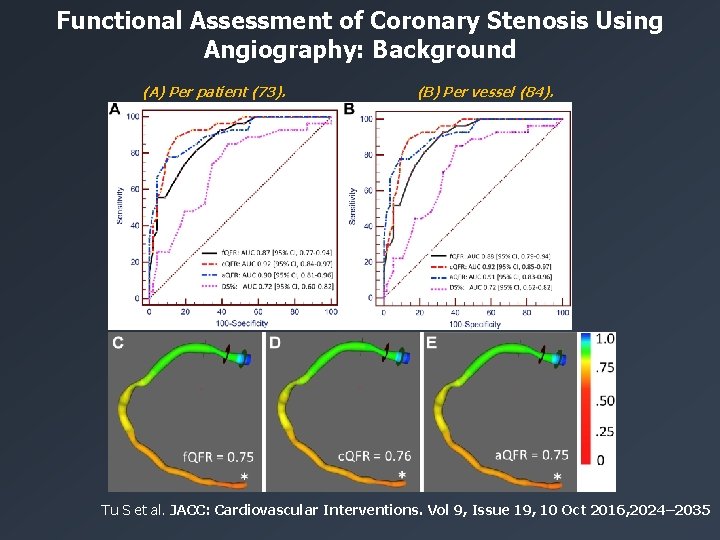
Functional Assessment of Coronary Stenosis Using Angiography: Background (A) Per patient (73). (B) Per vessel (84). Tu S et al. JACC: Cardiovascular Interventions. Vol 9, Issue 19, 10 Oct 2016, 2024– 2035
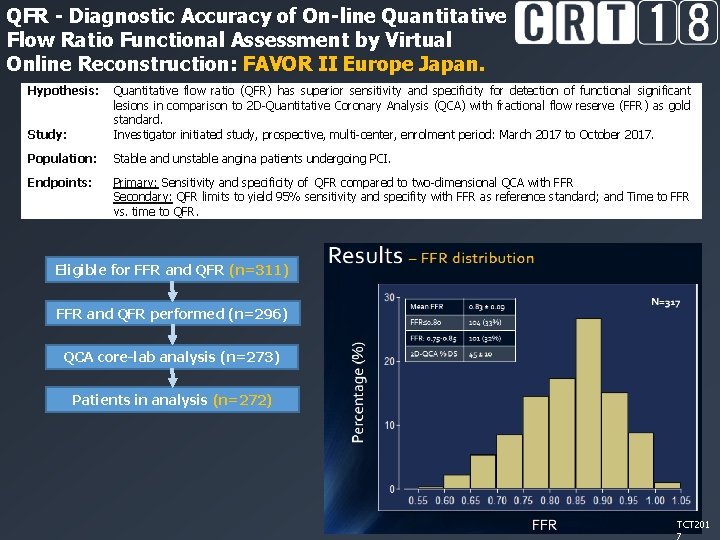
QFR - Diagnostic Accuracy of On-line Quantitative Flow Ratio Functional Assessment by Virtual Online Reconstruction: FAVOR II Europe Japan. Hypothesis: Study: Quantitative flow ratio (QFR) has superior sensitivity and specificity for detection of functional significant lesions in comparison to 2 D-Quantitative Coronary Analysis (QCA) with fractional flow reserve (FFR) as gold standard. Investigator initiated study, prospective, multi-center, enrolment period: March 2017 to October 2017. Population: Stable and unstable angina patients undergoing PCI. Endpoints: Primary: Sensitivity and specificity of QFR compared to two-dimensional QCA with FFR Secondary: QFR limits to yield 95% sensitivity and specifity with FFR as reference standard; and Time to FFR vs. time to QFR. Eligible for FFR and QFR (n=311) FFR and QFR performed (n=296) QCA core-lab analysis (n=273) Patients in analysis (n=272) TCT 201 7
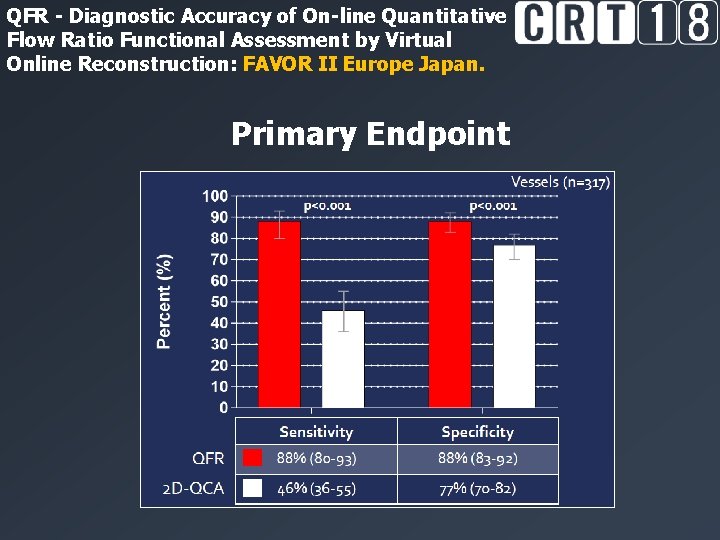
QFR - Diagnostic Accuracy of On-line Quantitative Flow Ratio Functional Assessment by Virtual Online Reconstruction: FAVOR II Europe Japan. Primary Endpoint
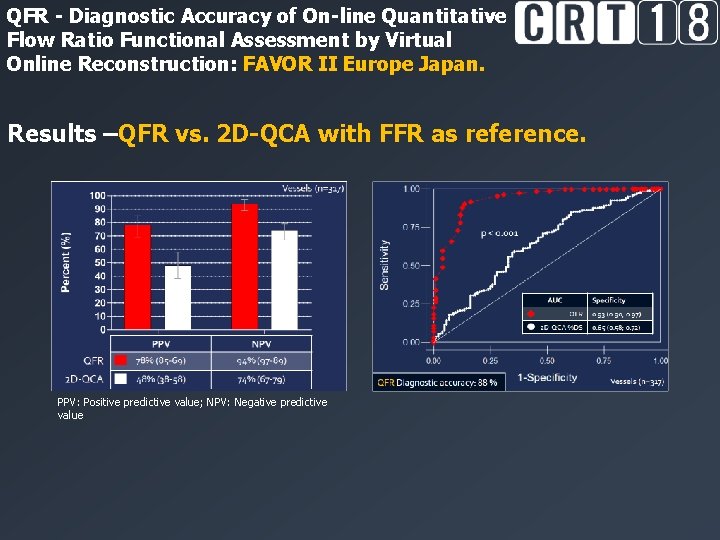
QFR - Diagnostic Accuracy of On-line Quantitative Flow Ratio Functional Assessment by Virtual Online Reconstruction: FAVOR II Europe Japan. Results –QFR vs. 2 D-QCA with FFR as reference. PPV: Positive predictive value; NPV: Negative predictive value
FAVOR II China Diagnostic Accuracy of the Angiographic Quantitative Flow Ratio in Patients With Coronary Artery Disease J Am Coll Cardiol. 2017 Dec 26; 70(25): 3077 -3087.
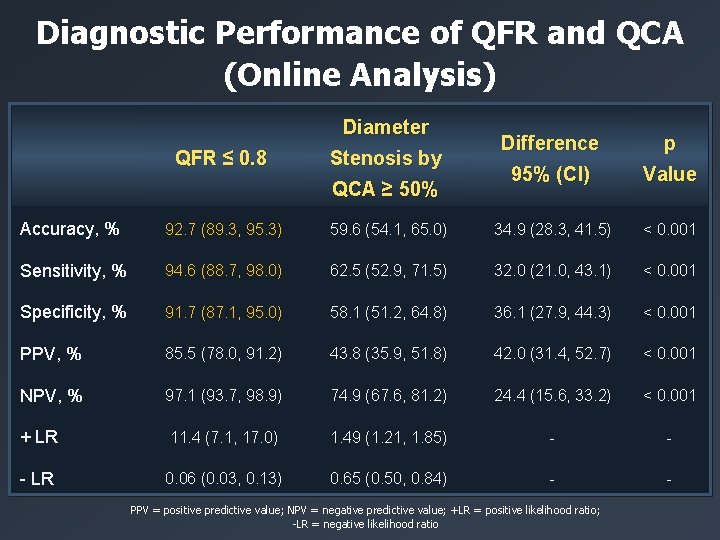
Diagnostic Performance of QFR and QCA (Online Analysis) Diameter QFR ≤ 0. 8 Stenosis by QCA ≥ 50% Difference p 95% (CI) Value Accuracy, % 92. 7 (89. 3, 95. 3) 59. 6 (54. 1, 65. 0) 34. 9 (28. 3, 41. 5) < 0. 001 Sensitivity, % 94. 6 (88. 7, 98. 0) 62. 5 (52. 9, 71. 5) 32. 0 (21. 0, 43. 1) < 0. 001 Specificity, % 91. 7 (87. 1, 95. 0) 58. 1 (51. 2, 64. 8) 36. 1 (27. 9, 44. 3) < 0. 001 PPV, % 85. 5 (78. 0, 91. 2) 43. 8 (35. 9, 51. 8) 42. 0 (31. 4, 52. 7) < 0. 001 NPV, % 97. 1 (93. 7, 98. 9) 74. 9 (67. 6, 81. 2) 24. 4 (15. 6, 33. 2) < 0. 001 + LR 11. 4 (7. 1, 17. 0) 1. 49 (1. 21, 1. 85) - - - LR 0. 06 (0. 03, 0. 13) 0. 65 (0. 50, 0. 84) - - PPV = positive predictive value; NPV = negative predictive value; +LR = positive likelihood ratio; -LR = negative likelihood ratio
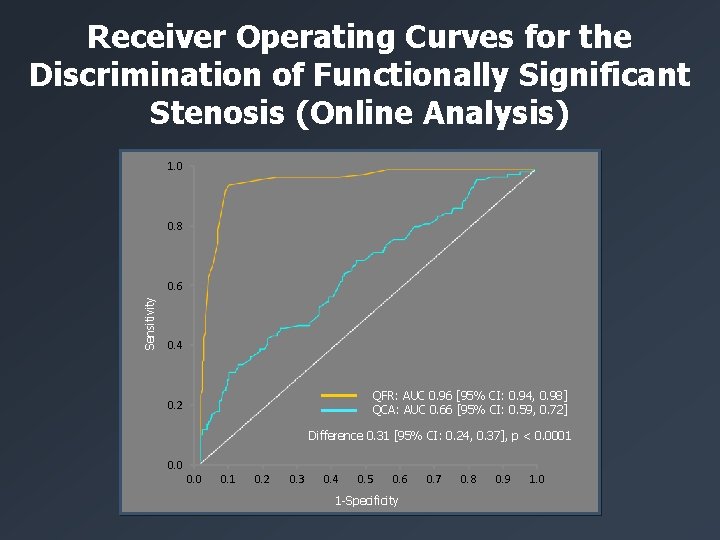
Receiver Operating Curves for the Discrimination of Functionally Significant Stenosis (Online Analysis) 1. 0 0. 8 Sensitivity 0. 6 0. 4 QFR: AUC 0. 96 [95% CI: 0. 94, 0. 98] QCA: AUC 0. 66 [95% CI: 0. 59, 0. 72] 0. 2 Difference 0. 31 [95% CI: 0. 24, 0. 37], p < 0. 0001 0. 0 0. 1 0. 2 0. 3 0. 4 0. 5 0. 6 1 -Specificity 0. 7 0. 8 0. 9 1. 0
Quantitative Flow Ratio Identifies Nonculprit Coronary Lesions Requiring Revascularization in Patients With ST-Segment–Elevation Myocardial Infarction and Multivessel Disease by Giosafat Spitaleri, Matteo Tebaldi, Simone Biscaglia, Jelmer Westra, Salvatore Brugaletta, Andrea Erriquez, Giulia Passarini, Alessandro Brieda, Antonio Maria Leone, Andrea Picchi, Alfonso Ielasi, Domenico Di Girolamo, Carlo Trani, Roberto Ferrari, Johan H. C. Reiber, Marco Valgimigli, Manel Sabatè, and Gianluca Campo Circ Cardiovasc Interv Volume 11(2): e 006023 February 15, 2018 Copyright © American Heart Association, Inc. All rights reserved.
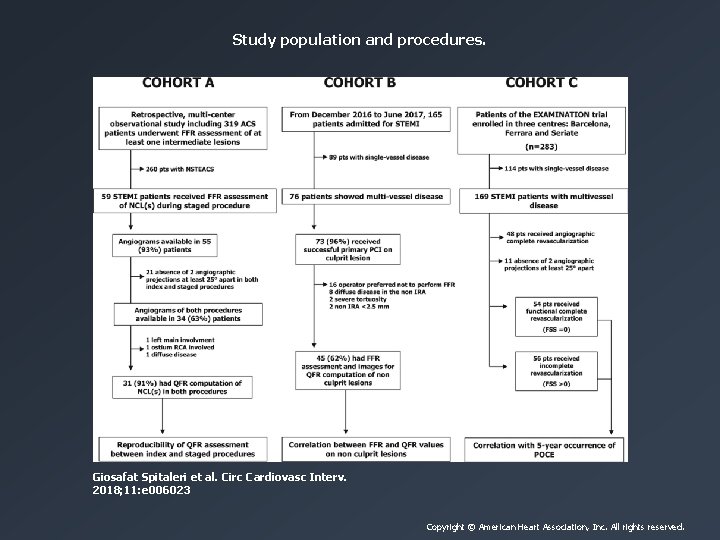
Study population and procedures. Giosafat Spitaleri et al. Circ Cardiovasc Interv. 2018; 11: e 006023 Copyright © American Heart Association, Inc. All rights reserved.
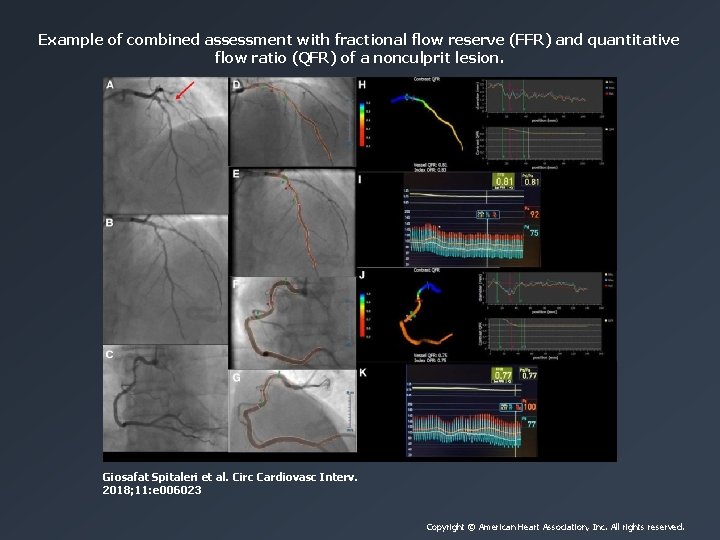
Example of combined assessment with fractional flow reserve (FFR) and quantitative flow ratio (QFR) of a nonculprit lesion. Giosafat Spitaleri et al. Circ Cardiovasc Interv. 2018; 11: e 006023 Copyright © American Heart Association, Inc. All rights reserved.
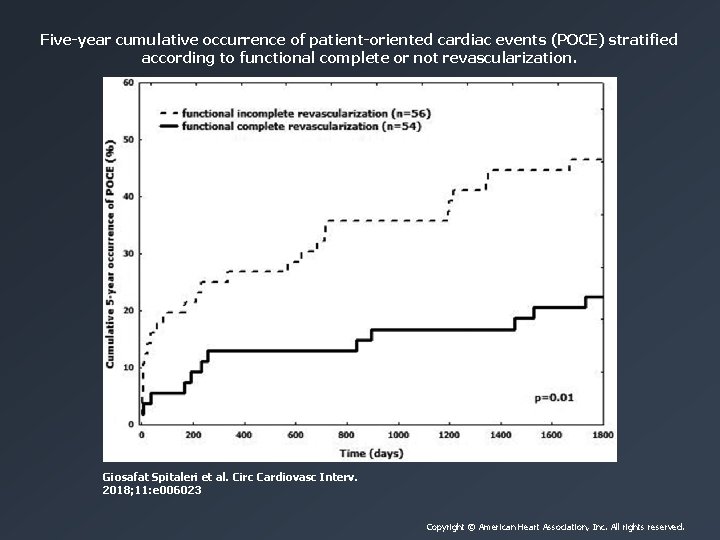
Five-year cumulative occurrence of patient-oriented cardiac events (POCE) stratified according to functional complete or not revascularization. Giosafat Spitaleri et al. Circ Cardiovasc Interv. 2018; 11: e 006023 Copyright © American Heart Association, Inc. All rights reserved.
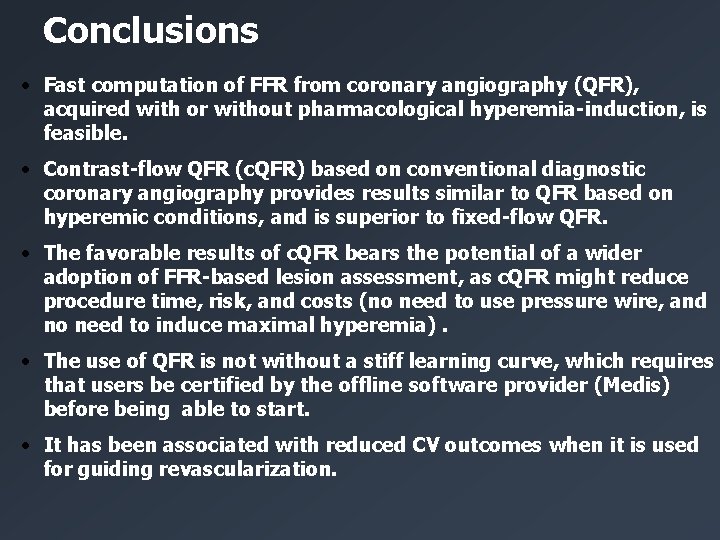
Conclusions • Fast computation of FFR from coronary angiography (QFR), acquired with or without pharmacological hyperemia-induction, is feasible. • Contrast-flow QFR (c. QFR) based on conventional diagnostic coronary angiography provides results similar to QFR based on hyperemic conditions, and is superior to fixed-flow QFR. • The favorable results of c. QFR bears the potential of a wider adoption of FFR-based lesion assessment, as c. QFR might reduce procedure time, risk, and costs (no need to use pressure wire, and no need to induce maximal hyperemia). • The use of QFR is not without a stiff learning curve, which requires that users be certified by the offline software provider (Medis) before being able to start. • It has been associated with reduced CV outcomes when it is used for guiding revascularization.
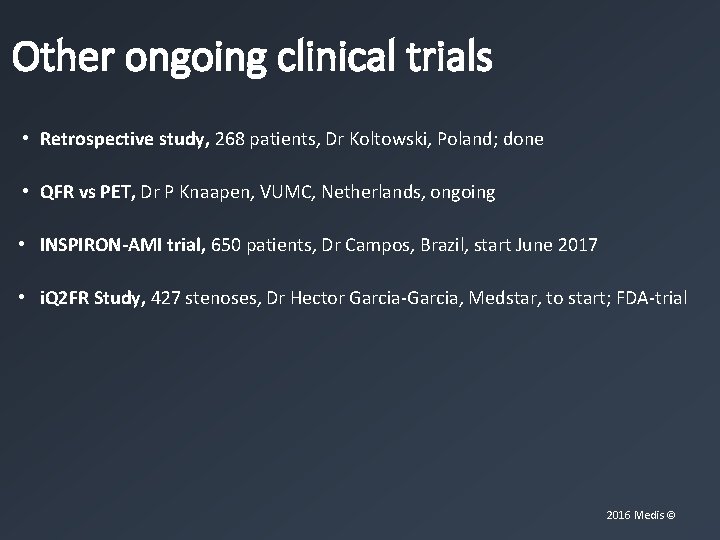
Other ongoing clinical trials • Retrospective study, 268 patients, Dr Koltowski, Poland; done • QFR vs PET, Dr P Knaapen, VUMC, Netherlands, ongoing • INSPIRON-AMI trial, 650 patients, Dr Campos, Brazil, start June 2017 • i. Q 2 FR Study, 427 stenoses, Dr Hector Garcia-Garcia, Medstar, to start; FDA-trial 2016 Medis ©
- Slides: 29