
Emerging evidence on AGYW HIV risk and prevention
- Slides: 14
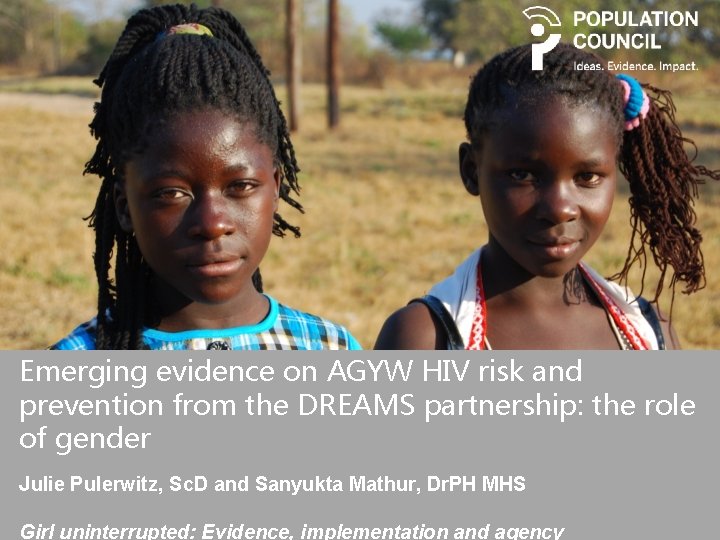
Emerging evidence on AGYW HIV risk and prevention from the DREAMS partnership: the role of gender Julie Pulerwitz, Sc. D and Sanyukta Mathur, Dr. PH MHS Girl uninterrupted: Evidence, implementation and agency
No conflicts of interest to disclose
Context § Should address the context in which AGYW live, to improve health & development outcomes § Gender-based power dynamics underpins many relationships § Power in sexual relationships* linked with violence, condom use, HIV incidence, untreated STIs, etc Ø High HIV risk and incidence rates among AGYW (esp. Southern and Eastern Africa) *Pulerwitz, J, Gortmaker, SL, & De. Jong, W. (2000) Measuring relationship power in HIV/STD Research. Sex Roles. 42(7/8); Mc. Mahon, JM, Volpe, EM, Klostermann, K, Trabold, N, & Xue, Y. (2015) A Systematic Review of the Psychometric Properties of the Sexual Relationship Power Scale in HIV/AIDS Research. Arch Sex Behav; 44(2): 267– 294.
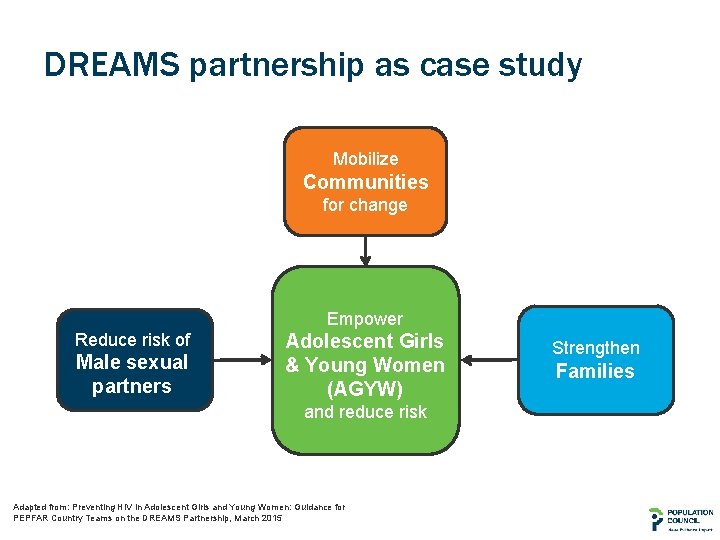
DREAMS partnership as case study Mobilize Communities for change Empower Reduce risk of Male sexual partners Adolescent Girls & Young Women (AGYW) and reduce risk Adapted from: Preventing HIV in Adolescent Girls and Young Women: Guidance for PEPFAR Country Teams on the DREAMS Partnership, March 2015 Strengthen Families
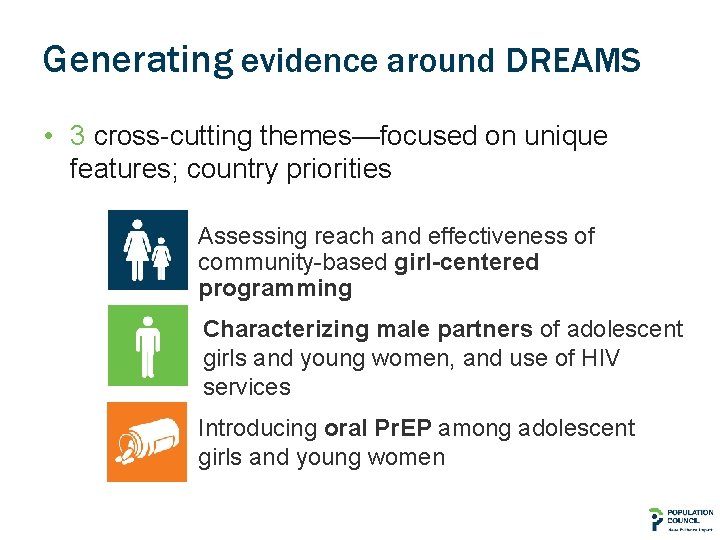
Generating evidence around DREAMS • 3 cross-cutting themes—focused on unique features; country priorities Assessing reach and effectiveness of community-based girl-centered programming Characterizing male partners of adolescent girls and young women, and use of HIV services Introducing oral Pr. EP among adolescent girls and young women
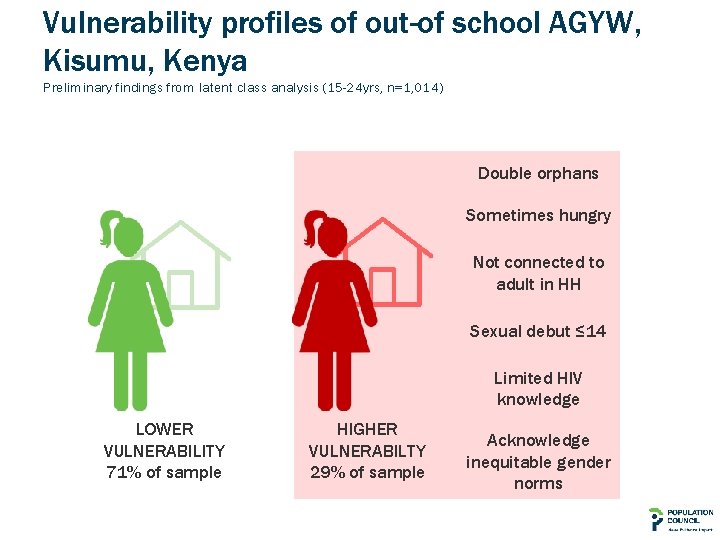
Vulnerability profiles of out-of school AGYW, Kisumu, Kenya Preliminary findings from latent class analysis (15 -24 yrs, n=1, 014) Double orphans Sometimes hungry Not connected to adult in HH Sexual debut ≤ 14 Limited HIV knowledge LOWER VULNERABILITY 71% of sample HIGHER VULNERABILTY 29% of sample Acknowledge inequitable gender norms
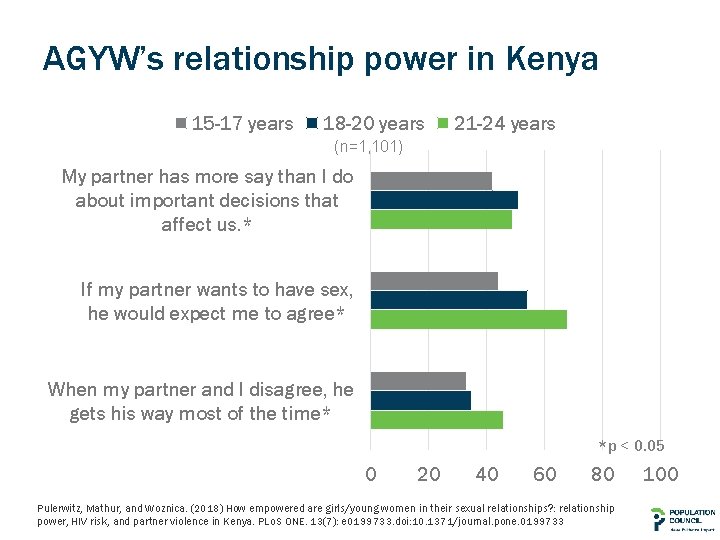
AGYW’s relationship power in Kenya 15 -17 years 18 -20 years 21 -24 years (n=1, 101) My partner has more say than I do about important decisions that affect us. * If my partner wants to have sex, he would expect me to agree* When my partner and I disagree, he gets his way most of the time* *p < 0. 05 0 20 40 60 80 Pulerwitz, Mathur, and Woznica. (2018) How empowered are girls/young women in their sexual relationships? : relationship power, HIV risk, and partner violence in Kenya. PLo. S ONE. 13(7): e 0199733. doi: 10. 1371/journal. pone. 0199733 100
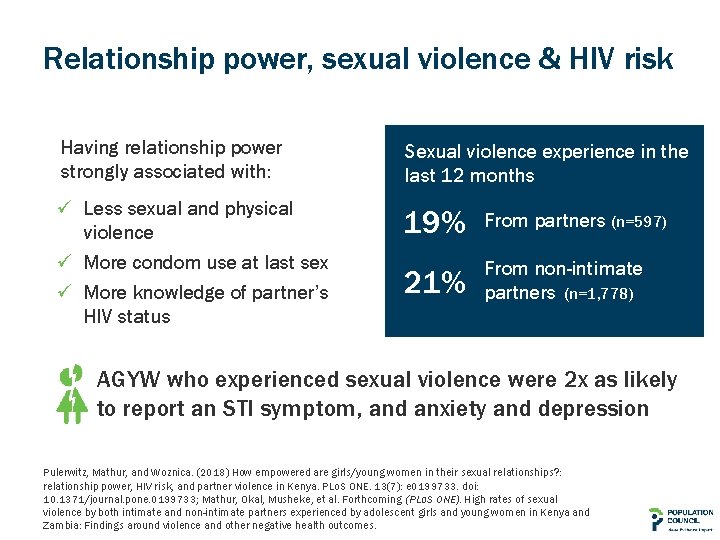
Relationship power, sexual violence & HIV risk Having relationship power strongly associated with: Sexual violence experience in the last 12 months ü Less sexual and physical violence ü More condom use at last sex ü More knowledge of partner’s HIV status 19% From partners (n=597) 21% From non-intimate partners (n=1, 778) AGYW who experienced sexual violence were 2 x as likely to report an STI symptom, and anxiety and depression Pulerwitz, Mathur, and Woznica. (2018) How empowered are girls/young women in their sexual relationships? : relationship power, HIV risk, and partner violence in Kenya. PLo. S ONE. 13(7): e 0199733. doi: 10. 1371/journal. pone. 0199733; Mathur, Okal, Musheke, et al. Forthcoming (PLo. S ONE). High rates of sexual violence by both intimate and non-intimate partners experienced by adolescent girls and young women in Kenya and Zambia: Findings around violence and other negative health outcomes.
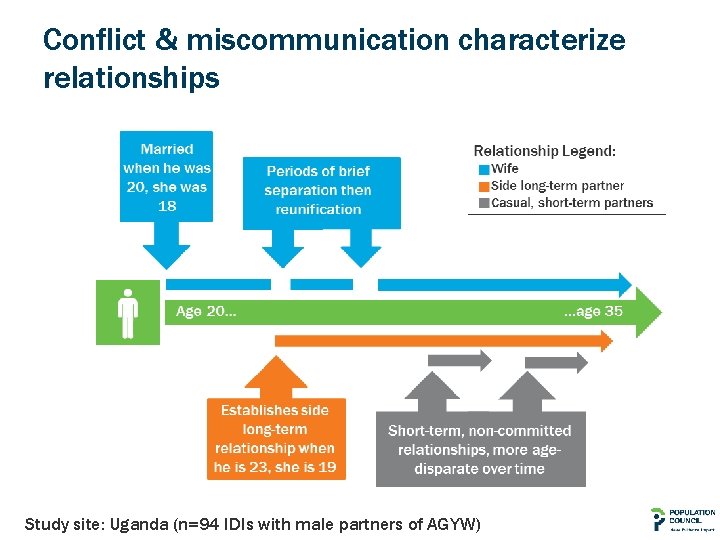
Conflict & miscommunication characterize relationships Study site: Uganda (n=94 IDIs with male partners of AGYW)
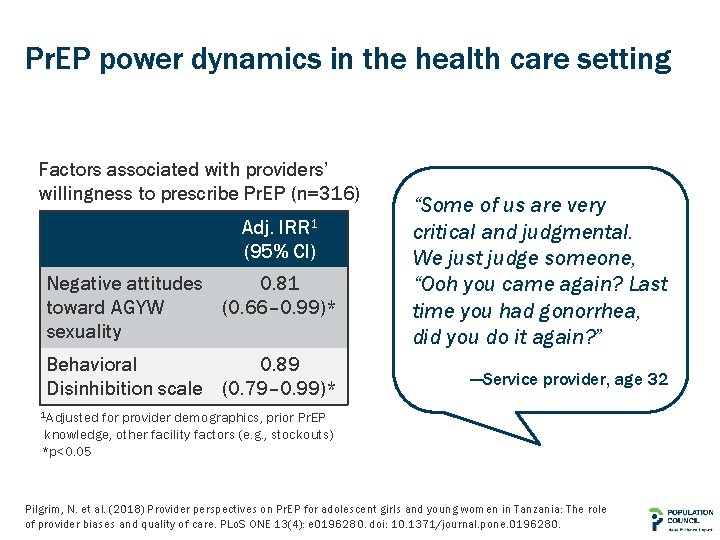
Pr. EP power dynamics in the health care setting Factors associated with providers’ willingness to prescribe Pr. EP (n=316) IRR 1 Adj. (95% CI) Negative attitudes 0. 81 toward AGYW (0. 66– 0. 99)* sexuality Behavioral 0. 89 Disinhibition scale (0. 79– 0. 99)* “Some of us are very critical and judgmental. We just judge someone, “Ooh you came again? Last time you had gonorrhea, did you do it again? ” —Service provider, age 32 1 Adjusted for provider demographics, prior Pr. EP knowledge, other facility factors (e. g. , stockouts) *p<0. 05 Pilgrim, N. et al. (2018) Provider perspectives on Pr. EP for adolescent girls and young women in Tanzania: The role of provider biases and quality of care. PLo. S ONE 13(4): e 0196280. doi: 10. 1371/journal. pone. 0196280.
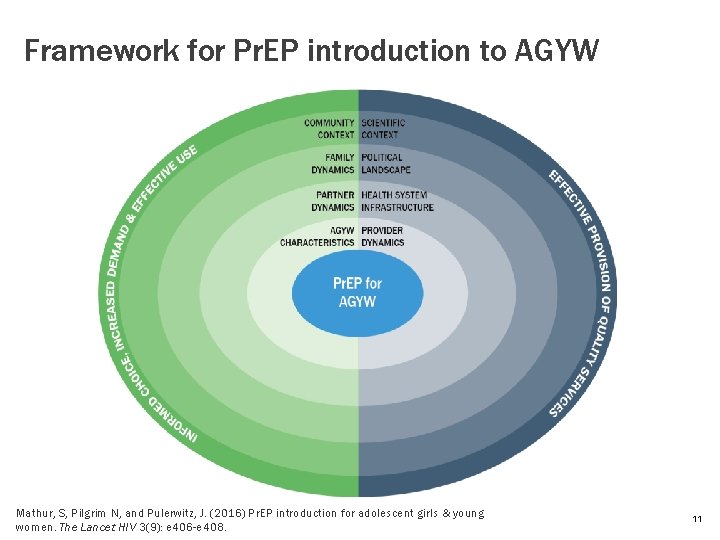
Framework for Pr. EP introduction to AGYW Mathur, S, Pilgrim N, and Pulerwitz, J. (2016) Pr. EP introduction for adolescent girls & young women. The Lancet HIV 3(9): e 406 -e 408. 11
Implications/next steps • Gender-related dynamics accentuate HIV risk and inhibit service use – Unpacking these relationships can provides useful insights for strengthening program/policy – Should be more consistently measured in programs • Phase 2 DREAMS Implementation Science will explore program effects – What worked, when, for whom, and why?
© 2018 The Population Council. All rights reserved. Use of these materials is permitted only for noncommercial purposes. The following full source citation must be included: Pulerwitz, Julie and Sanyukta Mathur. 2018. “Addressing adolescent girl and young women’s risk and empowerment: Emerging lessons from the DREAMS Partnership. ” Presented at 22 nd International AIDS Conference (AIDS 2018), Amsterdam, The Netherlands, 24 July. This presentation may contain materials owned by others. User is responsible for obtaining permissions for use from third parties as needed.
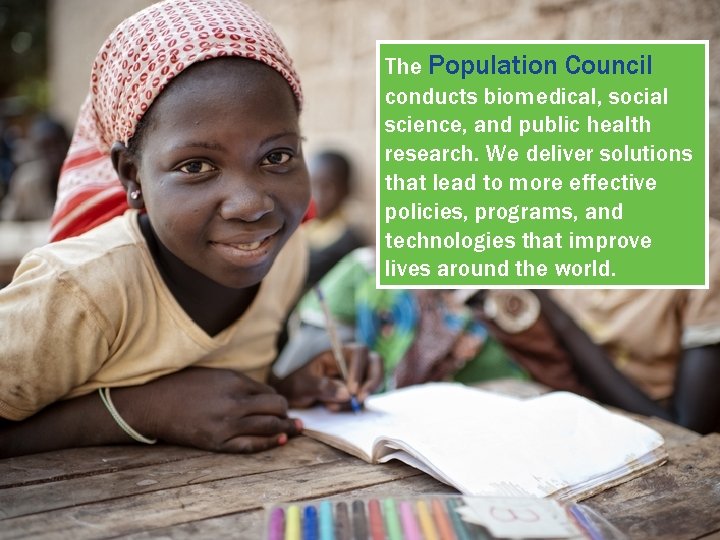
The Population Council conducts biomedical, social science, and public health research. We deliver solutions that lead to more effective policies, programs, and technologies that improve lives around the world.