
Emerging Data on Rodinia Rifting from Marathon FoldThrust
- Slides: 15
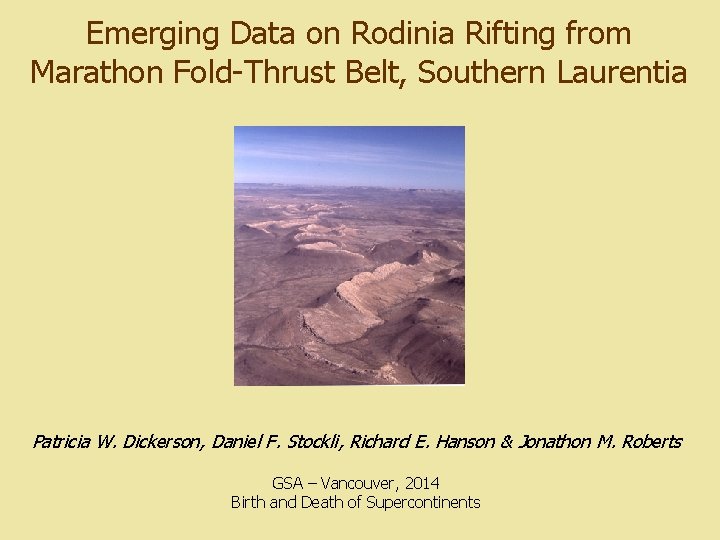
Emerging Data on Rodinia Rifting from Marathon Fold-Thrust Belt, Southern Laurentia Patricia W. Dickerson, Daniel F. Stockli, Richard E. Hanson & Jonathon M. Roberts GSA – Vancouver, 2014 Birth and Death of Supercontinents
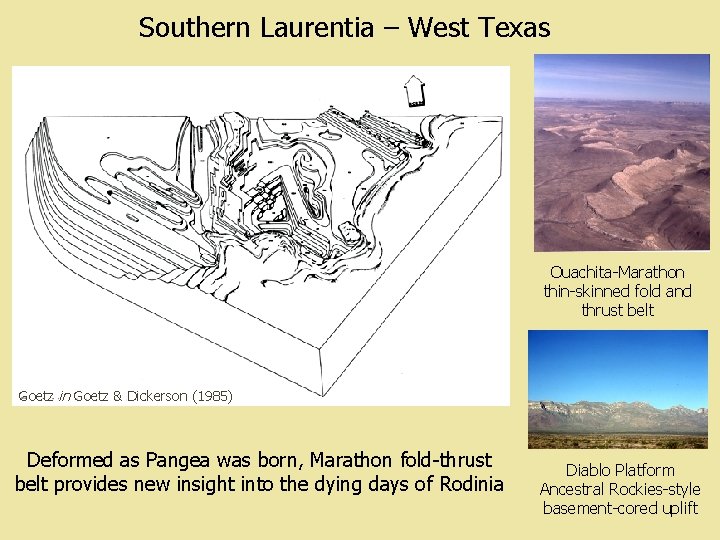
Southern Laurentia – West Texas Ouachita-Marathon thin-skinned fold and thrust belt Goetz in Goetz & Dickerson (1985) Deformed as Pangea was born, Marathon fold-thrust belt provides new insight into the dying days of Rodinia Diablo Platform Ancestral Rockies-style basement-cored uplift
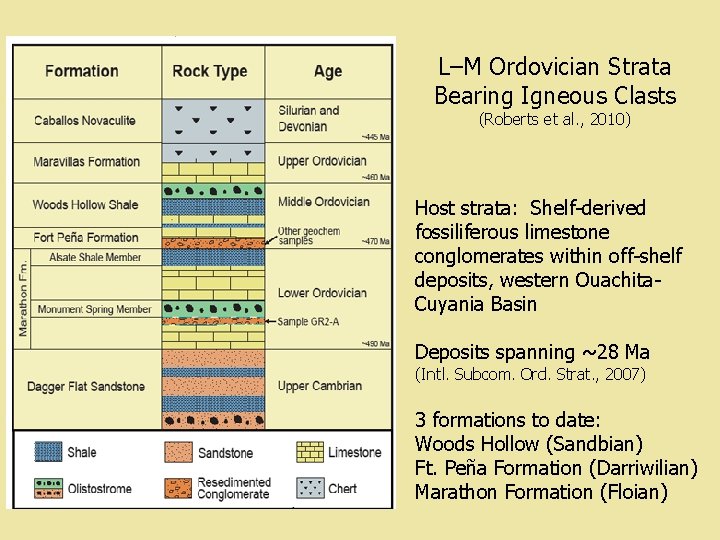
L–M Ordovician Strata Bearing Igneous Clasts (Roberts et al. , 2010) Host strata: Shelf-derived fossiliferous limestone conglomerates within off-shelf deposits, western Ouachita. Cuyania Basin Deposits spanning ~28 Ma (Intl. Subcom. Ord. Strat. , 2007) 3 formations to date: Woods Hollow (Sandbian) Ft. Peña Formation (Darriwilian) Marathon Formation (Floian)
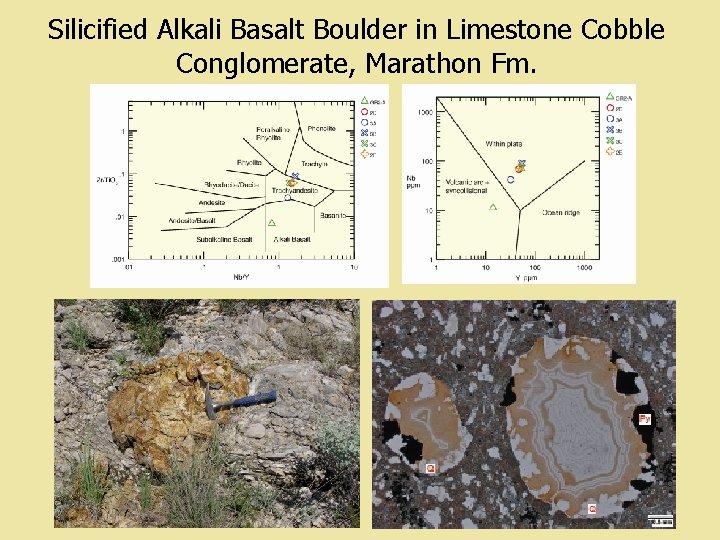
Silicified Alkali Basalt Boulder in Limestone Cobble Conglomerate, Marathon Fm.
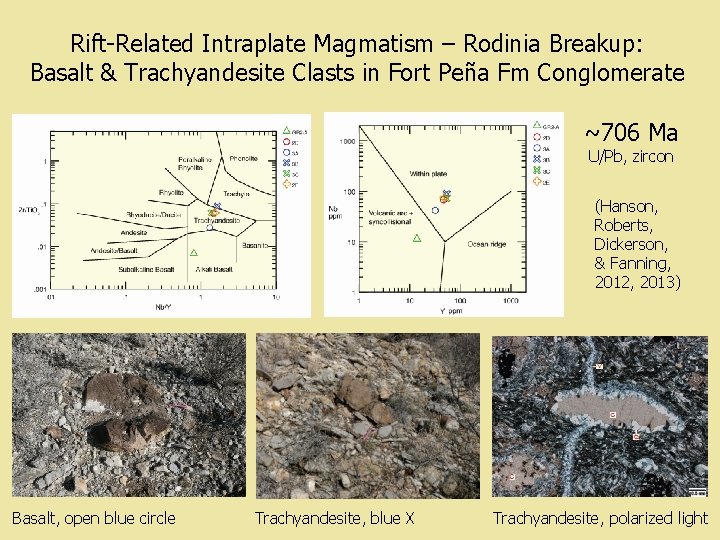
Rift-Related Intraplate Magmatism – Rodinia Breakup: Basalt & Trachyandesite Clasts in Fort Peña Fm Conglomerate ~706 Ma U/Pb, zircon (Hanson, Roberts, Dickerson, & Fanning, 2012, 2013) Basalt, open blue circle Trachyandesite, blue X Trachyandesite, polarized light
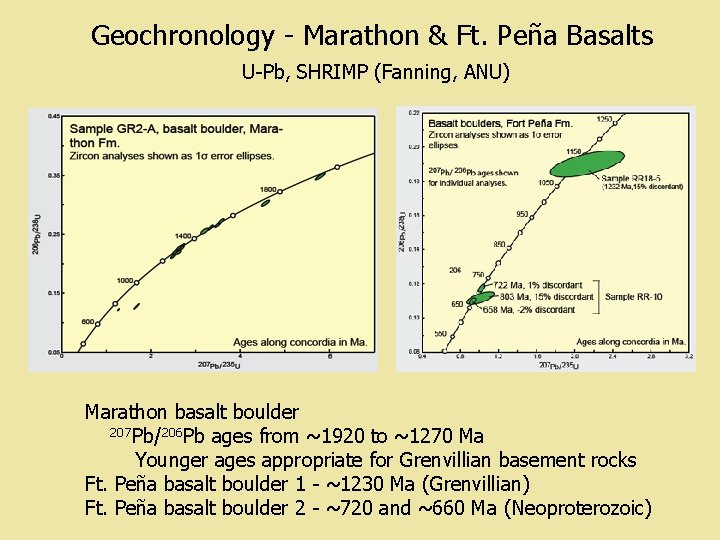
Geochronology - Marathon & Ft. Peña Basalts U-Pb, SHRIMP (Fanning, ANU) Marathon basalt boulder 207 Pb/206 Pb ages from ~1920 to ~1270 Ma Younger ages appropriate for Grenvillian basement rocks Ft. Peña basalt boulder 1 - ~1230 Ma (Grenvillian) Ft. Peña basalt boulder 2 - ~720 and ~660 Ma (Neoproterozoic)
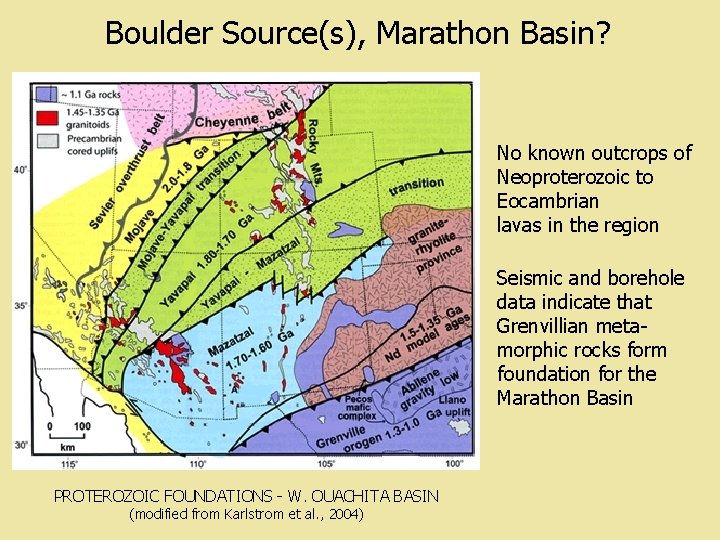
Boulder Source(s), Marathon Basin? No known outcrops of Neoproterozoic to Eocambrian lavas in the region Seismic and borehole data indicate that Grenvillian metamorphic rocks form foundation for the Marathon Basin PROTEROZOIC FOUNDATIONS - W. OUACHITA BASIN (modified from Karlstrom et al. , 2004)
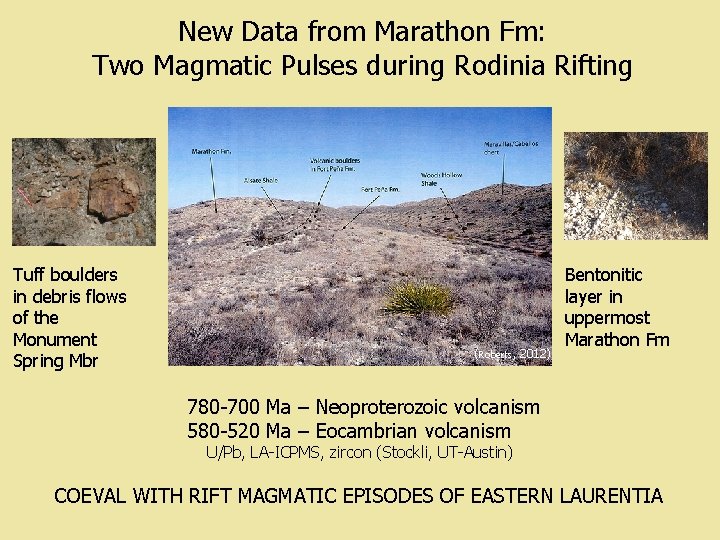
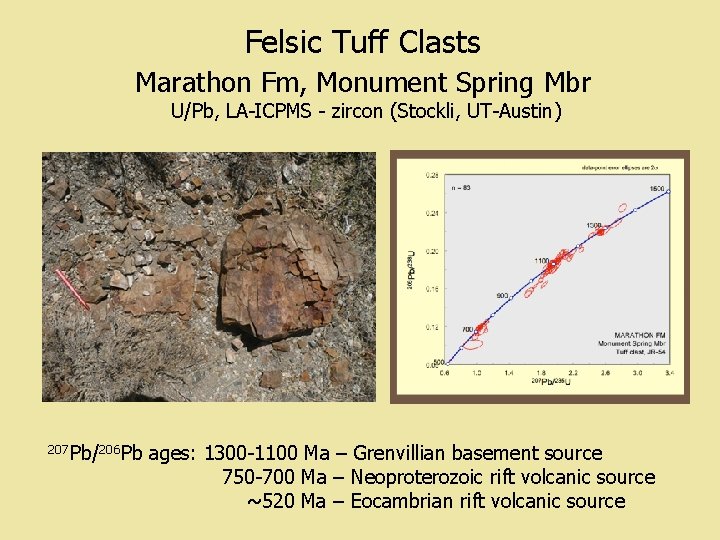
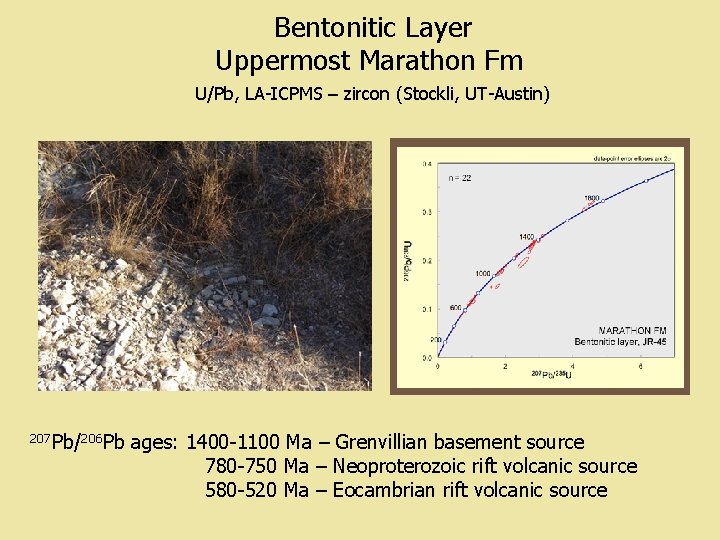
New Data from Marathon Fm: Two Magmatic Pulses during Rodinia Rifting Tuff boulders in debris flows of the Monument Spring Mbr (Roberts, 2012) Bentonitic layer in uppermost Marathon Fm 780 -700 Ma – Neoproterozoic volcanism 580 -520 Ma – Eocambrian volcanism U/Pb, LA-ICPMS, zircon (Stockli, UT-Austin) COEVAL WITH RIFT MAGMATIC EPISODES OF EASTERN LAURENTIA
Felsic Tuff Clasts Marathon Fm, Monument Spring Mbr U/Pb, LA-ICPMS - zircon (Stockli, UT-Austin) 207 Pb/206 Pb ages: 1300 -1100 Ma – Grenvillian basement source 750 -700 Ma – Neoproterozoic rift volcanic source ~520 Ma – Eocambrian rift volcanic source
Bentonitic Layer Uppermost Marathon Fm U/Pb, LA-ICPMS – zircon (Stockli, UT-Austin) 207 Pb/206 Pb ages: 1400 -1100 Ma – Grenvillian basement source 780 -750 Ma – Neoproterozoic rift volcanic source 580 -520 Ma – Eocambrian rift volcanic source
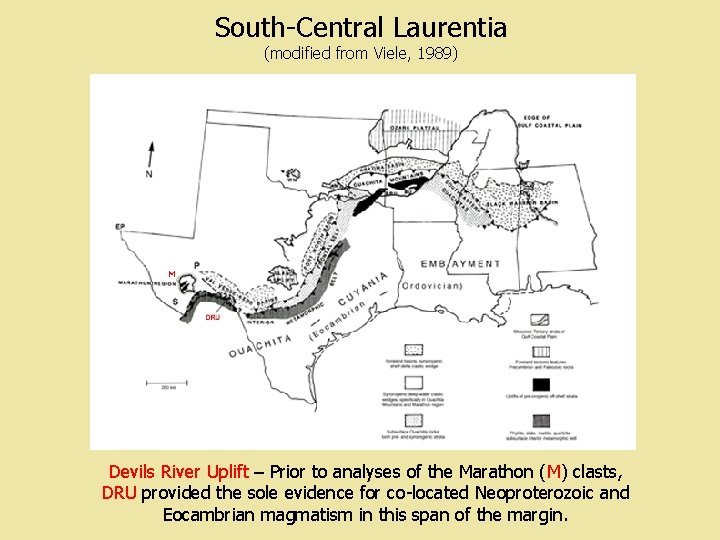
South-Central Laurentia (modified from Viele, 1989) M Devils River Uplift – Prior to analyses of the Marathon (M) clasts, DRU provided the sole evidence for co-located Neoproterozoic and Eocambrian magmatism in this span of the margin.
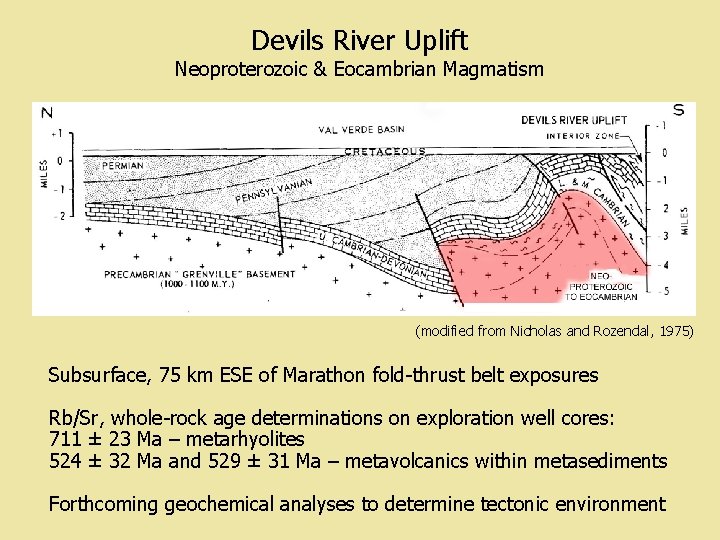
Devils River Uplift Neoproterozoic & Eocambrian Magmatism (modified from Nicholas and Rozendal, 1975) Subsurface, 75 km ESE of Marathon fold-thrust belt exposures Rb/Sr, whole-rock age determinations on exploration well cores: 711 ± 23 Ma – metarhyolites 524 ± 32 Ma and 529 ± 31 Ma – metavolcanics within metasediments Forthcoming geochemical analyses to determine tectonic environment
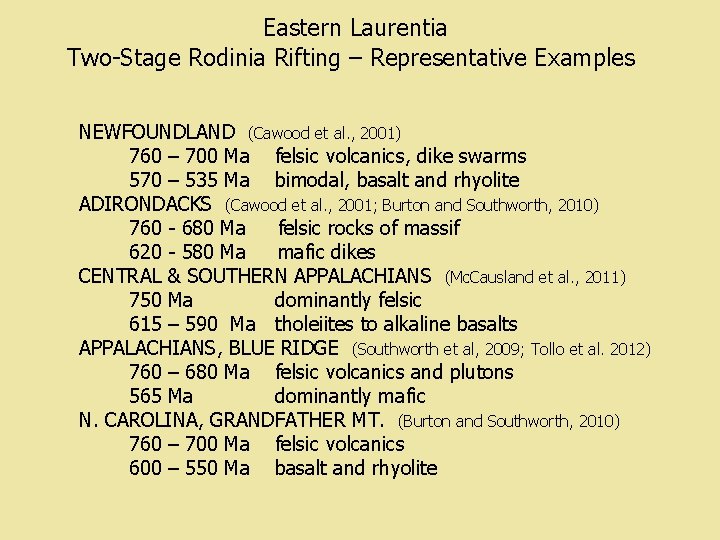
Eastern Laurentia Two-Stage Rodinia Rifting – Representative Examples NEWFOUNDLAND (Cawood et al. , 2001) 760 – 700 Ma felsic volcanics, dike swarms 570 – 535 Ma bimodal, basalt and rhyolite ADIRONDACKS (Cawood et al. , 2001; Burton and Southworth, 2010) 760 - 680 Ma felsic rocks of massif 620 - 580 Ma mafic dikes CENTRAL & SOUTHERN APPALACHIANS (Mc. Causland et al. , 2011) 750 Ma dominantly felsic 615 – 590 Ma tholeiites to alkaline basalts APPALACHIANS, BLUE RIDGE (Southworth et al, 2009; Tollo et al. 2012) 760 – 680 Ma felsic volcanics and plutons 565 Ma dominantly mafic N. CAROLINA, GRANDFATHER MT. (Burton and Southworth, 2010) 760 – 700 Ma felsic volcanics 600 – 550 Ma basalt and rhyolite
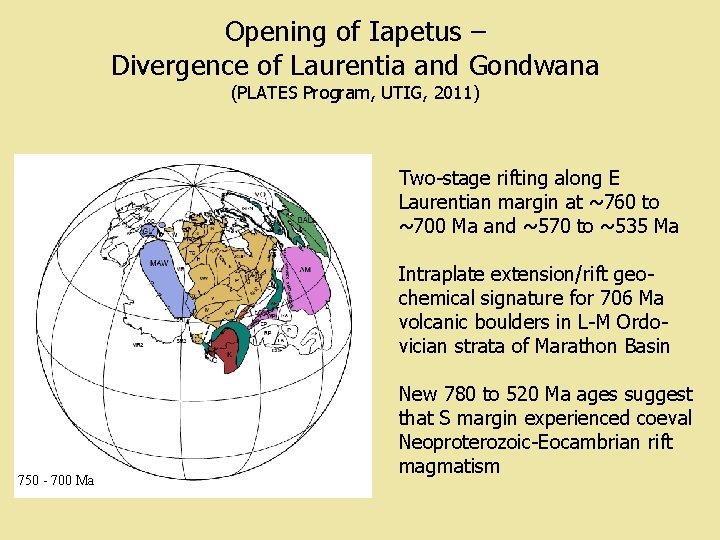
Opening of Iapetus – Divergence of Laurentia and Gondwana (PLATES Program, UTIG, 2011) Two-stage rifting along E Laurentian margin at ~760 to ~700 Ma and ~570 to ~535 Ma Intraplate extension/rift geochemical signature for 706 Ma volcanic boulders in L-M Ordovician strata of Marathon Basin 750 - 700 Ma New 780 to 520 Ma ages suggest that S margin experienced coeval Neoproterozoic-Eocambrian rift magmatism
Eos – the dawn of Iapetus A fragmentary record of Neoproterozoic - Eocambrian volcanism – possible within-plate extensional magmatism during rifting of south-central Laurentia