
Emerging Contaminants Fate During Wastewater Treatment and Strategies




- Slides: 63
Emerging Contaminants: Fate During Wastewater Treatment and Strategies to Enhance Removal David Quanrud The University of Arizona New Directions in Wastewater Treatment AZ Water Association 21 October 2014
Outline 1. Let’s talk terminology: ECs and EDCs 2. Fate of estrogenic activity during WW treatment – Comparison of AZ WWTPs – WERF project: WWTP mass balances 3. How can we improve removal of ECs during WWT?
Terminology Salad • Emerging contaminants (ECs) • Compounds of emerging concern (CECs) • Trace organic contaminants (TOr. Cs) • Pharmaceutically active compounds (Ph. ACs) • Pharmaceuticals and personal care products (PPCPs) • Endocrine disrupting compounds (EDCs) • Hormonally active agents (HAAs) Many terms are in use but they do not all mean the same thing…
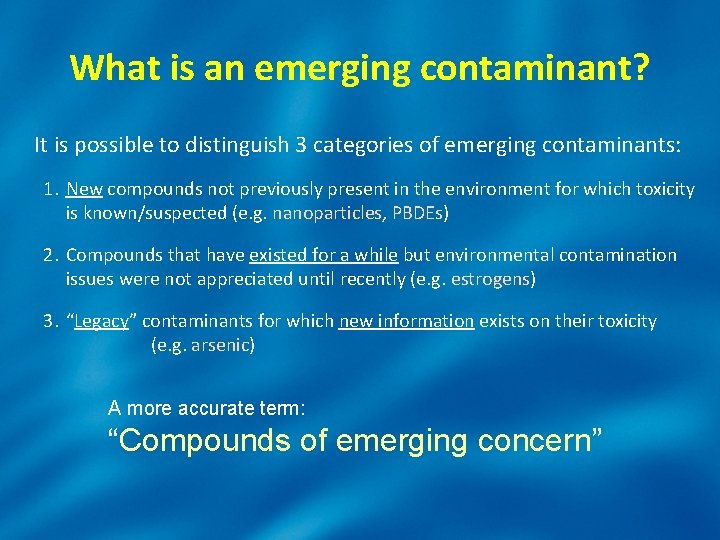
What is an emerging contaminant? It is possible to distinguish 3 categories of emerging contaminants: 1. New compounds not previously present in the environment for which toxicity is known/suspected (e. g. nanoparticles, PBDEs) 2. Compounds that have existed for a while but environmental contamination issues were not appreciated until recently (e. g. estrogens) 3. “Legacy” contaminants for which new information exists on their toxicity (e. g. arsenic) A more accurate term: “Compounds of emerging concern”
05 22 0: . 0 00 6. 19 : 0 0 0 24 5 0: . 0 00 6. 19 : 0 0 0 26 5 0: . 0 00 6. 19 : 0 0 0 28 5 0: . 0 00 6. 19 : 0 0 0 30 5 0. 0 : 0 6. 0: 19 00 05 02 0: . 0 00 7. 19 : 0 04 5 0. 0 : 0 7. 0: 19 00 05 06 0: . 0 00 7. 19 : 0 0 05 0: 00 : 0 0 19 . 0 6. 20 Number of articles by year containing term “emerging contaminant” (Science. Direct literature search, 10 -15 -14) 800 700 600 500 400 300 200 100 0
Why are we more aware of ECs Our Stolen Future (1996) now? • • USGS national reconnaissance survey (2002) • Associated Press investigation (2008) • Increased usage over time (e. g. additives in hand soaps) • Improved analytical methods! (ppb, ppt, ppq) Caffeinated soap!
Examples of ECs • Pharmaceuticals – – – over-the-counter prescription caffeine nicotine veterinary drugs • Personal care products – – soaps sunscreens cosmetics bug sprays • Industrial compounds – flame retardants – plasticizers – bisphenol A Some of these compounds are endocrine disruptors (EDCs), but many are not… So, what is an endocrine disruptor?
What is an endocrine disrupting compound? “An endocrine disruptor is an exogenous substance or mixture that alters function(s) of the endocrine system and consequently causes adverse health effects in an intact organism, or its progeny…. ” From: “Global Assessment of the State-of-the-Science of Endocrine Disruptors. ” International Programme on Chemical Safety, World Health Organization (2002)
Yeast estrogen screen (YES) bioassay E R lac z E CPRG yellow red R E R Cytoplasm h. ER b-gal Cytoplasm =Estrogens E =Estrogen R = Receptor • In vitro reporter gene bioassay • Utilizes human estrogen receptor • →Total estrogenic activity reported as equivalent concentration of EE 2, based on comparison to standard curve
Fate of Estrogenic Activity during Conventional Wastewater Treatment (trickling filter) Where did it go? influent effluent Two possibilities: ~50% removal – compound destruction (biodegradation) – mass transfer (adsorption to the sludge)
Estrogenic Activity: Comparison of Arizona WWTPs Oxidation ditch Membrane bioreactor Influent Activated Sludge + BNR Effluent Activated Sludge (pure O 2) Biotower #1 (shorter SRT) Biotower #2 (longer SRT) Sludge
Comparison of six Arizona WWTPs Influent Effluent Estrogenic activity remaining in effluent (%) Estrogenic activity remaining in solid (sludge) (%) Oxidation Ditch 1% <0. 01% Activated Sludge 24% 18% Membrane Bioreactor <0. 01% Sludge Act. Sl. + BNR <0. 01% <0. 1% Biotower #1 Biotower #2 63% 16% 3% 14%
Fate of Estrogenic Compounds During Municipal Sludge Stabilization & Dewatering WERF Project 04 -HHE-6 Beverley Stinson, Ph. D Kathleen Esposito Mohammed Abu-Orf, Ph. D Edward Furlong, Ph. D James Gray, Ph. D Dana Kolpin Patrick Phillips David Quanrud, Ph. D Wendell Ela, Ph. D Sondra Teske Dave Newman Alan Hais, PE, BCEE
Analytical Methods • Chemical analysis • In vitro bioassay – yeast estrogen screen (YES) WERF Project 04 -HHE-6
Wastewater Treatment Processes Primary Treatment Secondary Treatment Aerobic Digestion Anaerobic Digestion mesophilic Lime Addition (Plant A) (Plant B) (Plant C) Settling Anaerobic Digestion thermophilic (Plant D) WERF Project 04 -HHE-6
Most Important Contributors to Estrogenicity WERF Project 04 -HHE-6 Compound Name Abbr. Log Kow Mol. Wt. [g/mol] Potency, relative to EE 2 [mol. EE 2/mol] 17α-ethinylestradiol EE 2 4. 15 296. 39 1. 000000 17α-estradiol E 2 a 3. 67 272. 37 0. 840000 17β-estradiol E 2 3. 94 272. 37 0. 840000 Estrone E 1 3. 43 270. 35 0. 319000 Estriol E 3 2. 81 288. 37 0. 002000 4 -n-Octylphenol 4 n. OP 5. 50 206. 33 0. 000360 4 -tert-Octylphenol 4 t. OP 5. 28 206. 33 0. 000360 4 -Octylphenol monoethoxylates OP 1 EO 250. 36 0. 000010 4 -Octylphenol diethoxylates OP 2 EO 294. 42 0. 000010 4 -Nonylphenol NP 5. 92 220. 34 0. 000010 4 -Nonylphenol monoethoxylates NP 1 EO 4. 17 264. 39 0. 000001 4 -Nonylphenol diethoxylates NP 2 EO 4. 21 290. 43 0. 000001 Diethylstilbestrol DES 5. 07 268. 34 0. 924000 Bisphenol A BPA 3. 64 228. 28 0. 000563 benzoph 3. 15 182. 22 0. 000168 DEHP 8. 39 390. 56 0. 000021 Benzophenone Diethylhexyl phthalate
Plant B (total masses of estrogenic activity per day) (Activated sludge) Mesophilic anaerobic digestion Liquid phase: – Estrogenic activity reduced by ~85% – Hormones are responsible for most of the estrogenic activity in effluent Solid phase: – Estrogenicity increased during anaerobic digestion of sludge – Alkylphenols are converted into more estrogenic metabolites (e. g. NP) WERF Project 04 -HHE-6
Plant D (total masses of estrogenic activity per day) (Activated sludge) Thermophilic anaerobic digestion Liquid phase: – Estrogenic activity reduced by ~95% – Hormones are responsible for most of the estrogenic activity in effluent Solid phase: – Estrogenicity increased during anaerobic digestion of sludge – Alkylphenols are converted into more estrogenic metabolites (e. g. NP) WERF Project 04 -HHE-6
Summary Observations WERF Project 04 -HHE-6 • Liquid phase: – Estrogen hormones account for majority of estrogenic activity in effluent of WWTPs – Most estrogenic compounds are efficiently removed during conventional activated sludge treatment • Solid phase—anaerobic digestion: – Estrogenicity increases – Alkylphenols are converted into more estrogenic metabolites (e. g. nonylphenol) – Important to consider the ECs present in biosolids (e. g. what happens during land application? )
Examples of trace organic compounds present in municipal wastewater Log Kow: a measure of how hydrophilic ("water-loving") or how hydrophobic ("water-fearing") a chemical substance is Compound Use Log Kow Iopromide PFOS (Scotchgard) Sucralose PFOA Primidone Sulfamethoxazole Trimethoprim TCEP Fluoxetine (Prozac) DEET Carbamazepine Tonalide (synthetic musk) X-ray contrast agent Surfactant Artificial sweetener Surfactant Anti-convulsant Antibiotic Flame retardant Anti-depressant Mosquito repellent Anti-convulsant Fragrance -2. 30 -1. 08 -1. 00 -0. 90 0. 11 0. 48 0. 91 1. 63 1. 80 2. 18 2. 45 5. 90 (None of these compounds are currently regulated in USA) hydrophilic (waterloving) (waterfearing) hydrophobic
Possible removal mechanisms for ECs during WWT Significant Sorption to solids — Dependent on hydrophobicity Biodegradation — Aerobic — Anoxic — Anaerobic Not Significant Volatilization — Low Henry’s constants Chemical transformations — Hydrolysis — Acid base — Photocatalytic
Generalizing on EC Fate during Wastewater Treatment Hydrophobicity (log KOW) ibuprofen Biodegradability & lots of others (maybe not much reason for concern) alkylphenols (e. g. NP) (may survive in sludges) Compounds of greatest concern: • Long half lives • High toxicity iopromide, PFOS, carbamazepine, sulfamethoxazole PBDEs, triclosan, PFCs (concern in treated WW) (concern in land applied biosolids)
Examples of compounds most susceptible to removal during conventional WWT • Ibuprophen • Thymol n • Estrone io t • Aspirin p r • Bezafibrateso • Fenoprofen + n acid • Salicylic o i t • Estriol a d • a Acetaminophen r • Cortisol g e d • Prednisone o i • Dexamethasone b Examples of compounds least susceptible to removal during conventional WWT • • • Carbamazepine Diclofenac Metoprolol Iopromide Sotalol n o i t a d a ion r g pt e r d o so i b o o N N Oulton et al. 2010. Pharmaceuticals and personal care products in effluent matrices: a survey of transformation and removal during wastewater treatment and implications for wastewater management. Journal of Environmental Monitoring. 12. 1956 -1978.
What are the options to increase removal of ECs during WWT? 1. Optimize biological treatment conditions – Increase SRT – Add BNR 2. Incorporate advanced treatment processes – – Activated carbon adsorption Ozonation Advanced oxidation processes (AOPs) Membranes (NF, RO)
Solids Retention Time Several studies have shown that increasing the SRT provides for greater removal of ECs • Increases the biodegradative capacity of activated sludge – May promote better adapted microbial populations for EC removal • Increases the sorptive capacity of activated sludge – May Improve hydrophobic/hydrophilic properties of flocs and their ability to act as sorbents for ECs However, other studies have found no correlation of SRT with removal of ECs, e. g. Joss et al. (2005); Gobel et al. (2007)
Laboratory simulation of wastewater treatment (activated sludge) Garrett Configuration Garrett 1958 Pumps Bio. Stat MD Control Unit CMAS Reactor Synthetic Wastewater Clarified Effluent /Clarifier
Effect of increasing sludge age on EDC removal during activated sludge treatment EC removal can be improved by increasing the sludge age
General consensus on effect of SRT • A majority of studies have shown a positive correlation between increased SRT and increased percentage removal of ECs • As sludge age increases, EC removal efficiency also increases • Other factors may also be important… – Temperature, p. H, seasonal variations – Microbial populations may vary among WWTPs • BNR: removal efficiency of ECs increases with higher rates of nutrient removal However…
What is an appropriate MCL for estrogens in effluent? • Environment Agency of England Wales suggests a predicted no-effect concentration (PNEC) of 1 ng/L total estrogens to protect aquatic wildlife • British Columbia has set an environmental guideline at 0. 5 ng/L EE 2 • Australia and Norway have used a PNEC of 0. 1 ng/L EE 2 for risk assessment (1 ng/L = 1 part per trillion = 1 penny in 10 billion dollars) Question: Can AS be sufficiently optimized to achieve these guidelines?
Effluent estrogen concentration vs. SRT Sum of E 1 and E 2 in effluent EE 2 in effluent Credit: Linda Gaulke, EAWAG • Even with long SRT, conventional WWT cannot achieve <1 ng/L of total estrogen hormones in effluent • Future regulation may necessitate use of advanced wastewater treatment? …
Advanced Wastewater Treatment EC destruction processes • Ozone • Advanced oxidation processes (AOPs) EC removal (separation) processes • Membranes (e. g. RO, NF) • Activated carbon Advanced treatment can provide complete to near complete removal of most ECs, but at a high cost
Comparison of PPCP Removal efficiencies by different WWTP technologies Oulton et al. 2010. Pharmaceuticals and personal care products in effluent matrices: a survey of transformation and removal during wastewater treatment and implications for wastewater management. Journal of Environmental Monitoring. 12. 1956 -1978.
Incidence of intersex in fish (Roach) Testis (control) Ovary (control) male female intersex (after 6 months exposure to different effluent treatment streams) SF = sand filtration; ASP = activated sludge process Intersex Testis (6 mo ASP) (12 mo ASP) Testis of Roach fish exhibited intersex characteristics after 6 and 12 months exposure to ASP effluent Conclusion: based on the in vivo fish intersex assay, tertiary SF provides equivalent benefits to more expensive advanced WWT options Baynes et al. 2012. Additional treatment of wastewater reduces endocrine disruption in wild fish—a comparative study of tertiary and advanced treatments. Environmental Science and Technology. 46. 5565 -5573.
Cost comparison for tertiary and advanced wastewater treatments treatment Total Cost CO 2 option ($/pe/yr) (kg/pe/yr) GAC Cl. O 2 Ozone SF 5. 53 2. 91 2. 25 1. 69 13 6 <3 - (from Baynes et al. , 2012) Sand filtration (SF) provided an effluent equivalent in quality to GAC, at about 1/3 of the total financial cost (based on in vivo fish intersex assay)
Economic ranking of options for reducing ECs in effluent discharge High cost 1. Advanced treatment ― Membranes, activated carbon ― Ozone, advanced oxidation processes 2. Tertiary treatment ― BNR ― Sand filtration 3. Optimize conventional WWT — Increase SRT Low cost 4. Source control — (Effectiveness is uncertain)
Will there be regulations pertaining to ECs? Regulating ECs is problematic… – ECs can exert biological effects at very low doses (ng/L) – Measuring ECs accurately is challenging and expensive – ECs occur as complex mixtures in wastewater; are biological effects multiplied by mixtures? – Should a biological test (bioassay) be used to assess ECs? (in vitro? in vivo? ) – in vivo: what biological endpoint should be used? (reproduction? intersex? ) – In the end, a combination of chemical and bioassay-based tests may be implemented to assess ECs in effluent
Summary 1. EC fate during conventional WWT is dependent on overall biological process efficiency 2. The majority of estrogenic activity in effluent is due to estrogen hormones 3. It is important to recognize ECs are also present in the solid phase 4. EC removal can be improved by increasing SRT 5. Additional biological treatment (SF, BNR) is effective 6. Advanced WWT is most effective and most expensive 7. Some type of future regulation of ECs is possible and may include a combination of chemical and bioassay-based parameters
Questions? Lower Santa Cruz River Tucson, AZ quanrud@email. arizona. edu
Sweetwater Recharge Facilities (Tucson, AZ) Soil aquifer treatment (SAT) (Courtesy of Tucson Water)
EC Removal during Soil Aquifer Treatment (Sweetwater Recharge Facilities, Tucson, AZ)
Occurrence of selected EDCs in treated biosolids in the U. S. Published in: Joel A. Citulski; Khosrow Farahbakhsh; Environ. Sci. Technol. 2010, 44, 8367 -8376.
Land Application of Biosolids: Long Term Fate of Trace Organics? Biosolids Field Marana, AZ Marana Agricultural Center (MAC) NW ~20 mi • Twenty years of biosolid application Tucson, AZ • Soil analyzed for: Øestrogenic activity ØNonylphenol Ø PBDEs
Land Application of Biosolids: Fate of TOr. Cs? • Estrogenic activity • Polybrominated diphenyl ethers (PBDEs) • Nonylphenol • Estrogenic activity and nonylphenol are removed under aerobic conditions and do not accumulate over time • PBDEs accumulate in soil over time and degrade very slowly, if at all
Plant B: Activated sludge Mesophilic anaerobic digestion
Plant D: Activated sludge Thermophilic anaerobic digestion (Model of Concentration Addition)
Definition (USGS) http: //toxics. usgs. gov/regional/emc/ “Emerging contaminants can be broadly defined as any synthetic or naturally occurring chemical or any microorganism that is not commonly monitored in the environment but has the potential to enter the environment and cause known or suspected adverse ecological and/or human health effects. ”
Fate of Ecs in the environment? • ECs are not uniquely special--they have measurable physical properties just like contaminants we’ve dealt with in the past, e. g. pesticides and others • ECs can be expected to follow similar behaviors as “legacy” pollutants that have similar physical properties…. • Properties: – Hydrophobicity – Volatility – Biodegradation potential
Reduction of Estrogenic Activity (based on YES bioassay) Plant Solid Stabilization Process Reduction A Aerobic Digestion 18% B Mesophilic Anaerobic Digestion -31% C Lime addition to dewatered sludge -312% D Thermophilic Anaerobic Digestion -135%
Factors affecting removal efficiency of ECs during biological treatment processes • SRT, HRT • p. H, temperature • BNR--nitrification/denitrification
What are the variables we can manipulate to enhance the removal of ECs during WWT? • HRT • SRT • Additional unit processes • Nutrient removal • What else?
Can we improve EC removal during conventional WW treatment? Hypothesis: increasing the solids retention time (sludge age) can improve EC removal during conventional activated sludge wastewater treatment
Sources of Emerging Contaminants epa. state. oh. us
Which treatment parameter(s) influence removal of ECs? Helbing et al. 2012. Micropollutant biotransformation kinetics associate with WWTP process parameters and microbial community characteristics. Environmental Science and Technology. 46. 10579 -10588.
How to proceed w. r. t. ECs? • First, optimize existing (biological) treatment processes for EC removal (SRT, HRT, etc. ) • Second, plan for flexibility in long-term WWTP design to take into account potential for future regulation of ECs • Third, incorporate advanced WWT processes as needed
Sum of E 1 and E 2 in effluent Is there a correlation between SRT and effluent concentrations of estrogens? (compilation of data from 8 research studies) Credit: Linda Gaulke, EAWAG
EE 2 in effluent Less data and lower concentrations; no apparent trend due to low values at both high and low SRT (compilation of data from 5 research studies) Credit: Linda Gaulke, EAWAG
Economics of advanced wastewater treatment Hypothetical comparison of total costs of advanced wastewater treatment options for three WWTP sizes (adapted from Jones et al. , 2007). Treatment Option Activated sludge with GAC + ozone Activated sludge with MF + RO Pop. Size Capital Operating Cost (Standard) (Advanced) (Standard) ($ million) Operating Cost (Advanced) ($ million) Total Cost (per m 3) ($) 5, 000 3. 25 1. 12 0. 30 0. 03 4. 91 50, 000 11. 1 4. 32 0. 22 2. 48 200, 000 33. 1 12. 8 0. 99 0. 86 1. 87 5, 000 3. 25 2. 08 0. 30 0. 19 6. 22 50, 000 11. 1 15. 3 0. 22 1. 50 3. 85 200, 000 33. 1 35. 5 0. 99 5. 77 2. 64 (1, 000 gal = 3. 79 m 3)
Cost comparison for tertiary and advanced wastewater treatments Treatment Option Activated sludge with GAC + ozone Pop. Size Total Cost (per m 3) ($) 5, 000 4. 91 50, 000 2. 48 200, 000 1. 87 treatment option GAC Cl. O 2 Ozone SF Total Cost ($pe/yr) CO 2 (kg/pe/yr) 5. 53 2. 91 2. 25 1. 69 13 6 <3 - (from Baynes et al. , 2012) Activated sludge with MF + RO 5, 000 6. 22 50, 000 3. 85 200, 000 2. 64 (from Jones et al. , 2007) (1, 000 gal = 3. 79 m 3) SF provided equivalent effluent quality as GAC, based on in vivo fish intersex tests, at about 1/3 of the total cost
Why are we more aware of ECs now? Improved analytical techniques – parts per billion (ppb) (µg/L) – parts per trillion (ppt) (ng/L) – parts per quadrillion (ppq) (pg/L) Our understanding of toxicity has not caught up with our ability to measure these compounds….
Economics of advanced wastewater treatment Summary findings: Capital Costs: advanced WWT can exceed conventional WWT Operating Costs: advanced WWT (membranes) can greatly exceed (up to 6 x) conventional WWT (along with increased energy consumption and CO 2 emissions) Modifying existing conventional WWT (increase SRT, add nutrient removal processes) may be almost as effective in removing ECs, but with much lower capital and operating costs 2007. Jones et al. Questioning the excessive use of advanced treatment to remove organic micropollutants from wastewater
Chemical vs. bioassays • Some studies have shown