
Emergency Trauma Care A Course on the Early

- Slides: 43
Emergency Trauma Care A Course on the Early Management of Victims of Trauma
Introduction: Goals of the Emergency Trauma Care Course Provide medicale personnel with a standardized systematic approach to caring for trauma victims n Encompass the care needed for both major and minor trauma n Improve morbidity and mortality rates in trauma victims n
Basic Sequence of Trauma Care Rapid primary assessment of the patient n Start resuscitative measures n Complete a secondary assessment n Determine if the patient needs emergent surgery or transfer to another medical facility for specialized or advanced care n Definitive care n Rehabilitation n
Why is Trauma Care Important n n n n U. S. A. statistics(per year): 60 million injuries total 30 million injuries need medical care 3, 6 million injuries need hospitalization 300. 000 injuries cause permanent disability 145. 000 deaths Trauma is the leading cause of death in the first four decades of life
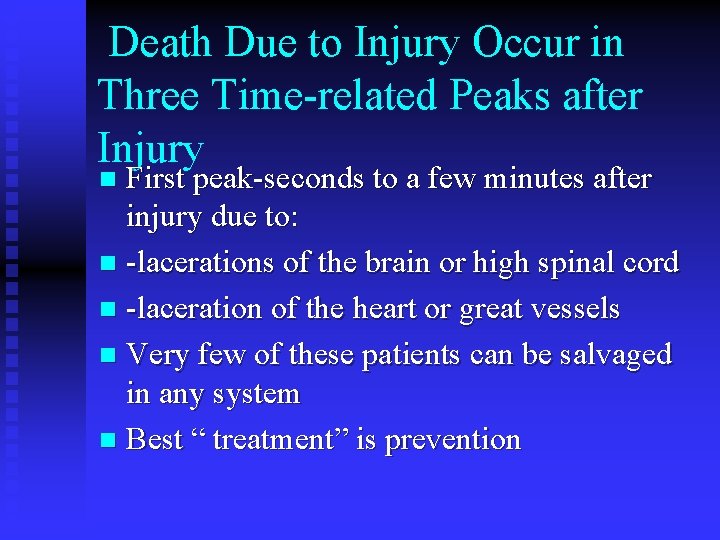
Death Due to Injury Occur in Three Time-related Peaks after Injury First peak-seconds to a few minutes after injury due to: n -lacerations of the brain or high spinal cord n -laceration of the heart or great vessels n Very few of these patients can be salvaged in any system n Best “ treatment” is prevention n
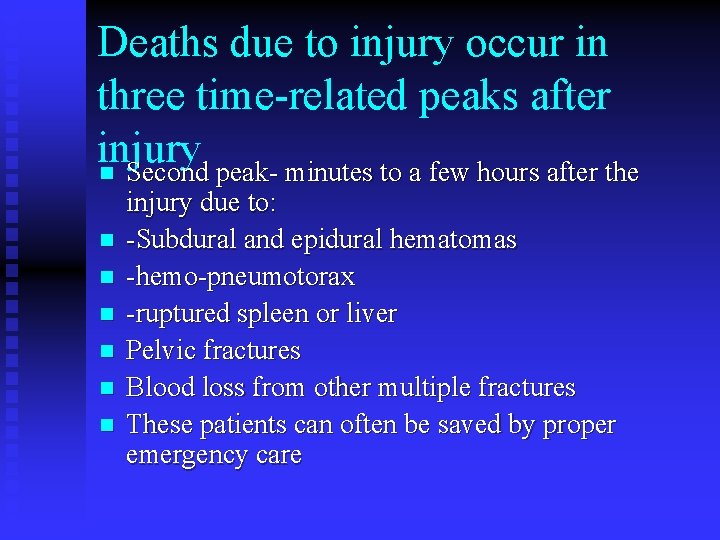
Deaths due to injury occur in three time-related peaks after injury n Second peak- minutes to a few hours after the n n n injury due to: -Subdural and epidural hematomas -hemo-pneumotorax -ruptured spleen or liver Pelvic fractures Blood loss from other multiple fractures These patients can often be saved by proper emergency care
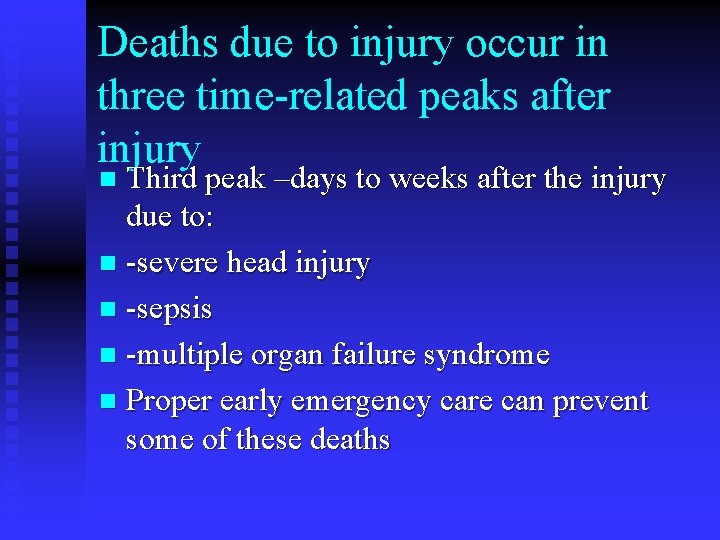
Deaths due to injury occur in three time-related peaks after injury Third peak –days to weeks after the injury due to: n -severe head injury n -sepsis n -multiple organ failure syndrome n Proper early emergency care can prevent some of these deaths n
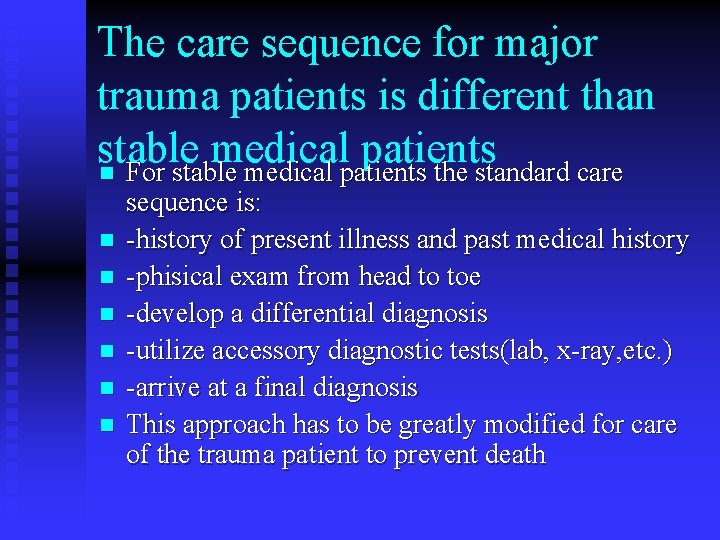
The care sequence for major trauma patients is different than stable medical patients n For stable medical patients the standard care n n n sequence is: -history of present illness and past medical history -phisical exam from head to toe -develop a differential diagnosis -utilize accessory diagnostic tests(lab, x-ray, etc. ) -arrive at a final diagnosis This approach has to be greatly modified for care of the trauma patient to prevent death
Three principles of Emergency Trauma Care n n n If a patient has multiple problems or injuries, treat first the one that is the greatest threat to life Indicated treatments should not be delayed simply because the diagnosis is not yet certain A detailed history is not essential to start evaluation and treatment of an injuried patient
Identifying the greatest threats to life in the trauma patient n n n Life threats from trauma are (in order of decreasing severity): - loss of airway -kills most quickly( head position, blood, vomitus, foreing body, external compression) - loss of breathing- kills next most quickly(pneumotorax, hemotorax, lung injury) Loss of circulation: bleeding(internal or external), heart injury, arrythmias Expanding intracranial mass
The “ABCDE” system for trauma care n n n n Always follow this sequence: -Airway ( with cervical spine control) -Breathing -Circulation( and haemorrage control) -Disability( neurologic status) -Expose and environment Completely undress the patient for exam, but take measures to avoid hypothermia
Initial assessment n n Objectives: -identify and treat immediately life-threatening injuries in the correct priority sequence Establish needed resuscitative measures to then allow a complete secondary survey to be conducted -allow triage decisions to be made when there are multiple simultaneous patients
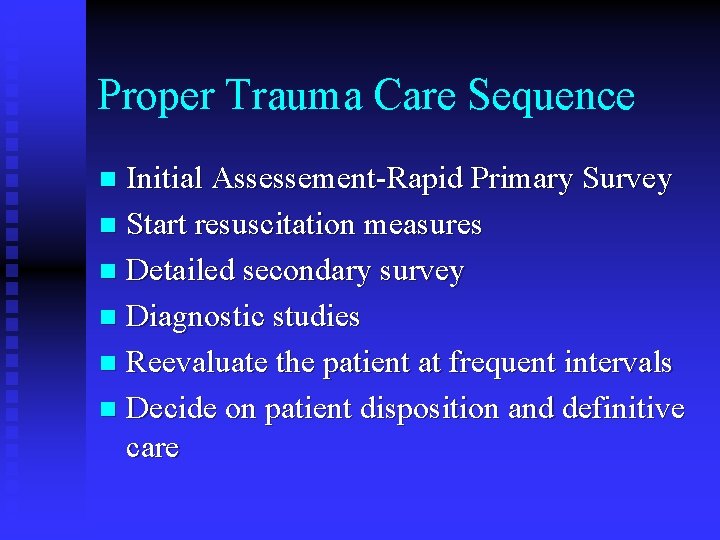
Proper Trauma Care Sequence Initial Assessement-Rapid Primary Survey n Start resuscitation measures n Detailed secondary survey n Diagnostic studies n Reevaluate the patient at frequent intervals n Decide on patient disposition and definitive care n
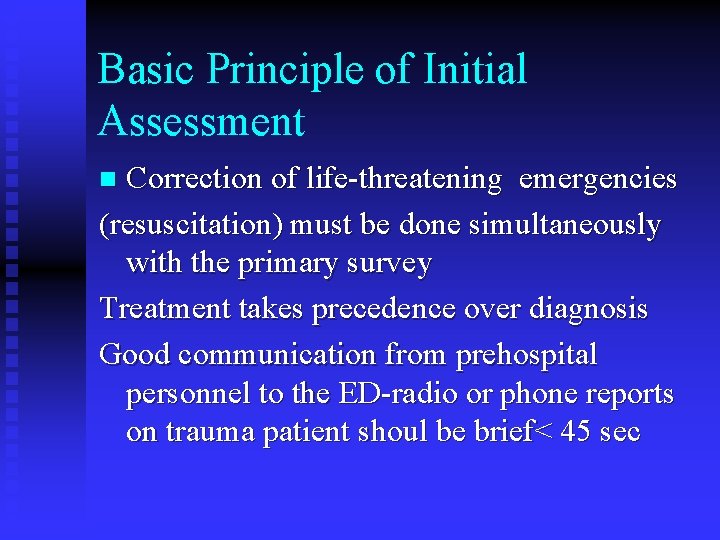
Basic Principle of Initial Assessment Correction of life-threatening emergencies (resuscitation) must be done simultaneously with the primary survey Treatment takes precedence over diagnosis Good communication from prehospital personnel to the ED-radio or phone reports on trauma patient shoul be brief< 45 sec n
Communication between prehospital personnel and the ED n n n n Number of victims and their age and gender Mechanism of injury Suspected injuries Vital signs Treatment measures started Estimated time of arrival Any special precautions for the E. D. : hazardous materals contamination, combative patient or accompanying persons
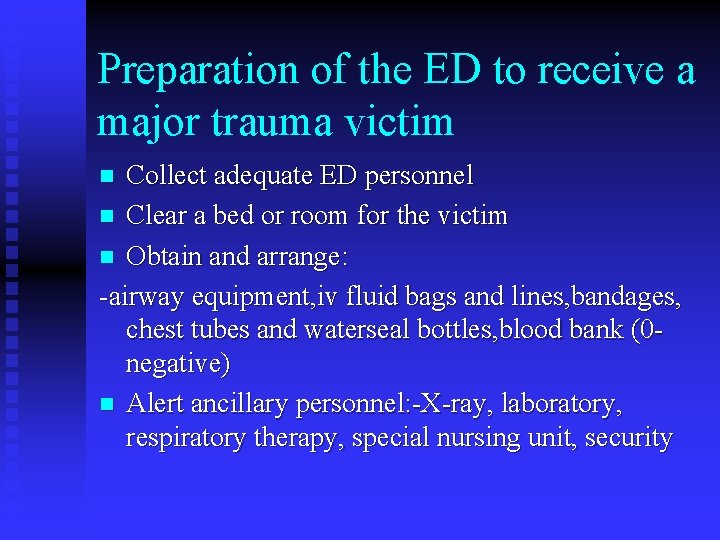
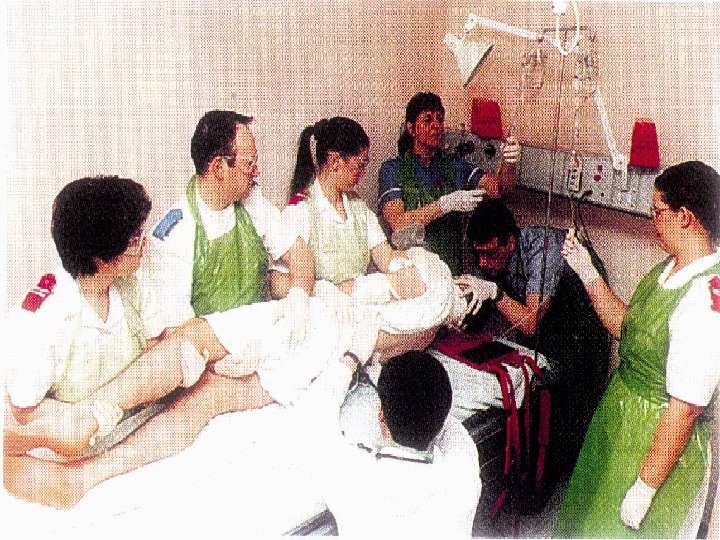
Preparation of the ED to receive a major trauma victim Collect adequate ED personnel n Clear a bed or room for the victim n Obtain and arrange: -airway equipment, iv fluid bags and lines, bandages, chest tubes and waterseal bottles, blood bank (0 negative) n Alert ancillary personnel: -X-ray, laboratory, respiratory therapy, special nursing unit, security n
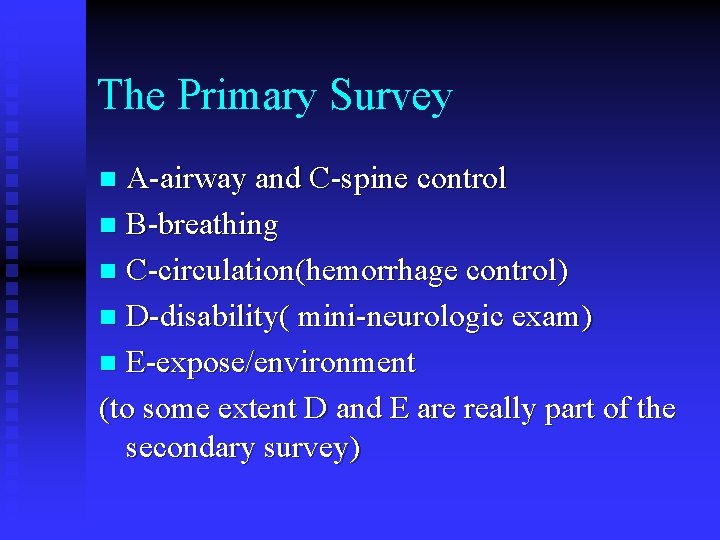
The Primary Survey A-airway and C-spine control n B-breathing n C-circulation(hemorrhage control) n D-disability( mini-neurologic exam) n E-expose/environment (to some extent D and E are really part of the secondary survey) n
How to do the primary survey Look at the patient from across the room: - is he breathing? - is he speaking? - What is the skin color? - Is he bleeding? - Is he immobilized properly? n Obtain a quick history of what happened: - mechanism of injury - Time of injury n
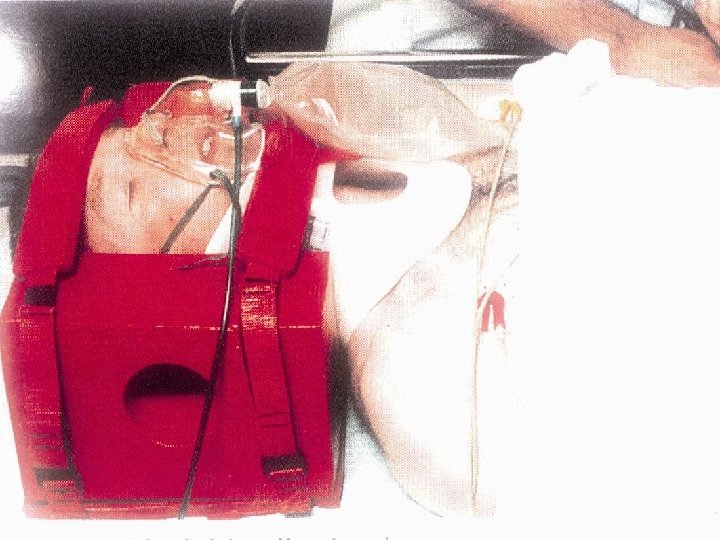
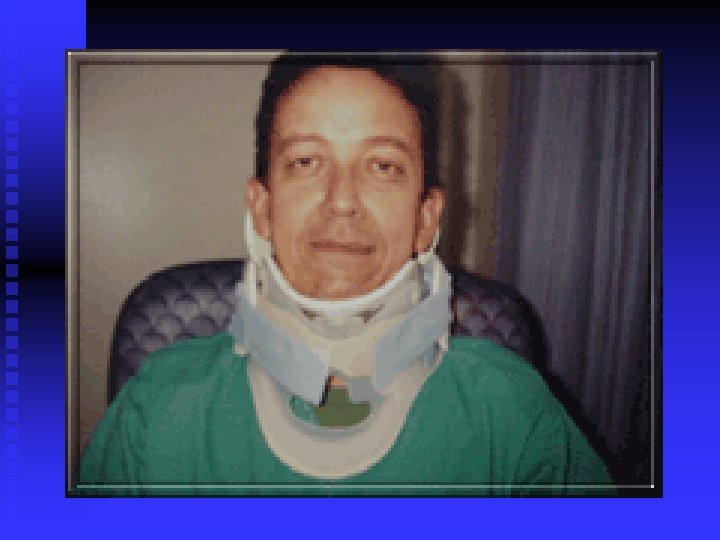
How to do the primary survey n n n Assess the airway: t Do airway- opening maneuvers if neccesary (c-spine precaution) t Place oral airway if unconscious Assess breathing: t Listen with stethoscope to the chest t Obtain pulsoximetry if available t Bag-valve-mask assisted ventilation if needed t Start oxygen by high flow face mask Early cervical spine injury precautions: t Immobilize the neck if any possibility of neck injury t “hard” collar t Blocks on either side of head and tape across forehead
Patients who might have a neck injury and need early c-spine immobilization n n Appropiate mechanism of injury t Fall t Vehicle accident t Struck by object on neck or head Unconscious Complaining of neck pain Crepitus or deformity of posterior neck Altered mental status (alcohol)
How to do the primary survey n Assess circulation u Check pulse, blood pressure, respiratory rate u Check temperature quickly u Check for external bleeding and apply direct pressure with gauze dressings u Place cardiac monitor leads and determine the patient’s cardiac rhytm
Emergency resucitation procedures that should be done immediately with the primary survey If inadequate airway: u Airway opening maneuvers u Oral airway if unconscious n If inadequate breathing: u Attempt BVM ventilation u Endotracheal intubation if BVM inadequate or unsuccessful n
Emergency endotracheal intubation Oral intubation with assistant holding head and neck steady ussualy best n May attempt nazal intubation if: u No possible nazal or mid-facial fractures u Not known coagulopathy n Surgical airway (cricothyroidotomy) if endotracheal attempt unsuccessful n
Emergency resucitation procedures that should be done immediately with the primary survey n If inadequate circulation or suspected major blood loss: u Start at least one large bore iv (16 -14 gauge) u Run lactated Ringer or normal saline • Run very slow if only isolated closed head injury • Run wide open (very fast) if patient hypotensive • Rapidly infuse 0 -negative bloode 2 or more units if obvious ongoing blood loss and severely hypotensive
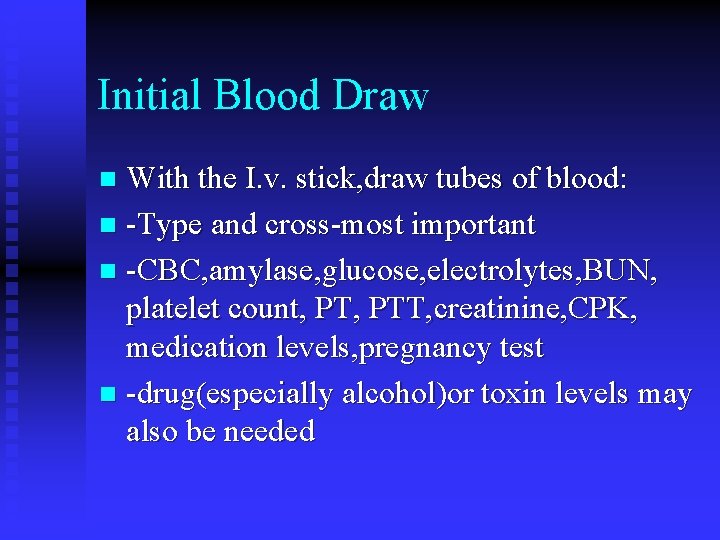
Initial Blood Draw With the I. v. stick, draw tubes of blood: n -Type and cross-most important n -CBC, amylase, glucose, electrolytes, BUN, platelet count, PTT, creatinine, CPK, medication levels, pregnancy test n -drug(especially alcohol)or toxin levels may also be needed n
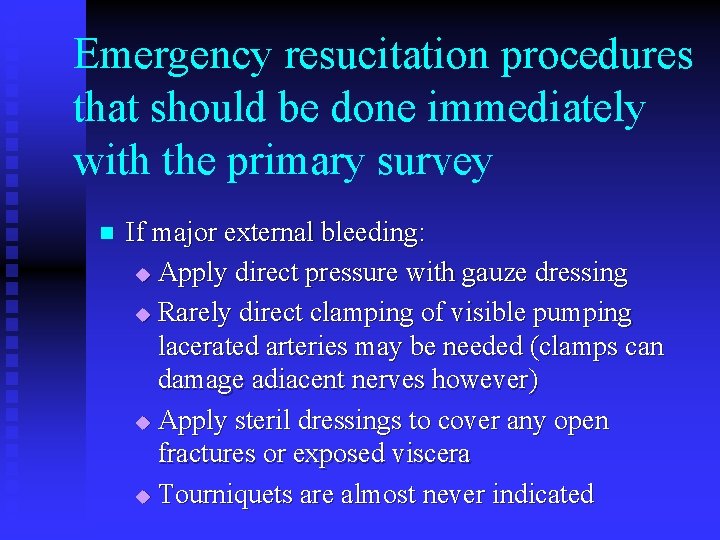
Emergency resucitation procedures that should be done immediately with the primary survey n If major external bleeding: u Apply direct pressure with gauze dressing u Rarely direct clamping of visible pumping lacerated arteries may be needed (clamps can damage adiacent nerves however) u Apply steril dressings to cover any open fractures or exposed viscera u Tourniquets are almost never indicated
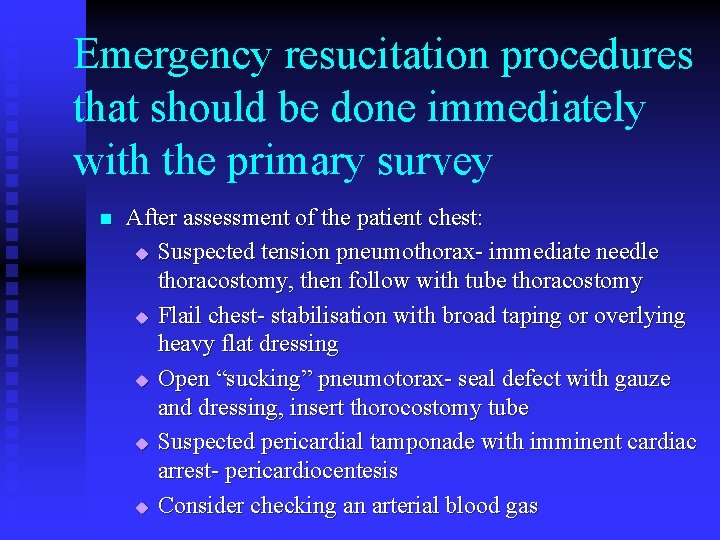
Emergency resucitation procedures that should be done immediately with the primary survey n After assessment of the patient chest: u Suspected tension pneumothorax- immediate needle thoracostomy, then follow with tube thoracostomy u Flail chest- stabilisation with broad taping or overlying heavy flat dressing u Open “sucking” pneumotorax- seal defect with gauze and dressing, insert thorocostomy tube u Suspected pericardial tamponade with imminent cardiac arrest- pericardiocentesis u Consider checking an arterial blood gas
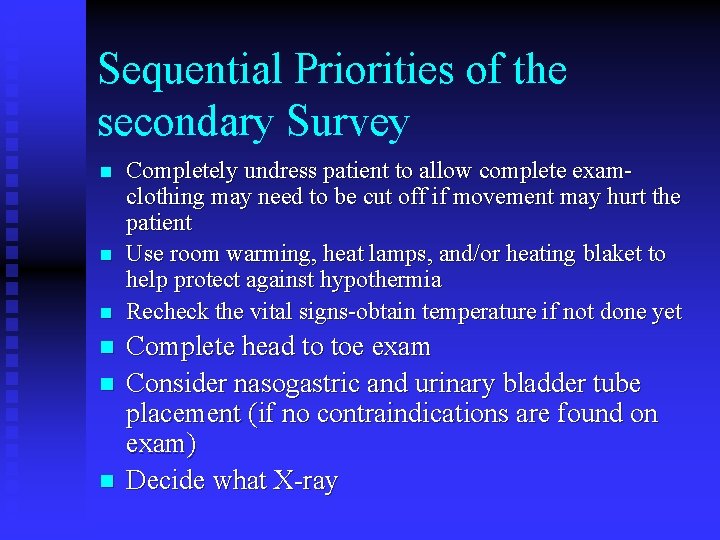
Sequential Priorities of the secondary Survey n n n Completely undress patient to allow complete examclothing may need to be cut off if movement may hurt the patient Use room warming, heat lamps, and/or heating blaket to help protect against hypothermia Recheck the vital signs-obtain temperature if not done yet Complete head to toe exam Consider nasogastric and urinary bladder tube placement (if no contraindications are found on exam) Decide what X-ray
Secondary Survey First, clarify the history of injury n One simple mnemonic is AMPLE: -Allergies -Medications -Past illnesses -Last meal(time) -events( preceding injury) n Clarify mechanism of injury n Assess for other conditions: -hypoglicemia, toxic exposure, smoke/CO exposure n
Secondary Survey: how to start the head to toe exam n n n n Assess mental status: assign Glasgow Coma Score Palpate scalp( use gloves) Look at tympanic membranes Look at nasal passages Look in mouth Palpate face and mandible Assess pulpilary light reaction and extraocular movements Fundoscopy can be done, but not usually helpfull
Secondary Survey: neck and Chest n n n n Hold patient’s head and neck stable Open the c-collar and observe anterior neck – check traheal position Palpate posterior neck, reapply collar Percuss and palpate chest wall and clavicles Auscultate lungs Auscultate heart Palpate upper back
Secondary Survey: abdomen , perineum and back n n n Auscultate and palpate and percuss abdomen Palpate and rock pelvis Logroll patient to look at back(maintain spine and limb stability with the logroll) Palpate genitalia Vaginal exam Rectal exam: -check for high prostate – Check stool guiac
Secondary Survey: exam of extremities: Palpate along all four limbs n Assess active joint range of motion n Palpate pulse and capilary refill n Assess tendon function n
Secondary Survey: neurologic exam Assign GCS n Mental status / orientation( to person, place, time, events) n Cranial nerves II thru XII n Motor, Sensory, Reflexes –all four limbs n Coordination n
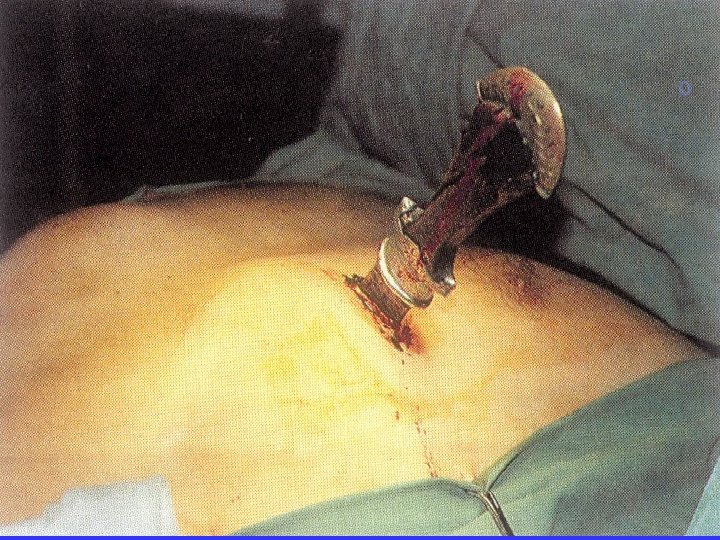
Secondary Survey: addional Considerations Splin and bandage injuries as these are discovered n Cleanse dirty wounds to allow better assessment of their depth and extent n Leave deeply imbedded objects in place for removal in the operating room( premature removal could result in exanguination if the object is tamponading a major vessel) n
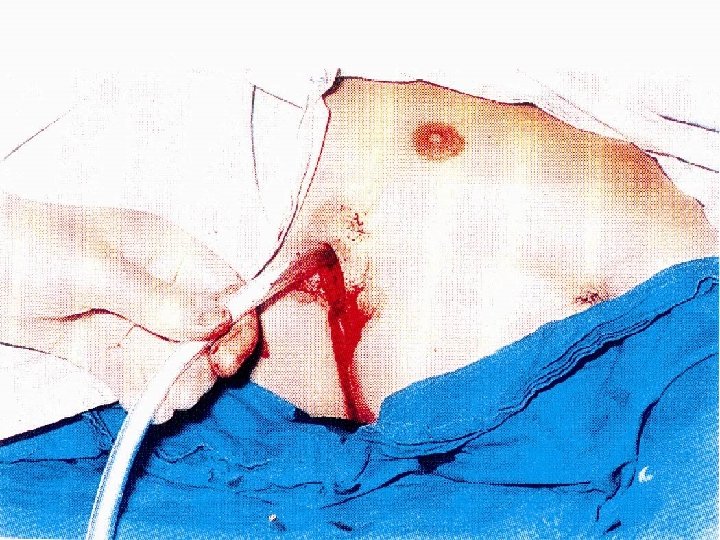
Secondary Survey: Final Considerations n n n Consider 12 lead ECG( if major chest trauma or chest pain) Usually minimum X-rays needed are( for major truncal trauma): lateral C-spine, CXR, AP pelvis(order these while doing secondary survey) X-ray all sites of potential fractures ( order these all at one time) Decide if special studies needed: peritoneal lavage, computed tomography, angiography, ultrasound Place Foley and or NG tube if no contraindications
Contraindication Nasogastric tube: nasal fractures, midfacial fractures, severe coagulopathy n Insert via mouth if any of these are present n Foley: suspected anterior urethral injuryblood at meatus, ”high-riding” or nonpalpate prostate, “butterfly” perineal hematoma n
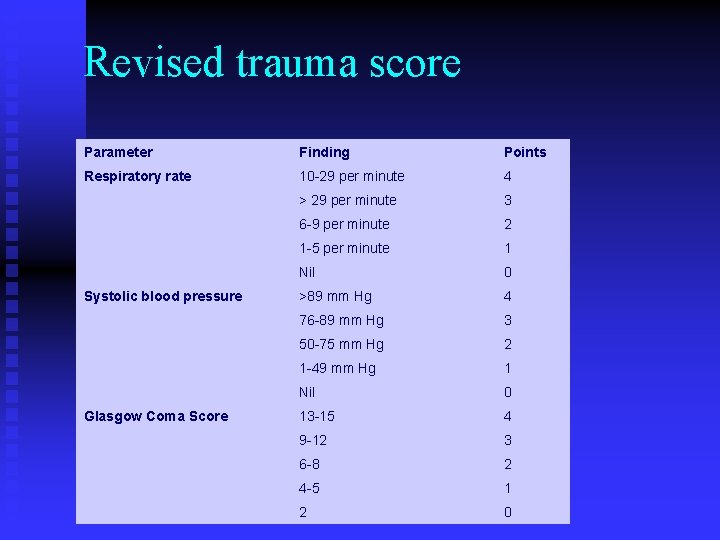
Revised trauma score Parameter Finding Points Respiratory rate 10 -29 per minute 4 > 29 per minute 3 6 -9 per minute 2 1 -5 per minute 1 Nil 0 >89 mm Hg 4 76 -89 mm Hg 3 50 -75 mm Hg 2 1 -49 mm Hg 1 Nil 0 13 -15 4 9 -12 3 6 -8 2 4 -5 1 2 0 Systolic blood pressure Glasgow Coma Score