
Emergency Solutions Grant Program Homelessness Prevention Agenda Part

- Slides: 33
Emergency Solutions Grant Program Homelessness Prevention Agenda ▫ ▫ ▫ Part I: Part III: Park IV: Part V: Eligible Uses Eligible Beneficiaries Client Documentation Additional Requirements Questions
Homelessness Prevention CFR 576. 103 ▫ Intended to provide rental assistance and housing relocation or stabilization services necessary to prevent an individual or family from moving into an emergency shelter, living on the streets, or a place not meant for human habitation
Eligible Uses
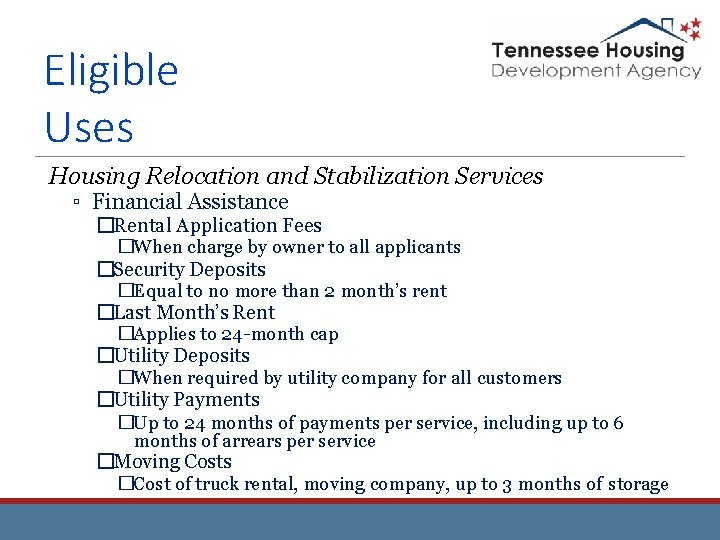
Eligible Uses Housing Relocation and Stabilization Services ▫ Financial Assistance �Rental Application Fees �When charge by owner to all applicants �Security Deposits �Equal to no more than 2 month’s rent �Last Month’s Rent �Applies to 24 -month cap �Utility Deposits �When required by utility company for all customers �Utility Payments �Up to 24 months of payments per service, including up to 6 months of arrears per service �Moving Costs �Cost of truck rental, moving company, up to 3 months of storage
Eligible Uses Housing Relocation and Stabilization Services ▫ Services �Housing Search and Placement �Up to 30 days during the period the program participant is literally homeless and seeking housing �Housing Stability Case Management �Up to 24 months �Mediation �Legal Services �Credit Repair
Eligible Uses Rental Assistance ▫ Tenant-Based or Project-Based �Short-term rental assistance � 0 -3 months �Medium-term rental assistance � 4 -12 months �Rental Arrears �One-time payment for up to 6 months of rent in arrears �Up to 24 months of rental assistance may be provided during any 3 -year period, including a onetime payment of rental arrears
Eligible Uses Additional Requirements ▫ Rental assistance cannot be provided to a program participant that is receiving Tenant-Based Rental Assistance or living in a unit receiving Project-Based Rental Assistance or operating assistance through other public sources �Exception applies to rental arrears on tenant’s portion of rental payment ▫ Utility assistance should not be the primary assistance provided, but should be provided as part of an overall stability plan �Only provided when housing has been identified �Other utility assistance available within the community should utilized first before ESG funds are utilized
Eligible Beneficiaries
Eligible Beneficiaries Homelessness Prevention ▫ Targeted to individual and families at risk of homelessness ▫ Available to persons below 30 percent of AMI and homeless or at risk of becoming homeless ▫ To prevent household from becoming homeless and to regain stability in current or other permanent housing
Eligible Beneficiaries Initial Evaluation ▫ Individual or family who meets Category 2, Category 3, or Category 4 of HUD’s Homeless Definition OR ▫ Individual or family who meets one of the three categories of HUD’s At Risk of Homelessness Definition AND ▫ Has an annual income below 30 percent of median family income for area
HUD’S Homeless Definition Category 2 - Imminent Risk of Homelessness ▫ Individual or family who will imminently lose their primary nighttime residence, provided that: � Residence will be lost within 14 days of the date of application for homeless assistance; � No subsequent residence has been identified; and � The individual or family lacks the resources or support networks need to obtain other permanent housing Category 3 - Homeless Under Other Federal Statues ▫ Unaccompanied youth under 25 years of age, or families with children and youth, who do not otherwise qualify as homeless under this definition, but who: � Are defined as homeless under the other listed federal statues; � Have not had a lease, ownership interest, or occupancy agreement in permanent housing during the 60 days prior to the homeless assistance application; � Have experienced persistent instability as measured by two moves or more during in the preceding 60 days; and � Can be expected to continue in such status for an extended period of time due to special needs or barriers Category 4 - Fleeing or Attempting to Flee DV ▫ Any individual or family who: � Is fleeing, or is attempting to flee, domestic violence; � Has no other residence; and � Lacks the resources or support networks to obtain other permanent housing
HUD’s At Risk of Homelessness Definition Category 1 – Individuals and Families ▫ An individual or family who: � Has an annual income at or below 30 percent of median family income for the area; and � Does not have sufficient resources or support networks immediately available to prevent them from moving to an emergency shelter or another place defined in Category 1 of the “homeless "definition; and � Meets one of the following conditions: � Has moved because of economic reasons 2 or more times during the 60 days immediately preceding the application for assistance; or � Is living in the home of another because of economic hardship; or � Has been notified that their right to occupy their current housing or living situation will be terminated within 21 days after the date of application for assistance; or � Lives in a hotel or motel and the cost is not paid for by charitable organizations or by federal, state, or local government programs for low-income individuals; or � Lives in an SRO or efficiency apartment unit in which there reside more than 2 persons or lives in a larger housing unit in which there reside more than one and a half persons per room; or � Is exiting a publicly funded institution or system or care; or � Otherwise lives in housing that has characteristics associated with instability and an increased risk of homelessness, as identified in the recipient’s approved Con Plan Category 2 – Unaccompanied Children and Youth ▫ A child or youth who does not qualify as homeless under the homeless definition, but qualifies as homeless under another federal statue Category 3 – Families with Children and Youth ▫ An unaccompanied youth who does not qualify as homeless under the homeless definition, but qualifies as homeless under the Mc. Kinney-Vento Homeless Assistance Act, and the parent(s) or guardians(s) or that child or youth if living with him or her
Eligible Beneficiaries Re-Evaluation of Eligibility ▫ Program participants must be re-evaluated at least once every three months ▫ Eligibility: �Program participant does not have an annual income that exceed 30 percent of median family income for the area �Program participant lacks sufficient resources and support networks necessary to retain housing without ESG assistance ▫ Types and amounts of assistance
Client Documentation
Client Documentation Forms ▫ Each documentation requirement must be met, whether a form is provided or not ▫ Agency is able to create own forms as long as the documentation requirement is met
Client Documentation Intake Documentation ▫ Documentation of ID for all program participants 18 and older ▫ Documentation of Social Security Number for each program participant
Client Documentation Eligibility Documentation ▫ Documentation of initial evaluation to determine the eligibility of each individual or family’s eligibility for ESG program ▫ Documentation of homeless status or at-risk of homelessness status ▫ Documentation of annual income ▫ Documentation of re-evaluation of participant’s eligibility ▫ Documentation of ineligibility for each individual or family determined ineligible for ESG program
Client Documentation Housing Documentation ▫ Lease ▫ Rental assistance agreements for the provision of rental assistance ▫ Documentation of rent reasonableness and fair market rent for all housing units ▫ Documentation of compliance with housing standards
Client Documentation Assistance Documentation ▫ Documentation of client need for assistance �Eviction notice, utility statements ▫ Documentation of types of services and/or assistance provided and amounts spend on services and/or assistance ▫ Documentation of payments made to owners for provision of rental assistance
Client Documentation Assistance Documentation ▫ Documentation of services and assistance provided to each program participant ▫ Documentation that the provision of services or assistance are eligible under the program component ▫ Documentation of compliance with termination of assistance requirement ▫ Documentation of use of local coordinated entry system, as available
Client Documentation Case Management Documentation ▫ Documentation of case management services ▫ Documentation of housing plan for stability in permanent housing ▫ Documentation of connecting participants to mainstream and other resources for supportive services
Additional Requirements
Additional Requirements Case Management ▫ Assistance through ESG is intended to be provided as a part of a system-wide approach �Develop a plan with each program participant on how they will retain permanent housing after the ESG assistance ends �Require program participants to meet with a case manager not less than once per month while they are receiving ESG-assistance to implement the plan and monitor progress towards housing stability �Exemption from this requirement if agency also receives funding under the VAWA or FVSP �Assist program participants in obtaining appropriate supportive services, as well as connecting them to other federal, state, local, and private benefits and services for which they may be eligible �Have written polices and procedures for coordination among different providers of services in the community ▫ Case management is required for any type of assistance
Additional Requirements Case Management ▫ Case management services should be directed towards address the housing stability needs of clients ▫ Should include goal planning, prioritization of client needs, client progress ▫ Documentation of client services must be included in client files to show agency is addressing the needs of clients and progress towards housing ▫ For clients protected by VAWA, case management can not be required to receive assistance, but it is required that the program offer services to clients and document frequent efforts of offering services
Additional Requirements Rent Reasonableness and Fair Market Rent ▫ Housing unit must not exceed the Fair Market Rent (FMR) established by HUD for each geographic area and comply with HUD’s standard of rent reasonableness ▫ Rent Reasonableness �Ensure that rents being paid are reasonable in relation to rents being charged for comparable unassisted units in the same market ▫ Fair Market Rent �Determined payment standards or rent ceilings for HUDfunded programs that provide rental assistance �Gross rent = rent + cost of utilities
Additional Requirements Rental Assistance Agreements ▫ Between the agency and property owner ▫ Sets the terms under which the rental assistance is being provided �A provision requiring the owner to give the agency a copy of any notice to the program participant to vacate the housing unit, or any compliant used under state or local law to commence an eviction against the program participant �The same payment due date, grace period, and late payment penalty requirements as the program participant’s lease �The agency should establish the term of the rental assistance agreement for the period of time they anticipate providing assistance
Additional Requirements Rental Assistance Agreements ▫ Should include provisions addressing: �Type of rental assistance being provided �Late payments �Program participant sharing in rent �Termination ▫ When assistance for rental arrears is provided, the agreement should provide the amount paid by the agency, include the number of months of arrears paid, any other terms and conditions of the payment, and should reflect the evidence/documentation used to justify that the arrears are an eligible payment
Additional Requirements Lease Agreements ▫ Each program participant receiving rental assistance must have a legally binding, written lease for the rental unit, unless the rental assistance is provided solely for rental arrears ▫ Must be between the program participant and the owner ▫ When assistance is provided solely for arrears, an oral lease agreement may be accepted in place of a written lease, if the agreement gives the program participant an enforceable leasehold interest under state law and the agreement and rent owed are sufficiently documented by the owner’s financial records, rent ledgers, or cancelled checks
Additional Requirements Habitability Standards ▫ When using ESG funds to help a program participant remain in or move into housing, must ensure that it meets the minimum habitability standards ▫ Housing unit must be inspected before providing services or assistance
Additional Requirements Prioritization ▫ Individuals and families with the greatest need receive priority for any type of assistance available ▫ Grantees should have prioritization policy in place which outlines the process by which the agency will prioritize the most in need of services ▫ Policies should be in place in order to ensure that ESG funding is being utilized in the most effective service provision methods
Additional Requirements Coordinated Entry Participation � 24 CFR 576. 400 (d) �Each local continuum of care is required to develop and/or operate a centralized or coordinated intake or assessment system if any agencies in the continuum of care receive federal funding �Sub-recipients must participate in the coordinated entry for their Co. C �If there is not yet a centralized intake, a sub-recipient must participate in its implementation and eventually its use �If Co. C has identified an intake tool for the community, agency must utilize as applicable
Additional Requirements Resource Coordination � 24 CFR 576. 400 (b) and (c) �Coordination with homeless services and mainstream resources �Grantee will assist homeless individuals in obtaining permanent housing, appropriate supportive services, and other federal, state, local, and private assistance available for such individuals �Documentation of coordination efforts must be included in client files
Contact Information Please submit all questions to esg@thda. org