
Emergency Services Collaboration Project brief Key Research Questions
Emergency Services Collaboration
Project brief - Key Research Questions To what extent are projects operating as outlined in their project plans and business cases? How has collaboration been achieved? To what extent do these collaboration projects support wider public service change? How do collaboration projects ensure longevity and become sustainable? What lessons have been identified? What evidence is there of successful outcomes (including financial) of these projects? Which indicators should be used to monitor collaboration activity in the future? What evidence is there of wider sharing of the lessons and of them being learnt? What are the national and local enablers and barriers to successful collaboration in the rest of England Wales?
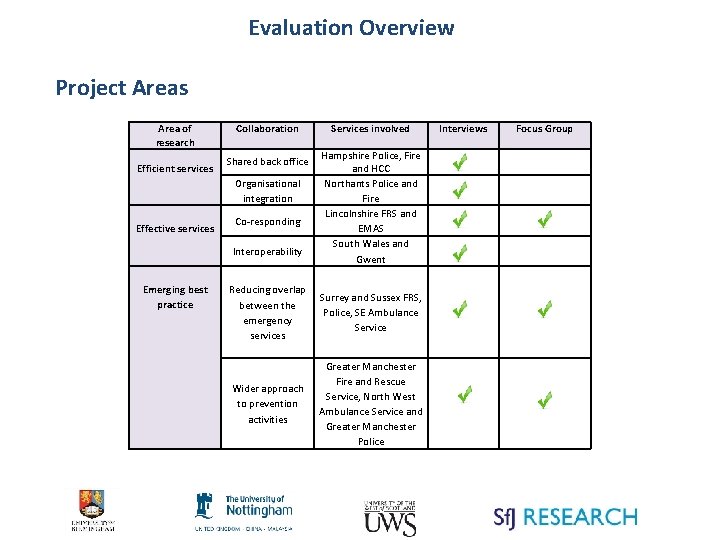
Evaluation Overview Project Areas Area of research Efficient services Collaboration Shared back office Organisational integration Effective services Co-responding Interoperability Emerging best practice Services involved Hampshire Police, Fire and HCC Northants Police and Fire Lincolnshire FRS and EMAS South Wales and Gwent Reducing overlap between the emergency services Surrey and Sussex FRS, Police, SE Ambulance Service Wider approach to prevention activities Greater Manchester Fire and Rescue Service, North West Ambulance Service and Greater Manchester Police Interviews Focus Group
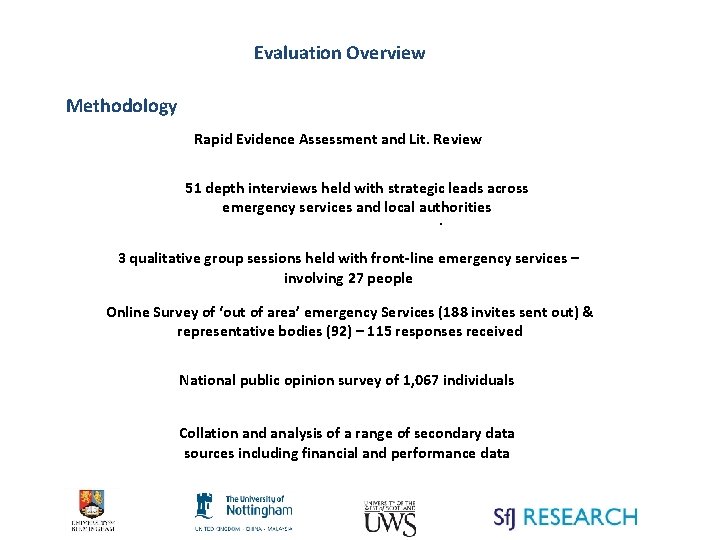
Evaluation Overview Methodology Rapid Evidence Assessment and Lit. Review 51 depth interviews held with strategic leads across emergency services and local authorities. 3 qualitative group sessions held with front-line emergency services – involving 27 people Online Survey of ‘out of area’ emergency Services (188 invites sent out) & representative bodies (92) – 115 responses received National public opinion survey of 1, 067 individuals Collation and analysis of a range of secondary data sources including financial and performance data
Evaluation Overview Outputs . Powerpoint presentation Booklet Final report with recommendations
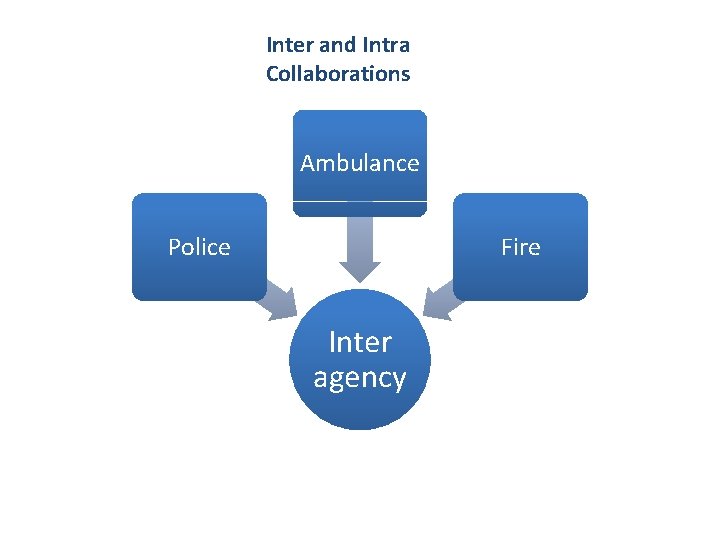
Inter and Intra Collaborations Ambulance Police Fire Inter agency
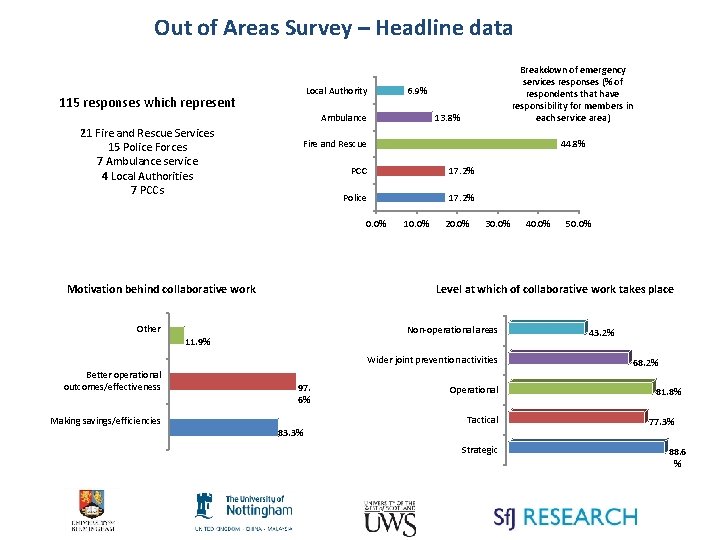
Out of Areas Survey – Headline data 6. 9% Local Authority 115 responses which represent 13. 8% Ambulance 21 Fire and Rescue Services 15 Police Forces 7 Ambulance service 4 Local Authorities 7 PCCs Breakdown of emergency services responses (% of respondents that have responsibility for members in each service area) Fire and Rescue 44. 8% PCC 17. 2% Police 17. 2% 0. 0% Motivation behind collaborative work 10. 0% 20. 0% 30. 0% Non-operational areas 11. 9% Wider joint prevention activities Making savings/efficiencies 50. 0% Level at which of collaborative work takes place Other Better operational outcomes/effectiveness 40. 0% 97. 6% Operational Tactical 83. 3% Strategic 43. 2% 68. 2% 81. 8% 77. 3% 88. 6 %
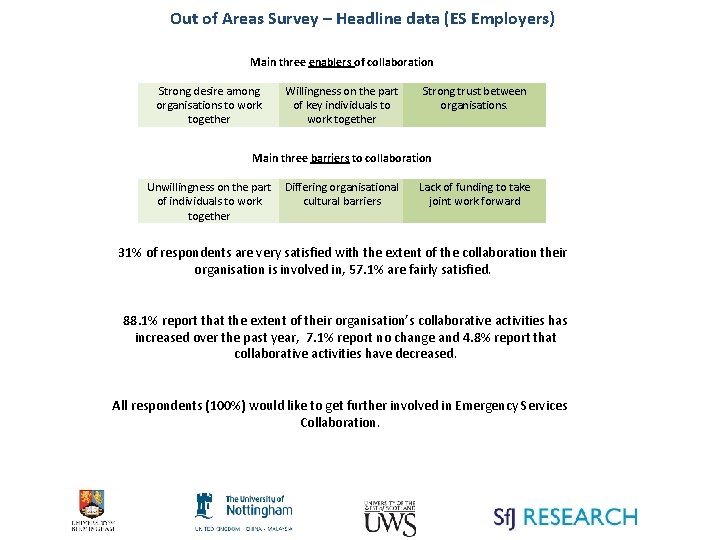
Out of Areas Survey – Headline data (ES Employers) Main three enablers of collaboration Strong desire among organisations to work together Willingness on the part of key individuals to work together Strong trust between organisations. Main three barriers to collaboration Unwillingness on the part Differing organisational of individuals to work cultural barriers together Lack of funding to take joint work forward 31% of respondents are very satisfied with the extent of the collaboration their organisation is involved in, 57. 1% are fairly satisfied. 88. 1% report that the extent of their organisation’s collaborative activities has increased over the past year, 7. 1% report no change and 4. 8% report that collaborative activities have decreased. All respondents (100%) would like to get further involved in Emergency Services Collaboration.
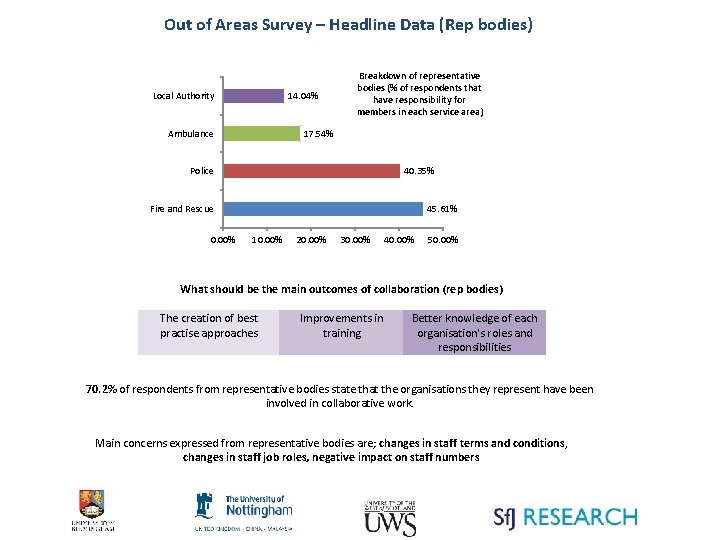
Out of Areas Survey – Headline Data (Rep bodies) 14. 04% Local Authority Ambulance Breakdown of representative bodies (% of respondents that have responsibility for members in each service area) 17. 54% Police 40. 35% Fire and Rescue 0. 00% 45. 61% 10. 00% 20. 00% 30. 00% 40. 00% 50. 00% What should be the main outcomes of collaboration (rep bodies) The creation of best practise approaches Improvements in training Better knowledge of each organisation's roles and responsibilities 70. 2% of respondents from representative bodies state that the organisations they represent have been involved in collaborative work. Main concerns expressed from representative bodies are; changes in staff terms and conditions, changes in staff job roles, negative impact on staff numbers
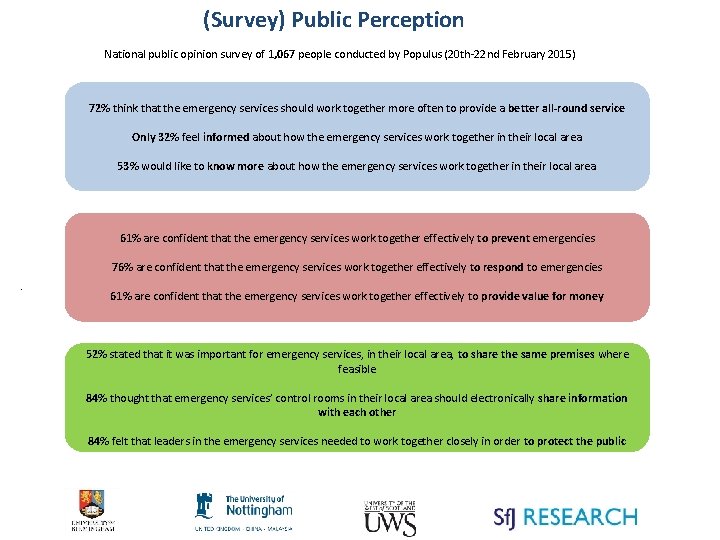
(Survey) Public Perception National public opinion survey of 1, 067 people conducted by Populus (20 th-22 nd February 2015) 72% think that the emergency services should work together more often to provide a better all-round service Only 32% feel informed about how the emergency services work together in their local area 53% would like to know more about how the emergency services work together in their local area 61% are confident that the emergency services work together effectively to prevent emergencies 76% are confident that the emergency services work together effectively to respond to emergencies. 61% are confident that the emergency services work together effectively to provide value for money 52% stated that it was important for emergency services, in their local area, to share the same premises where feasible 84% thought that emergency services’ control rooms in their local area should electronically share information with each other 84% felt that leaders in the emergency services needed to work together closely in order to protect the public
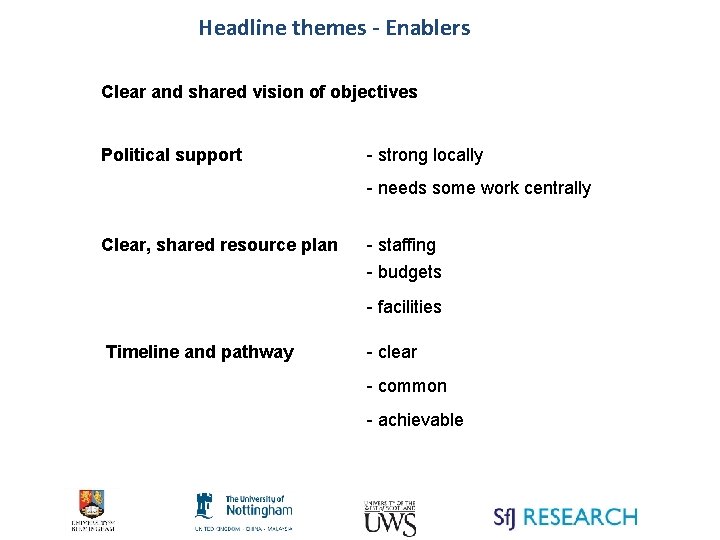
Headline themes - Enablers Clear and shared vision of objectives Political support - strong locally - needs some work centrally Clear, shared resource plan - staffing - budgets - facilities Timeline and pathway - clear - common - achievable
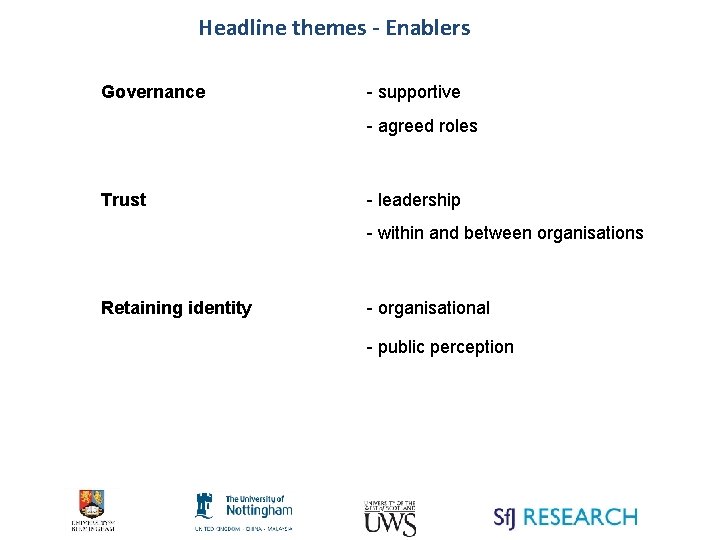
Headline themes - Enablers Governance - supportive - agreed roles Trust - leadership - within and between organisations Retaining identity - organisational - public perception
Headline themes - Barriers Reverse of enablers Funding - access - different structures - allocation process - future Focus - needs widening - emergency only misses the point
Headline themes - Barriers Government departments - risk of silo mentality - structural issues - conflicting visions Representative bodies - staff issues - location issues - could also be an enabler Legislation - issues to be addressed BUT should not be used as a barrier to progress Organisational differences - terms and conditions - rosters - internal structures
Economic/data analysis - findings Main findings All business cases report a mix of financial and non-financial benefits Cost and benefit estimates provided in each case BUT Varying degrees of details with some areas providing detailed basis for their projections and other providing cost breakdown without underlying assumptions Similar variation in providing estimates of benefits In most cases, it is early days to measure success but we provide suggestion how success can be measured in the future
Economic/data analysis - recommendations Recommendations • Provides advice on making better business cases by reporting underlying model on which costs and benefits are calculated • Best business cases provide detailed breakdown and rationale for costs and benefits which should be emulated • Best cases also provide bounds (high and low scenarios) and discount factors used that should be adopted
Economic/data analysis - recommendations All areas would benefit from laying out a better understanding of non-monetary benefits which can be monitored over a number of years Greater understanding of other related factors that can change outcomes would lead to a more robust understanding of what changes can be attributed to joint working Develop a clearer understanding of the mechanisms through which change occurs as a result of joint working
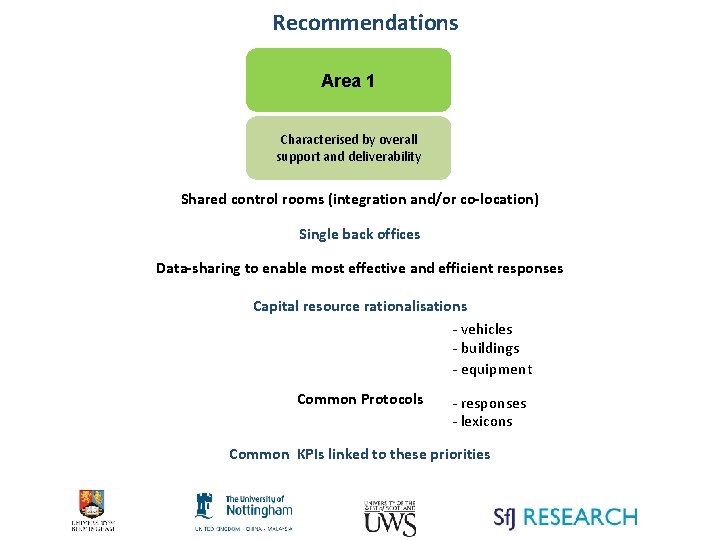
Recommendations Area 1 Characterised by overall support and deliverability Shared control rooms (integration and/or co-location) Single back offices Data-sharing to enable most effective and efficient responses Capital resource rationalisations - vehicles - buildings - equipment Common Protocols - responses - lexicons Common KPIs linked to these priorities
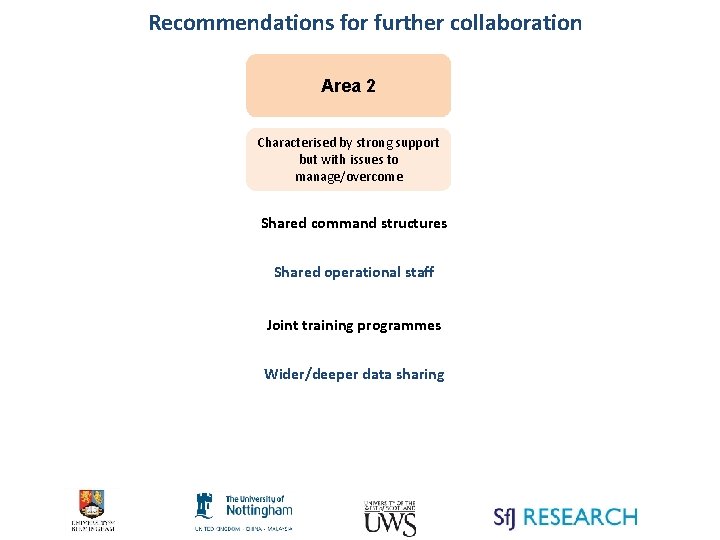
Recommendations for further collaboration Area 2 Characterised by strong support but with issues to manage/overcome Shared command structures Shared operational staff Joint training programmes Wider/deeper data sharing
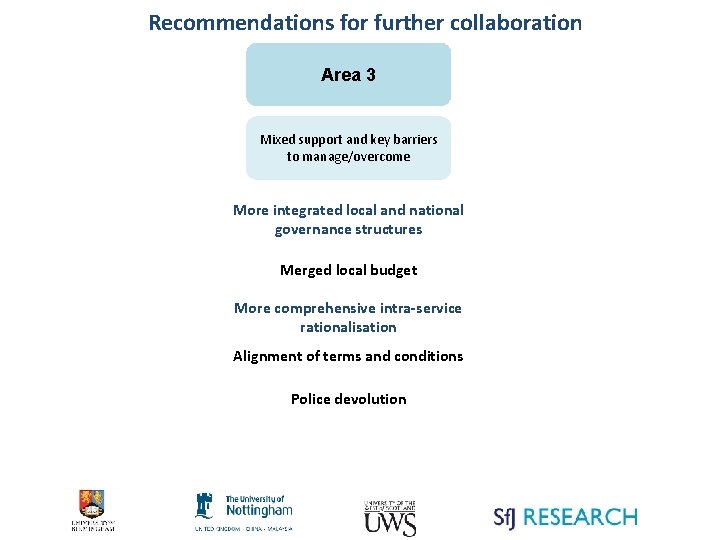
Recommendations for further collaboration Area 3 Mixed support and key barriers to manage/overcome More integrated local and national governance structures Merged local budget More comprehensive intra-service rationalisation Alignment of terms and conditions Police devolution
- Slides: 20