
Emergency Room Resuscitation of the Unstable Trauma Patient
Emergency Room Resuscitation of the Unstable Trauma Patient N. K. Jain, MD, FRCSC General Surgeon, North York General Hospital Toronto, Canada March 2007
Objectives: Trauma Resuscitation • Review approach • Review knowledge and technical skills • Discuss appropriate investigations • Discuss transfer of care
Goals of trauma resuscitation • Maintain: – Systemic oxygenation – Systemic perfusion – Neurologic function
Approach to unstable trauma patient • Primary survey – Detect and manage life threatening injuries Examples: Hypoxia, tension pneumo, shock, tamponade, herniation How: ABCD • Secondary survey – Detect other injuries and formulate treatment plan Examples: All other injuries or fractures How: Expose patient Head-toe exam Investigations
Airway The first step is assessing the adequacy of the airway Ventilatory inadequacy may result from the a mechanical obstruction of the airway e. g. tongue, foreign body, vomitus, food, blood, or from inadequate ventilatory effort. A partially obstructed airway is indicated by: 1. Noisy and laboured breathing ( stridor) 2. Use of accessory muscles of breathing ( sternomastoid) 3. Soft tissue retraction of the intercostal, supraclavicular, and suprasternal areas. 4. Paradoxical or “seesaw “ breathing. Normally in the unobstructed airway the chest and abdomen rise and fall together. If the airway is partially or completely obstructed and cardiac arrest has not occurred, the chest is sucked in as the abdomen rises. 5. Cyanosis. A circulating reduced Hb level of < 5 gms% is associated with cyanosis- this is a late sign of hypoxia esp if the pt is anemic. Ventilatory failure is noted by minimal or absent chest or abdominal movement and an inability to detect air movement through the mouth or nose. The most important step for successful resuscitation is immediate opening of the airway , establishing an adequate airway and maintaining adequate ventilation
AIRWAY MANAGEMENT • • Head tilt Chin lift Mandibular thrust- forward displacement Oropharngeal airway-only in unconscious/stuporous pt • Bag and mask
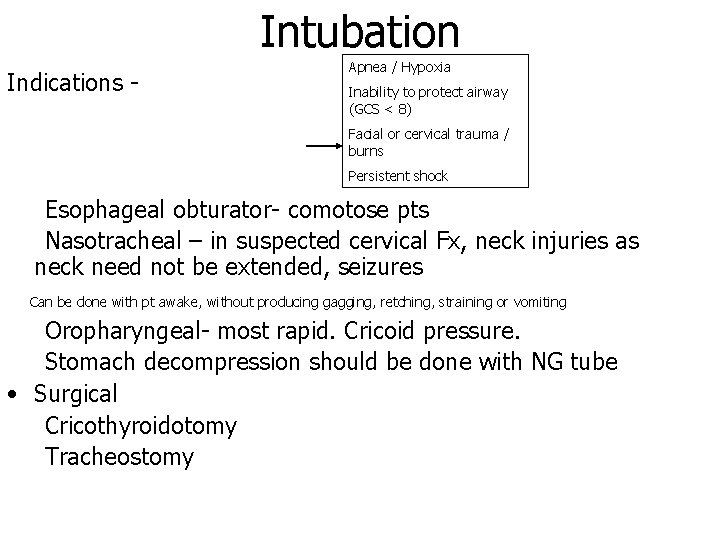
Intubation Indications - Apnea / Hypoxia Inability to protect airway (GCS < 8) Facial or cervical trauma / burns Persistent shock Esophageal obturator- comotose pts Nasotracheal – in suspected cervical Fx, neck injuries as neck need not be extended, seizures Can be done with pt awake, without producing gagging, retching, straining or vomiting Oropharyngeal- most rapid. Cricoid pressure. Stomach decompression should be done with NG tube • Surgical Cricothyroidotomy Tracheostomy
Breathing • Knowledge – Indications for inserting chest tube • Skills – Needle thoracostomy – Chest tube insertion Possible tension pneumo Simple pneumo Hemothorax
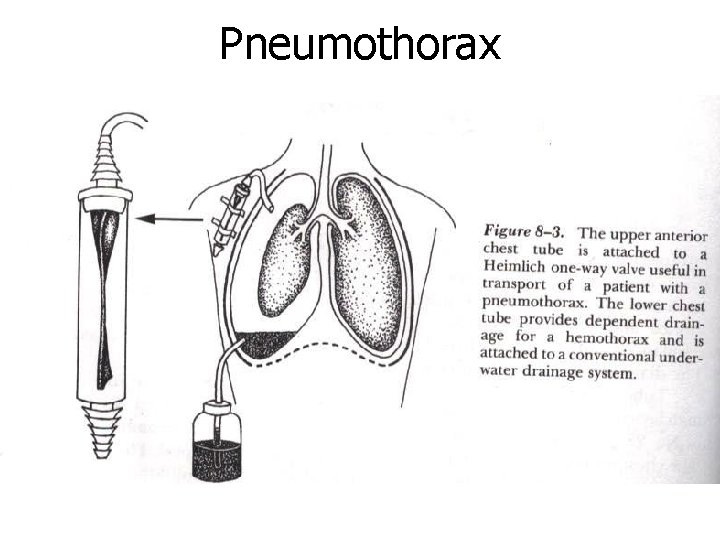
Pneumothorax
Circulation • Knowledge – Differential diagnosis of shock in trauma • • Hemorrhagic / hypovolemic Obstructive (tension pneumo, tamponade) Neurogenic (usually not cardiogenic, septic, or anaphylactic) – Fluid resuscitation • 2 L crystalloid, then blood (uncrossmatched or matched) • Skills – – – IV Central line (femoral) Interosseus line Cut down Arterial puncture (femoral)
Classification of Hemorrhage • Class 1 - 15% blood volume- normal BP, min inc in pulse and resp, blanching of nail capillaries by pressure may be increased indicating peripheral vasoconstriction, Tilt test neg– pt sits up for 90 secs without vertigo or dec BP Give crystalloid – 3: 1 rule- 3 times as much crystalloid is given as estimated volume loss. • Class 2 – 20 -25% blood loss-Hypotension, tachycardia and tachypnoea, Tilt test +, capillary blanch +. Give blood if there is continued blood loss eg pelvic / femur fractures • Class 3 – 30 -40% blood loss- Shock. Give crystalloid 3: 1 and blood • Class 4 - 40 -50% blood loss- Pt obtunded
Hemorrhagic Shock • External bleeding – Control with direct pressure / staples / sutures – Fluid resuscitation usually successful • Internal bleeding – May be from thorax, abdomen, or pelvis – Usually requires surgical intervention if fluid resuscitation unsuccessful
Disability • Knowledge – Familiarity with GCS & basic neuro exam – Managing raised ICP • Hyperventilate (p. CO 2 28 -30) • Mannitol 1 g / kg IV • Gently raise head of bed • Skills – Applying a collar – (Most of us cannot do burr holes)
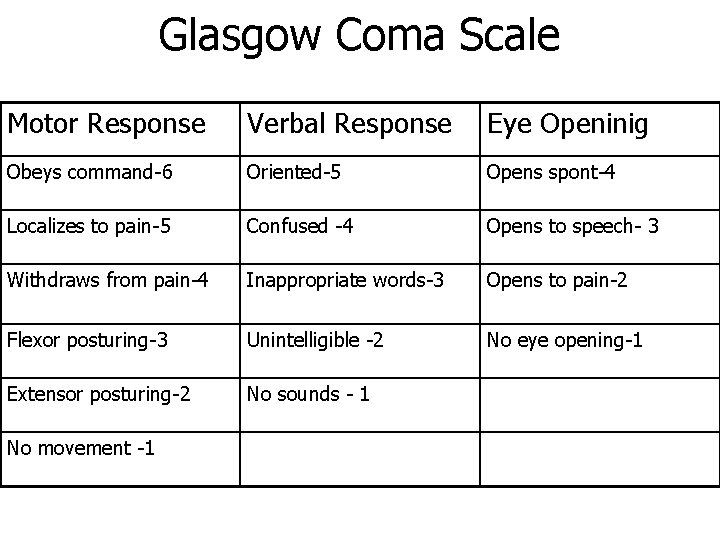
Glasgow Coma Scale Motor Response Verbal Response Eye Openinig Obeys command-6 Oriented-5 Opens spont-4 Localizes to pain-5 Confused -4 Opens to speech- 3 Withdraws from pain-4 Inappropriate words-3 Opens to pain-2 Flexor posturing-3 Unintelligible -2 No eye opening-1 Extensor posturing-2 No sounds - 1 No movement -1
Evaluation-Secondary Survey • • Exposure – cut clothing Head to toe exam Assess pelvic stability Log roll DRE (high riding prostate, blood, tone) Foley insertion NG insertion (prevent aspiration, look for blood) • Applying a pelvic brace if indicated(bedsheet)
FRACTURES Stablisation
Investigations 1) Blood work (including cross match) 2) CXR 3) Pelvic X-ray • In unstable patient, do not usually need further X-rays or CT prior to transfer • In stable patient, further investigations as indicated
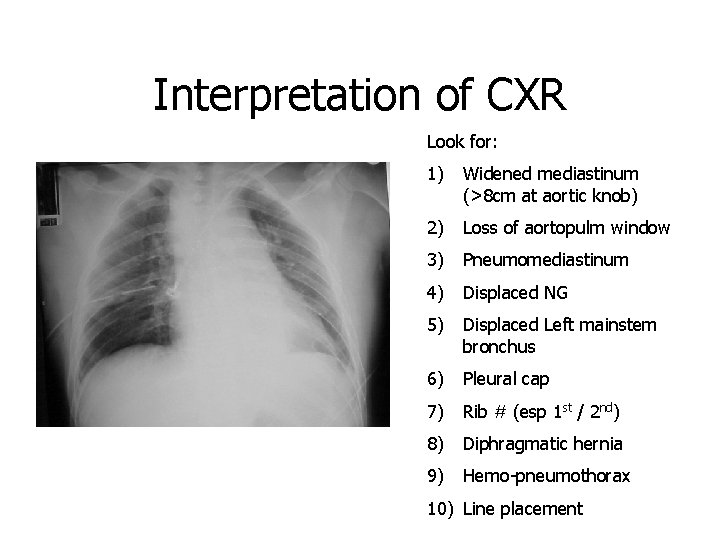
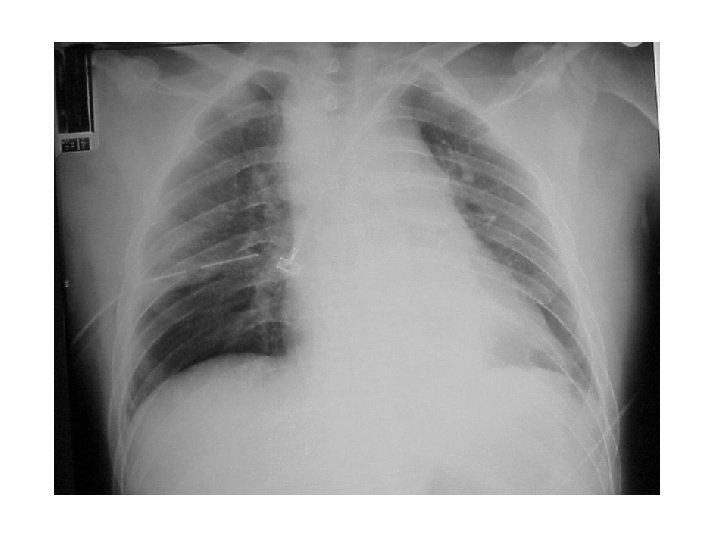
Interpretation of CXR Look for: 1) Widened mediastinum (>8 cm at aortic knob) 2) Loss of aortopulm window 3) Pneumomediastinum 4) Displaced NG 5) Displaced Left mainstem bronchus 6) Pleural cap 7) Rib # (esp 1 st / 2 nd) 8) Diphragmatic hernia 9) Hemo-pneumothorax 10) Line placement
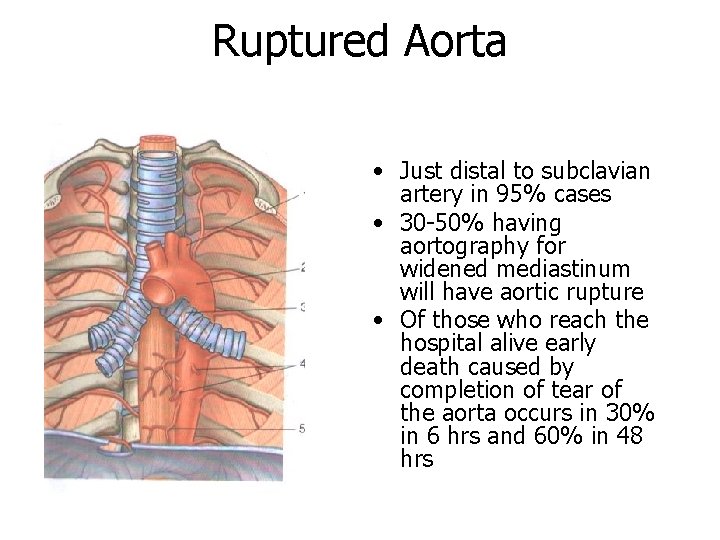
Ruptured Aorta • Just distal to subclavian artery in 95% cases • 30 -50% having aortography for widened mediastinum will have aortic rupture • Of those who reach the hospital alive early death caused by completion of tear of the aorta occurs in 30% in 6 hrs and 60% in 48 hrs
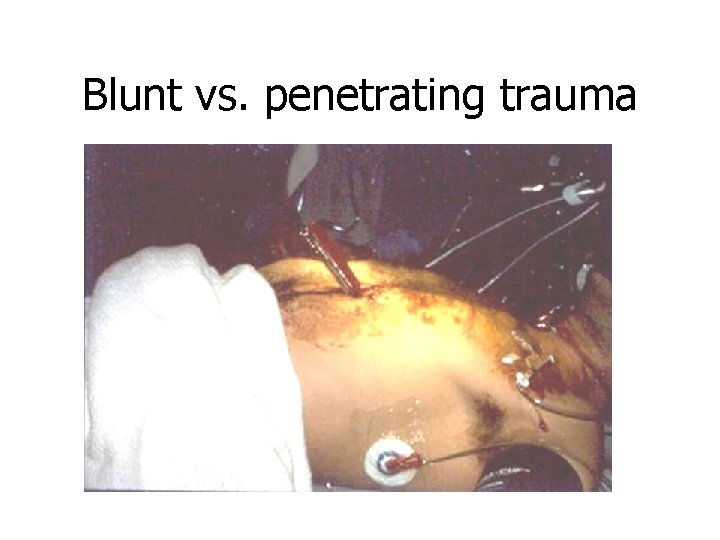
Blunt vs. penetrating trauma
Blunt vs. penetrating trauma • Similar management • If implement still present (eg, knife), leave it in place, should be removed intra-op • Look for “entry” and “exit” sites • Give tetanus if indicated
Transfer of unstable patient • Call for help early • Prior to transfer, carefully consider need to intubate or insert chest tubes • Ensure adequate IV access • Send with blood • Send with trained personel • Send with CXR / pelvic X-ray if possible • Unnecessary investigations will delay transfer
Summary - Knowledge • • • Indications for intubation Indications for chest tube insertion Approach to shock / fluid resuscitation Familiarity with GCS Managing raised ICP
Summary - Skills • • • Intubation Surgical airway (needle cricothyrodotomy) Needle thoracostomy or chest tube insertion Intravenous Central line insertion Interosseus insertion Arterial stab Applying a C-spine collar Foley / NG Applying a pelvic brace (FAST or DPL to look for intra-abdominal bleeding – usually in trauma centre or by local surgeon)
Remember… Managing an unstable trauma patient can be stressful. Following the “primary / secondary survey” approach will help you organize your thoughts and prioritize management.

Scenarios
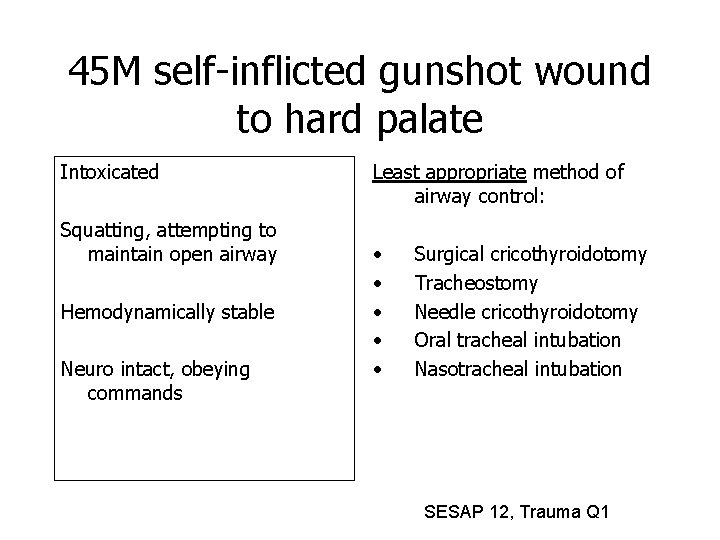
45 M self-inflicted gunshot wound to hard palate Intoxicated Squatting, attempting to maintain open airway Hemodynamically stable Neuro intact, obeying commands Least appropriate method of airway control: • • • Surgical cricothyroidotomy Tracheostomy Needle cricothyroidotomy Oral tracheal intubation Nasotracheal intubation SESAP 12, Trauma Q 1
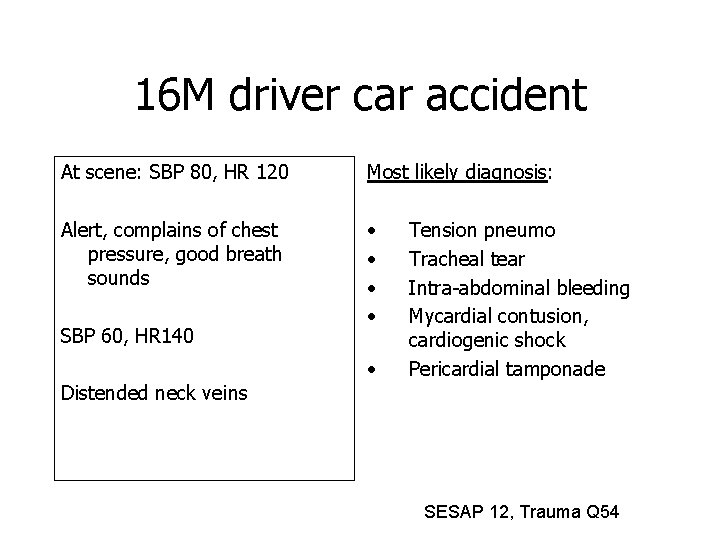
16 M driver car accident At scene: SBP 80, HR 120 Most likely diagnosis: Alert, complains of chest pressure, good breath sounds • • SBP 60, HR 140 Distended neck veins • Tension pneumo Tracheal tear Intra-abdominal bleeding Mycardial contusion, cardiogenic shock Pericardial tamponade SESAP 12, Trauma Q 54
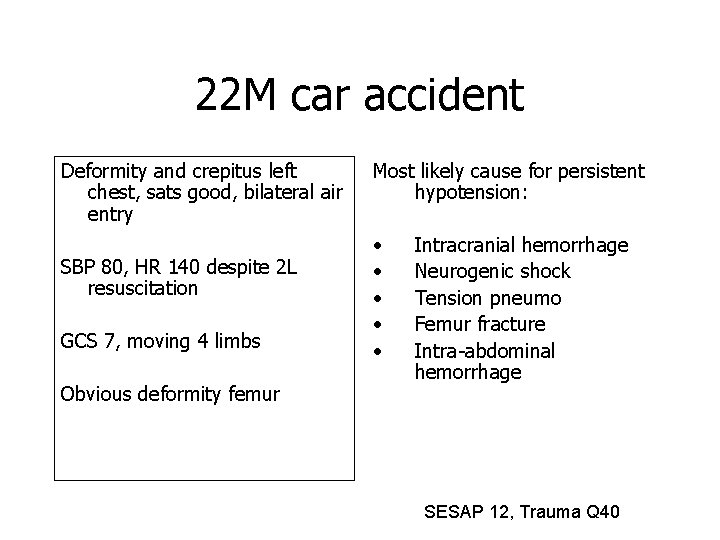
22 M car accident Deformity and crepitus left chest, sats good, bilateral air entry SBP 80, HR 140 despite 2 L resuscitation GCS 7, moving 4 limbs Obvious deformity femur Most likely cause for persistent hypotension: • • • Intracranial hemorrhage Neurogenic shock Tension pneumo Femur fracture Intra-abdominal hemorrhage SESAP 12, Trauma Q 40
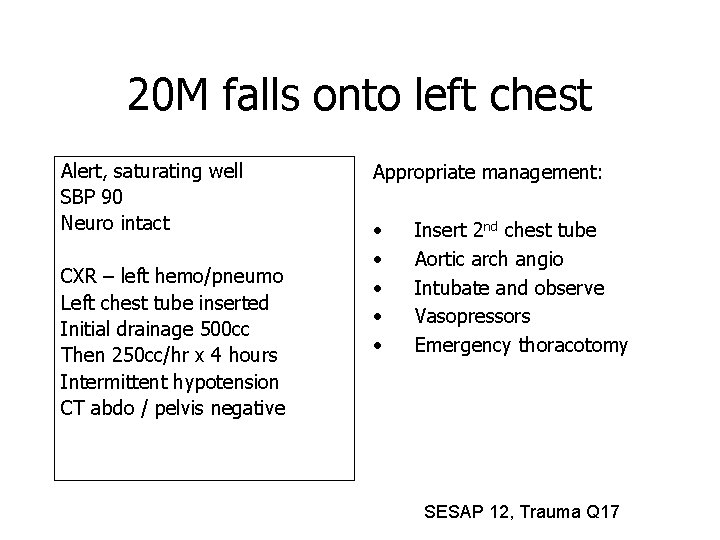
20 M falls onto left chest Alert, saturating well SBP 90 Neuro intact CXR – left hemo/pneumo Left chest tube inserted Initial drainage 500 cc Then 250 cc/hr x 4 hours Intermittent hypotension CT abdo / pelvis negative Appropriate management: • • • Insert 2 nd chest tube Aortic arch angio Intubate and observe Vasopressors Emergency thoracotomy SESAP 12, Trauma Q 17
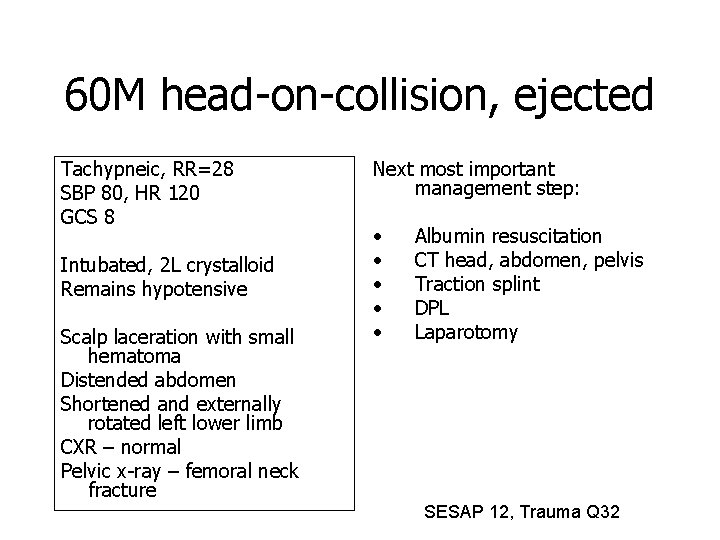
60 M head-on-collision, ejected Tachypneic, RR=28 SBP 80, HR 120 GCS 8 Intubated, 2 L crystalloid Remains hypotensive Scalp laceration with small hematoma Distended abdomen Shortened and externally rotated left lower limb CXR – normal Pelvic x-ray – femoral neck fracture Next most important management step: • • • Albumin resuscitation CT head, abdomen, pelvis Traction splint DPL Laparotomy SESAP 12, Trauma Q 32
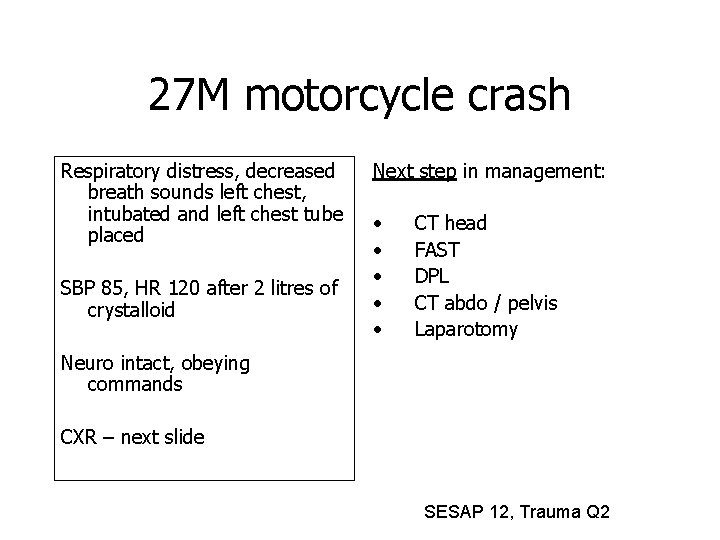
27 M motorcycle crash Respiratory distress, decreased breath sounds left chest, intubated and left chest tube placed SBP 85, HR 120 after 2 litres of crystalloid Next step in management: • • • CT head FAST DPL CT abdo / pelvis Laparotomy Neuro intact, obeying commands CXR – next slide SESAP 12, Trauma Q 2
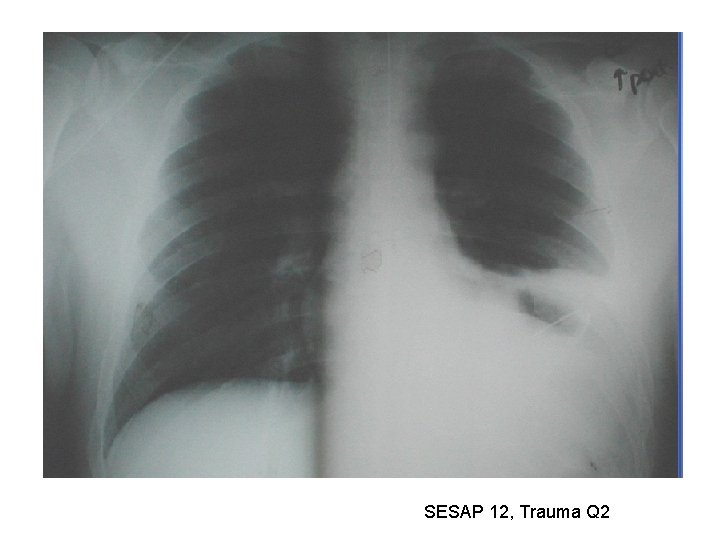
SESAP 12, Trauma Q 2
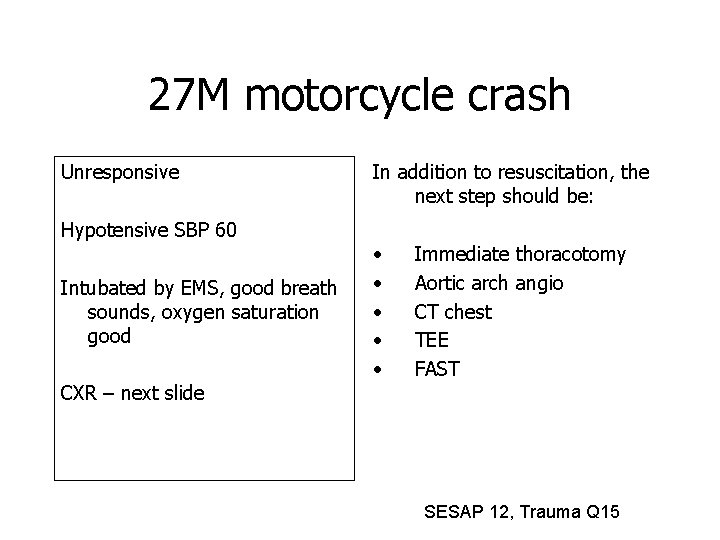
27 M motorcycle crash Unresponsive Hypotensive SBP 60 Intubated by EMS, good breath sounds, oxygen saturation good CXR – next slide In addition to resuscitation, the next step should be: • • • Immediate thoracotomy Aortic arch angio CT chest TEE FAST SESAP 12, Trauma Q 15
- Slides: 35