
Emergency Response Rescue Planning by Mr G S
Emergency Response & Rescue Planning by Mr. G. S. Saini Director, National Civil Defence College

Scenario #1 • You are a Safety officer of your Plant. • You receive a call from a worker reporting a person down, clutching his throat and coughing. • Upon arrival at the scene you notice several people in the immediate vicinity also down – Some are clutching their chests and some are coughing heavily.
Scenario #1 Questions • What is happening? • Is this a normal reaction for a heart attack? • Is it likely that five people have had heart attacks at the same time and place?
Scenario #2 • Now people are staggering away from the scene • All are complaining of blurred vision & red teary eyes.
Scenario #2 Questions • What might we be dealing with? • Are we dealing with something other than a heart attack? • Could this be caused by something in the atmosphere?
Scenario #3 • People are starting to run from the scene. • Some people have lost consciousness.
Scenario #3 Questions • What could account for all these symptoms? • What would you look for as the cause?
Observations of Incident • There is no debris, which might indicate a blast • No smoke or fire is apparent • There are multiple casualties, without the presence of trauma • It was a sudden onset
Operational Clues • Clues that indicate a chemical incident – Symptoms exhibited in multiple casualties that are normally seen in a single person. – Multiple casualties for no apparent reason – Multiple casualties without trauma – Escalating number of victims – Escalating symptoms of the victims
Solution • Observations indicate a toxic chemical agent has caused the incident • Symptoms indicate victims have likely been exposed to a choking agent- CHLORINE
What is the Next Move? • Call in support based on – Increasing number of victims – Responder hazard (first response was for a unknown factor, now there is a chemical hazard) – Need for additional equipment • Protect yourself • Treat the victims
What is a Hazard ?
Hazard “Any substance/operation that poses an unreasonable risk to life, property or the environment. ” • Hazardous Material – “Any substance that poses an unreasonable risk to life, the environment, or property when not properly contained. ”
How to Identify ? Hazardous materials pose many problems. One of the obvious problems is determining what constitutes a hazardous materials incident. Many agencies are involved with the handling, use, and the problems associated with hazardous materials. Each of these agencies has identified hazardous materials as it relates to their realm of service.
Definition • OSHA and the National Institute for Occupational Safety and Health Administration (NIOSH) views a hazardous material from the standpoint of potential hazard. They rate conditions that may cause injury or death as they are found in the working environment, whether they are obvious or not.
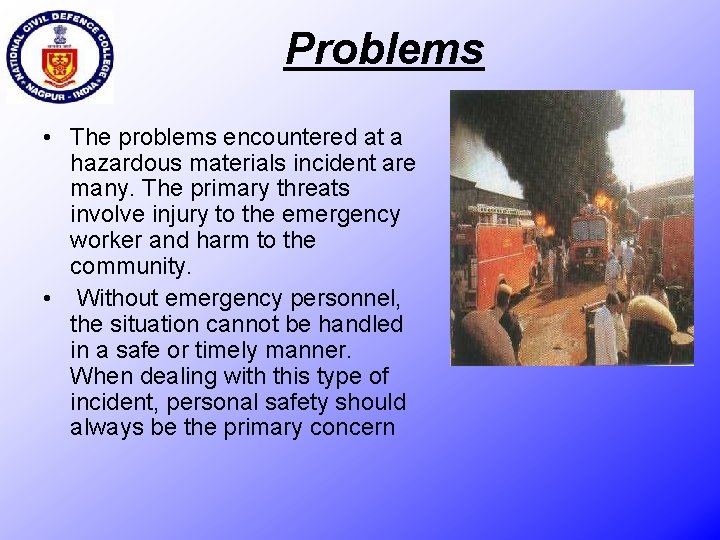
Problems • The problems encountered at a hazardous materials incident are many. The primary threats involve injury to the emergency worker and harm to the community. • Without emergency personnel, the situation cannot be handled in a safe or timely manner. When dealing with this type of incident, personal safety should always be the primary concern
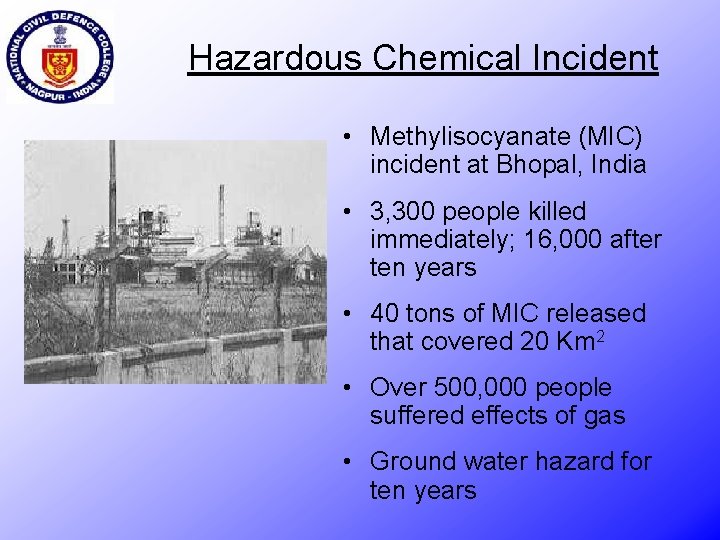
Hazardous Chemical Incident • Methylisocyanate (MIC) incident at Bhopal, India • 3, 300 people killed immediately; 16, 000 after ten years • 40 tons of MIC released that covered 20 Km 2 • Over 500, 000 people suffered effects of gas • Ground water hazard for ten years
Hazardous Chemicals Any chemical (solid, liquid, gas) that can cause harm to people and their surroundings Physical Hazards • Explosives • Compressed gases • Flammable and combustible liquids • Flammable solids • Oxidizers • Poisons • Radioactive • Corrosives Health Hazards • Asphyxiant • Carcinogen • Irritant • Corrosive • Sensitizer • Toxic Agent
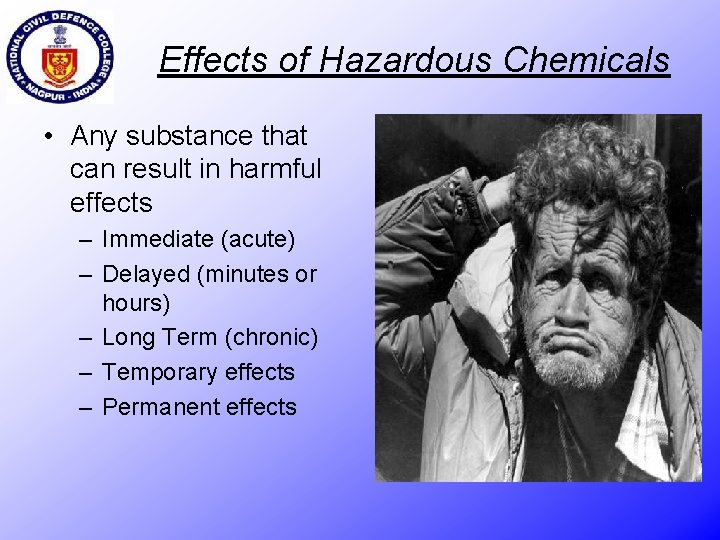
Effects of Hazardous Chemicals • Any substance that can result in harmful effects – Immediate (acute) – Delayed (minutes or hours) – Long Term (chronic) – Temporary effects – Permanent effects
Intensity of Effects • Varies by – Type of chemical – Exposure (time X amount) – Physical health – Age – Weather (wind, temperature, rain)
Symptoms • Coughing • Constricted pupils, red teary eyes • Bleeding or hemorrhaging • Strong or unusual smell • Strange behavior • Convulsions • Unconsciousness
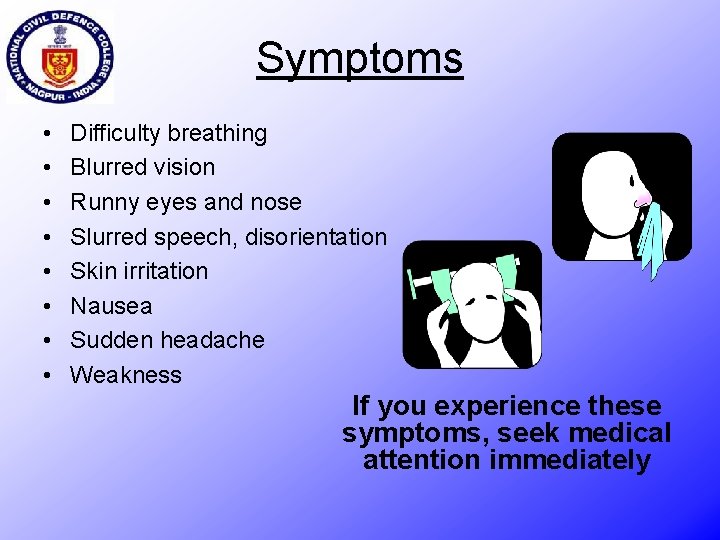
Symptoms • • Difficulty breathing Blurred vision Runny eyes and nose Slurred speech, disorientation Skin irritation Nausea Sudden headache Weakness If you experience these symptoms, seek medical attention immediately
Safety Considerations for Emergency Response & Rescue
Safety is a Matter of Attitude • Negative attitudes promote: – – – Carelessness Recklessness Overconfidence • Positive safety attitudes promote: – – – Openness to new ideas Alertness Planning ahead
Multiple Hazard Characteristics • • Explosive Flammable Thermally unstable Reactive Poisonous Infectious Radioactive Corrosive
Safety Keypoint #1 • “Always consider the possibility of multiple hazard characteristics in each hazard class. ”
Safety Keypoint #2 • “Approach all hazardous material incidents from upwind, upgrade, and upstream, positioning vehicles and apparatus headed away from the incident scene. ”
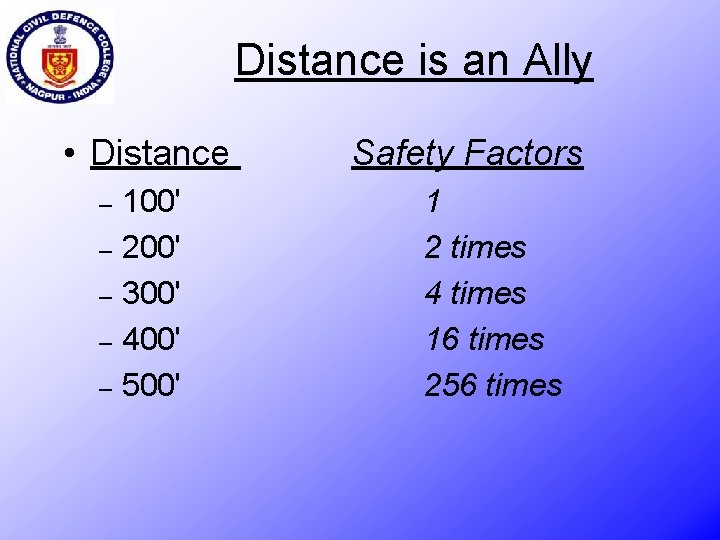
Distance is an Ally • Distance 100' – 200' – 300' – 400' – 500' – Safety Factors 1 2 times 4 times 16 times 256 times
Staging Area • A safe haven for personnel and equipment that allows a 3 minute scene access from a safe distance should the incident suddenly escalate
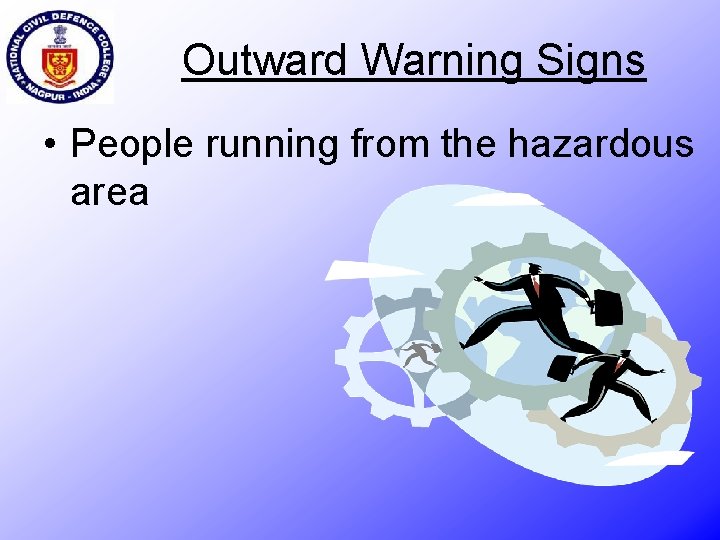
Outward Warning Signs • People running from the hazardous area
Outward Warning Signs • People running from the hazardous area • People collapsed inside the hazardous area
Outward Warning Signs • People running from the hazardous area • People collapsed inside the hazardous area • Evidence of fire indicated by smoke
Outward Warning Signs • • People running from the hazardous area People collapsed inside the hazardous area Evidence of fire indicated by smoke A loud roar of increasing pitch from an operating relief valve
Outward Warning Signs • • People running from the hazardous area People collapsed inside the hazardous area Evidence of fire indicated by smoke A loud roar of increasing pitch from an operating relief valve • Evidence of a leak indicated by a hissing sound
Outward Warning Signs • • People running from the hazardous area People collapsed inside the hazardous area Evidence of fire indicated by smoke A loud roar of increasing pitch from an operating relief valve • Evidence of a leak indicated by a hissing sound • Birds and insects falling out of the sky
Rescue Considerations • The Victim Has the presence of the person(s) requiring rescue been confirmed visually or by credible sources? – How long has the person(s) been exposed to the hazardous material? – Is the person viable? – Is the person(s) requiring rescue trapped in a vehicle or by debris? –
Rescue Considerations • The Product What are the hazards of the material involved? – Is a fire or explosion likely? – How fast is the product leaking from it’s container? – Is the person(s) directly exposed to the product or it’s vapors? –
Rescue Considerations • The Responder(s) – – – Does the responder have adequate training? Is appropriate protective equipment available? Are there sufficient personnel present to provide back-up? How long must responders be exposed in the process of attempting rescue? Are the proper tools available?
Rescue Considerations • Physical Factors Must the vehicle or entrapping debris be stabilized? – Can the flow of product be diverted away from victim or stopped altogether? – Is access to the person difficult due to steep terrain or other reasons? –
Safety Keypoint #3 • “In a hazardous material incident you may have to delay attending to the injured in order to save the lives of many others”
Scene Control • Initial actions taken to secure the scene will save many lives by preventing “convergence” into the hazardous area.
Synergism • Two or more chemicals combined resulting in a new compound – The resulting compound can be more hazardous than the original substances. Chlorine + Ammonia = Chloramine gas
Safety Keypoint #4 • First operational priority: – Isolate the hazard area and deny entry.
Establish Perimeters • Establish inner perimeter first. • Initially establish a large outer perimeter by closing major roadways into the area by using incoming response units. • Downwind perimeters should be 2 -3 times larger than other perimeter boundaries.
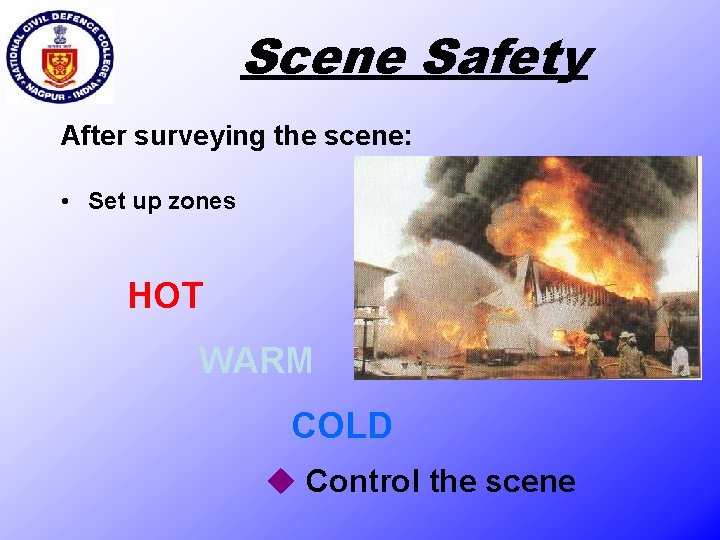
Scene Safety After surveying the scene: • Set up zones HOT WARM COLD u Control the scene
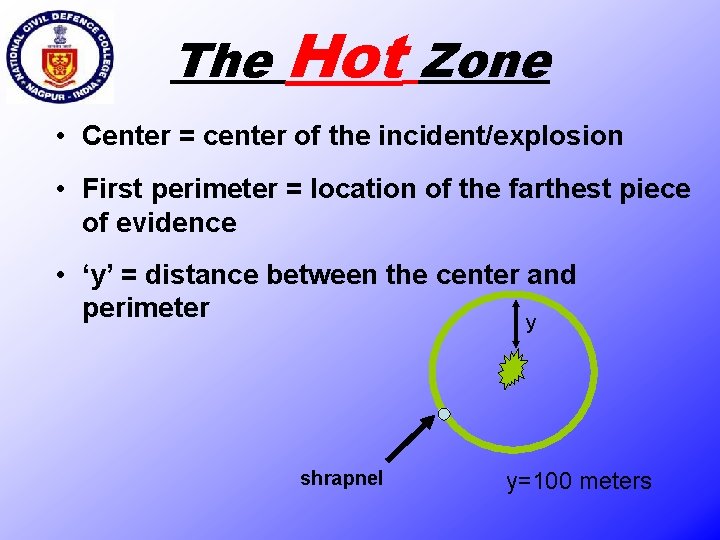
The Hot Zone • Center = center of the incident/explosion • First perimeter = location of the farthest piece of evidence • ‘y’ = distance between the center and perimeter y shrapnel y=100 meters
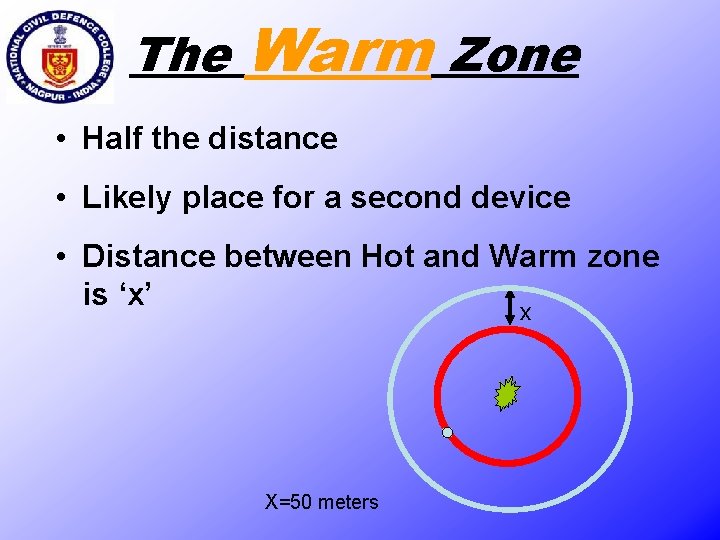
The Warm Zone • Half the distance • Likely place for a second device • Distance between Hot and Warm zone is ‘x’ x X=50 meters
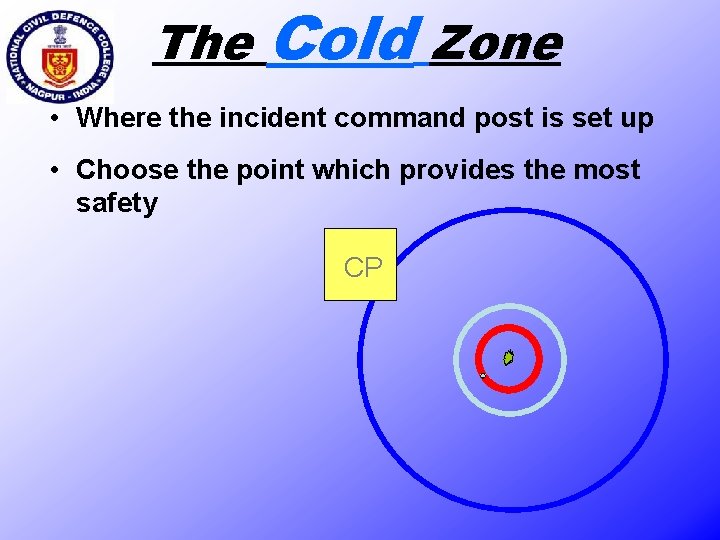
The Cold Zone • Where the incident command post is set up • Choose the point which provides the most safety CP

Safe Deployment of Resources Maintain safe distances, up wind and up hill, if possible
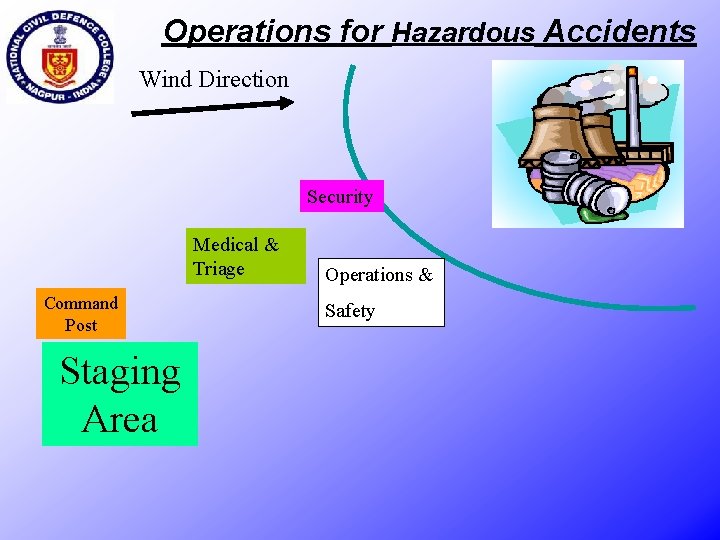
Operations for Hazardous Accidents Wind Direction Security Medical & Triage Command Post Staging Area Operations & Safety
Safety Keypoint #5 • Only those emergency personnel in the proper protective clothing and positive pressure SCBA, “who are actively performing emergency operations” are to operate within the inner perimeter. ”
Emergency Response Plans • Must identify minimum perimeter distances to be utilized by the emergency responders for the protection of both the emergency responders and the citizens.
Control Zones • Recommended minimum initial isolation distances: Minor incident = 150 mtrs – Major incident = 500 mtrs – Explosion potential = 800 mtrs – • Isolate in all directions
Safety Keypoint #6 • “Recommended minimum safety perimeter for citizens = 1, 000 mtrs beyond inner perimeter boundaries in open areas. ”
Safety Keypoint #7 • “To avoid inhalation hazards, SCBA must be properly worn, used and maintained. ” Recognize the potential for downwind hazards to be present; – Use personnel in the proper level of personal protective clothing to expand downwind perimeters to well beyond the hazardous area. –
Safety Keypoint #8 • “Never eat, smoke or drink at or around hazardous material incident scenes until you decontaminate and wash your hands, face, and hair thoroughly. ”
Absorption • Skin absorption occurs by: – Direct contact of material with exposed skin (such as splashes and spills on unprotected skin) – Handling of contaminated patients, clothing, and equipment – Penetration of protective clothing
Safety Keypoint #9 • “Consult protective clothing compatibility data to ensure available protective clothing is compatible with the hazardous material(s) involved in the incident. ”
Medical Surveillance • Pre-employment exam • Annual or periodic exams and testing • Post employment • Post exposure treatment • Record keeping
Exposure Records • • Date Time Incident number Blood gas levels (carboxyhemoglobin) Material involved Level of exposure Medical treatment received
General Safety Precautions • Isolate the hazard area and deny entry
General Safety Precautions • Isolate the hazard area and deny entry • Do not walk into or touch any spilled material
General Safety Precautions • Isolate the hazard area and deny entry • Do not walk into or touch any spilled material • Avoid inhalation of all gases, fumes, and smoke,
General Safety Precautions • Isolate the hazard area and deny entry • Do not walk into or touch any spilled material • Avoid inhalation of all gases, fumes, and smoke, • Do not assume that gases or vapors are harmless just because you can't see or smell them.
General Safety Precautions • Isolate the hazard area and deny entry • Do not walk into or touch any spilled material • Avoid inhalation of all gases, fumes, and smoke, • Do not assume that gases or vapors are harmless just because you can't see or smell them.
Safety Keypoint #10 “Think of safety with every breath you take. ”
Primary Considerations for Response • Responder Safety • Risk Assessment • Public Safety • Scene Security • Hazard Assessment • Environmental Concerns • Property Conservation
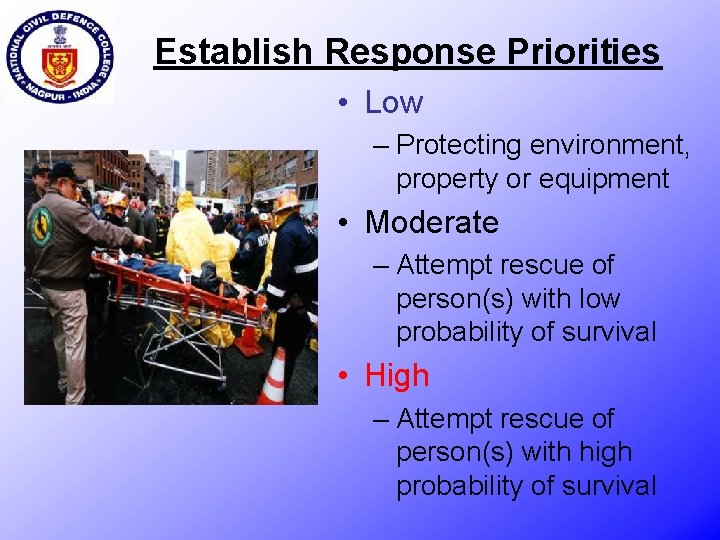
Establish Response Priorities • Low – Protecting environment, property or equipment • Moderate – Attempt rescue of person(s) with low probability of survival • High – Attempt rescue of person(s) with high probability of survival
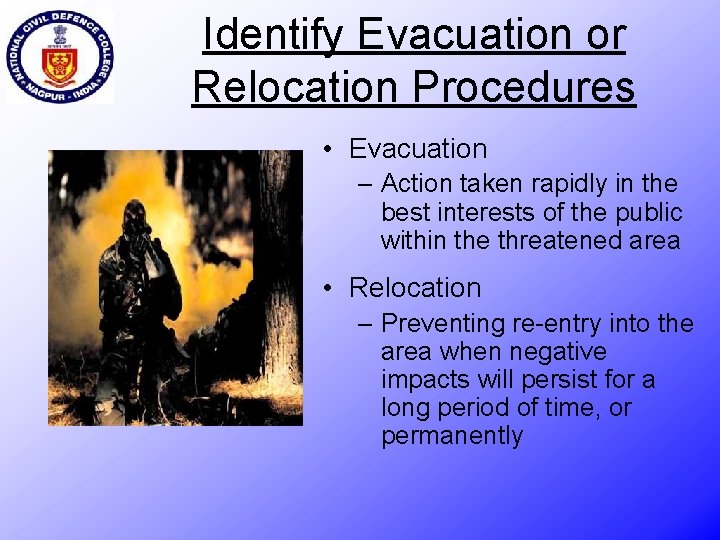
Identify Evacuation or Relocation Procedures • Evacuation – Action taken rapidly in the best interests of the public within the threatened area • Relocation – Preventing re-entry into the area when negative impacts will persist for a long period of time, or permanently
Response Reactions • When looking at the hazards involved consider your responders safety and will their effects dramatically change the outcome of the incident • Decision time – “Stay and Play” (safely do the job) – “Get Out” (the risks are too great)
Safe Work Practices • Prevent direct contact with hazardous chemicals • Limit exposure levels and time • Good hygiene • Take appropriate fire prevention and control measures
Safe Work Practices • Use appropriate personal protective equipment • Use equipment and tools not affected by the chemical being handled • Prevent chemicals from mixing that cause adverse reactions • Use good common sense
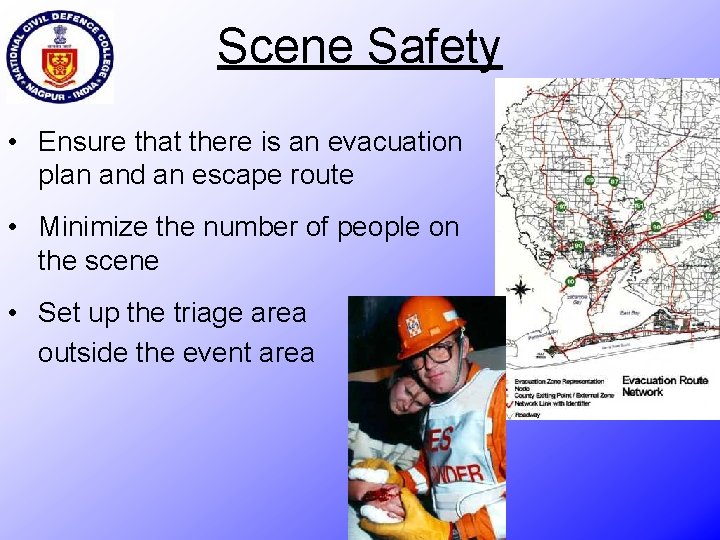
Scene Safety • Ensure that there is an evacuation plan and an escape route • Minimize the number of people on the scene • Set up the triage area outside the event area
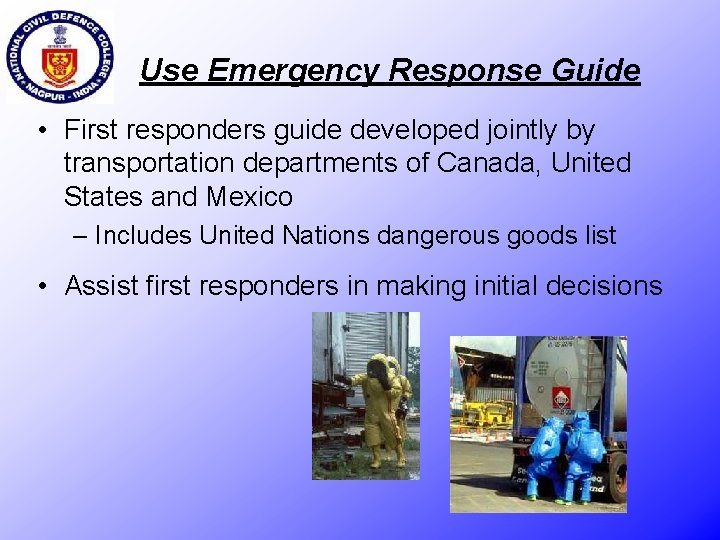
Use Emergency Response Guide • First responders guide developed jointly by transportation departments of Canada, United States and Mexico – Includes United Nations dangerous goods list • Assist first responders in making initial decisions
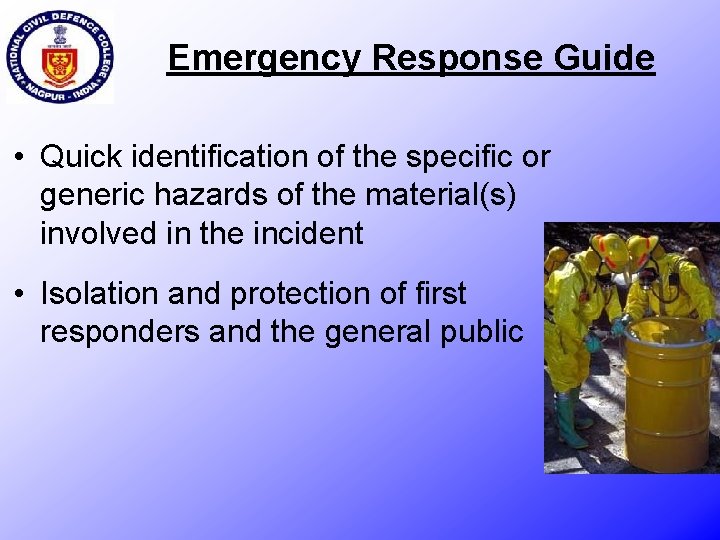
Emergency Response Guide • Quick identification of the specific or generic hazards of the material(s) involved in the incident • Isolation and protection of first responders and the general public
Emergency Response Guide • Not a substitute for emergency response training, knowledge or sound judgment • Does not address all possible circumstances • No physical or chemical properties of hazardous materials
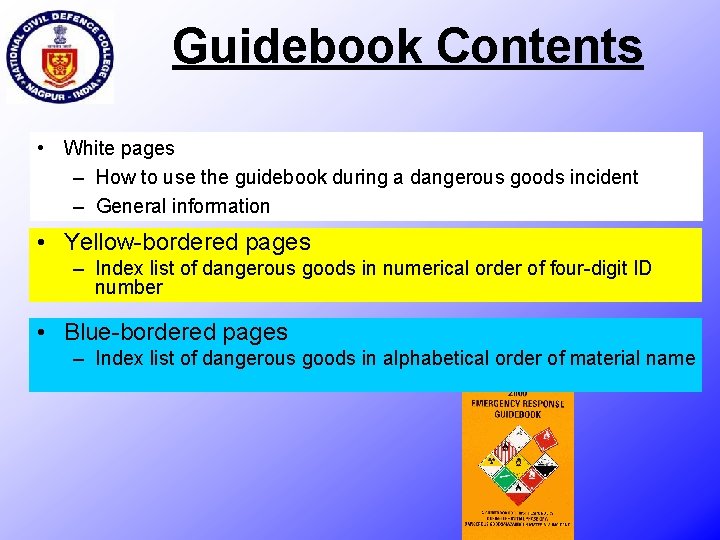
Guidebook Contents • White pages – How to use the guidebook during a dangerous goods incident – General information • Yellow-bordered pages – Index list of dangerous goods in numerical order of four-digit ID number • Blue-bordered pages – Index list of dangerous goods in alphabetical order of material name
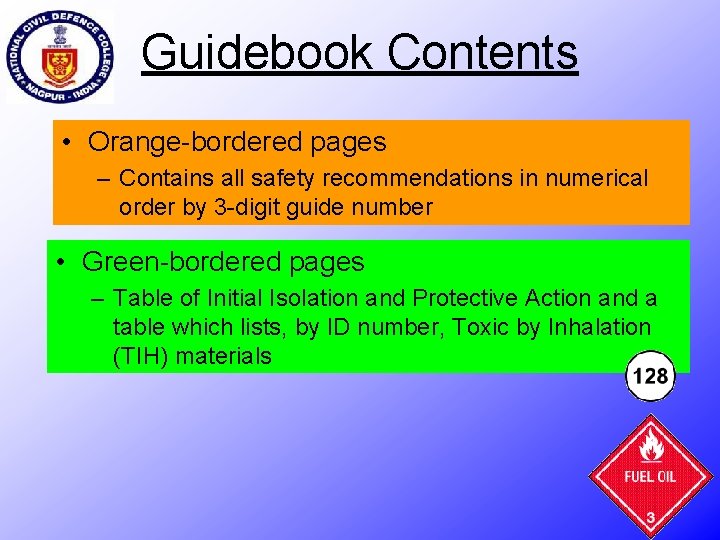
Guidebook Contents • Orange-bordered pages – Contains all safety recommendations in numerical order by 3 -digit guide number • Green-bordered pages – Table of Initial Isolation and Protective Action and a table which lists, by ID number, Toxic by Inhalation (TIH) materials
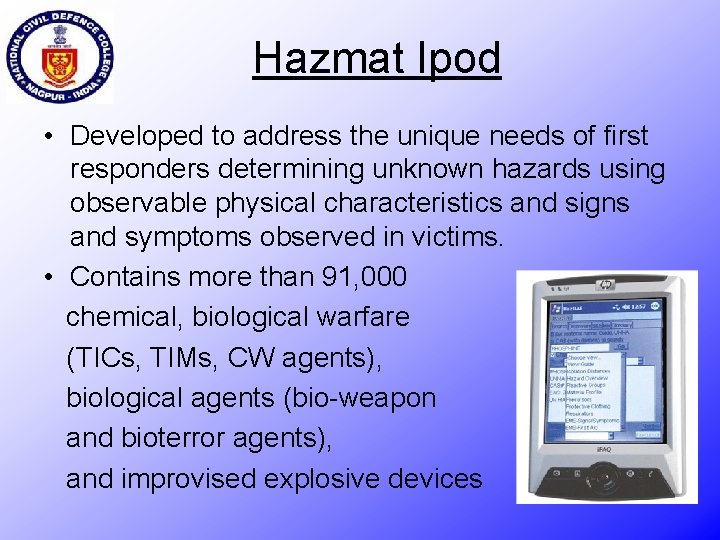
Hazmat Ipod • Developed to address the unique needs of first responders determining unknown hazards using observable physical characteristics and signs and symptoms observed in victims. • Contains more than 91, 000 chemical, biological warfare (TICs, TIMs, CW agents), biological agents (bio-weapon and bioterror agents), and improvised explosive devices
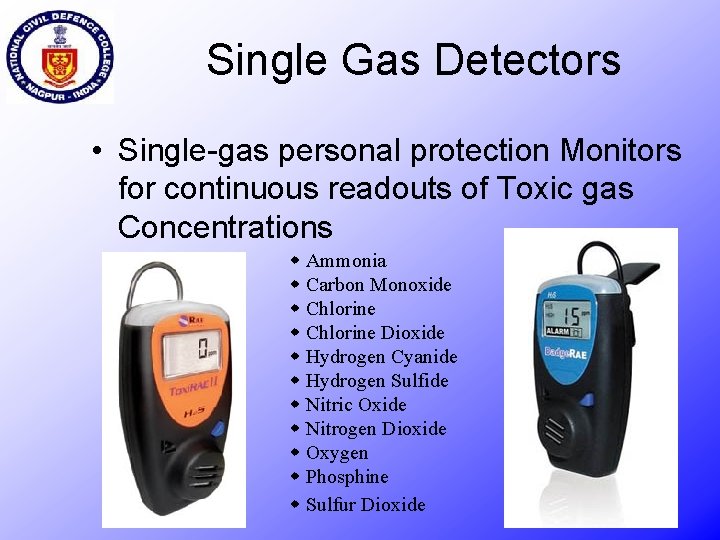
Single Gas Detectors • Single-gas personal protection Monitors for continuous readouts of Toxic gas Concentrations w Ammonia w Carbon Monoxide w Chlorine Dioxide w Hydrogen Cyanide w Hydrogen Sulfide w Nitric Oxide w Nitrogen Dioxide w Oxygen w Phosphine w Sulfur Dioxide
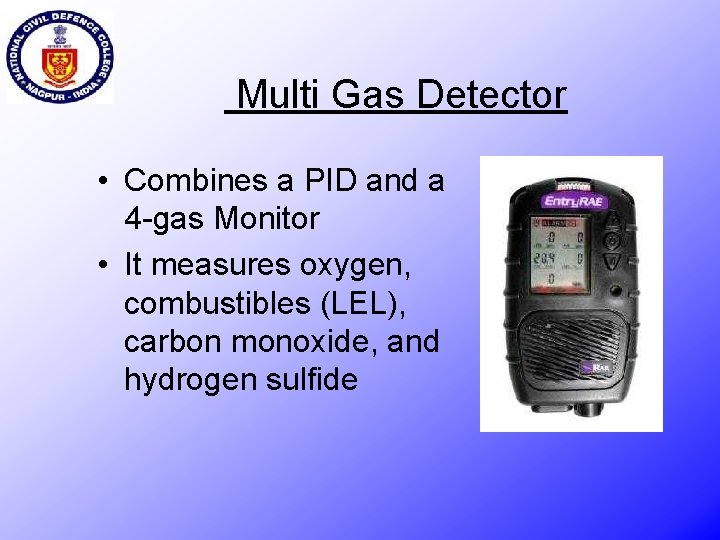
Multi Gas Detector • Combines a PID and a 4 -gas Monitor • It measures oxygen, combustibles (LEL), carbon monoxide, and hydrogen sulfide
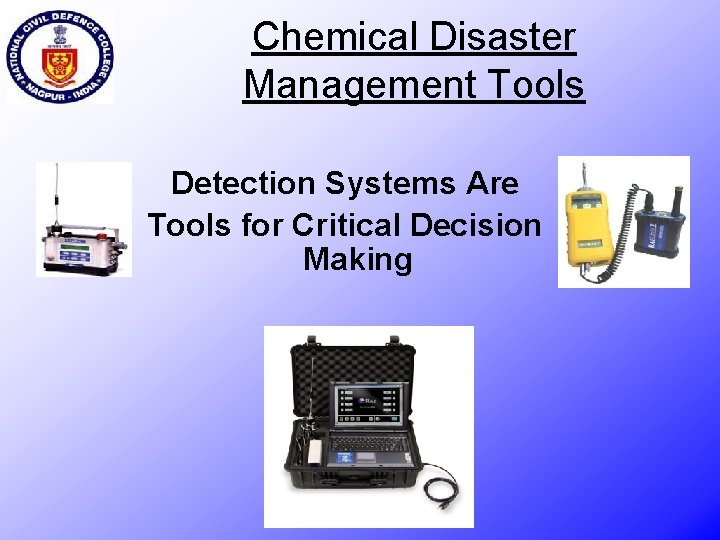
Chemical Disaster Management Tools Detection Systems Are Tools for Critical Decision Making
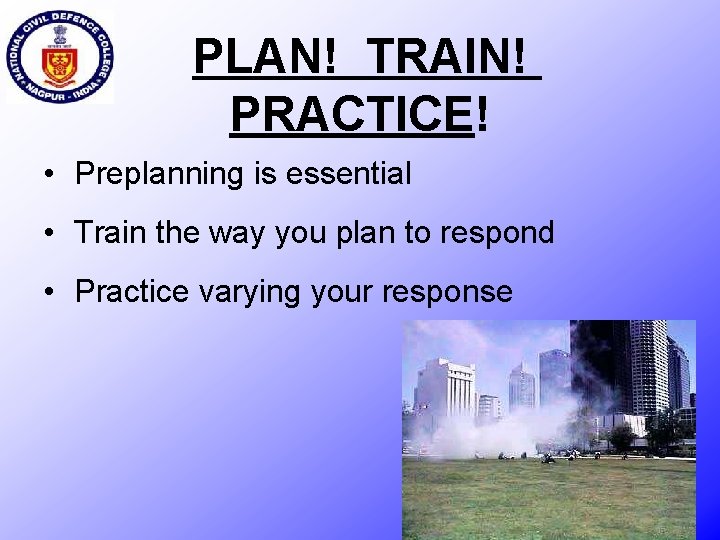
PLAN! TRAIN! PRACTICE! • Preplanning is essential • Train the way you plan to respond • Practice varying your response
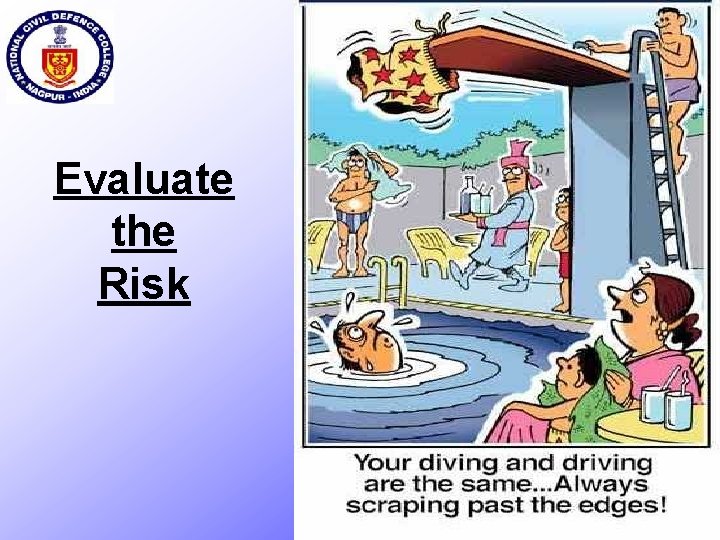
Evaluate the Risk
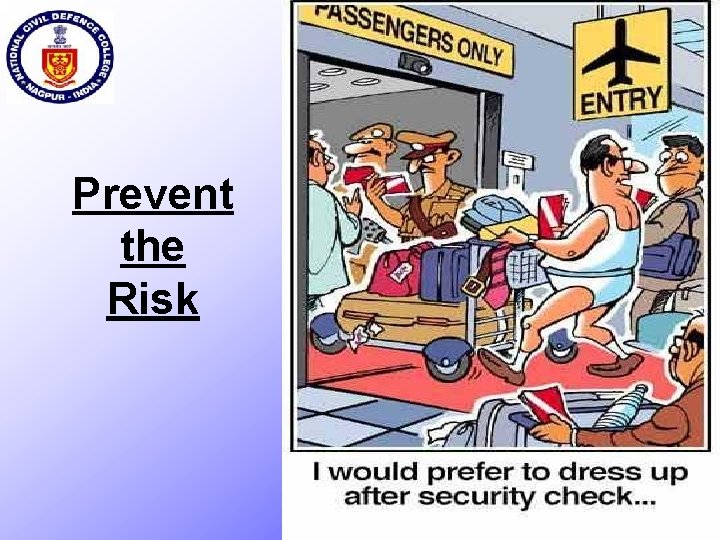
Prevent the Risk
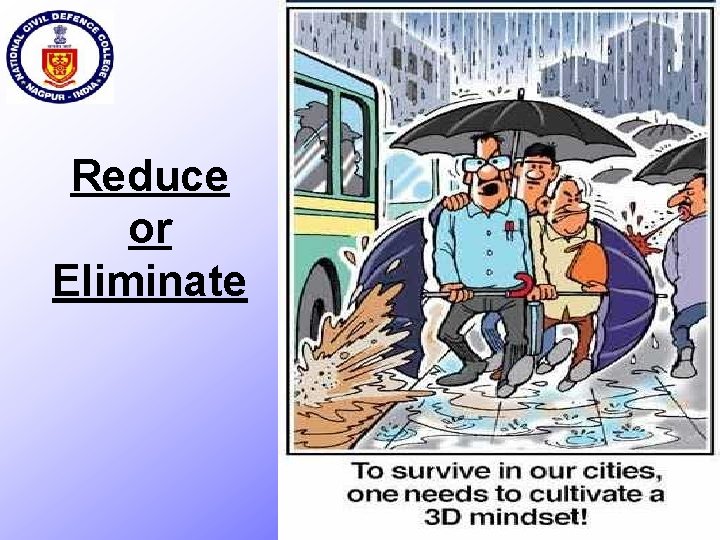
Reduce or Eliminate
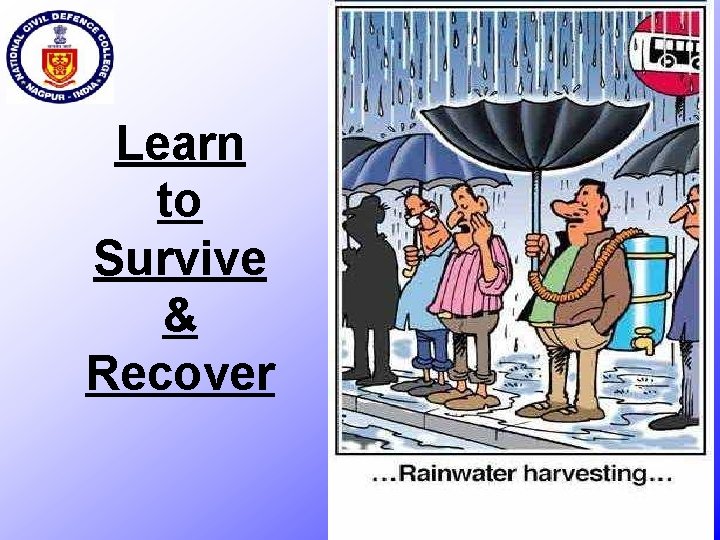
Learn to Survive & Recover
SUMMARY • • Identify physical and structural hazards Identify threats Ensure responder safety. Mark hazard areas and designate safety zones • Request specialized services • Communicate & coordinate • Use appropriate equipment

Any Questions

THE END
- Slides: 90