
Emergency Response Nuclear and radiological incidents Introduction IAEA







- Slides: 27
Emergency Response Nuclear and radiological incidents – Introduction IAEA International Atomic Energy Agency Day 10 – Lecture 1
Introduction - Objective • Radiation sources are an integral part of our technology-based life • The potential for accidents is there and it is not disappearing • The potential for accidents that could lead to radiological consequences will be examined IAEA 2
Content • • • Types of radiation accidents Where they can happen Accident consequences Statistics of radiation accidents Summary IAEA 3
What is a Radiation Accident • A situation in which there is an unintentional exposure to ionising radiation or radioactive contamination • Exposure may be real or suspected IAEA 4
General Classification • The range of potential emergencies involving ionizing radiations is enormous • From a major reactor accident to accidents involving small amounts of radioactive material • In general, emergencies may be classified into two broad categories: • Nuclear accidents • Radiological accidents IAEA 5
Nuclear Accidents • The term nuclear accident (emergency) applies to • Reactor accident • Accident at reprocessing plants • Accidents at other large nuclear facilities • Accident involving the detonation with partial nuclear yield of a nuclear weapon • It is one that involves the nuclear fuel cycle and the potential for criticality IAEA 6
IAEA 7
Where Can They Occur • The highest risk of severe health effects resulting from a radioactive release comes from nuclear power plants or facilities storing large amounts of nuclear waste from reprocessed nuclear fuel • By far the most common facility containing very large amounts of radioactive material is a nuclear power plant • There are 437 commercial nuclear power plants (NPP) operating in the world (as of January 2013) IAEA 8
Reactor Accidents • • • NRX, Canada, 1952 Windscale, UK, 1957 NRU, Canada, 1957 Westing House test reactor, USA, 1960 SL-1, USA, 1961 Enrico Fermi, USA Lucens, Switzerland, 1976 Browns Ferry fire, USA TMI, USA, 1979 Chernobyl, USSR, 1986 Fukushima , March 2011 IAEA 9
Radiological Accidents • A radiological accident (emergency) is one that involves • Sources other than nuclear fuel • The dispersion of material from a nuclear weapon without a nuclear yield • Radiological emergencies that could result from deliberate acts, such as terrorist activities or illicit trafficking IAEA 10
IAEA 11
Types of Radiological Accidents • Radiological accidents can be classified in three major categories: • Accidents with radiation sources or radioactive material • Accidents outside the country with transboundary effects, and • Nuclear powered satellite re-entry IAEA 12
Accidents With Radioactive Sources • • Discovery of a source or contamination Missing source (lost or stolen) Damaged source or loss of shielding Fire involving radioactive source(s) Dispersion of alpha emitter Transport accident with radioactive sources Accident involving nuclear or radiological devices (research reactor, neutron generator, accelerator…) IAEA 13
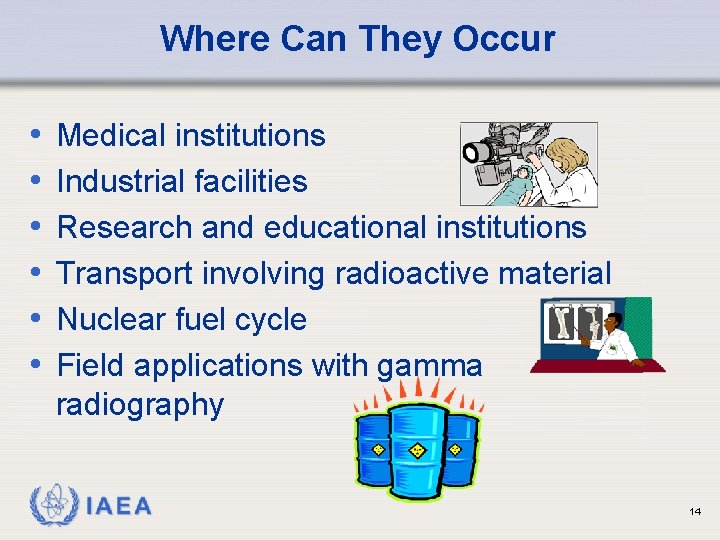
Where Can They Occur • • • Medical institutions Industrial facilities Research and educational institutions Transport involving radioactive material Nuclear fuel cycle Field applications with gamma radiography IAEA 14
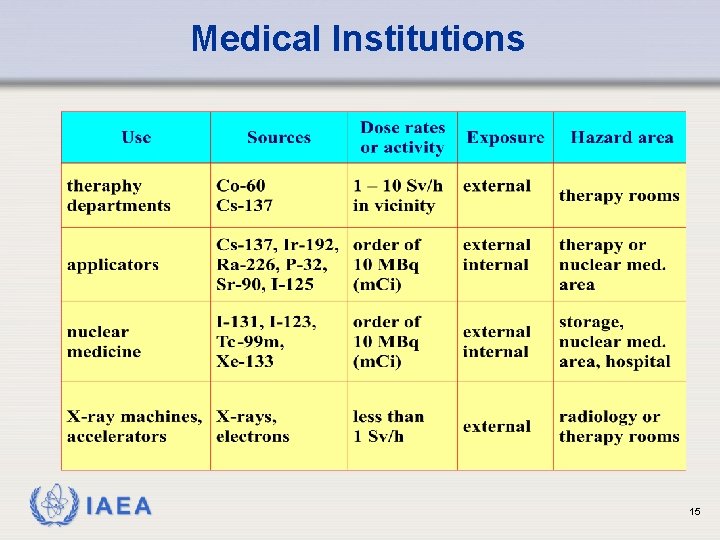
Medical Institutions IAEA 15
Industrial Facilities IAEA 16
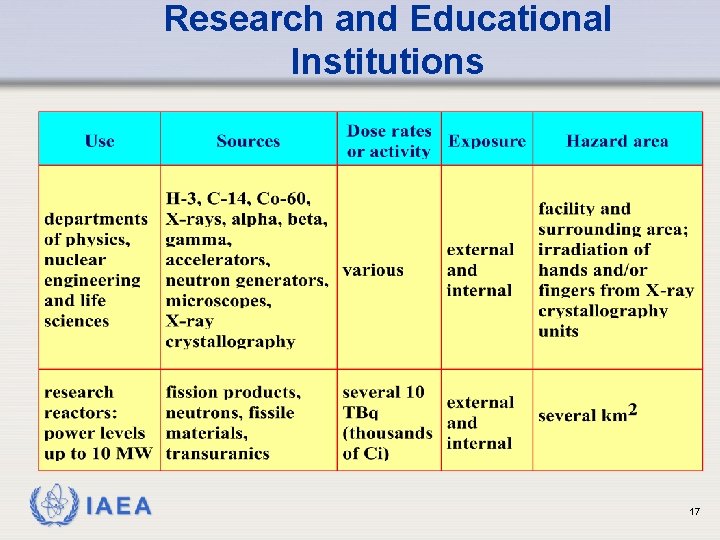
Research and Educational Institutions IAEA 17
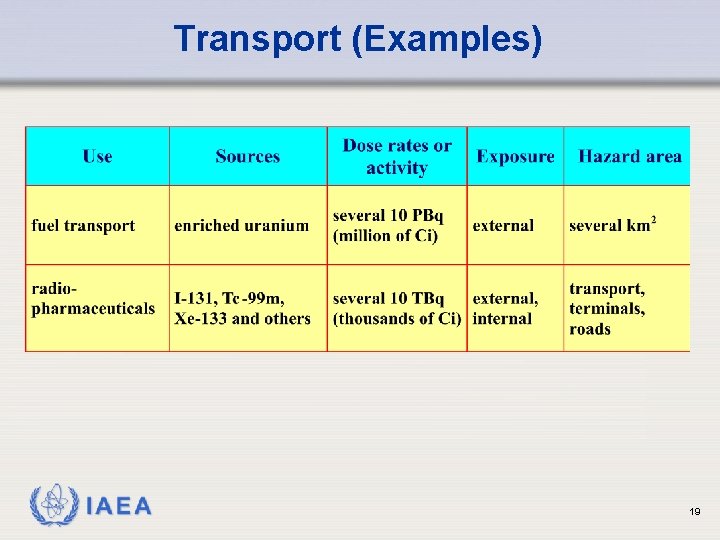
Transport • Approximately 2. 5 million packages of radioactive materials are shipped only in the USA each year • Transport emergencies have caused no serious radiation overexposure • However, the subsequent loss of sources has led to serious injuries, e. g. Algeria, 1976 IAEA 18
Transport (Examples) IAEA 19
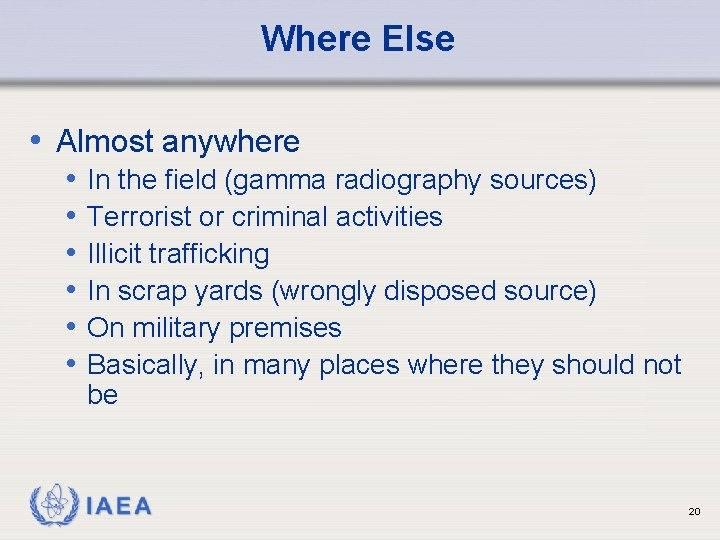
Where Else • Almost anywhere • • • In the field (gamma radiography sources) Terrorist or criminal activities Illicit trafficking In scrap yards (wrongly disposed source) On military premises Basically, in many places where they should not be IAEA 20
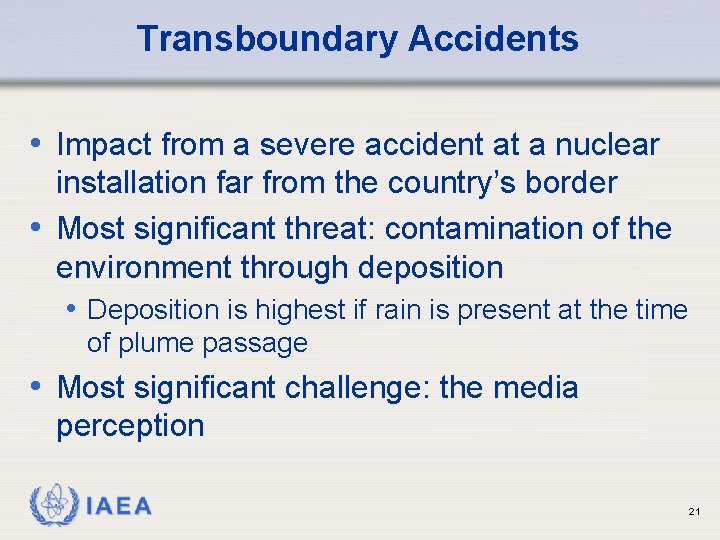
Transboundary Accidents • Impact from a severe accident at a nuclear installation far from the country’s border • Most significant threat: contamination of the environment through deposition • Deposition is highest if rain is present at the time of plume passage • Most significant challenge: the media perception IAEA 21
Nuclear Powered Satellite Re-entry • Nuclear power sources are used in space vehicles such as satellites and deep space probes • Satellites may carry a small nuclear reactor, radioisotopic thermoelectric generators and heating units contain plutonium • Launch accidents are not a significant threat • Accidental re-entry is a possible threat • Crash on ground may lead to wide-spread of contamination (e. g. COSMOS 954, Canada, 1979) IAEA 22
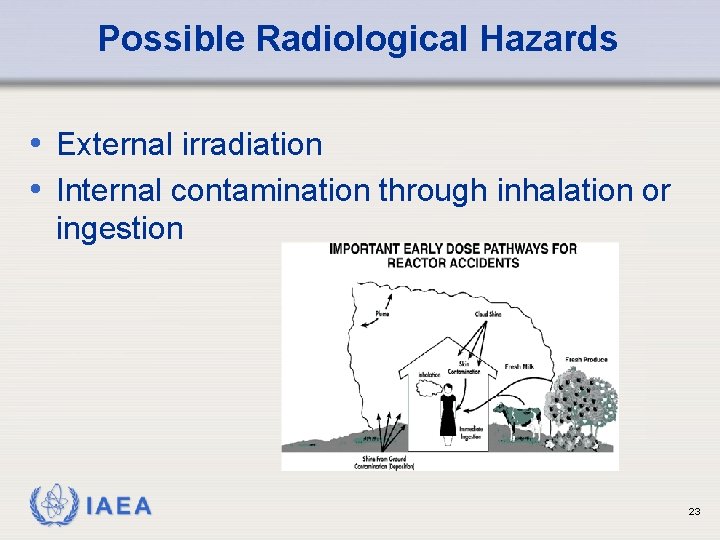
Possible Radiological Hazards • External irradiation • Internal contamination through inhalation or ingestion IAEA 23
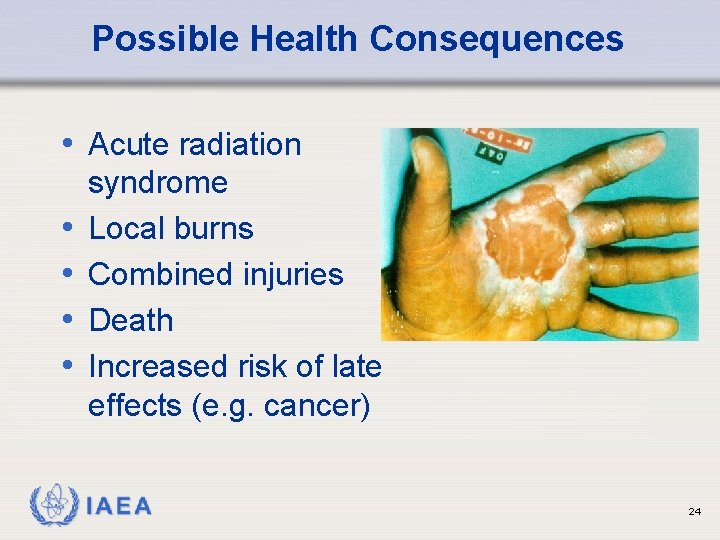
Possible Health Consequences • Acute radiation • • syndrome Local burns Combined injuries Death Increased risk of late effects (e. g. cancer) IAEA 24
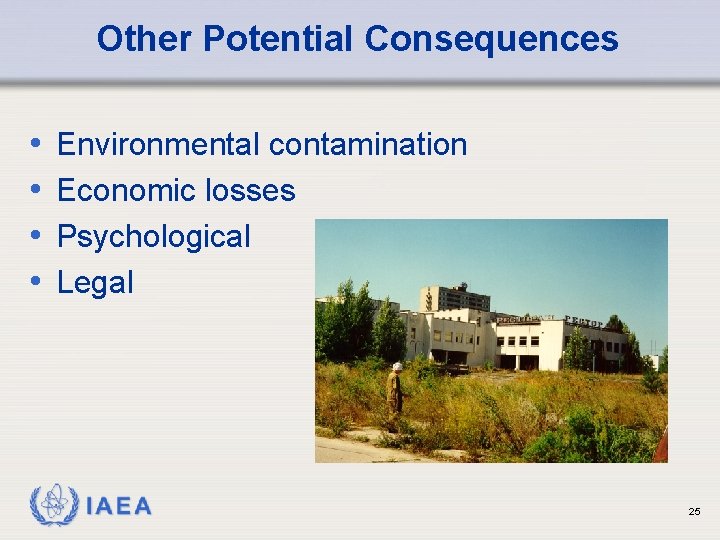
Other Potential Consequences • • Environmental contamination Economic losses Psychological Legal IAEA 25
Summary • Radiation accidents can happen • Serious radiological consequences are rare but they can occur • Stochastic effects • Severe injuries • Death • Therefore, emergency response plans are required IAEA 26
Where to Get More Information • Generic Procedures for Assessment and Response During a Radiological Emergency, IAEA-TECDOC-1162 (2000) • Lessons learned from Accidents in Industrial Radiography, IAEA Safety Reports Series No. 7 (1998) IAEA 27