
Emergency Regulation Recreational Clams Sand Crabs and Shrimp
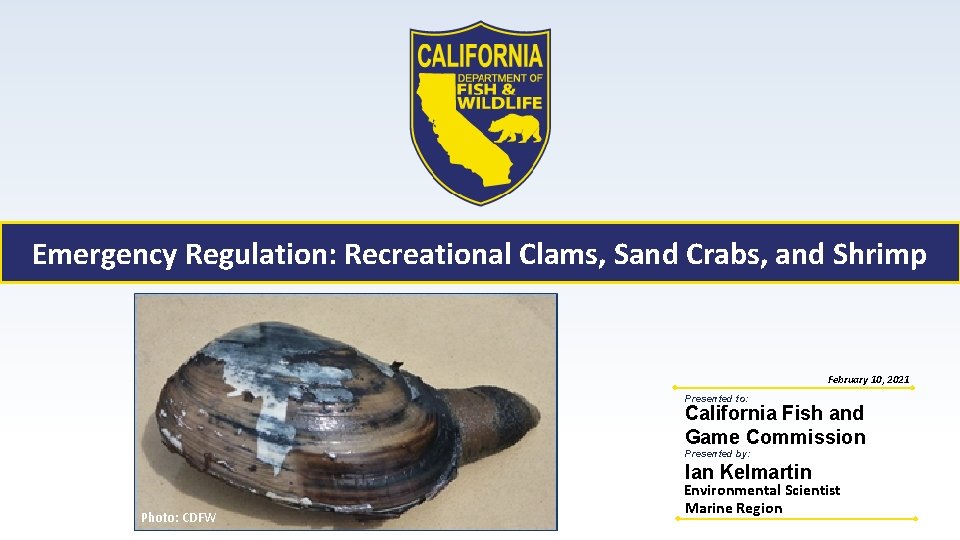
Emergency Regulation: Recreational Clams, Sand Crabs, and Shrimp February 10, 2021 Presented to: California Fish and Game Commission Presented by: Ian Kelmartin Photo: CDFW Environmental Scientist Marine Region

Outline • • • Clam Life History and Fishery Information Hydraulic Pump Design and Use Issues Caused by Pumps Proposed Emergency Regulation Next Steps
Life History and Fishery Information 3

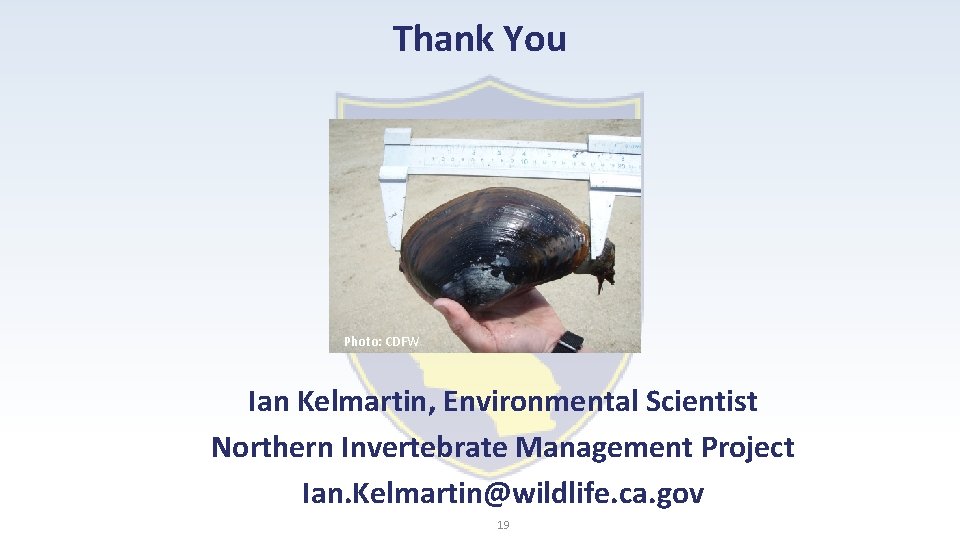
Life History • Species: – Pacific gaper clam (Tresus nuttalli) – Fat gaper clam (T. capax) – Washington clam (Saxidomus nuttalli) – Butter clam (S. gigantea) Photo: CDFW
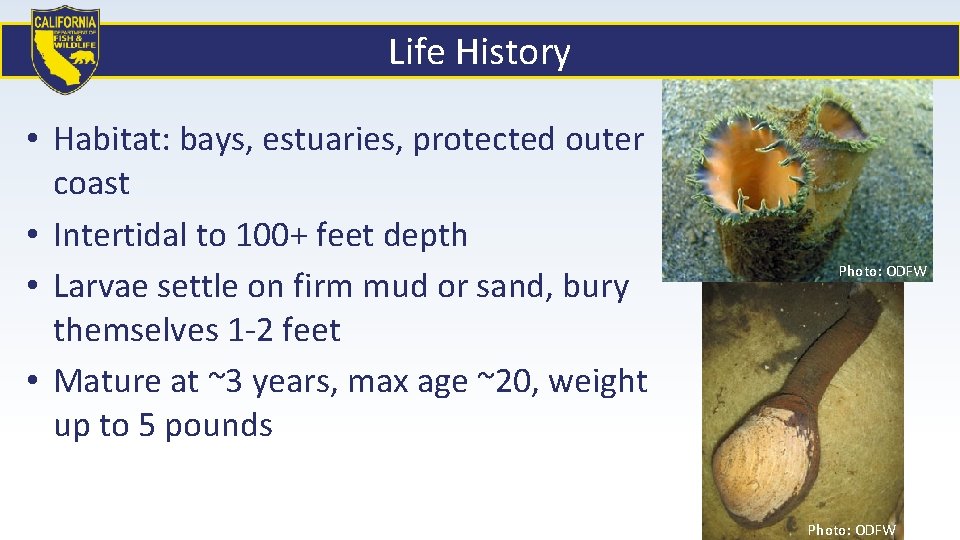
Life History • Habitat: bays, estuaries, protected outer coast • Intertidal to 100+ feet depth • Larvae settle on firm mud or sand, bury themselves 1 -2 feet • Mature at ~3 years, max age ~20, weight up to 5 pounds Photo: ODFW
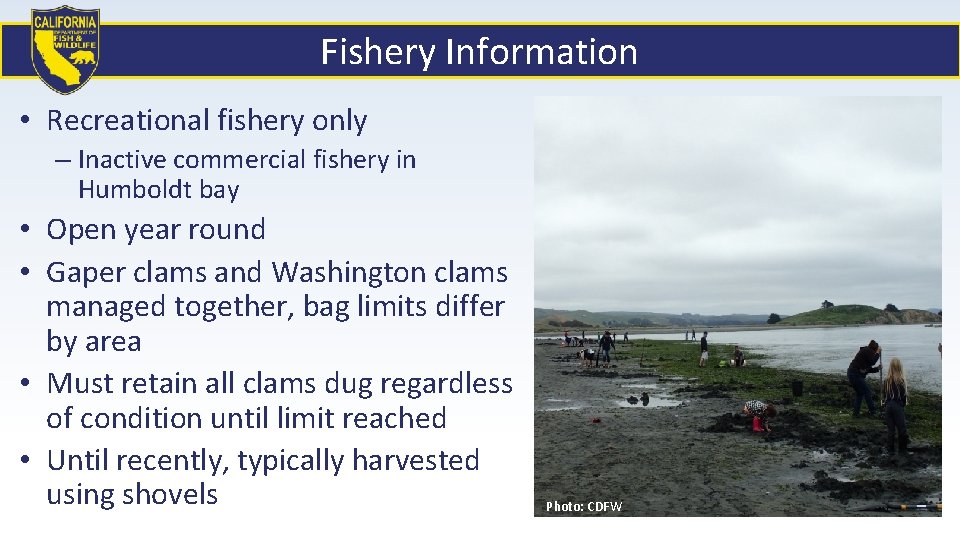
Fishery Information • Recreational fishery only – Inactive commercial fishery in Humboldt bay • Open year round • Gaper clams and Washington clams managed together, bag limits differ by area • Must retain all clams dug regardless of condition until limit reached • Until recently, typically harvested using shovels Photo: CDFW
Hydraulic Pump Design and Use

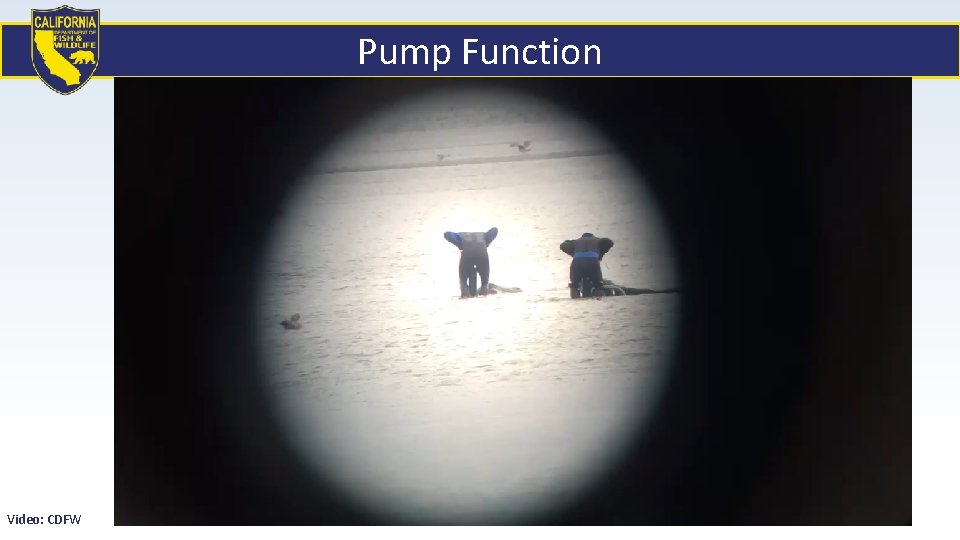
Pump Function • Liquifies sediment surrounding clam to allow easy extraction by hand • Inlet in base, outlet through flexible hose with rigid nozzle • Often used in teams of two Photo: CDFW
Pump Function Video: CDFW
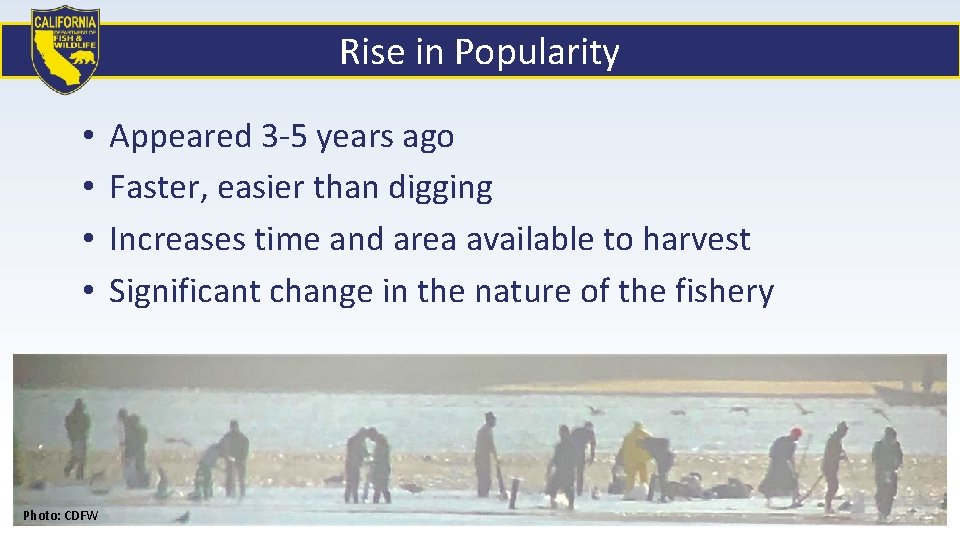
Rise in Popularity • • Photo: CDFW Appeared 3 -5 years ago Faster, easier than digging Increases time and area available to harvest Significant change in the nature of the fishery
Issues Caused by Pumps

Increased Pressure on Resource and Habitat • Increased efficiency • Increased participation • Disturbance of Eelgrass beds Photo: CDFW

Law Enforcement Concerns • Increase in citations associated with use of pumps • High grading: retention of only largest clams • Illegal activity concealed underwater • Illegal commercialization Photo: CDFW
Proposed Emergency Regulation

Existence of Emergency • Petition referred by Commission to CDFW August 2019 • Finding: Increased participation, combined with high efficiency of pumps, poses risk to clam stocks and fishery • Goal of Emergency Regulation: Provide additional protection to clam stocks in 2021 until further evaluation can be completed
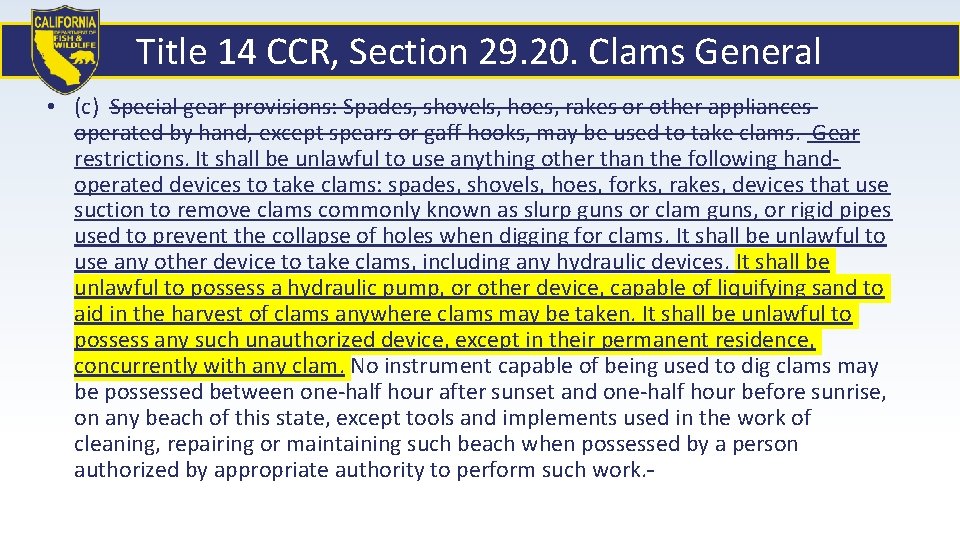
Proposed Emergency Regulation Changes • Title 14, Section 29. 20 Clams General – Specify tools allowed to take clams – Define hydraulic pumps, prohibit use to take clams – Prohibit possession of hydraulic pumps anywhere clams may be taken, and concurrently with any clam except in one’s permanent residence – Require each person to use their own container when harvesting clams and transporting them to shore

Proposed Emergency Regulation Changes • Title 14, Section 29. 80 Gear Restrictions – Need identified during internal review – Sand crabs, shrimp, and clams co-occupy habitat – Increase enforceability of pump prohibition, regulatory consistency – Specify tools allowed to take sand crabs and shrimp – Prohibit use of hydraulic pumps
Next Steps • Continue Outreach – MPA program, Tackle shops • Conduct Creel Surveys • Evaluate stocks and sustainability of fishery • Consider need for regular rulemaking and readoption of emergency regulation
Thank You Photo: CDFW Ian Kelmartin, Environmental Scientist Northern Invertebrate Management Project Ian. Kelmartin@wildlife. ca. gov 19
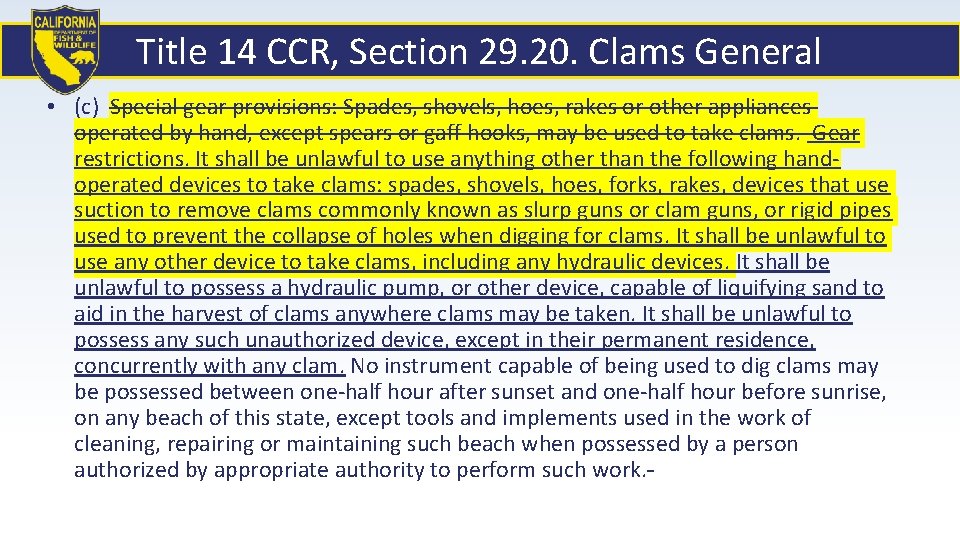
Title 14 CCR, Section 29. 20. Clams General • (c) Special gear provisions: Spades, shovels, hoes, rakes or other appliances operated by hand, except spears or gaff hooks, may be used to take clams. Gear restrictions. It shall be unlawful to use anything other than the following handoperated devices to take clams: spades, shovels, hoes, forks, rakes, devices that use suction to remove clams commonly known as slurp guns or clam guns, or rigid pipes used to prevent the collapse of holes when digging for clams. It shall be unlawful to use any other device to take clams, including any hydraulic devices. It shall be unlawful to possess a hydraulic pump, or other device, capable of liquifying sand to aid in the harvest of clams anywhere clams may be taken. It shall be unlawful to possess any such unauthorized device, except in their permanent residence, concurrently with any clam. No instrument capable of being used to dig clams may be possessed between one-half hour after sunset and one-half hour before sunrise, on any beach of this state, except tools and implements used in the work of cleaning, repairing or maintaining such beach when possessed by a person authorized by appropriate authority to perform such work.
Title 14 CCR, Section 29. 20. Clams General • (c) Special gear provisions: Spades, shovels, hoes, rakes or other appliances operated by hand, except spears or gaff hooks, may be used to take clams. Gear restrictions. It shall be unlawful to use anything other than the following handoperated devices to take clams: spades, shovels, hoes, forks, rakes, devices that use suction to remove clams commonly known as slurp guns or clam guns, or rigid pipes used to prevent the collapse of holes when digging for clams. It shall be unlawful to use any other device to take clams, including any hydraulic devices. It shall be unlawful to possess a hydraulic pump, or other device, capable of liquifying sand to aid in the harvest of clams anywhere clams may be taken. It shall be unlawful to possess any such unauthorized device, except in their permanent residence, concurrently with any clam. No instrument capable of being used to dig clams may be possessed between one-half hour after sunset and one-half hour before sunrise, on any beach of this state, except tools and implements used in the work of cleaning, repairing or maintaining such beach when possessed by a person authorized by appropriate authority to perform such work.
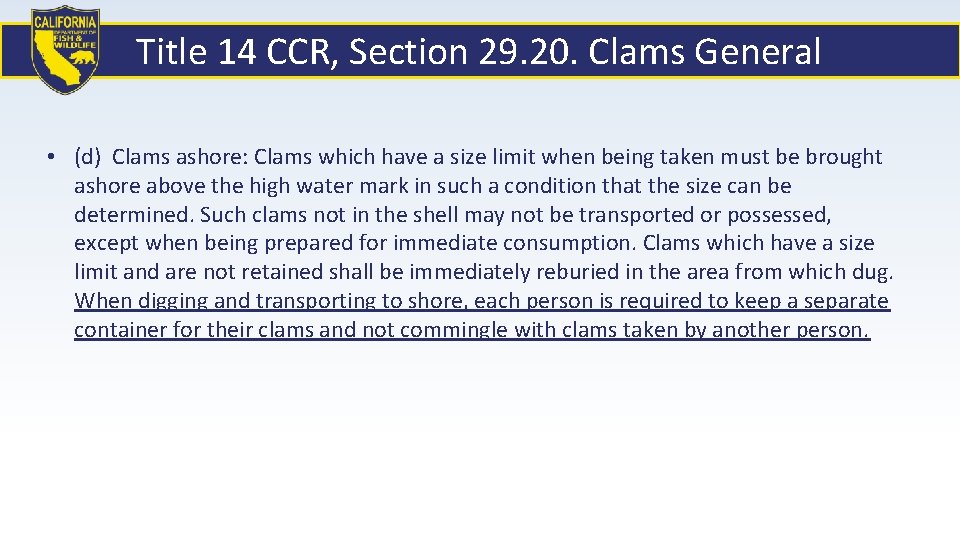
Title 14 CCR, Section 29. 20. Clams General • (d) Clams ashore: Clams which have a size limit when being taken must be brought ashore above the high water mark in such a condition that the size can be determined. Such clams not in the shell may not be transported or possessed, except when being prepared for immediate consumption. Clams which have a size limit and are not retained shall be immediately reburied in the area from which dug. When digging and transporting to shore, each person is required to keep a separate container for their clams and not commingle with clams taken by another person.
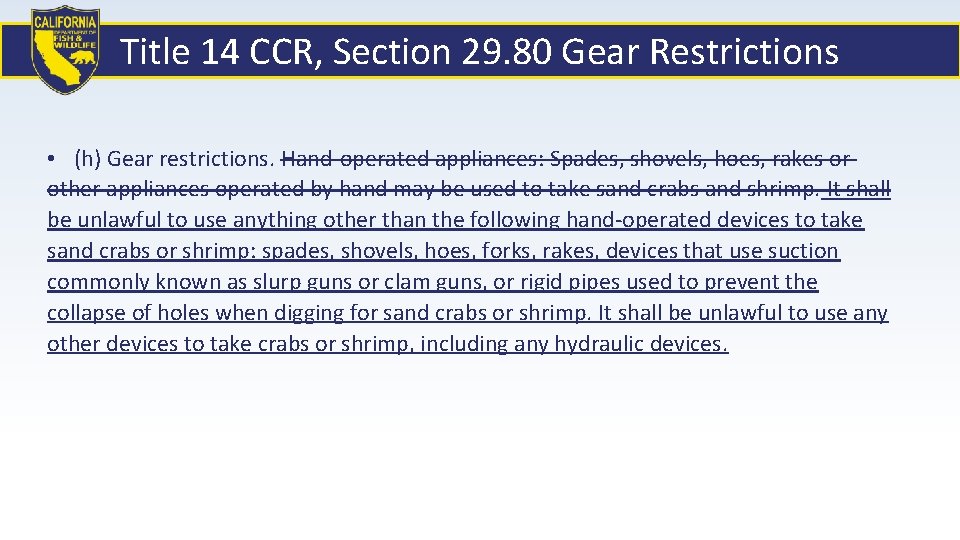
Title 14 CCR, Section 29. 80 Gear Restrictions • (h) Gear restrictions. Hand-operated appliances: Spades, shovels, hoes, rakes or other appliances operated by hand may be used to take sand crabs and shrimp. It shall be unlawful to use anything other than the following hand-operated devices to take sand crabs or shrimp: spades, shovels, hoes, forks, rakes, devices that use suction commonly known as slurp guns or clam guns, or rigid pipes used to prevent the collapse of holes when digging for sand crabs or shrimp. It shall be unlawful to use any other devices to take crabs or shrimp, including any hydraulic devices.
- Slides: 23