
Emergency Rapid Sequence Intubation A How and When
Emergency Rapid Sequence Intubation: A “How and When To” Guide Pat Melanson, MD, FRCPC Department of Emergency Medicine Division of Critical Care Medicine Royal Victoria Hospital Emergency RSI
Rapid Sequence Intubation : Definition • The near simultaneous administration of a sedative-hypnotic agent and a neuromuscular blocker in the presence of continuous cricoid pressure to facilitate endotracheal intubation and minimize risk of aspiration • modifications are made depending upon the clinical scenario Emergency RSI
A Brief History of Emergency RSI n n n intubation of the newly/nearly dead (prehistoric) techniques adapted from anesthetists in Case Room and “crash” full-stomach induction's (exploration) rapid dissemination of RSI teaching to emergency physicians (proselytism) evidence-based research supporting safety and advantages of emergency RSI (enlightenment) increasingly sophisticated techniques and methodology critically evaluated (postmodern) Emergency RSI
Intubation Dilemmas: • • Intubate Awake or Asleep Oral or Nasal Laryngoscopy or Blind Intubation To Paralyze or Not Emergency RSI
Oral Intubation Without Drugs • • • Emergency RSI Reserved for the completely unconscious, unresponsive, pulseless and apneic Arrest situations only The “ CRASH AIRWAY”
Oral Intubation with Sedation proponents argue use of BZ or opioids – improves airway access – decreases patient resistance – avoids risks of NMB • Generally obtunds patient to point of loss of protective reflexes and respiratory drive • lower success rate, higher complications compared with RSI Emergency RSI •
Oral Intubation with Sedation • Emergency RSI “ In general, the technique of administering a potent sedative agent to obtund the patient’s responses and permit intubation in the absence of NMB is hazardous and to be discouraged… is not an appropriate alternative to properly conducted RSI and affords neither the success rate or the minimal complication rate of RSI. ” – RM Walls, page 4, Chapter 1, Rosen
Oral Intubation with Sedation n “ The avoidance of NMB actually creates a more hazardous situation for the patient and this practice should no longer be considered an appropriate method for emergency department ET intubation. ” ä Emergency RSI RM Walls, page 8, Chapter 1, Rosen
Oral Intubation with Sedation: Use for the Anticipated Difficult Airway • • Emergency RSI if time permits –topical anesthesia –careful titrated sedation –avoid obtundation ‘Awake” intubation technique
Blind Nasal Intubation • • • Emergency RSI success rates 65 - 80 % in most series high complication rates – epistaxis – pharyngeal/ esophageal perforations – increased incidence of O 2 desats Considered second line approach only reserved for when RSI contraindicated The “ DIFFICULT AIRWAY”
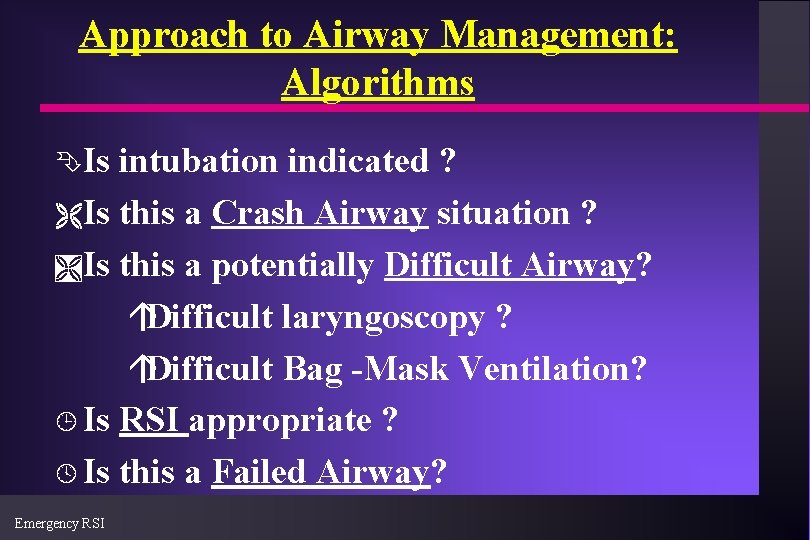
Approach to Airway Management: Algorithms ÊIs intubation indicated ? ËIs this a Crash Airway situation ? ÌIs this a potentially Difficult Airway? áDifficult laryngoscopy ? áDifficult Bag -Mask Ventilation? ¹ Is RSI appropriate ? º Is this a Failed Airway? Emergency RSI
Emergency Airway Concerns • • “full” stomach minimal respiratory reserve hemodynamic instability acute myocardial ischemia increased intracranial pressure C-spine injury The “Difficult” Airway ä Laryngoscopy ä bag-mask Emergency RSI difficulty
Advantages of RSI n facilitates and expedites endotracheal intubation ä ä n n increased success rate decreased time to intubation minimizes trauma during laryngoscopy minimizes hypoxia and hypercapnia minimizes risk of aspiration minimizes hemodynamic effects of intubation Emergency RSI
Disadvantages of RSI operator assumes complete responsibility for oxygenation, ventilation and airway patency n irreversible commitment n ä (burnt bridges) adverse effects of medications n ? ? increases surgical airway rate n ä no evidence Emergency RSI
Rapid Sequence Intubation: Principles • • • Emergency intubation is indicated The patient has a “full” stomach Intubation is predicted to be successful If intubation fails, ventilation is predicted to be successful Consists of a series of planned discrete steps Emergency RSI

Principles of RSI n n Competing demands: ä Minimizing risk of aspiration vs. risk of hypoxia Preoxygenation: ä ideally avoid BMV-PPV to minimize aspiration ä adequate N 2 washout (5 min 100% O 2 ) gives oxygen reservoir providing several minutes of O 2 supply despite apnea ä 4 assisted PPV breaths prior to paralysis ä pulse oximetry essential ä ANTICIPATE the O 2 trend! Emergency RSI
Principles of RSI (cont) n Minimizing gastric distention ä avoidance of BMV-PPV ä cricoid pressure – caudal to thyroid cartilage – complete ring esophageal occlusion – release if vomiting occurs – maintain until ETT position confirmed ä minimize peak pressures if BMV-PPV ä immediate ID of esophageal intubation Emergency RSI
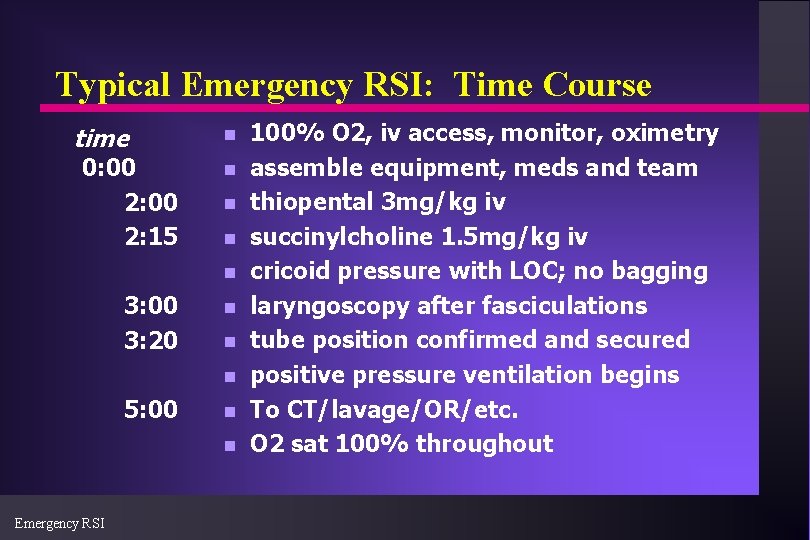
Typical Emergency RSI: Time Course time 0: 00 2: 15 n n n 3: 00 3: 20 n n n 5: 00 n n Emergency RSI 100% O 2, iv access, monitor, oximetry assemble equipment, meds and team thiopental 3 mg/kg iv succinylcholine 1. 5 mg/kg iv cricoid pressure with LOC; no bagging laryngoscopy after fasciculations tube position confirmed and secured positive pressure ventilation begins To CT/lavage/OR/etc. O 2 sat 100% throughout
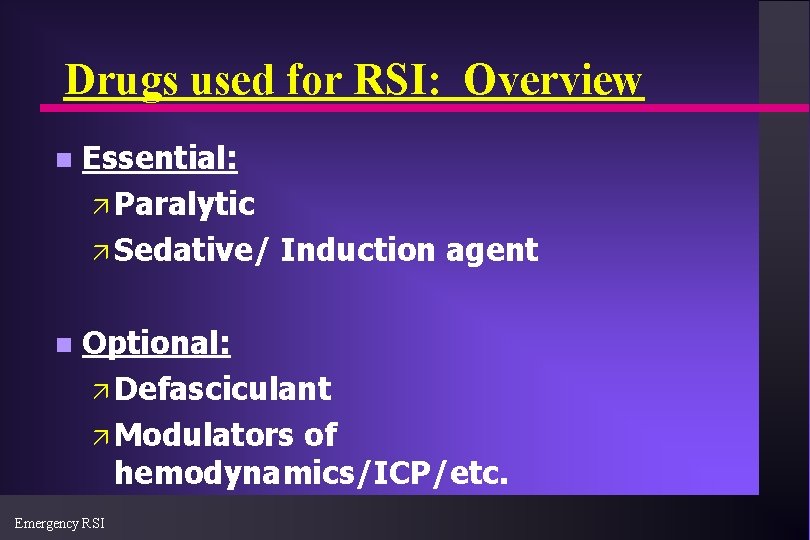
Drugs used for RSI: Overview n Essential: ä Paralytic ä Sedative/ Induction agent n Optional: ä Defasciculant ä Modulators of hemodynamics/ICP/etc. Emergency RSI
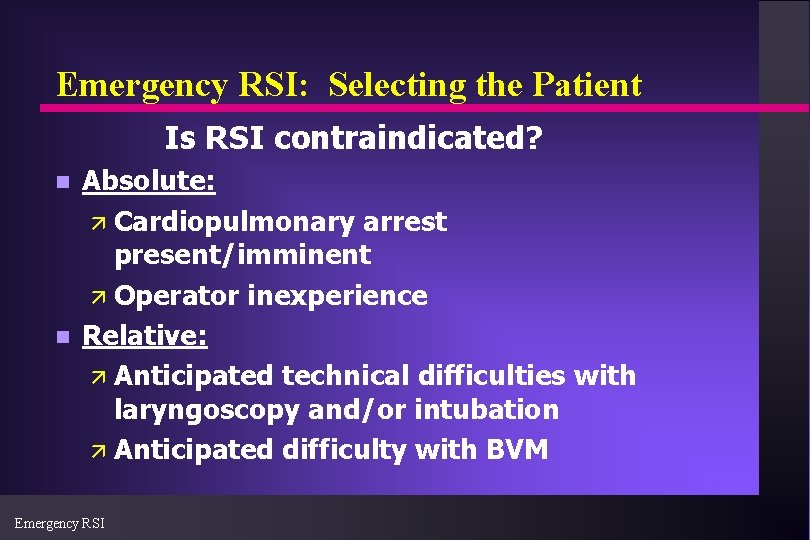
Emergency RSI: Selecting the Patient Is RSI contraindicated? n n Absolute: ä Cardiopulmonary arrest present/imminent ä Operator inexperience Relative: ä Anticipated technical difficulties with laryngoscopy and/or intubation ä Anticipated difficulty with BVM Emergency RSI
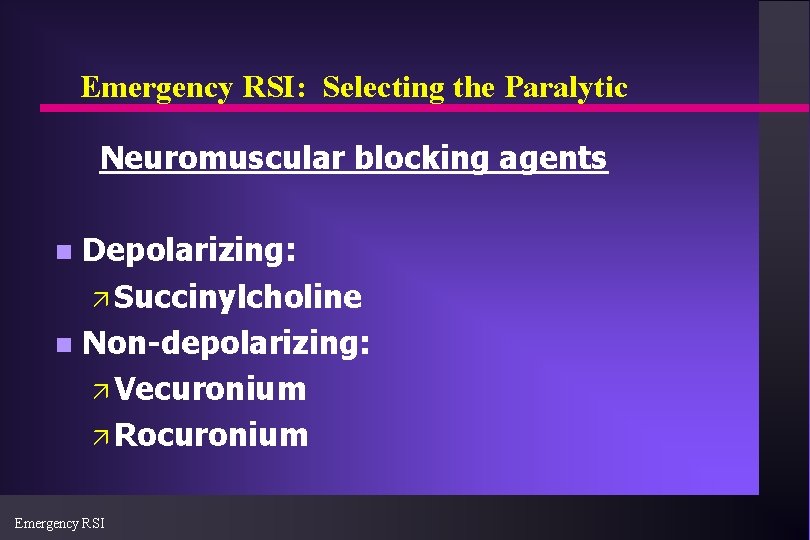
Emergency RSI: Selecting the Paralytic Neuromuscular blocking agents Depolarizing: ä Succinylcholine n Non-depolarizing: ä Vecuronium ä Rocuronium n Emergency RSI
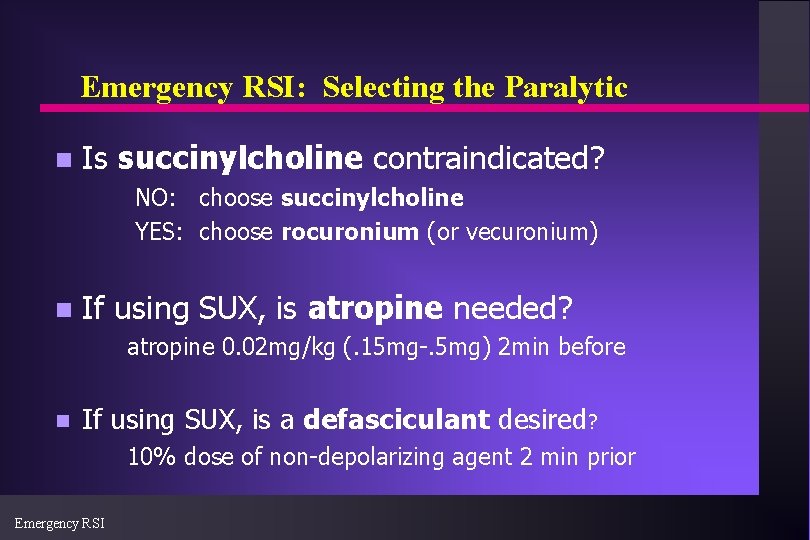
Emergency RSI: Selecting the Paralytic n Is succinylcholine contraindicated? NO: choose succinylcholine YES: choose rocuronium (or vecuronium) n If using SUX, is atropine needed? atropine 0. 02 mg/kg (. 15 mg-. 5 mg) 2 min before n If using SUX, is a defasciculant desired? 10% dose of non-depolarizing agent 2 min prior Emergency RSI
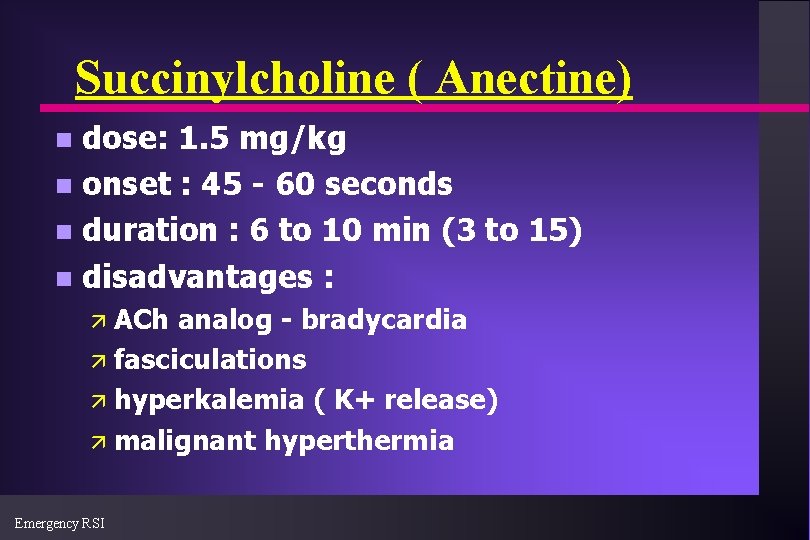
Succinylcholine ( Anectine) dose: 1. 5 mg/kg n onset : 45 - 60 seconds n duration : 6 to 10 min (3 to 15) n disadvantages : n ä ACh analog - bradycardia ä fasciculations ä hyperkalemia ( K+ release) ä malignant hyperthermia Emergency RSI

Succinylcholine : Contraindications • • • Emergency RSI Hyperkalemia - renal failure Active neuromuscular disease with functional denervation • ( 6 days to 6 months) Extensive burns, crush injuries Malignant hyperthermia Pseudocholinesterase deficiency Organophosphate poisoning
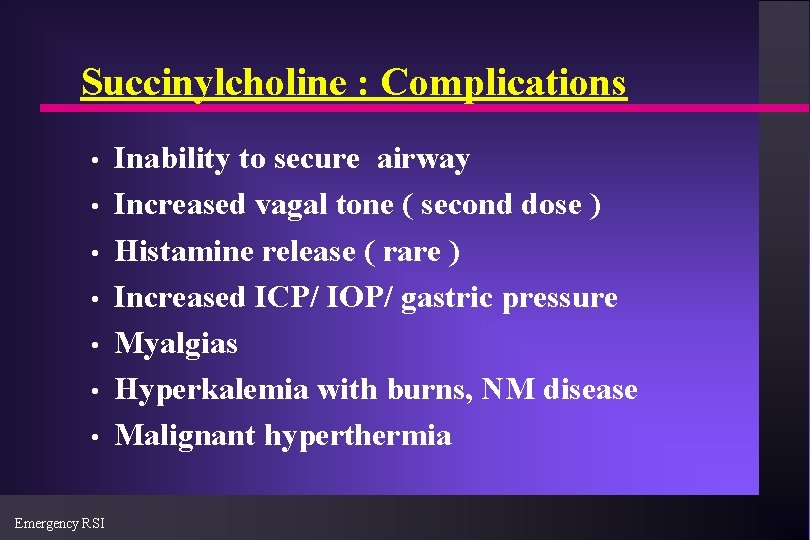
Succinylcholine : Complications • • Emergency RSI Inability to secure airway Increased vagal tone ( second dose ) Histamine release ( rare ) Increased ICP/ IOP/ gastric pressure Myalgias Hyperkalemia with burns, NM disease Malignant hyperthermia
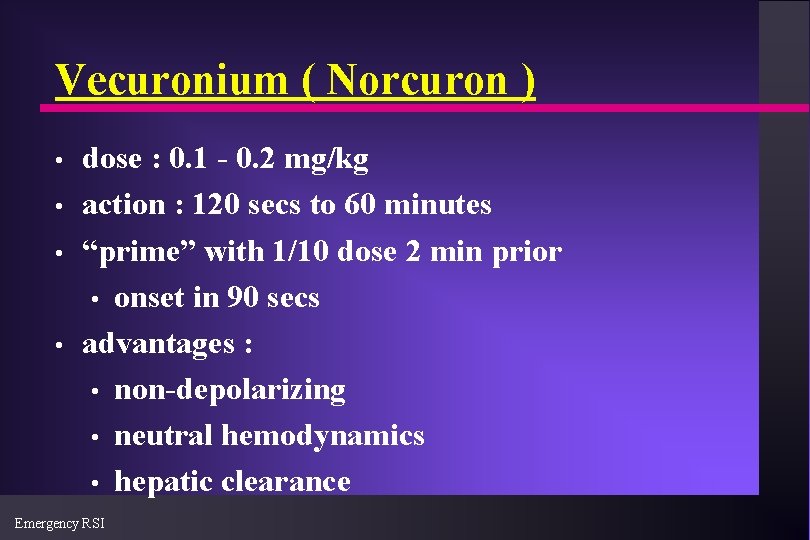
Vecuronium ( Norcuron ) • • dose : 0. 1 - 0. 2 mg/kg action : 120 secs to 60 minutes “prime” with 1/10 dose 2 min prior • onset in 90 secs advantages : • non-depolarizing • neutral hemodynamics • hepatic clearance Emergency RSI
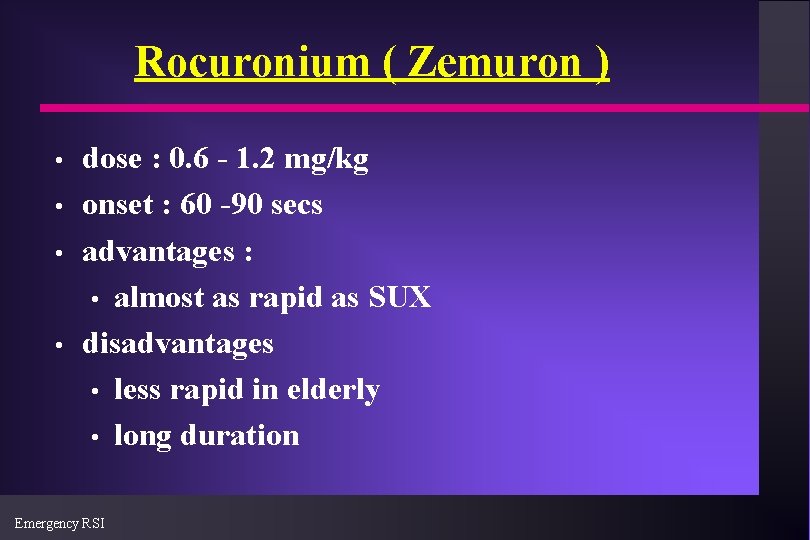
Rocuronium ( Zemuron ) • • dose : 0. 6 - 1. 2 mg/kg onset : 60 -90 secs advantages : • almost as rapid as SUX disadvantages • less rapid in elderly • long duration Emergency RSI
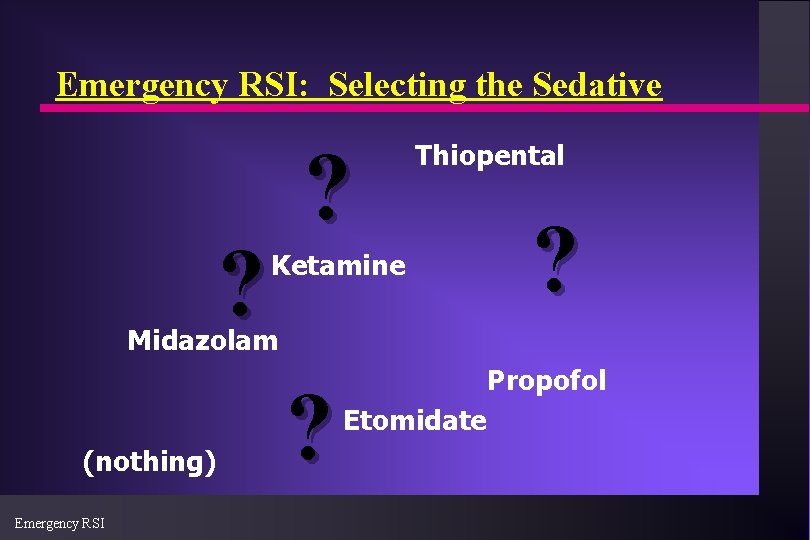
Emergency RSI: Selecting the Sedative ? ? Thiopental Ketamine ? Midazolam (nothing) Emergency RSI ? Propofol Etomidate
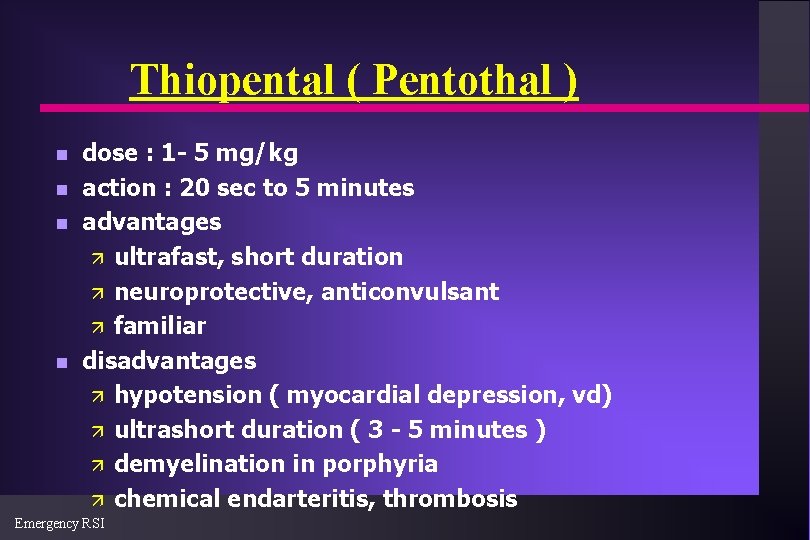
Thiopental ( Pentothal ) n n dose : 1 - 5 mg/kg action : 20 sec to 5 minutes advantages ä ultrafast, short duration ä neuroprotective, anticonvulsant ä familiar disadvantages ä hypotension ( myocardial depression, vd) ä ultrashort duration ( 3 - 5 minutes ) ä demyelination in porphyria ä chemical endarteritis, thrombosis Emergency RSI
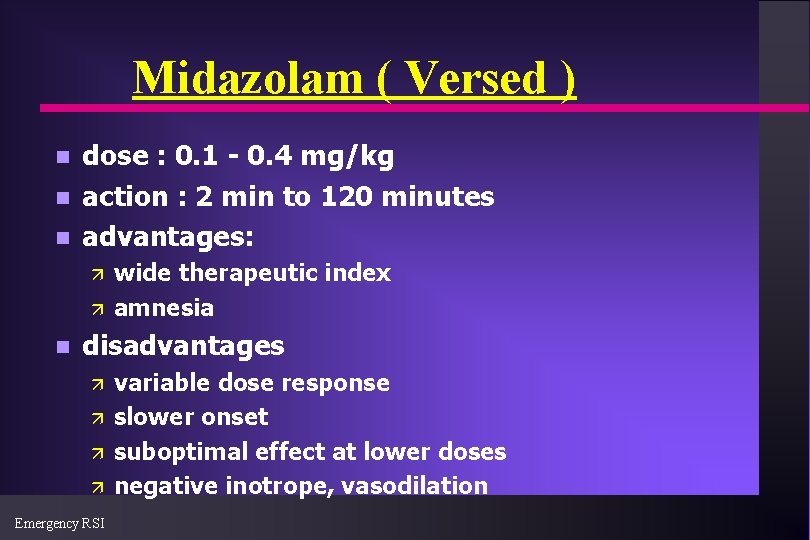
Midazolam ( Versed ) n n n dose : 0. 1 - 0. 4 mg/kg action : 2 min to 120 minutes advantages: ä ä n wide therapeutic index amnesia disadvantages ä ä Emergency RSI variable dose response slower onset suboptimal effect at lower doses negative inotrope, vasodilation
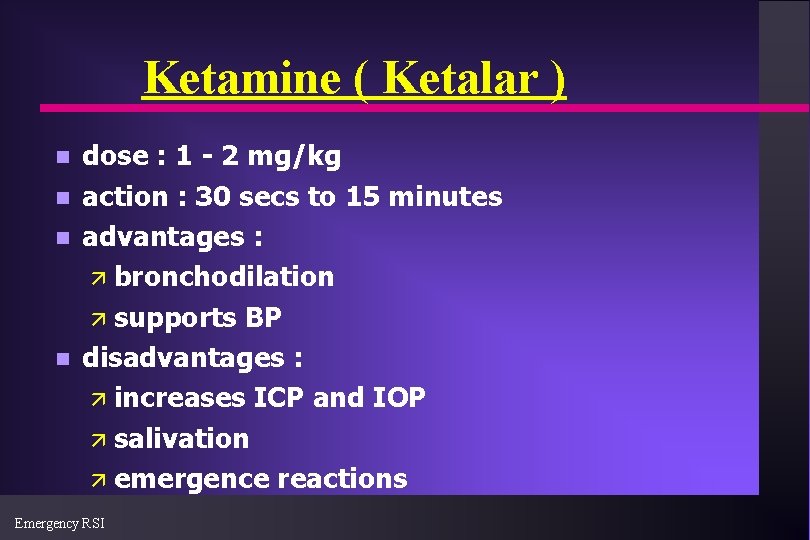
Ketamine ( Ketalar ) n n dose : 1 - 2 mg/kg action : 30 secs to 15 minutes advantages : ä bronchodilation ä supports BP disadvantages : ä increases ICP and IOP ä salivation ä emergence reactions Emergency RSI
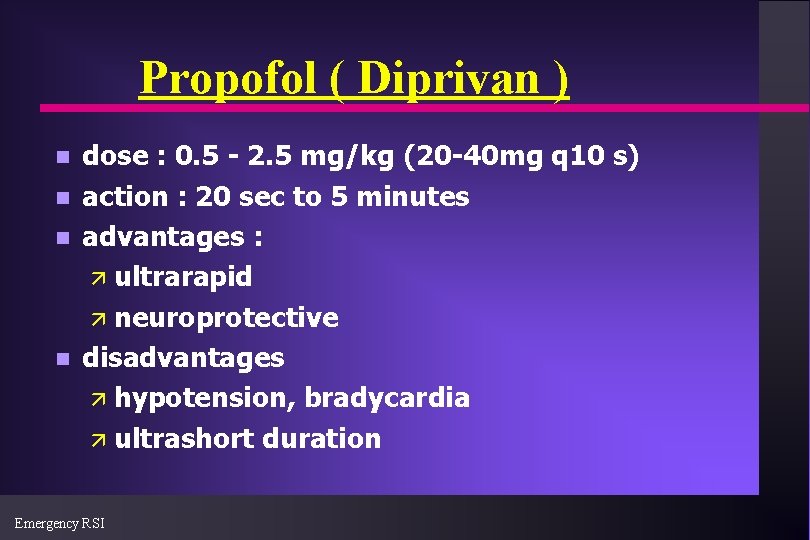
Propofol ( Diprivan ) n n dose : 0. 5 - 2. 5 mg/kg (20 -40 mg q 10 s) action : 20 sec to 5 minutes advantages : ä ultrarapid ä neuroprotective disadvantages ä hypotension, bradycardia ä ultrashort duration Emergency RSI
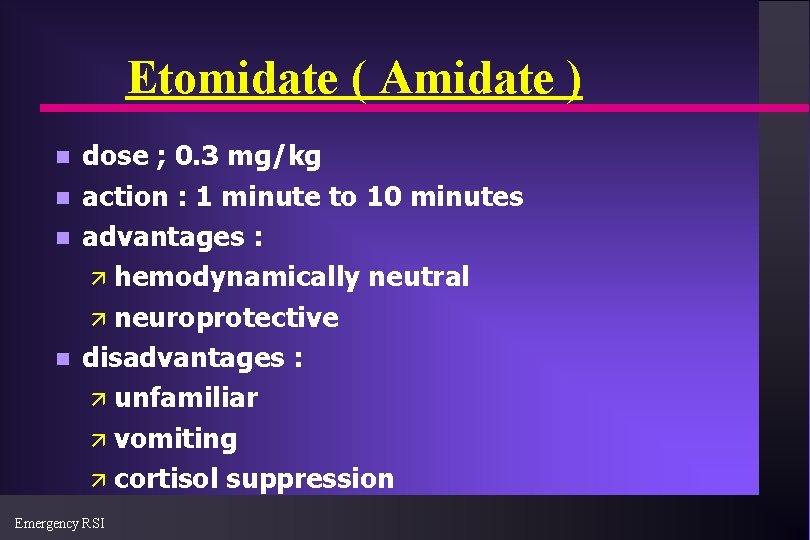
Etomidate ( Amidate ) n n dose ; 0. 3 mg/kg action : 1 minute to 10 minutes advantages : ä hemodynamically neutral ä neuroprotective disadvantages : ä unfamiliar ä vomiting ä cortisol suppression Emergency RSI
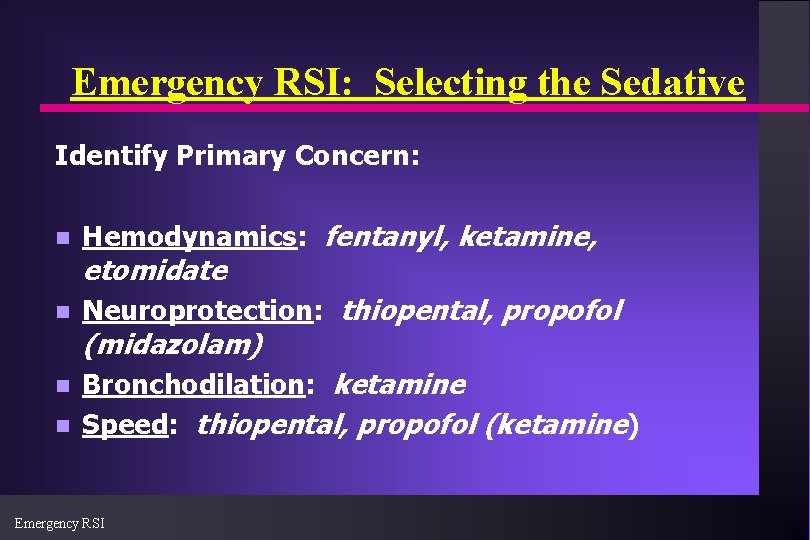
Emergency RSI: Selecting the Sedative Identify Primary Concern: n Hemodynamics: fentanyl, ketamine, n Neuroprotection: thiopental, propofol n Bronchodilation: ketamine Speed: thiopental, propofol (ketamine) n etomidate (midazolam) Emergency RSI

Emergency RSI: Selecting the Sedative Identify any Secondary Concerns: n n n Hemodynamics: beware thiopental, propofol (midazolam) Neuroprotection: avoid ketamine (? ? ) Speed: beware midazolam Patient given naloxone: avoid fentanyl Specific contraindications (e. g. porphyria): avoid drug Emergency RSI
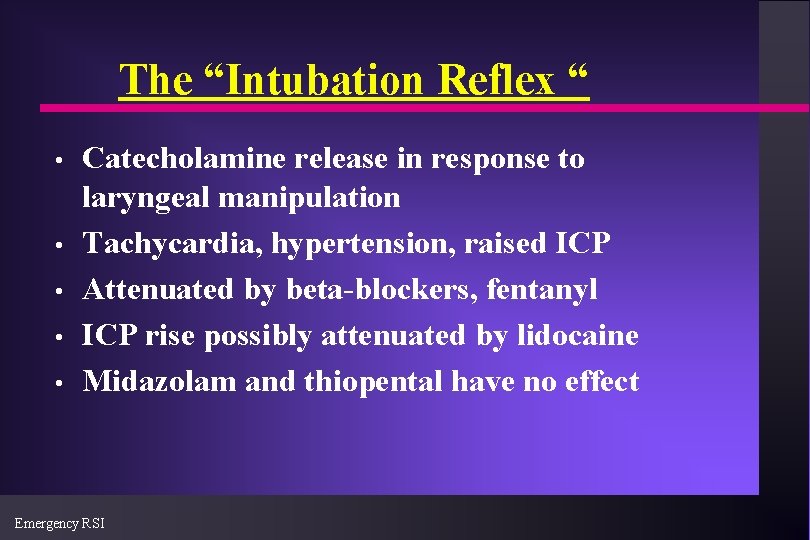
The “Intubation Reflex “ • • • Catecholamine release in response to laryngeal manipulation Tachycardia, hypertension, raised ICP Attenuated by beta-blockers, fentanyl ICP rise possibly attenuated by lidocaine Midazolam and thiopental have no effect Emergency RSI
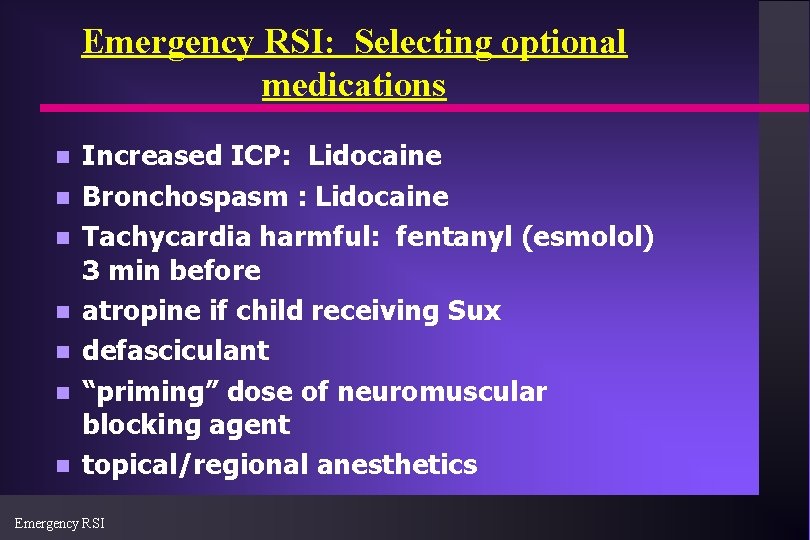
Emergency RSI: Selecting optional medications n n n n Increased ICP: Lidocaine Bronchospasm : Lidocaine Tachycardia harmful: fentanyl (esmolol) 3 min before atropine if child receiving Sux defasciculant “priming” dose of neuromuscular blocking agent topical/regional anesthetics Emergency RSI
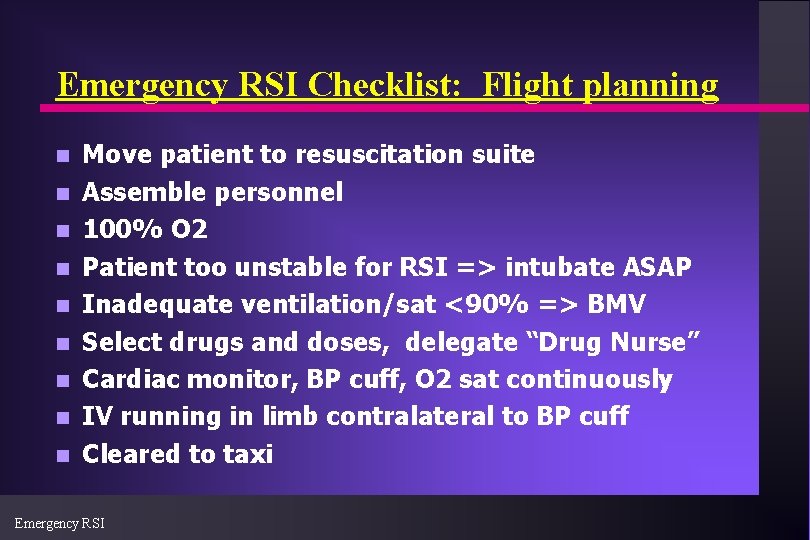
Emergency RSI Checklist: Flight planning n n n n n Move patient to resuscitation suite Assemble personnel 100% O 2 Patient too unstable for RSI => intubate ASAP Inadequate ventilation/sat <90% => BMV Select drugs and doses, delegate “Drug Nurse” Cardiac monitor, BP cuff, O 2 sat continuously IV running in limb contralateral to BP cuff Cleared to taxi Emergency RSI
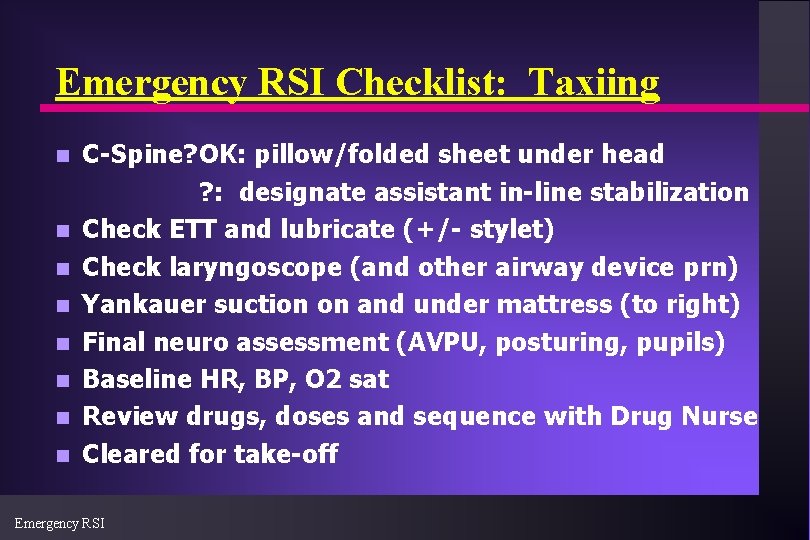
Emergency RSI Checklist: Taxiing n n n n C-Spine? OK: pillow/folded sheet under head ? : designate assistant in-line stabilization Check ETT and lubricate (+/- stylet) Check laryngoscope (and other airway device prn) Yankauer suction on and under mattress (to right) Final neuro assessment (AVPU, posturing, pupils) Baseline HR, BP, O 2 sat Review drugs, doses and sequence with Drug Nurse Cleared for take-off Emergency RSI
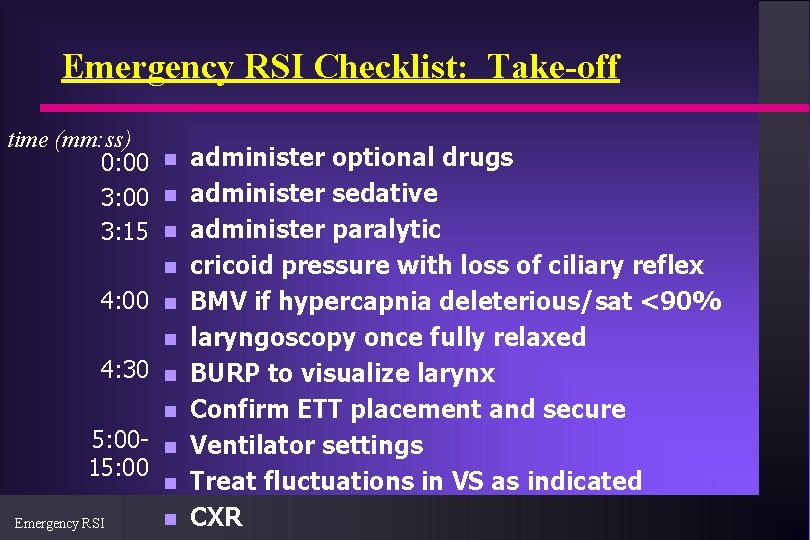
Emergency RSI Checklist: Take-off time (mm: ss) 0: 00 n administer optional drugs 3: 00 n administer sedative 3: 15 n administer paralytic n cricoid pressure with loss of ciliary reflex 4: 00 n BMV if hypercapnia deleterious/sat <90% n laryngoscopy once fully relaxed 4: 30 n BURP to visualize larynx n 5: 00 - n 15: 00 n Emergency RSI n Confirm ETT placement and secure Ventilator settings Treat fluctuations in VS as indicated CXR
Rapid Sequence Intubation : Procedure • • Emergency RSI Pre-intubation assessment Pre-oxygenate Prepare Premedicate Paralyze with Induction Pressure on cricoid Place the tube Post intubation assessment
Pre-oxygenate ( Time - 5 Minutes) • • • Emergency RSI 100 % oxygen for 5 minutes 4 conscious deep breaths of 100 % O 2 Fill FRC with reservoir of 100 % O 2 Allows 3 to 5 minutes of apnea Essential to allow avoidance of bagging If necessary bag with cricoid pressure
Preparation ( Time - 5 Minutes ) • • • ETT, stylet, blades, suction, BVM Cardiac monitor, pulse oximeter, ETCO 2 One ( preferably two ) iv lines Drugs Difficult airway kit including cric kit Patient positioning Emergency RSI
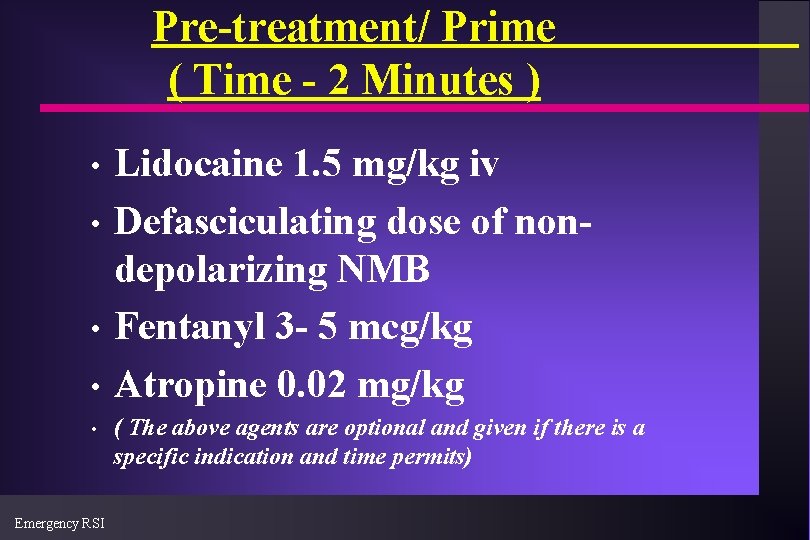
Pre-treatment/ Prime ( Time - 2 Minutes ) Lidocaine 1. 5 mg/kg iv • Defasciculating dose of nondepolarizing NMB • Fentanyl 3 - 5 mcg/kg • Atropine 0. 02 mg/kg • • Emergency RSI ( The above agents are optional and given if there is a specific indication and time permits)
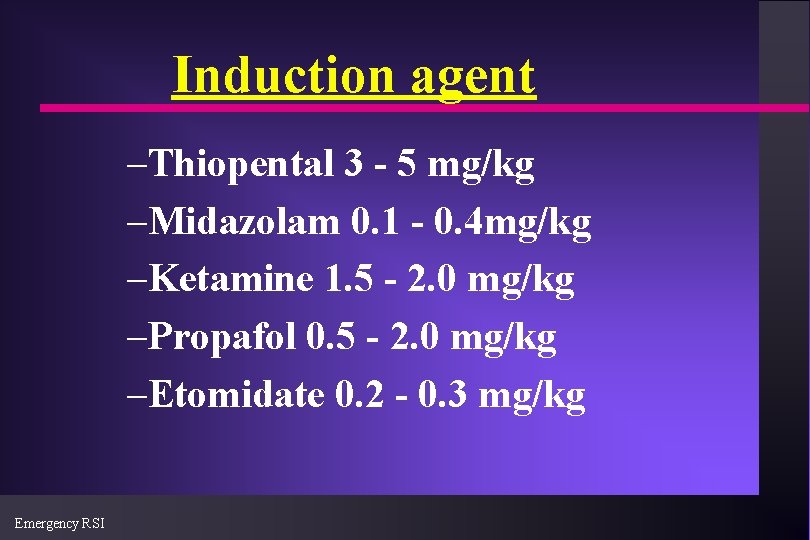
Induction agent –Thiopental 3 - 5 mg/kg –Midazolam 0. 1 - 0. 4 mg/kg –Ketamine 1. 5 - 2. 0 mg/kg –Propafol 0. 5 - 2. 0 mg/kg –Etomidate 0. 2 - 0. 3 mg/kg Emergency RSI
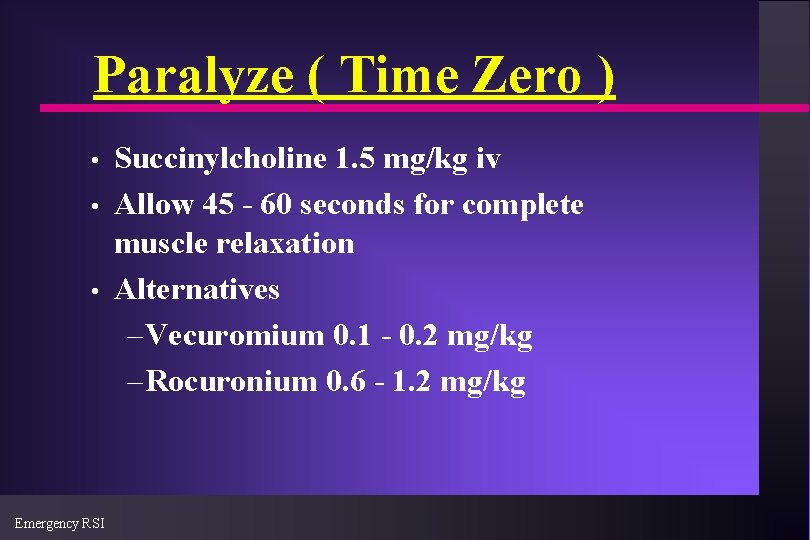
Paralyze ( Time Zero ) • • • Emergency RSI Succinylcholine 1. 5 mg/kg iv Allow 45 - 60 seconds for complete muscle relaxation Alternatives – Vecuromium 0. 1 - 0. 2 mg/kg – Rocuronium 0. 6 - 1. 2 mg/kg
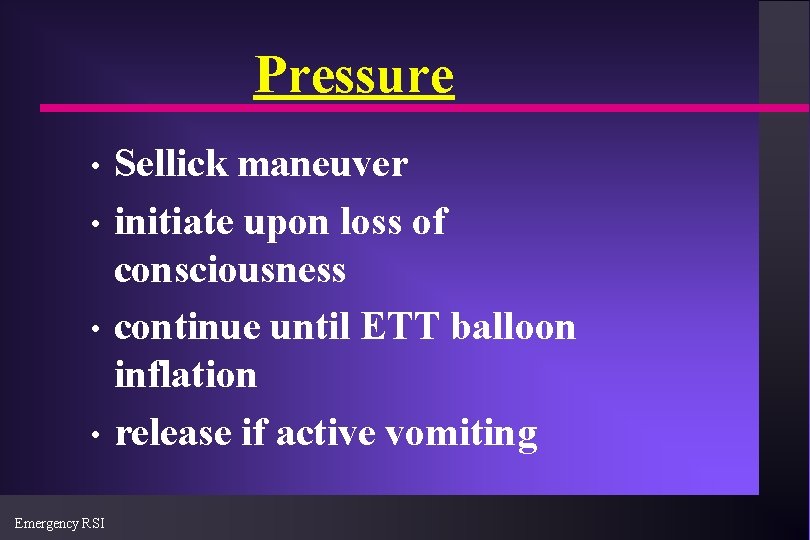
Pressure Sellick maneuver • initiate upon loss of consciousness • continue until ETT balloon inflation • release if active vomiting • Emergency RSI
Place the Tube ( Time Zero + 45 Secs ) • Wait for optimal paralysis • Confirm tube placement with ETCO 2 Emergency RSI
Post-intubation Hypotension • • Loss of sympathetic drive Myocardial infarction Tension pneumothorax Auto-peep Emergency RSI
Difficult Airway Kit • • • Emergency RSI Multiple blades and ETTs ETT guides ( stylets, bougé, light wand) Emergency nonsurgical ventilation ( LMA, Combitube, TTJV ) Emergency surgical airway access ( cricothyroidotomy kit, cricotomes ) ETT placement verification Fiberoptic and retrograde intubation
Amitriptyline tripper 27 year old overdose benzos + TCAs 1 hour PTA. Decreasing LOC (? ciliary reflex). HR 140 wide-complex regular, BP 90/50, RR 24, O 2 sat 99% on O 2. Emergency RSI

Walking at the scene 22 yr old multiple abdominal stab wounds 6” knife. Evisceration, agitation and uncooperative. HR 140, BP 90/50, RR 22, O 2 sat 99% on O 2. Emergency RSI
Status asthmaticus severus 50 yr old asthmatic x years, never admitted O/N. SOB x 2 d despite prednisone, antibiotics, and salbutamol q 1 h. Despite continuous salbutamol, epi s/c x 2, and Solu. Medrol iv, begins to fatigue. p. H 7. 22, p. CO 2 70, p. O 2 140. Emergency RSI
Collapse at bank 38 year old male, standing in line at bank, complained of sudden severe HA and collapsed. On arrival, HR 55 BP 170/100 RR 12 decorticate posturing. Emergency RSI

NOT renal colic 68 year old male, hypertensive, no past history of urolithiasis, presents with R flank pain and hematuria. While you are booking the spiral CT, he complains of increasing back pain, then vomits. HR 140 BP 85/palp diaphoretic ++. And then he gets worse. Emergency RSI
Overdue for dialysis 68 yr old hemodialysis-dependent pt in florid pulmonary edema and decreasing LOC. HR 120 reg, BP 220/120, O 2 sat 85% on non-rebreather 15 L/min. Emergency RSI
Too much Nintendo 14 year old known epileptic on multiple meds, still seizing after diazepam, phenobarb and over 30 minutes in the ED. 160 100/50 37. 2 99% sat. Small jaw. Emergency RSI

“I would especially commend the physician who, in acute diseases, by which the bulk of mankind are cutoff, conducts the treatment better than others. ” Hippocrates Emergency RSI
- Slides: 58