
Emergency plan instructions September 2019 Contents Purpose Types
Emergency plan instructions September 2019
Contents • • Purpose Types of calamity Duty to report Alarm signal Alarm phases Positions in the emergency organisation Carrying out tasks Code Of Conduct IMM 16 -04 -2019 2
Purpose • At Yara Sluiskil, a preventive policy is implemented to prevent calamities. If, despite everything, a calamity nevertheless occurs, Yara Sluiskil and its emergency organisation want to limit the calamity to a minimum – if necessary – in cooperation with the local government. • Acquiring basic knowledge of the emergency plan. IMM 16 -04 -2019 3

Types of calamity • Fire caused by burning and accompanied by flames, capable of reproducing itself. • Accident with hazardous substance An event, such as a major emission or an explosion, associated with an unusual occurrence in an industrial activity, presenting a serious hazard, immediate or delayed, to people inside or outside the establishment and/or to the environment, and involving one or more hazardous substances. • Accident with injury A sudden event that causes a person to have a physical injury or even causes death. IMM 16 -04 -2019 4

Duty to report • Every employee has a duty to report a life-threatening event, accident, fire or serious leak immediately. • Attention: It is not allowed to use the emergency number as a ‘normal’ phone line • How? In case of a fire, press the fire alarm button and call the emergency number or call the emergency number immediately. − 100 or (F 1) 100 with a landline or call 0115 474 100 with your mobile. − Briefly state: • • who you are; what happened; where it happened; any consequences inside and/or outside the department/company. − If it is not a fire, do not use the fire alarm button but call the emergency number. IMM 16 -04 -2019 5
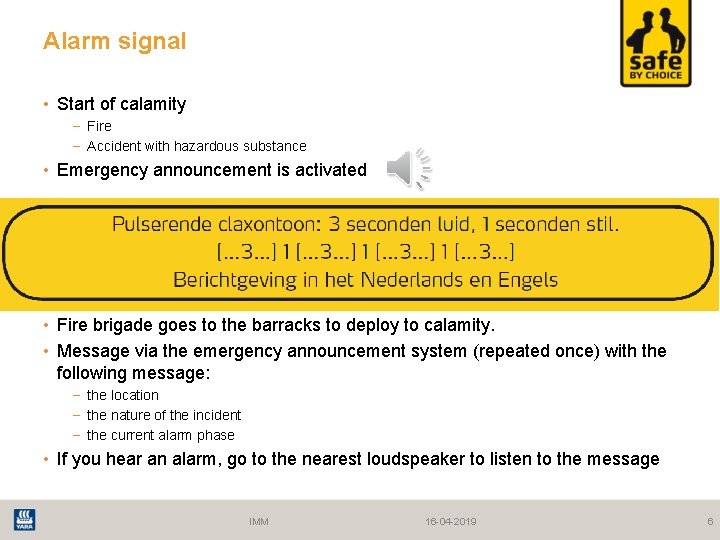
Alarm signal • Start of calamity − Fire − Accident with hazardous substance • Emergency announcement is activated • Fire brigade goes to the barracks to deploy to calamity. • Message via the emergency announcement system (repeated once) with the following message: − the location − the nature of the incident − the current alarm phase • If you hear an alarm, go to the nearest loudspeaker to listen to the message IMM 16 -04 -2019 6
Different alarm phases • Assistance phase = Assistance from the fire brigade required for planned activities • Alarm phase 0 = Deployment to a department • Alarm phase 1 = Deployment to a department where external help is required • Alarm phase 2 = Calamity extends to multiple departments • Alarm phase 3 = Calamity extends to outside Yara Sluiskil IMM 16 -04 -2019 7
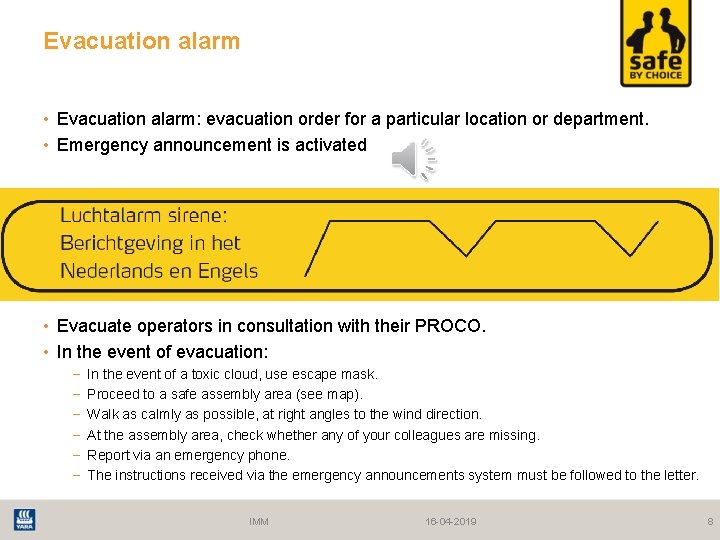
Evacuation alarm • Evacuation alarm: evacuation order for a particular location or department. • Emergency announcement is activated • Evacuate operators in consultation with their PROCO. • In the event of evacuation: − In the event of a toxic cloud, use escape mask. − Proceed to a safe assembly area (see map). − Walk as calmly as possible, at right angles to the wind direction. − At the assembly area, check whether any of your colleagues are missing. − Report via an emergency phone. − The instructions received via the emergency announcements system must be followed to the letter. IMM 16 -04 -2019 8

Assembly areas IMM 16 -04 -2019 9
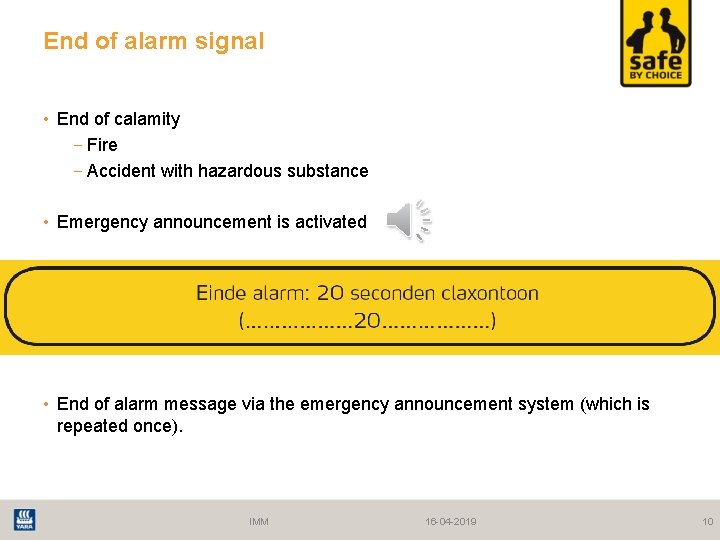
End of alarm signal • End of calamity − Fire − Accident with hazardous substance • Emergency announcement is activated • End of alarm message via the emergency announcement system (which is repeated once). IMM 16 -04 -2019 10

Signal for announcements • Announcement via alarm system • Emergency announcement is activated • Weekly test: every Tuesday at 10: 00 a. m. IMM 16 -04 -2019 11
Positions in the emergency organisation Depending on the alarm phase: • • • In-company firefighting team First aid/Health service Security officer Duty HESQ chief Emergency plan coordinators Service engineers Maintenance PROCO/duty department head Evacuation supervisor/Evacuators Duty manager Company Relief Team (= BOT team) Yara employees, subcontractors and contractors IMM 16 -04 -2019 12
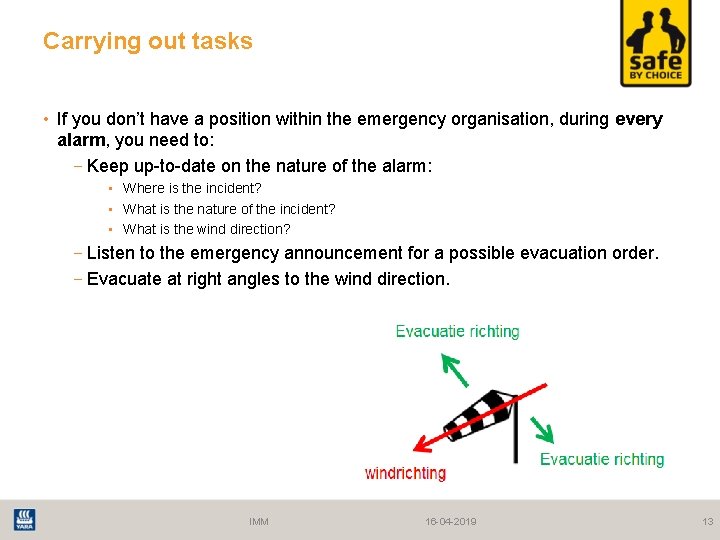
Carrying out tasks • If you don’t have a position within the emergency organisation, during every alarm, you need to: − Keep up-to-date on the nature of the alarm: • Where is the incident? • What is the nature of the incident? • What is the wind direction? − Listen to the emergency announcement for a possible evacuation order. − Evacuate at right angles to the wind direction. IMM 16 -04 -2019 13
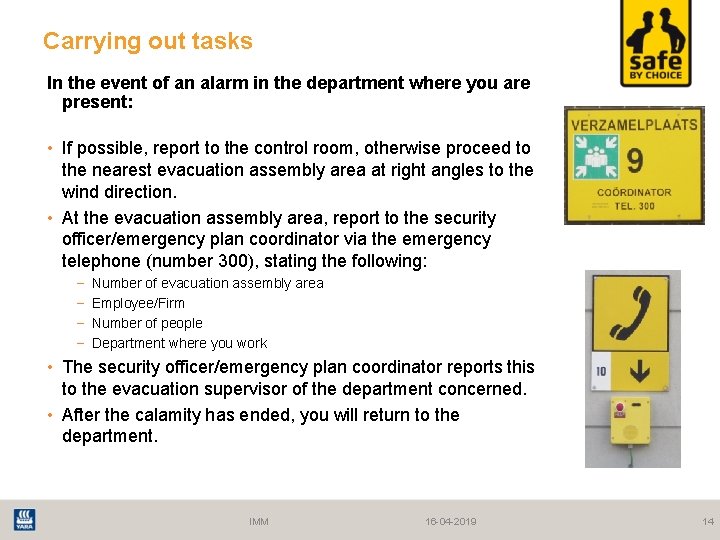
Carrying out tasks In the event of an alarm in the department where you are present: • If possible, report to the control room, otherwise proceed to the nearest evacuation assembly area at right angles to the wind direction. • At the evacuation assembly area, report to the security officer/emergency plan coordinator via the emergency telephone (number 300), stating the following: − Number of evacuation assembly area − Employee/Firm − Number of people − Department where you work • The security officer/emergency plan coordinator reports this to the evacuation supervisor of the department concerned. • After the calamity has ended, you will return to the department. IMM 16 -04 -2019 14
Carrying out tasks • Additional measures: − In case of Alarm phase 0 or 1 at your own department: • Work permits are being revoked • Close windows and external doors, stop forced ventilation • Stay inside − In case of Alarm phase 2 or 3: • Work permits are being revoked on the entire site • Close windows and external doors, stop forced ventilation • Stay inside • In event of evacuation − Follow the instructions of the evacuation supervisor and the evacuators in your department • Internal assembly area • External assembly area • Who are the evacuation supervisor and evacuators? − Recognisable by their yellow vest − Mentioned on evacuation plan of the department IMM 16 -04 -2019 15
Code Of Conduct • • • Never leave the site without signing yourself out; Always wear the necessary PPE; Always move at right angles to the wind direction in relation to the calamity; Minimise internal phone traffic; Always listen carefully to the communication via the emergency announcement system; Always follow the instructions of members of the emergency organisation; All communication for the benefit of the emergency organisation takes place via telephone 300; Never go in the direction of the calamity if you are not part of the emergency organisation; The general Code of Conduct continue to apply at all times; From alarm phase 2: − everyone on the site should go inside, stay inside or go to an evacuation assembly area; − all traffic movements, with the exception of the emergency organisation, are prohibited. IMM 16 -04 -2019 16
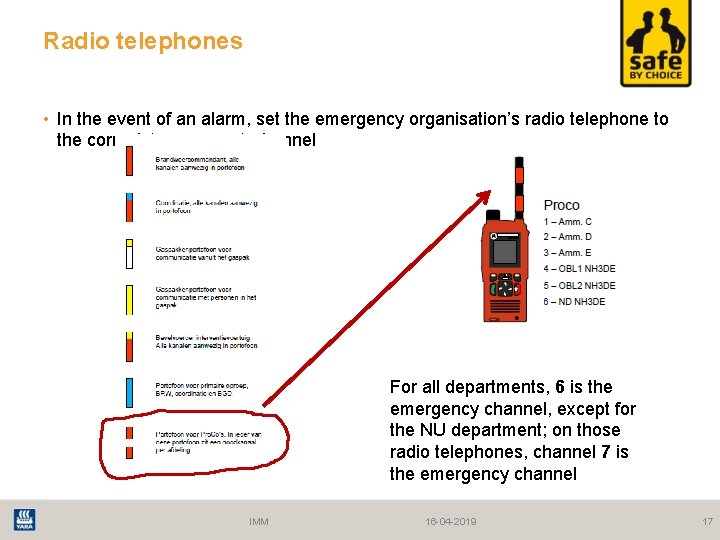
Radio telephones • In the event of an alarm, set the emergency organisation’s radio telephone to the correct (emergency) channel For all departments, 6 is the emergency channel, except for the NU department; on those radio telephones, channel 7 is the emergency channel IMM 16 -04 -2019 17

- Slides: 18