
Emergency Operation Center Preparedness COVID19 Considerations The mark

- Slides: 43
Emergency Operation Center Preparedness: COVID-19 Considerations The mark “CDC” is owned by the US Dept. of Health and Human Services and is used with permission. Use of this logo is not an endorsement by HHS or CDC of any particular product, service, or enterprise. cdc. gov/coronavirus
Objectives § This presentation is intended to: – Explain the importance of emergency management activities throughout the emergency management cycle – Describe trainings and exercises for EOC preparedness – Discuss After Action Reviews
Emergency Management Activities
Emergency Management § The management of public health emergencies consists of a range of activities that ensure that all aspects of an emergency are considered. § The use of emergency management elements to guide public health emergencies provides the structure to support: – Decision making and operational competence – Data processing into action plans – Deployment of resources – Human and financial resourcing and accountability § The mentioned capabilities are essential to setting up an effective EOC.
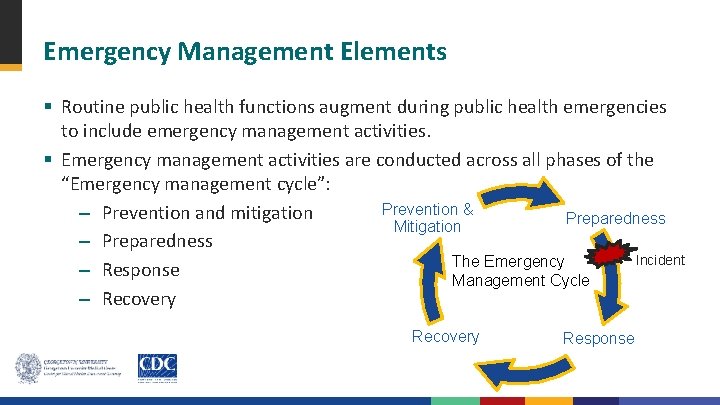
Emergency Management Elements § Routine public health functions augment during public health emergencies to include emergency management activities. § Emergency management activities are conducted across all phases of the “Emergency management cycle”: Prevention & – Prevention and mitigation Preparedness Mitigation – Preparedness Incident The Emergency – Response Management Cycle – Recovery Response
Prevention and Mitigation Activities § Prevention and mitigation refer to the activities that involve treating and/or dealing with the identified risks to prevent or reduce their impact. § With respect to COVID-19, it can include the following activities: – Outbreak prevention and control – Food and water safety – Community education – Social mobilization – Vaccination of populations, other prophylaxis (if and when available)
Preparedness Activities § Preparedness refers to the activities conducted in anticipation of a public health emergency § It includes the following activities: – Risk assessment (see later slide for additional details) – Assessment of capacities, capabilities and available resources – Development of plans and procedures – Maintenance of infrastructure and stockpiles of resources – Training of personnel (training and exercising) § Preparedness activities are influenced by the ”preparedness cycle”
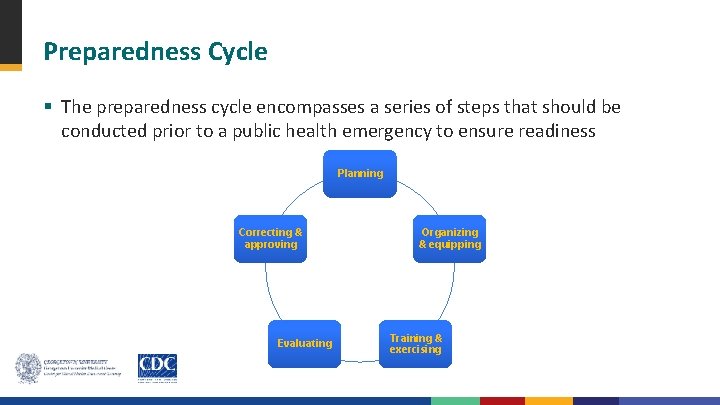
Preparedness Cycle § The preparedness cycle encompasses a series of steps that should be conducted prior to a public health emergency to ensure readiness Planning Correcting & approving Evaluating Organizing & equipping Training & exercising
Preparedness § Preparedness is an on-going effort that can (and should) take place throughout the emergency management cycle. § The lessons learned during prevention, mitigation, preparedness, response, and recovery from emergency responses should be incorporated into the preparedness cycle. – The results obtained from other emergency responses improves future preparedness for public health emergencies. – During the COVID-19 response, plans and other preparedness documents can be updated based on new data or information.
Risk Assessment § Risk assessment is a critical process that underlies all aspects of emergency management, but is particularly associated with preparedness § It refers to the standardized process for gathering and documenting information to assign a level of risk. § It includes the following activities: – Hazard identification – Vulnerability or threat assessment – Risk estimation – Surveillance and monitoring of potential or evolving threats, i. e. COVID-19
Response Activities § Response refers to the use of preparedness resources in reaction to a public health emergency § With reference to COVID-19, response includes the following activities: – Mobilization of treatment and prevention resources – Enhanced surveillance and monitoring – Contact tracing – Intervention § Please see the “How do we operate our EOC” module for more details on response activities for COVID-19
Recovery Activities § Recovery refers to when a public health emergency is brought under control, response activities progressively cease, and routine public health activities are renewed § It includes the following activities: – Restoration of routine surveillance and monitoring (see also the module on deactivation of the EOC) – Restoration of impacted infrastructure and resources – Conducting an After Action Review (AAR) – Developing and implementing action plan to mitigate future public health risks and improve future responses
Preparedness: Training and Exercises
Training – Staff Competencies § Establishing staff competencies should align with the EOC and its functions. § Competencies may vary across EOCs, but should include the following as core competences: – Leadership – Emergency management frameworks, functions and communications – Information technology – Training development and facilitation § There may also be response specific competencies, i. e. , physical distancing and use of PPE for COVID-19. More information on Staff Competencies can be found in WHO’s Handbook for Developing a Public Health Emergency Operations Centre Part C: Training and Exercises
Preparedness: Training and Exercises § The preparedness phase in emergency management refers to the activities conducted in anticipation of an emergency (i. e. COVID-19). § Preparedness training and exercising refers to capacitating personnel to respond to a public health emergency. – In this context, that EOC personnel are capable and ready for the activation of an EOC.
Training § Training is defined as any learning experience and/or activity that improves knowledge, skills and/or abilities to achieve a specific level of proficiency. § The following steps should be carried out for the effective training of EOC personnel: – Prepare training curriculum – Conduct a training needs assessment – Define training evaluation – Design training program methods – Establish staff competencies – Identify the types of trainings to be offered
Training – Designing Training Program § Designing a suitable training program is the first step in the training process. § The process consists of: – Conducting (or reviewing) a needs assessment – Establishing goals and learning objectives – Designing content, selecting methods, and determining materials required – Defining expected outcomes – Deciding on monitoring, evaluation, and review techniques
Training – Types of Training § EOC trainings can be conducted through various methods and be directed to diverse audiences. § Training methods may include: – Classroom-based and e-Learning courses – Internships, fellowships and field assignments – Participation in exercises, orientation, mentoring and team-building sessions • These may need to be adapted during COVID-19 to accommodate social distancing or other infection prevention requirements – Participation in planning and development of operating procedures
Training – Types of Training ( continued ) § Types of training: – Individual (requires personal study and participation in courses, seminars and workshops) – Organizational (involves training and exercise activities that enhance learning conditions for all EOC staff)
Training – Training Needs Assessment § A training needs assessment is conducted to formulate training objectives. § Training objectives are developed from the evaluation of the skills needed in an EOC, training needs, and existing opportunities for collaboration with different sectors. § Training needs assessments may be conducted through: – Presentations – Exercises – Self-reporting – Evaluation of a response (After Action Review)
Training – EOC Training Curriculum § EOC training curriculum should be developed based on the objectives established and the expected outcomes identified at the beginning of the training process. § Training curriculums should be prepared and maintained by the personnel who will staff the EOCs and those whose competences would be improve by the training. More information on EOC Training Curriculum can be found in the Handbook for Developing a Public Health Emergency Operations Centre Part C: Training and Exercises
Training – Training Evaluation § Defining training evaluation methods should be done in the early stages of the development of the training program to ensure learning objectives are met and how the course material was received. § Training evaluation methods may include: – Observations – Presentations – Pre-tests and post-tests – Exams and exercises
Exercises § Exercises are controlled, objective-driven activities that simulate real situations to test and evaluate EOC plans and procedures. § Exercises help to better prepare EOCs for the effective response to public health emergencies by increasing their confidence in response and identifying gaps and weaknesses in response plans. § Exercises are usually carried out during non-response phases, in order to reduce strain on personnel and resources during an actual response. – During COVID-19, EOCs should carefully consider their epidemiological context to assess benefits to conducting exercises at this time.
Exercises – Types of Exercise § Identifying the type of exercise to be conducted is done based on the objective, schedule, and training for the exercise. § The following are the two primary types of exercises that can be organized: – Discussion-based exercises – Operations-based exercises § More information on Discussion-Based Exercises can be found in the Handbook for Developing a Public Health Emergency Operations Centre Part C: Training and Exercises
Exercises – Discussion-Based Exercises § Discussion-based exercises serve to develop new policies and procedures and/or to facilitate familiarization with current policies, plans and procedures. § Discussion-based exercises include: – Orientation exercises (seminars and workshops) – Table-top exercises (group discussions of simulated emergency response) – Use of gaming (video alternative to enhance the simulation of an exercise)
Exercises – Operations-Based Exercises § Operations-based exercises function to validate established plans, policies, and procedures. § Operational-based exercises include: – Drills (targets a specific skill, function and/or process) – Functional exercises (practices and evaluates procedures) – Full-scale exercises (evaluates full capabilities for preparedness and response)
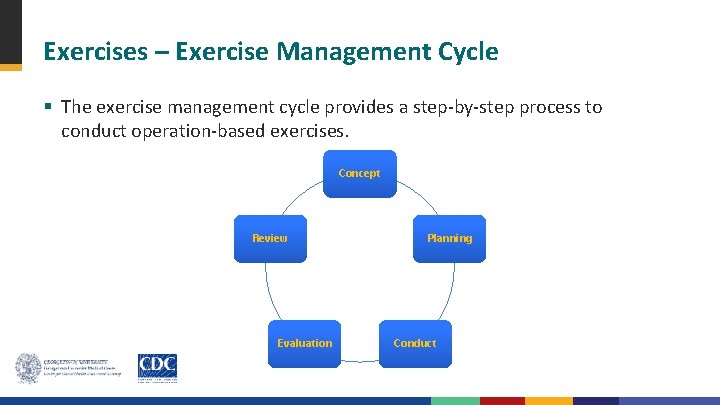
Exercises – Exercise Management Cycle § The exercise management cycle provides a step-by-step process to conduct operation-based exercises. Concept Review Evaluation Planning Conduct
Exercises – Exercise Management Cycle § The steps in the exercise management cycle are the following: – Concept (a concept paper is created to provide senior leadership with a synopsis of the exercise) – Planning and development (the structure of the exercise is determined) – Conduct of exercise (the exercise takes place) – Evaluation and Review (the final analysis of the exercise, its activities and performance is completed) (i. e. , post-exercise debriefings, after action reviews, evaluation report, etc. )
EOC Training and Exercise Program § EOCs should establish training and exercises programs to guarantee that EOC personnel is fully equipped and capacitated to manage the response to a public health emergency. § The continuous access to these resource benefits EOC personnel, as well as the preparedness process for the next response.
After Action Reviews
After Action Reviews § A post-incident assessment, or After Action Review (AAR) refers to the process of reviewing the actions taken during the response to a public health emergency. § AARs are considered emergency management procedures and are part of the process of EOCs. § The process should take place during the deactivation phase of an EOC or within three months following the official end date of the event. § The successful completion of an AAR, following a real response or simulation, is a voluntary component of the International Health Regulations Monitoring and Evaluation Framework.
After Action Reviews § There are three phases that all AARs share: – Objective observation: How were actions implemented? – Analysis of gaps/best practices: Gaps between planning and practice? What worked and what did not work? – Identification of areas for improvement: How can actions be improved? More information on AAR objectives, formats, and planning can be found in the WHO Guidance for After Action Review.
Benefits of AARs § Conducting AARs following the response to a public health emergency (i. e. , COVID-19) provides a set of benefits that: – Allows for the documentation of lessons learned that can improve – – conditions for future public health emergencies. Encourages critical thinking around the event to identify failures and successes during response. Supports cross-sectoral learning and strengthens coordination. Builds capacity for preparedness and response through the consensus of team members by identifying issues that need follow-up. Even during the COVID-19 response, planning can begin for the AAR.
Before an AAR § To conduct an AAR, the first step is to define and identify the objectives, scope, and stakeholders to be involved in the process. – Determining these three factors facilitates the planning process of an AAR and serves to identify which AAR format would work best. § The second step refers to selecting the appropriate AAR format. – Selecting a format for the AAR is based on multiple factors, particularly the complexity of the event and the amount of resources required to conduct the AAR.
Before an AAR - Formats § There are four formats of AARs: – Debrief – Working group – Key informant interview – Mixed-method
Before an AAR § Based on the AAR format adopted, the next steps in the process should be determined: – Build AAR team – Establish budget – Develop checklist and agenda – Select venue to host AAR – Summarize concepts and inform participants
Preparing for an AAR § For all formats of AARs there are key actions that need to be completed to prepare for conducting the AAR. § These actions are: – Collect and review information to gain understanding of the response actions implemented. This could include documents developed during response (i. e. , situational reports, outbreak reports, reviews, evaluations). – Refine trigger questions to guide the discussion of the AAR. These questions should be based on the phases, including objective observation, analysis of gaps/best practices and identification of areas for improvement.
Preparing for an AAR ( continued ) – Identify facilitators and interviewers and brief participants on their roles. • All COVID-19 relevant partners and sectors should be represented. This may include political leaders, clinical professionals, community leaders, etc. – Set up AAR by holding a preliminary meeting to inform and coordinate with AAR team the scope, the objectives, and the AAR format selected.
During an AAR § The first session of an AAR workshop introduces participants to the agenda, objectives, scope, methodology and expected outputs. § During an AAR there are three main actions that should be carried out: – Conduct analytical part of AAR by identifying challenges, agreeing on the best practices during response, and recognizing new capacities developed. – Building consensus of the final best practices, challenges and new capacities developed. – Close AAR process and conduct evaluation of the workshop to make necessary improvements to format or methodology.
AAR Results and Follow-Up § The final step of conducting an AAR refers to presenting the results, identifying lessons learned, and determining recommendations for future response to a public health emergency. § The final process of the AAR consists of: – Conducting debriefings – Developing the final report – Documenting progress – Establishing or adding information to the lessons learned database
References § WHO (2019) Guidance for After Action Review (AAR). Retrieved from https: //extranet. who. int/iris/restricted/bitstream/handle/10665/311537/ WHO-WHE-CPI-2019. 4 eng. pdf; jsessionid=D 8534058405 EEC 17 A 4 B 2 F 6640 C 78 BB 32? sequence=1 § WHO (2018) Handbook for Developing a Public Health Emergency Operations Centre Part C: Training and Exercises. Retrieved from https: //apps. who. int/iris/bitstream/handle/10665/311545/978924151513 9 -eng. pdf? sequence=1
References § WHO (2012) Rapid Risk Assessment of Acute Public Health Events. Retrieved from https: //apps. who. int/iris/bitstream/handle/10665/70810/WHO_HSE_GAR _ARO_2012. 1_eng. pdf? sequence=1 § WHO (2015) Framework for a Public Health Emergency Operations Centre. Retrieved from https: //apps. who. int/iris/bitstream/handle/10665/196135/978924156513 4_eng. pdf? sequence=1
For more information, contact CDC 1 -800 -CDC-INFO (232 -4636) TTY: 1 -888 -232 -6348 www. cdc. gov The findings and conclusions in this report are those of the authors and do not necessarily represent the official position of the Centers for Disease Control and Prevention.