
Emergency Management Professional Program EMPP New Opportunities for






- Slides: 18
Emergency Management Professional Program (EMPP) New Opportunities for Collaboration Dr. Kelly E. Garrett Director, Emergency Management Professional Program Emergency Management Institute
Emergency Management Professional Program (EMPP) § The EMPP Basic, Advanced, and Executive Academies provide a structured and progressive framework for acquiring the knowledge, skills, and abilities to enter and progress through the field of emergency management, while meeting the challenges of a dynamic and complex environment. § The Basic, Advanced, and Executive Academies of the EMPP have evolved into a whole community forum for the training and professional development of the emergency management profession. § Started in 2011, the Basic Academy provides the opportunity to acquire a foundational understanding of the key concepts of emergency management. § Launched in 2013, the Advanced Academy creates conditions for an academically rigorous learning environment by using critical thinking and complex problem solving processes in examining key topics in the contemporary emergency management environment. § Initiated in 2013, the Executive Academy enhances the knowledge of our Nation’s executive emergency managers through a well-rounded understanding of, and ability to apply, emergency management executive leadership core competencies in a collaborative learning environment. 1
Emergency Management Professional Program (EMPP) § Over the past few years, a significant number of students in the EMPP academies expressed the desire to achieve a professional certification upon graduation. § The academies’ curriculum focuses on readying the Nation’s emergency managers for catastrophic disasters through a whole community approach. § The Director of EMPP approached key officers of International Association of Emergency Managers (IAEM) to explore aligning the academies with the Certified Emergency Manager (CEM) training requirements for certification. § Through collaboration with key partners such as the Chair of the IAEM Training & Education Committee, the Global Chair of the Certification Board, and the IAEM President, a detailed educational crosswalk of the EMPP curriculum was completed. 2
Emergency Management Professional Program (EMPP) § This resulted in the EMPP academies becoming closely aligned with the CEM certification/recertification training requirements. § Not only does graduation from the academies provide a comprehensive professional development throughout a career in emergency management for students, EMPP now also serves as a pathway to achieving certification or recertification as a CEM. 3
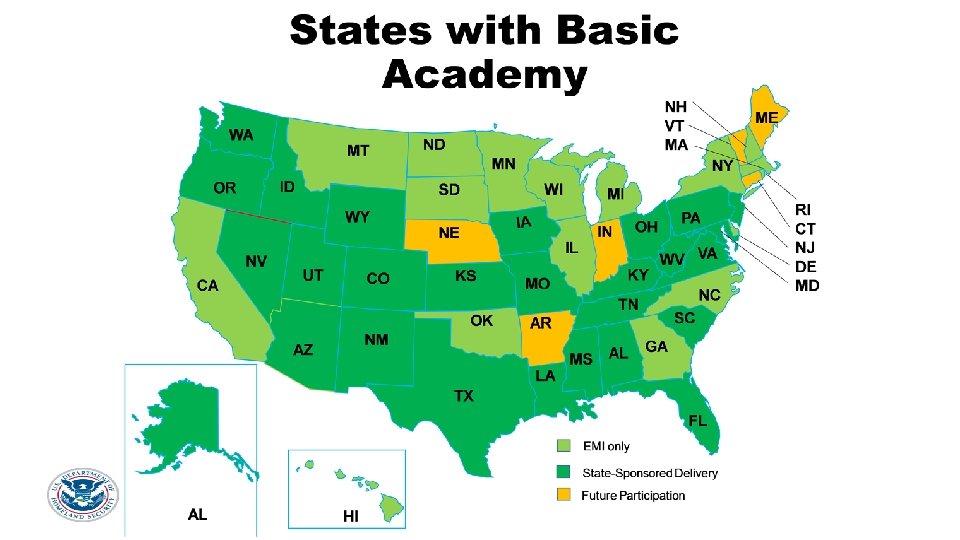
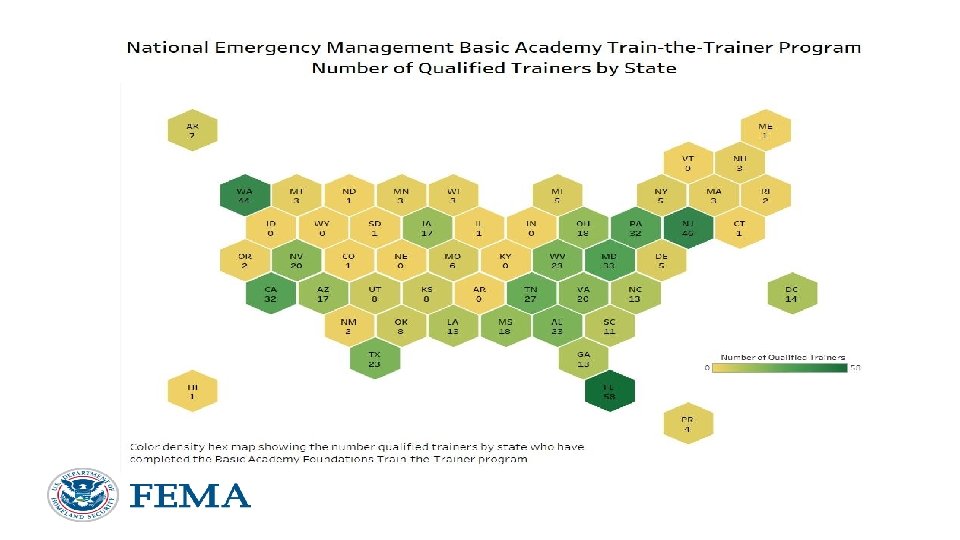
Basic Academy § Provides the opportunity to acquire a foundational understanding of the key concepts of emergency management. § Enhances the early careers of emergency managers by combining the knowledge of fundamental systems, training, concepts and practices of contemporary emergency management. § Enables students to gain a common understanding of the roles, responsibilities, legal and ethical implications of emergency management; build an emergency management community of practice in the initial phase of their careers; and establish a network of professional contacts. 4
Basic Academy Curriculum (152 hours) Course 1: E/L 0101 Foundations of Emergency Management (80 hours) Introduces the knowledge and skills needed to perform at the entry-level of emergency management. Topics include: prevention and protection, mitigation, response and recovery. Course 2: E/L 0102 Science for Disasters (24 hours) An overview of the scientific principles and concepts that shape our increasingly dangerous world. Course 3: E/L 0103 Planning Emergency Operations (16 hours) Basic planning concepts and processes unique to the field of emergency management. Course 4: E/L 0104 Exercise Design, now HSEEP (16 hours) Introduction to the fundamentals of exercise simulation and design as integrated systems. Course 5: E/L 0105 Public Information and Warning (16 hours) Introduces the role of the Public Information Officer in emergency management and provides information about the Integrated Public Alert and Warning System. 5
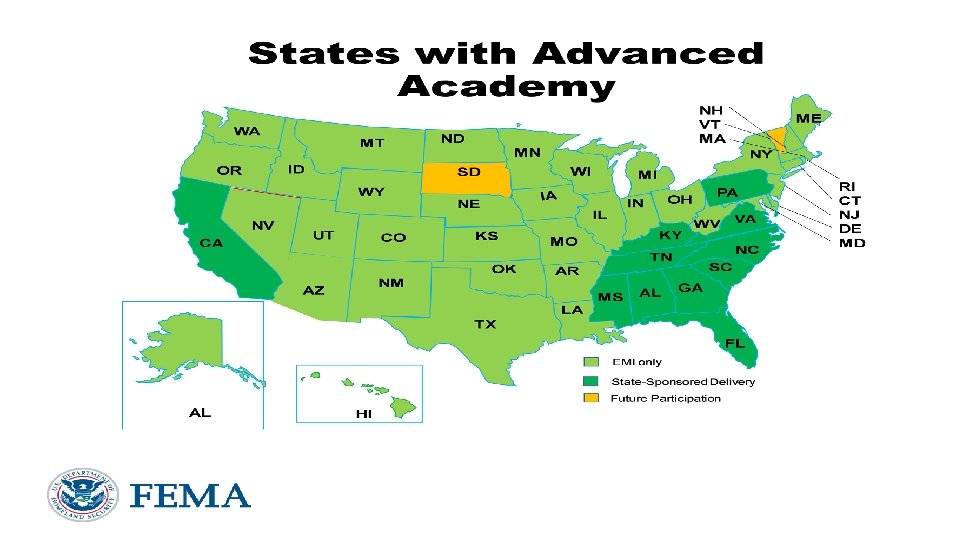
Advanced Academy § Provides essential skills and tools for mid-career or well-experienced emergency management professionals to manage dynamic and resilient programs. § Creates conditions for an academically rigorous learning environment, using critical thinking and complex problem solving processes. § Focuses on serving the emergency management profession as an Individual, as part of a Team, within an Organization, and in leading the Profession. § Enables the development of peer networks as students work together on projects within a collaborative environment. § Utilizes an academic paper to demonstrate the ability to apply the concepts of the program and to facilitate the growth of emergency management practitioners into evolving leadership roles. § The Advanced Academy is available as a FEMA-Region and/or state-sponsored field delivery course. 8
Advanced Academy Curriculum (160 hours) Course 1: E/L 0451 Advanced Application of Individual Concepts in Emergency Management (40 hours) A survey of major advanced concepts in emergency management for the individual: personal leadership and management skills, critical thinking and problem solving, mission and vision statements and the value of each, understanding personal power and influence, paper guidance/preparation and topic identification, and analysis of a case study. Course 2: E/L 0452 Assessment of Teams in Professional Emergency Management (40 hours) A team-focused leadership and management approach of advanced issues in emergency management, legal issues for emergency managers in the community, building teams as emergency managers, ethical leadership, and a team approach to reviewing, assessing and briefing on an EM case study. Students also provide an executive review of a book of their choice. Course 3: E/L 0453 Contemporary Issues in the Emergency Management Organization (40 hours) An organizational leadership and management approach of contemporary issues in the community of practice, change management and the effects on the organization, along with strategic planning, innovation and conflict resolution strategies. Course 4: E/L 0454 Advanced Concepts and Policy in the EM Profession (40 hours) A community of practice and holistic approach at advanced issues in emergency management, building resilient communities, development within the profession of Emergency Management, and contemporary issues. Student academic papers are shared with the cohort. 9
11
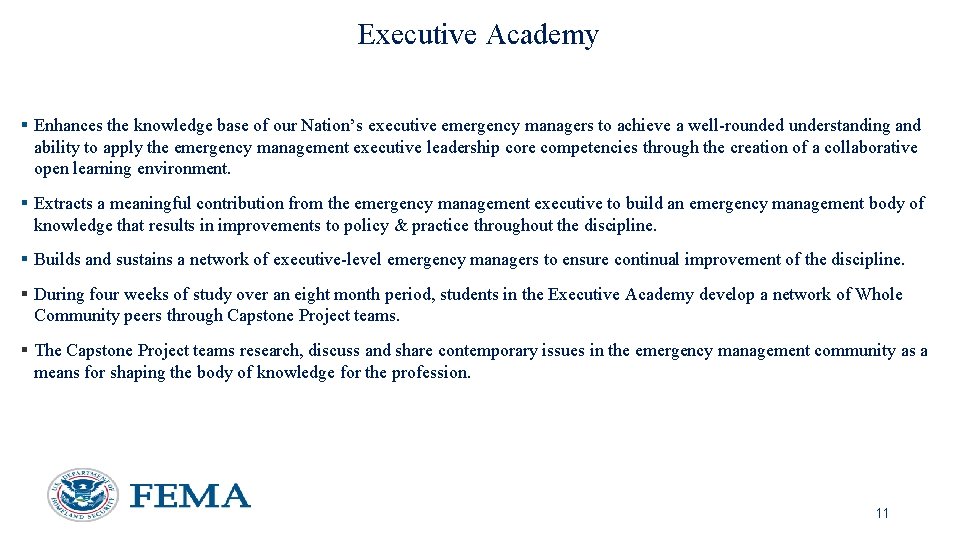
Executive Academy § Enhances the knowledge base of our Nation’s executive emergency managers to achieve a well-rounded understanding and ability to apply the emergency management executive leadership core competencies through the creation of a collaborative open learning environment. § Extracts a meaningful contribution from the emergency management executive to build an emergency management body of knowledge that results in improvements to policy & practice throughout the discipline. § Builds and sustains a network of executive-level emergency managers to ensure continual improvement of the discipline. § During four weeks of study over an eight month period, students in the Executive Academy develop a network of Whole Community peers through Capstone Project teams. § The Capstone Project teams research, discuss and share contemporary issues in the emergency management community as a means for shaping the body of knowledge for the profession. 11
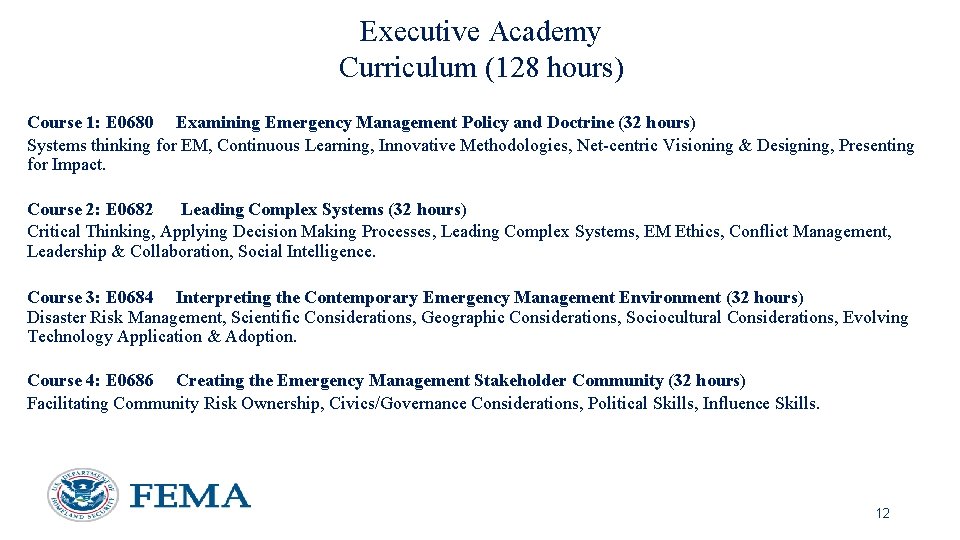
Executive Academy Curriculum (128 hours) Course 1: E 0680 Examining Emergency Management Policy and Doctrine (32 hours) Systems thinking for EM, Continuous Learning, Innovative Methodologies, Net-centric Visioning & Designing, Presenting for Impact. Course 2: E 0682 Leading Complex Systems (32 hours) Critical Thinking, Applying Decision Making Processes, Leading Complex Systems, EM Ethics, Conflict Management, Leadership & Collaboration, Social Intelligence. Course 3: E 0684 Interpreting the Contemporary Emergency Management Environment (32 hours) Disaster Risk Management, Scientific Considerations, Geographic Considerations, Sociocultural Considerations, Evolving Technology Application & Adoption. Course 4: E 0686 Creating the Emergency Management Stakeholder Community (32 hours) Facilitating Community Risk Ownership, Civics/Governance Considerations, Political Skills, Influence Skills. 12
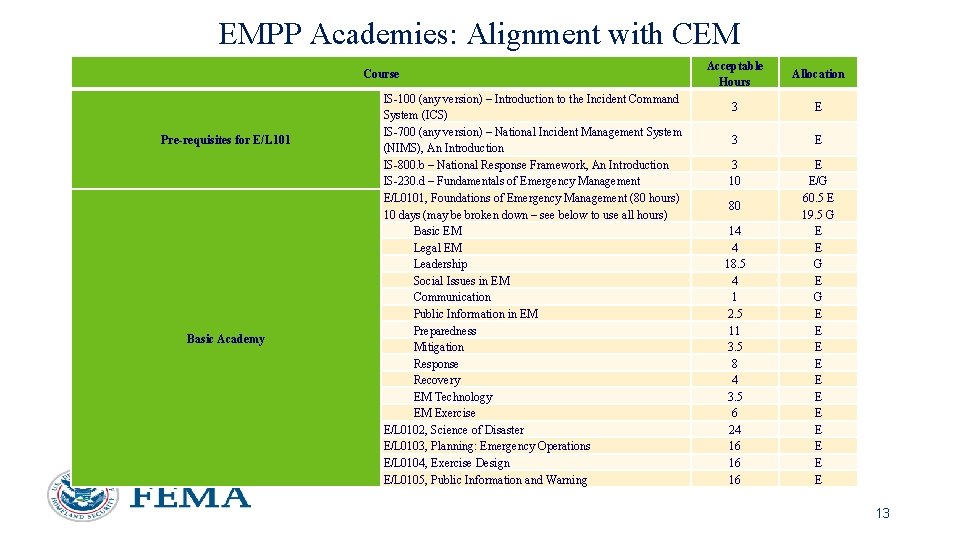
EMPP Academies: Alignment with CEM Course Pre-requisites for E/L 101 Basic Academy IS-100 (any version) – Introduction to the Incident Command System (ICS) IS-700 (any version) – National Incident Management System (NIMS), An Introduction IS-800. b – National Response Framework, An Introduction IS-230. d – Fundamentals of Emergency Management E/L 0101, Foundations of Emergency Management (80 hours) 10 days (may be broken down – see below to use all hours) Basic EM Legal EM Leadership Social Issues in EM Communication Public Information in EM Preparedness Mitigation Response Recovery EM Technology EM Exercise E/L 0102, Science of Disaster E/L 0103, Planning: Emergency Operations E/L 0104, Exercise Design E/L 0105, Public Information and Warning Acceptable Hours Allocation 3 E 3 10 E E/G 60. 5 E 19. 5 G E E E E E E 80 14 4 18. 5 4 1 2. 5 11 3. 5 8 4 3. 5 6 24 16 16 16 13
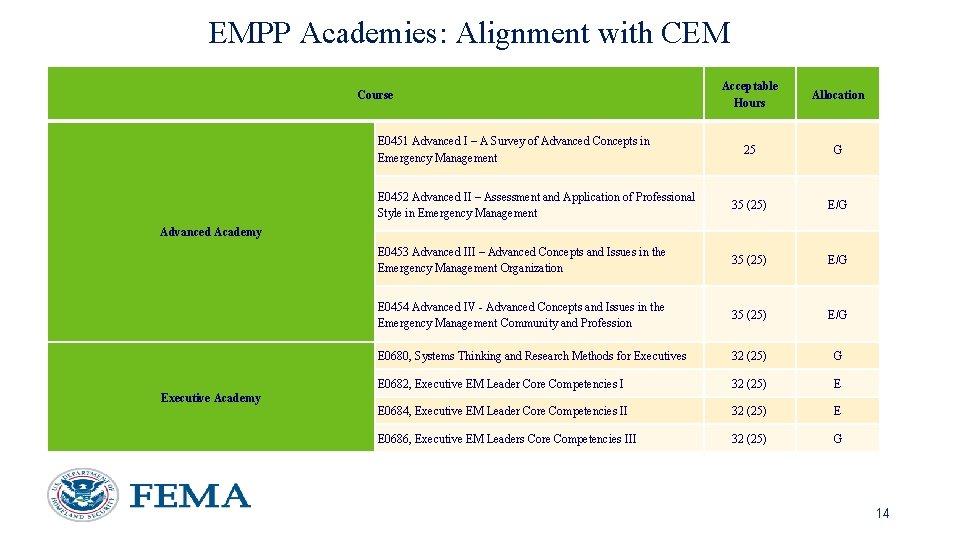
EMPP Academies: Alignment with CEM Acceptable Hours Allocation 25 G E 0452 Advanced II – Assessment and Application of Professional Style in Emergency Management 35 (25) E/G E 0453 Advanced III – Advanced Concepts and Issues in the Emergency Management Organization 35 (25) E/G E 0454 Advanced IV - Advanced Concepts and Issues in the Emergency Management Community and Profession 35 (25) E/G E 0680, Systems Thinking and Research Methods for Executives 32 (25) G E 0682, Executive EM Leader Core Competencies I 32 (25) E E 0684, Executive EM Leader Core Competencies II 32 (25) E E 0686, Executive EM Leaders Core Competencies III 32 (25) G Course E 0451 Advanced I – A Survey of Advanced Concepts in Emergency Management Advanced Academy Executive Academy 14
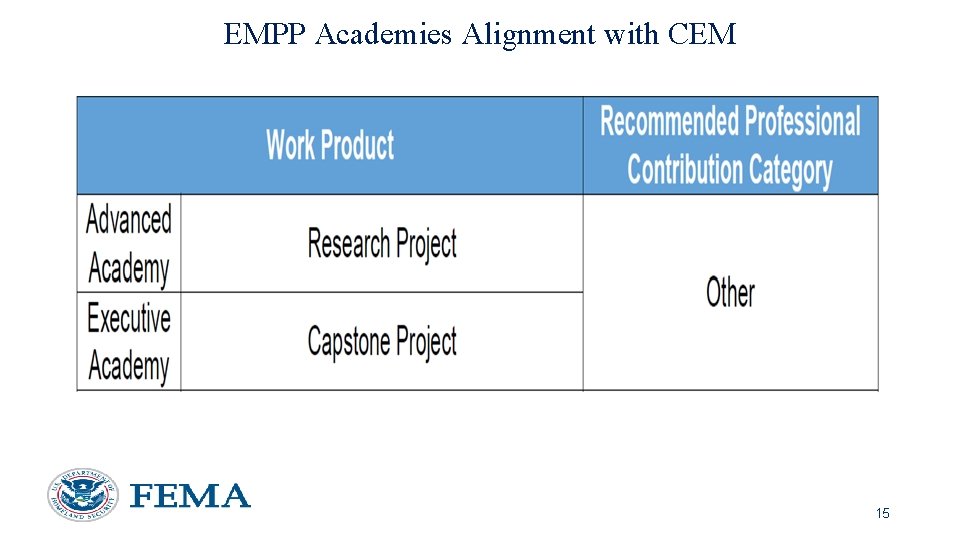
EMPP Academies Alignment with CEM 15
EMPP Academies: Course Content Matrix COMPETENCIES BASIC ACADEMY ADVANCED ACADEMY EXECUTIVE ACADEMY Be: What to Think Do: How to Do Be: How to Think Do: What to Do Be: Why to Think Do: Why to Do Technical 75% 40% 25% Management/Administrative 17% 35% 25% Leadership Development 8% 25% 50% Lead Self; Team Member Lead Programs, Projects, Teams, People Lead Organizations and the Profession Know: Knowledge, Skills, Abilities 16
QUESTIONS? 17