
EMERGENCE of the WEAK SCALE from M THEORY

- Slides: 53
EMERGENCE of the WEAK SCALE from M THEORY WITH STABILIZED MODULI and UNIFICATION, and ASSOCIATED COLLIDER and DARK MATTER PHENOMENOLOGY -- compactify on manifolds with G 2 holonomy Bobby Acharya, Konstantin Bobkov, Kane, Piyush Kumar, Diana Vaman, hep-th/0606262, Phys Rev Lett Acharya, Bobkov, Kane, Kumar, Jing Shao, hep-ph/0701034 some recent progress
Good for this meeting – -- derive LHC predictions from string theory (M theory) – select some solutions to focus on, and some assumptions about hidden sector Kahler potential, but generic -- unconventional and interesting spectrum and LHC phenomenology, derived -- Pythia and Isajet and other software hang up with string theory input!
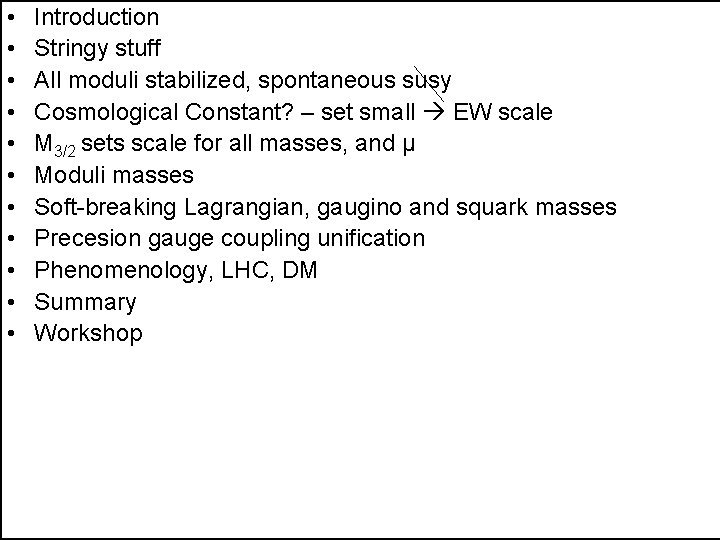
• • • Introduction Stringy stuff All moduli stabilized, spontaneous susy Cosmological Constant? – set small EW scale M 3/2 sets scale for all masses, and µ Moduli masses Soft-breaking Lagrangian, gaugino and squark masses Precesion gauge coupling unification Phenomenology, LHC, DM Summary Workshop
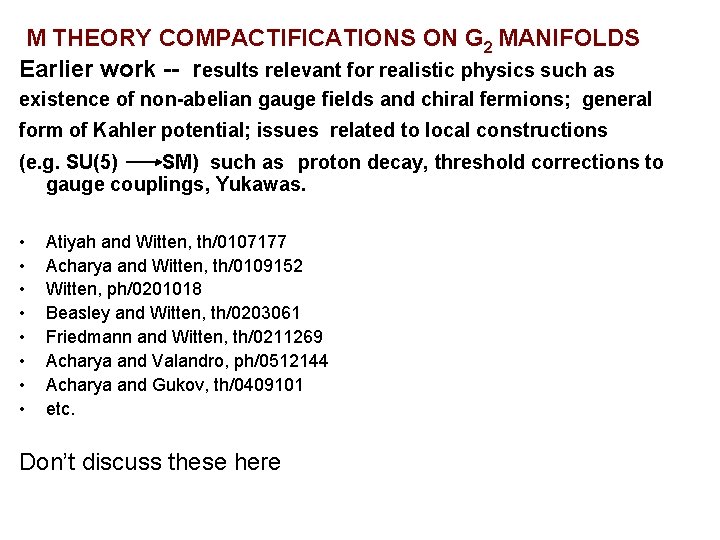
M THEORY COMPACTIFICATIONS ON G 2 MANIFOLDS Earlier work -- results relevant for realistic physics such as existence of non-abelian gauge fields and chiral fermions; general form of Kahler potential; issues related to local constructions (e. g. SU(5) SM) such as proton decay, threshold corrections to gauge couplings, Yukawas. • • Atiyah and Witten, th/0107177 Acharya and Witten, th/0109152 Witten, ph/0201018 Beasley and Witten, th/0203061 Friedmann and Witten, th/0211269 Acharya and Valandro, ph/0512144 Acharya and Gukov, th/0409101 etc. Don’t discuss these here
Our work: Given a set of (dimensionless) “microscopic” parameters characterizing the vacua, simultaneously -- Generate the EW scale in a unique metastable de Sitter vacuum with spontaneous SUSY -- Stabilize all moduli -- Consistent with standard gauge unification (Munif ~ 1016 Ge. V) -- Assume a natural GUT visible sector breaking to MSSM chiral spectrum phenomenological predictions, e. g. for LHC and DM, possibly unique Only dimensionful input – the Planck scale ! Presumably can combine this with earlier work
STRINGY • 7 dimensions form a space with G 2 holonomy, preserves supersymmetry in 4 D • No fluxes -- not needed for stabilization in our case, tend to raise masses to string scale • In these vacua, non-Abelian gauge fields localized along 3 D submanifolds at which there is an orbifold singularity [Acharya, th/9812205; th/0011089; Achaya-Gukov th/0409191] • Chiral fermions localized at points at which there are conical singularities [Acharya and Witten, th/0109152, Acharya and Gukov, th/0409191; Atiyah and Witten, th/0107177] • Generically two 3 D submanifolds do not intersect in a 7 D space, so no light matter fields charged under both SM gauge group and hidden sector gauge groups susy breaking generically gravity mediated in these vacua
• • Geometry Joyce, and Kovalev, have constructed examples of G 2 manifolds without singularities Dualities with heterotic and Type IIA vacua suggest the existence of singular examples Can extend Kovalev’s constructions to include orbifold singularities, and Yang-Mills fields Get similar picture from M theory dual of the heterotic string on a CY manifold at large complex structure Existence of a global manifold with G 2 holonomy with realistic gauge and chiral structure probably guaranteed by stringy duality arguments from heterotic and IIA – but not yet constructed Nevertheless, expect lack of G 2 mathematical knowledge will not prevent going ahead with most aspects of the physics
MODULI STABILIZATION • All G 2 moduli fields si have axionic partners ti which have a shift symmetry in the absence of fluxes (different from heterotic or IIB) – such symmetries can only be broken by non-perturbative effects • So in zero-flux sector only contributions to superpotential are nonperturbative, from strong dynamics (e. g. gaugino condensation or instantons) – focus on former • In M theory the superpotential, and gauge kinetic function, in general depend on all the moduli -- expect the effective supergravity potential has isolated minima • See explicitly here that the hidden sector gaugino condensation produces an effective potential that stabilizes all moduli
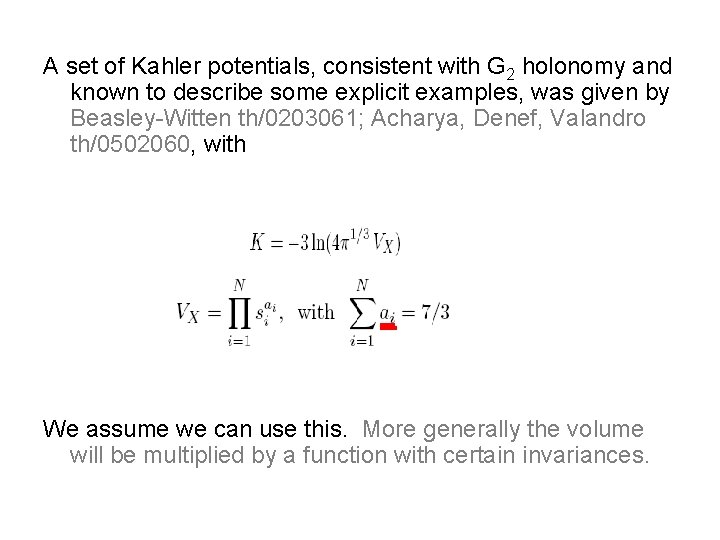
A set of Kahler potentials, consistent with G 2 holonomy and known to describe some explicit examples, was given by Beasley-Witten th/0203061; Acharya, Denef, Valandro th/0502060, with We assume we can use this. More generally the volume will be multiplied by a function with certain invariances.
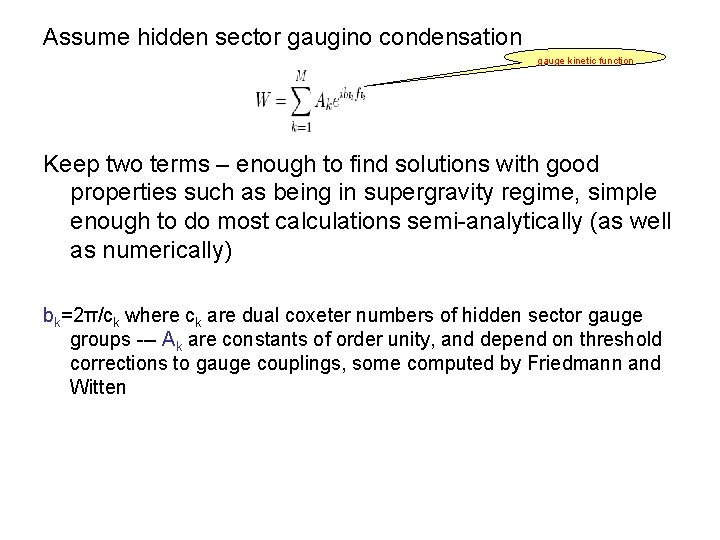
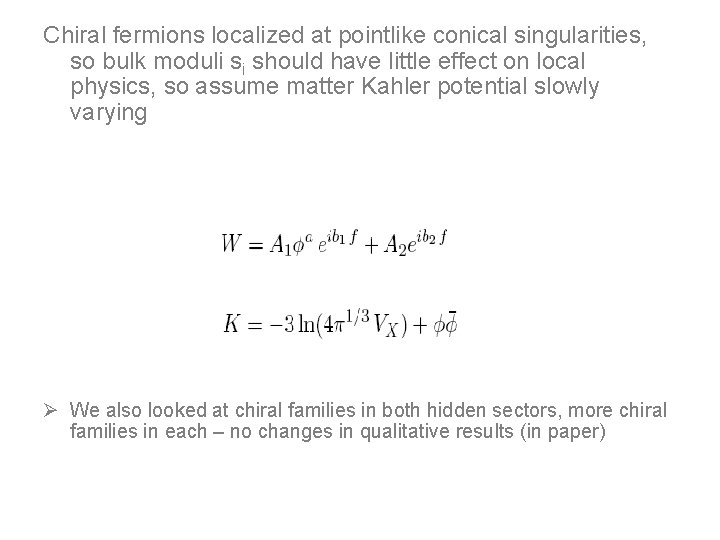
Assume hidden sector gaugino condensation gauge kinetic function Keep two terms – enough to find solutions with good properties such as being in supergravity regime, simple enough to do most calculations semi-analytically (as well as numerically) bk=2π/ck where ck are dual coxeter numbers of hidden sector gauge groups --- Ak are constants of order unity, and depend on threshold corrections to gauge couplings, some computed by Friedmann and Witten
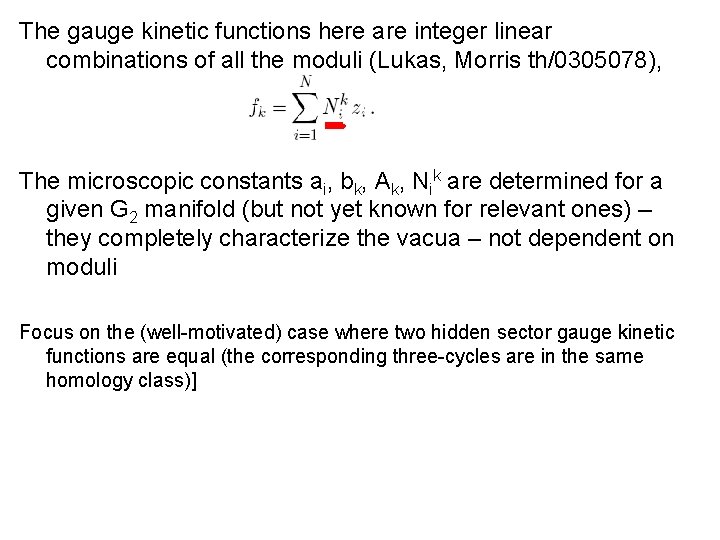
The gauge kinetic functions here are integer linear combinations of all the moduli (Lukas, Morris th/0305078), The microscopic constants ai, bk, Ak, Nik are determined for a given G 2 manifold (but not yet known for relevant ones) -they completely characterize the vacua – not dependent on moduli Focus on the (well-motivated) case where two hidden sector gauge kinetic functions are equal (the corresponding three-cycles are in the same homology class)]
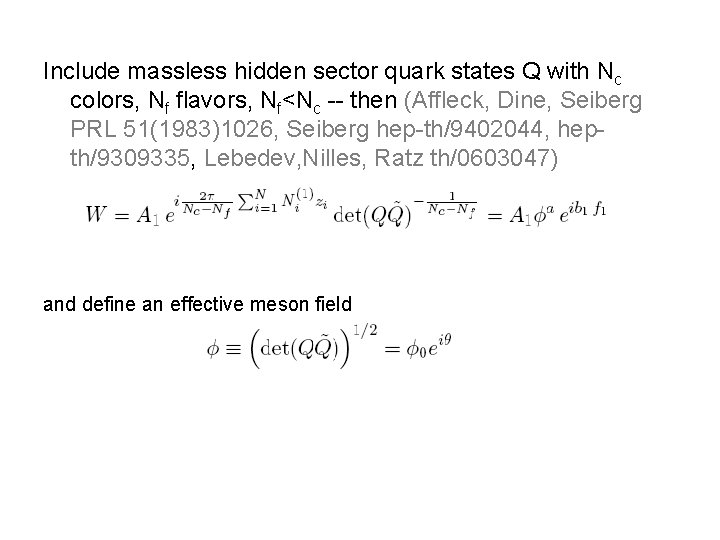
Include massless hidden sector quark states Q with Nc colors, Nf flavors, Nf<Nc -- then (Affleck, Dine, Seiberg PRL 51(1983)1026, Seiberg hep-th/9402044, hepth/9309335, Lebedev, Nilles, Ratz th/0603047) and define an effective meson field
Chiral fermions localized at pointlike conical singularities, so bulk moduli si should have little effect on local physics, so assume matter Kahler potential slowly varying Ø We also looked at chiral families in both hidden sectors, more chiral families in each – no changes in qualitative results (in paper)
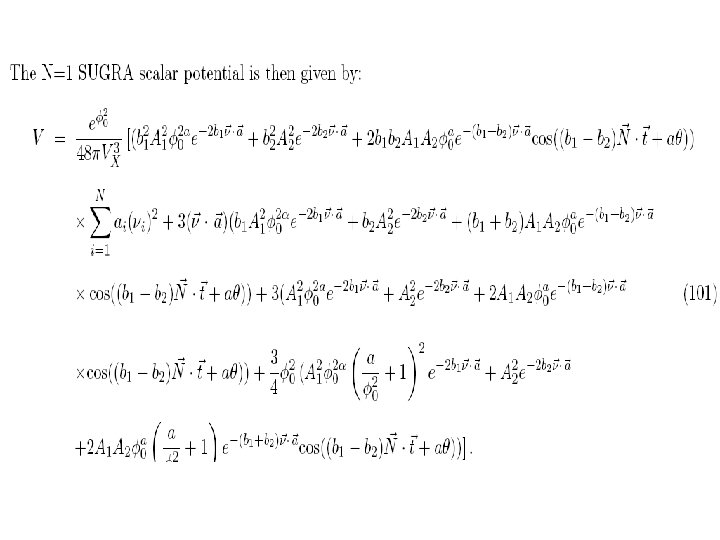
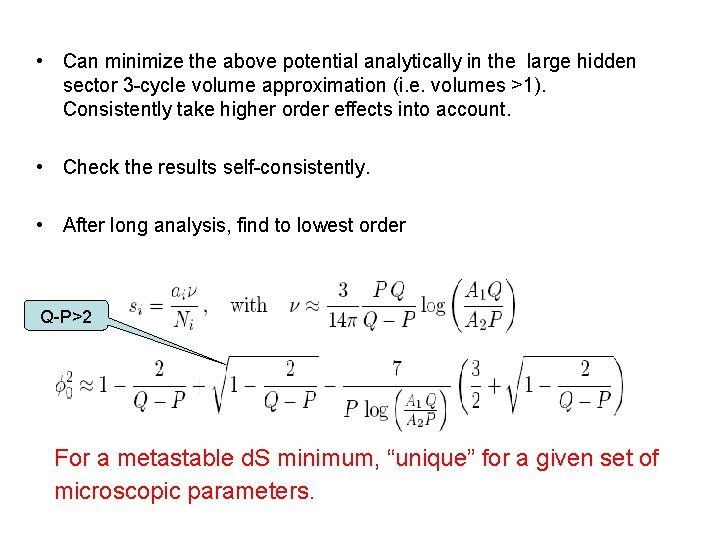
• Can minimize the above potential analytically in the large hidden sector 3 -cycle volume approximation (i. e. volumes >1). Consistently take higher order effects into account. • Check the results self-consistently. • After long analysis, find to lowest order Q-P>2 For a metastable d. S minimum, “unique” for a given set of microscopic parameters.
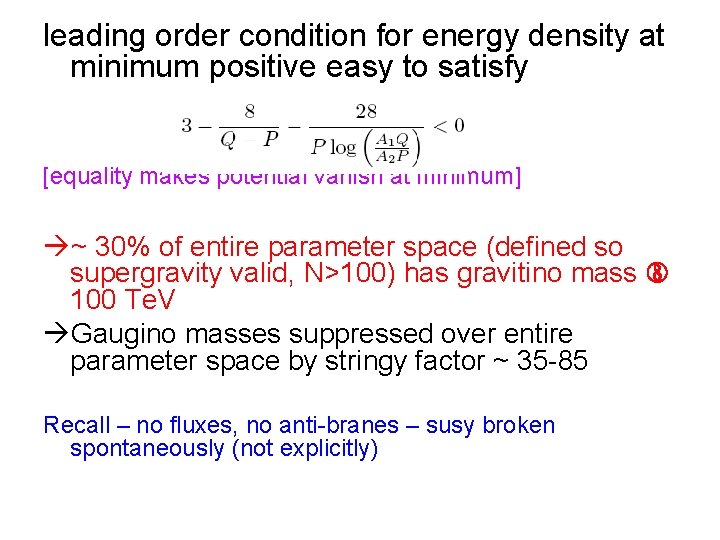
leading order condition for energy density at minimum positive easy to satisfy [equality makes potential vanish at minimum] ~ 30% of entire parameter space (defined so supergravity valid, N>100) has gravitino mass 100 Te. V Gaugino masses suppressed over entire parameter space by stringy factor ~ 35 -85 Recall – no fluxes, no anti-branes – susy broken spontaneously (not explicitly)
COSMOLOGICAL CONSTANT? No solution here – can we still do meaningful phenomenology? Of course, CC problem may be solved by other physics Set above V 0 (potential at minimum) to zero at leading order by (assuming we can) tune A 1 Q/A 2 P We check that tuning V 0 to all orders numerically has little effect on M 3/2 and on superpartner masses
Now study these solutions, with -- CC tuned to be small -- μ from (Giudice-Masiero) Higgs mixing term in Kahler potential -- assume GUT visible sector MSSM by Wilson lines (very natural) and require -- radiative EW symmetry breaking ***LEP lower bound on chargino mass [but chargino and LSP degenerate at tree level so effect of bound will change – so far haven’t had time to include that] -- precision two loop gauge coupling unification including all high scale corrections
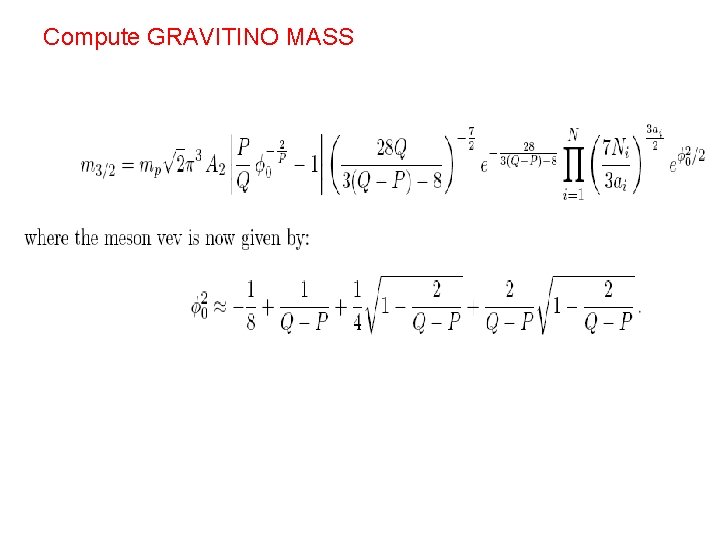
Compute GRAVITINO MASS
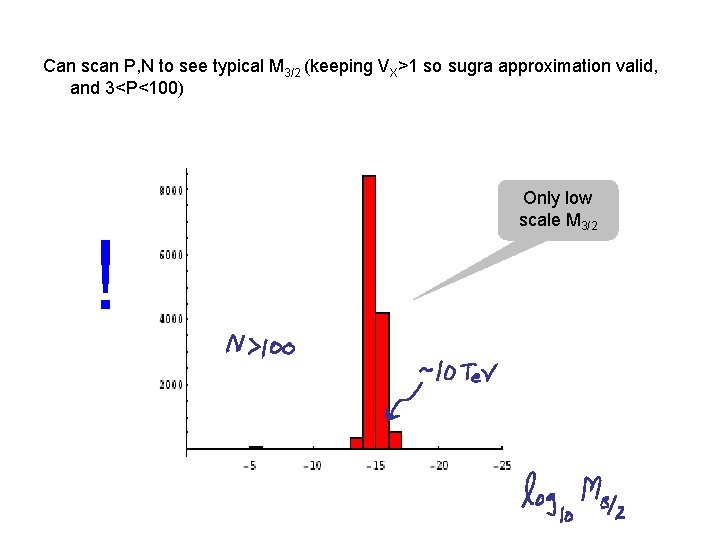
Can scan P, N to see typical M 3/2 (keeping VX>1 so sugra approximation valid, and 3<P<100) ! Only low scale M 3/2
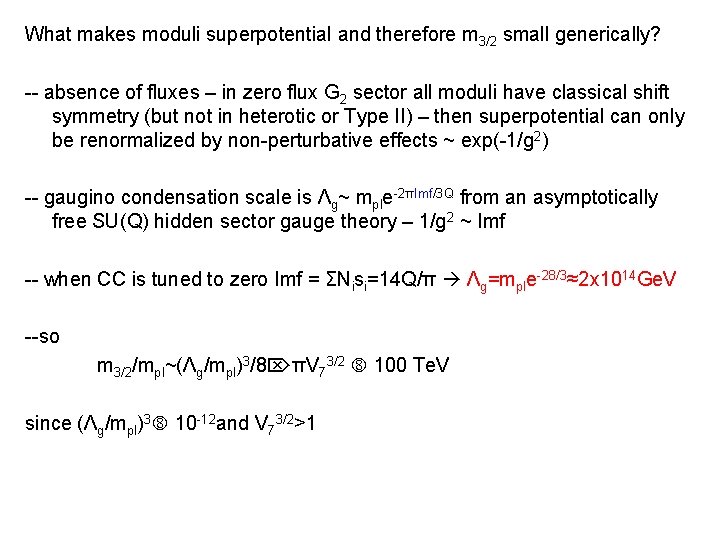
What makes moduli superpotential and therefore m 3/2 small generically? -- absence of fluxes – in zero flux G 2 sector all moduli have classical shift symmetry (but not in heterotic or Type II) – then superpotential can only be renormalized by non-perturbative effects ~ exp(-1/g 2) -- gaugino condensation scale is Λg~ mple-2πImf/3 Q from an asymptotically free SU(Q) hidden sector gauge theory – 1/g 2 ~ Imf -- when CC is tuned to zero Imf = ΣNisi=14 Q/π Λg=mple-28/3≈2 x 1014 Ge. V --so m 3/2/mpl~(Λg/mpl)3/8 πV 73/2 100 Te. V since (Λg/mpl)3 10 -12 and V 73/2>1
Condition from setting CC to zero at tree level seems to imply a relation between small CC and M 3/2 ~ Te. V do not have to independently tune CC to be small and M 3/2 to be ~ Te. V !
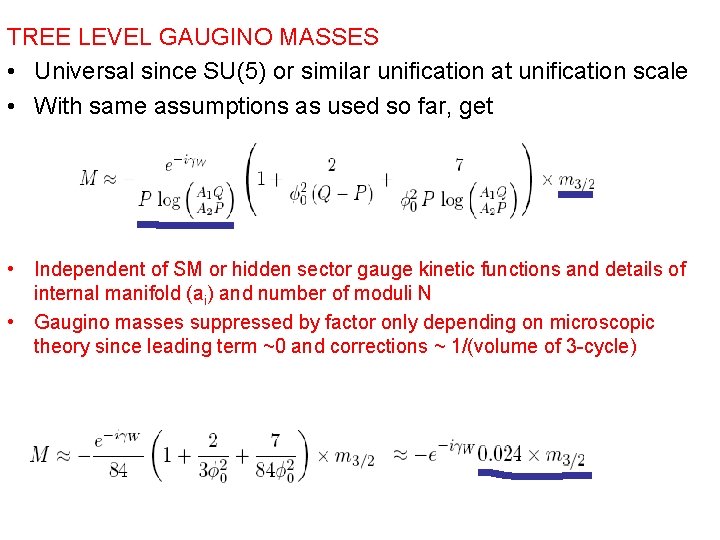
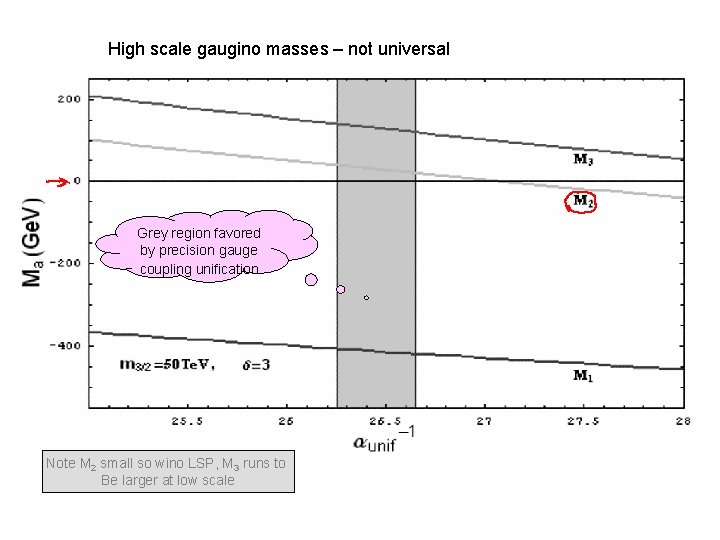
TREE LEVEL GAUGINO MASSES • Universal since SU(5) or similar unification at unification scale • With same assumptions as used so far, get • Independent of SM or hidden sector gauge kinetic functions and details of internal manifold (ai) and number of moduli N • Gaugino masses suppressed by factor only depending on microscopic theory since leading term ~0 and corrections ~ 1/(volume of 3 -cycle)
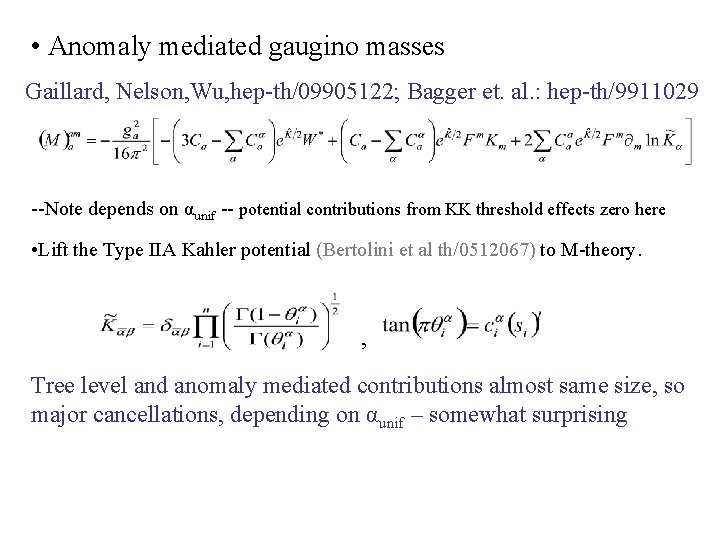
• Anomaly mediated gaugino masses Gaillard, Nelson, Wu, hep-th/09905122; Bagger et. al. : hep-th/9911029 --Note depends on αunif -- potential contributions from KK threshold effects zero here • Lift the Type IIA Kahler potential (Bertolini et al th/0512067) to M-theory. , Tree level and anomaly mediated contributions almost same size, so major cancellations, depending on αunif – somewhat surprising
High scale gaugino masses – not universal Grey region favored by precision gauge coupling unification Note M 2 small so wino LSP, M 3 runs to Be larger at low scale
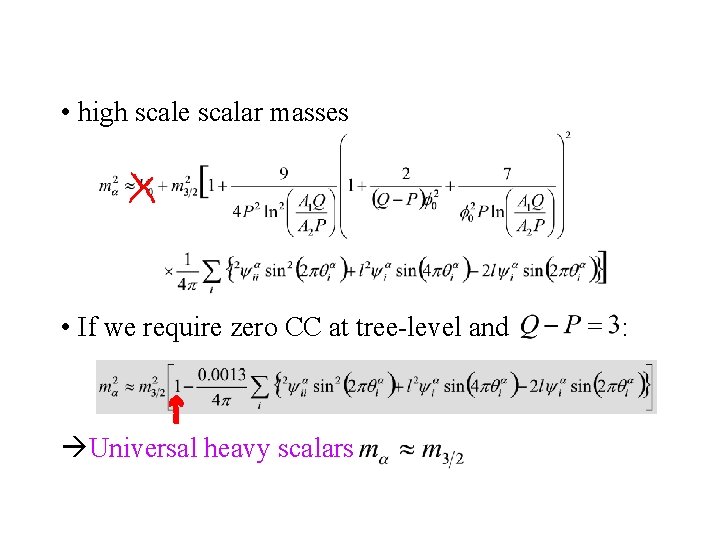
• high scale scalar masses • If we require zero CC at tree-level and Universal heavy scalars :
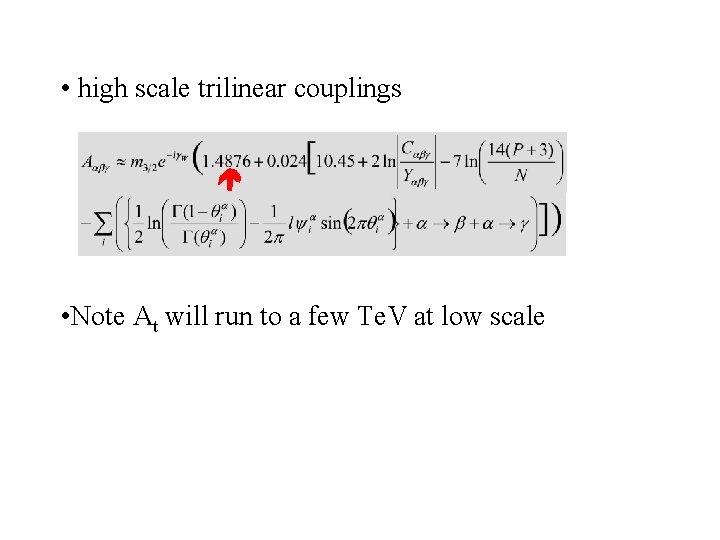
• high scale trilinear couplings • Note At will run to a few Te. V at low scale
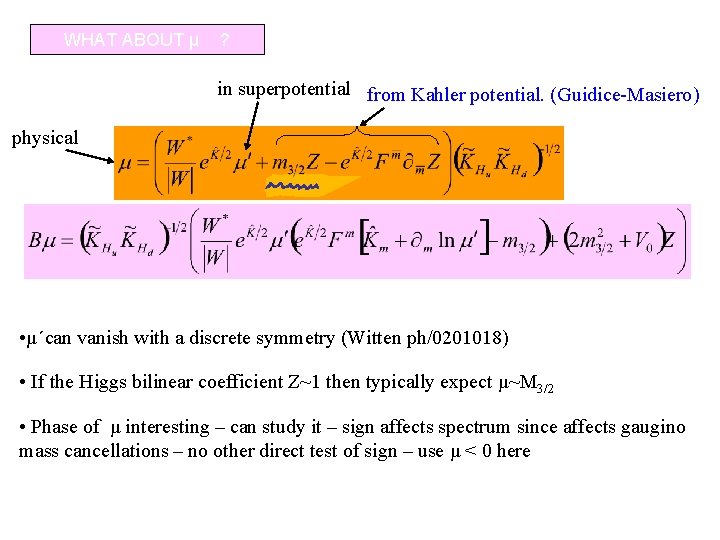
WHAT ABOUT μ ? in superpotential from Kahler potential. (Guidice-Masiero) physical • µ΄can vanish with a discrete symmetry (Witten ph/0201018) • If the Higgs bilinear coefficient Z~1 then typically expect μ~M 3/2 • Phase of μ interesting – can study it – sign affects spectrum since affects gaugino mass cancellations – no other direct test of sign – use μ < 0 here
MODULI MASSES • diagonalize for simplest case with all ai=7/(3 N) – all eigenvalues positive, with N-1 having Ms≈2 M 3/2 and one heavy state with mass ~ 500 M 3/2 Gravitino and moduli problems with BBN etc likely OK but not checked carefully yet
PHENOMENOLOGY
GAUGE COUPLING UNIFICATION • Gaugino masses depend on αunif, and αunif depends on corrections to gauge couplings from low scale superpartner thresholds, so feedback • Big cancellation between tree level and anomaly contributions to gaugino masses, so large sensitivity • Squarks and sleptons in complete multiplets so do not affect unification, but higgs, higgsinos, and gauginos do – μ large so unification depends most on M 3/M 2 (here µ large and higgsinos heavy, not like split susy) • For SU(5) if higgs triplets lighter than Munif their threshold contributions make unification harder, so assume triplets as heavy as unification scale • Scan parameter space of α and threshold corrections, find good region for 26. 24 αunif-1 26. 45 in full two-loop analysis, for certain range of threshold corrections, Munif=1. 8 x 10¹⁶ Ge. V!
CP VIOLATION • One common phase for all soft terms • Don’t know if that can be rotated away until understand μ and its phase – if μ real or has same phase as gaugino masses, then no “susy CP problem”, no EDMs • Phases of Yukawas not studied yet – depends on origin of small masses
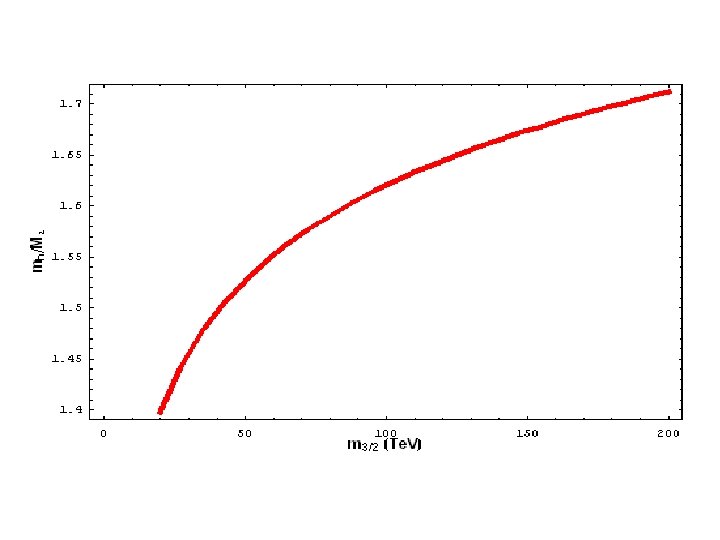
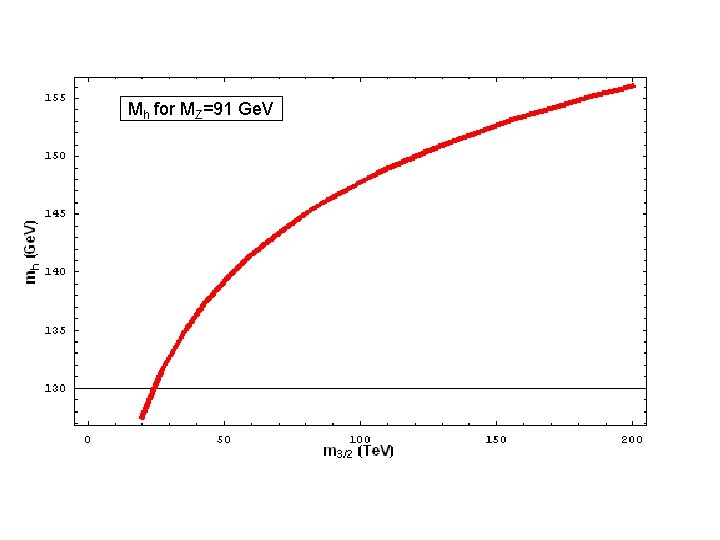
EW SYMMETRY BREAKING • Can get EWSB, but have little hierarchy • Compute tanβ from underlying theory, tanβ≈1. 5 • Basically M 3/2 ~ Te. Vs, so μ ~ Te. Vs, so MZ ~ Te. V expected – can tune it small • Apparently no mechanism to suppress MZ • But NO approach has succeeded in getting small MZ [what mechanism can give small gauge boson masses ? ? ]
Mh for MZ=91 Ge. V
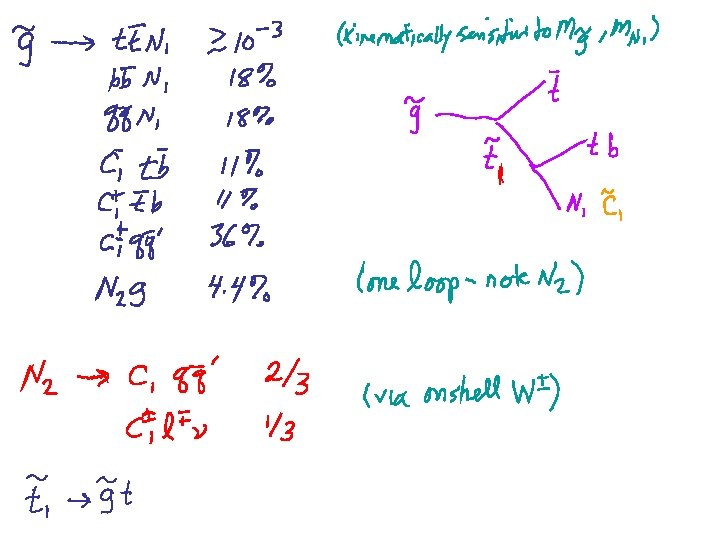
LHC PHENOMENOLOGY • Have seen explicitly here that it makes sense to go from string theory to superpartner masses – study production cross sections and decays and find LHC signatures • Low scale superpartner masses fully determined relative to M 3/2 for these solutions – no parameters • G 2 spectrum distinctive – will get characteristic signatures that occupy finite regions in “signature space” • Gluinos light so large cross section
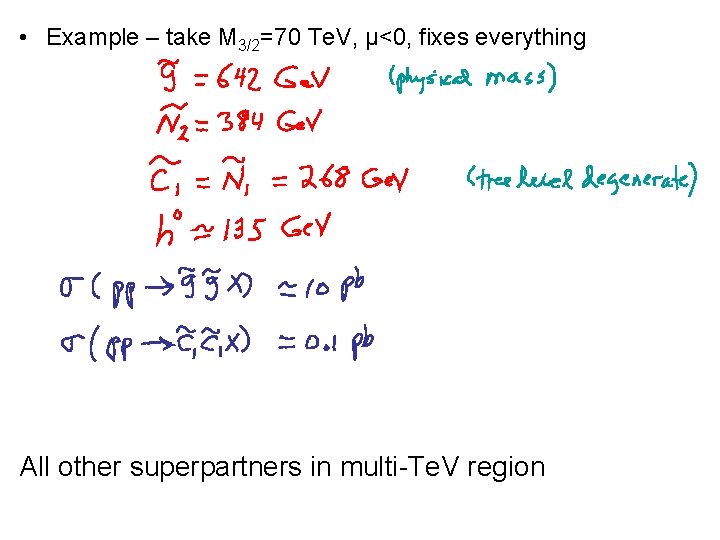
• Example – take M 3/2=70 Te. V, μ<0, fixes everything All other superpartners in multi-Te. V region
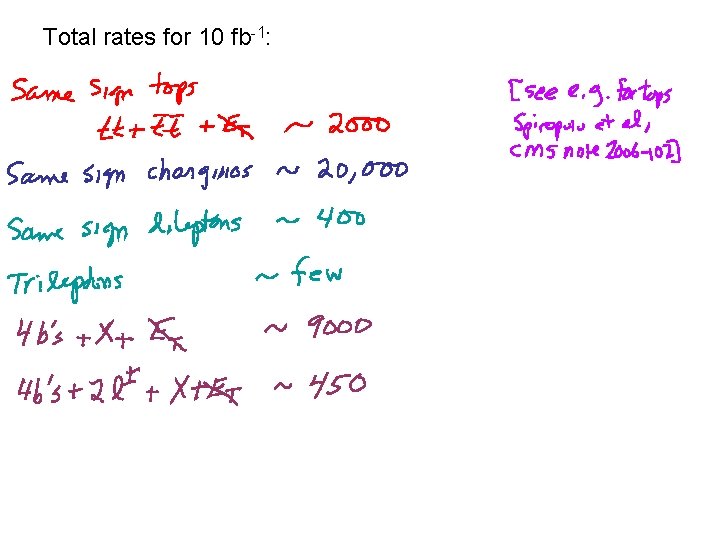
Total rates for 10 fb-1:
Generically other approaches that stabilize moduli (and more generally) occupy different regions of LHC signature space [GK, Kumar, Shao, ph/0610038] – for signals observable in ~ 10 fb-1 have • IIB KKLT vacua gluino ~ squarks (Choi et al, Baer, Park, Tata, T. Wang) • IIB very large volume vacua gluinos >> squarks (Abdussalam, Conlon, Quevedo, Suruliz) • G 2 vacua gluino << squarks (Acharya, Bobkov, Kane, Kumar, Shao) e. g. large charge asymmetry at LHC in one and two lepton + jets + ET for large volume, some for KKLT, none for G 2 Lots of such types of ways to distinguish classes of string theories
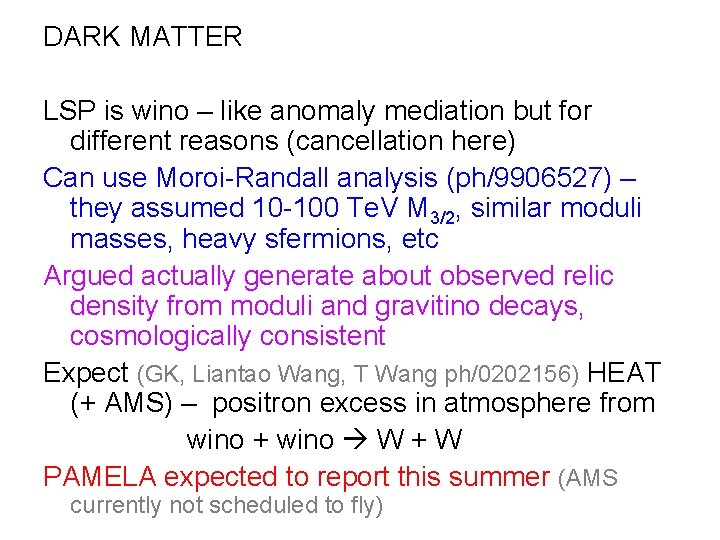
DARK MATTER LSP is wino – like anomaly mediation but for different reasons (cancellation here) Can use Moroi-Randall analysis (ph/9906527) – they assumed 10 -100 Te. V M 3/2, similar moduli masses, heavy sfermions, etc Argued actually generate about observed relic density from moduli and gravitino decays, cosmologically consistent Expect (GK, Liantao Wang, T Wang ph/0202156) HEAT (+ AMS) – positron excess in atmosphere from wino + wino W + W PAMELA expected to report this summer (AMS currently not scheduled to fly)
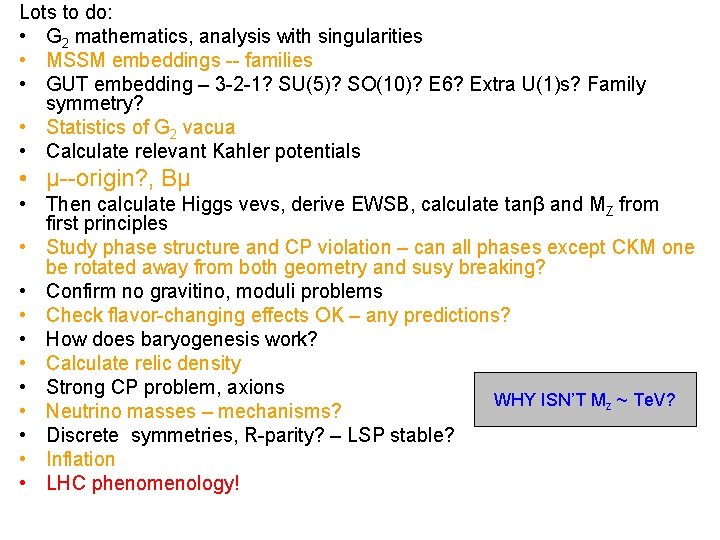
Lots to do: • G 2 mathematics, analysis with singularities • MSSM embeddings -- families • GUT embedding – 3 -2 -1? SU(5)? SO(10)? E 6? Extra U(1)s? Family symmetry? • Statistics of G 2 vacua • Calculate relevant Kahler potentials • µ--origin? , Bµ • Then calculate Higgs vevs, derive EWSB, calculate tanβ and MZ from first principles • Study phase structure and CP violation – can all phases except CKM one be rotated away from both geometry and susy breaking? • Confirm no gravitino, moduli problems • Check flavor-changing effects OK – any predictions? • How does baryogenesis work? • Calculate relic density • Strong CP problem, axions WHY ISN’T Mz ~ Te. V? • Neutrino masses – mechanisms? • Discrete symmetries, R-parity? – LSP stable? • Inflation • LHC phenomenology!
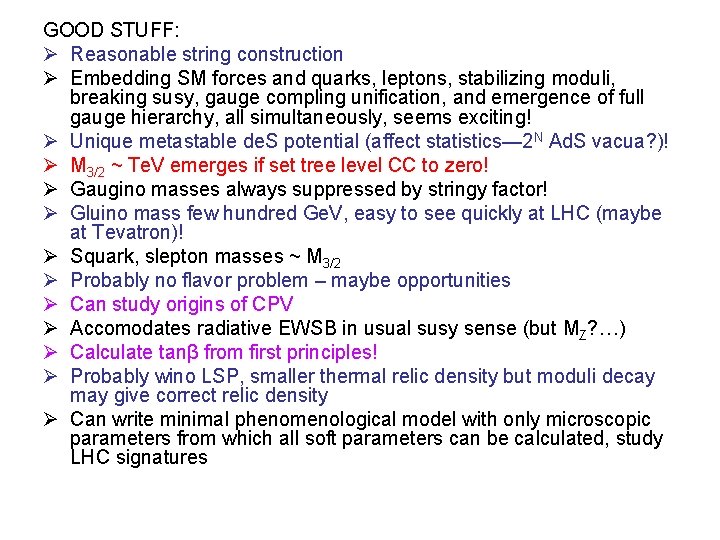
GOOD STUFF: Ø Reasonable string construction Ø Embedding SM forces and quarks, leptons, stabilizing moduli, breaking susy, gauge compling unification, and emergence of full gauge hierarchy, all simultaneously, seems exciting! Ø Unique metastable de. S potential (affect statistics— 2 N Ad. S vacua? )! Ø M 3/2 ~ Te. V emerges if set tree level CC to zero! Ø Gaugino masses always suppressed by stringy factor! Ø Gluino mass few hundred Ge. V, easy to see quickly at LHC (maybe at Tevatron)! Ø Squark, slepton masses ~ M 3/2 Ø Probably no flavor problem – maybe opportunities Ø Can study origins of CPV Ø Accomodates radiative EWSB in usual susy sense (but MZ? …) Ø Calculate tanβ from first principles! Ø Probably wino LSP, smaller thermal relic density but moduli decay may give correct relic density Ø Can write minimal phenomenological model with only microscopic parameters from which all soft parameters can be calculated, study LHC signatures
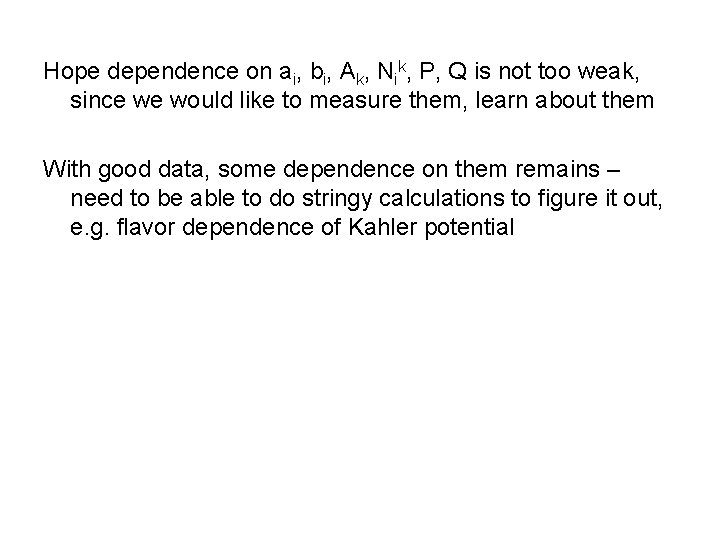
Hope dependence on ai, bi, Ak, Nik, P, Q is not too weak, since we would like to measure them, learn about them With good data, some dependence on them remains – need to be able to do stringy calculations to figure it out, e. g. flavor dependence of Kahler potential
Workshop “Physics and mathematics of G 2 compactifications” Michigan Center for Theoretical Physics May 3 -5, 2007 International Organizing Committee Acharya, Bobkov, Gukov, Joyce, Kane, Kumar, Larsen, Liu, Lykken Sign up on MCTP website
Back-up slides
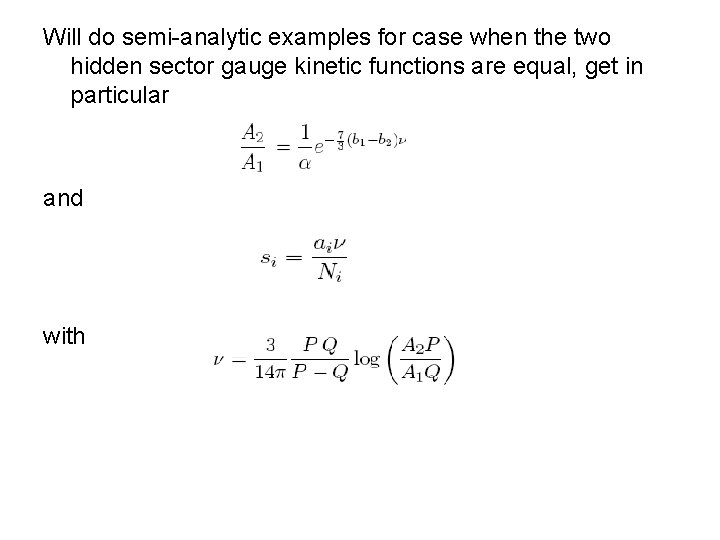
Will do semi-analytic examples for case when the two hidden sector gauge kinetic functions are equal, get in particular and with
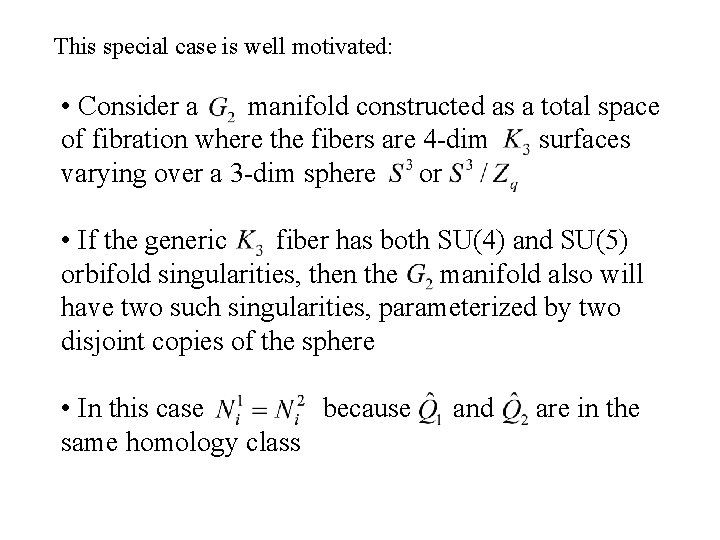
This special case is well motivated: • Consider a manifold constructed as a total space of fibration where the fibers are 4 -dim surfaces varying over a 3 -dim sphere or • If the generic fiber has both SU(4) and SU(5) orbifold singularities, then the manifold also will have two such singularities, parameterized by two disjoint copies of the sphere • In this case because same homology class and are in the
WHY ARE ALL THE MODULI STABILIZED/ -- in general the gauge kinetic function and therefore the superpotential depends on all the moduli, so they can all be stabilized nonperturbatively at same time hierarchy is generated -- why is gauge kinetic function expected to depend on all the moduli here (but not in heterotic or type. II)? – in M theory only one kind of moduli, vs 3 kinds in 10 D string theory – since gauge kinetic function linear in moduli it is in general a linear combination of all rather than only a subset -- could some of the coefficients be zero? – very unlikely for two reasons o Moduli correspond to 3 -cycles in geometry – number of 3 -cycles in M theory larger than number of supersymmetric 3 -cycles in general, so they cannot form a complete basis – so a given one has to be written in a basis of all o Also, in the basis in which the kahler potential is given by the usual formula it is very unlikely the gauge kinetic function will be aligned precisely along the direction of the basis vectors
WHY DOES ONE GET A d. S MINIMUM FROM CHARGED MATTER IN AT LEAST ONE HIDDEN SECTOR? -- F-term contribution to the scalar potential due to the matter in the hidden sector is fairly large, cancels the 3 W 2 term and gives a vacuum with positive energy density
WHY ARE TREE LEVEL GAUGINO MASSES SUPPRESSED RELATIVE TO GRAVITINO MASS? -- the d. S minimum is near the “would be” susy Ad. S extremum from the pure gauge hidden sectors – the matter F-term gives a large contribution to the vacuum energy but does not contribute to the gaugino masses -- the gaugino mass is proportional to the moduli F-terms which are nearly zero near the susy point – the nonvanishing contribution comes from the subleading order, which is suppressed by the 1/V expansion
WHY IS THE CONSTRUCTION CONSISTENT WITH FULL GAUGE COUPLING UNIFICATION/ -- Have full M theory – need M 11> MGUT -- Have M 11 ~ mpl/ V 7 and MGUT~ mpl/V(Q) where V 7=Πsiai and V(Q)=Imf=ΣNisi -- Since V 7 a product and V(Q) a sum, and 0<ai~1/N<1, M 11>MGUT
HOW CAN ONE CALCULATE THE SOFT MASSES RELIABLY WITHOUT KNOWING THE KALHER METRIC IN M THEORY? -- Need Kahler metric for visible sector matter for – Anomaly mediated gaugino mass contributions – Scalars – Trilinears • In our analysis we used the Bertolini et al results from type. IIA and lifted it to M theory, since there is a limit of M theory which is equivalent to IIA -- Then found that for N 50 moduli the contributions to soft parameters from matter kahler metric are negligible -- So expect lact of detailed knowledge about kahler metric in M theory should not affect the low scale soft parameters much