
Emergence of the modern united states THE PROGRESSIVE
- Slides: 48
Emergence of the modern united states • THE PROGRESSIVE ERA • AN EMERGING WORLD POWER • WORLD WAR I AND BEYOND
The Progressive Era 1890 -1920
The Drive for Reform 1 B, 7 C
KEY TERMS AND PEOPLE �Progressive Era �Muckraker �Lincoln Steffens �Jacob Riis �Social Gospel �Settlement House �Jane Addams �Direct Primary �Initiative �Referendum �Recall
Origins of Progressivism �Progressivism Reform Honest, efficient government Leaders emerged from growing middle class Dissatisfied industrial workers Few wealthy Americans
Common Beliefs �Believed industrialization and urbanization had created social and political problems �Wanted laws to address the issues of the poor �Logic and reason to make society work in a more efficient way �Similar to Populism Rid of government corruption Make government more responsive to people’s needs �Differed from Populism Mostly middle class
Target a Variety of Problems �Political and Government Reform Women’s right to vote Honest government Political machines �Social Welfare Crowded cities Need paved streets Water sanitation Decent housing
Target a Variety of Problems, Cont’d �Big Business “busts the trusts” Create more economic opportunities for small business Sherman Antitrust Act is inadequate and ineffective �Labor Conditions Reduce the growing gap between the rich and poor Attack the harsh conditions Child labor laws
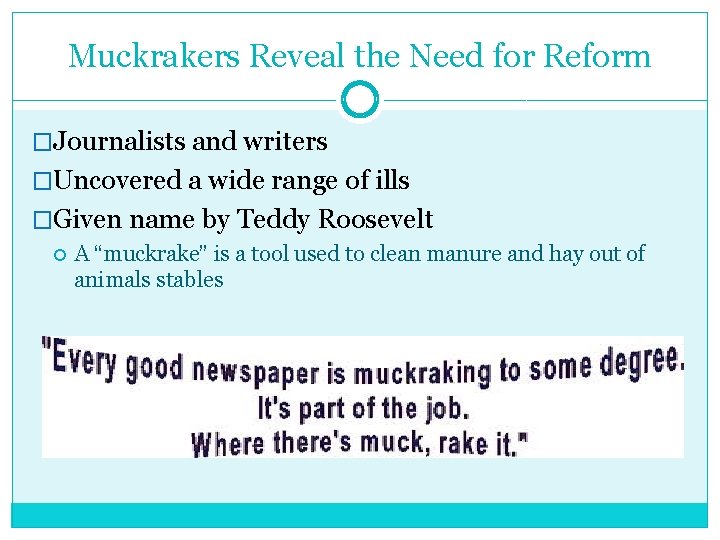
Muckrakers Reveal the Need for Reform �Journalists and writers �Uncovered a wide range of ills �Given name by Teddy Roosevelt A “muckrake” is a tool used to clean manure and hay out of animals stables
Journalists �Lincoln Steffens The Shame of the Cities Collection of articles on political corruption �Jacob Riis Photographer How the Other Half Lives Shot the crowded, unsafe, rat-infested tenement buildings �Ida Tarbell The History of Standard Oil Report of John Rockefeller’s ruthless methods to ruin his competitors
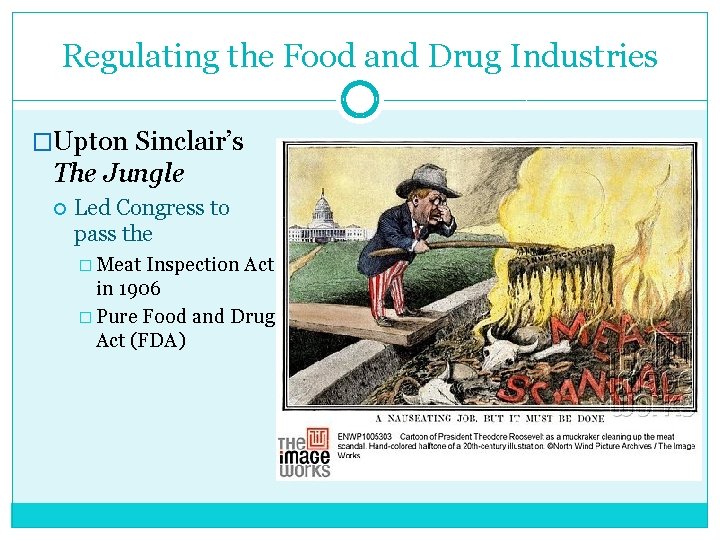
Novelists �Frank Norris The Octopus Dramatized Southern Pacific Railroad’s stronghold on California farmers �Upton Sinclair The Jungle Wrote about the despairs of Chicago immigrants working in meat packing industry “aimed for their hearts but hit them in their stomachs”
Progressives Reform Society �The Social Gospel Walter Rauschenbusch � Christianity is the basis of social reform Followed Bible’s teachings of charity and justice People can make society “the Kingdom of God” Pushed an end to child labor, shorter work week, limit corporations and trusts �Settlement Houses Community center that provided social services to the urban poor � Classes in child care, English, nursery schools, theater, art, etc Put in place to help and assimilate Jane Addams: The Hull House in Chicago, leading figure
Protecting Children �Florence Kelley Lawyer, got Illinois to ban child labor Helped for National Child Labor Committee � Lobbied the federal government to create the U. S. Children’s Bureau in 1912 �Keating-Owens Act, 1916 Banned child labor Later ruled unconstitutional by the Supreme Court � 1938 before child labor is banned for good
Improving Education �States passed laws that required children to attend school until a certain age �Debate Work skills vs literature and music Girls vs boys �John Dewey Educator New subjects: history/geography as well as work skills
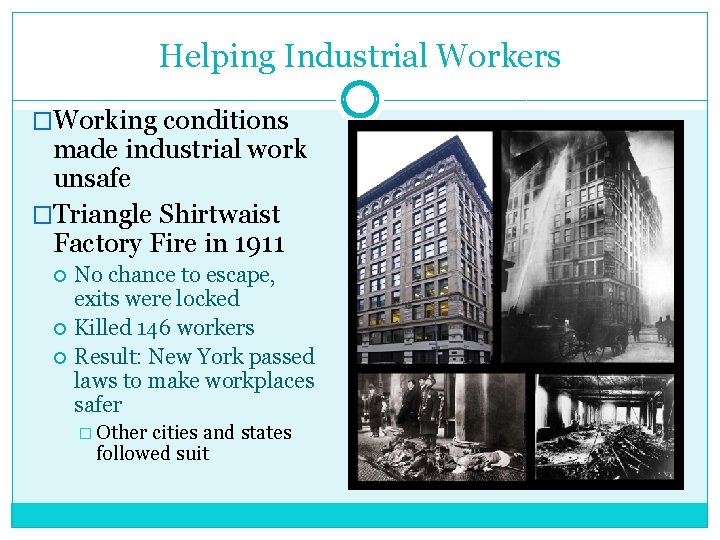
Helping Industrial Workers �Working conditions made industrial work unsafe �Triangle Shirtwaist Factory Fire in 1911 No chance to escape, exits were locked Killed 146 workers Result: New York passed laws to make workplaces safer � Other cities and states followed suit
Reforming Government �Election Rules Direct Primary � An election where citizens themselves vote to select nominees for upcoming elections � Wisconsin is the first to pilot this, Gov. Robert La Follete Initiative � Gave citizens the power to put a proposed new law directly on the ballot Referendum � Gave citizens the power to approve or reject laws Recall � Gave citizens the power to remove public servants from office �All of these give the PEOPLE more political power
Women Make Progress 2 C, 4 A, 4 B
KEY TERMS AND PEOPLE �Florence Kelley �NCL �Temperance Movement �Margaret Sanger �Ida B. Wells �Suffrage �Carrie Chapman Catt �NAWSA �Alice Paul �Nineteenth Amendment
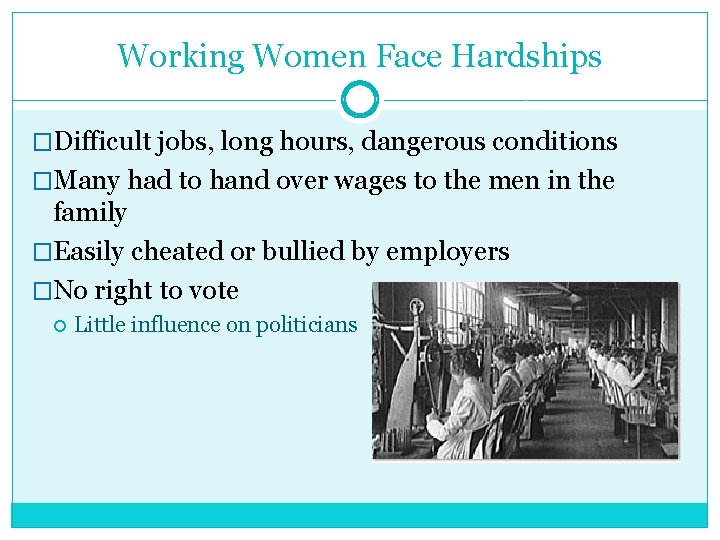
Working Women Face Hardships �Difficult jobs, long hours, dangerous conditions �Many had to hand over wages to the men in the family �Easily cheated or bullied by employers �No right to vote Little influence on politicians
Reformers Champion Working Women’s Rights �Key goal: limit working hours Oregon law capped at 10 hours Muller vs Oregon � Argument: long working hours harm women & families � Decision: “women could be placed in a class by themselves” Laws can limit their working hours and not for men � At the time, seen as a victory. It was later used against women when they demanded things such as equal pay. �Florence Kelley: lawyer that worked for child labor Believed women were hurt by the unfair prices of goods needed for women to run their homes Helped form National Consumer’s League (NCL) � Labels for goods produced in fair, safe, healthy conditions Women’s Trade Union League (WTUL) � Worked for minimum wage and 8 hour work day
Women Work for Change in Family Life �Key goal: improve family life Temperance Movement: practice of never drinking alcohol � Lead by WCTU � Argument: men spent earnings on liquor, not family � Result: lead to the passage of the 18 th amendment (prohibition) Birth Control � Nurse Margaret Sanger � Mother’s should have fewer children � First birth control clinic National Association of Colored Women (NACW) � Ida B. Wells � Teacher helped set up day-care centers to educate black children
Women Fight for the Right to Vote �Suffrage: the right to vote �Carrie Chapman Catt Urged women to join NAWSA � Action on 2 fronts Congress pass a constitutional amendment Referendum process to pass state suffrage laws • Helped in New York, Michigan, Oklahoma �Alice Paul Formed National Women’s Party (NWP) Used public marches to push women’s right to vote
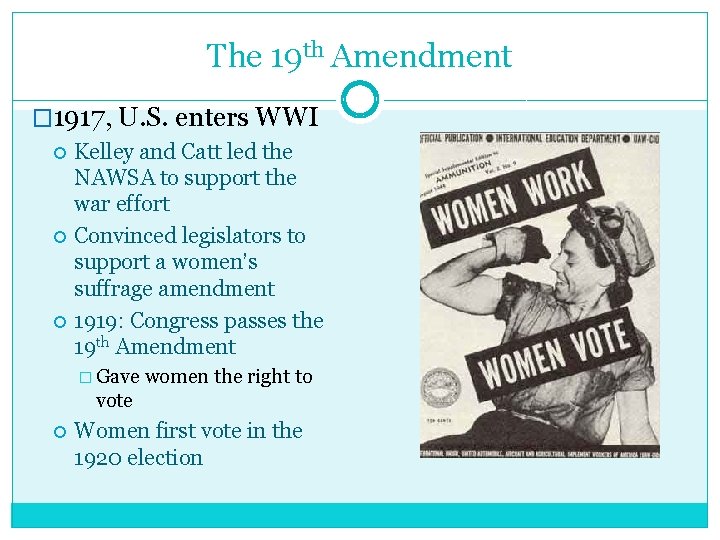
The 19 th Amendment � 1917, U. S. enters WWI Kelley and Catt led the NAWSA to support the war effort Convinced legislators to support a women’s suffrage amendment 1919: Congress passes the 19 th Amendment � Gave women the right to vote Women first vote in the 1920 election
The Struggle Against Discrimination 4 ABC
KEY TERMS AND PEOPLE �Americanization �Booker T. Washington �W. E. B. Du. Bois �Niagara Movement �NAACP �Urban League �Anti-Defamation League �Mutualistas
Progressivism Presents Contradictions �Progressive Era not so progressive for non-whites and immigrant Americans Most Progressives were white, Anglo-Saxon Protestant � Indifferent and even hostile to minorities �Social Reform or Social Control? Americanization=assimilation � Settlement houses, etc � Taught English and tried to change immigrants way of life How to dress and eat “American” Get rid of food and culture of their homelands � Believed assimilating would make immigrants more loyal
Racism Limits the Goals of Progressivism �Most Progressives were prejudiced against those who were Nonwhite Non Protestant Non Middle Class
African Americans Demand Reform �Booker T. Washington “gradual” progress �W. E. B. Du. Bois “immediate” equality Niagara Movement � Black men across the south were being denied right to vote � Denounced gradual progress � Wanted more education than “work skills” � Never got very strong NAACP 1909 � Included black and white Progressives � Use the courts to challenge unfair laws
�Urban League African Americans migrating from rural to urban areas Focused on poorer workers
Reducing Prejudice and Protecting Rights �Anti-Defamation League Jewish group formed in response to anti-Semitism Goal: defend Jews and others against verbal and physical attacks, false statements, and justice and fair treatment �Mexican Americans Mutualistas � Groups that made loans and provided legal assistance � Had insurance programs to help if too sick to work �Native Americans Urged to preserve their cultures and avoid being dependent on government �Asian Americans Fought laws that prevented them from being citizens Shot down by the Supreme Court
Roosevelt’s Square Deal 1 B, 1 C, 2 B
KEY TERMS AND PEOPLE �Theodore Roosevelt �Square Deal �Hepburn Act �Meat Inspection Act �Pure Food and Drug Act �John Muir �Gifford Pinchot �National Reclamation Act �New Nationalism �Progressive Party
Roosevelt Shapes the Modern Presidency �First “Progressive” President after Presidents considered weak in the Gilded Age �Spanish-American War Hero Fought with the Rough Riders Calvary William Mc. Kinley’s Vice-President � Assassinated allowing T. Roosevelt to become President in 1901 �Square Deal Used his office and power to convince Americans the need for reform Goals: keep the wealthy and powerful from taking advantage of small business owners and the poor What his goal WAS NOT: everyone gets rich, government take care of the lazy
Trust Busting and Regulating Industry �Strike involvement 1902, coal miners in Pennsylvania went on strike � Better He was sympathetic toward workers BUT � Coal pay and shorter work day is needed to keep factories running and homes warm What did he do? � First: tried to reason with coal miners=FAIL � Second: threatened to send in federal troops to take control of mines and run them with federal employees Result: Mine owners gave small pay raise and 9 hour work day Why does it matter? � For the first time, the federal government had stepped in to help workers in a labor dispute
Roosevelt Takes on the Railroads �Issue: the cost of shipping freight Companies can charge what they want � 1887: Congress created the ICC to oversee rail charges � 1900: Supreme Court had stripped most of ICC power � 1906: Hepburn Act Gave the ICC strong enforcement power Gave government the authority to set and limit shipping costs
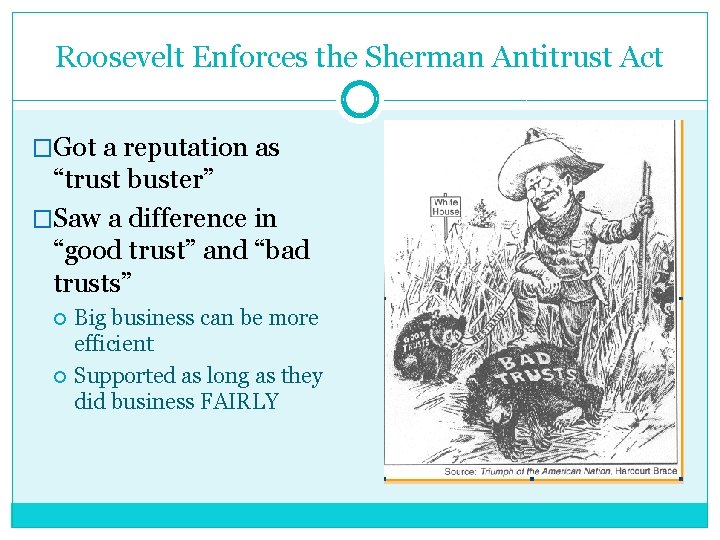
Roosevelt Enforces the Sherman Antitrust Act �Got a reputation as “trust buster” �Saw a difference in “good trust” and “bad trusts” Big business can be more efficient Supported as long as they did business FAIRLY
Regulating the Food and Drug Industries �Upton Sinclair’s The Jungle Led Congress to pass the � Meat Inspection Act in 1906 � Pure Food and Drug Act (FDA)
The Government Manages the Environment �Should National Forests be Conserved or Preserved? T. Roosevelt loved nature � Admired John Muir efforts led to Yellow Stone National Park He did not believe all forest land should be preserved � Some should be conserved and use their natural resources �Gifford Pinchot Led the Division of Foresty Forests be preserved for public use � Trees have time to mature into good labor to be used for housing, etc. �Water Policy Highly controversial natural resource � Who owned water rights and how water was to be shared National Reclamation Act of 1902 � Gave the Federal government the power to decide
Roosevelt and Taft Differ �Roosevelt helped Taft get elected in 1908 Left his policies to Taft to continue �Taft took own course Payne-Aldrich Act: didn’t lower tariffs as much as Roosevelt wanted Mann-Elkins Act: government control of telephone and telegraph rates Proposed income tax Busted Standard Oil Trust Relaxed the Sherman Antitrust Act Fired Gifford Pinchot
New Nationalism �Roosevelt was IRRATE with Taft for breaking away from “his policies” �Traveled the country speaking about New Nationalism Program to restore the government’s trust-busting ability Declared himself “strong as a bull moose” Vowed to tackle trusts in a third presidential term � 1912 election The Taft-Roosevelt split the Republican Party � Roosevelt became the “Progressive Party” The split in the party allowed the Democrats, Woodrow Wilson, to win the election
Wilson’s New Freedom 6 ABC
KEY TERMS AND PEOPLE �Woodrow Wilson �New Freedom �Sixteenth Amendment �Federal Reserve Act �Federal Trade Commission �Clayton Antitrust Act
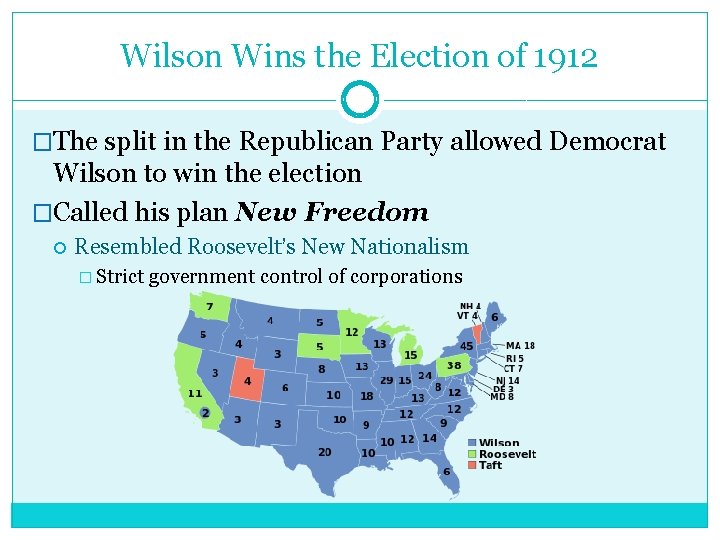
Wilson Wins the Election of 1912 �The split in the Republican Party allowed Democrat Wilson to win the election �Called his plan New Freedom Resembled Roosevelt’s New Nationalism � Strict government control of corporations
Wilson Regulates the Economy �Congress lowers tariffs and Raises Taxes Passed Underwood Tariff � Prevented big manufacturers from unfairly charging high prices 1913 Sixteenth Amendment � Graduated income tax Wealthy people pay a higher percentage of their income than poor people Rationale: money the government lost from lowering tariffs would be made up from the income tax collected
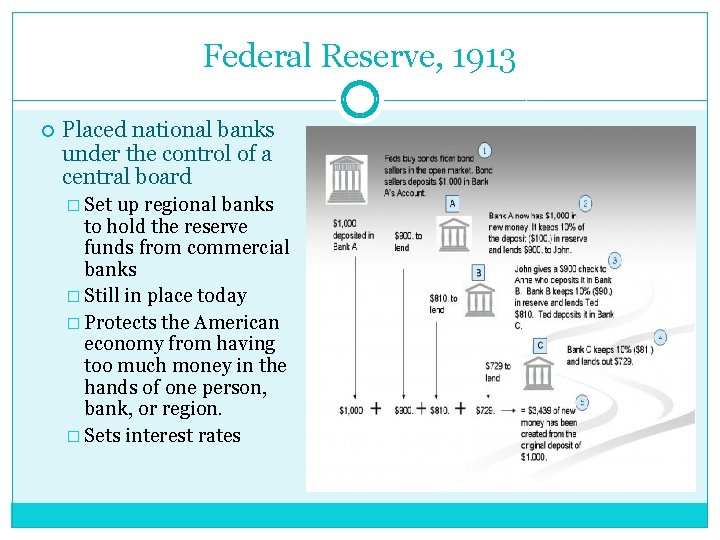
Federal Reserve, 1913 Placed national banks under the control of a central board � Set up regional banks to hold the reserve funds from commercial banks � Still in place today � Protects the American economy from having too much money in the hands of one person, bank, or region. � Sets interest rates
Wilson Strengthens Antitrust Regulation �Federal Trade Commission (FTC) Monitor business practices, false advertising, and dishonest labeling �Clayton Antitrust Act Strengthened the Sherman Antitrust Act � Spelled out specific activities businesses could not do
Workers’ Rights Protected �The Clayton Antitrust Act also protected labor unions from being attacked as trusts Remember the Sherman Antitrust Act did the opposite �Working Man’s Compensation Act Gave wages to temporarily disabled civil service employees
Progressivism’s Legacy �Expanding Voters’ Influence Direct Primary Initiative Referendum Recall �More protection of Americans’ private lives at the same time gaining more control �Left the idea the government can take action to help people fix problems Also a criticism of Progressivism � People will now want to rely on the government to fix ALL their problems