
Emergence of the Americas in global affairs 1880
Emergence of the Americas in global affairs 1880 -1929 Motives for U. S. Imperialism • “White Man’s Burden”/Social Darwinism • Economic: Markets & Raw Materials • Civilizing Mission: Spread Christianity • Alfred T. Mahan: Need for Naval Bases • The Frontier Thesis • Spread Democracy Manifest Destiny)
Causes of Spanish American War • American Sympathy towards Cuban Fight for Freedom against Spanish Rule – “Butcher” Weyler forced 300, 000 Cuban Rebels into concentration camps • Monroe Doctrine – chance to get Spain out of Western Hemisphere • Economic Interests – sugar plantations • Yellow Journalism – American Press got American’s behind going to war • Spark: Sinking of the USS Maine
Important Events • Sinking of the USS Maine – 266 US Servicemen are killed – Blamed on a Spanish mine • Admiral Dewey – Surprise attack on the Spanish Fleet in Manila Harbor – All Spanish Ships are Sunk • Spanish Defeated in Battle of San Juan Hill – T. Roosevelt led the “Rough Riders” to victory • Spain signs Treat of Paris Ending the War
Effects of the Spanish American War • US becomes an Imperialist Power • Guam, Puerto Rico, and the Philippines become colonies of the US • Cuba gains its independence from Spain, but becomes a US Protectorate – US will “protect” and partially control Cuba • Philippine rebels wanting independence declare war on US
The U. S. Becomes a World Power • At the turn of the 20 th century, the U. S. emerged as a world power: – The U. S. asserted its dominance in Spanish. American War (1898) – America built the 3 rd largest navy in the world – Annexed Hawaii, the Philippines, Puerto Rico, many Pacific islands – Asserted economic control over almost all of Latin America
The U. S. Becomes a World Power • The U. S. developed a new, aggressive foreign policy under T. Roosevelt (Big Stick), Taft (Dollar Diplomacy), & Wilson (Moral Diplomacy): • Their policies differed, but all revealed a desire to increase American wealth, military power, & stature in the world, especially Latin America
The Roosevelt Corollary • One of the greatest concerns was the intervention of European nations in Latin America: – In 1903, Germany & England threatened to invade Venezuela to recoup unpaid debts – TR issued Roosevelt Corollary to the Monroe Doctrine in 1904 claiming special “police powers” in the Western Hemisphere TR warned European nations to stay out AND warned Latin American nations to be more responsible or the U. S. would intervene
Conclusions • After the Spanish-American War, the USA assumed an aggressive foreign policy: – In order to maintain order, forestall foreign intervention, & protect U. S. economic interests – By the outbreak of WW I, the USA had seen its foreign policy evolve from strict neutrality, to imperialist, to police officer
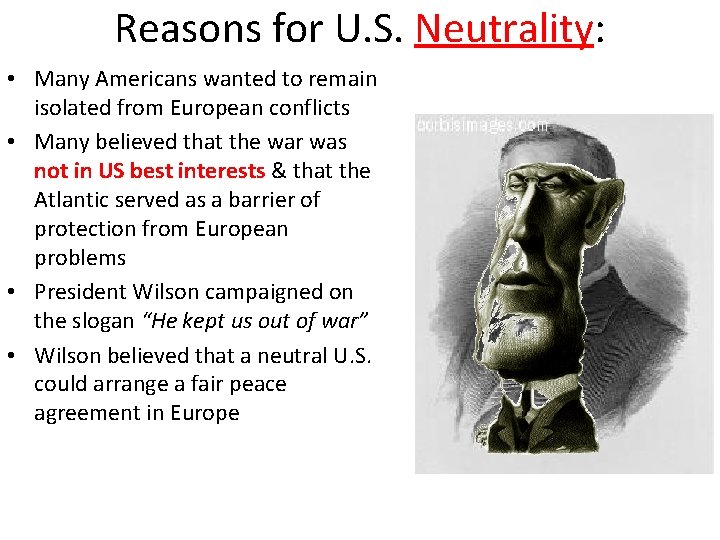
Reasons for U. S. Neutrality: • Many Americans wanted to remain isolated from European conflicts • Many believed that the war was not in US best interests & that the Atlantic served as a barrier of protection from European problems • President Wilson campaigned on the slogan “He kept us out of war” • Wilson believed that a neutral U. S. could arrange a fair peace agreement in Europe
Reasons why the U. S. Entered the War: • Economic ties – The U. S. traded more with Britain and France. (U. S. was not strictly neutral) Many sympathized w/Br. & Fr. • Submarine warfare – German U-boats attack ships in British ports – U. S. protested unrestricted submarine warfare – Wilson vows to hold Germany responsible for loss of American life or property • Germany sinks the Lusitania (British ship) – 128 Americans are killed – At this point, Germany did not want war with the U. S. and agreed to stop attacking neutral ships. – Later, Germany continued unrestricted submarine warfare in British waters
The Zimmermann Telegram • Germany’s foreign secretary (Zimmermann) sent a secret note to Mexico (February 1917) • Germany urged Mexico to attack the U. S. and in return, Mexico would gain back territory previously lost to the U. S. • Americans and Wilson are outraged by the Zimmermann telegram
Other Reasons for U. S. Entrance • Russian Revolution When war broke out (1914) Russian people supported their Czar Heavy losses and economic hardship caused discontent In March 1917, the Czar was forced to step down (eventually executed) Wilson believed that the revolution would end Russian monarchy and bring democracy – Without a Czar, it was easier for Wilson to support the allies (keeping the world safe for democracy) – – • Germany resumes unrestricted submarine warfare – German U-boats sank several U. S. merchant ships
• Why did the U. S. abandon neutrality and enter WWI? – America had economic ties to the British & French • Sold war millions in war materials to both/sympathy for Br. & Fr. – Fear of German power • Possible threat to US security – Unrestricted submarine warfare • German interference with US shipping • Sinking of the Lusitania – The Zimmerman Telegram • Americans were outraged when details of the telegram were published in newspapers – The Russian Revolution • With the Czar gone, it was easier to support the allies (Democracy)
Why did the US Reject the Treaty of Versailles? • Critics of the Treaty believed that the League would drag the US into future European wars (Senator Henry Cabot Lodge) • Americans were “war weary” and wanted to return to isolationism • Wilson suffered a stroke and was unable to sell the treaty to the people • The US refused to join the League of Nations, making the League a “paper tiger” or weak on the world stage.
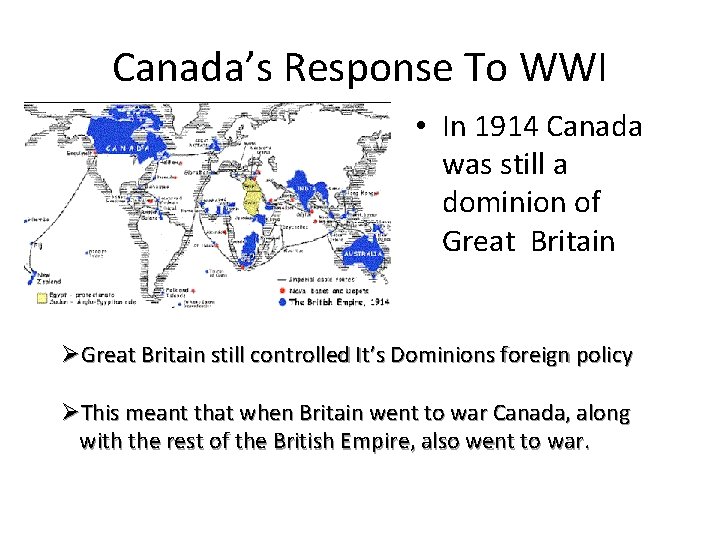
Canada’s Response To WWI • In 1914 Canada was still a dominion of Great Britain ØGreat Britain still controlled It’s Dominions foreign policy ØThis meant that when Britain went to war Canada, along with the rest of the British Empire, also went to war.
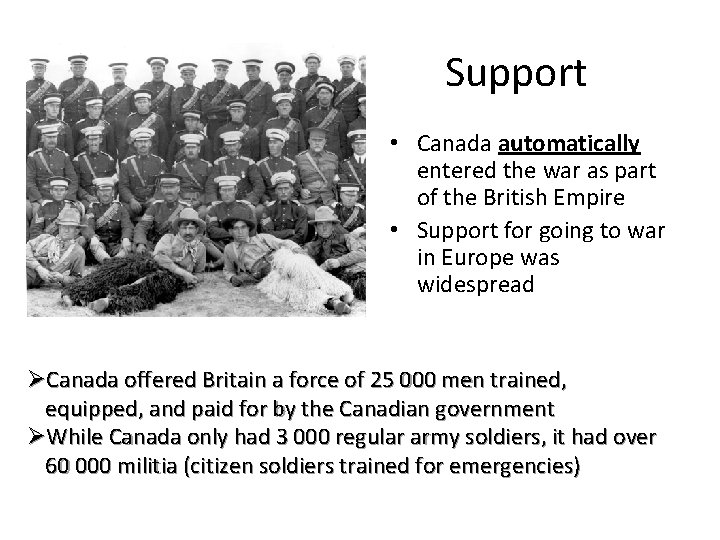
Support • Canada automatically entered the war as part of the British Empire • Support for going to war in Europe was widespread ØCanada offered Britain a force of 25 000 men trained, equipped, and paid for by the Canadian government ØWhile Canada only had 3 000 regular army soldiers, it had over 60 000 militia (citizen soldiers trained for emergencies)
The People’s Response • Responses to Canada’s involvement in the war varied. • Those Canadian’s of British decent were enthusiastic, while the Francophone (native French speaking) and population and the Maritime provinces were far less interested in Canadian involvement in a war overseas. • Why would the Canadiens and the Maritime provinces be less interested in going to war in Europe than those Canadian’s of British heritage?
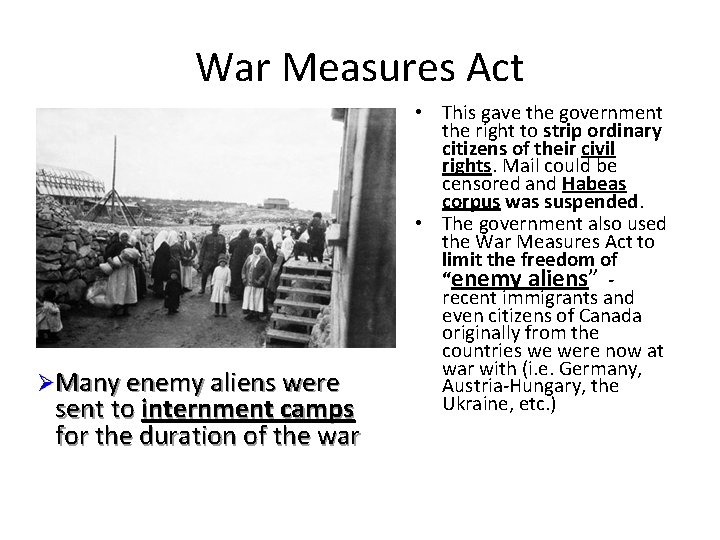
War Measures Act ØMany enemy aliens were sent to internment camps for the duration of the war • This gave the government the right to strip ordinary citizens of their civil rights. Mail could be censored and Habeas corpus was suspended. • The government also used the War Measures Act to limit the freedom of “enemy aliens” recent immigrants and even citizens of Canada originally from the countries we were now at war with (i. e. Germany, Austria-Hungary, the Ukraine, etc. )

- Slides: 19