
Emergence of Landscape Ecology Equilibrium View Structure Function
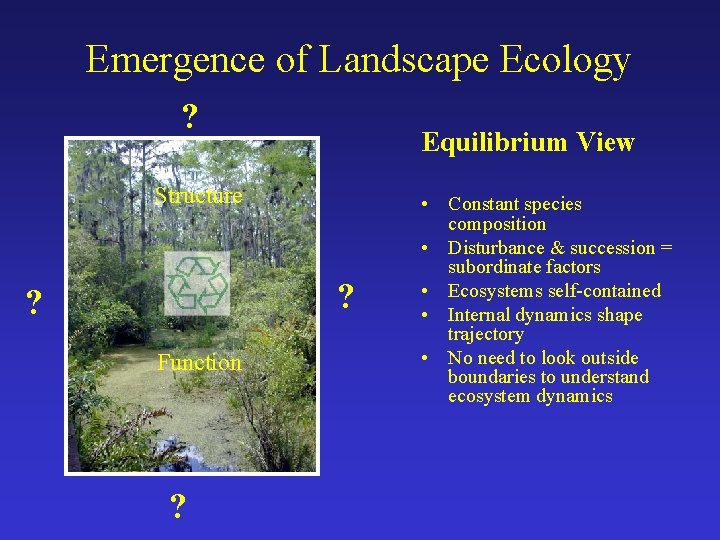
Emergence of Landscape Ecology ? Equilibrium View Structure ? ? Function ? • Constant species composition • Disturbance & succession = subordinate factors • Ecosystems self-contained • Internal dynamics shape trajectory • No need to look outside boundaries to understand ecosystem dynamics
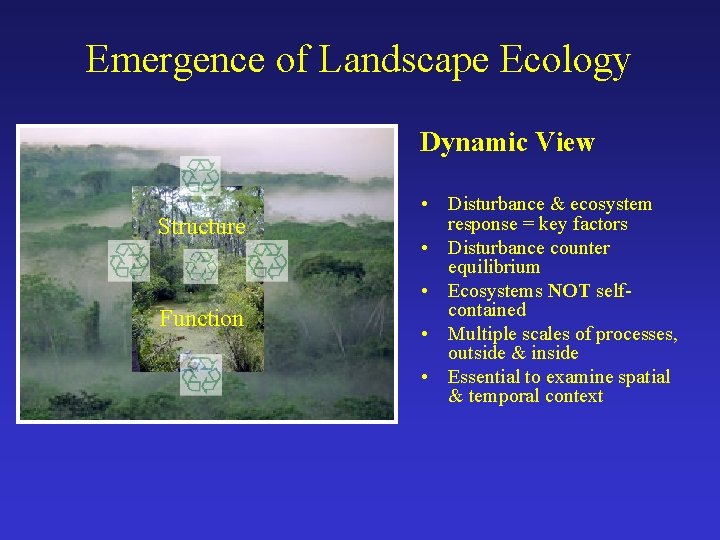
Emergence of Landscape Ecology Dynamic View Structure Function • Disturbance & ecosystem response = key factors • Disturbance counter equilibrium • Ecosystems NOT selfcontained • Multiple scales of processes, outside & inside • Essential to examine spatial & temporal context
Scale • What’s the big deal? • Seminal pubs – Allen & Starr (1982) – Hierarchy: perspectives for ecological complexity – Delcourt et al. (1983) – Quaternary Science Review 1: 153 -175 – O’Neill et al. (1986) – A hierarchical concept of ecosystems
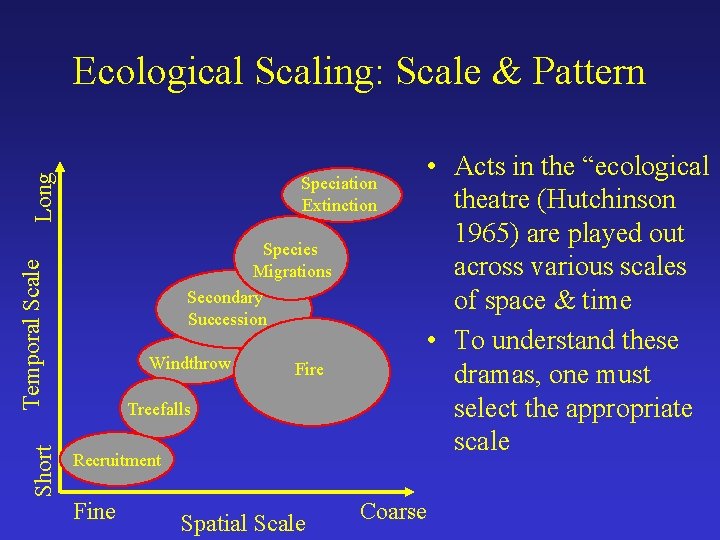
Long Ecological Scaling: Scale & Pattern Speciation Extinction Short Temporal Scale Species Migrations Secondary Succession Windthrow Fire Treefalls Recruitment Fine Spatial Scale Coarse • Acts in the “ecological theatre (Hutchinson 1965) are played out across various scales of space & time • To understand these dramas, one must select the appropriate scale
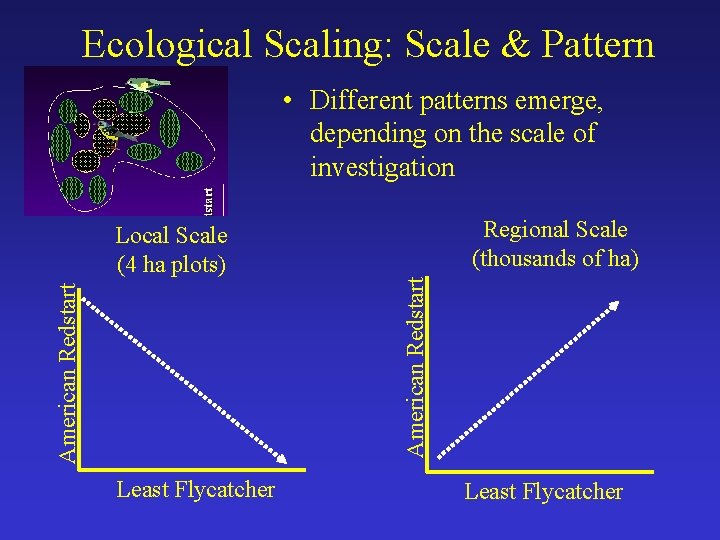
Ecological Scaling: Scale & Pattern • Different patterns emerge, depending on the scale of investigation Regional Scale (thousands of ha) American Redstart Local Scale (4 ha plots) Least Flycatcher
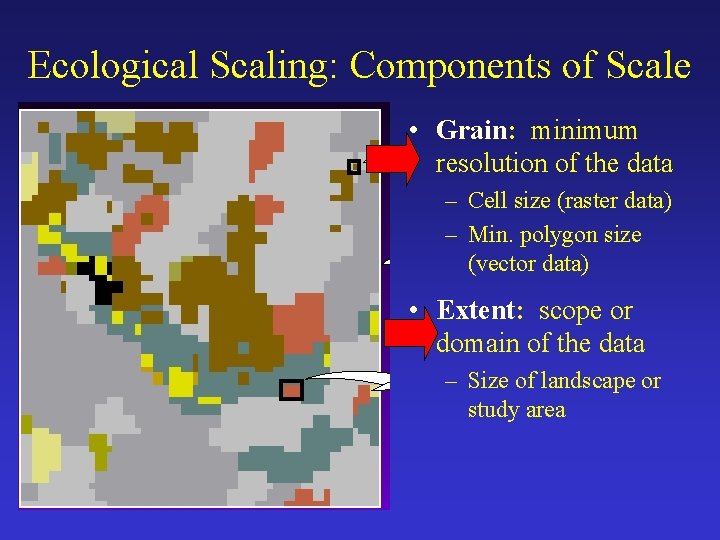
Ecological Scaling: Components of Scale • Grain: minimum resolution of the data – Cell size (raster data) – Min. polygon size (vector data) • Extent: scope or domain of the data – Size of landscape or study area
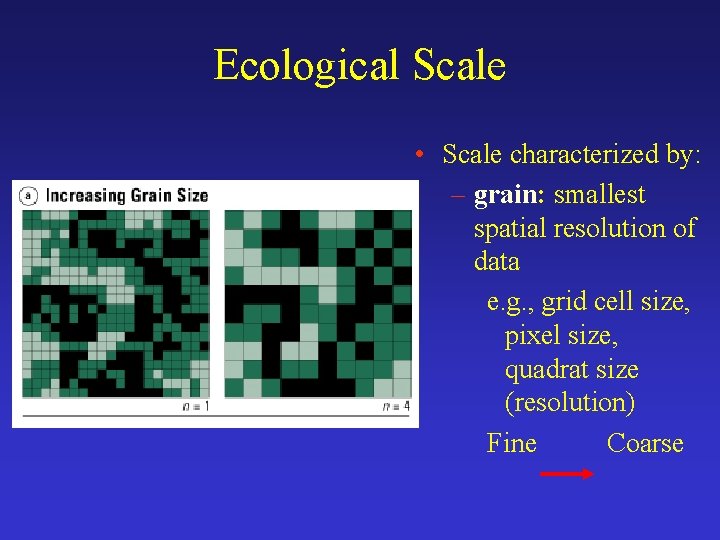
Ecological Scale • Scale characterized by: – grain: smallest spatial resolution of data e. g. , grid cell size, pixel size, quadrat size (resolution) Fine Coarse
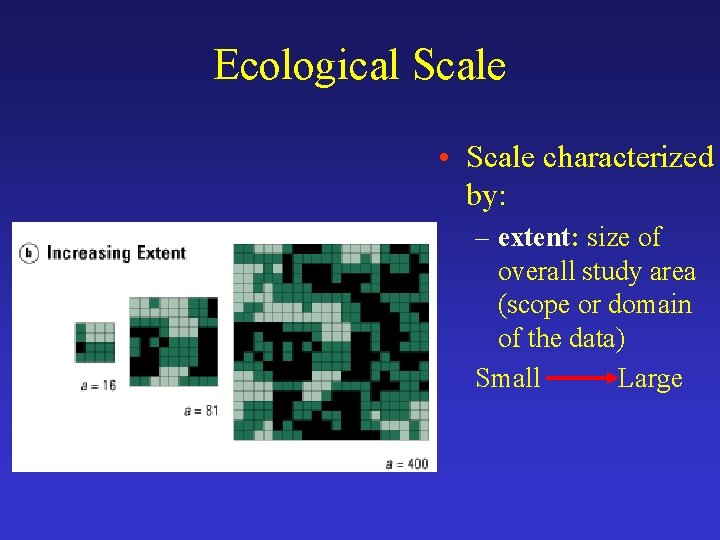
Ecological Scale • Scale characterized by: – extent: size of overall study area (scope or domain of the data) Small Large
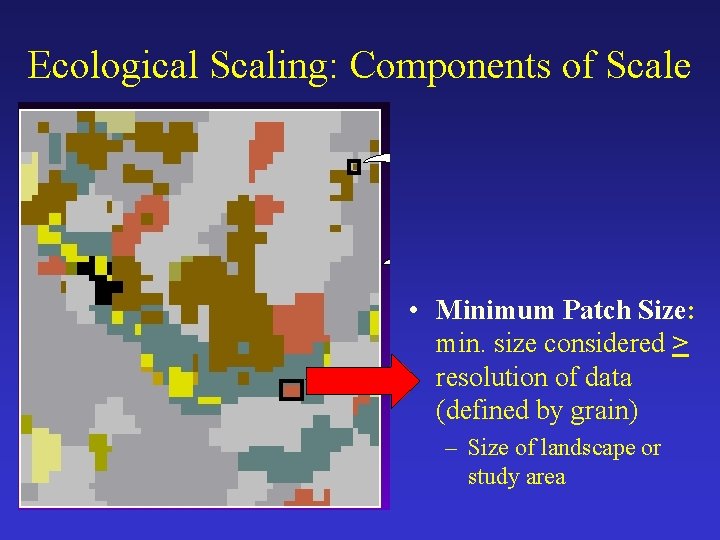
Ecological Scaling: Components of Scale • Minimum Patch Size: min. size considered > resolution of data (defined by grain) – Size of landscape or study area
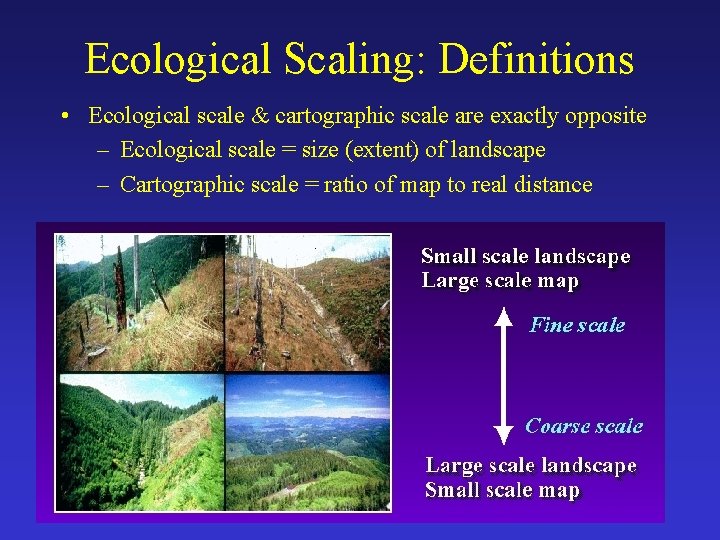
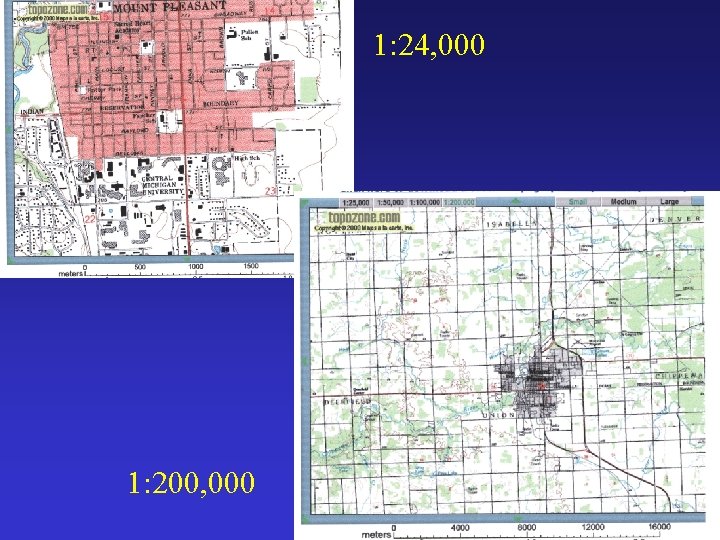
Ecological Scaling: Definitions • Ecological scale & cartographic scale are exactly opposite – Ecological scale = size (extent) of landscape – Cartographic scale = ratio of map to real distance
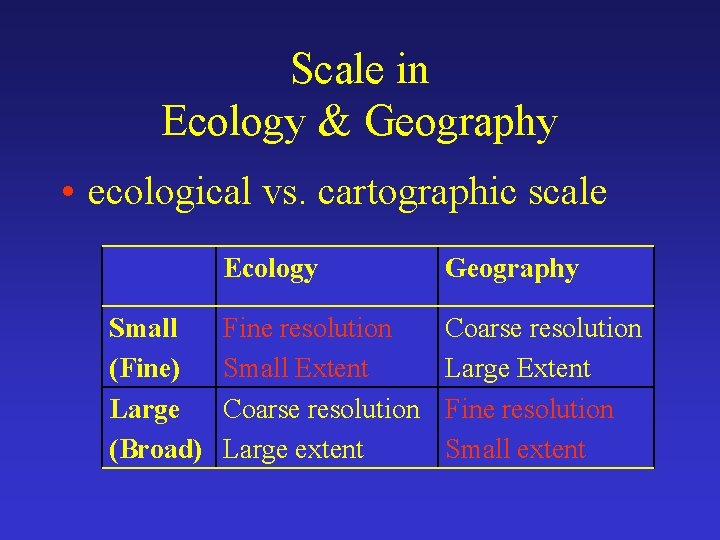
Scale in Ecology & Geography • ecological vs. cartographic scale Small (Fine) Large (Broad) Ecology Geography Fine resolution Small Extent Coarse resolution Large extent Coarse resolution Large Extent Fine resolution Small extent
Scale in Ecology & Geography • ecological vs. cartographic scale – e. g. , map scale 1: 24, 000 vs. 1: 3, 000 fine vs. coarse large vs. small extent
1: 24, 000 1: 200, 000
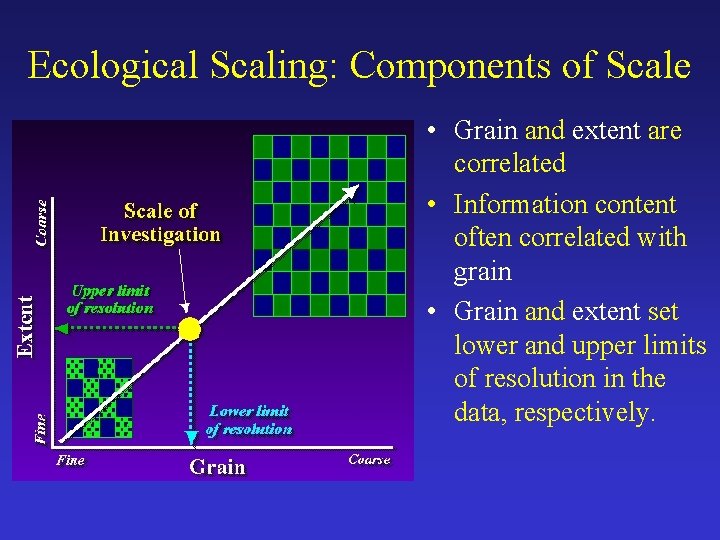
Ecological Scaling: Components of Scale • Grain and extent are correlated • Information content often correlated with grain • Grain and extent set lower and upper limits of resolution in the data, respectively.
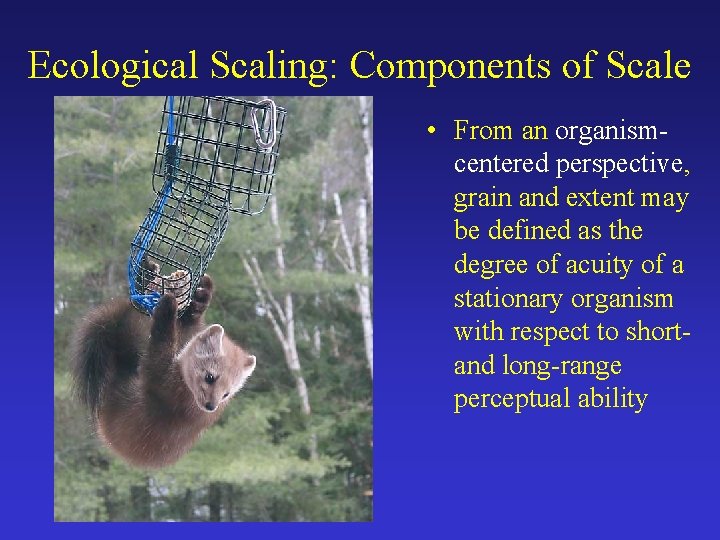
Ecological Scaling: Components of Scale • From an organismcentered perspective, grain and extent may be defined as the degree of acuity of a stationary organism with respect to shortand long-range perceptual ability
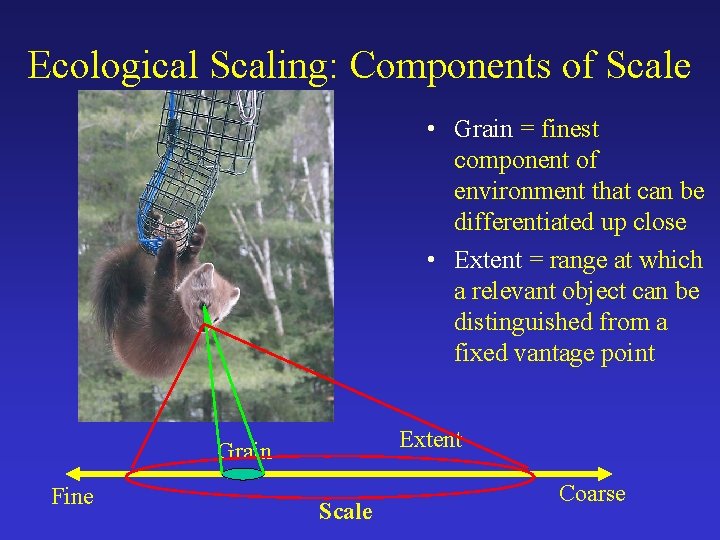
Ecological Scaling: Components of Scale • Grain = finest component of environment that can be differentiated up close • Extent = range at which a relevant object can be distinguished from a fixed vantage point Extent Grain Fine Scale Coarse
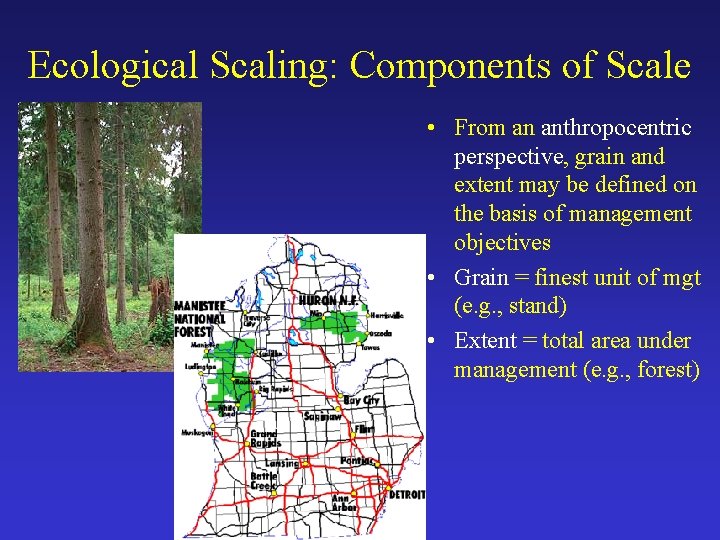
Ecological Scaling: Components of Scale • From an anthropocentric perspective, grain and extent may be defined on the basis of management objectives • Grain = finest unit of mgt (e. g. , stand) • Extent = total area under management (e. g. , forest)
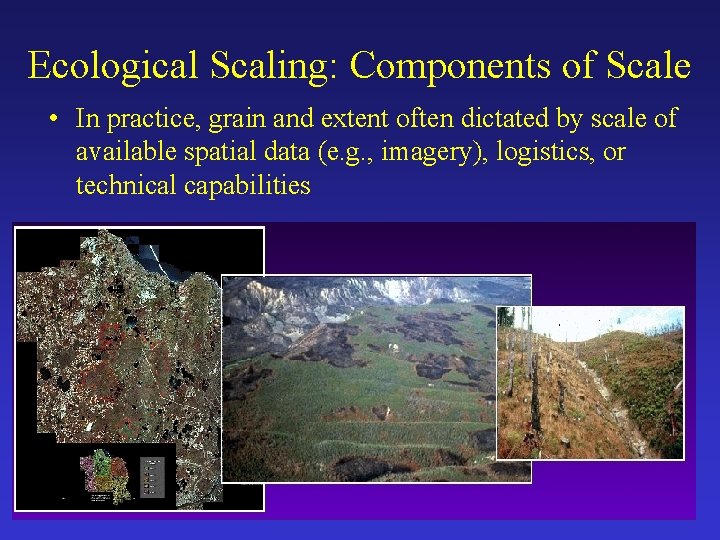
Ecological Scaling: Components of Scale • In practice, grain and extent often dictated by scale of available spatial data (e. g. , imagery), logistics, or technical capabilities
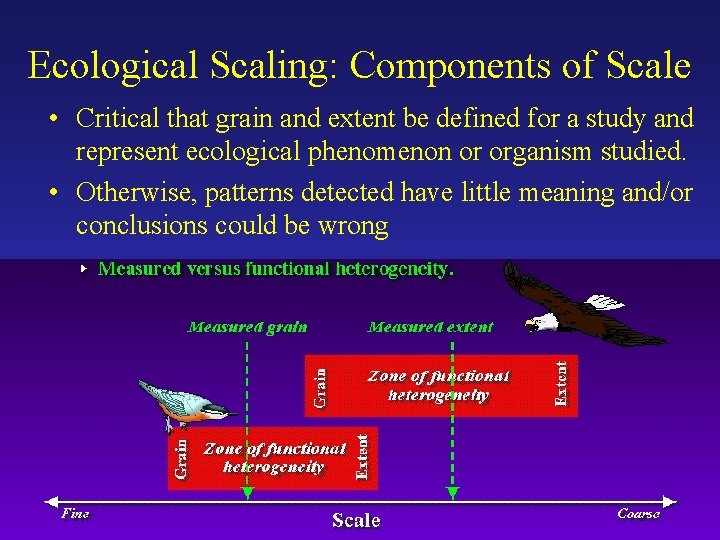
Ecological Scaling: Components of Scale • Critical that grain and extent be defined for a study and represent ecological phenomenon or organism studied. • Otherwise, patterns detected have little meaning and/or conclusions could be wrong
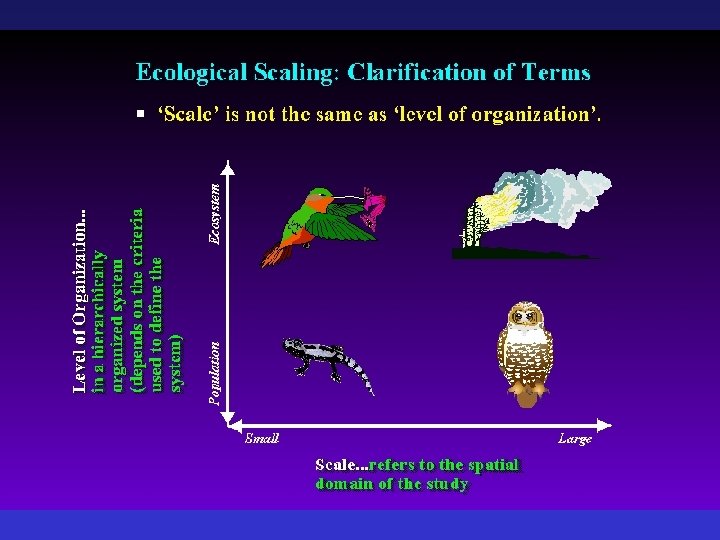
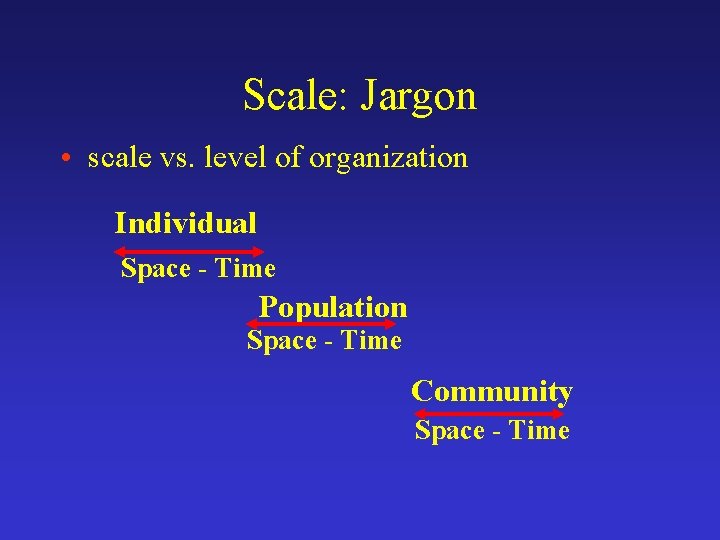
Scale: Jargon • scale vs. level of organization Individual Space - Time Population Space - Time Community Space - Time
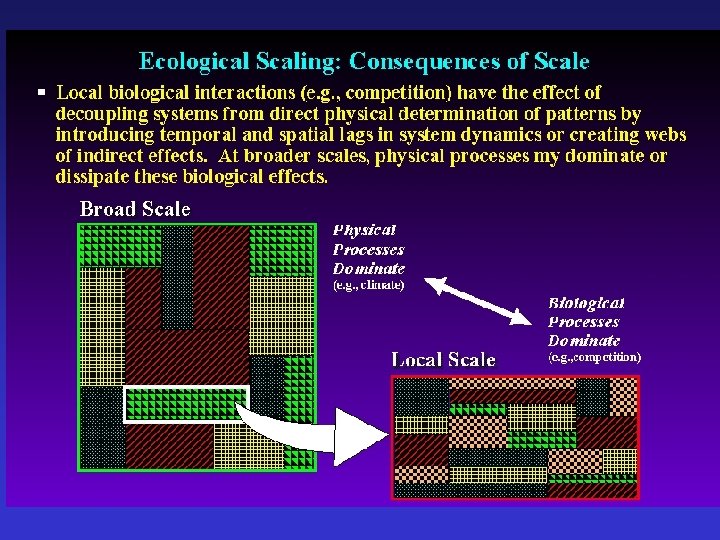
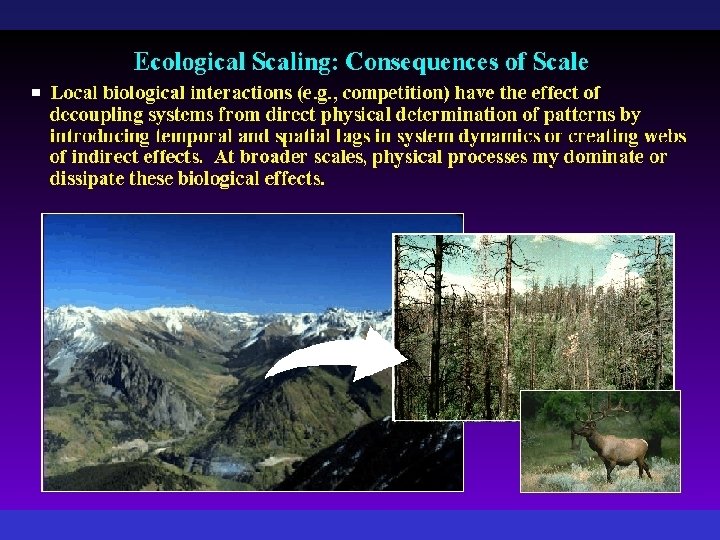
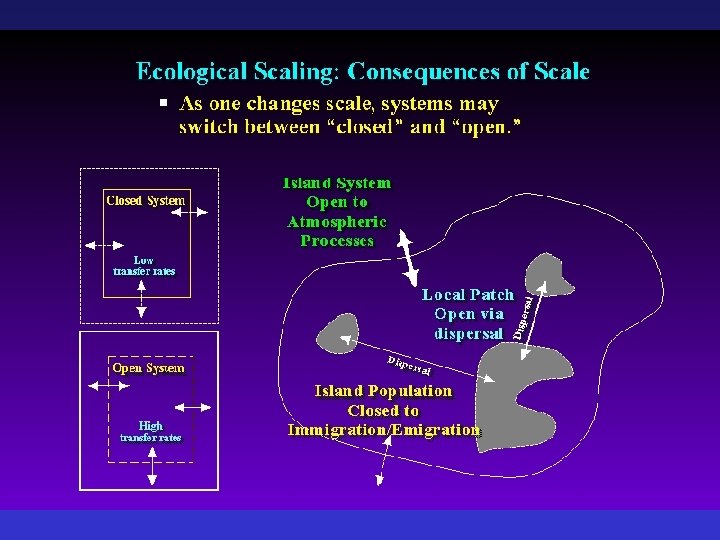
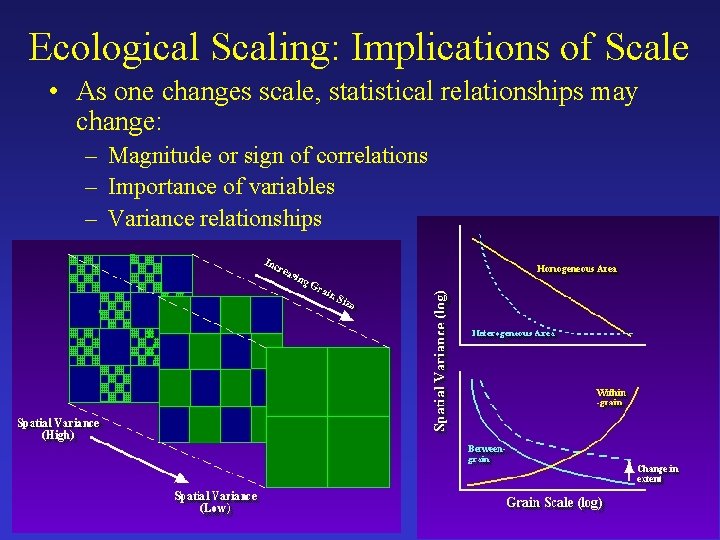
Ecological Scaling: Implications of Scale • As one changes scale, statistical relationships may change: – Magnitude or sign of correlations – Importance of variables – Variance relationships
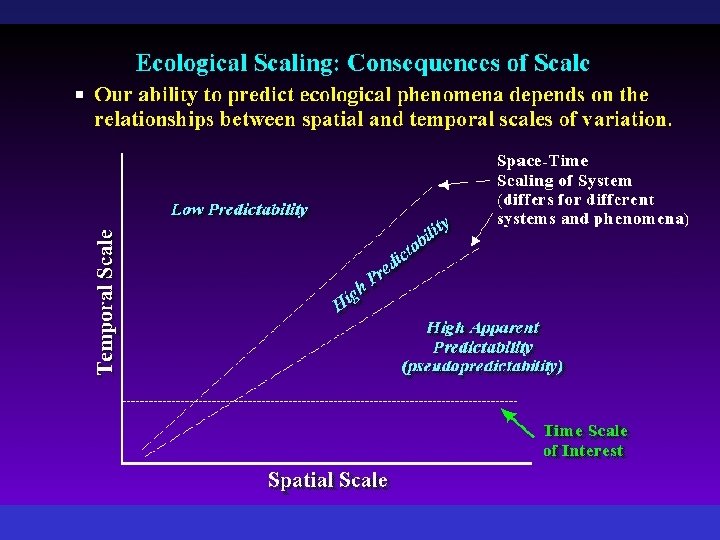
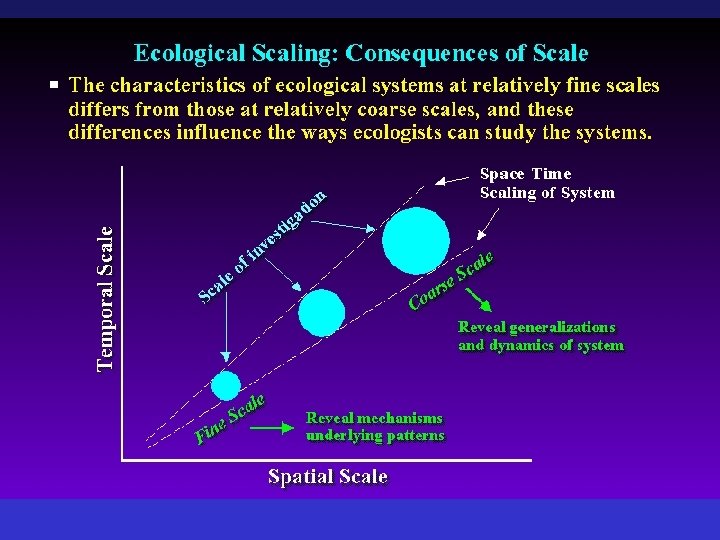
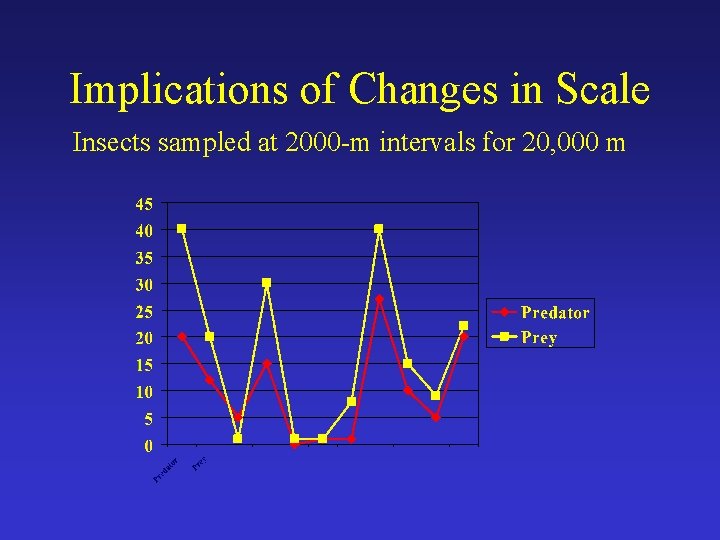
Implications of Changes in Scale • Processes and/or patterns may change • Hierarchy theory = structural understanding of scale-dependent phenomena Example Abundance of forest insects sampled at different distance Intervals in leaf litter,
Implications of Changes in Scale Insects sampled at 10 -m intervals for 100 m
Implications of Changes in Scale Insects sampled at 2000 -m intervals for 20, 000 m
Identifying the “Right” Scale(s) • • No clear algorithm for defining Autocorrelation & Independence Life history correlates Dependent on objectives and organisms • Multiscale analysis! • e. g. , Australian leadbeater’s possum
Multiscale Analysis • Species-specific perception of landscape features : scale-dependent – e. g. , mesopredators in Indiana • Modeling species distributions in fragmented landscapes
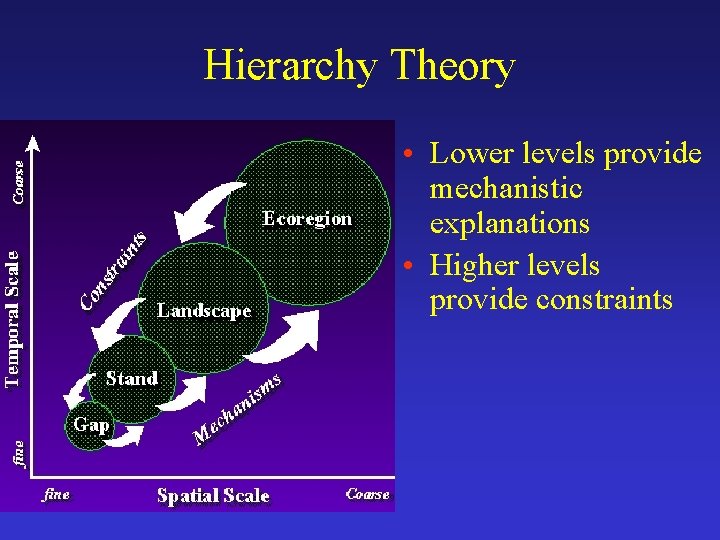
Hierarchy Theory • Lower levels provide mechanistic explanations • Higher levels provide constraints
Scale & Hierarchy Theory • Hierarchical structure of systems = helps us explain phenomena – Why? : next lower level – So What? : next higher level • minimum 3 hierarchical levels needed
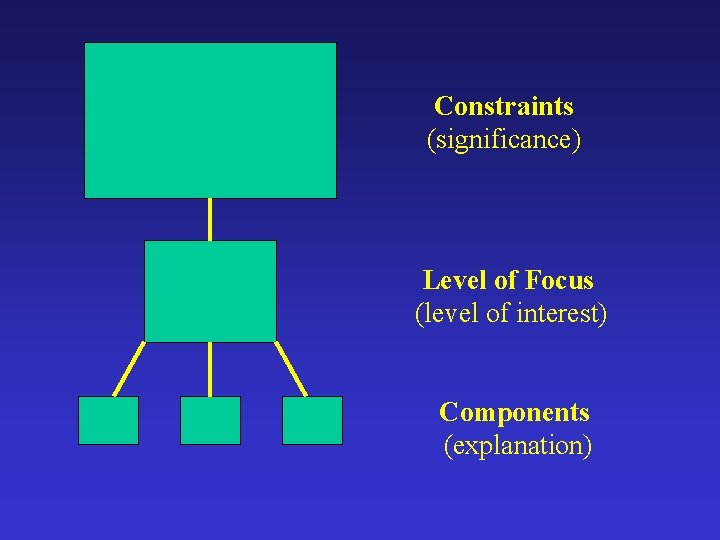
Constraints (significance) Level of Focus (level of interest) Components (explanation)
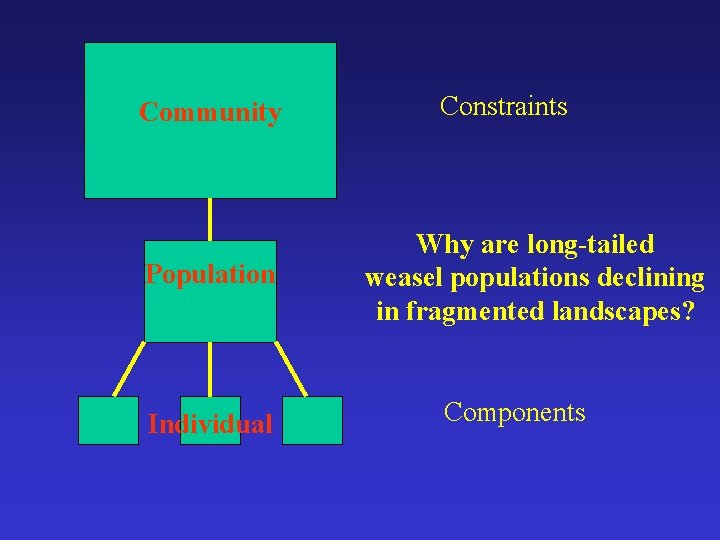
Community Population Individual Constraints Why are long-tailed weasel populations declining in fragmented landscapes? Components
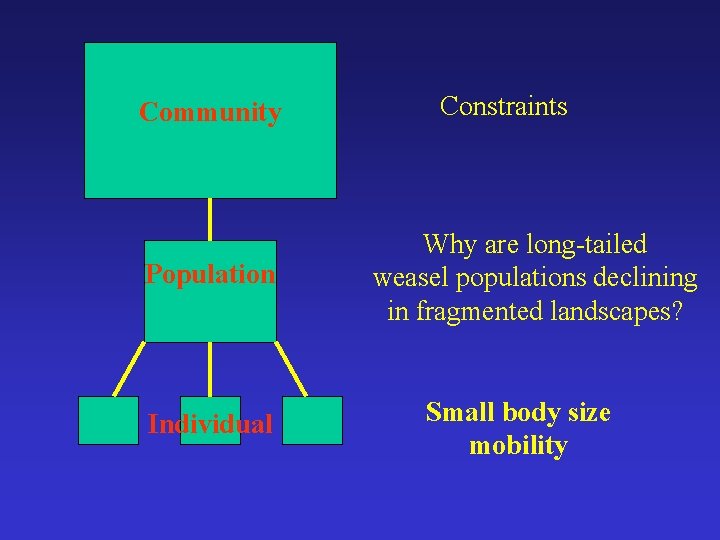
Community Population Individual Constraints Why are long-tailed weasel populations declining in fragmented landscapes? Small body size mobility
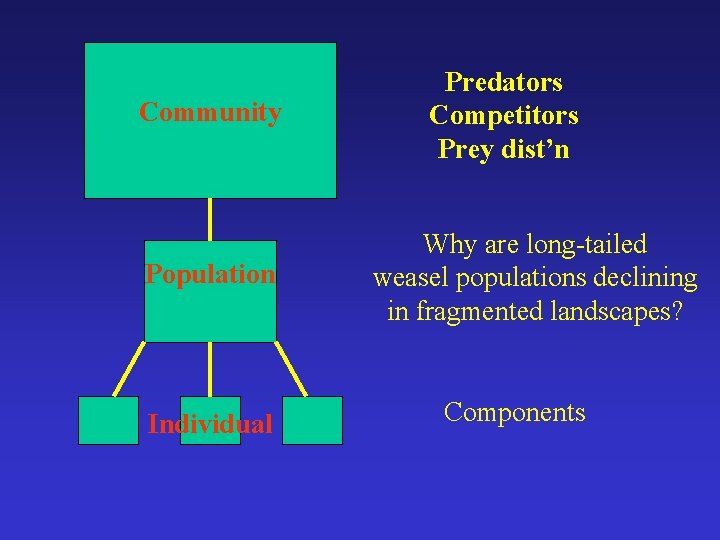
Community Population Individual Predators Competitors Prey dist’n Why are long-tailed weasel populations declining in fragmented landscapes? Components
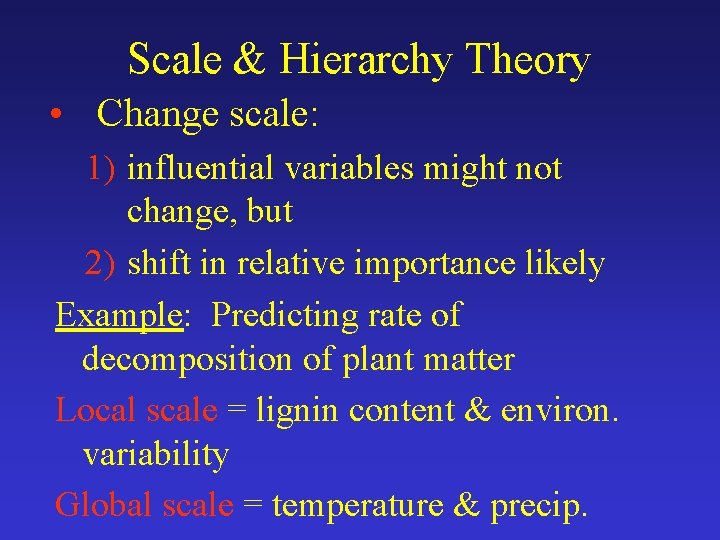
Scale & Hierarchy Theory • Change scale: 1) influential variables might not change, but 2) shift in relative importance likely Example: Predicting rate of decomposition of plant matter Local scale = lignin content & environ. variability Global scale = temperature & precip.
- Slides: 39