
EMERGENCE OF INTEGRATIVE SCIENCE CHALLENGES TO CHEMISTRY EDUCATION
- Slides: 34
EMERGENCE OF INTEGRATIVE SCIENCE: CHALLENGES TO CHEMISTRY EDUCATION Dr. S. Sivaram, National Chemical Laboratory, Pune-411 008, INDIA Tel : 0091 20 2589 2614 Fax : 0091 20 2589 2615 Email : s. sivaram@ncl. res. in Visit us at : http: //www. ncl-india. org Seminar on “New Methodologies in Chemistry Education”, Royal College of Arts, Science and Commerce, Thane December 20, 2011
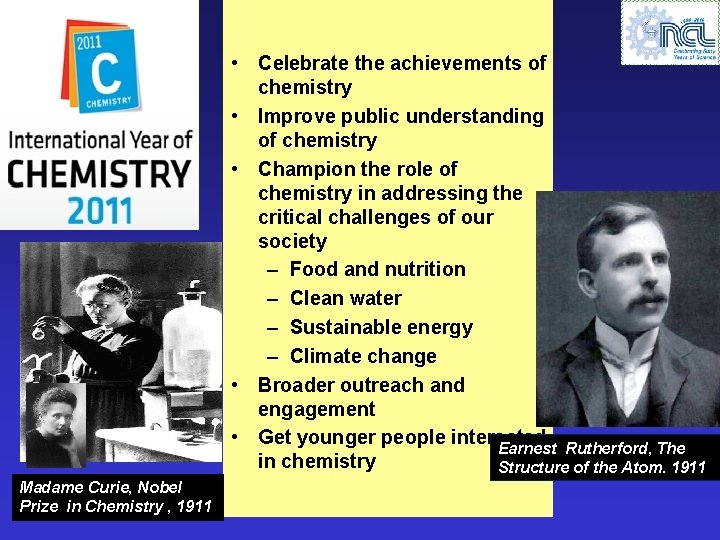
• Celebrate the achievements of chemistry • Improve public understanding of chemistry • Champion the role of chemistry in addressing the critical challenges of our society – Food and nutrition – Clean water – Sustainable energy – Climate change • Broader outreach and engagement • Get younger people interested Earnest Rutherford, The in chemistry Structure of the Atom. 1911 Madame Curie, Nobel Prize in Chemistry , 1911
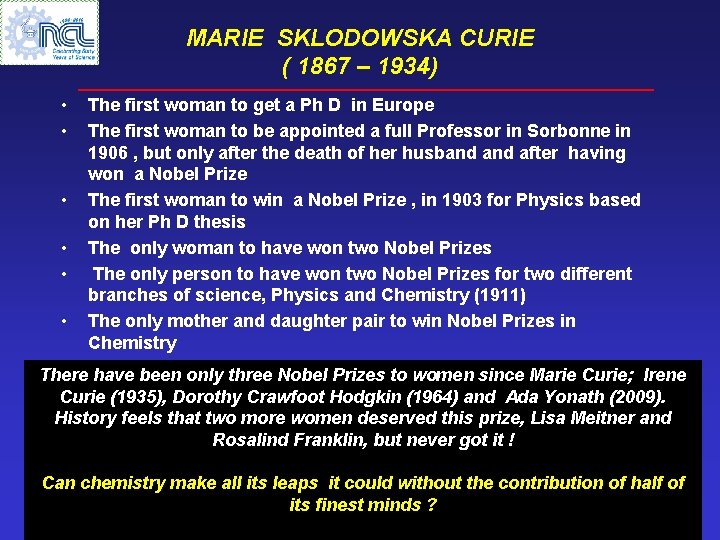
MARIE SKLODOWSKA CURIE ( 1867 – 1934) • • • The first woman to get a Ph D in Europe The first woman to be appointed a full Professor in Sorbonne in 1906 , but only after the death of her husband after having won a Nobel Prize The first woman to win a Nobel Prize , in 1903 for Physics based on her Ph D thesis The only woman to have won two Nobel Prizes The only person to have won two Nobel Prizes for two different branches of science, Physics and Chemistry (1911) The only mother and daughter pair to win Nobel Prizes in Chemistry There have been only three Nobel Prizes to women since Marie Curie; Irene Curie (1935), Dorothy Crawfoot Hodgkin (1964) and Ada Yonath (2009). History feels that two more women deserved this prize, Lisa Meitner and Rosalind Franklin, but never got it ! Can chemistry make all its leaps it could without the contribution of half of its finest minds ?
TEACHING AND EDUCATION • Archaic • Non-demanding • Not very relevant
EDUCATION IS NOT A RACE • Competitive pressures generate debilitating sense of anxiety and takes the joy out of learning • Research on motivation tells us that attention exclusively on scholastic performance destroys the intrinsic interest the subject might have had. • Education can become more relevant if the subject is connected to student`s personal life and interests. • Opportunities to solve multi-dimensional problems, designing solutions through experimentation and working collaboratively can make a student more emotionally engaged with the subject • In life, problem solving and critical analysis skills are far more important than being able to give correct answer to questions D. Stipek, Science, 332, 24 June 2011; Motivation in Education : Theory , Research and Applications, Prentice Hall, 2007
More often than not, failure in science is rooted in not having asked an important question, rather than in having arrived at an incorrect answer
INTEGRATIVE LEARNING “ Making connections within disciplines, between fields, between curriculum, cocurriculum, or between academic knowledge and practice" Awbrey, S. M, Dana, D. , Miller, V. W. , Robinson, P. , Ryan, M. M. and Scott, D. K. (Eds. ), (2006). Integrative Learning and Action: A Call to Wholeness (Studies in Education and Spirituality), New York: Peter Lang Publications
EDUCATION IN SCIENCE MUST CULTIVATE • • • Curiosity A keen eye – power of observation Courage to ask simple or even stupid questions Seek unity in nature; nature does not play dice Differentiate puzzles from problems Imagination and whole brain thinking Creativity is applied imagination
Every great advance in science has been issued from a new audacity of imagination John Dewey
WHAT IS INTEGRATED SCIENCE ? • Integrated Science is an attempt to break down traditional disciplinary barriers • A series of courses taken in the first and second years provides students with first-rate preparation for a major in any of the core scientific disciplines and in such a way that helps retain the connections to the other disciplines. • The curriculum is founded on the expectation that much of the most important science of the future, though based on the classical disciplines, will lie in areas that span two or more of them. • Any budding researcher needs a foundation in several fields to be able to work on the most important problems confronting society today.
WHAT IS THE INTEGRATED SCIENCE CURRICULUM ? • The curriculum covers the core material of introductory physics, chemistry, biology (genetics and biochemistry), and computer science, all in an integrated manner. The central role of mathematics as a universal language of science is emphasized throughout. In every area of science, students learn in part through quantitative problem solving; to this end computational methods are taught and integrated into the entire program • Collaborative problem solving is stressed over memorization and regurgitation of facts. At the top level of almost any field, people are distinguished not by what they know but how they deal with the unknown
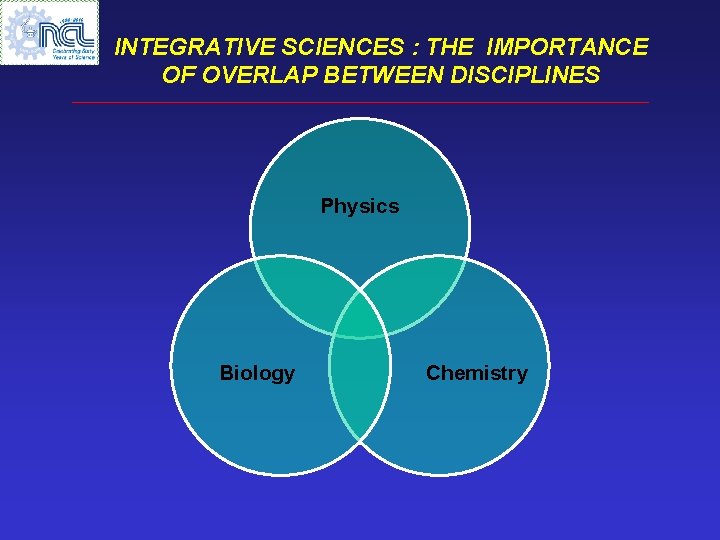
INTEGRATIVE SCIENCES : THE IMPORTANCE OF OVERLAP BETWEEN DISCIPLINES Physics Biology Chemistry
INTEGRATIVE SCIENCE IS NOT NEW • Science, when it began as an organized body of knowledge was essentially integrated or holistic. • Science was part of a larger domain of knowledge called Natural Sciences, that included the study of chemistry, biology, physics, mathematics, logic and philosophy • Most departments of sciences in the nineteenth century and early twentieth century were called Department of Natural Sciences • As science expanded during the second half of twentieth century, fragmentation of disciplines became more prevalent • Integrative Science recognizes the absence of borders between sciences. Science finds its strengths in the unity of its diverse disciplines
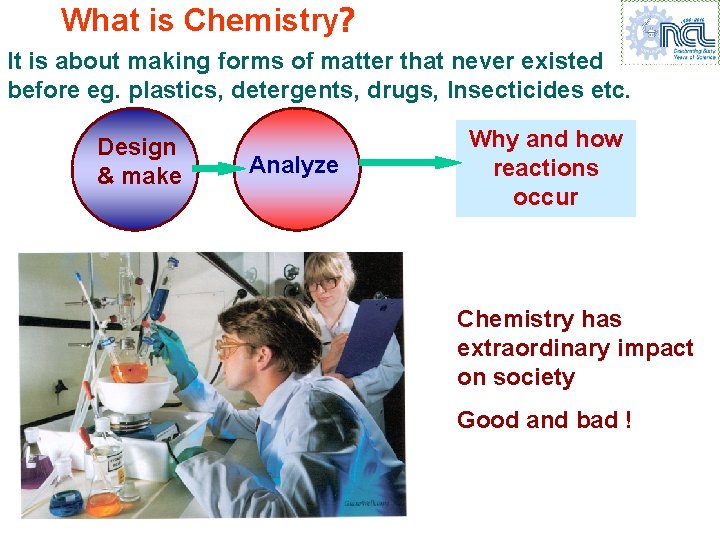
What is Chemistry? It is about making forms of matter that never existed before eg. plastics, detergents, drugs, Insecticides etc. Design & make Analyze Why and how reactions occur Chemistry has extraordinary impact on society Good and bad !
CHANGING FACE OF CHEMISTRY • • Chemistry is becoming more and more an interdisciplinary pursuit However, students usually learn chemistry in isolation Is there a case for teaching science in an integrative fashion ? Can principles of chemistry be illustrated using familiar biological phenomena or ecosystem behavior or semiconductor physics ? • Structure and function constitute the central theme of chemistry. All chemistry must be taught in the context of this theme • We tend to teach chemistry in the chronological order of its evolution. This is unnecessary • We should teach chemistry in the context of contemporary knowledge. The origins of chemistry must be covered in a module called “History of Science” In the world of research traditional disciplines are not relevant; Why don’t we teach chemistry the way it is practiced ?
EDUCATION IN CHEMISTRY • What is the objective ? To teach students what we know or how to think • We must tailor distinctive curriculum to those who will go on to become scientists and those who will not ; Differentiate between educating the masses and educating the few who are committed to pursue science as a career. • The former will require a conceptual approach to scientific knowledge, in the form of rigorous facts and principles, often taught in an abstract manner • The latter will require to be provided with basic scientific literacy, allowing them to understand the world they live in and engage in a meaningful way with scientific developments that will have impact on their lives Inclusive education does not imply reducing it to the lowest common denominator
CONTEXT LED APPROACH TO EDUCATION IN CHEMISTRY (D. K. Smith, Nature Chemistry, 3, 681 (2011) • Instead of teaching chemistry in the traditional way, context led approach relies on engaging students natural curiosity to understand the world around them • It teaches them to solve real life problems by exploring the underlying chemistry • Its emphasis is on interpretation and analysis rather than the breadth of conceptual coverage • The teaching does not subdivide chemistry in terms of traditional disciplines ; instead it teaches chemistry through illustrative examples from everyday experiences that a student can easily relate to
INTEGRATION OF TEACHING WITH PRACTICE • Students at a very early stage of their learning must experience thrill of doing chemistry • Chemistry, is in the ultimate, a sensual science. Its beauty lies not in the pages of drab textbooks, but in the perception of its colors, smell and even sound ! • Students must practice chemistry in all its dimensions • Experiments must be open ended and must inculcate the discipline of inquiry based learning • It is never too early to get students involved in research. Small research modules can completely replace traditional laboratory experiments • Students must be given opportunity to do science so that they can discover whether “research is for me” If we have to infect young minds with the thrill of doing research, we should let student experience what goes on in the life of a scientist In a research laboratory
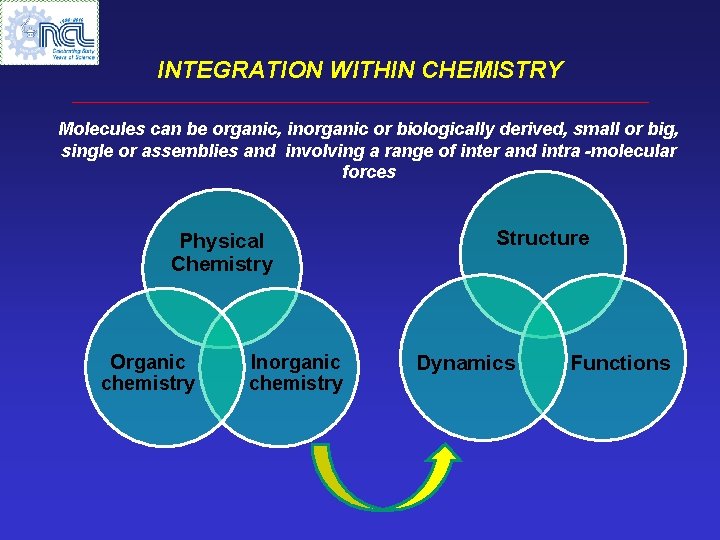
INTEGRATION WITHIN CHEMISTRY Molecules can be organic, inorganic or biologically derived, small or big, single or assemblies and involving a range of inter and intra -molecular forces Physical Chemistry Organic chemistry Inorganic chemistry Structure Dynamics Functions
CHEMISTRY EDUCATION IN THE INTERNET ERA • Information and facts abound in the world wide web; Era of distributed teaching and learning • Information retrieval no longer a rate limiting step • However, one needs higher order skills to get the true value of available information • Interpretation, making creative connections between data from different sources and spot the needles in the ever expanding information haystacks • Shift from acquiring knowledge to sharpening the cognitive skills • Providing facts to students no longer relevant; Is the classroom relevant ? • The objective now is to make a student active and independent learner • From “chalk and talk” to “ learn to connect and create”
The most important thing in science is not so much to obtain new facts as to discover new ways of thinking about them William Bragg
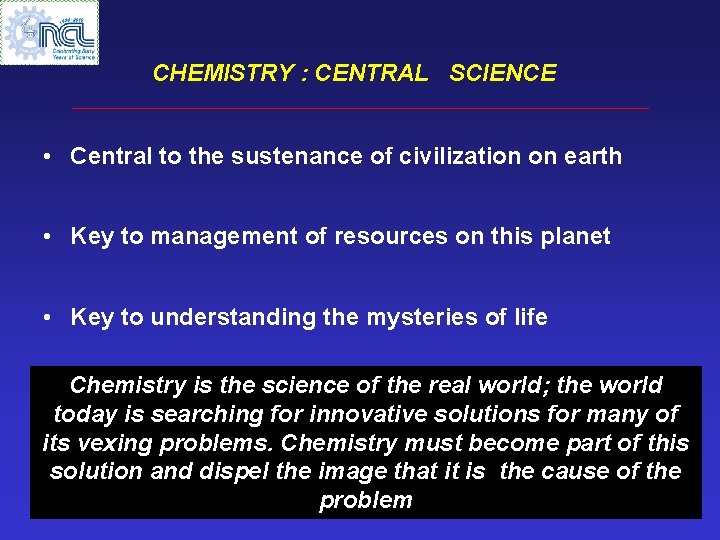
CHEMISTRY : CENTRAL SCIENCE • Central to the sustenance of civilization on earth • Key to management of resources on this planet • Key to understanding the mysteries of life Chemistry is the science of the real world; the world today is searching for innovative solutions for many of its vexing problems. Chemistry must become part of this solution and dispel the image that it is the cause of the problem
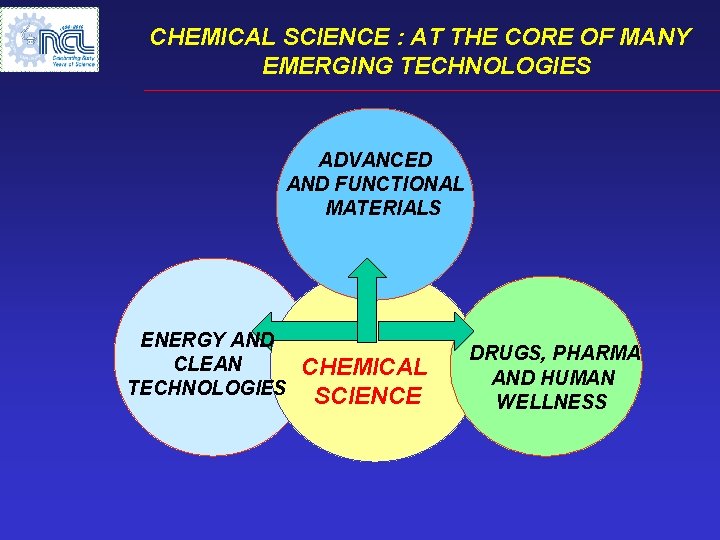
CHEMICAL SCIENCE : AT THE CORE OF MANY EMERGING TECHNOLOGIES ADVANCED AND FUNCTIONAL MATERIALS ENERGY AND CLEAN TECHNOLOGIES CHEMICAL SCIENCE DRUGS, PHARMA AND HUMAN WELLNESS
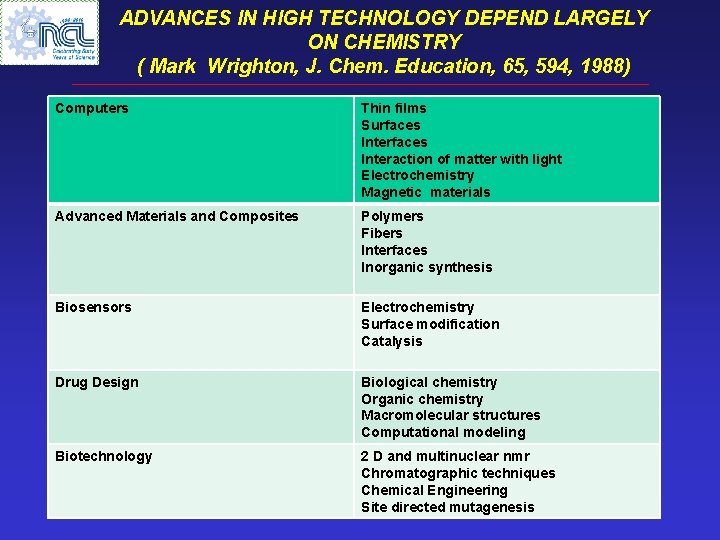
ADVANCES IN HIGH TECHNOLOGY DEPEND LARGELY ON CHEMISTRY ( Mark Wrighton, J. Chem. Education, 65, 594, 1988) Computers Thin films Surfaces Interaction of matter with light Electrochemistry Magnetic materials Advanced Materials and Composites Polymers Fibers Interfaces Inorganic synthesis Biosensors Electrochemistry Surface modification Catalysis Drug Design Biological chemistry Organic chemistry Macromolecular structures Computational modeling Biotechnology 2 D and multinuclear nmr Chromatographic techniques Chemical Engineering Site directed mutagenesis
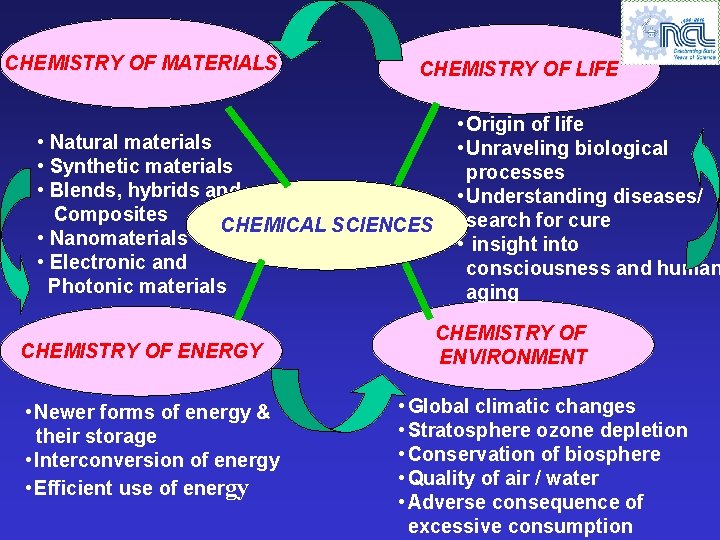
CHEMISTRY OF MATERIALS CHEMISTRY OF LIFE • Natural materials • Synthetic materials • Blends, hybrids and Composites CHEMICAL SCIENCES • Nanomaterials • Electronic and Photonic materials CHEMISTRY OF ENERGY • Newer forms of energy & their storage • Interconversion of energy • Efficient use of energy • Origin of life • Unraveling biological processes • Understanding diseases/ search for cure • insight into consciousness and human aging CHEMISTRY OF ENVIRONMENT • Global climatic changes • Stratosphere ozone depletion • Conservation of biosphere • Quality of air / water • Adverse consequence of excessive consumption
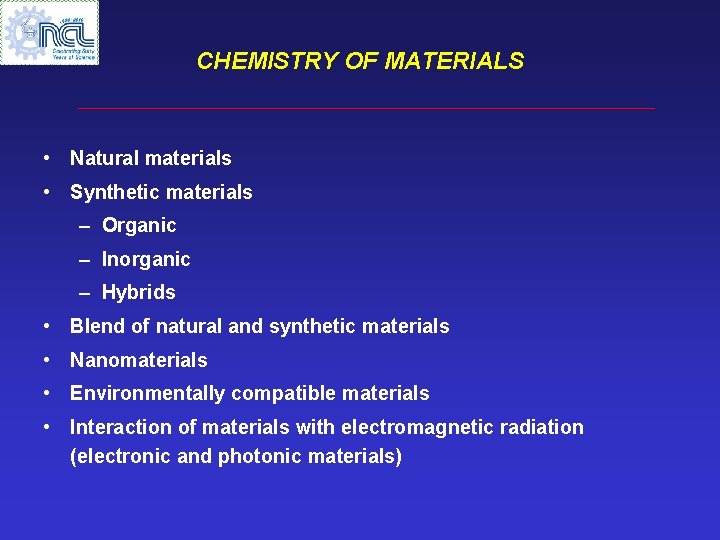
CHEMISTRY OF MATERIALS • Natural materials • Synthetic materials – Organic – Inorganic – Hybrids • Blend of natural and synthetic materials • Nanomaterials • Environmentally compatible materials • Interaction of materials with electromagnetic radiation (electronic and photonic materials)
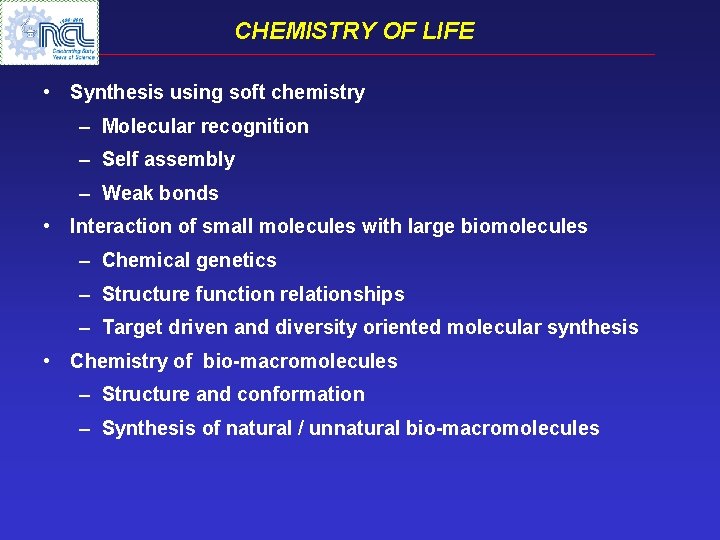
CHEMISTRY OF LIFE • Synthesis using soft chemistry – Molecular recognition – Self assembly – Weak bonds • Interaction of small molecules with large biomolecules – Chemical genetics – Structure function relationships – Target driven and diversity oriented molecular synthesis • Chemistry of bio-macromolecules – Structure and conformation – Synthesis of natural / unnatural bio-macromolecules
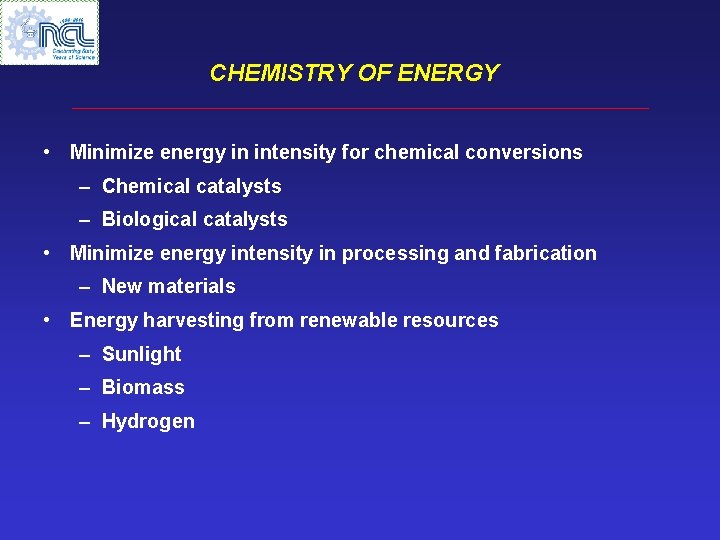
CHEMISTRY OF ENERGY • Minimize energy in intensity for chemical conversions – Chemical catalysts – Biological catalysts • Minimize energy intensity in processing and fabrication – New materials • Energy harvesting from renewable resources – Sunlight – Biomass – Hydrogen
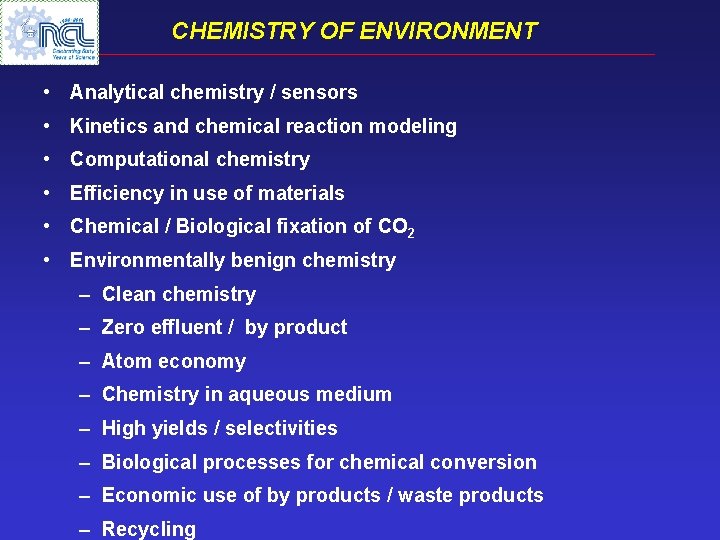
CHEMISTRY OF ENVIRONMENT • Analytical chemistry / sensors • Kinetics and chemical reaction modeling • Computational chemistry • Efficiency in use of materials • Chemical / Biological fixation of CO 2 • Environmentally benign chemistry – Clean chemistry – Zero effluent / by product – Atom economy – Chemistry in aqueous medium – High yields / selectivities – Biological processes for chemical conversion – Economic use of by products / waste products – Recycling
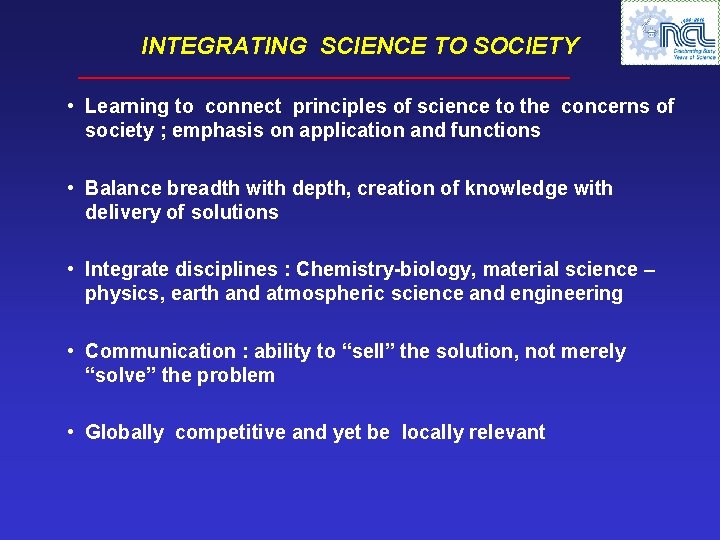
INTEGRATING SCIENCE TO SOCIETY • Learning to connect principles of science to the concerns of society ; emphasis on application and functions • Balance breadth with depth, creation of knowledge with delivery of solutions • Integrate disciplines : Chemistry-biology, material science – physics, earth and atmospheric science and engineering • Communication : ability to “sell” the solution, not merely “solve” the problem • Globally competitive and yet be locally relevant
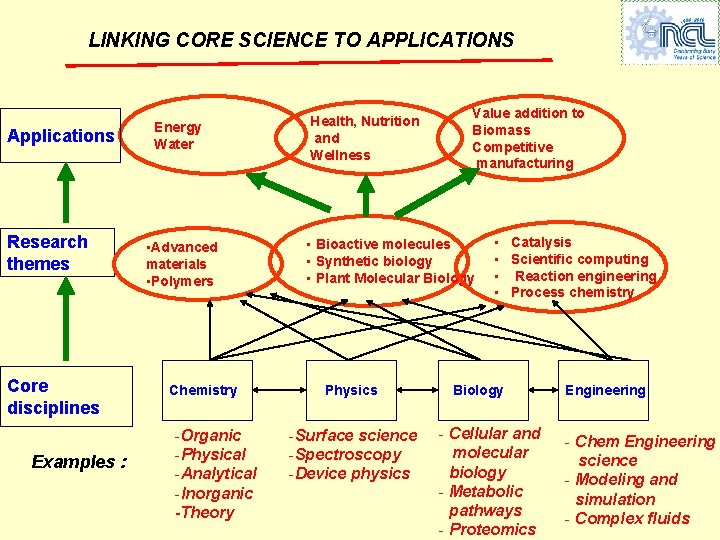
LINKING CORE SCIENCE TO APPLICATIONS Applications Research themes Core disciplines Examples : Energy Water • Advanced materials • Polymers Chemistry -Organic -Physical -Analytical -Inorganic -Theory Health, Nutrition and Wellness Value addition to Biomass Competitive manufacturing • Bioactive molecules • Synthetic biology • Plant Molecular Biology Physics -Surface science -Spectroscopy -Device physics • Catalysis • Scientific computing • Reaction engineering • Process chemistry Biology - Cellular and molecular biology - Metabolic pathways - Proteomics Engineering - Chem Engineering science - Modeling and simulation - Complex fluids
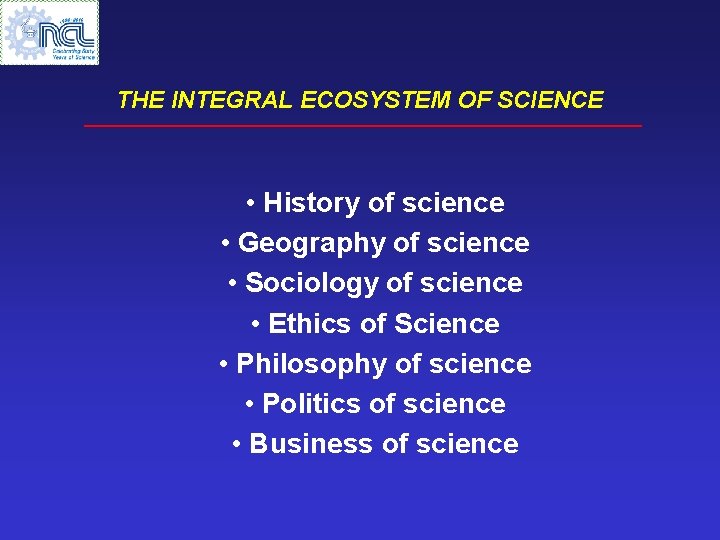
THE INTEGRAL ECOSYSTEM OF SCIENCE • History of science • Geography of science • Sociology of science • Ethics of Science • Philosophy of science • Politics of science • Business of science
Institutions rarely are murdered; They meet their end by suicide. They die because they have outlived their usefulness or fail to do the work that the world wants done Lawrence Lowell President , Harvard University
THANK YOU