
EMC issues for cabling and racks layout design
EMC issues for cabling and racks layout design. (Belle II – Grounding) F. Arteche

Outline • 1. Introduction • 2. Cables • 3. Racks • 4. Future plans for grounding • 5. Conclusions 1 de 17 14 th Open Meeting of the Belle II Collaboration March 4 th -7 th , 2013, KEK, Japan
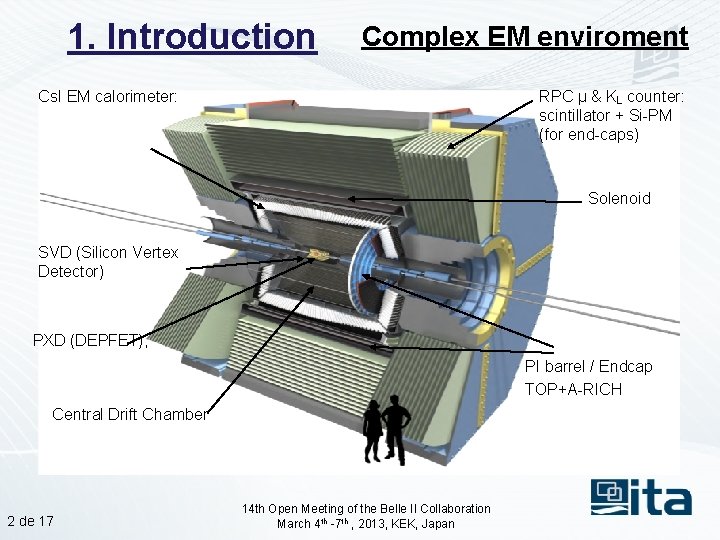
1. Introduction Complex EM enviroment Cs. I EM calorimeter: RPC μ & KL counter: scintillator + Si-PM (for end-caps) Solenoid SVD (Silicon Vertex Detector) PXD (DEPFET), PI barrel / Endcap TOP+A-RICH Central Drift Chamber 2 de 17 14 th Open Meeting of the Belle II Collaboration March 4 th -7 th , 2013, KEK, Japan
1. Introduction 3 de 17 14 th Open Meeting of the Belle II Collaboration March 4 th -7 th , 2013, KEK, Japan

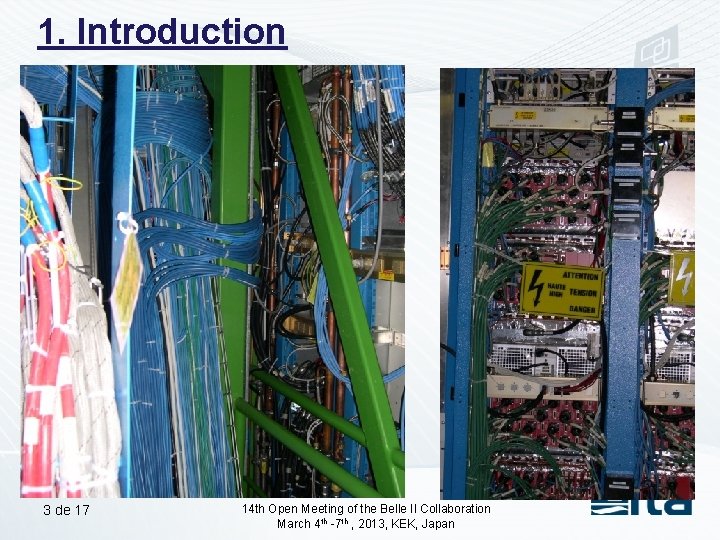
1. Introduction • There are two elements that play an important role in the electromagnetic noise level of any experiment: – Cables – Racks • They may generated many EMC problems: – Cable radiation – Cable susceptibility – Malfunctions due to high electronics density • The EMC effects of this type of elements may be decreased by design ( layout and connectivity) – It is only a recommendation (where is possible) 4 de 17 14 th Open Meeting of the Belle II Collaboration March 4 th -7 th , 2013, KEK, Japan
2. Cables • Cables may be classified based on EMC cable category – Class 1 is for cables carrying very sensitive signals. • C 1 A - Low-level analogue signals such as millivolt output transducers and radio receiver antennae. • C 1 B - High-rate digital communications. – Class 2 is for cables carrying slightly sensitive signals, • Ordinary analogue (e. g. 4 -20 m. A, 0 -10 V, and signals under 1 MHz), low-rate digital communications (e. g. RS 422, RS 485), and digital inputs and outputs (e. g. limit switches, encoders, control signals). – Class 3 is for cables carrying slightly interfering signals • Low voltage AC distribution (< 1 k. V) or DC power (e. g. 48 V telecomm's power), where these do not also power 'noisy' apparatus. – Class 4 is for cables carrying strongly interfering signals. • This includes all the power inputs or outputs (to or from) adjustable motor drives, power converters; and their DC links, RF equipment. 5 de 17 14 th Open Meeting of the Belle II Collaboration March 4 th -7 th , 2013, KEK, Japan
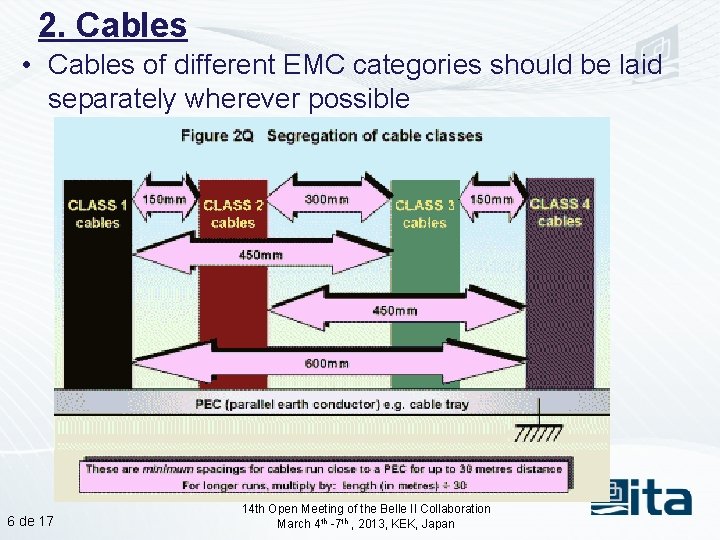
2. Cables • Cables of different EMC categories should be laid separately wherever possible 6 de 17 14 th Open Meeting of the Belle II Collaboration March 4 th -7 th , 2013, KEK, Japan
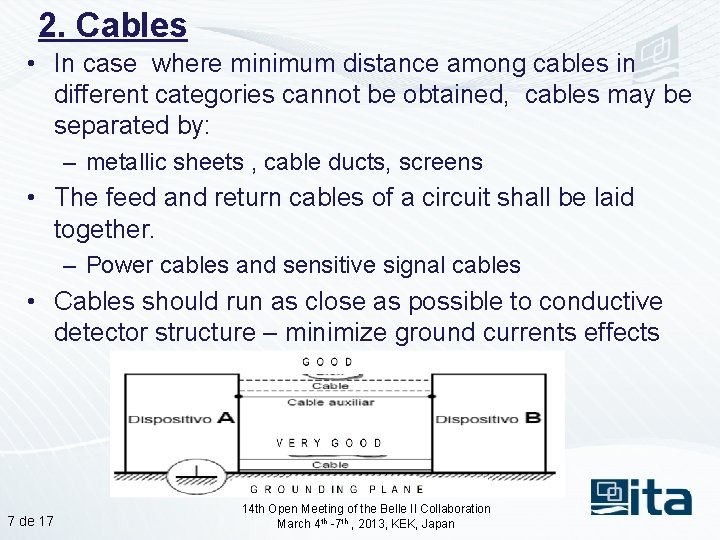
2. Cables • In case where minimum distance among cables in different categories cannot be obtained, cables may be separated by: – metallic sheets , cable ducts, screens • The feed and return cables of a circuit shall be laid together. – Power cables and sensitive signal cables • Cables should run as close as possible to conductive detector structure – minimize ground currents effects 7 de 17 14 th Open Meeting of the Belle II Collaboration March 4 th -7 th , 2013, KEK, Japan
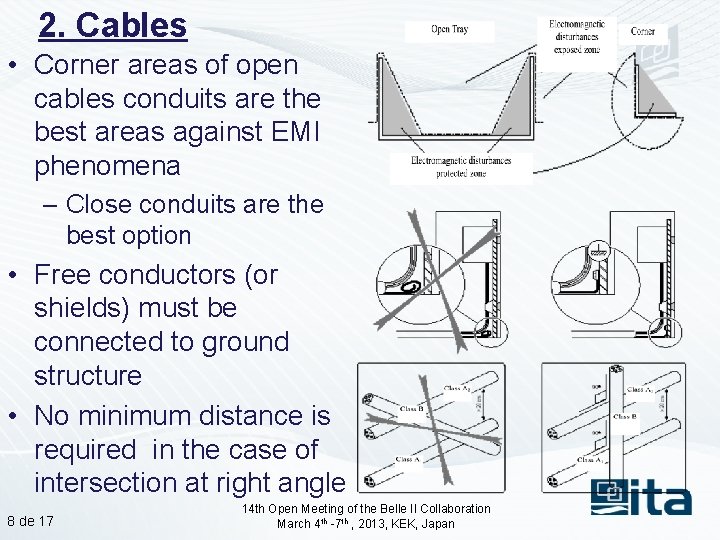
2. Cables • Corner areas of open cables conduits are the best areas against EMI phenomena – Close conduits are the best option • Free conductors (or shields) must be connected to ground structure • No minimum distance is required in the case of intersection at right angle 8 de 17 14 th Open Meeting of the Belle II Collaboration March 4 th -7 th , 2013, KEK, Japan
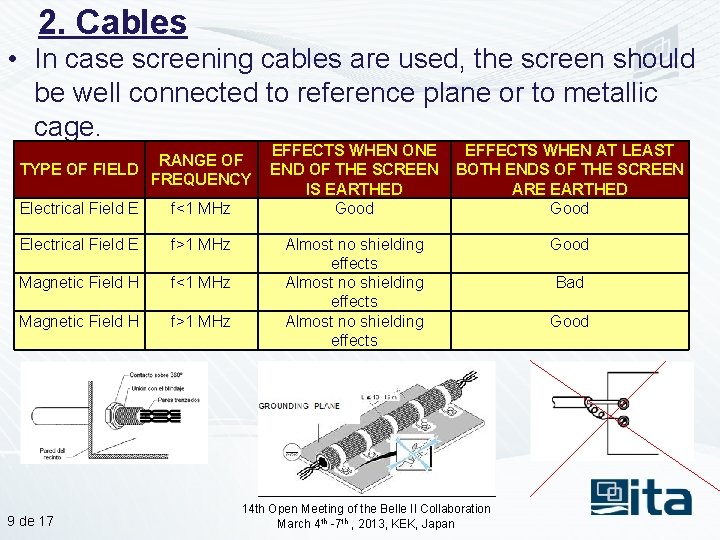
2. Cables • In case screening cables are used, the screen should be well connected to reference plane or to metallic cage. RANGE OF TYPE OF FIELD FREQUENCY Electrical Field E f<1 MHz Electrical Field E f>1 MHz Magnetic Field H f<1 MHz Magnetic Field H f>1 MHz 9 de 17 EFFECTS WHEN ONE END OF THE SCREEN IS EARTHED Good EFFECTS WHEN AT LEAST BOTH ENDS OF THE SCREEN ARE EARTHED Good Almost no shielding effects Good 14 th Open Meeting of the Belle II Collaboration March 4 th -7 th , 2013, KEK, Japan Bad Good
3. Racks • Racks layout design may improve system performance against EMI phenomena • The most important elements that play an important role in rack (cabinet) noise issues are: – – Reference plane or structure Cable routing inside the rack Equipment distribution Rack grounding and shielding connection. • REFERENCE PLANE – It helps to control EMC phenomena associate to local PS, filtering and electronics. – Walls or rack doors may used as REF. plane 10 de 17 14 th Open Meeting of the Belle II Collaboration March 4 th -7 th , 2013, KEK, Japan
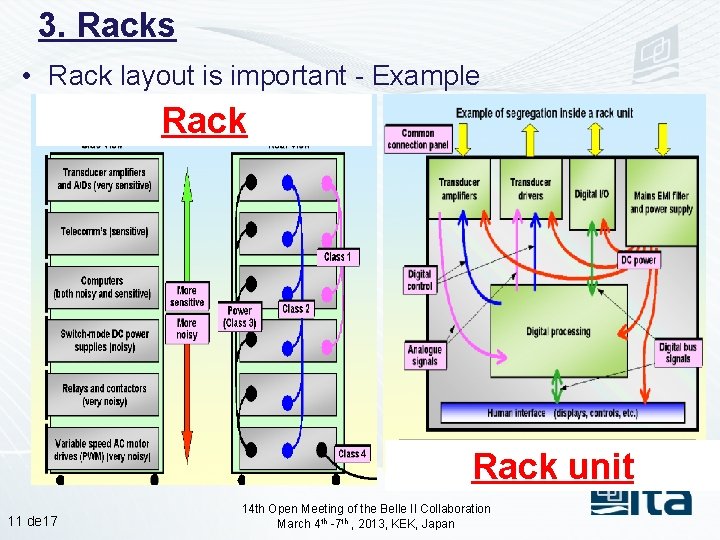
3. Racks • Rack layout is important - Example Rack unit 11 de 17 14 th Open Meeting of the Belle II Collaboration March 4 th -7 th , 2013, KEK, Japan

3. Racks • Inside rack cabinets cables may be split in 4 categories: – A - Power lines (DC-DC mainly) – B - LV ac lines (power mains), relays, contactors, . . – C 2 - Sensitive power and electronics, low digital communications – C 1 - Sensitive lines (analogue signals, output transducers , Ethernet cables, high rate communications) • It is recommended to keep certain distance among cables categories. 12 de 17 14 th Open Meeting of the Belle II Collaboration March 4 th -7 th , 2013, KEK, Japan
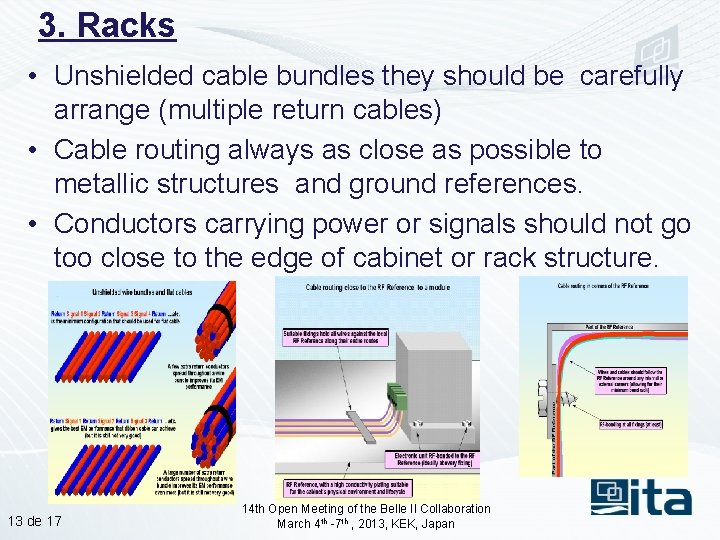
3. Racks • Unshielded cable bundles they should be carefully arrange (multiple return cables) • Cable routing always as close as possible to metallic structures and ground references. • Conductors carrying power or signals should not go too close to the edge of cabinet or rack structure. 13 de 17 14 th Open Meeting of the Belle II Collaboration March 4 th -7 th , 2013, KEK, Japan
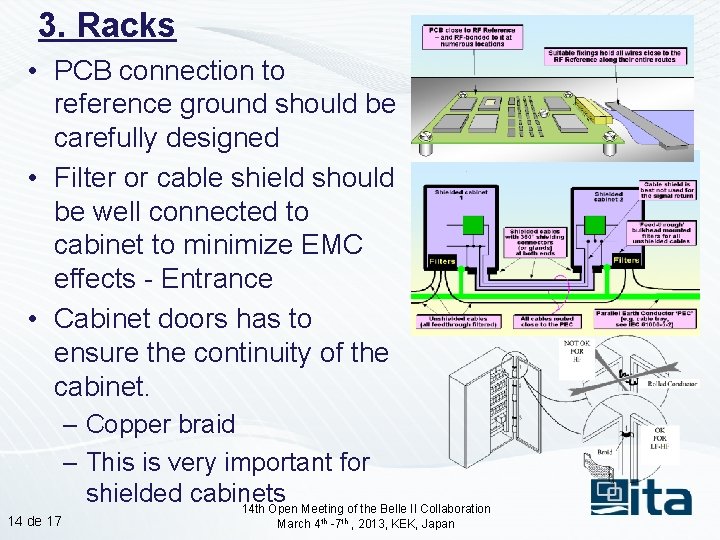
3. Racks • PCB connection to reference ground should be carefully designed • Filter or cable shield should be well connected to cabinet to minimize EMC effects - Entrance • Cabinet doors has to ensure the continuity of the cabinet. 14 de 17 – Copper braid – This is very important for shielded cabinets 14 th Open Meeting of the Belle II Collaboration March 4 th -7 th , 2013, KEK, Japan
4. Future meetings • Grounding sessions have been a very good opportunity to exchange information and experience among detectors. – We have to continue with them. • It is planned to have a new big grounding session in the next B 2 GM – July at VPI, USA – A grounding review • Main goal: – Continue system integration – Fix the project status - Review • A common structure of the grounding status will be prepared by each sub-detector – We can keep the template used in the past 15 de 17 14 th Open Meeting of the Belle II Collaboration March 4 th -7 th , 2013, KEK, Japan
4. Future meetings • The suggested structure may cover the following aspects: – Outline of the grounding strategy • Information about current or previous grounding topology – Design approach • Implementation aspects – Emission and susceptibility issues. • Analysis of the main noise sources and most susceptible components. – Identification & test plans – Shielding aspects, such as cabling layout connections and characteristics, are included in this point. – Conclusions and a summary of relevant results exposed. • The grounding web-page (not finish yet) will be operational for the meeting (earlier) – Exchange information 16 de 17 14 th Open Meeting of the Belle II Collaboration March 4 th -7 th , 2013, KEK, Japan
• • 5. Conclusions Noise issues associated with cabling and racks may be decreased by layout Attention should be paid in cable and rack layout (small details will help) – It costs nothing – small details Good cable classification and rack distribution will help – Power and noise level – Proper grounding connections A new grounding session is planned for the next B 2 GM meeting – VPI , USA 17 de 17 14 th Open Meeting of the Belle II Collaboration March 4 th -7 th , 2013, KEK, Japan
- Slides: 18