
Embryonic period Department of Anatomy Inje University College
Embryonic period Department of Anatomy In-je University College of Medicine
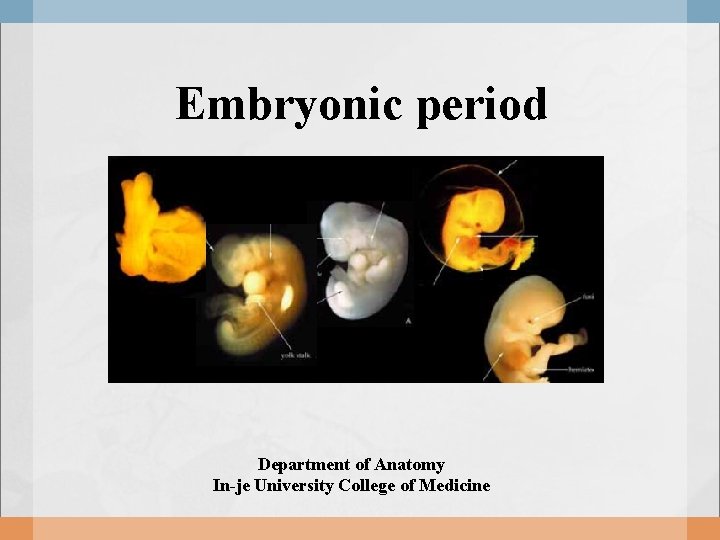
Organogenesis: 3 ~ 8 week Formation of all basic organ systems: Cardiovascular and nervous – 3 week External genitalia – later than 8 week Changes in outer shape Most critical period
Formation of 3 D shape Head fold Tail fold Lateral folds Head fold - growth of brain and spinal cord – folding (septum transversum and heart are pushed ventrally) Changes in shape of intraembryonic coelomic cavity Tail fold – cloacal membrane is also pushed ventrally Lateral folds – gut closure, formation of umbilical cord
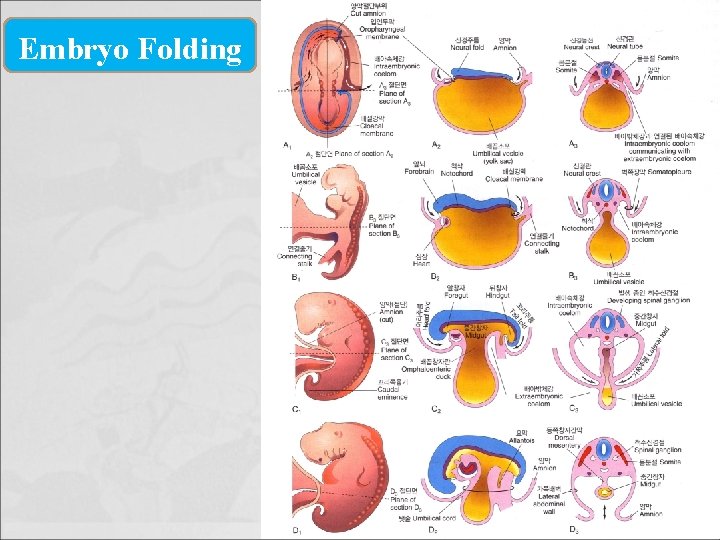
Embryo Folding
Folding in Horizontal plane : Lateral fold 1. Embryo 양측이 folding 되면 right & left lateral fold 형성 2. 양측 lat. Folds는 앞쪽으로 rolling되어 합쳐 원주형 embryo형성 3. Lat. & ventral abdominal wall이 형성되면 yalk sac의 일부가 embryo와 결합하여 midgut을 형성하고 이 때 yalk sac은 좁은 yalk stalk을 형성 4. Folding 후 amnion과 embryo 부착부는 상대적으로 좁아져 umbilical region을 형성 5. Amnion cavity가 팽창되고 extraembryonic coelom이 없어지면서 amnion은 umbilical cord의 상피를 형성
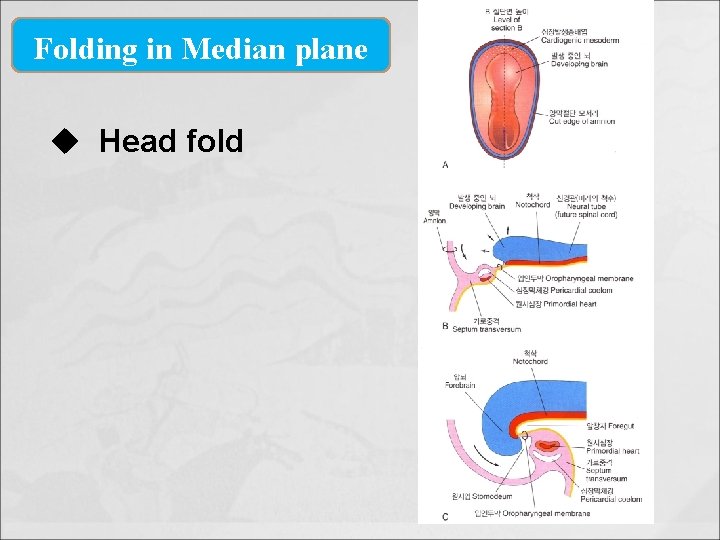
Folding in Median plane u Head fold
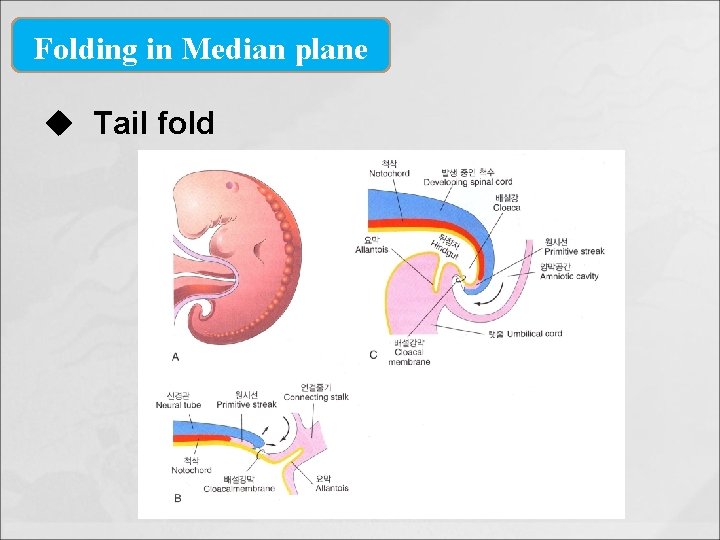
Folding in Median plane u Tail fold
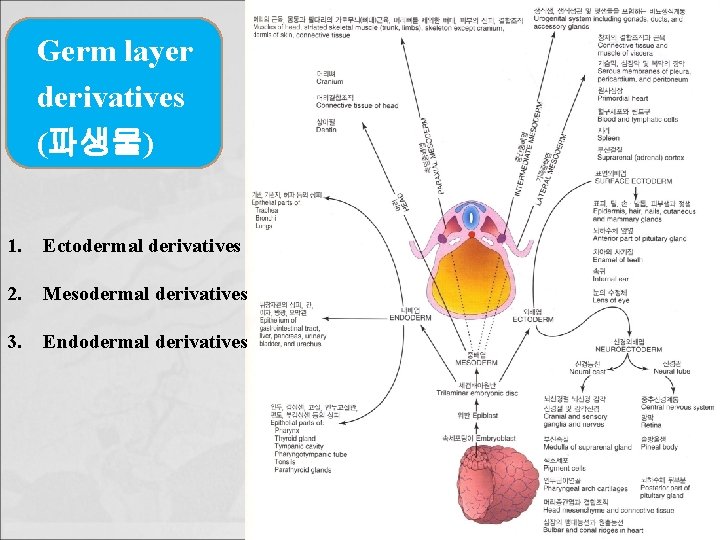
Germ layer derivatives (파생물) 1. Ectodermal derivatives 2. Mesodermal derivatives 3. Endodermal derivatives
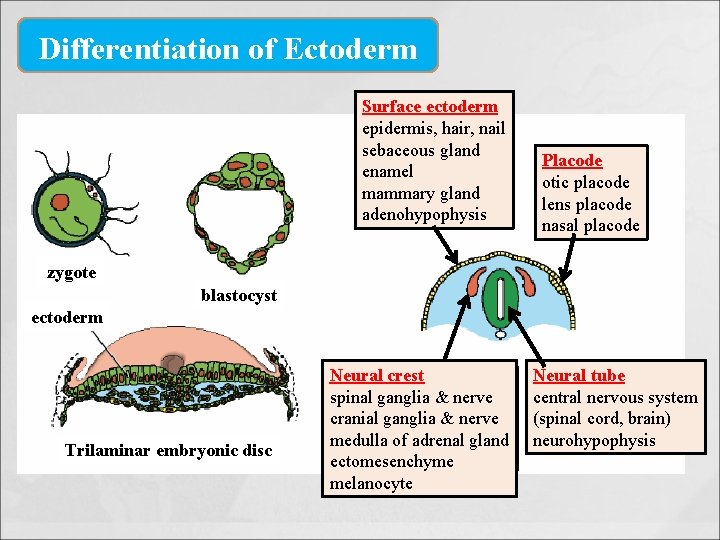
Differentiation of Ectoderm Surface ectoderm epidermis, hair, nail sebaceous gland enamel mammary gland adenohypophysis Placode otic placode lens placode nasal placode zygote blastocyst ectoderm Trilaminar embryonic disc Neural crest spinal ganglia & nerve cranial ganglia & nerve medulla of adrenal gland ectomesenchyme melanocyte Neural tube central nervous system (spinal cord, brain) neurohypophysis
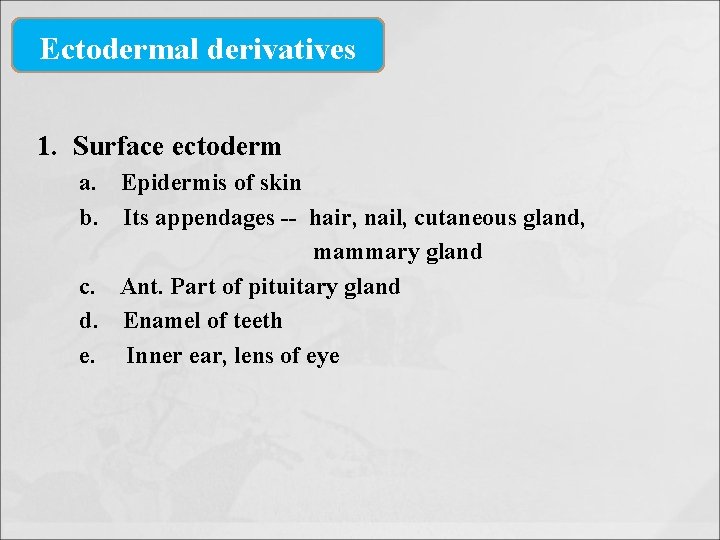
Ectodermal derivatives 1. Surface ectoderm a. Epidermis of skin b. Its appendages -- hair, nail, cutaneous gland, mammary gland c. Ant. Part of pituitary gland d. Enamel of teeth e. Inner ear, lens of eye
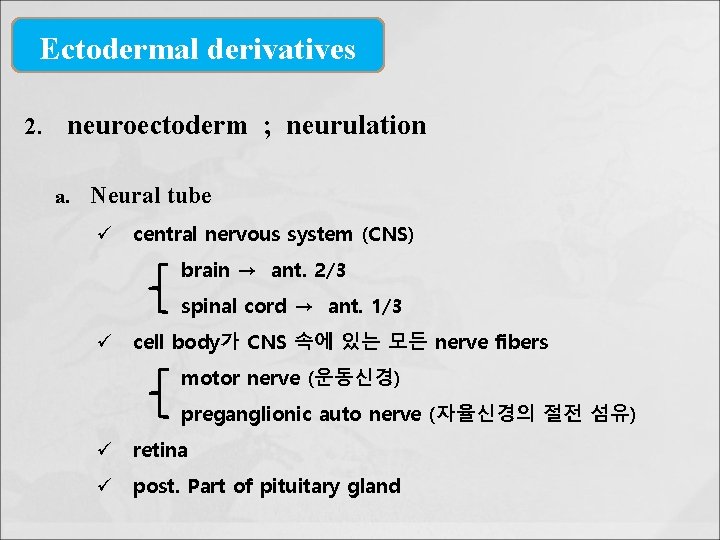
Ectodermal derivatives 2. neuroectoderm ; neurulation a. Neural tube ü central nervous system (CNS) brain → ant. 2/3 spinal cord → ant. 1/3 ü cell body가 CNS 속에 있는 모든 nerve fibers motor nerve (운동신경) preganglionic auto nerve (자율신경의 절전 섬유) ü retina ü post. Part of pituitary gland
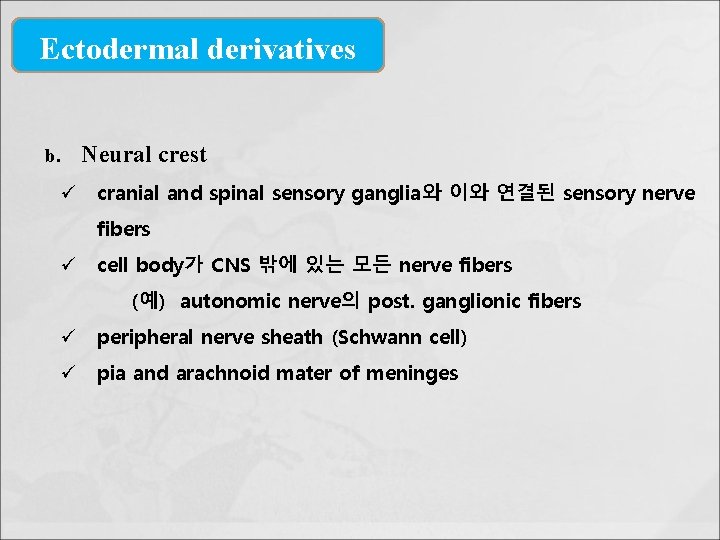
Ectodermal derivatives b. Neural crest ü cranial and spinal sensory ganglia와 이와 연결된 sensory nerve fibers ü cell body가 CNS 밖에 있는 모든 nerve fibers (예) autonomic nerve의 post. ganglionic fibers ü peripheral nerve sheath (Schwann cell) ü pia and arachnoid mater of meninges
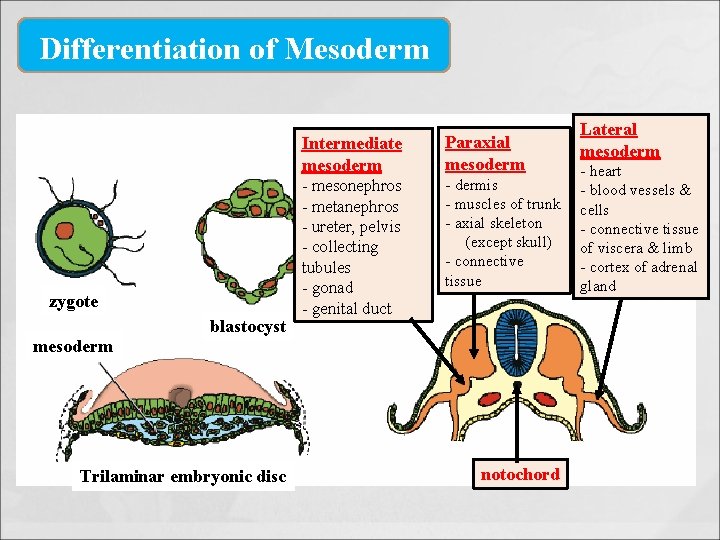
Differentiation of Mesoderm zygote mesoderm blastocyst Trilaminar embryonic disc Intermediate mesoderm Paraxial mesoderm - mesonephros - metanephros - ureter, pelvis - collecting tubules - gonad - genital duct - dermis - muscles of trunk - axial skeleton (except skull) - connective tissue notochord Lateral mesoderm - heart - blood vessels & cells - connective tissue of viscera & limb - cortex of adrenal gland
Mesodermal derivatives 1. Paraxial mesoderm • 3 layers of somite ① Dermatome (피부분절) ② Myotome (근육분절) ③ Sclerotome (뼈대분절) u Dermatome (피부분절) • dermis of skin • subcutaneus tissue u Myotome (근육분절) • muscles (smooth, cardiac & skeletal m. ) u Sclerotome (뼈대분절) • Bone and cartilages • Interstitial connective tissue
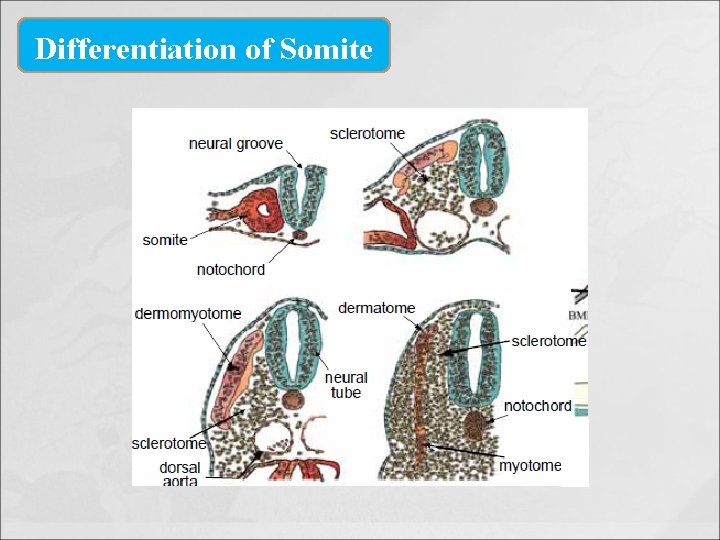
Differentiation of Somite
Mesodermal derivatives 2. Intermediate mesoderm ① Urinary organs ; kidney, ureter, bladder ② Genital organs ; gonade and its ducts 3. Lateral mesoderm ① ② ③ ④ ⑤ wall of viscera (connective tissue & smooth m) pleura, pericardium, peritoneum heart blood and lymph cells spleen 4. Notochord ① Induces the neuroectoderm to neural tube ② Induces the vertebral bodies ③ Forms the nucleus pulposus of intervertebral disc 5. Cardiogenic region → heart
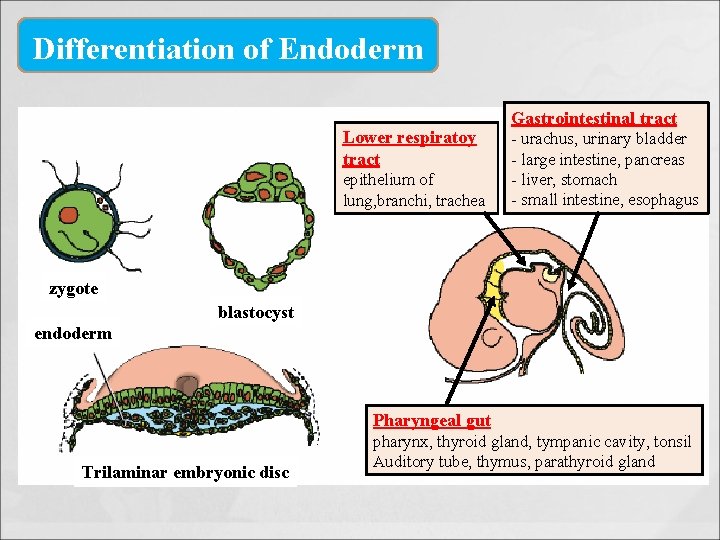
Differentiation of Endoderm Lower respiratoy tract epithelium of lung, branchi, trachea Gastrointestinal tract - urachus, urinary bladder - large intestine, pancreas - liver, stomach - small intestine, esophagus zygote blastocyst endoderm Pharyngeal gut Trilaminar embryonic disc pharynx, thyroid gland, tympanic cavity, tonsil Auditory tube, thymus, parathyroid gland
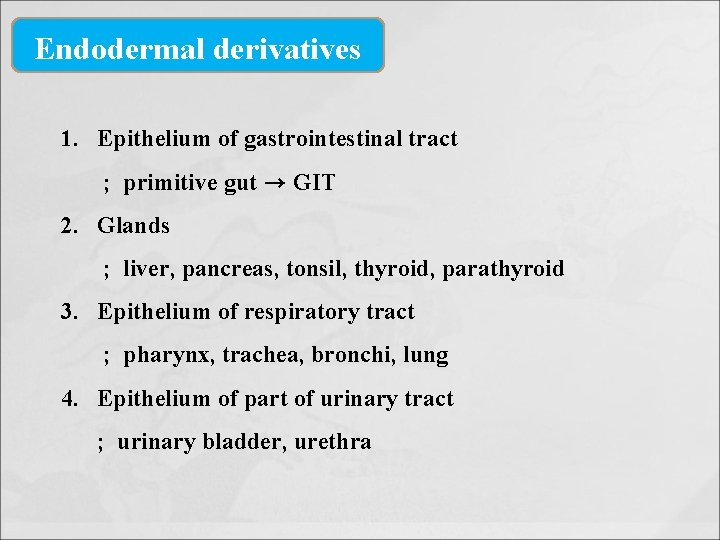
Endodermal derivatives 1. Epithelium of gastrointestinal tract ; primitive gut → GIT 2. Glands ; liver, pancreas, tonsil, thyroid, parathyroid 3. Epithelium of respiratory tract ; pharynx, trachea, bronchi, lung 4. Epithelium of part of urinary tract ; urinary bladder, urethra
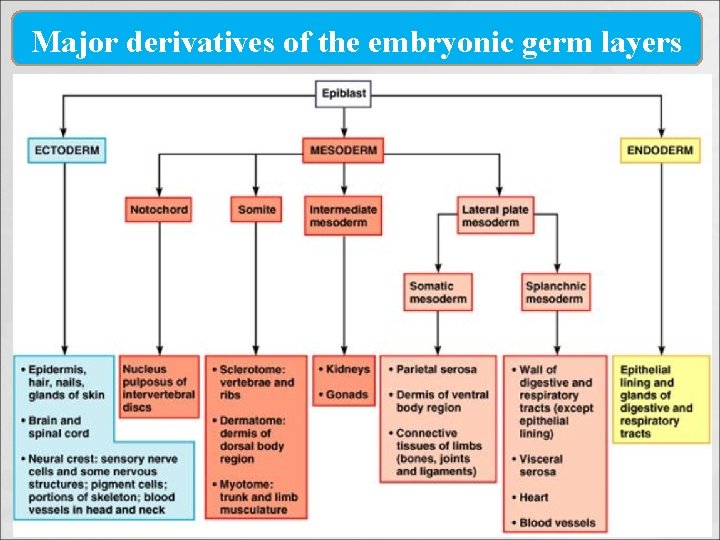
Major derivatives of the embryonic germ layers
Embryonic period의 중요변화
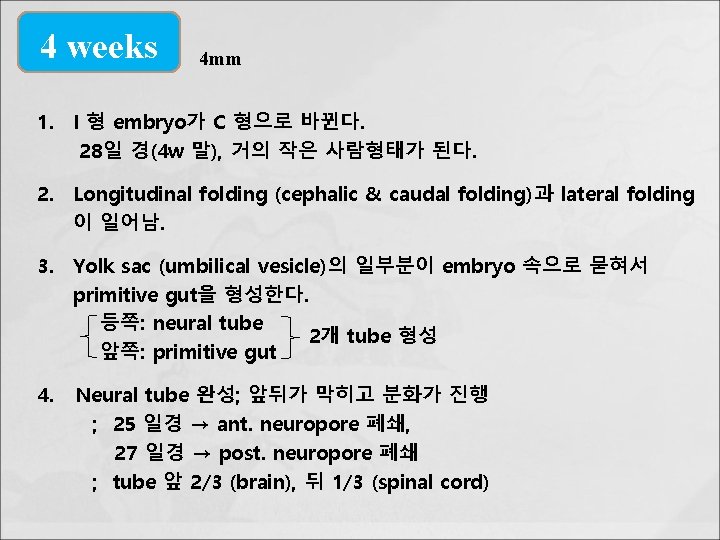
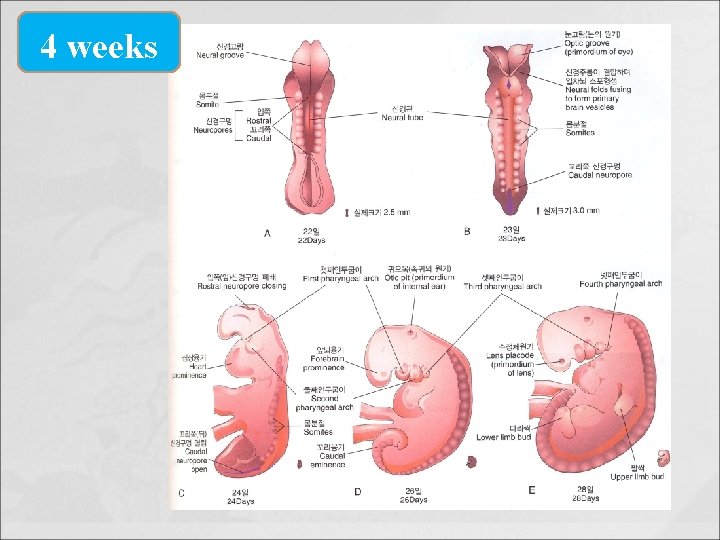
4 weeks 4 mm 1. I 형 embryo가 C 형으로 바뀐다. 28일 경(4 w 말), 거의 작은 사람형태가 된다. 2. Longitudinal folding (cephalic & caudal folding)과 lateral folding 이 일어남. 3. Yolk sac (umbilical vesicle)의 일부분이 embryo 속으로 묻혀서 primitive gut을 형성한다. 등쪽: neural tube 2개 tube 형성 앞쪽: primitive gut 4. Neural tube 완성; 앞뒤가 막히고 분화가 진행 ; 25 일경 → ant. neuropore 폐쇄, 27 일경 → post. neuropore 폐쇄 ; tube 앞 2/3 (brain), 뒤 1/3 (spinal cord)
4 weeks 5. Otic pit (→ ear), lens placode (→ eye) 출현 6. 4쌍의 pharyngeal(branchial) arch 형성 → 얼굴 형성, pharynx가 됨. 7. Somite 형성이 완성; 20일 (1쌍) ~28일 (30 -35쌍) 8. Connecting stalk과 yolk sac의 나머지 부분 (vitelline duct)이 umbilical cord를 만든다. 9. upper & lower limb bud 출현 ; upper 발생 진행 속도가 lower보다 1일 더 빠름. primordium이 각 장기에서 생겨나기 시작함. 10. Other → heart와 vessel 형성 (3~7주) → 대부분의 organ primordium 형성
4 weeks
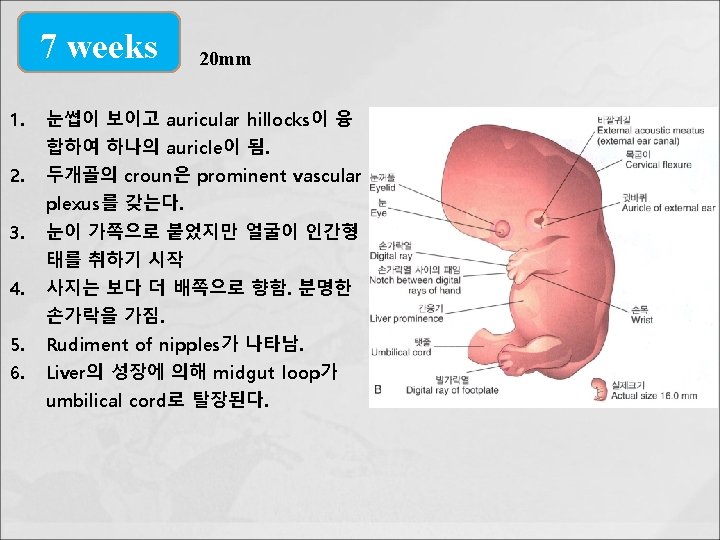
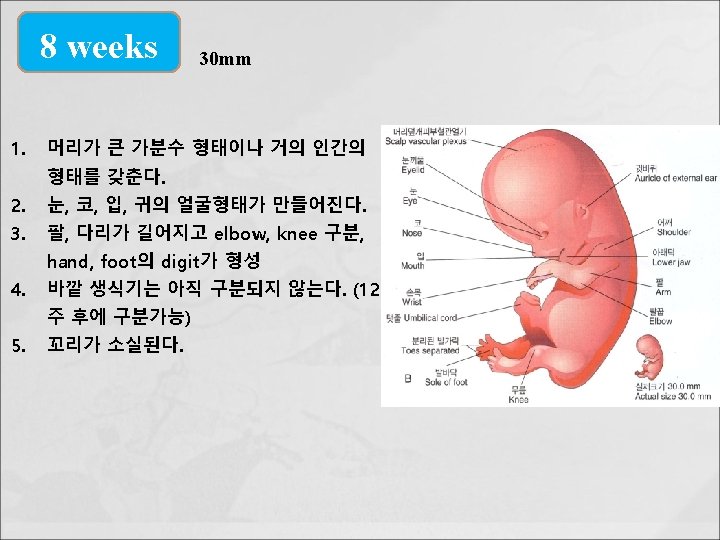
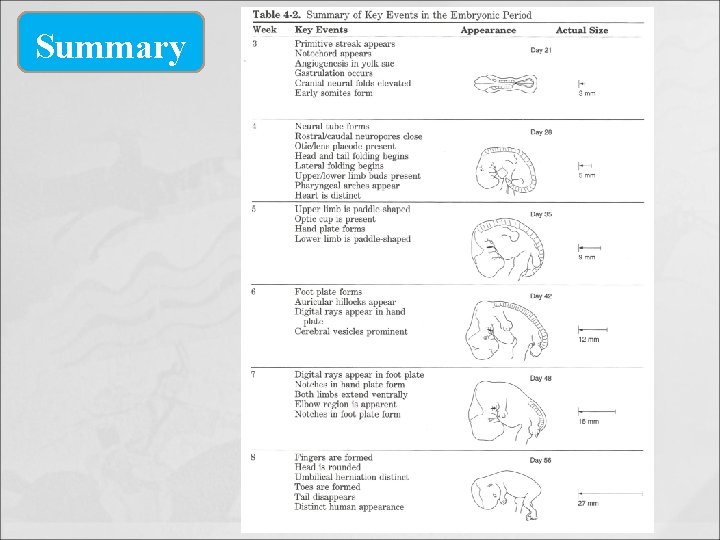
Summary
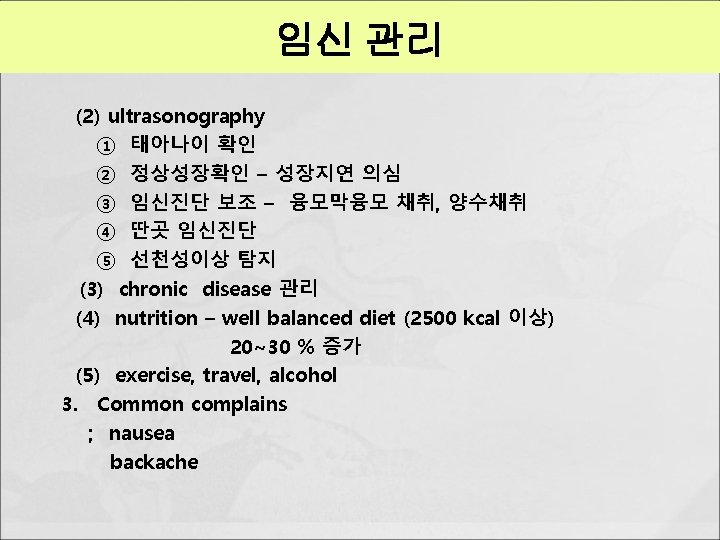
임신 관리 (2) ultrasonography ① 태아나이 확인 ② 정상성장확인 – 성장지연 의심 ③ 임신진단 보조 – 융모막융모 채취, 양수채취 ④ 딴곳 임신진단 ⑤ 선천성이상 탐지 (3) chronic disease 관리 (4) nutrition – well balanced diet (2500 kcal 이상) 20~30 % 증가 (5) exercise, travel, alcohol 3. Common complains ; nausea backache
- Slides: 33