
embryology of BRAIN SPINE sa Ravanan overview Dorsal
embryology of BRAIN & SPINE sa. Ravanan
overview Dorsal induction Ventral induction Neuronal prolif. , diff. &histogenesis Neuronal migration Axonal myelination

dorsal induction Formation of neural plate, notochord, neural groove, neural fold and neural tube 4 – 7 wks Primary neurulation Secondary neurulation
ventral induction Formation of brain vesicles, telencephalon, diencephalon, mesencephalon, metencephalon, myelencephalon 5 – 10 wks
neuronal prolif. , diff. & histogenesis Germinal matrix formation, prolif of neurons & differentiation, choroid plexus formation and CSF formation 2 – 5 months and after birth
neuronal migration from ventricular, subventricular layers around primitive brain vesicles to supf cortex, deep nuc of cerebrum & cerebellum 3, 4, 5 months formation of corpus callosum, commissures, interhemispheric neuronal migrations
axonal myelination Starts at brainstem, cerebellum, thalamus, internal capsule Other areas after birth 3 wks – 2 yrs and into adolescence
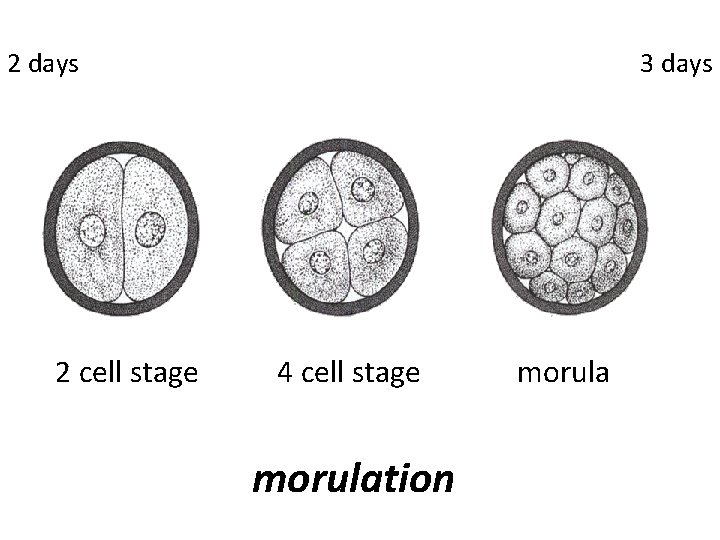
2 days 2 cell stage 3 days 4 cell stage morulation morula
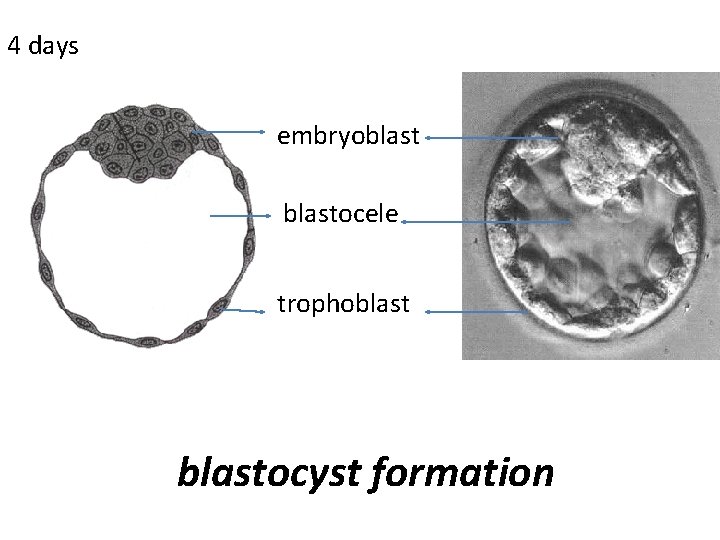
4 days embryoblastocele trophoblastocyst formation
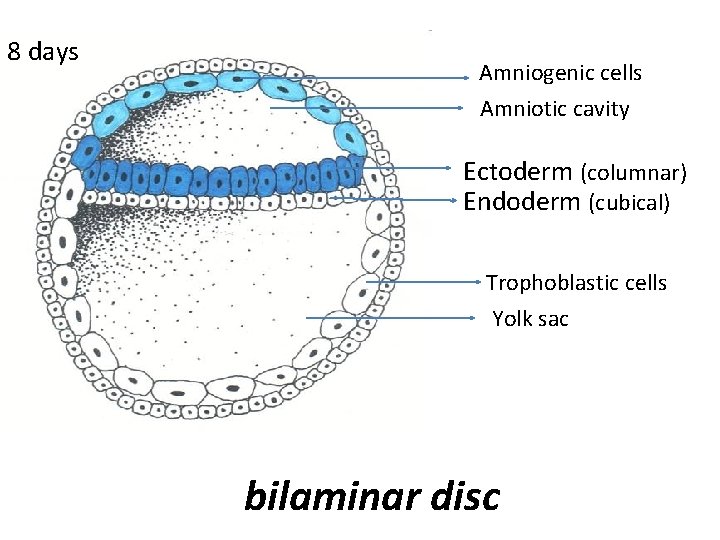
8 days Amniogenic cells Amniotic cavity Ectoderm (columnar) Endoderm (cubical) Trophoblastic cells Yolk sac bilaminar disc
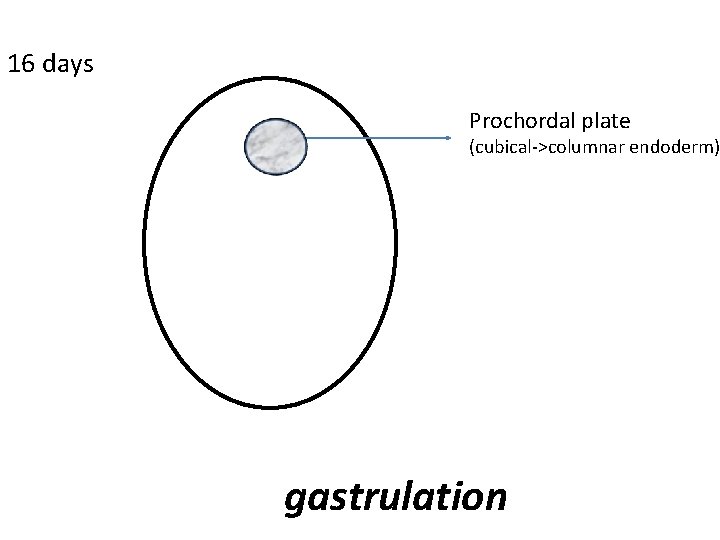
16 days Prochordal plate (cubical->columnar endoderm) gastrulation
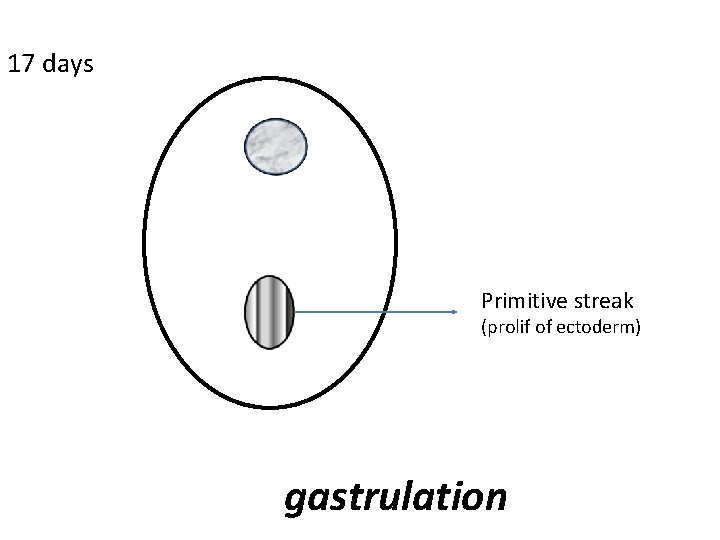
17 days Primitive streak (prolif of ectoderm) gastrulation
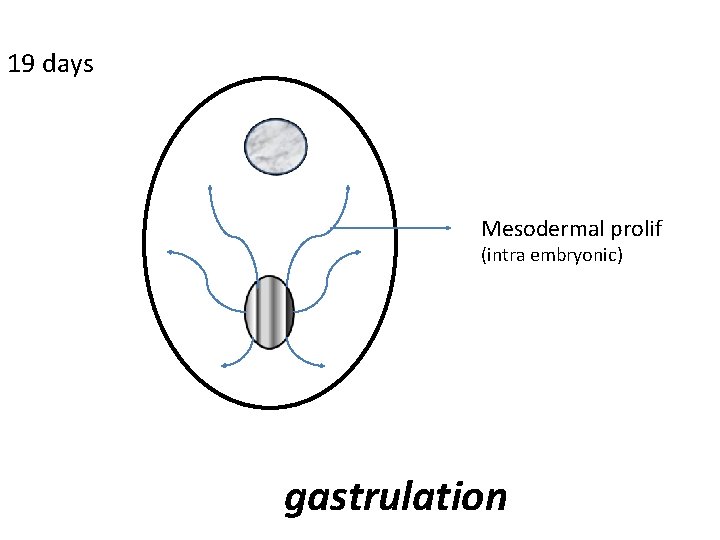
19 days Mesodermal prolif (intra embryonic) gastrulation
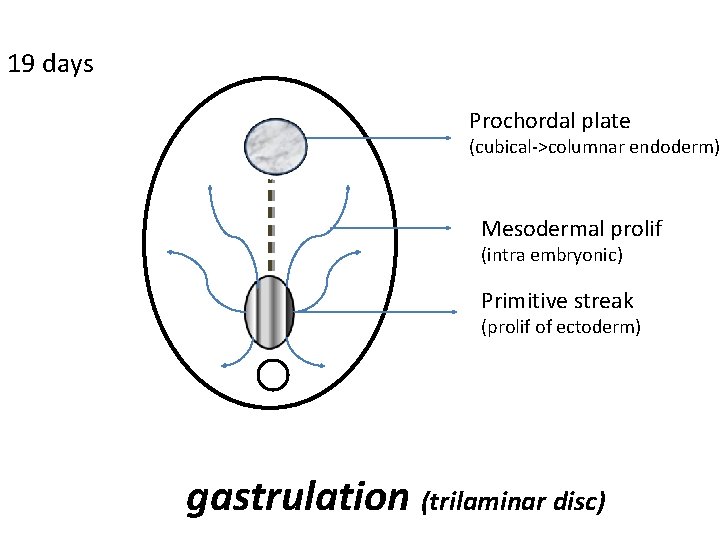
19 days Prochordal plate (cubical->columnar endoderm) Mesodermal prolif (intra embryonic) Primitive streak (prolif of ectoderm) gastrulation (trilaminar disc)
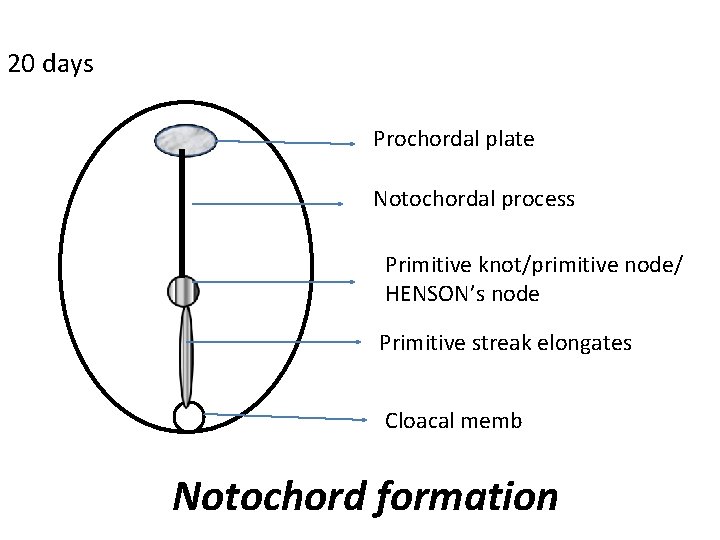
20 days Prochordal plate Notochordal process Primitive knot/primitive node/ HENSON’s node Primitive streak elongates Cloacal memb Notochord formation
21 -23 days neural tube formation Notochord guides NT formation Ectoderm overlying notochord from prochordal plate to primitive node Primary Neurulation- from neural plate, cranial end to L 1, L 2 Secondary Neurulation- lower L, S, Co from caudal cell mass; no neural plate
neural tube formation Neural groove <Median Hinge Protein> Elevation&Convergence <Dorso. Lateral Hinge Protein> Closure: middle- cranial(25 day)- caudal(27 day) Neural crest from edge of neural plate to dorsum of Neural tube Dysjn. of cutaneous & neural ectoderm

neural tube formation

neural tube formation
somites Intraemb mesoderm-paraxial, lateral plate, intermed Paraxial mesoderm segmented to form SOMITES on either side of neural tube --dorsolateral Dermatomyotome: skeletal muscle, dermis --ventromedial Sclerotome: cartilage, bone, ligaments of vertebral column
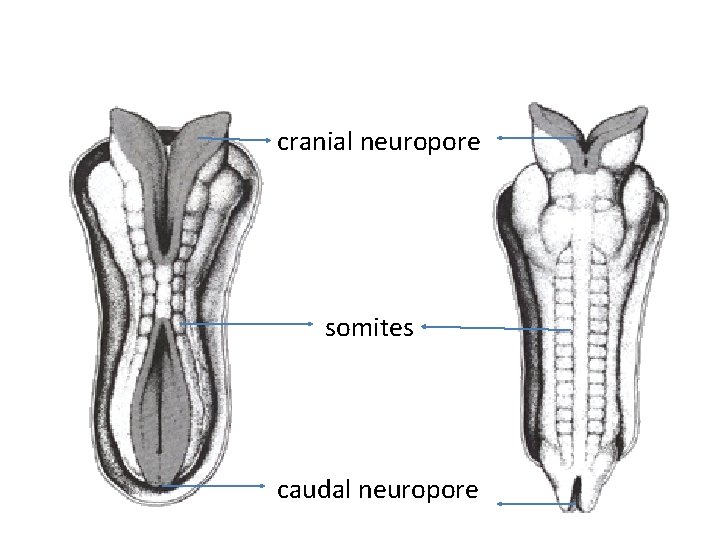
cranial neuropore somites caudal neuropore
Neural Tube- CNS (brain & spinal cord) Neural Crest- PNS & ANS Somites- skull, vertebra, ligaments, muscle Notochord- induces neurectoderm- Neural tube and deriv. mesenchyme- spinal column, ligaments, muscles remains nucleus pulposus
neural tube derivatives
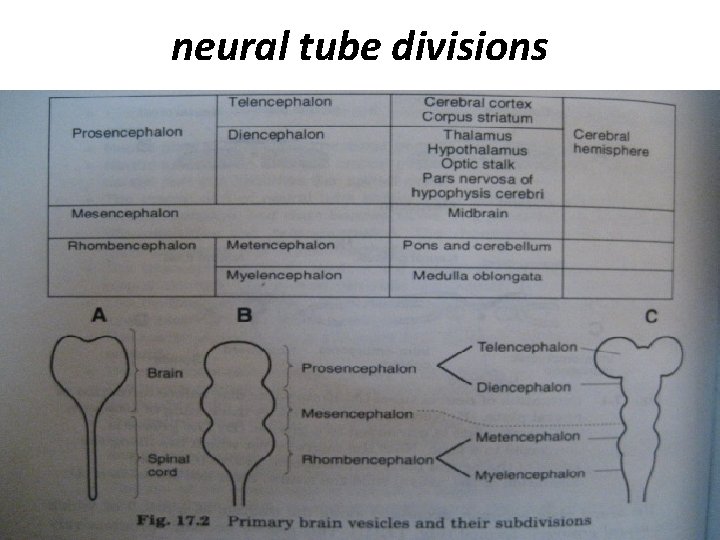
neural tube divisions
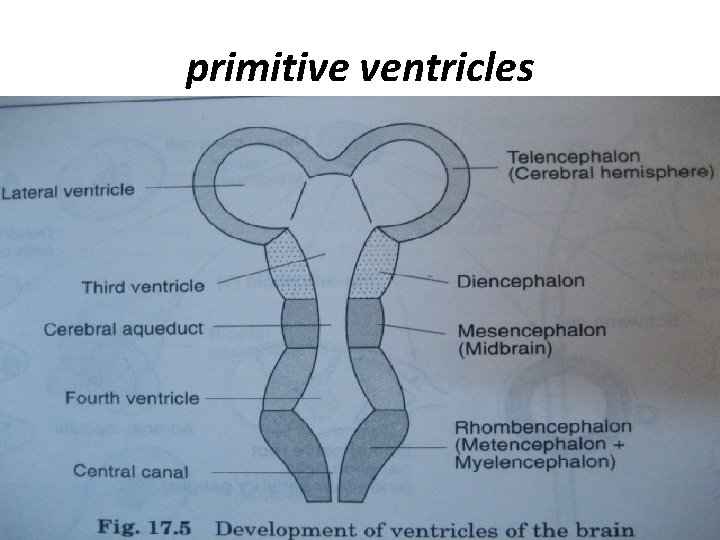
primitive ventricles
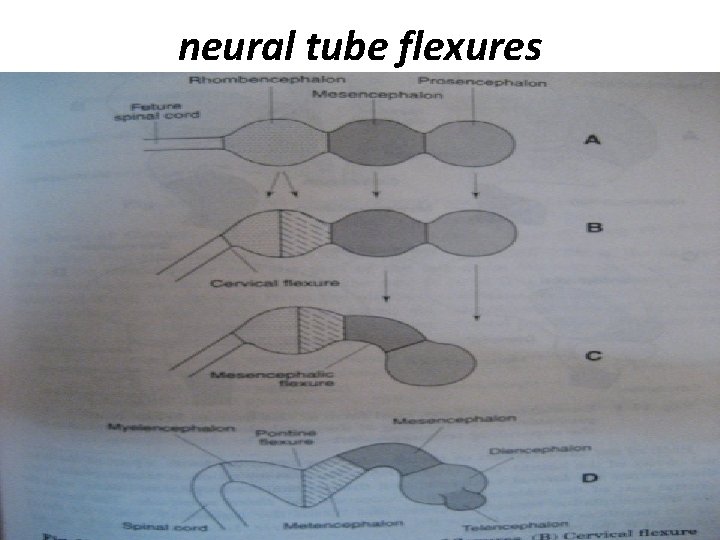
neural tube flexures
neural tube histology Matrix layer/ependymal/germinal layernerve cells, glial cells & more germinal cells produced Mantle layerdeveloping nerve cells & glial cells Marginal layerno nerve cells; reticulum of glial cells into which developing nerve cells grow
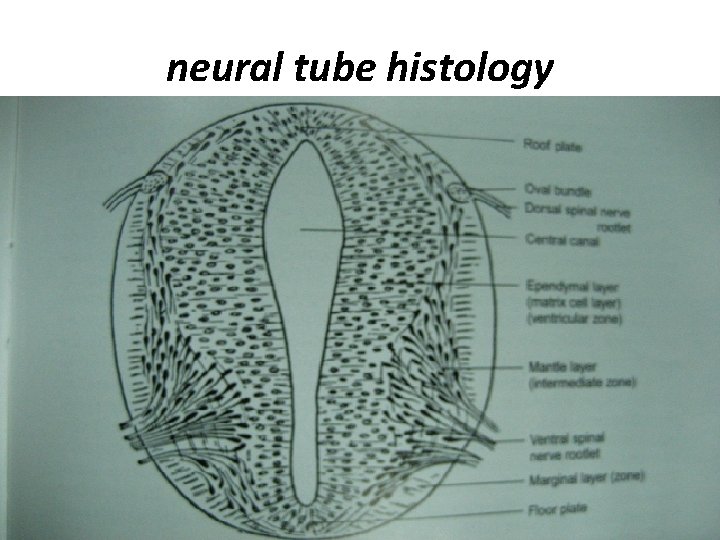
neural tube histology
cells Neuroblasts (apolar-bipolar- multipolar-dendrites formation-synapse formation) neurons Glioblasts/Medulloblasts astrocytes oligodendroblasts oligodendrocytes Mesodermal (migrates along with blood vessels) microglia
myelination PNS Schwann cells (from neural crest) invaginates around axon and forms multiple layers into which lipids are deposited CNS Oligodendrocytes form myelin sheath
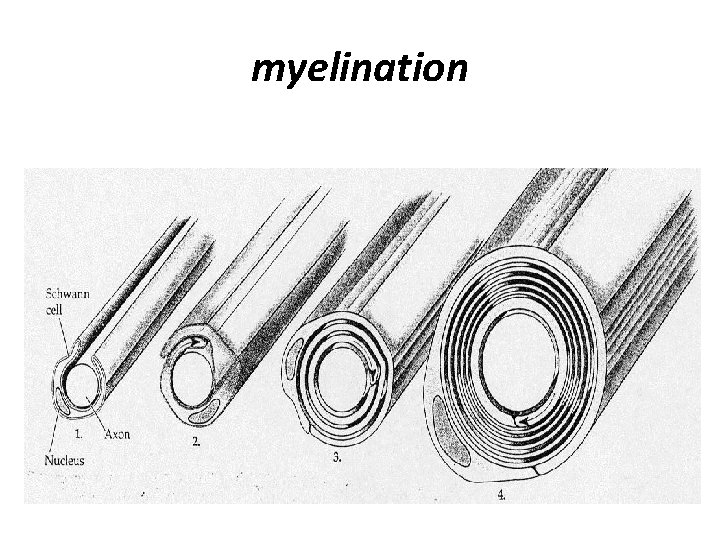
myelination
spinal cord dorsal part grows faster, thicker, forms- basal lamina- motor in function alar lamina- sensory in function divided by sulcus limitans dorsal nerve roots are formed from neural crest Recession of spinal cord due to relative differential growth
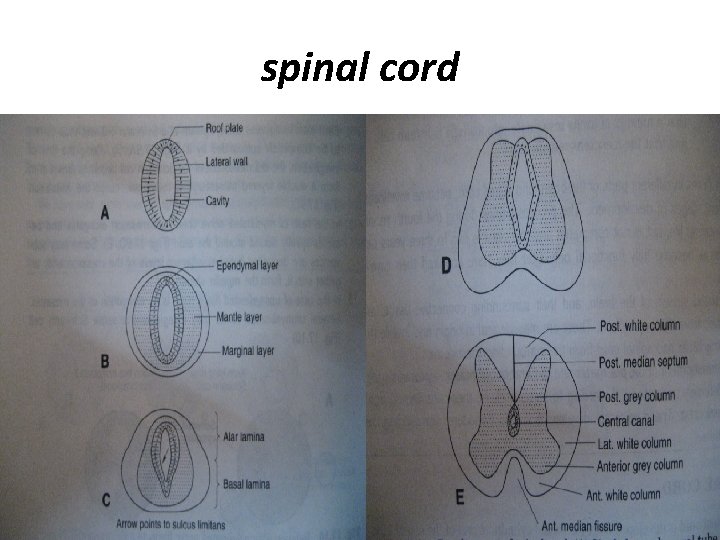
spinal cord
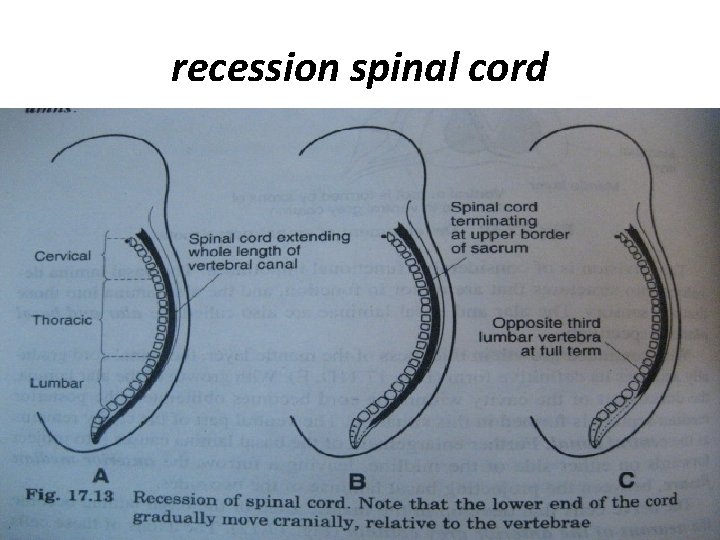
recession spinal cord
medulla From Myelencephalon Roof plate widens Sulcus limitans divides dorsal(lateral) alar laminacaudal bulbopontine extension olivary nuclei Sensory nuclei of cranial n of medulla ventral(medial) basal lamina. Motor nuclei of cranial n of medulla
pons From ventral part of Metencephalon Cranial bulbopontine extension pontine nuclei Axons of bulbopontine extension Middle cerebellar peduncle Alar and basal lamina cranial n nuclei Fibres from cortex corticospinal, corticopontine& corticobulbar tracts Lateralpart of alar lamina rhombic lip (cerebellum)
midbrain From mesencephalon Dorsal or alar lamina oculomotor n nuc trochlear n nuc Edinger Westphal nuc Ventral or basal lamina cells of colliculi red nucleus substantia nigra Descending fibres form crus cerebri/basis pedunculi
cerebellum From dorsolateral part of alar lamina of Metencephalon Cells migrate from mantle -marginal layer Cortex Cells that do not migrate dentate, emboliform, globose& fastigial nuclei Supr cerebellar peduncle- axons out of dentate nucleus Middle- axons from pontine nuclei into cerebellum Inferior- axons from spinal cord & medulla

cerebrum from two telencephalic vesicles of prosencephalon Forms together with Corpus striatum Grows upward, forward, backwards. . Encloses lateral ventricles within Medial wall invaginates – choroid fissure Fold of pia extends in-- telachoroidea Tuft of capillaries enter– choroid plexus
thalamus&hypothalamus From diencephalon Two grooves— epithalamic sulcus hypothalamic sulcus Forms three regions— epithalamus(habenular nuc&pineal body) thalamus hypothalamus
neural crest derivatives
neural crest derivatives Neurons of spinal postr nerve root ganglion Neurons of sensory ganglia of V, VIII. IX, X Neurons of Sympathetic ganglia Schwann cells of all peripheral nerves Cells of adrenal medulla Chromaffn tissue Melanoblasts of skin
ANS Sympathetic preganglionic– mantle region of T 1 – L 2, 3 postganglionic– neural crest Parasympathtic preganglionic– cranial- GVE brainstem- EW nuc, salivary, lacrimatory, dorsal nuc of X sacral- mantle layer of sacral spinal cord postganglionic-same regions
mesenchyme derivatives
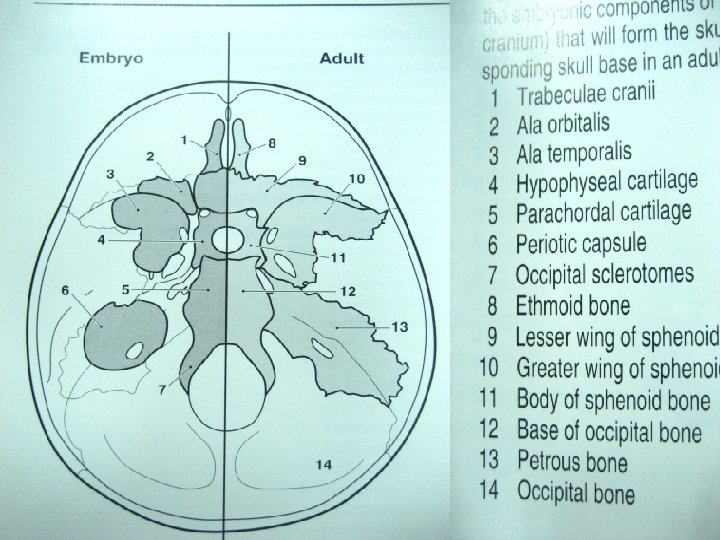
skull -viscerocranium(from neural crest) bones of face -neurocranium(from mesoderm of occipital somites) --membranous part vault of skull with flat bones separated by sutures --cartilaginous part base of skull wth many ossific centres Postr fontanelle closes by 2 months Antr fontanelle closes by 2 years Defects: anencephaly, scaphocephaly, plagiocephaly, microcephaly, mandibulo facial dysostosis, cong hydrocephalus
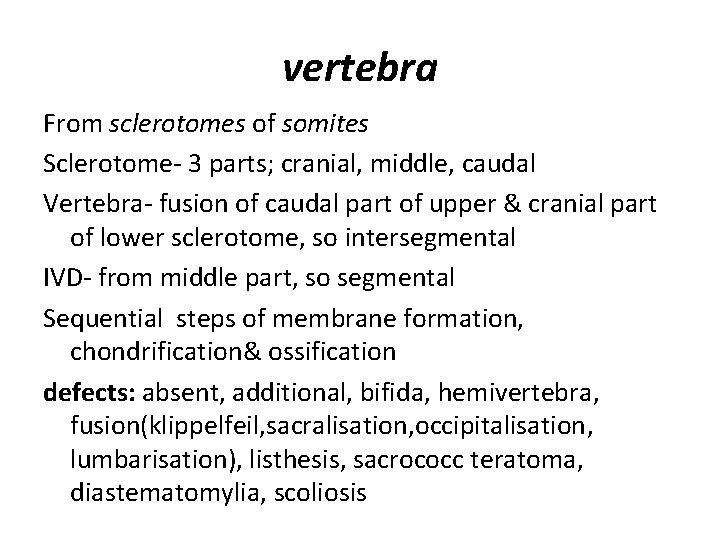
vertebra From sclerotomes of somites Sclerotome- 3 parts; cranial, middle, caudal Vertebra- fusion of caudal part of upper & cranial part of lower sclerotome, so intersegmental IVD- from middle part, so segmental Sequential steps of membrane formation, chondrification& ossification defects: absent, additional, bifida, hemivertebra, fusion(klippelfeil, sacralisation, occipitalisation, lumbarisation), listhesis, sacrococc teratoma, diastematomylia, scoliosis
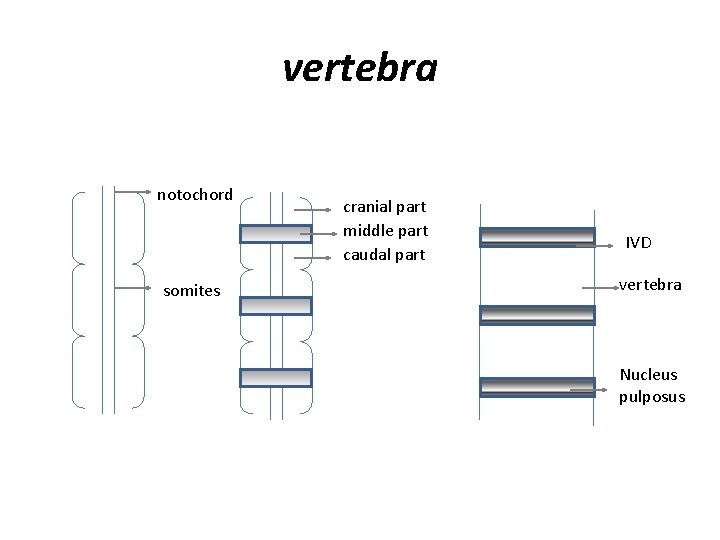
vertebra notochord somites cranial part middle part caudal part IVD vertebra Nucleus pulposus
vessels ICA- third primitive aortic arch A ACA- primitive olfactory A A Com- joining of two primitive olfactory A MCA- arises from ICA ECA- outgrowth of extension of primitive third aortic arch Basilar A- primitive basilar A PCA- fusion of many primitive antr arch A as extension of ICA, then shifts to Basilar A
meninges Primitive Meninx from loose mesenchyme surrounding the developing neural tube
factors in neurodevelopment Growth Cone Raman Y Cajal, 1890 expanded end of growing axon which is active, exploring, develops growing along suitable surface to form dendrites
factors in neurodevelopment Growth factors (neurotrophins) NGF, BDNF, NT-3, NT-4, NT-5, ciliary NTF, FGF
factors in neurodevelopment Receptors P 75 NTF Trk s
factors in neurodevelopment Inducers Noggin Chordin Follistatin (inhibits BMP ) (Bone Morphogenetic Protein inhibits Neural Tube formation)
factors in neurodevelopment Genes Hox a, b, c, d Pax Dlx Emx Otx
defects in neurodevelopment Dorsal induction- anencephaly, cephaloceles, Chiaris, spinal dysraphisms, caudal regression synd, tethered cord Ventral induction- holoprosencephalies, septoopticdysplasia, Dandy Walker, Joubert’s, facial anamolies Neur prolif, Diff, Histog- micro, megalocephaly, neurocut. synd, aqueductal stenosis, arachnoid cysts Neur migration- schizencephaly, lissencephaly, heterotopias, callosal agenesis, pachy/polymicrogyria
defects in neurodevelopment contd. . Myelination- dysmyelinating diseases Acquired(degen, toxic, inflmm)- hydranencephaly, hemiatrophy, multicystic encephalomalacia, periventric leukomalacia Chromosomal/Genetic- structural deformities to mental retardation to death
references Human Embryology: Inderbir Singh & G. P. Pal, 7 th. Ed Gray’s anatomy- the anatmical basis of clinical practice: Henry Gray, 39 th Ed Brain development and congenital malformations: Anne G. Osborn & Richard S. Boyer Atlas of neuroradiological embryology, anatomy & variations: J. Randy Jinkins
thank U. .
- Slides: 59