
Embryo Culture Embryo Culture Isolation growth of an
Embryo Culture
Embryo Culture �Isolation & growth of an immature or mature embryo in vitro, with the goal of obtaining a viable plant. �The first attempt to grow the embryos of angiosperms was made by Hannig (1904) from two Crucifers Cochleria & Raphanus.
Types of Embryo culture �Mature Embryo Culture �Immature Embryo Culture/ Embryo rescue

Mature Embryo Culture �It is the culture of mature embryos derived from ripe seeds. �This type of culture is done when embryos do not survive invivo or become dormant for long periods of time. �This culture is done to eliminate the inhibition of seed germination.
Immature Embryo Culture �It is the culture of immature embryos to rescue the embryos of wide crosses. �This type of culture is mainly used to avoid embryo abortion with the purpose of producing a viable plant.
Media Requirement �For Mature embryos. Basal salt medium with a carbon energy source. �For Immature embryos. Different vitamins, amino acids & growth regulators are required.
Culture-medium factors • mineral salts – K, Ca, N most important • carbohydrate and osmotic pressure - 2% sucrose works well for mature embryos - 8 -12% for immature embryos - transfer to progressively lower levels as embryo grows

Culture-medium factors • Amino acids - reduced N is often helpful - up to 10 amino acids can be added to replace N salts, incl. glutamine, alanine, arginine, aspartic acid, etc. - requires filter-sterilizing a portion of the medium

Culture-medium factors • natural plant extracts - Coconut milk (liquid endosperm of coconut) - enhanced growth attributed to undefined hormonal factors and/or organic compounds - others – extracts of dates, bananas, milk, tomato juice
Culture-medium factors • Plant Growth Regulators - globular embryos – require low conc. of auxin and cytokinin - heart-stage and later – moderate level of auxin & low level of cytokinin - GA and ABA regulate "precocious germination"

Embryo Rescue • In immature embryo culture, wide hybrids often suffer from early spontaneous abortion due to several barriers which operate at pre- & post- fertilization levels. • Pre- fertilization barriers include all factors that hinder effective fertilization. (due to inhibition of pollen tube growth)
Embryo Rescue �Post fertilization barriers retard the development of the zygote after fertilization and normal development of the seed. (due to failure of endosperm) �This is known as embryo-endosperm incompatibility where the endosperm produces toxins that kills the embryo.
EMBRYO CULTURE OF MAIZE
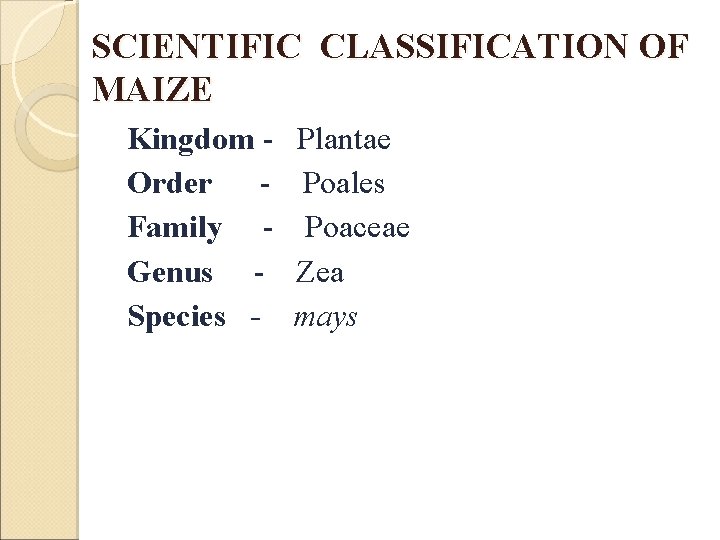
SCIENTIFIC CLASSIFICATION OF MAIZE Kingdom Order Family Genus Species - Plantae Poales Poaceae Zea mays
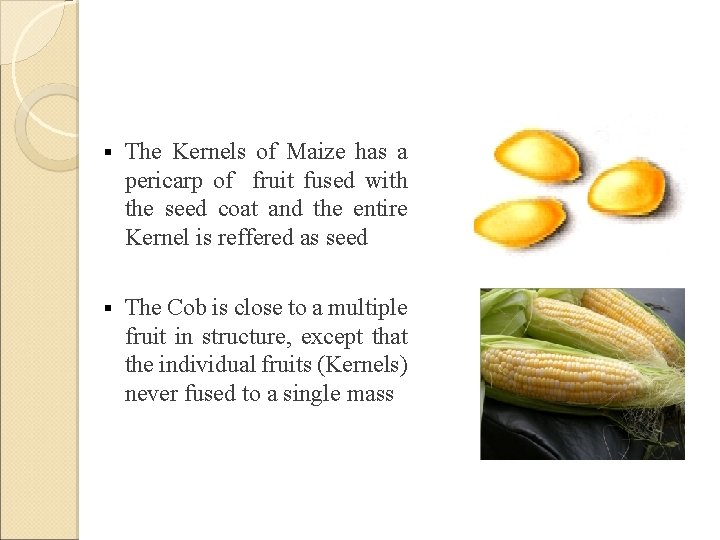
§ The Kernels of Maize has a pericarp of fruit fused with the seed coat and the entire Kernel is reffered as seed § The Cob is close to a multiple fruit in structure, except that the individual fruits (Kernels) never fused to a single mass
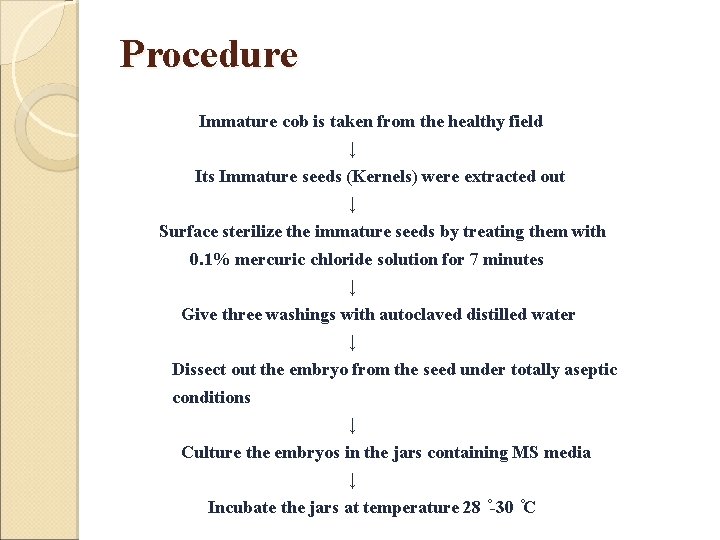
Procedure Immature cob is taken from the healthy field ↓ Its Immature seeds (Kernels) were extracted out ↓ Surface sterilize the immature seeds by treating them with 0. 1% mercuric chloride solution for 7 minutes ↓ Give three washings with autoclaved distilled water ↓ Dissect out the embryo from the seed under totally aseptic conditions ↓ Culture the embryos in the jars containing MS media ↓ Incubate the jars at temperature 28 -30 C
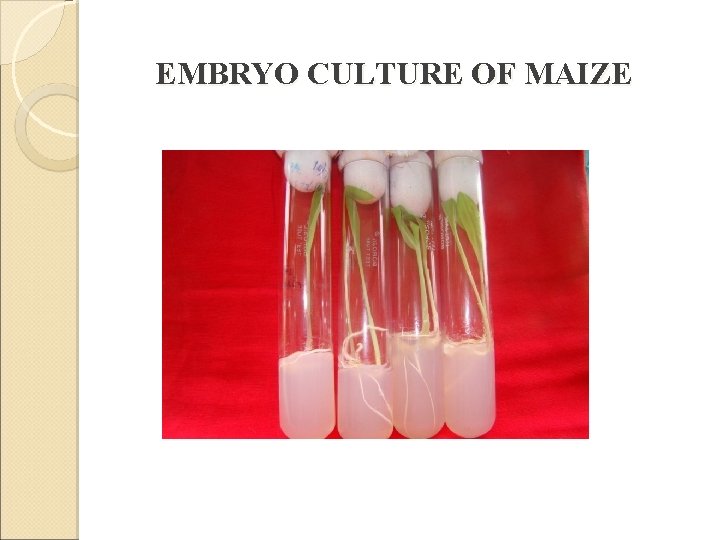
EMBRYO CULTURE OF MAIZE
Applications of Embryo Culture �Production of haploids �Prevention of embryo abortion in wide crosses �Overcoming Seed dormancy �Shortening of breeding cycle �Prevention of embryo abortion with early ripening stone fruits
Production of haploids �Production of monoploids - useful for obtaining "haploids" of barley, wheat, other cereals. - the barley system uses Hordeum bulbosum as a pollen parent.
Production of haploids • Hordeum vulgare is the seed parent. • zygote develops into an embryo with elimination of HB chromosomes. • eventually, only HV chromosomes are left • embryo is "rescued" by culturing 10 PP to avoid abortion.
Prevention of embryo abortion �Embryo rescue from a cross between an early Japanese cv. - Sunago wase & a Chinese cv. Yuhualu obtained “Zaoxialu” an extra early maturing peach cultivar.
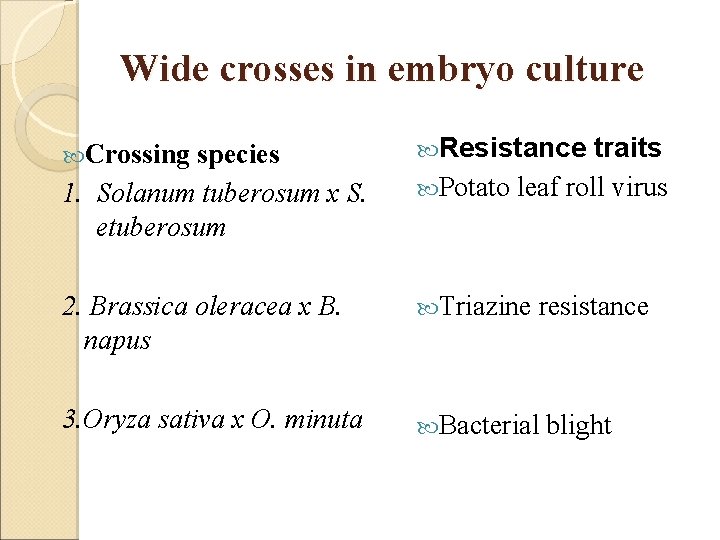
Wide crosses in embryo culture Crossing species 1. Solanum tuberosum x S. etuberosum Resistance traits Potato leaf roll virus 2. Brassica oleracea x B. napus Triazine 3. Oryza sativa x O. minuta Bacterial resistance blight
Overcoming Seed dormancy �Embryo rescue technique is applied to break seed dormancy. �Production of seedlings from seed of naturally vegetatively propagated plants such as Banana & Colocasia, whose seeds do not germinate in nature.
Shortening of breeding cycle �Under proper germination conditions, 3 years are required for seeds from mature berries to complete their embryonic development. �The excised embryo goes through all the developmental sequences in vitro & plants can be obtained in 2 -3 weeks time.
Prevention of embryo abortion in stone fruits �Some species produce sterile seeds that will not germinate under appropriate conditions e. g. - Peach, Nectarine, Plum. �Embryo culture has been practised as a general method in horticultured crops including Peach, Nectarine & Plum.
- Slides: 25