
Embolism Definition Embolus An insoluble solid liquid or
Embolism ● Definition Embolus: An insoluble (solid, liquid or gaseous) mass circulating in the blood stream. Embolism: Is the process of impaction of the embolus in a narrow vessel.

Embolism ● Causes & Types: 1 - Detached thrombi (thrombo-embolism) 2 - Fat embolism: The fat of the bone marrow reaches the circulation after fracture of bones. 3 - Air embolism: due to injury of neck & chest veins. 4 - Parasitic emboli: e. g. bilharzial worms and ova. 5 - Tumor emboli: groups of tumour cells penetrate the wall of blood vessels especially veins. 6 - Amniotic fluid embolism.

1 - Detached thrombi (thromboembolism) • Sources & Sites of impaction: 1 - Pulmonary embolism 2 - Portal embolism 3 - Systemic embolism 4 - Paradoxical embolism • Effects depends upon: 1 - Size of the embolus. 2 - Nature of the embolus (septic or aseptic). 3 - State of the collateral circulation in the affected site.
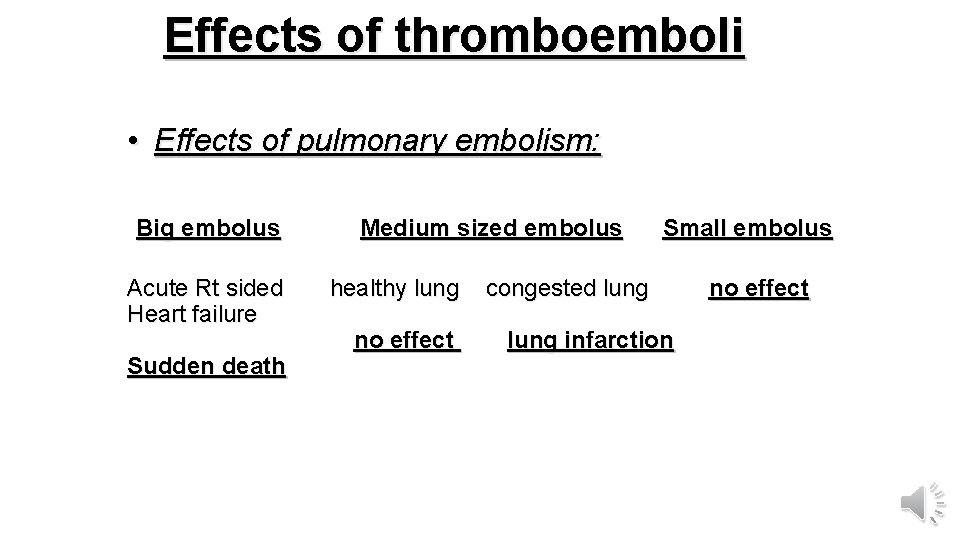
Effects of thromboemboli • Effects of pulmonary embolism: Big embolus Acute Rt sided Heart failure Sudden death Medium sized embolus healthy lung no effect Small embolus congested lung infarction no effect

Air embolism • Rare and may result from: 1 - Injury to the large neck veins. Air is sucked by the negative pressure in the thorax. 2 - During cardiothoracic surgery → air may enter veins 3 - In criminal abortion → air may pass into uterine veins 4 - Caisson’s disease (decompression sickness): - In deep dives, the high pressure increases the amount of gasses dissolved in the blood of the divers. - If decompression is done rapidly, gases esp. nitrogen form emboli in the blood vessels. - Small amount of air is harmless, but 50 -100 cc. interferes with cardiac contraction and causes acute heart failure.
Fat embolism • • Rare condition Causes include: (1) Bone fractures and crush limb injuries. (2) Trauma to adipose tissue (infl. or burns). (3) Trauma to a grossly fatty liver. (4) Major surgery.
Ischemia • Definition: Deficient supply of arterial blood to an organ or tissue due to partial or complete occlusion of its artery. • Types: Ischemia may be either: 1 - Acute ischemia (complete or sudden ischemia) 2 - Chronic ischemia (partial or gradual ischemia)
Acute ischemia • Causes: Sudden complete arterial occlusion by: 1 - Thrombosis or embolism. (most common) 2 - Surgical ligature of the artery. 3 - Twisting of the pedicle of a movable organ e. g. intestinal loop. 4 - Arterial spasm as in ergot poisoning. • Effects: depends on the efficiency of collaterals: ● Sudden occlusion of end arteries or arteries with poor collaterals → infarction or gangrene. ● Sudden occlusion of arteries with efficient collaterals may not cause tissue damage.
Chronic Ischemia • Causes: Incomplete arterial occlusion by: 1 - Atherosclerosis. 2 - Pressure on the artery by enlarged lymph node, tumor. . . etc. 3 - End arteritis as in chronic inflammation. • Effects: depends on the efficiency of collaterals: ● With inefficient collaterals: - pain on exercise: angina pectoris, intermittent claudication. . - cellular degeneration, atrophy followed by fibrosis. ● With efficient collaterals no tissue damage occurs.

Infarction • Definition An infarct is an area of coagulative necrosis (liquefactive in the brain) caused by sudden ischemia.
Infarction • Causes 1 - Thrombosis that may occur inside diseased arteries. 2 - Embolism. 3 - Strangulation or twisting of an organ as in loops of intestine, testes or ovaries.
• Types of infarcts: 1 - Red infarcts (hemorrhagic): - Occur in vascular organs as the lung, liver and intestine. - The red color is due to hge in the substance of the infarct. 2 - Pale infarcts: - Are more common and occur in firm and less vascular organs as the kidney, heart and spleen. 3 - Liquefactive infarcts: - Occur in the brain and spinal cord.

Pathological features of the infarct ● Gross picture: • Shape: The infarct is wedge shaped or pyramidal. The base is directed towards the surface of the organ. • Site: The infarct is subcapsular, raised when recent due to edema and depressed when healed due to fibrosis. • Size: depends on the size of the occluded vessel. • Color: Infarcts are of two types; red and pale. • It is surrounded by a red zone of inflammatory hyperemia.
Microscopic picture: • Early: the cells show various post-necrotic changes. • Next: structural details are lost but the outlines are preserved. • Lastly: necrotic tissue appears as granular pink debris. • The infarct is surrounded by a red zone of inflammatory hyperemia.
● General reactions: Infarcts are associated with general reactions in the form of: • Fever • Leucocytosis • Increased sedimentation rate; ESR • Elevation of certain serum enzymes as transaminase in myocardial infarction.
Fate of the infarct • Small infarct: Necrotic tissues are removed by macrophages, granulation tissue fills the defect followed by fibrosis. • Large infarct: Gets surrounded by a fibrous capsule and its substance may show dystrophic calcification.
- Slides: 16