
Embodied Cognition Course Gert Kootstra Embodied Cognition Course
Embodied Cognition Course Gert Kootstra
Embodied Cognition Course �Course coordinator �Gert Kootstra, CVAP �kootstra@kth. se �Other organizers �Orjan Ekeberg, CB �Giampiero Salvi, TMH �Time �Wednesdays 10: 00 -12: 00 �Place �For now Teknikringen, Room 304 Embodied Cognition
Course setup �Lectures given by participants �Invited lecture (internal and external) �Lab visits �CVAP, TMH, CB Embodied Cognition
Course material �“How the Body Shapes the Way We Think” – Rolf Pfeifer and Josh Bongard �Additional papers selected by the participants �Papers provided by the invited speakers Embodied Cognition
Objectives �After the course you should be able to �Demonstrate insights in the field of embodied cogn �Have a multi-disciplinary perspective �Know about the research at TMH, CB, and CVAP �Place your research in a broader perspective �Setup a multi-disciplinary research project Embodied Cognition
What you need to do to pass �Attend all lectures �Give one lecture (groups of two) �Actively participate in the lectures �Read the course material �Prepare questions for the invited speakers �Write a multi-disciplinary research proposal Embodied Cognition
To give a lecture �In groups of two �Discuss the content of a book chapter �Discuss some of the studies referred to in more detail �Choose two additional papers based on the content and your own interest/research �Think about the diversity of backgrounds �Mail articles a week before the lecture �End lecture with a discussion, provide topics Embodied Cognition
Invited speakers �External �Peter König �Luc Steels �Auke Ijspeert �Internal �From all groups �We will discuss papers a week earlier �You will have to prepare questions Embodied Cognition
Multi-disciplinary research proposal �Groups of two �Write a research proposal combining your research or research area (5 pages) �In the field of Embodied Cognition �Place your research in a broader perspective �Multi-disciplinary collaborations �Exercise to write a research proposal Embodied Cognition
Schedule for next few weeks � 26 jan � 2 feb � 9 feb � 16 feb � 23 feb �… Introduction Personal presentations (5 min pp) Auke Ijspeert Chapter 1&2 by me Chapter 3 by … … Embodied Cognition
Introduction to Embodied Cognition
Embodied Cognition �Having a body, interacting with the world, is essential in cognition �Active perception �Perception Action , but also… �Action Perception �The body shapes the way we think Embodied Cognition
The body shapes the way we think �The brain obviously controls our body �Consciously: we act when we want to act �Unconsciously: heart beat, walking, dogging when something approaches us, etc. �Title of the book is the reverse. �Aren’t we free to think what we want? �The body constraints thought �But also enables thought Embodied Cognition
Categorization example �Elementary capacity: categorization �Eatable/non-eatable, �Categories friend/foo, etc. are determined by embodiment �Morphology: shape of body, types of sensors, types of actuators �Material properties of muscles, sensors �Categories are determined by interaction �What can you do with an object �A chair is a chair because you can sit on it. Embodied Cognition
Hypothesis �Cognition is grounded (shaped by) the body �Categorization �Spatial cognition �Social cognition �Problem solving �Reasoning �Abstract thinking �Language Embodied Cognition
A theory of intelligence �Throughout the book, a general theory of intelligence is formed �Applicable to different types of agents �Humans �Animals �Robots Embodied Cognition
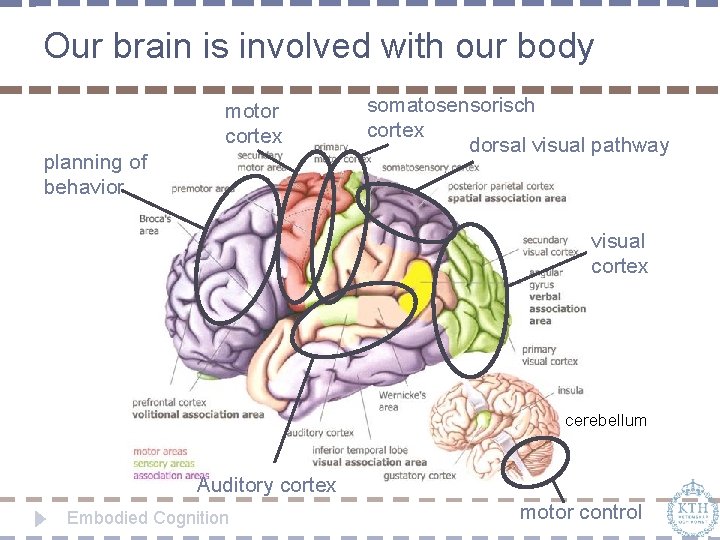
Our brain is involved with our body motor cortex planning of behavior somatosensorisch cortex dorsal visual pathway visual cortex cerebellum Auditory cortex Embodied Cognition motor control

A very brief history of Artificial Intelligence
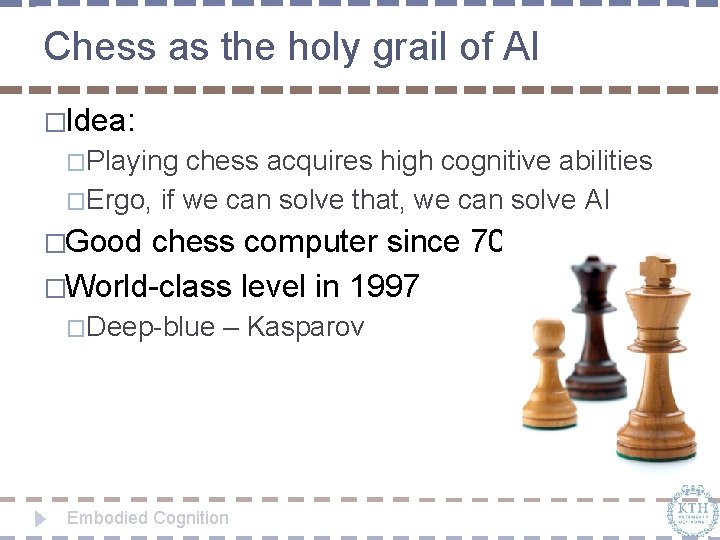
Chess as the holy grail of AI �Idea: �Playing chess acquires high cognitive abilities �Ergo, if we can solve that, we can solve AI �Good chess computer since 70’s �World-class level in 1997 �Deep-blue – Kasparov Embodied Cognition
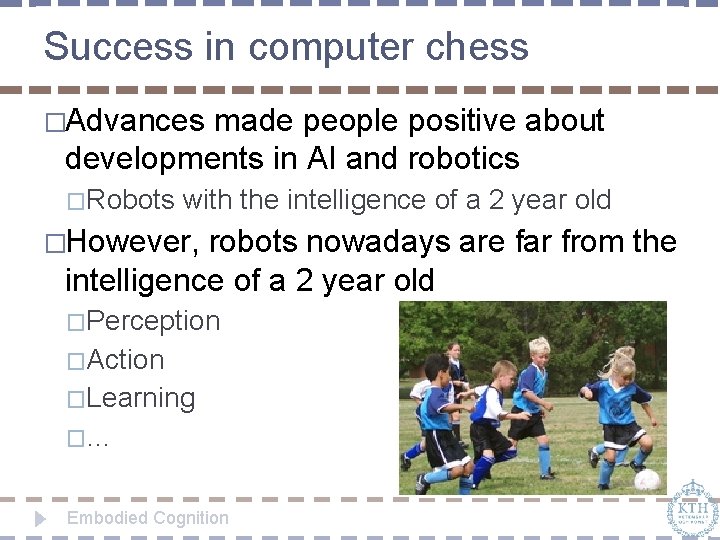
Success in computer chess �Advances made people positive about developments in AI and robotics �Robots with the intelligence of a 2 year old �However, robots nowadays are far from the intelligence of a 2 year old �Perception �Action �Learning �… Embodied Cognition
Moravec’s paradox �High cognitive processes �Conscious processes (chess, problem solving, …) �Difficult for humans �Easy for computers �Low cognitive processes �Perception, action, (social) interactions �Easy for humans �Difficult for computers Embodied Cognition
Explanation: Moravec’s paradox �Interactions with the world have evolved over billions of years �Essential for survival and reproduction �Mainly unconscious processes �We are not aware of the difficulty �Abstract thinking is much more recent �Often conscious �We are aware of the difficulty Embodied Cognition
The limited world of chess �Chess �Limited number of states �Limited number of actions �No uncertainty �Makes use of symbols trivial �Not the case for real-world systems �Elephants don’t play chess (Brook 1990) Embodied Cognition
A Very Brief History of Robotics
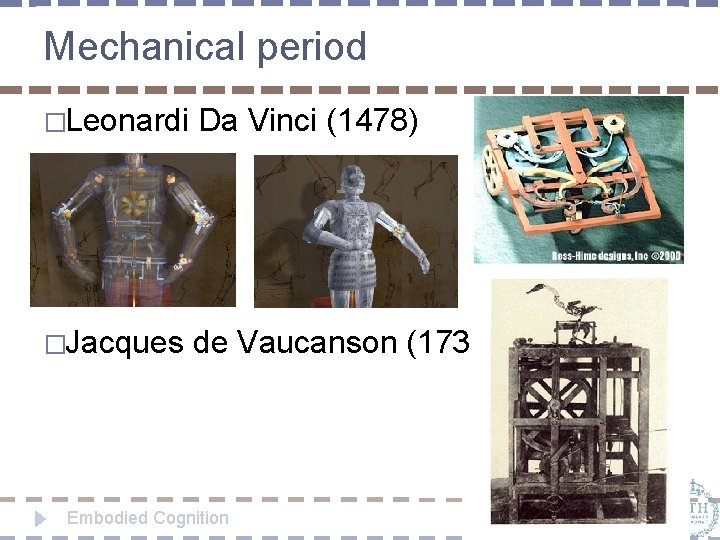
Mechanical period �Leonardi Da Vinci (1478) �Jacques de Vaucanson (1738) Embodied Cognition
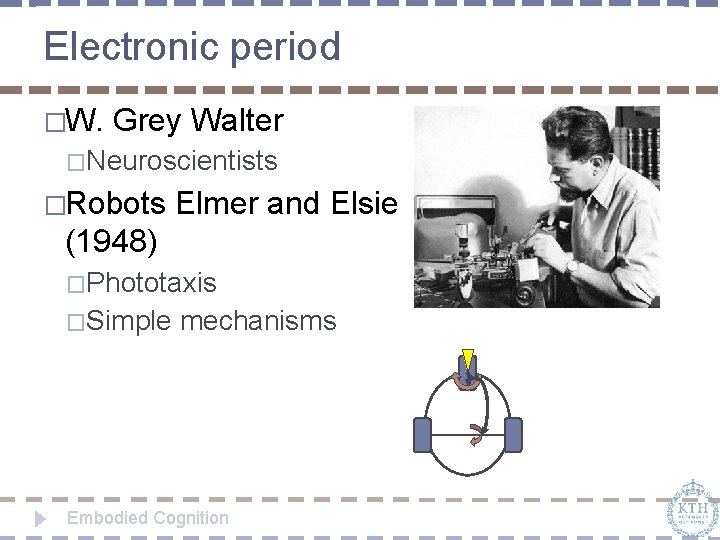
Electronic period �W. Grey Walter �Neuroscientists �Robots Elmer and Elsie (1948) �Phototaxis �Simple mechanisms Embodied Cognition
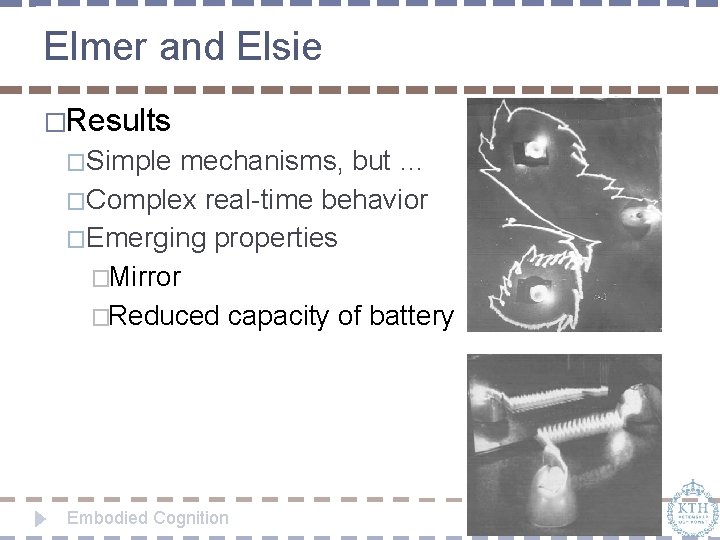
Elmer and Elsie �Results �Simple mechanisms, but … �Complex real-time behavior �Emerging properties �Mirror �Reduced capacity of battery Embodied Cognition
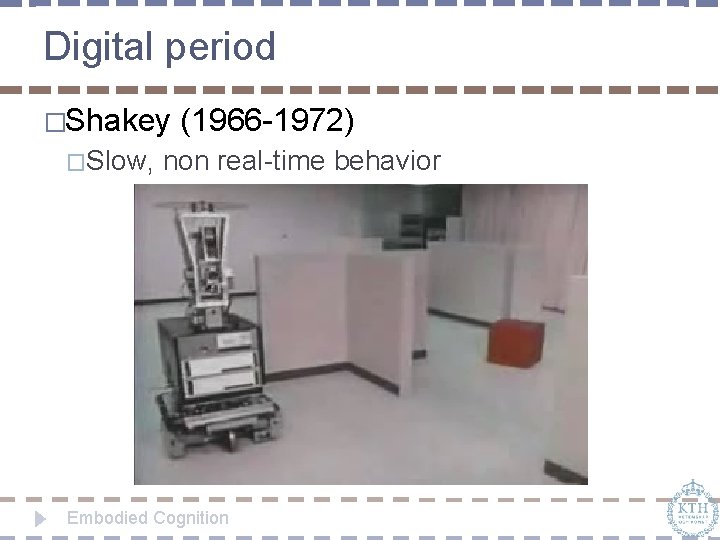
Digital period �Shakey �Slow, (1966 -1972) non real-time behavior Embodied Cognition
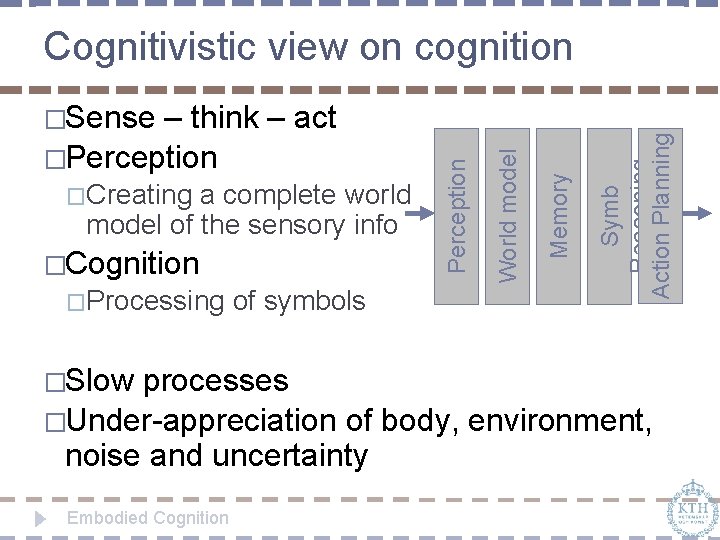
a complete world model of the sensory info �Cognition �Processing �Slow of symbols Memory �Creating World model – think – act �Perception �Sense Symb Reasoning Action Planning Cognitivistic view on cognition processes �Under-appreciation of body, environment, noise and uncertainty Embodied Cognition
Representation
The impression of seeing everything �Despite only a small fovea, we have the impression of seeing everything �Classically view �We integrate the information gathered while making eye movements �But do we make a detailed representation of the scene? Embodied Cognition
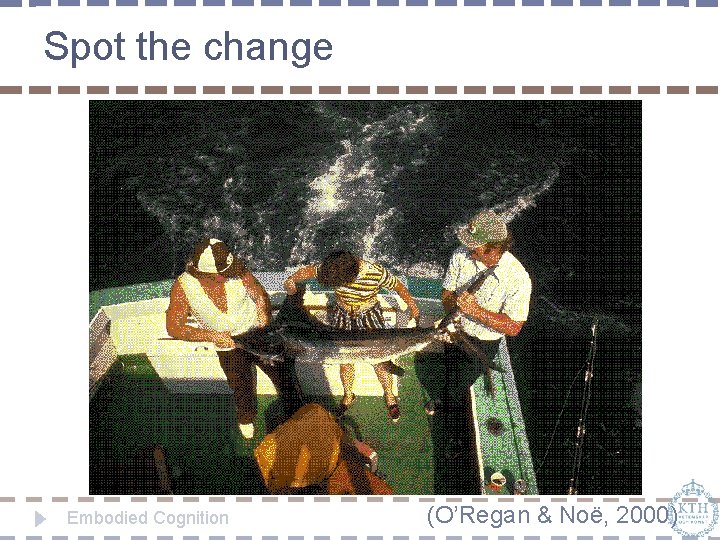
Spot the change Embodied Cognition (O’Regan & Noë, 2000)
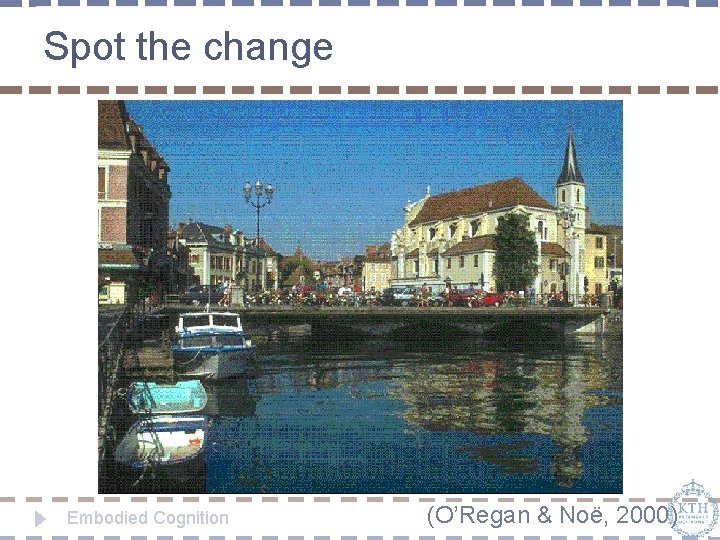
Spot the change Embodied Cognition (O’Regan & Noë, 2000)
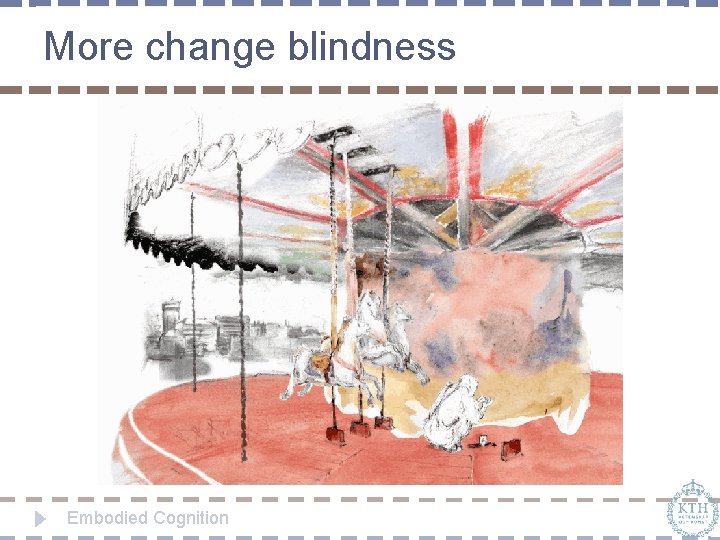
Change blindness �Without blank frame �Change �With is spotted easily by motion detectors blank frame �Change is hart to spot �Blank frame create motion all over the image Embodied Cognition
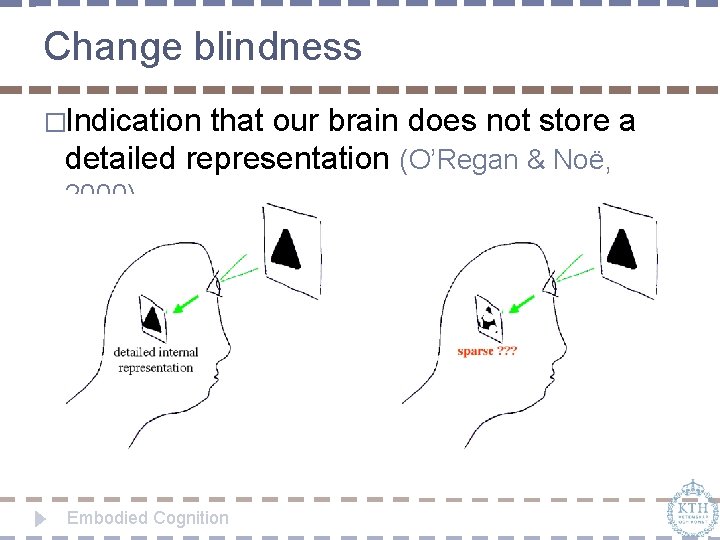
Change blindness �Indication that our brain does not store a detailed representation (O’Regan & Noë, 2000) Embodied Cognition
The world as outside memory �We have an impression of a full representation of the scene, because we can access the information if needed �Only the recipe to get at the info need to be stored �Active perception �The world as outside memory �We make use of our embodiment! Embodied Cognition
The world as outside memory �Intelligence without representation (Brooks ‘ 91) �“the world is its own best model. It is always exactly up to date. It always has every detail there is to be known. The trick is to sense it appropriately and often enough. ” Embodied Cognition
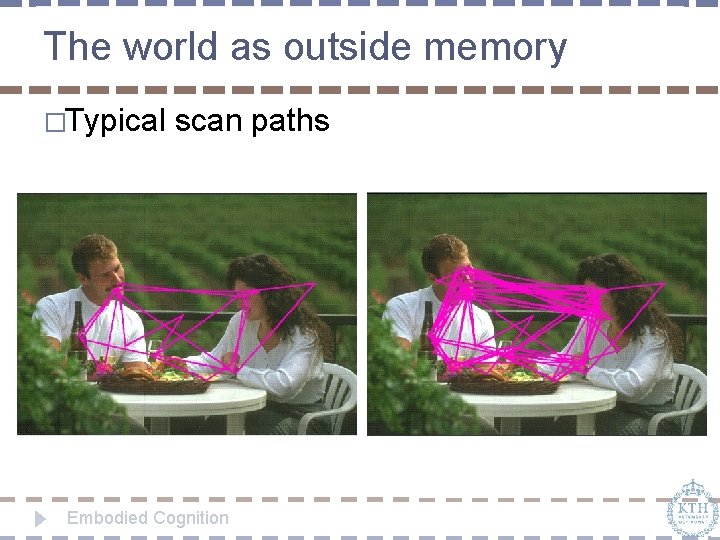
The world as outside memory �Typical scan paths Embodied Cognition
More change blindness Embodied Cognition
More change blindness Embodied Cognition

Complete Agent
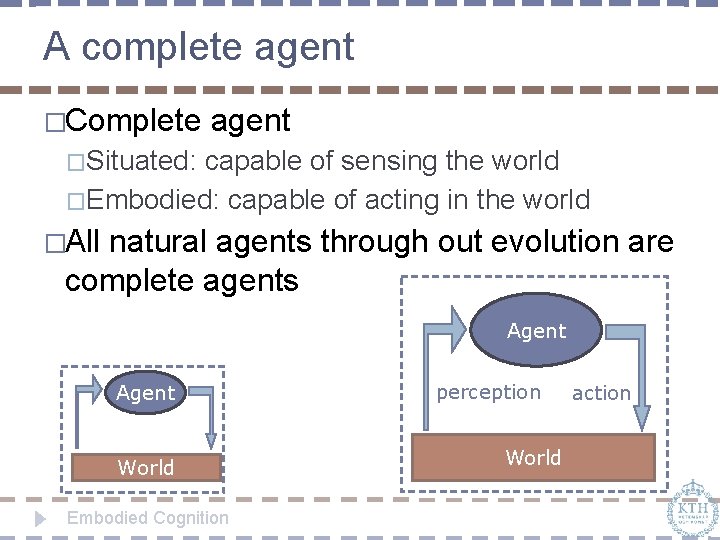
A complete agent �Complete agent �Situated: capable of sensing the world �Embodied: capable of acting in the world �All natural agents through out evolution are complete agents Agent World Embodied Cognition perception World action
Complete agent �Important to keep in mind when �Studying natural systems �E. g. , Interpreting brain functions as being part of a complete agent �Developing artificial systems �E. g. , Exploiting active capabilities of the agent Embodied Cognition
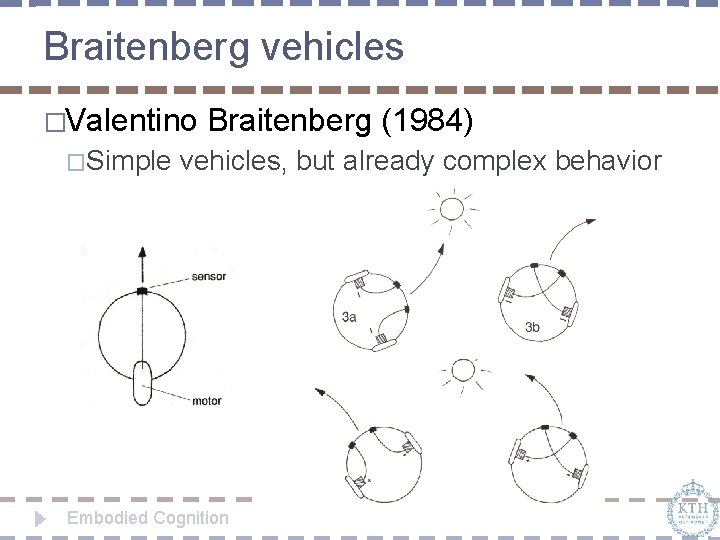
Braitenberg vehicles �Valentino �Simple Braitenberg (1984) vehicles, but already complex behavior Embodied Cognition
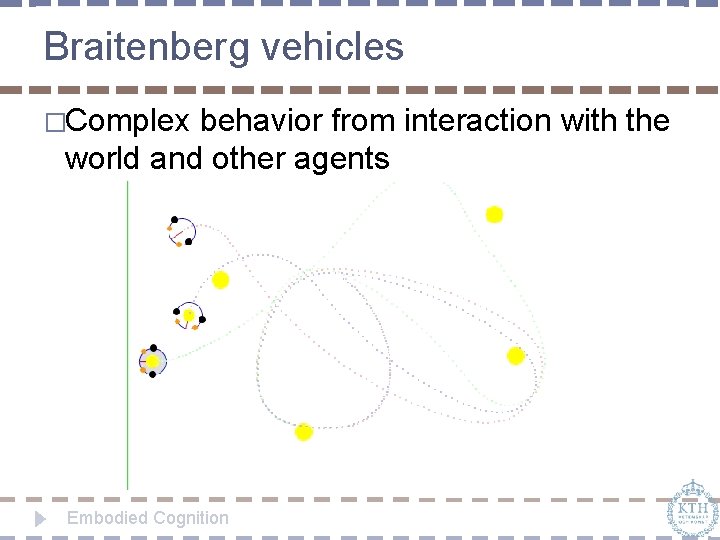
Braitenberg vehicles �Complex behavior from interaction with the world and other agents Embodied Cognition
Interaction
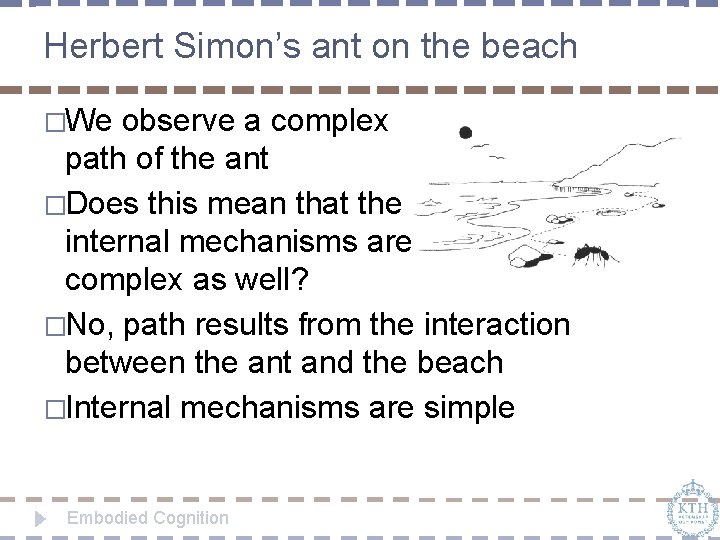
Herbert Simon’s ant on the beach �We observe a complex path of the ant �Does this mean that the internal mechanisms are complex as well? �No, path results from the interaction between the ant and the beach �Internal mechanisms are simple Embodied Cognition
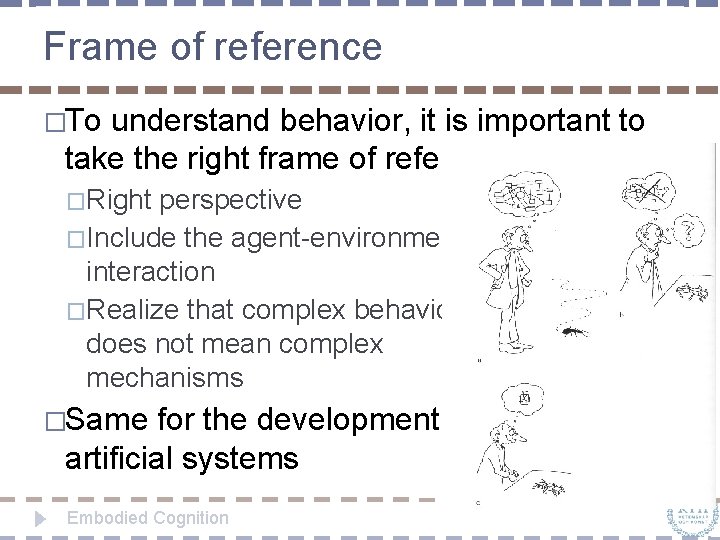
Frame of reference �To understand behavior, it is important to take the right frame of reference �Right perspective �Include the agent-environment interaction �Realize that complex behavior does not mean complex mechanisms �Same for the development of artificial systems Embodied Cognition
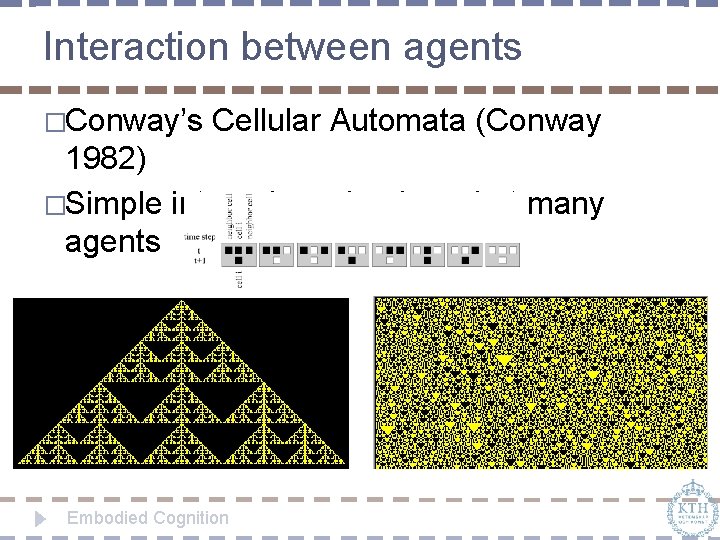
Interaction between agents �Conway’s Cellular Automata (Conway 1982) �Simple internal mechanisms but many agents Embodied Cognition
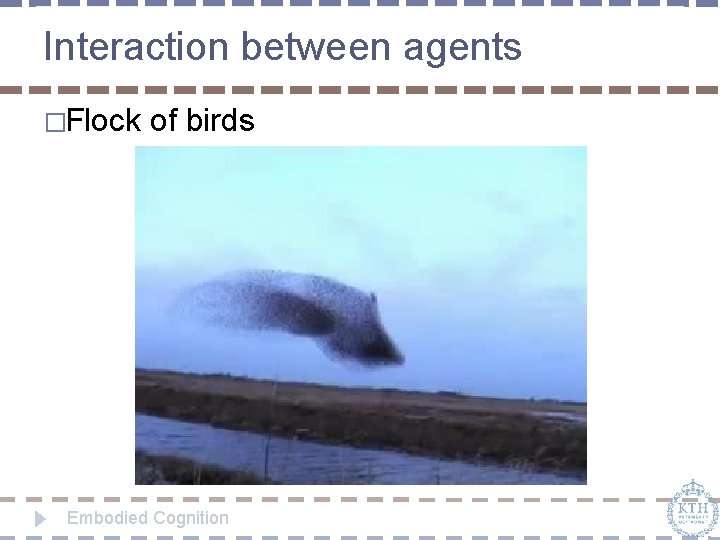
Interaction between agents �Flock of birds Embodied Cognition
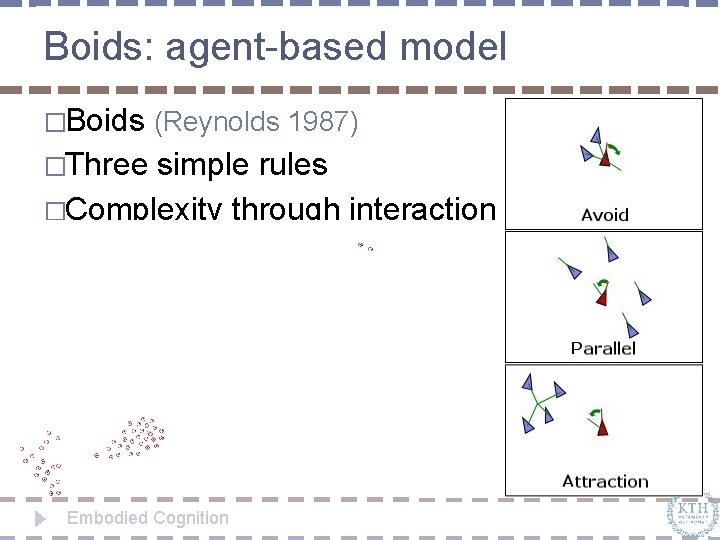
Boids: agent-based model �Boids (Reynolds 1987) �Three simple rules �Complexity through interaction Embodied Cognition
Active perception
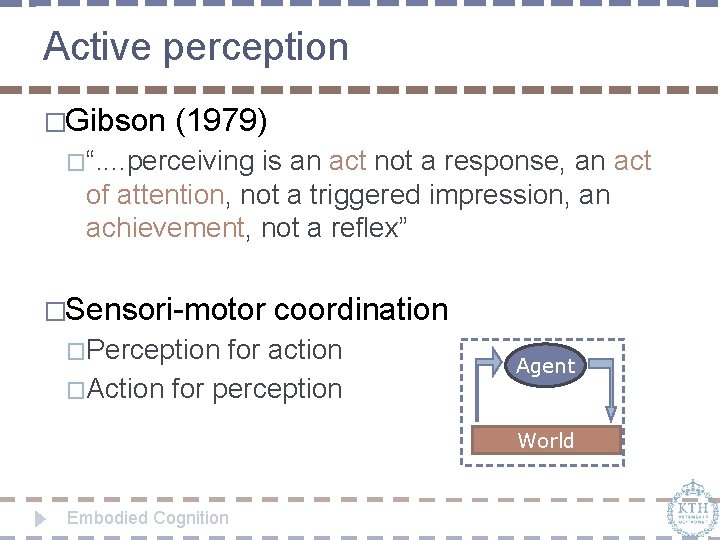
Active perception �Gibson (1979) �“. . perceiving is an act not a response, an act of attention, not a triggered impression, an achievement, not a reflex” �Sensori-motor �Perception coordination for action �Action for perception Agent World Embodied Cognition
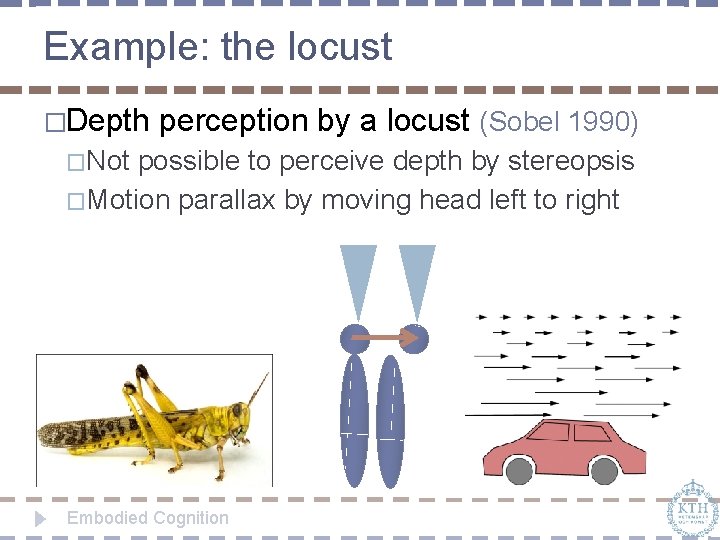
Example: the locust �Depth perception by a locust (Sobel 1990) �Not possible to perceive depth by stereopsis �Motion parallax by moving head left to right Embodied Cognition
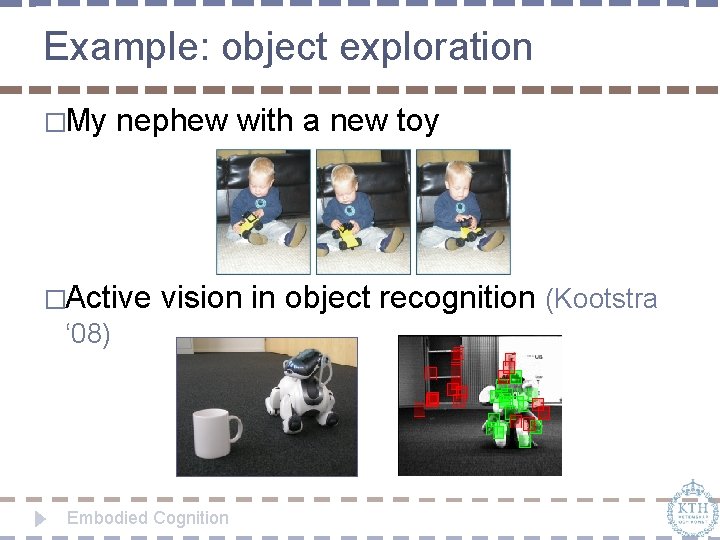
Example: object exploration �My nephew with a new toy �Active vision in object recognition (Kootstra ‘ 08) Embodied Cognition
Active perception �Actively change the input of sensors �Disambiguation �Egomotion �Simplifies many perceptual tasks Embodied Cognition

The Intelligent Body
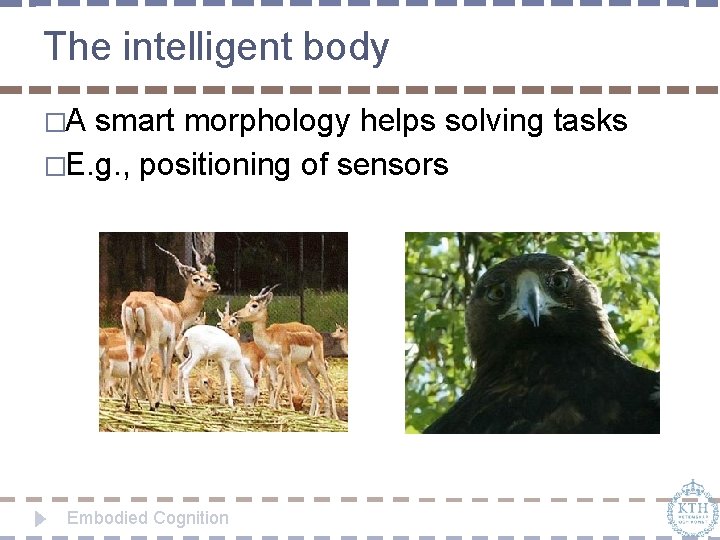
The intelligent body �A smart morphology helps solving tasks �E. g. , positioning of sensors Embodied Cognition
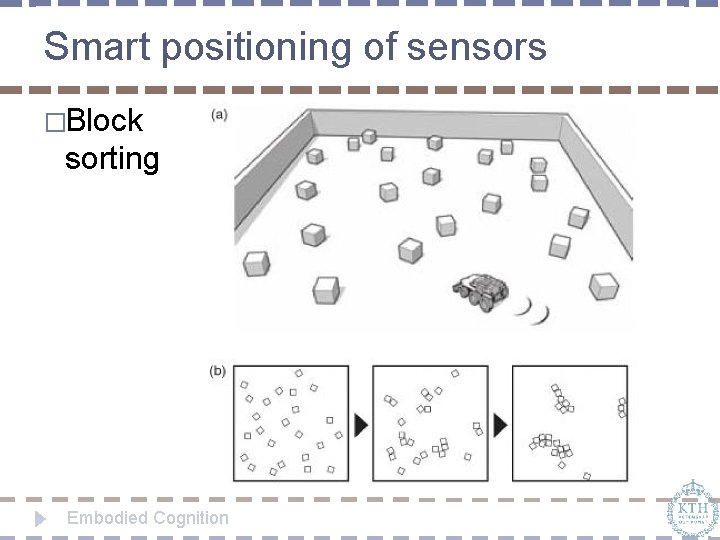
Smart positioning of sensors �Block sorting Embodied Cognition
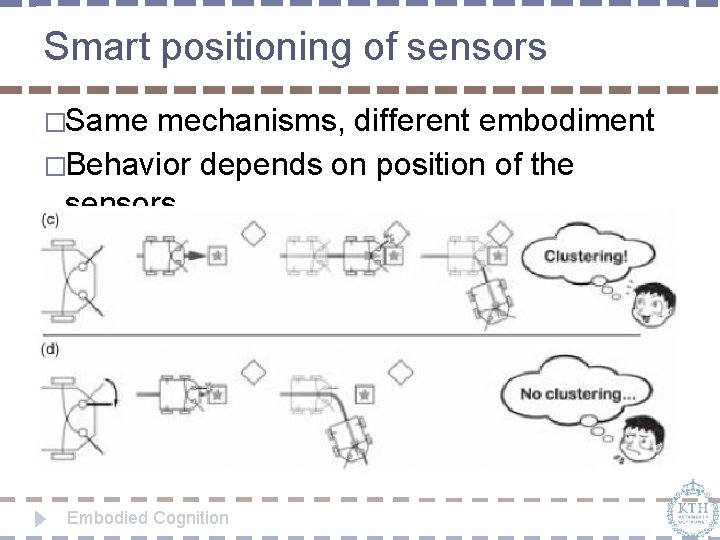
Smart positioning of sensors �Same mechanisms, different embodiment �Behavior depends on position of the sensors Embodied Cognition
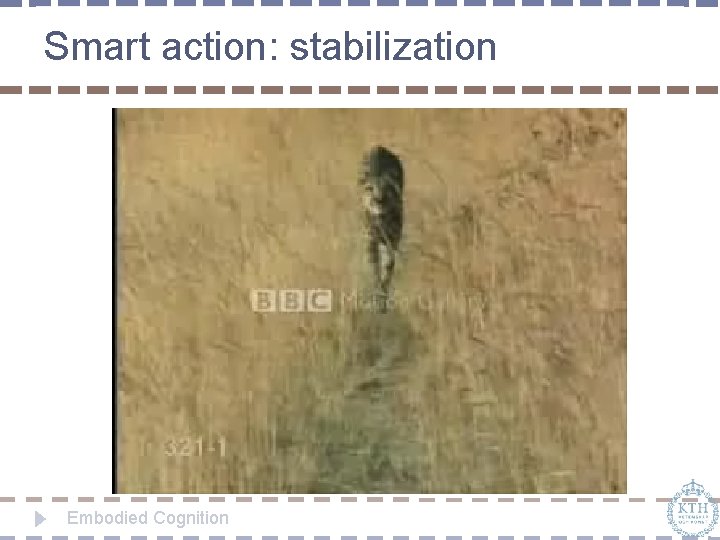
Smart action: stabilization Embodied Cognition
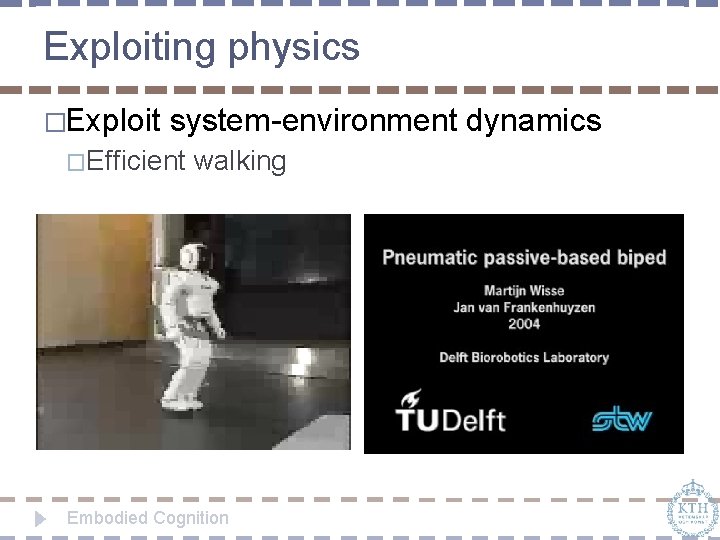
Exploiting physics �Exploit system-environment dynamics �Efficient walking Embodied Cognition
Synthetic approach
Synthetic approach �Learning by building �Robotics �Computational modeling �Why? �Learning by building �Need for specific models, no black boxes �Can be used to make predictions Embodied Cognition

Take home message
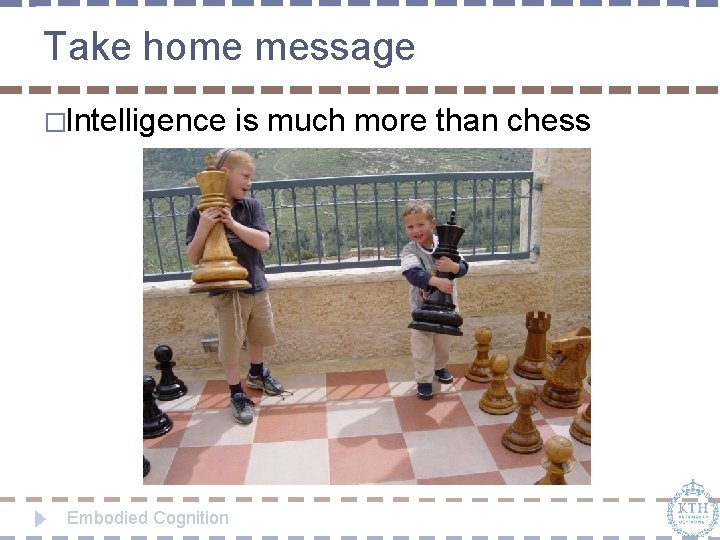
Take home message �Intelligence Embodied Cognition is much more than chess
- Slides: 66