
Embedded Systems Design Design Constraints Slide credit P
Embedded Systems Design

Design Constraints Slide credit – P Koopman, CMU Introduction to Embedded Systems Setha Pan-ngum 2
Design Challenges • Does it really work? • • Is the specification correct? Does the implementation meet the spec? How do we test for real-time characteristics? How do we test on real data? • How do we work on the system? • Observability, controllability? • What is our development platform? Slide credit – P Koopman, CMU • More importantly – optimising design metrics!! Introduction to Embedded Systems Setha Pan-ngum 3
Design Metrics • Common metrics • Unit cost: the monetary cost of manufacturing each copy of the system, excluding NRE cost • NRE cost (Non-Recurring Engineering cost): The one-time monetary cost of designing the system • Size: the physical space required by the system • Performance: the execution time or throughput of the system • Power: the amount of power consumed by the system • Flexibility: the ability to change the functionality of the system without incurring heavy NRE cost Slide credit Vahid/Givargis, Embedded Systems Design: A Unified Hardware/Software Introduction to Embedded Systems Setha Pan-ngum 4
Design Metrics • Common metrics (continued) • Time-to-prototype: the time needed to build a working version of the system • Time-to-market: the time required to develop a system to the point that it can be released and sold to customers • Maintainability: the ability to modify the system after its initial release • Correctness, safety, many more Slide credit Vahid/Givargis, Embedded Systems Design: A Unified Hardware/Software Introduction to Embedded Systems Setha Pan-ngum 5
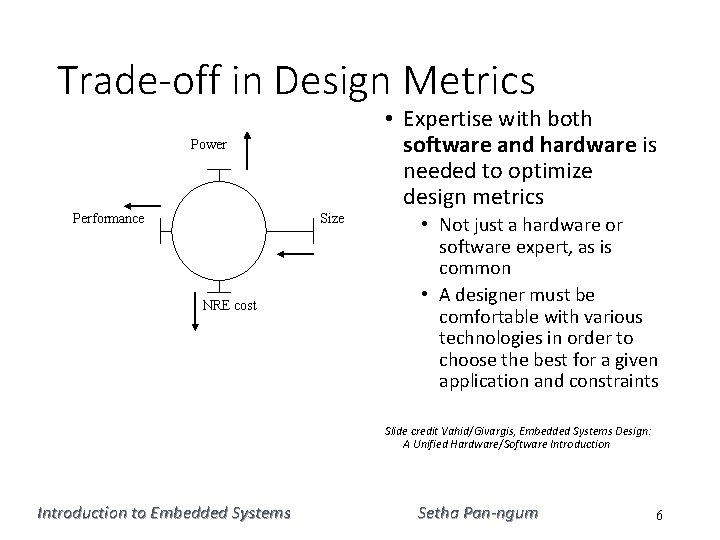
Trade-off in Design Metrics • Expertise with both software and hardware is needed to optimize design metrics Power Performance Size NRE cost • Not just a hardware or software expert, as is common • A designer must be comfortable with various technologies in order to choose the best for a given application and constraints Slide credit Vahid/Givargis, Embedded Systems Design: A Unified Hardware/Software Introduction to Embedded Systems Setha Pan-ngum 6
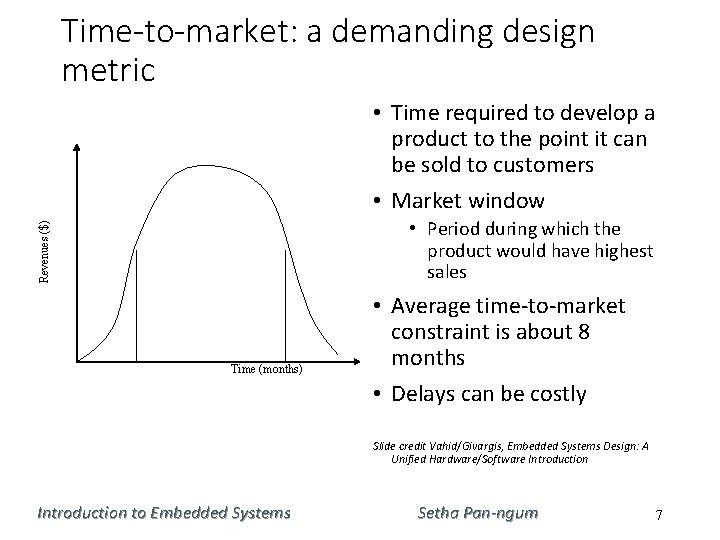
Time-to-market: a demanding design metric • Time required to develop a product to the point it can be sold to customers • Market window Revenues ($) • Period during which the product would have highest sales Time (months) • Average time-to-market constraint is about 8 months • Delays can be costly Slide credit Vahid/Givargis, Embedded Systems Design: A Unified Hardware/Software Introduction to Embedded Systems Setha Pan-ngum 7
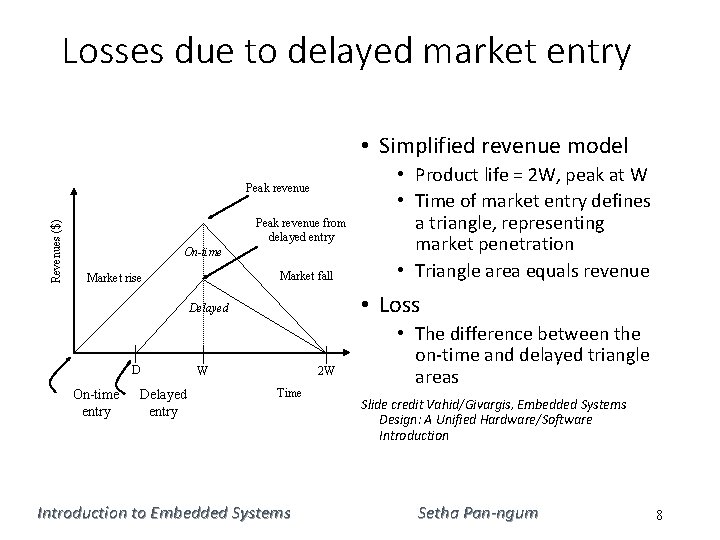
Losses due to delayed market entry • Simplified revenue model Revenues ($) Peak revenue from delayed entry On-time Market fall Market rise • Loss Delayed D On-time entry Delayed entry • Product life = 2 W, peak at W • Time of market entry defines a triangle, representing market penetration • Triangle area equals revenue W 2 W Time Introduction to Embedded Systems • The difference between the on-time and delayed triangle areas Slide credit Vahid/Givargis, Embedded Systems Design: A Unified Hardware/Software Introduction Setha Pan-ngum 8
Other Design Considerations • Dependability • Reliability: probability of system working correctly provided that it worked at time t=0 • Maintainability: probability of system working correctly d time units after error occurred. [Some systems require no maintenance throughout their operating lives (e. g. electric kettles, computer keyboards), while some may need it such as mobile phones and airplane flight control (software upgrade)] Introduction to Embedded Systems Setha Pan-ngum 9
Other Design Considerations • Dependability • Availability: probability of system working at time t • Safety • Security: in communication Basically, critical applications have to operate correctly at all time e. g. airplane flight control computer. This includes both hardware and software aspects. Introduction to Embedded Systems Setha Pan-ngum 10
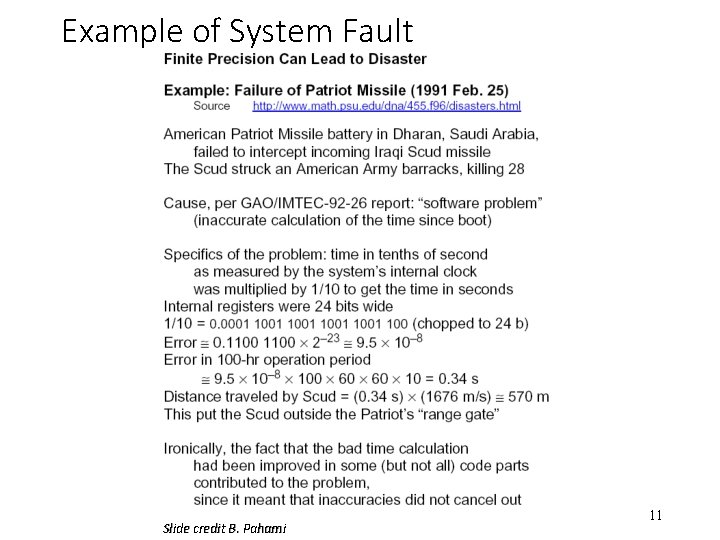
Example of System Fault Slide credit B. Pahami 11
Other Design Considerations • Operating environment Some engine Electronic Control Units (ECUs) in cars are located under the bonnets. So they have to work at high temperature, as well as dusty and wet environment. • EMI (Electromagnetic Interference) Introduction to Embedded Systems Setha Pan-ngum 12
Real-Time Consideration • Correct operation of real-time systems means: • Working correctly (functionally correct) • Producing outputs in time! • i. e. correct result at the right time Introduction to Embedded Systems Setha Pan-ngum 13
Hard Real-time • System designed to meet all deadlines • A missed deadline is a design flaw • For examples: ABS brake, nuclear reactor monitoring system • System hardware (over) designed for worst-case performance • System software rigorously tested • Formal proofs used to guarantee timing correctness Slide credit – T Givargis Introduction to Embedded Systems Setha Pan-ngum 14
Firm Real-time • System designed to meet all deadlines, but occasional missed deadline is allowed • Sometimes statistically quantified (e. g. 5% misses) • For examples: multimedia systems • System hardware designed for average case performance • System software tested under average (ideal) conditions Slide credit – T Givargis Introduction to Embedded Systems Setha Pan-ngum 15
Soft Real-time • System designed to meet as many deadlines as possible • Best effort to complete within specified time, but may be late • For examples: network switch or router • System hardware designed for average case performance • System software tested under averaged (ideal) conditions Slide credit – T Givargis Introduction to Embedded Systems Setha Pan-ngum 16
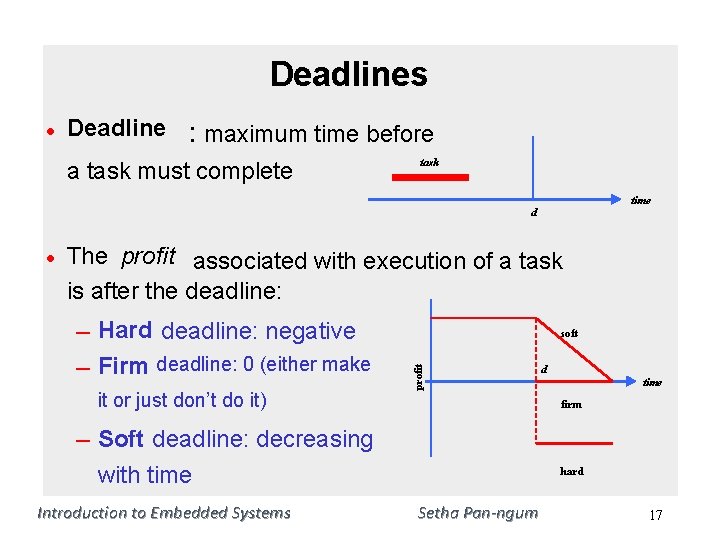
Deadlines • Deadline : maximum time before a task must complete task time d • The profit associated with execution of a task is after the deadline: it or just don’t do it) – Soft deadline: decreasing with time Introduction to Embedded Systems soft profit – Hard deadline: negative – Firm deadline: 0 (either make d firm Slide taken from J. J Lukkien Setha Pan-ngum time hard 17
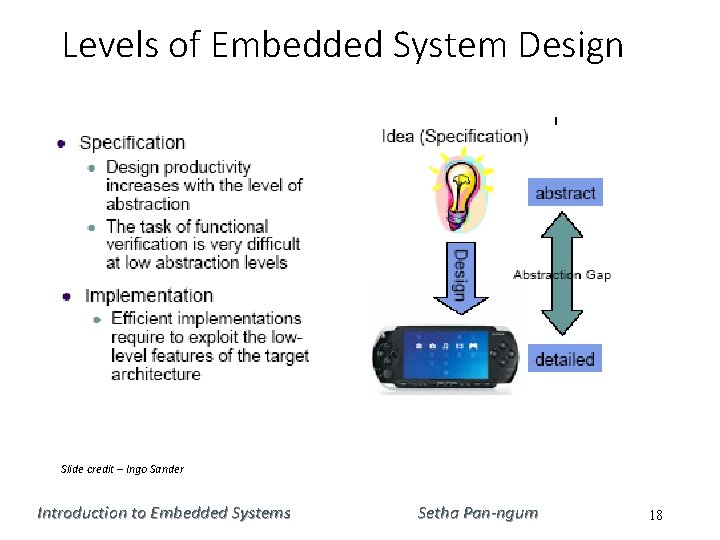
Levels of Embedded System Design Slide credit – Ingo Sander Introduction to Embedded Systems Setha Pan-ngum 18
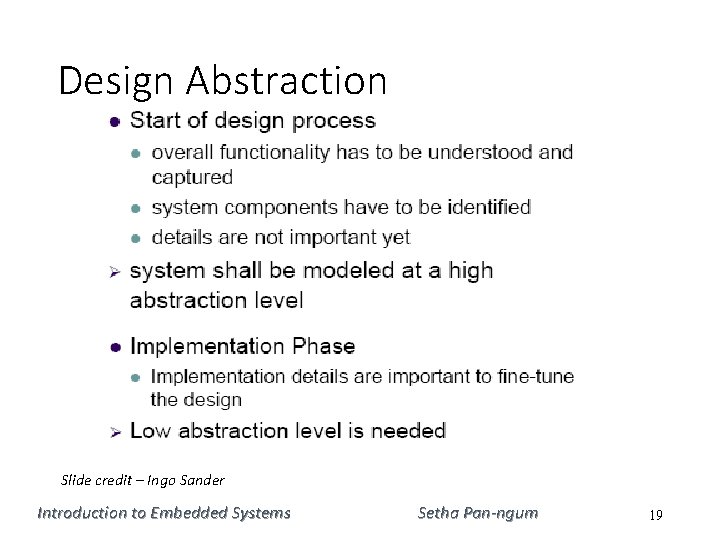
Design Abstraction Slide credit – Ingo Sander Introduction to Embedded Systems Setha Pan-ngum 19
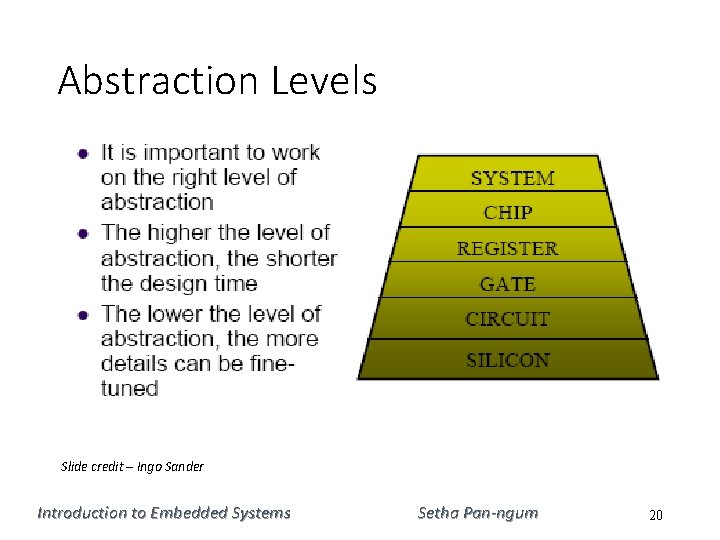
Abstraction Levels Slide credit – Ingo Sander Introduction to Embedded Systems Setha Pan-ngum 20
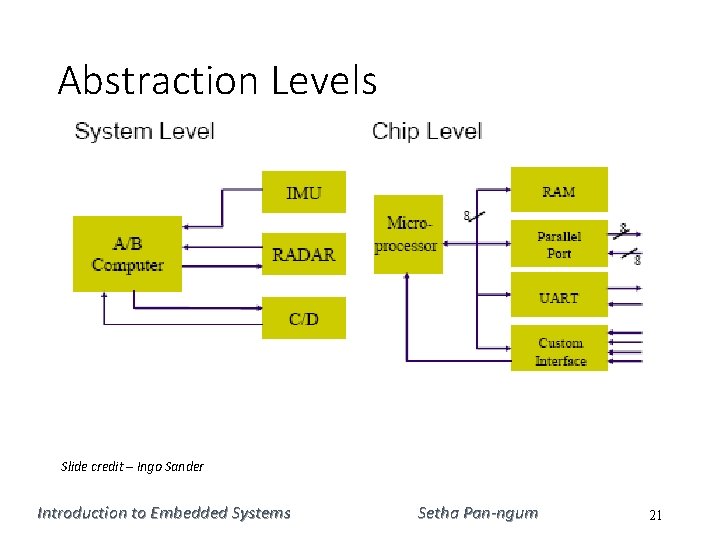
Abstraction Levels Slide credit – Ingo Sander Introduction to Embedded Systems Setha Pan-ngum 21
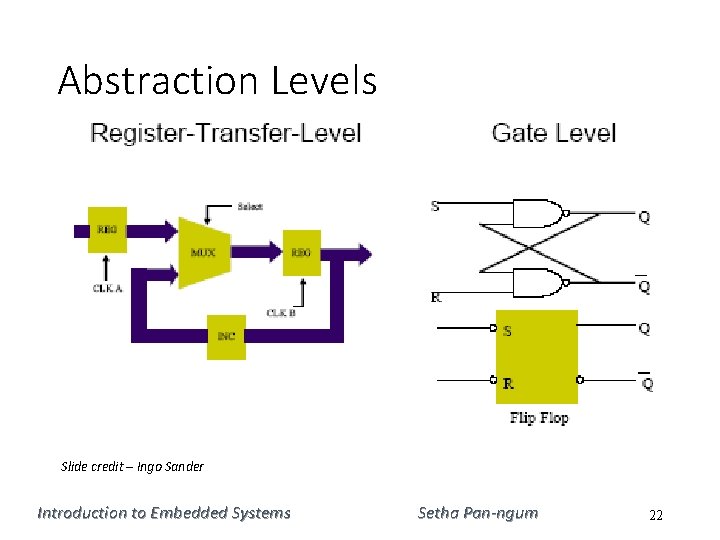
Abstraction Levels Slide credit – Ingo Sander Introduction to Embedded Systems Setha Pan-ngum 22
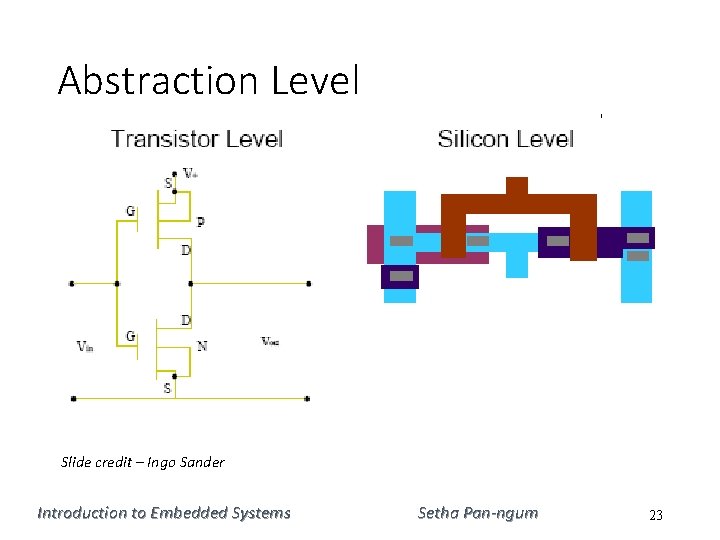
Abstraction Level Slide credit – Ingo Sander Introduction to Embedded Systems Setha Pan-ngum 23
Hardware vs Software • Many functions can be done by software on a general purpose microprocessor OR by hardware on an application specific ICs (ASICs) • For examples: game console graphic, PWM, PID control • Leads to Hardware/Software Co-design concept Introduction to Embedded Systems Setha Pan-ngum 24
Hardware or Software? • Where to place functionality? • ex: A Sort algorithm • Faster in hardware, but more expensive. • More flexible in software but slower. • Other examples? • Must be able to explore these various trade-offs: • • Cost. Speed. Reliability. Form (size, weight, and power constraints. ) Slide credit - W. Mc. Umber, MSU Introduction to Embedded Systems Setha Pan-ngum 25
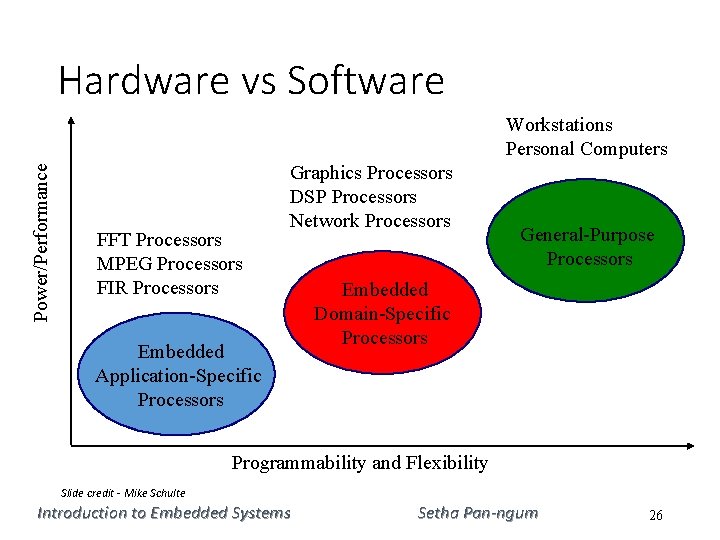
Hardware vs Software Power/Performance Workstations Personal Computers FFT Processors MPEG Processors FIR Processors Graphics Processors DSP Processors Network Processors Embedded Application-Specific Processors General-Purpose Processors Embedded Domain-Specific Processors Programmability and Flexibility Slide credit - Mike Schulte Introduction to Embedded Systems Setha Pan-ngum 26
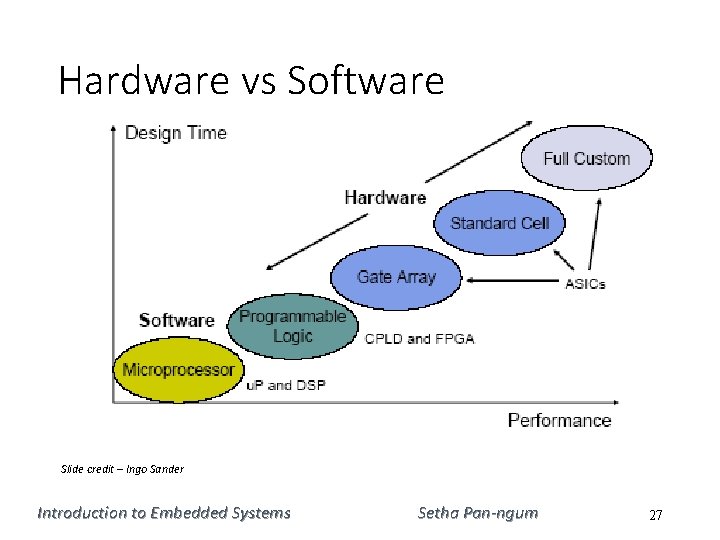
Hardware vs Software Slide credit – Ingo Sander Introduction to Embedded Systems Setha Pan-ngum 27
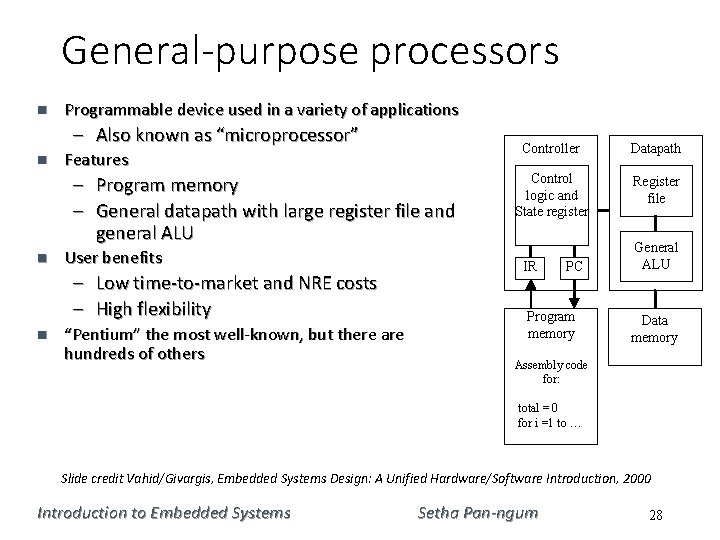
General-purpose processors n Programmable device used in a variety of applications – Also known as “microprocessor” n Features – Program memory – General datapath with large register file and general ALU n User benefits – Low time-to-market and NRE costs – High flexibility n “Pentium” the most well-known, but there are hundreds of others Controller Datapath Control logic and State register Register file IR PC Program memory General ALU Data memory Assembly code for: total = 0 for i =1 to … Slide credit Vahid/Givargis, Embedded Systems Design: A Unified Hardware/Software Introduction, 2000 Introduction to Embedded Systems Setha Pan-ngum 28
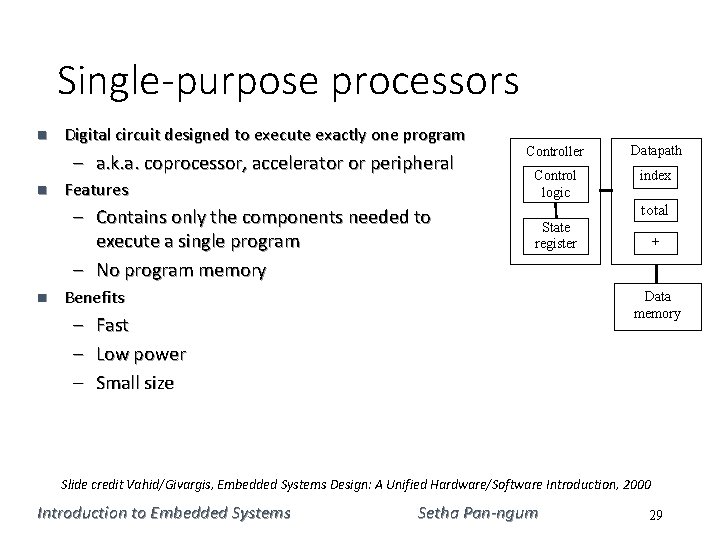
Single-purpose processors n Digital circuit designed to execute exactly one program – a. k. a. coprocessor, accelerator or peripheral n Features – Contains only the components needed to execute a single program – No program memory n Controller Datapath Control logic index total State register Benefits – – – + Data memory Fast Low power Small size Slide credit Vahid/Givargis, Embedded Systems Design: A Unified Hardware/Software Introduction, 2000 Introduction to Embedded Systems Setha Pan-ngum 29
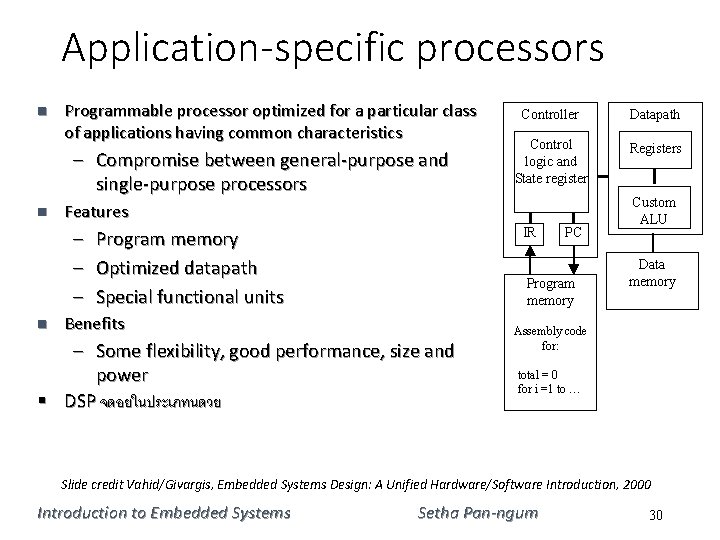
Application-specific processors n Programmable processor optimized for a particular class of applications having common characteristics – Compromise between general-purpose and single-purpose processors n Datapath Control logic and State register Registers Features IR – Program memory – Optimized datapath – Special functional units n Controller PC Program memory Benefits – Some flexibility, good performance, size and power § DSP จดอยในประเภทนดวย Custom ALU Data memory Assembly code for: total = 0 for i =1 to … Slide credit Vahid/Givargis, Embedded Systems Design: A Unified Hardware/Software Introduction, 2000 Introduction to Embedded Systems Setha Pan-ngum 30
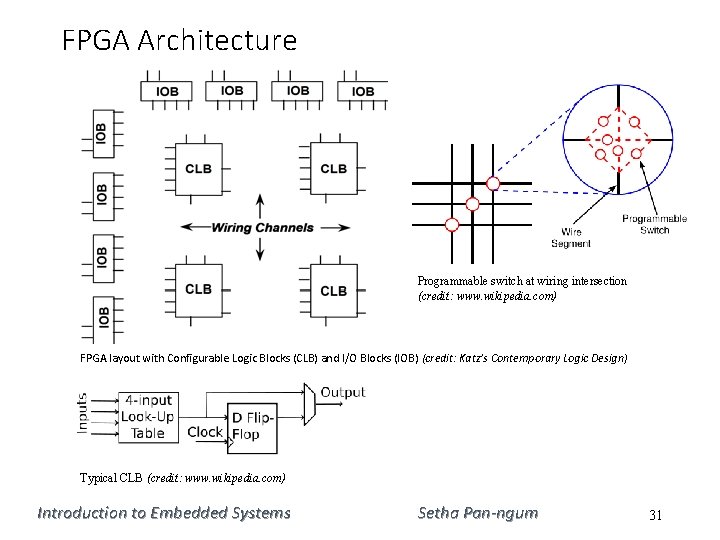
FPGA Architecture Programmable switch at wiring intersection (credit: www. wikipedia. com) FPGA layout with Configurable Logic Blocks (CLB) and I/O Blocks (IOB) (credit: Katz’s Contemporary Logic Design) Typical CLB (credit: www. wikipedia. com) Introduction to Embedded Systems Setha Pan-ngum 31
• Highly constrained products tend to use application specific processors • Many mobile phones (power&size constrained) contain ARM chips • Hi-Fi (high performance&time constrained) contain DSP chips Introduction to Embedded Systems Setha Pan-ngum 32
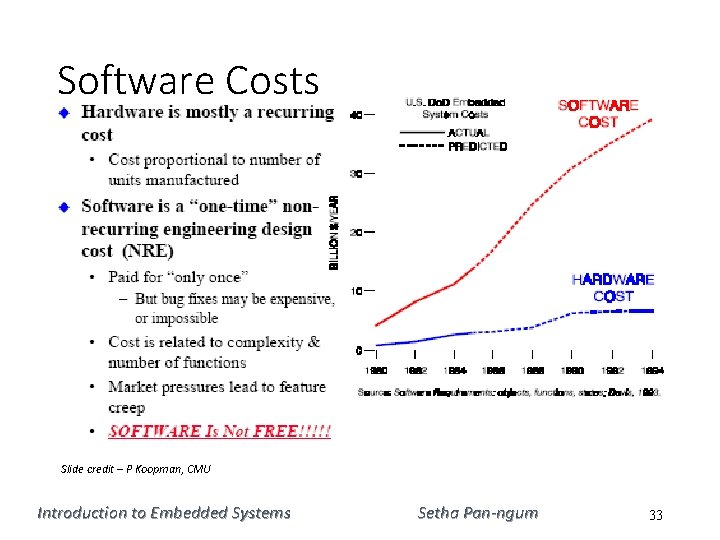
Software Costs Slide credit – P Koopman, CMU Introduction to Embedded Systems Setha Pan-ngum 33
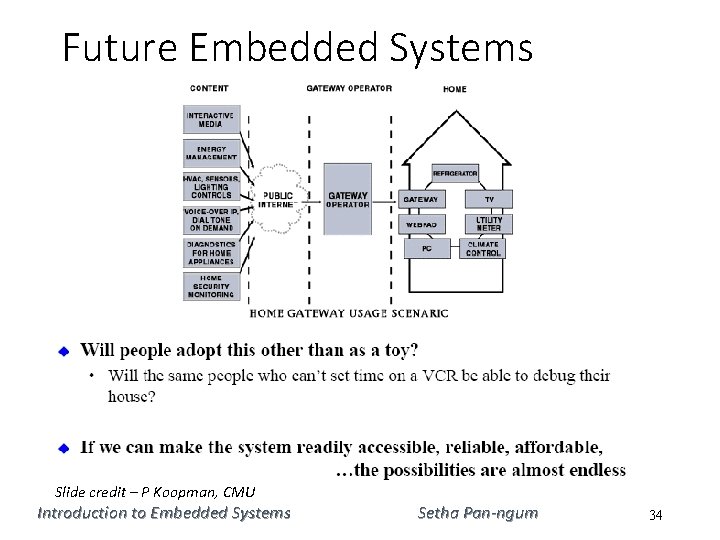
Future Embedded Systems Slide credit – P Koopman, CMU Introduction to Embedded Systems Setha Pan-ngum 34
- Slides: 34