
Embedded Computer Architecture 5 SAI 0 Chip MultiProcessors
Embedded Computer Architecture 5 SAI 0 Chip Multi-Processors (ch 8) Henk Corporaal www. ics. ele. tue. nl/~heco/courses/ECA h. corporaal@tue. nl TUEindhoven 2016 -2017 Advanced Computer Architecture pg
Welcome back Chip Multi-Processors • 8. 3: Multi-threading: – Coarse grain multi-threading – Fine-grain multi-threading – SMT (simultaneous multi-threading) • called hyperthreading by Intel Material: – Book chapter 8 • 8. 3: SMT Advanced Computer Architecture pg 2
New Approach: Multi-Threaded • Multithreading = multiple threads share the functional units of 1 processor – duplicate independent state of each thread e. g. , a separate copy of register file, a separate PC – HW for fast thread switch; much faster than full process switch 100 s to 1000 s of clocks • When to switch? – Next instruction next thread (fine grain), or – When a thread is stalled, perhaps for a cache miss, another thread can be executed (coarse grain) Advanced Computer Architecture pg 3
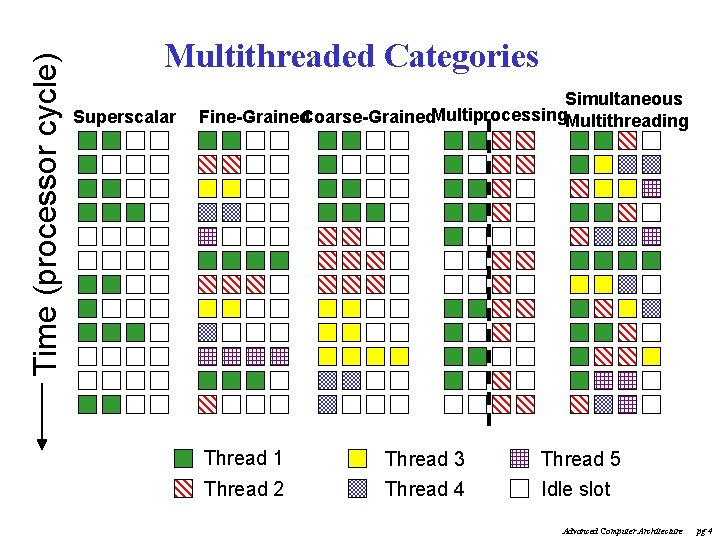
Time (processor cycle) Multithreaded Categories Superscalar Simultaneous Fine-Grained. Coarse-Grained. Multiprocessing. Multithreading Thread 1 Thread 2 Thread 3 Thread 4 Thread 5 Idle slot Advanced Computer Architecture pg 4

Fine-Grained Multithreading • Switches between threads on each instruction, causing the execution of multiples threads to be interleaved • Usually done in a round-robin fashion, skipping any stalled threads • CPU must be able to switch threads every clock • Advantage: it can hide both short and long stalls, since instructions from other threads executed when one thread stalls • Disadvantage: may slow down execution of individual threads • Used in e. g. Sun’s Niagara Advanced Computer Architecture pg 5
Course-Grained Multithreading • Switches threads only on costly stalls, such as L 2 cache misses • Advantages – Relieves need to have very fast thread-switching – Doesn’t slow down thread, since instructions from other threads issued only when the thread encounters a costly stall • Disadvantage: hard to overcome throughput losses from shorter stalls, due to pipeline start-up costs – Since CPU issues instructions from 1 thread, when a stall occurs, the pipeline must be emptied or frozen – New thread must fill pipeline before instructions can complete • Because of this start-up overhead, coarse-grained multithreading is better for reducing penalty of high cost stalls, where pipeline refill << stall time • Used in e. g. IBM AS/400 Advanced Computer Architecture pg 6
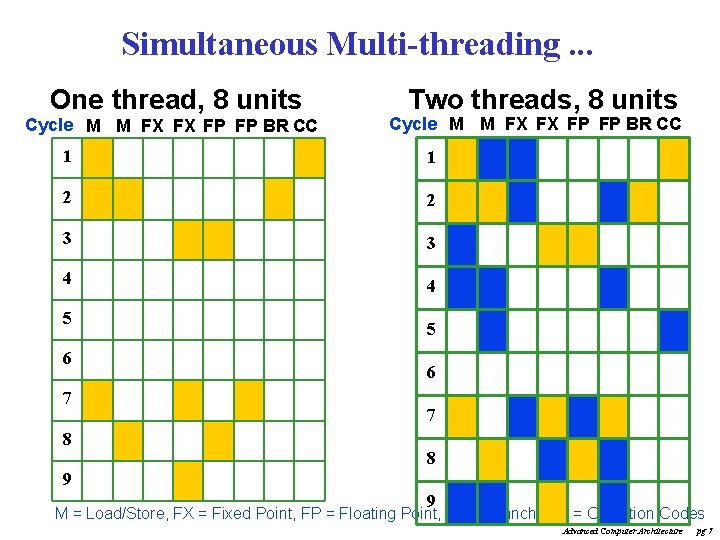
Simultaneous Multi-threading. . . One thread, 8 units Cycle M M FX FX FP FP BR CC Two threads, 8 units Cycle M M FX FX FP FP BR CC 1 1 2 2 3 3 4 4 5 6 7 8 9 9 M = Load/Store, FX = Fixed Point, FP = Floating Point, BR = Branch, CC = Condition Codes Advanced Computer Architecture pg 7
Simultaneous Multithreading (SMT) • SMT: dynamically scheduled processors already has many HW mechanisms to support multithreading: – Large set of virtual registers that can be used to hold the register sets of independent threads – Register renaming provides unique register identifiers, so instructions from multiple threads can be mixed in datapath without confusing sources and destinations across threads – Out-of-order completion allows the threads to execute out of order, and get better utilization of the HW • Just adding a per thread renaming table and keeping separate PCs Advanced Computer Architecture pg 8
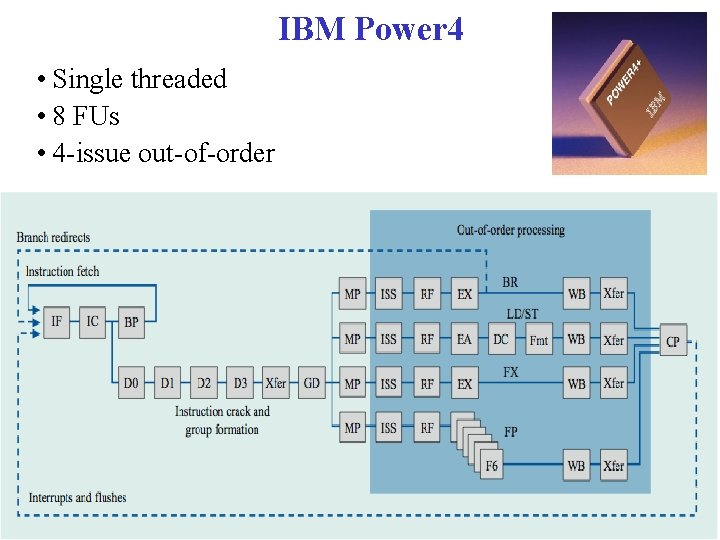
IBM Power 4 • Single threaded • 8 FUs • 4 -issue out-of-order Advanced Computer Architecture pg 9
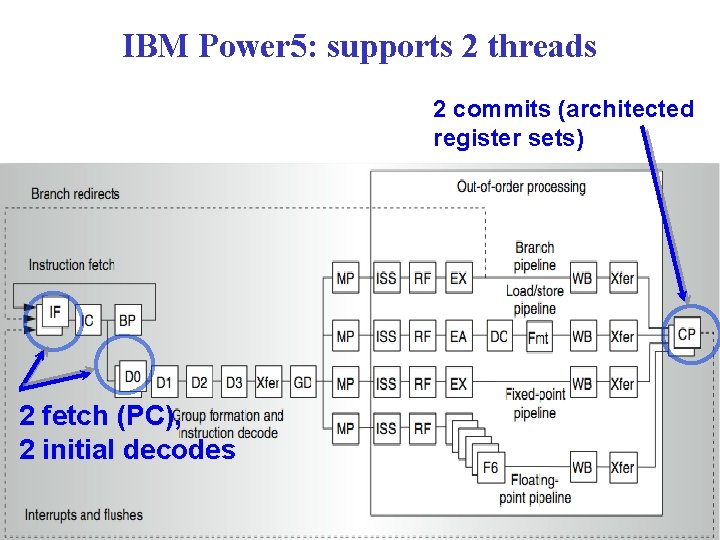
IBM Power 5: supports 2 threads 2 commits (architected register sets) 2 fetch (PC), 2 initial decodes Advanced Computer Architecture pg 10
Changes in Power 5 to support SMT • Increased associativity of L 1 instruction cache and the instruction address translation buffers • Added per thread load and store queues • Increased size of the L 2 (1. 92 vs. 1. 44 MB) and L 3 caches • Added separate instruction prefetch and buffering per thread • Increased the number of virtual registers from 152 to 240 • Increased the size of several issue queues • The Power 5 core is about 24% larger than the Power 4 core because of the addition of SMT support Advanced Computer Architecture pg 11
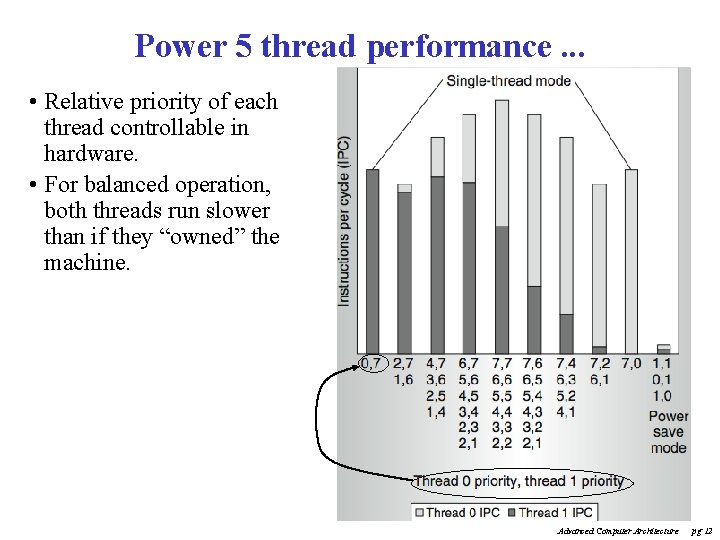
Power 5 thread performance. . . • Relative priority of each thread controllable in hardware. • For balanced operation, both threads run slower than if they “owned” the machine. Advanced Computer Architecture pg 12
• Do you like Multi-Threading? • Do we need it? – when? • Can you compare pros and cons of MT and Multi-Processing ? Advanced Computer Architecture pg 13
- Slides: 13