
EMarketing Lecture 6 Ethical and Legal Issues By
E-Marketing Lecture 6 Ethical and Legal Issues By Hanniya Abid Assistant Professor COMSATS Institute of Information Technology
Objectives �After this lecture, you will be able to: �Compare and contrast ethics and law. �Discuss the implications of ethical codes and self-regulation. �Identify some of the main privacy concerns within traditional and digital contexts. �Explain some of the important patent, copyright, trademark, and data ownership issues related to the Internet. �Highlight key ethical and legal concerns related to online expression.
Software Infringement Copyright infringement occurs when people download copyrighted software without a license, loan software to others for which they have no licenses, or install software on more computers than allowed. Counterfeiting occurs when illegally copied software is duplicated and distributed on a large scale. Globally, over a third of the software sold is an infringing version.
Software Infringement, cont. Microsoft uses the following remedies: Proposes intellectual property legislation. Files civil lawsuits. Creates noninfringement technologies such as digital rights management (DRM) security programs embedded in software CDs. Microsoft believes that education is the best weapon against piracy. Do you agree?
Legal challenges in e-Marketing �Online businesses: �Must comply with the same laws and regulations that govern the operations of all businesses �Face complicating factors �The Web extends a company’s reach beyond traditional boundaries �The Web increases the speed and efficiency of business communications �The Web creates a network of customers
Borders and Jurisdiction � Territorial borders in the physical world mark the range of culture and reach of applicable laws very clearly � Power �A form of control over physical space and the people and objects that reside in that space �A defining characteristic of statehood � Jurisdiction �Ability of a government to exert control over a person or corporation � Legitimacy �Idea that those subject to laws should have some role in formulating them

Jurisdiction on the Internet �Power, effects, legitimacy, and notice do not translate well to the virtual e-commerce world �To enforce laws governments must establish jurisdiction over business conduct �Contract �Promise or set of promises between two or more legal entities
Ethics and Legal Issues �Ethics and law are integrally related. �Modern technology presents challenges to marketing ethics. Critical issues include: �Ownership of intellectual property �The role of privacy in a virtual world �Freedom of expression �Use of data and its collection �Status of children and digital networks
The Problem of Self-Regulation �The development of the Internet has been left to the free operation of the market. �Supporters of self-regulation stress the private sector’s ability to identify and resolve problems. �Critics argue that incentives for self-regulation are insufficient and true deterrence will not be achieved. �Policy-making activities indicate that governments are asserting themselves in areas such as fraud prevention and children’s privacy.
Privacy �The concept of privacy encompasses both ethical and legal aspects. �There is constant debate regarding privacy and it has proved to be an elusive concept, both ethically and legally. �Within society, privacy interests compete with concerns for safety, economics, and need for association with others.
Privacy Within Digital Contexts �Conflicts about how data should be collected and used have developed. �AMA Code of Ethics for marketing on the Internet: “information collected from customers should be confidential and used only for expressed purposes. ” �Online advertising firms such as Double. Click have traditionally recorded users’ clickstreams to form user profiles for marketing purposes. �Controversy arose in 2000 when Double. Click acquired consumer names, addresses, and buying histories and planned to combine the offline data with clickstream data.
Online Data Collection �Data are obtained through the use of digital cookies, packets of data created and stored on the user’s hard drive in response to instructions received from a web page. �Cookies serve many purposes: �Create shopping baskets to hold purchases �Recall stored sales information �Collect user data �Cookies allow marketers to pinpoint an individual’s online behavior.
Privacy Debates And Policy Access to personal data is another important online privacy issue. � Cutting-edge applications also raise additional issues. � Hostile applets � Intelligent agents � � While laws relating to Internet privacy remain in debate, many offenses can be addressed by conventional statutes.
Other Privacy Issues �Ethical collection of information from children 12 or under. �Privacy within electronic mail remains an unsettled aspect of online interaction.
International Privacy Issues The European Union (EU) and the U. S. reached agreement in 2000 to protect EU citizen data. The Federal Trade Corporation has identified the following norms for the ethical use of consumer information: Notice Consent Access Security Enforcement
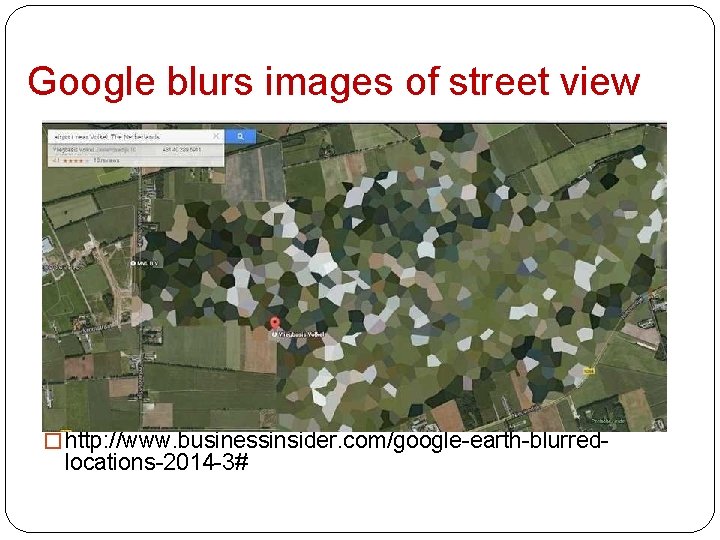
Google blurs images of street view � MEG VAN HUYGEN, ATLAS OBSCURA MAR. 28, 2014, 10: 56 AM � http: //www. businessinsider. com/google-earth-blurredlocations-2014 -3#
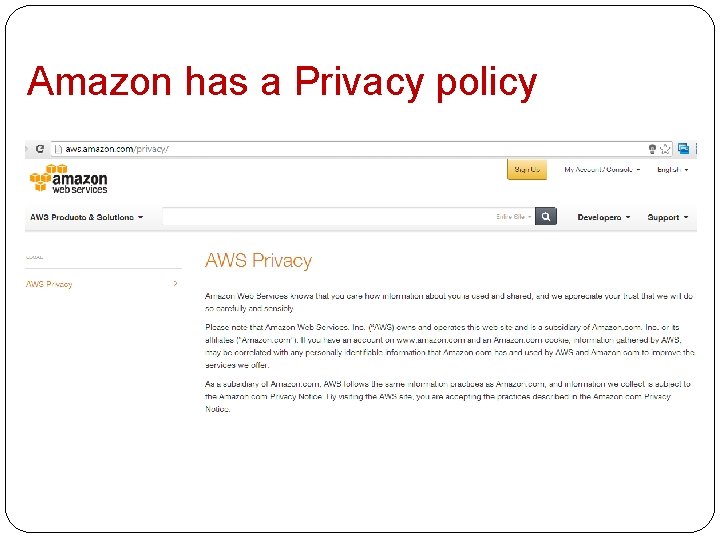
Amazon has a Privacy policy
Intellectual Property �“Intellectual property (IP) are the legally recognized exclusive rights to creations of the mind. ” – wikipedia �Intellectual property �Includes all products of the human mind �Products can be tangible or intangible �Intellectual property rights �Include protections by governments through: �Granting of copyrights and patents �Registration of trademarks and service marks
Digital Property �The law protects intangible or intellectual property through 3 basic mechanisms: �Patent law is centered on inventions. �Copyright addresses issues of expression. �Trademark is concerned with words or images used in the market.
Patents �Applying patent law to computing is an uncertain but developing field. � Patents prevent competitors from doing the same thing a different way. � Patent protection has been claimed for reverse online auctions and secure credit card processing. � The U. S. Patent Office has decided to increase the rigor of reviewing applications for software-related protection.
Patent Infringement �Patent �Exclusive right granted by a government to an individual to make, use, and sell an invention �To be patentable the invention must be genuine, novel, useful, and not obvious, given the current state of technology �Business process patent �Protects a specific set of procedures for conducting a particular business activity Business methods must be: Useful New Non-obvious http: //www. gigalaw. com/articles/
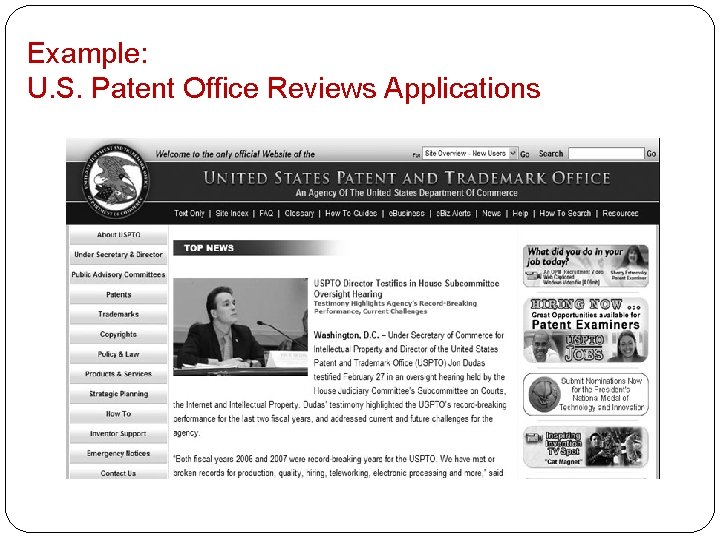
Example: U. S. Patent Office Reviews Applications
Copyright � Copyright is the primary means of protecting most expression on the Internet. � Doctrine of Fair Use � Ability to copy protected material for education and news reporting. � Doctrine of First Sale � Limit the ability of copyright holder to obtain profit after the initial time at which the material is sold.
Web Site Content Issues �Copyright �Right granted by a government to an author or creator of a literary or artistic work �Creations that can be copyrighted include all forms of artistic or intellectual expression �Works copyrighted by corporations or not-for- profit organizations are protected for 95 years
Web Site Content Issues �Fair use of a copyrighted work �Includes copying it for use in criticism, comment, news reporting, teaching, or research
You. Tube Deletes thousand of Files After a Copyright Complaint “TOKYO, Oct. 20 (AP) — The popular video-sharing site You. Tube deleted nearly 30, 000 files after a Japanese entertainment group complained of copyright infringement. (NY Times 10/23/06)”
Copyright, cont. �Examples of copyright laws: �Confer copyright protection for computer content and imposes sanctions for infringement. �Protects ISPs from acts of user infringement. �Criminalizes the circumvention of software protections. �Complies with international standards for copyrighted material.
Trademarks � Trademark law concerns the ownership of intellectual property that identifies goods or services. � Trademark law has been applied to the Internet naming system of domain names. � Similarities in names may result in trademark infringement claims. � A trademark violation, cybersquatting, involves the registration of domains that resemble or duplicate existing ones.
Trademark Infringement �Trademark �Distinctive mark, device, motto, or implement that a company affixes to goods it produces �Service mark �Used to identify services provided �Trade name �Name that a business uses to identify itself �Common law �Part of British and U. S. law established by the history of court decisions
Advertising Regulation �Regulates advertising. �Publishes regulations and investigates claims of false advertising �Provides policy statements �Policies cover specific areas such as: �Bait advertising �Consumer lending and leasing �Endorsements and testimonials
Domain Names, Cyber squatting, Name Stealing �Cyber squatting �Registering a domain name that is the trademark of a person or company and hoping to sell it to that person or company for money �Name changing �Registering misspelled variations of well- known domain names �Name stealing �Ownership of a site’s assigned domain name is changed to another site and
Defamation �Defamatory statement �Statement that is false and injures the reputation of another person or company �Product disparagement �If a defamatory statement injures the reputation of a product or service instead of a person �Per se defamation �Court deems some types of statements to be so negative that injury is assumed See: http: //www. efl-law. com/internet-libel. php
Online Crime, Terrorism, and Warfare �Online crime �Obstacles faced by law enforcement: �Jurisdiction �Difficulty applying laws written before the Internet became prone to criminal actions �Online warfare and terrorism �Sustained effort by a well-financed terrorist group could slow down operation of major transaction-processing centers
Ethical Issues �Web businesses find ethical issues are important to consider when making policy decisions �Electronic Communications Privacy �Differences in cultures throughout the world have resulted in different expectations about privacy in electronic commerce.
Principles for handling customer data �Use data collected to provide improved customer service �Do not share customer data with others outside your company without the customer’s permission �Tell customers what data you are collecting and what you are doing with it �Give customers the right to have you delete any of the data you have collected about them
Some Examples of Ethical Issues �Under what conditions should the privacy of others be invaded? �What legitimizes intruding into others’ lives through unobtrusive surveillance, through market research, or by whatever means? �Do we have to inform people that we are eavesdropping? �Do we have to inform people that we are using credit history information for employment
Analyzing Ethical Dilemmas �Dilemma �a situation is which there at least two diametrically opposed actions, each of which supports a desirable outcome �Can use a five-step process to analyze a dilemma
Analyzing Ethical Dilemmas Identify and describe clearly the facts Ø Find out who did what to whom, and where, when, and how. 2. Define the conflict or dilemma and identify the higher-order values Ø Ethical, social, and political issues always reference higher values 3. Identify the stakeholders Ø Parties with an interest in the outcome, who have invested in the situation, and have vocal opinions 1.
Analyzing Ethical Dilemmas 4. Identify the options that you can reasonably take Ø None of the options may satisfy all interests involved 5. Identify the potential consequences of your options -- and choose Ø Some options may be ethically correct but disastrous from other points of view Ø Some options might work once but not over time
Candidate Ethical Principles �The Golden Rule �Do unto others as you would have them do unto you �Universalism �If an action is not right for all situations, then it is not right for any specific situation �Slippery Slopes �If an action cannot be taken repeatedly, then it is not right to take at all �Collective Utilitarian Principle �Take the action that achieves the greater value for
Candidate Ethical Principles �Risk Aversion �Take the action that produces the least harm, or the least potential cost. �choose actions whose consequences would not be catastrophic, even if there were a failure �No Free Lunch �Assume that virtually all tangible and intangible objects are owned by someone else unless there is a specific declaration otherwise
Summary �Ethical vs legal issues �Intellectual Property in the internet �Privacy �Understanding of legal and ethical issues is of prime importance
Exercise �Use the above rules for analysis and principles to analyze (choose one or two and discuss): �Downloading music �Advertising networks (like Double. Click) who track Web surfing behavior �Data mining by retail stores and credit card companies �Using opt out vs. opt in policies �Another issue of your choice
- Slides: 44