
EM 1 Enterprise Modelling as a way to
- Slides: 20
EM 1 - Enterprise Modelling as a way to achieve Interoperability Module 2 - What are the current methods and tools for Enterprise Modelling? © 2005 -2006 The ATHENA Consortium.
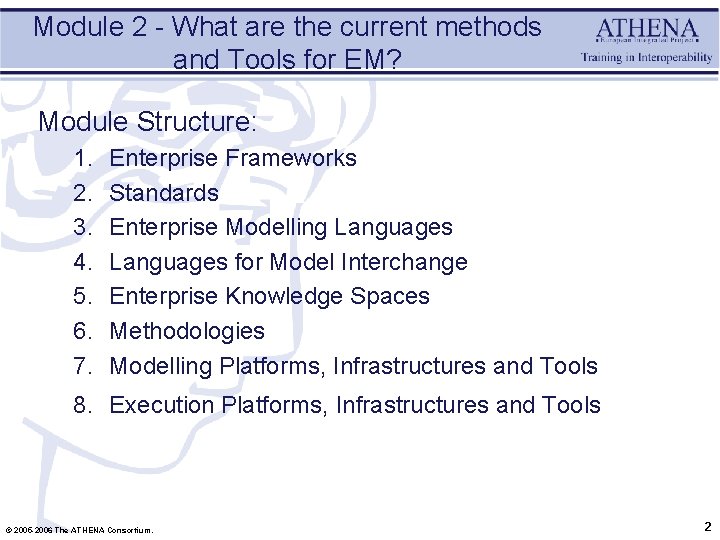
Module 2 - What are the current methods and Tools for EM? Module Structure: 1. 2. 3. 4. 5. 6. 7. Enterprise Frameworks Standards Enterprise Modelling Languages for Model Interchange Enterprise Knowledge Spaces Methodologies Modelling Platforms, Infrastructures and Tools 8. Execution Platforms, Infrastructures and Tools © 2005 -2006 The ATHENA Consortium. 2
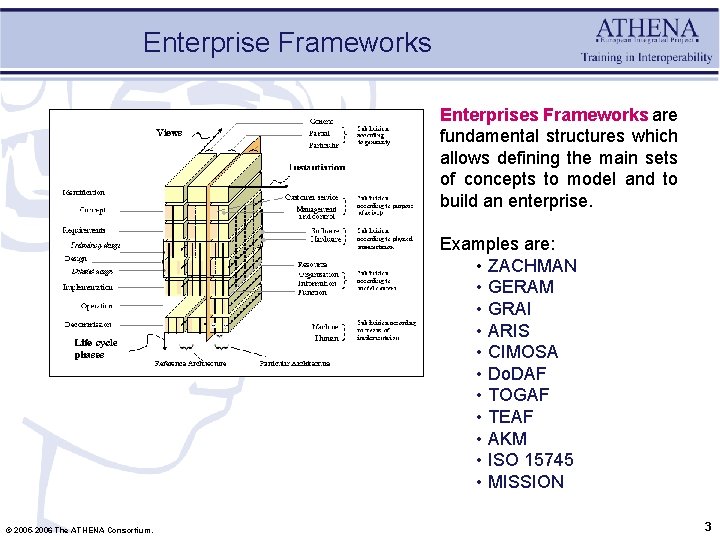
Enterprise Frameworks Enterprises Frameworks are fundamental structures which allows defining the main sets of concepts to model and to build an enterprise. Examples are: • ZACHMAN • GERAM • GRAI • ARIS • CIMOSA • Do. DAF • TOGAF • TEAF • AKM • ISO 15745 • MISSION © 2005 -2006 The ATHENA Consortium. 3
Enterprise Frameworks (2) Architectural frameworks mentioned are designed to define views of specific enterprise domains. Frameworks lack capabilities for: • meta-data management • role-driven viewing • integration with platforms • model-driven design • generation of interoperable solutions. © 2005 -2006 The ATHENA Consortium. 4
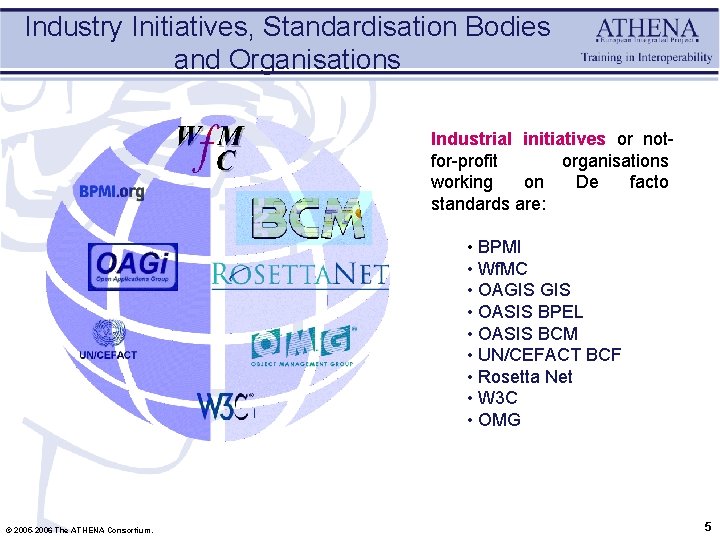
Industry Initiatives, Standardisation Bodies and Organisations Industrial initiatives or notfor-profit organisations working on De facto standards are: • BPMI • Wf. MC • OAGIS • OASIS BPEL • OASIS BCM • UN/CEFACT BCF • Rosetta Net • W 3 C • OMG © 2005 -2006 The ATHENA Consortium. 5
Standards European and international standards relevant to enterprise interoperability are: • EN/ISO 19439: Framework for enterprise modelling • EN/ISO 19400: Constructs for enterprise modelling • CEN TS 14818: Decisional reference model • ISO CD 18629: PSL • ISO 15704: Requirements for enterprise architectures and methodologies • ISO 14258: Concepts and Rules for Enterprise Models • ISO/IEC 15414: Open Distributed Processing – Reference Model © 2005 -2006 The ATHENA Consortium. 6
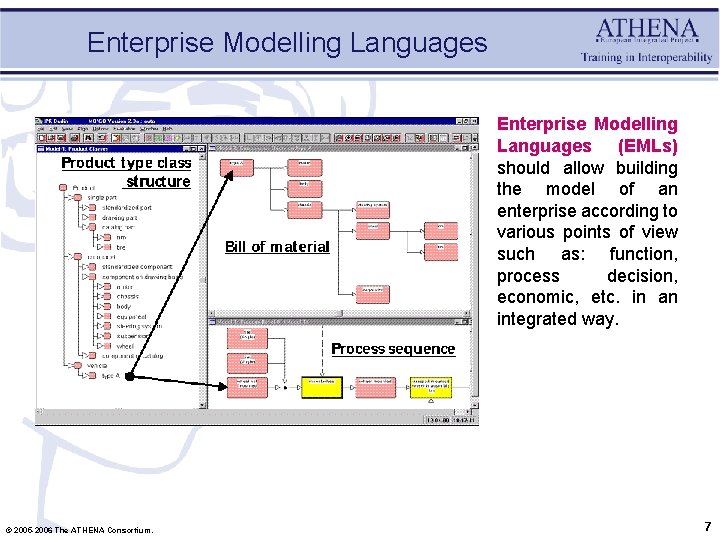
Enterprise Modelling Languages (EMLs) should allow building the model of an enterprise according to various points of view such as: function, process decision, economic, etc. in an integrated way. © 2005 -2006 The ATHENA Consortium. 7
Enterprise Modelling Languages (2) There are two categories of languages: • Languages defined at high level of abstraction as Constructs for EM (for example GRAI) which are independent of the technology of implementation • Languages more related to a specific technology such as INTERNET technology based languages (for example eb. XML). IEM Metis ITM Metis BPM Metis UML MEML Petri Nets CIMOSA GRAI IDEF PSL © 2005 -2006 The ATHENA Consortium. WPDL XPDL BPML EDOC UML profile for EAI eb. XML BPDM EPC 8
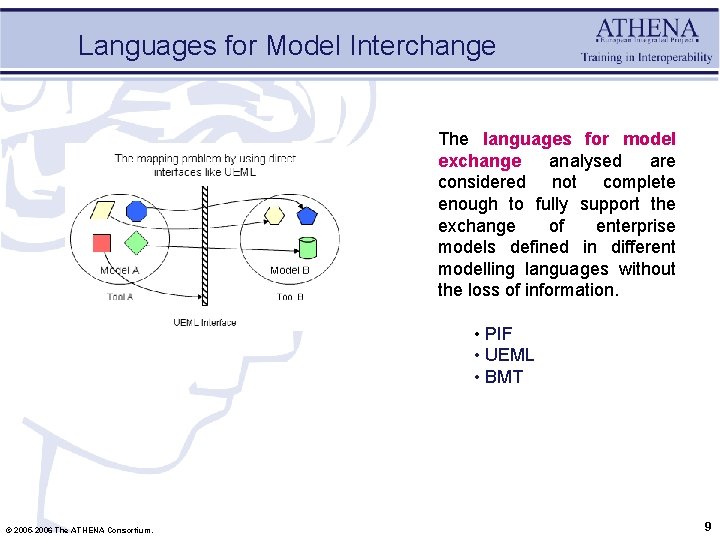
Languages for Model Interchange The languages for model exchange analysed are considered not complete enough to fully support the exchange of enterprise models defined in different modelling languages without the loss of information. • PIF • UEML • BMT © 2005 -2006 The ATHENA Consortium. 9
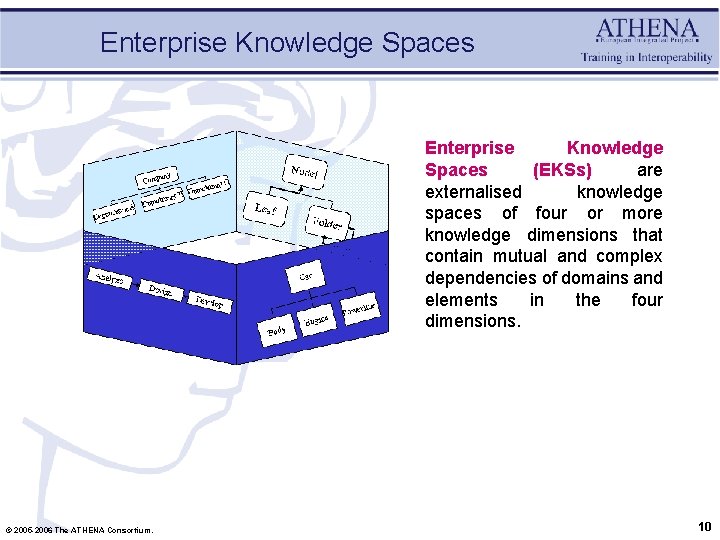
Enterprise Knowledge Spaces (EKSs) are externalised knowledge spaces of four or more knowledge dimensions that contain mutual and complex dependencies of domains and elements in the four dimensions. © 2005 -2006 The ATHENA Consortium. 10
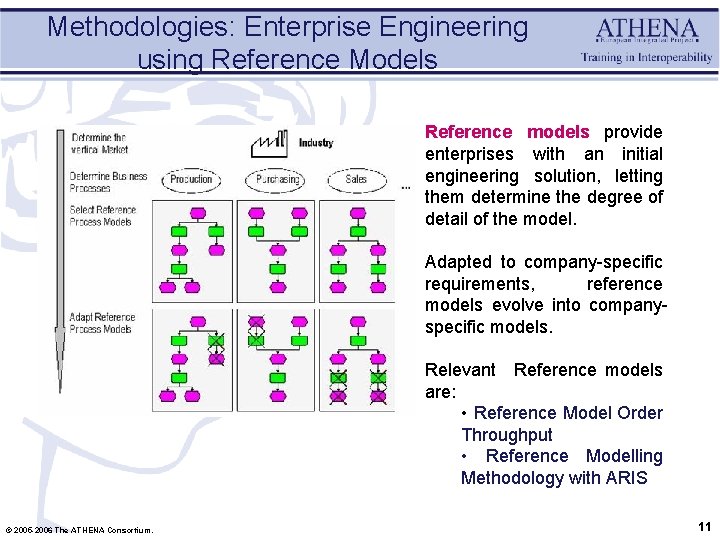
Methodologies: Enterprise Engineering using Reference Models Reference models provide enterprises with an initial engineering solution, letting them determine the degree of detail of the model. Adapted to company-specific requirements, reference models evolve into companyspecific models. Relevant Reference models are: • Reference Model Order Throughput • Reference Modelling Methodology with ARIS © 2005 -2006 The ATHENA Consortium. 11
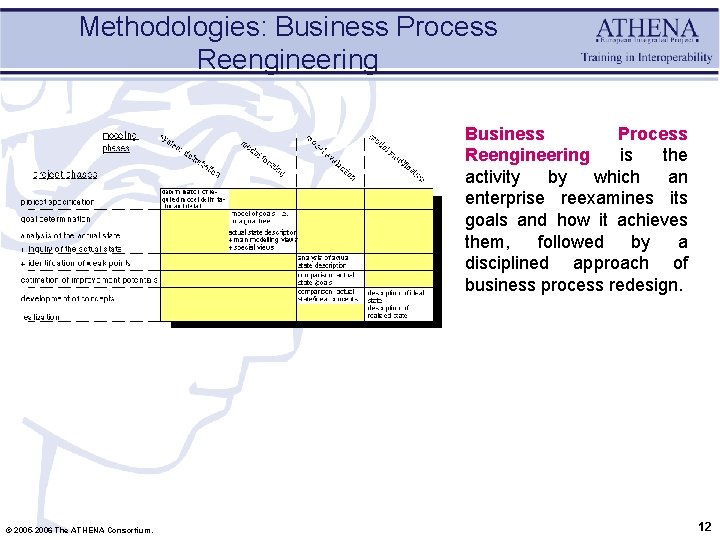
Methodologies: Business Process Reengineering is the activity by which an enterprise reexamines its goals and how it achieves them, followed by a disciplined approach of business process redesign. © 2005 -2006 The ATHENA Consortium. 12
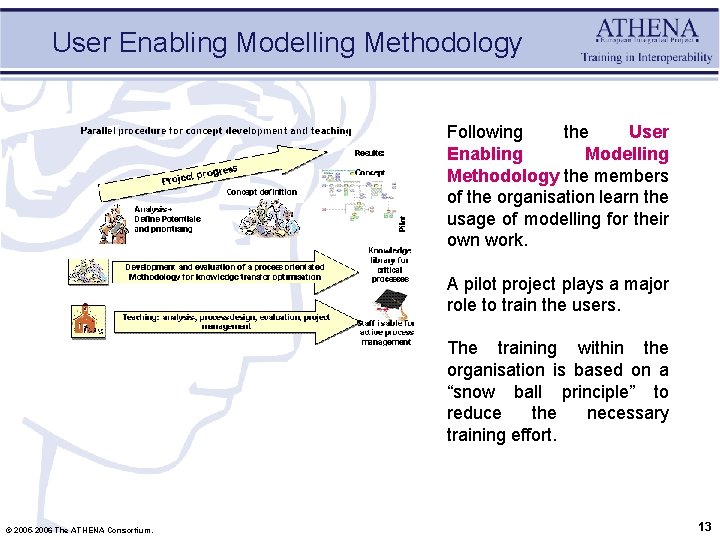
User Enabling Modelling Methodology Following the User Enabling Modelling Methodology the members of the organisation learn the usage of modelling for their own work. A pilot project plays a major role to train the users. The training within the organisation is based on a “snow ball principle” to reduce the necessary training effort. © 2005 -2006 The ATHENA Consortium. 13
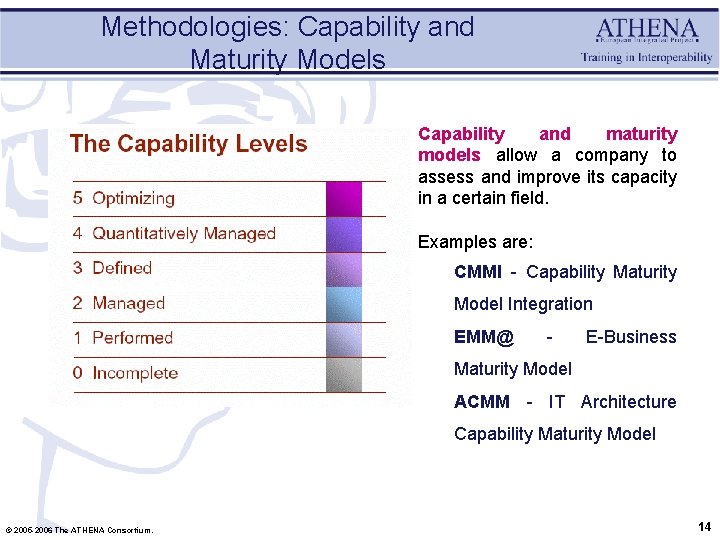
Methodologies: Capability and Maturity Models Capability and maturity models allow a company to assess and improve its capacity in a certain field. Examples are: CMMI - Capability Maturity Model Integration EMM@ - E-Business Maturity Model ACMM - IT Architecture Capability Maturity Model © 2005 -2006 The ATHENA Consortium. 14
Conclusions on Methodologies mentioned are designed to fit the requirements of specific tool suppliers in establishing and marketing their Enterprise Modelling products. Methodologies to be developed in the future must be generic enough to be independent of the modelling languages and enterprise architecture methodologies being offered. © 2005 -2006 The ATHENA Consortium. 15
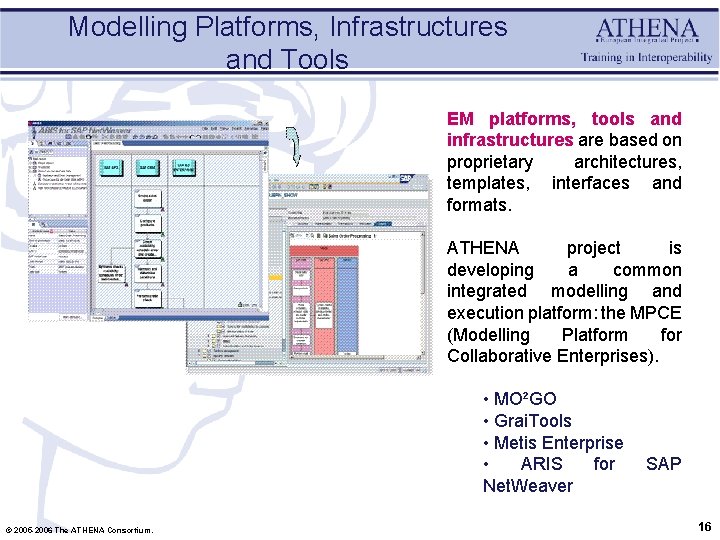
Modelling Platforms, Infrastructures and Tools EM platforms, tools and infrastructures are based on proprietary architectures, templates, interfaces and formats. ATHENA project is developing a common integrated modelling and execution platform: the MPCE (Modelling Platform for Collaborative Enterprises). • MO²GO • Grai. Tools • Metis Enterprise • ARIS for Net. Weaver © 2005 -2006 The ATHENA Consortium. SAP 16
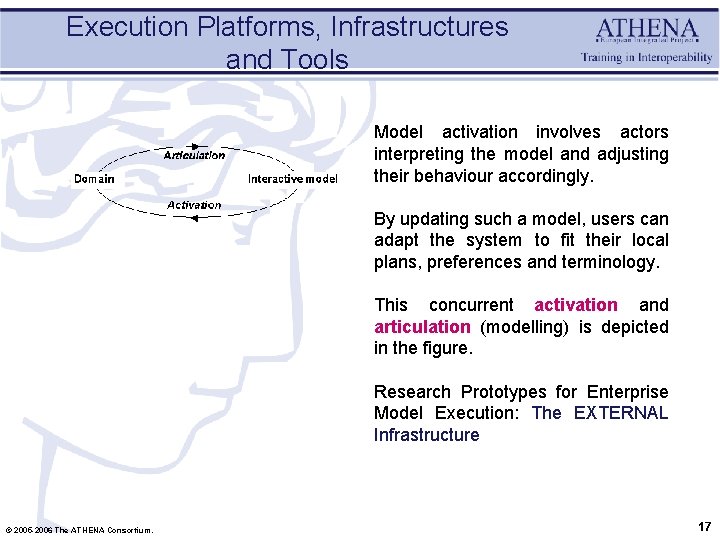
Execution Platforms, Infrastructures and Tools Model activation involves actors interpreting the model and adjusting their behaviour accordingly. By updating such a model, users can adapt the system to fit their local plans, preferences and terminology. This concurrent activation and articulation (modelling) is depicted in the figure. Research Prototypes for Enterprise Model Execution: The EXTERNAL Infrastructure © 2005 -2006 The ATHENA Consortium. 17
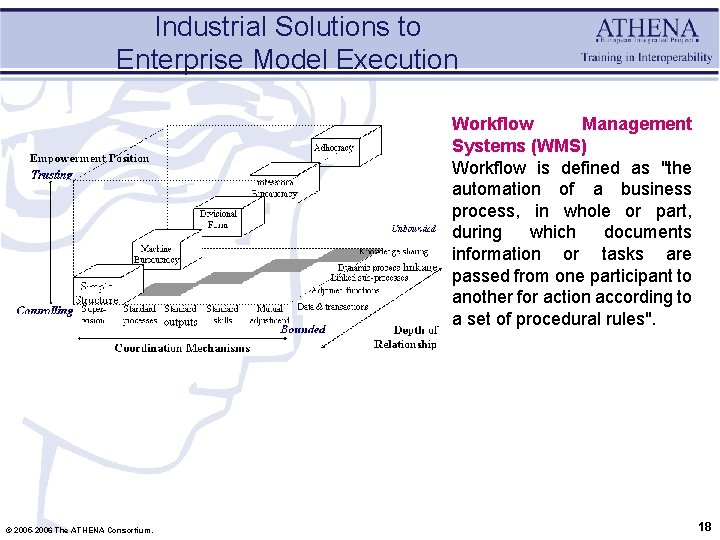
Industrial Solutions to Enterprise Model Execution Workflow Management Systems (WMS) Workflow is defined as "the automation of a business process, in whole or part, during which documents information or tasks are passed from one participant to another for action according to a set of procedural rules". © 2005 -2006 The ATHENA Consortium. 18
Conclusions on Execution Platforms, Infrastructures and Tools The Modelling Platform for Collaborative Enterprises (MPCE) will support distributed modelling and model generated workplaces. New research topic for the workflow community are: • user involvement to simplify the languages and mechanisms of the Workflow Management Systems • integrating support for manual interpretation © 2005 -2006 The ATHENA Consortium. 19
This course has been developed under the funding of the EC with the support of the EC ATHENA-IP Project. Disclaimer and Copyright Notice: Permission is granted without fee for personal or educational (non-profit) use, previous notification is needed. For notification purposes, please, address to the ATHENA Training Programme Chair at rg@uninova. pt. In other cases please, contact at the same e_mail address for use conditions. Some of the figures presented in this course are freely inspired by others reported in referenced works/sources. For such figures copyright and all rights therein are maintained by the original authors or by other copyright holders. It is understood that all persons copying these figures will adhere to the terms and constraints invoked by each copyright holder. © 2005 -2006 The ATHENA Consortium. 20