
Elvis 8 1963 Andy Warhol The Doppler Effect
- Slides: 19
Elvis 8 (1963) Andy Warhol The Doppler Effect Vocabulary: • Doppler effect • source • observer • red shift • blue shift This topic can be found on pp. 412 -413 of your textbook.
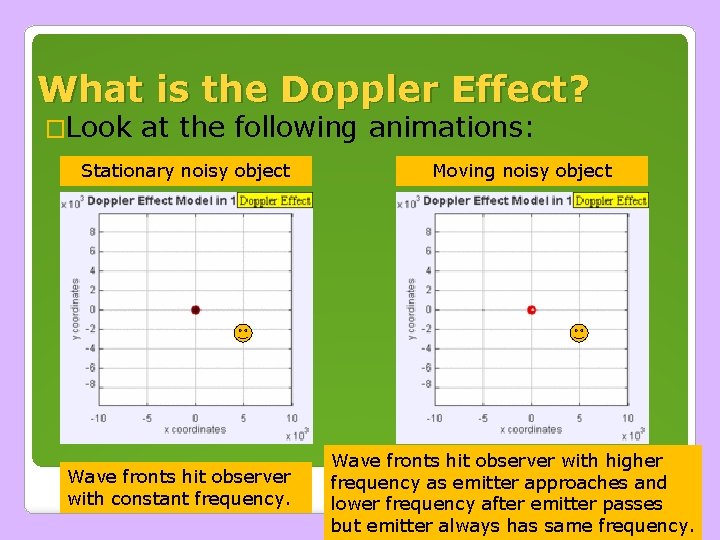
What is the Doppler Effect? �Look at the following animations: Stationary noisy object Wave fronts hit observer with constant frequency. Moving noisy object Wave fronts hit observer with higher frequency as emitter approaches and lower frequency after emitter passes but emitter always has same frequency.
What is the Doppler Effect? � An observed change in frequency of a wave when an observer and source have a relative motion between them.
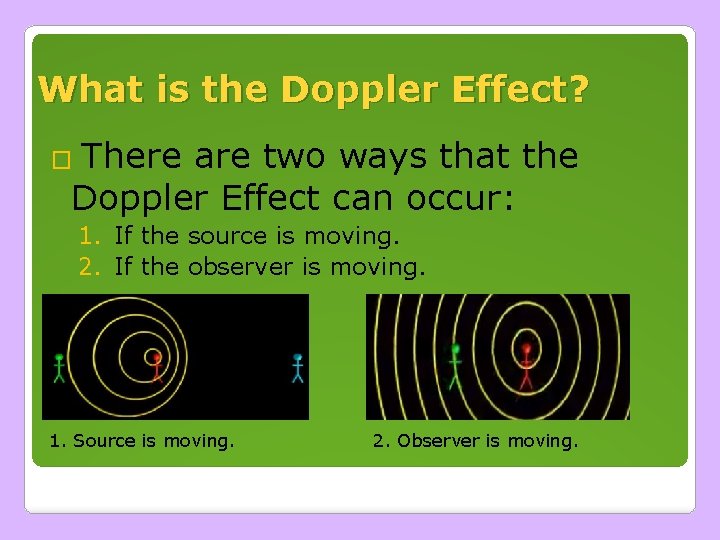
What is the Doppler Effect? � There are two ways that the Doppler Effect can occur: 1. If the source is moving. 2. If the observer is moving. 1. Source is moving. 2. Observer is moving.
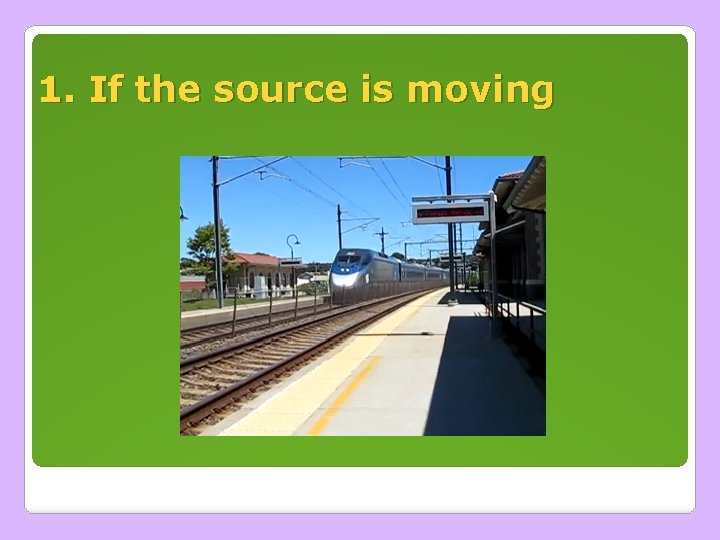
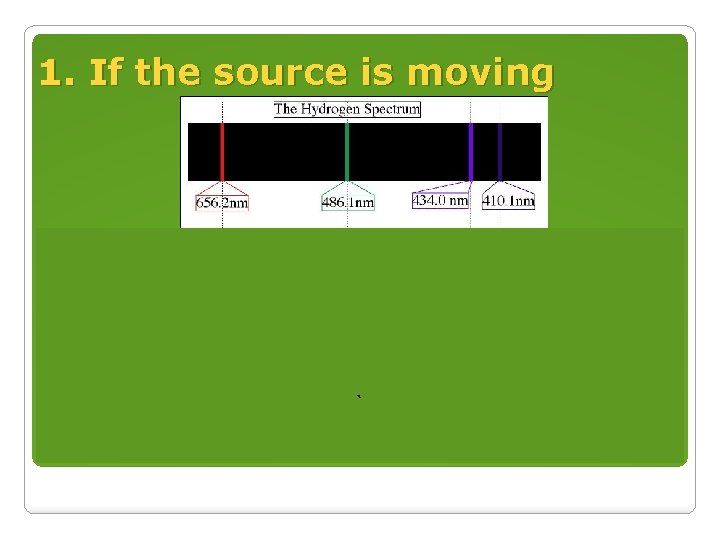
1. If the source is moving
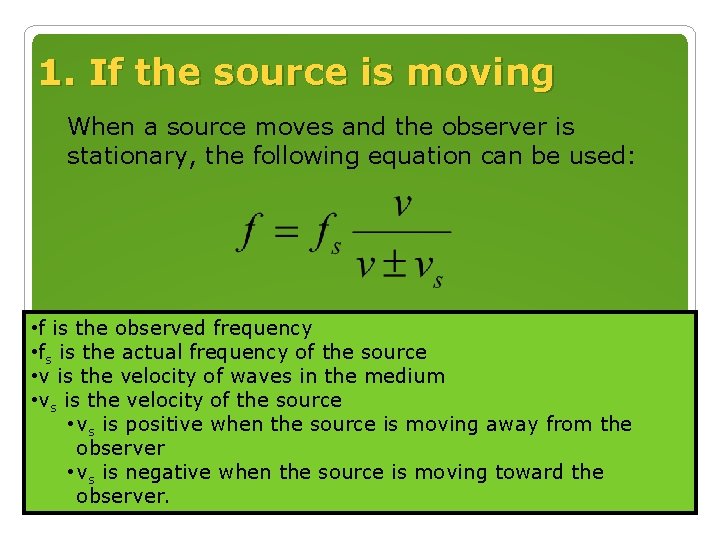
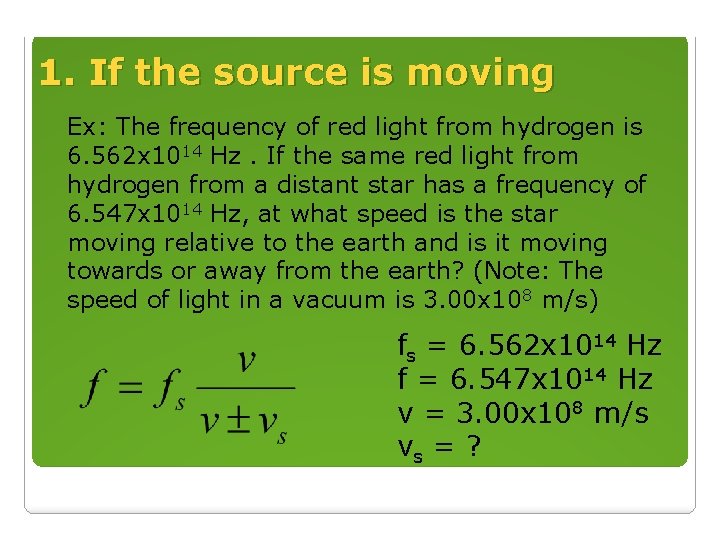
1. If the source is moving When a source moves and the observer is stationary, the following equation can be used: • f is the observed frequency • fs is the actual frequency of the source • v is the velocity of waves in the medium • vs is the velocity of the source • vs is positive when the source is moving away from the observer • vs is negative when the source is moving toward the observer.
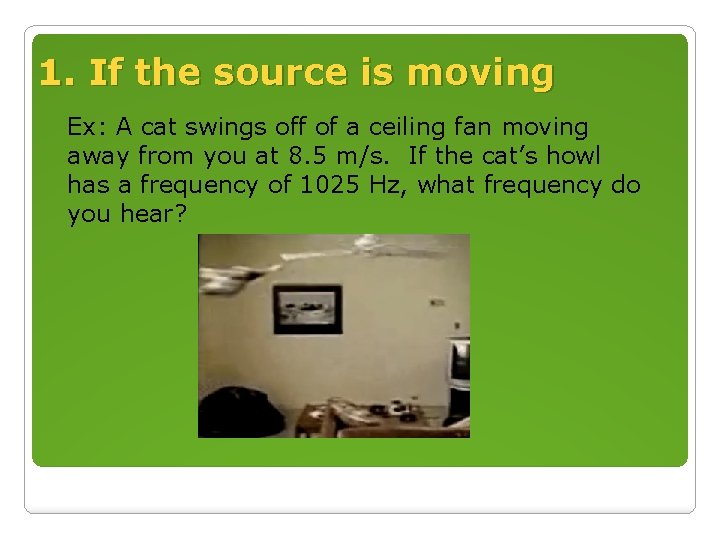
1. If the source is moving Ex: A cat swings off of a ceiling fan moving away from you at 8. 5 m/s. If the cat’s howl has a frequency of 1025 Hz, what frequency do you hear?
1. If the source is moving Ex: The frequency of red light from hydrogen is 6. 562 x 1014 Hz. If the same red light from hydrogen from a distant star has a frequency of 6. 547 x 1014 Hz, at what speed is the star moving relative to the earth and is it moving towards or away from the earth? (Note: The speed of light in a vacuum is 3. 00 x 108 m/s)
1. If the source is moving `
1. If the source is moving Ex: The frequency of red light from hydrogen is 6. 562 x 1014 Hz. If the same red light from hydrogen from a distant star has a frequency of 6. 547 x 1014 Hz, at what speed is the star moving relative to the earth and is it moving towards or away from the earth? (Note: The speed of light in a vacuum is 3. 00 x 108 m/s) fs = 6. 562 x 1014 Hz f = 6. 547 x 1014 Hz v = 3. 00 x 108 m/s vs = ?
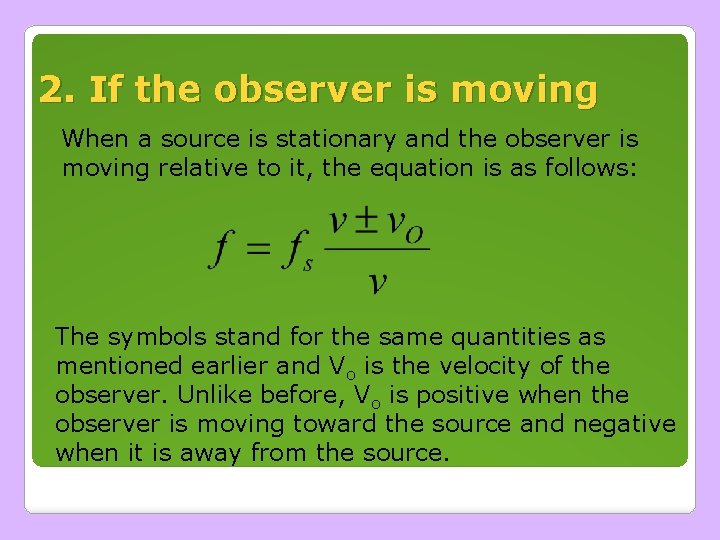
2. If the observer is moving When a source is stationary and the observer is moving relative to it, the equation is as follows: The symbols stand for the same quantities as mentioned earlier and Vo is the velocity of the observer. Unlike before, Vo is positive when the observer is moving toward the source and negative when it is away from the source.
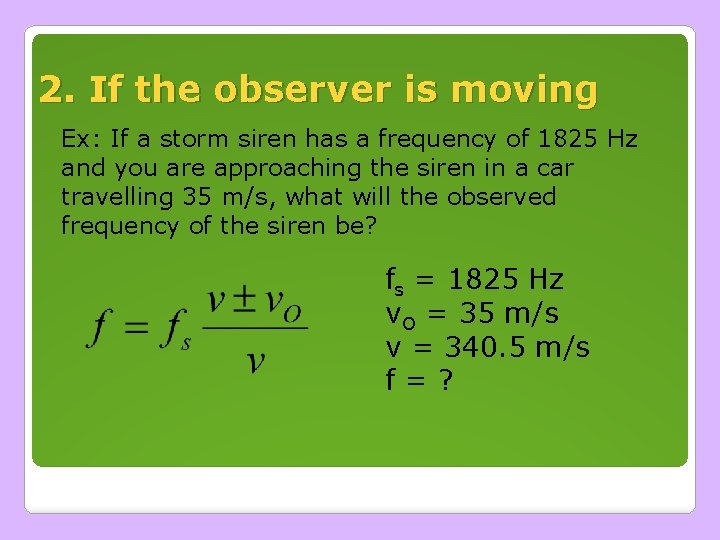
2. If the observer is moving Ex: If a storm siren has a frequency of 1825 Hz and you are approaching the siren in a car travelling 35 m/s, what will the observed frequency of the siren be? fs = 1825 Hz v. O = 35 m/s v = 340. 5 m/s f = ?
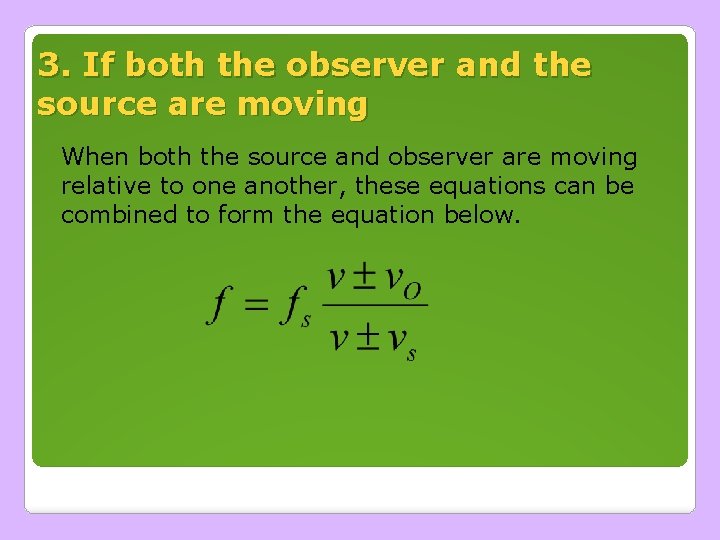
3. If both the observer and the source are moving When both the source and observer are moving relative to one another, these equations can be combined to form the equation below.
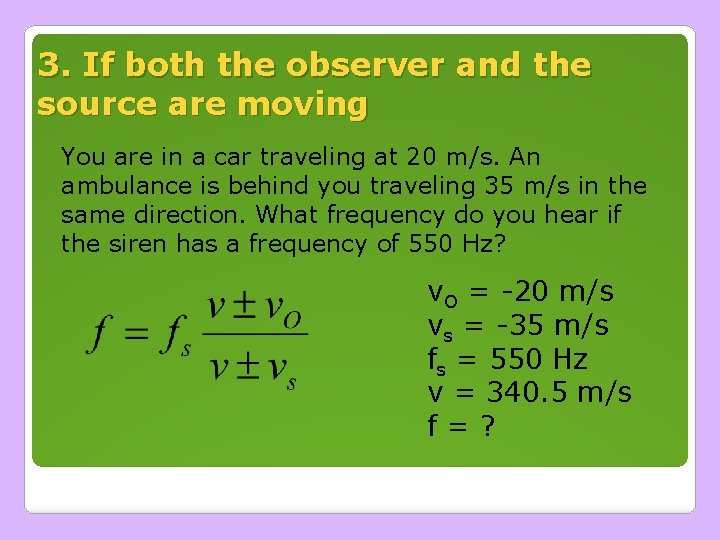
3. If both the observer and the source are moving You are in a car traveling at 20 m/s. An ambulance is behind you traveling 35 m/s in the same direction. What frequency do you hear if the siren has a frequency of 550 Hz? v. O = -20 m/s vs = -35 m/s fs = 550 Hz v = 340. 5 m/s f = ?
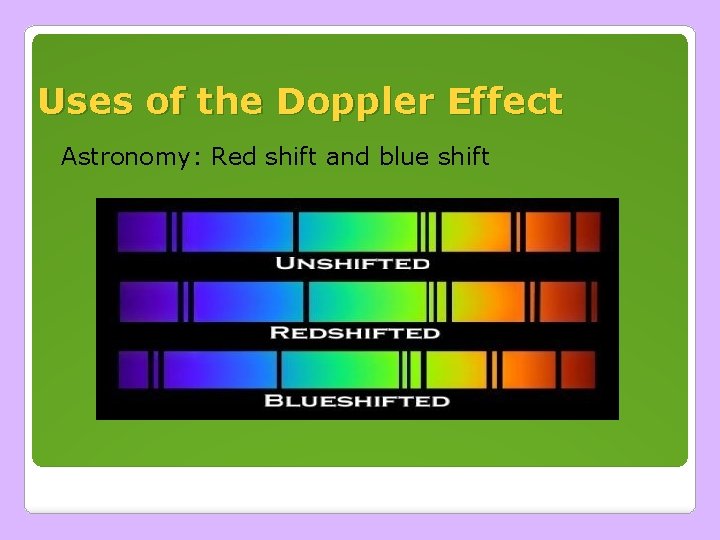
Uses of the Doppler Effect Astronomy: Red shift and blue shift
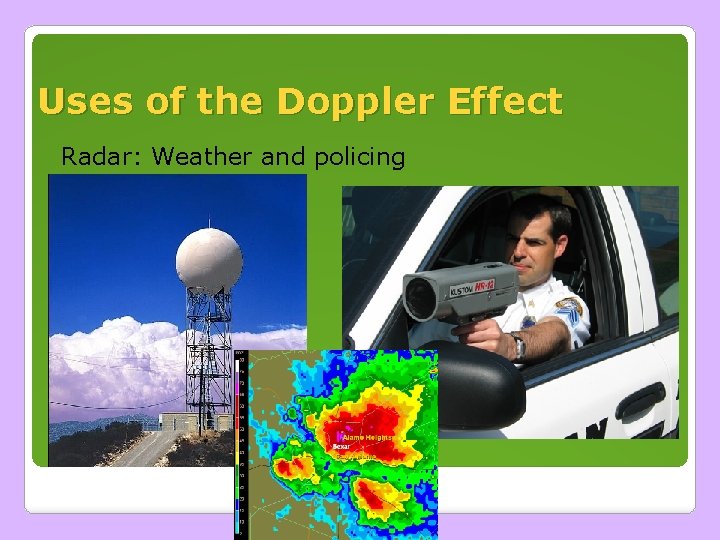
Uses of the Doppler Effect Radar: Weather and policing
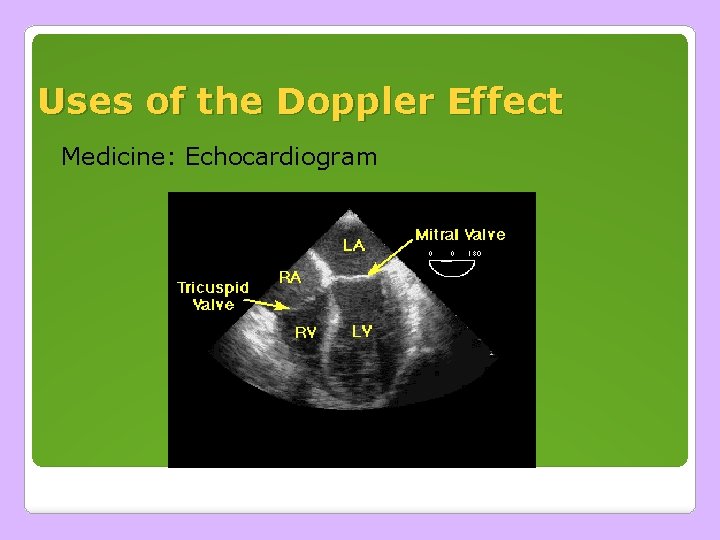
Uses of the Doppler Effect Medicine: Echocardiogram
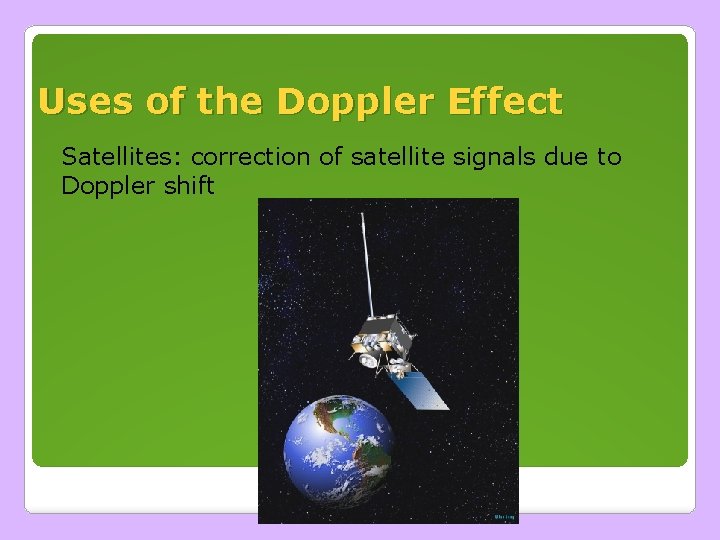
Uses of the Doppler Effect Satellites: correction of satellite signals due to Doppler shift
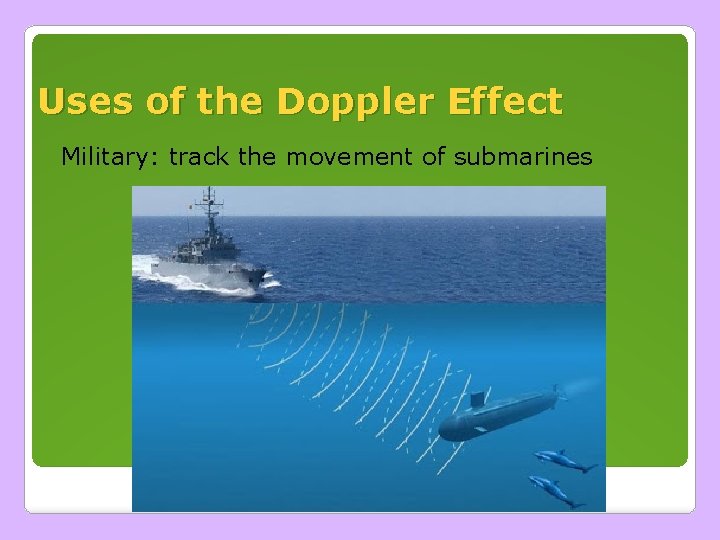
Uses of the Doppler Effect Military: track the movement of submarines