
Eltrombopag for the Treatment of Thrombocytopenia of Low
Eltrombopag for the Treatment of Thrombocytopenia of Low and Intermediate-1 IPSS Risk Myelodysplastic Syndromes: Interim Results on Efficacy, Safety and Quality of Life of an International, Multicenter Prospective, Randomized, Trial 1 Luspatercept Treatment Leads to Long Term Increases in Hemoglobin and Reductions in Transfusion Burden in Patients with Low or Intermediate-1 Risk Myelodysplastic Syndromes (MDS): Preliminary Results from the Phase 2 PACE-MDS Extension Study 2 1 Oliva EN et al Proc ASH 2015; Abstract 91. 2 Giagounidis A et al. Proc ASH 2015; Abstract 92.
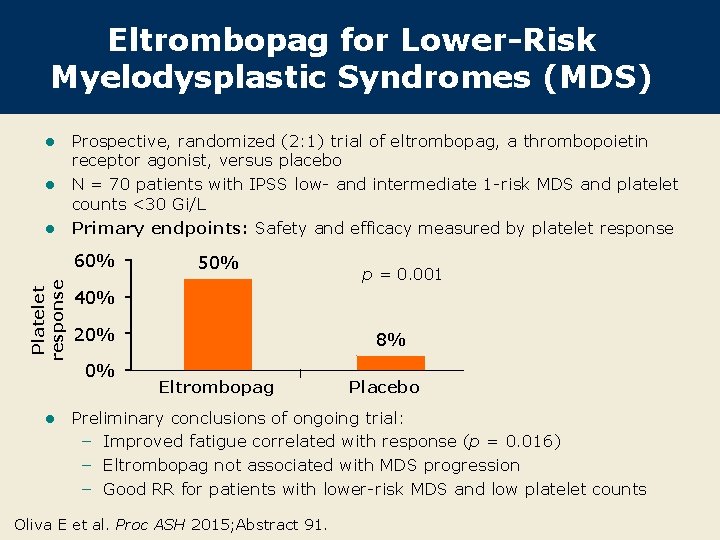
Eltrombopag for Lower-Risk Myelodysplastic Syndromes (MDS) l l l Prospective, randomized (2: 1) trial of eltrombopag, a thrombopoietin receptor agonist, versus placebo N = 70 patients with IPSS low- and intermediate 1 -risk MDS and platelet counts <30 Gi/L Primary endpoints: Safety and efficacy measured by platelet response Platelet response 60% l 50% p = 0. 001 40% 20% 0% 8% Eltrombopag Placebo Preliminary conclusions of ongoing trial: – Improved fatigue correlated with response (p = 0. 016) – Eltrombopag not associated with MDS progression – Good RR for patients with lower-risk MDS and low platelet counts Oliva E et al. Proc ASH 2015; Abstract 91.

PACE-MDS Extension Study: Luspatercept (LUS) for Lower-Risk MDS Phase II dose-escalation study extension evaluating 3 months (q 3 wk) of subcutaneous LUS, a fusion protein that promotes erythropoiesis l N = 32 transfusion-dependent patients with IPSS low- or intermediate 1 -risk MDS l Primary endpoint: IWG erythroid hematologic improvement (HI-E) l IWG HI-E (N = 32) RBC-TI (N = 22) All patients § Presence of ringed sideroblasts 69% 72% 50% 53% Prior ESA § Yes § No 63% 77% 50% Baseline EPO § <200 U/L § 200 -500 U/L § >500 U/L 80% 71% 20% 54% 50% 40% Characteristic RBC-TI = red blood cell transfusion independence; ESA = erithropoietin-stimulating agent; EPO = erythropoietin Giagounidis A et al. Proc ASH 2015; Abstract 92.

PACE-MDS Extension Study: Conclusions l Robust hematologic improvement (IWG HI-E) and reduced transfusion burden were observed in patients with lowerrisk MDS treated with LUS. – Sustained hemoglobin increases and prolonged TI with treatment up to 1 year – High response rates for patients with ESA-refractory MDS and those with EPO ≤ 500 U/L l LUS is safe and well tolerated with no Grade 3 or higher related adverse events. l These results support initiation of a randomized Phase III trial (MEDALIST) for patients with lower-risk MDS with ringed sideroblasts requiring red blood cell transfusion. Giagounidis A et al. Proc ASH 2015; Abstract 92.
Investigator Commentary: Initial Results from Phase II Trials of Eltrombopag or LUS for Myelosuppression in IPSS Low- and Intermediate-Risk MDS The treatment of low-risk MDS is controversial. Patients tend to have favorable long-term outcomes but are often plagued by anemia and/or thrombocytopenia. The presentation by Dr Oliva and colleagues showed that the thrombopoietin agonist eltrombopag was safe and effective in patients with IPSS low- and intermediate 1 -risk MDS. Concern about using eltrombopag for patients with high-risk MDS related to the possibility that leukemia proliferation might be stimulated. No such problem arose in this study. Eltrombopag may have a role in the treatment of lower-risk MDS in patients with refractory thrombocytopenia. An interesting class of compounds includes the so-called activin trap antibody-like molecules, which bind to some of the “negative regulatory cytokines” like Smad 2/3 that might be playing a role in the anemia of low-risk MDS. One such agent, LUS, may be effective in low-risk MDS. continued
Investigator Commentary: Initial Results from Phase II Trials of Eltrombopag or LUS for Myelosuppression in IPSS Low- and Intermediate-Risk MDS The results of a Phase II trial in which LUS was administered to patients with low-risk MDS suggest that these patients, particularly those with low transfusional burdens, can experience an important reduction in or termination of the need for red blood cell transfusions. Follow-up randomized trials will be required, but LUS is certainly one of the few promising drugs in lower-risk MDS. Interview with Richard M Stone, MD, February 16, 2016
- Slides: 6