
ELRC ECD WORK STREAM MEETING Updated ECD Migration

- Slides: 33
ELRC ECD WORK STREAM MEETING Updated ECD Migration Plan 29 May 2019
OUTLINE 1. Critical context 2. Understanding the mandate 3. Roles and responsibilities 4. Overview of the migration 5. Implications 6. Progress and way forward
CRITICAL CONTEXT
ECD LANDSCAPE Centre-based and non centre-based programmes; Majority of centres cater for multiple age cohorts; Location of Grade R learners – not only in schools; Majority of Grade RR learners are in centre-based and non centre-based programmes; • Unfunded critical expectations: • • – Salaries for practitioners. – Expansion of nutrition programmes to ECD. – Inclusion of ECD centres in the DBE Infrastructure programmes.
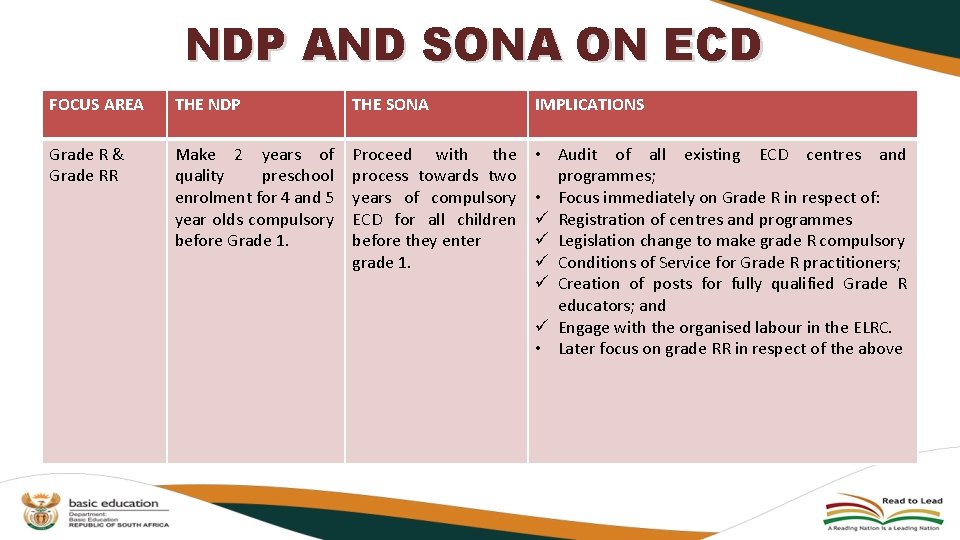
NDP AND SONA ON ECD FOCUS AREA THE NDP THE SONA IMPLICATIONS Grade R & Grade RR Make 2 years of quality preschool enrolment for 4 and 5 year olds compulsory before Grade 1. Proceed with the process towards two years of compulsory ECD for all children before they enter grade 1. • Audit of all existing ECD centres and programmes; • Focus immediately on Grade R in respect of: ü Registration of centres and programmes ü Legislation change to make grade R compulsory ü Conditions of Service for Grade R practitioners; ü Creation of posts for fully qualified Grade R educators; and ü Engage with the organised labour in the ELRC. • Later focus on grade RR in respect of the above
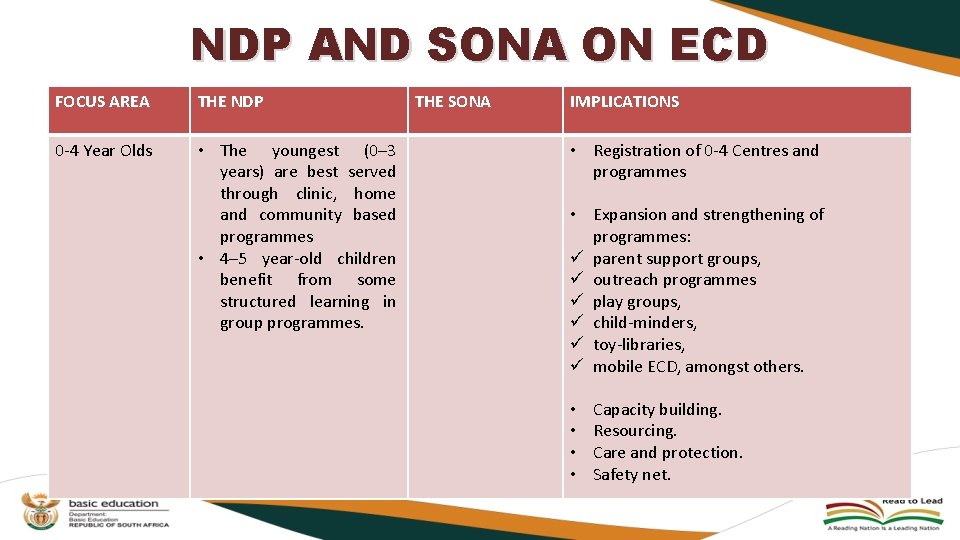
NDP AND SONA ON ECD FOCUS AREA THE NDP 0 -4 Year Olds • The youngest (0– 3 years) are best served through clinic, home and community based programmes • 4– 5 year-old children benefit from some structured learning in group programmes. THE SONA IMPLICATIONS • Registration of 0 -4 Centres and programmes • Expansion and strengthening of programmes: ü parent support groups, ü outreach programmes ü play groups, ü child-minders, ü toy-libraries, ü mobile ECD, amongst others. • • Capacity building. Resourcing. Care and protection. Safety net.
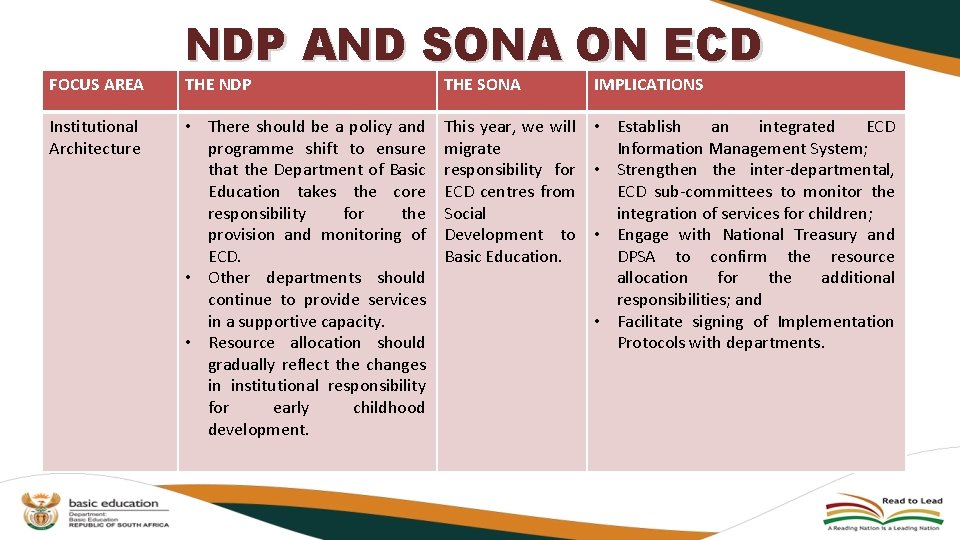
FOCUS AREA Institutional Architecture NDP AND SONA ON ECD THE NDP THE SONA IMPLICATIONS • There should be a policy and programme shift to ensure that the Department of Basic Education takes the core responsibility for the provision and monitoring of ECD. • Other departments should continue to provide services in a supportive capacity. • Resource allocation should gradually reflect the changes in institutional responsibility for early childhood development. This year, we will migrate responsibility for ECD centres from Social Development to Basic Education. • Establish an integrated ECD Information Management System; • Strengthen the inter-departmental, ECD sub-committees to monitor the integration of services for children; • Engage with National Treasury and DPSA to confirm the resource allocation for the additional responsibilities; and • Facilitate signing of Implementation Protocols with departments.
UNDERSTANDING THE MANDATE
WHAT IS THE MANDATE? A. The function/responsibility shift from DSD to DBE: The overall function of leadership and coordination of the National Integrated ECD Policy implementation will shift from the DSD to the DBE at national and provincial levels.
WHAT IS THE MANDATE? B. Proceed with the process towards two years of compulsory ECD for all children before they enter grade 1. Prioritise the registration, monitoring, regulation and quality assurance of centres and programmes with children eligible for Grade R admission (4 turning 5 by June) by the DBE – 2030 2. Registration, monitoring, regulation and quality assurance of centres and programmes with children eligible for Grade RR admission (3 turning 4 by June) by the DBE– 2045
WHAT IS THE MANDATE? C. The youngest (0– 3/4 years) are best served through clinic, home and community based programmes 1. ECD centres and programmes for children from birth to 4 years will be coordinated, monitored, led, quality assured and regulated by DBE with support from DSD, Do. H, COGTA and other relevant departments.
ROLES AND RESPONSIBILITIES IN THE CURRENT NATIONAL INTEGRATED POLICY
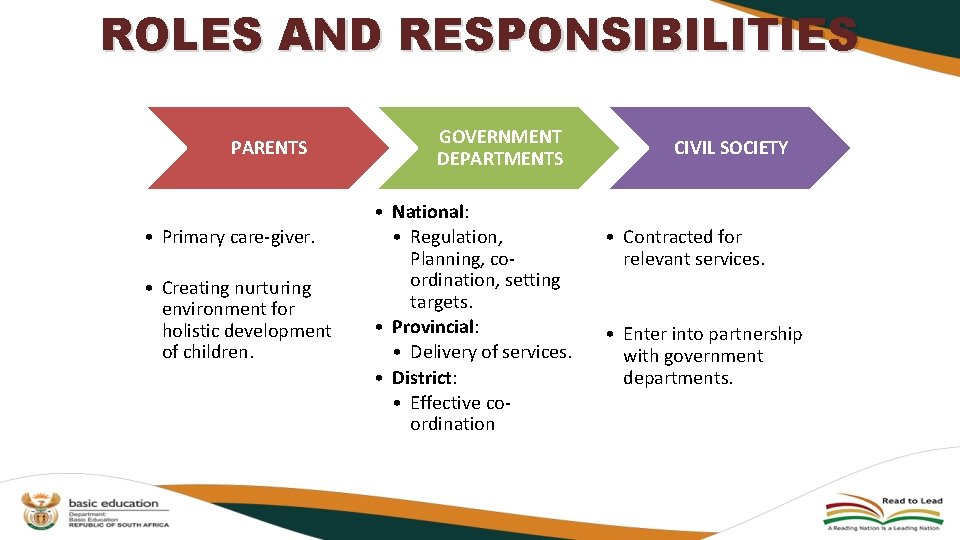
ROLES AND RESPONSIBILITIES PARENTS • Primary care-giver. • Creating nurturing environment for holistic development of children. GOVERNMENT DEPARTMENTS • National: • Regulation, Planning, coordination, setting targets. • Provincial: • Delivery of services. • District: • Effective coordination CIVIL SOCIETY • Contracted for relevant services. • Enter into partnership with government departments.
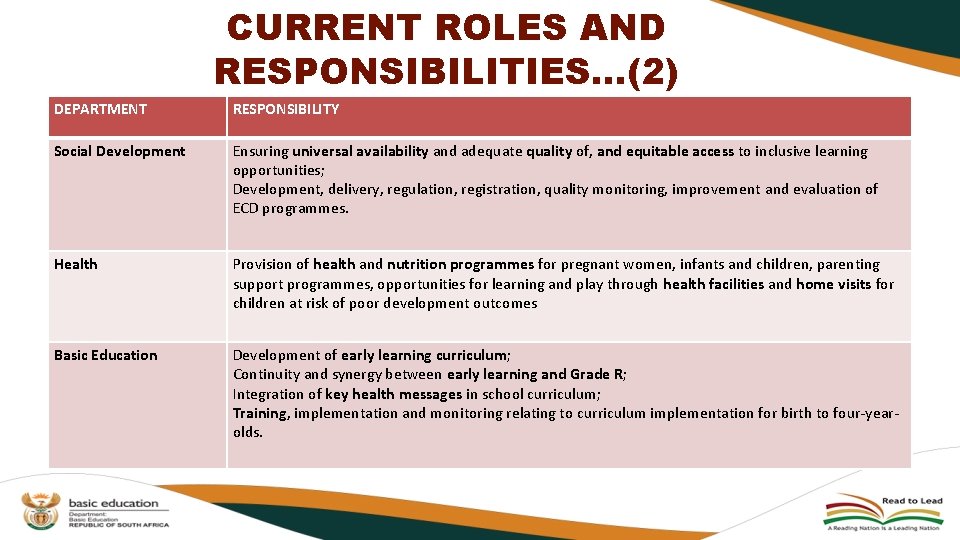
CURRENT ROLES AND RESPONSIBILITIES…(2) DEPARTMENT RESPONSIBILITY Social Development Ensuring universal availability and adequate quality of, and equitable access to inclusive learning opportunities; Development, delivery, regulation, registration, quality monitoring, improvement and evaluation of ECD programmes. Health Provision of health and nutrition programmes for pregnant women, infants and children, parenting support programmes, opportunities for learning and play through health facilities and home visits for children at risk of poor development outcomes Basic Education Development of early learning curriculum; Continuity and synergy between early learning and Grade R; Integration of key health messages in school curriculum; Training, implementation and monitoring relating to curriculum implementation for birth to four-yearolds.
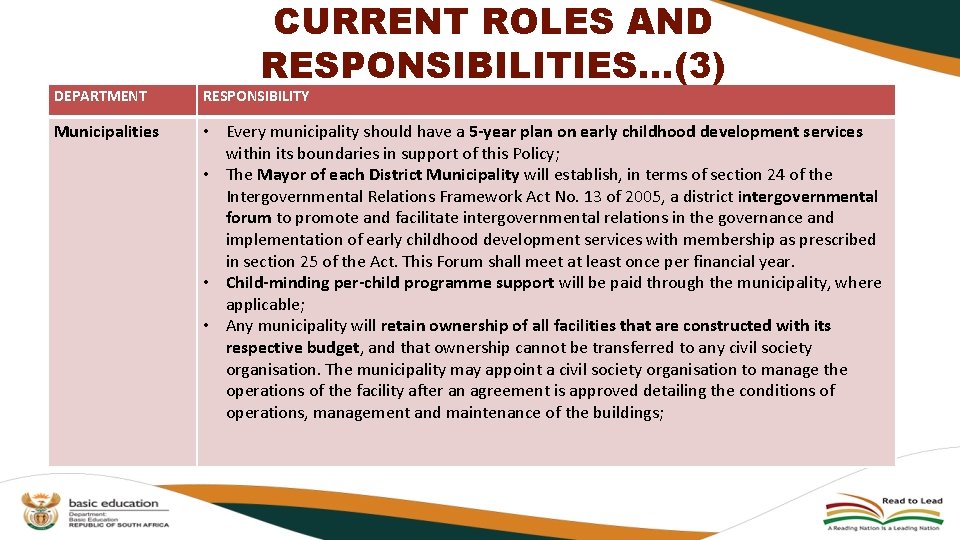
CURRENT ROLES AND RESPONSIBILITIES…(3) DEPARTMENT RESPONSIBILITY Municipalities • Every municipality should have a 5 -year plan on early childhood development services within its boundaries in support of this Policy; • The Mayor of each District Municipality will establish, in terms of section 24 of the Intergovernmental Relations Framework Act No. 13 of 2005, a district intergovernmental forum to promote and facilitate intergovernmental relations in the governance and implementation of early childhood development services with membership as prescribed in section 25 of the Act. This Forum shall meet at least once per financial year. • Child-minding per-child programme support will be paid through the municipality, where applicable; • Any municipality will retain ownership of all facilities that are constructed with its respective budget, and that ownership cannot be transferred to any civil society organisation. The municipality may appoint a civil society organisation to manage the operations of the facility after an agreement is approved detailing the conditions of operations, management and maintenance of the buildings;
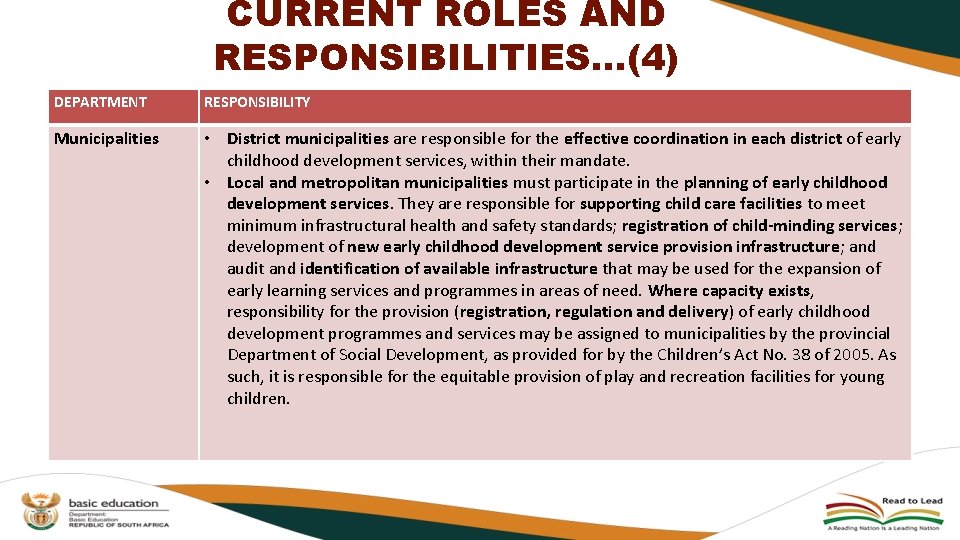
CURRENT ROLES AND RESPONSIBILITIES…(4) DEPARTMENT RESPONSIBILITY Municipalities • District municipalities are responsible for the effective coordination in each district of early childhood development services, within their mandate. • Local and metropolitan municipalities must participate in the planning of early childhood development services. They are responsible for supporting child care facilities to meet minimum infrastructural health and safety standards; registration of child-minding services; development of new early childhood development service provision infrastructure; and audit and identification of available infrastructure that may be used for the expansion of early learning services and programmes in areas of need. Where capacity exists, responsibility for the provision (registration, regulation and delivery) of early childhood development programmes and services may be assigned to municipalities by the provincial Department of Social Development, as provided for by the Children’s Act No. 38 of 2005. As such, it is responsible for the equitable provision of play and recreation facilities for young children.
OVERVIEW OF THE SHIFT
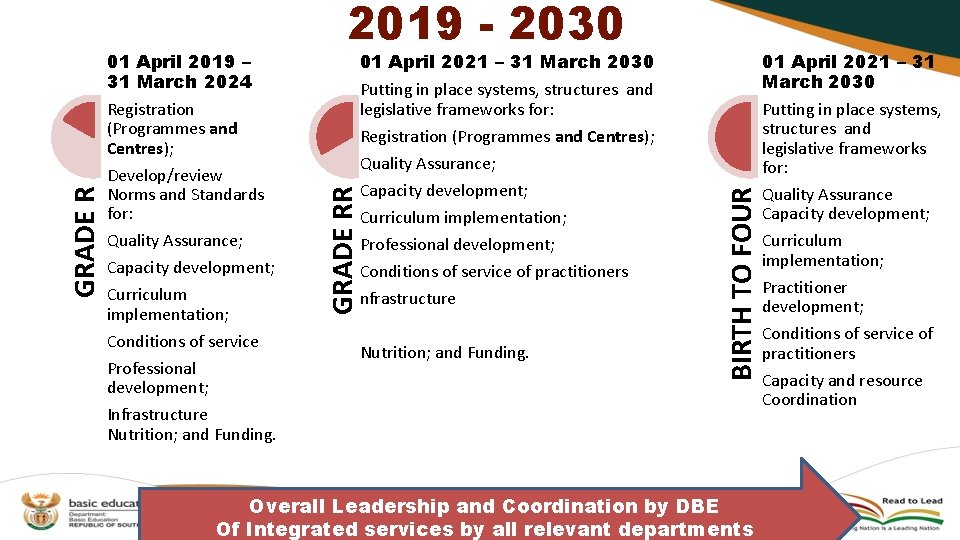
Nutrition; and Funding. BIRTH TO FOUR 01 April 2021 – 31 March 2030 Putting in place systems, structures and legislative frameworks for: Registration (Programmes and Centres); Quality Assurance; Capacity development; Curriculum implementation; Professional development; Conditions of service of practitioners nfrastructure GRADE RR GRADE R 01 April 2019 – 31 March 2024 Registration (Programmes and Centres); Develop/review Norms and Standards for: Quality Assurance; Capacity development; Curriculum implementation; Conditions of service Professional development; Infrastructure Nutrition; and Funding. 2019 - 2030 Overall Leadership and Coordination by DBE Of Integrated services by all relevant departments 01 April 2021 – 31 March 2030 Putting in place systems, structures and legislative frameworks for: Quality Assurance Capacity development; Curriculum implementation; Practitioner development; Conditions of service of practitioners Capacity and resource Coordination
IMPLICATIONS
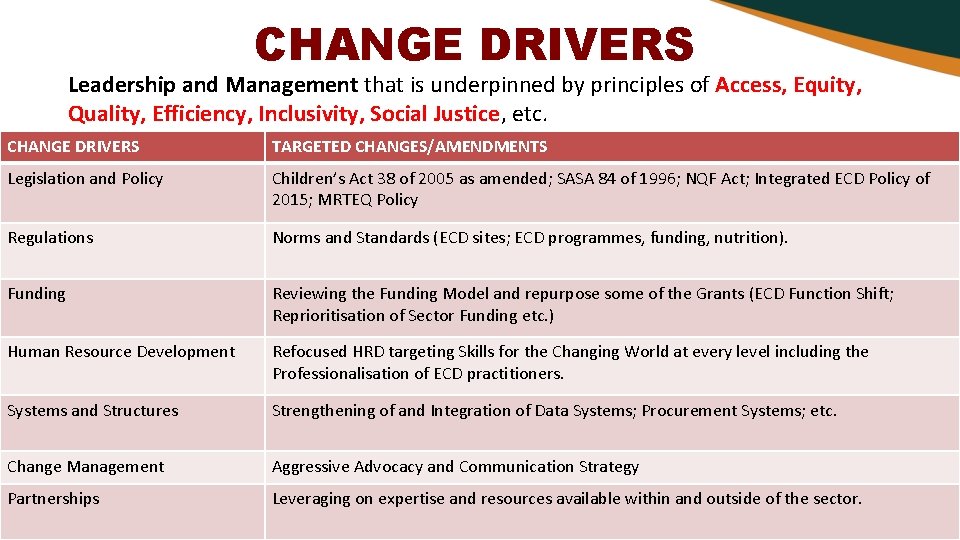
CHANGE DRIVERS Leadership and Management that is underpinned by principles of Access, Equity, Quality, Efficiency, Inclusivity, Social Justice, etc. CHANGE DRIVERS TARGETED CHANGES/AMENDMENTS Legislation and Policy Children’s Act 38 of 2005 as amended; SASA 84 of 1996; NQF Act; Integrated ECD Policy of 2015; MRTEQ Policy Regulations Norms and Standards (ECD sites; ECD programmes, funding, nutrition). Funding Reviewing the Funding Model and repurpose some of the Grants (ECD Function Shift; Reprioritisation of Sector Funding etc. ) Human Resource Development Refocused HRD targeting Skills for the Changing World at every level including the Professionalisation of ECD practitioners. Systems and Structures Strengthening of and Integration of Data Systems; Procurement Systems; etc. Change Management Aggressive Advocacy and Communication Strategy Partnerships Leveraging on expertise and resources available within and outside of the sector.
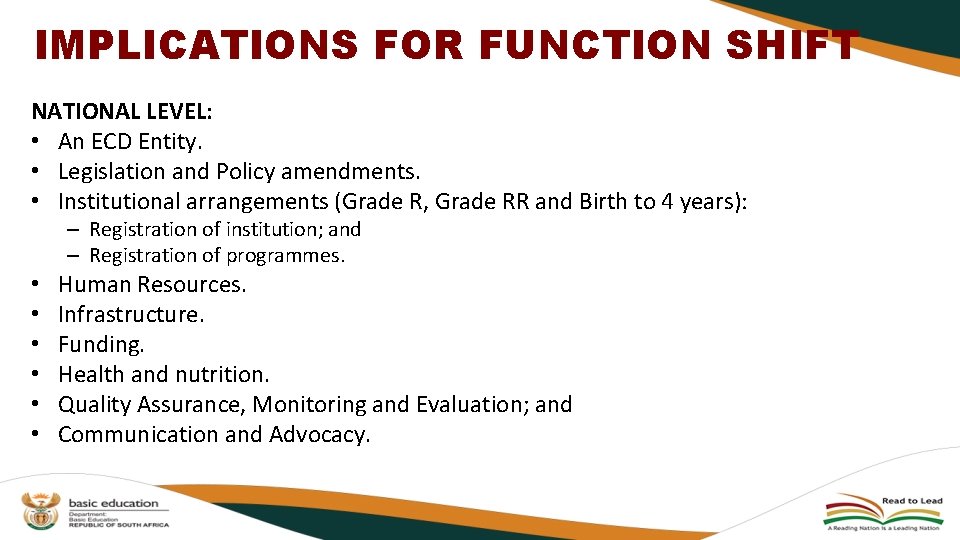
IMPLICATIONS FOR FUNCTION SHIFT NATIONAL LEVEL: • An ECD Entity. • Legislation and Policy amendments. • Institutional arrangements (Grade R, Grade RR and Birth to 4 years): – Registration of institution; and – Registration of programmes. • • • Human Resources. Infrastructure. Funding. Health and nutrition. Quality Assurance, Monitoring and Evaluation; and Communication and Advocacy.
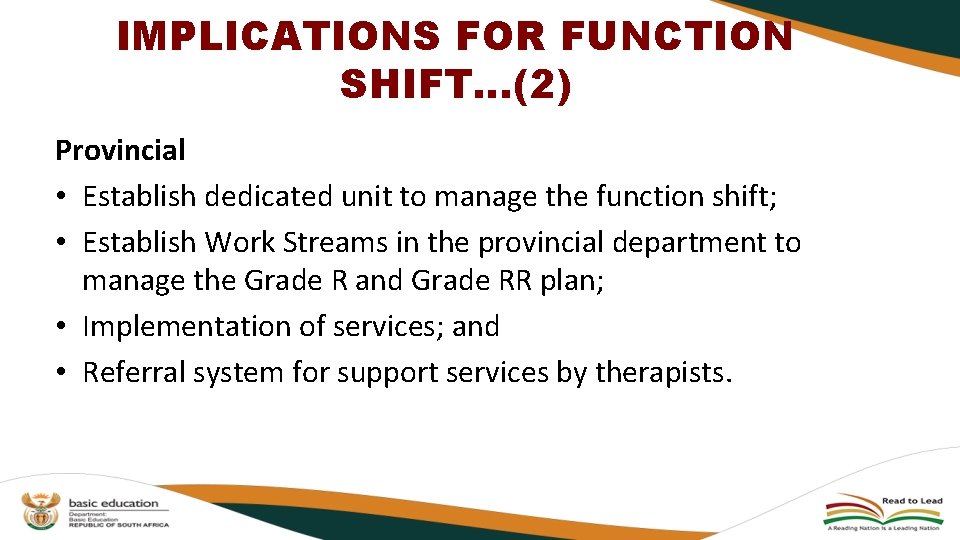
IMPLICATIONS FOR FUNCTION SHIFT…(2) Provincial • Establish dedicated unit to manage the function shift; • Establish Work Streams in the provincial department to manage the Grade R and Grade RR plan; • Implementation of services; and • Referral system for support services by therapists.
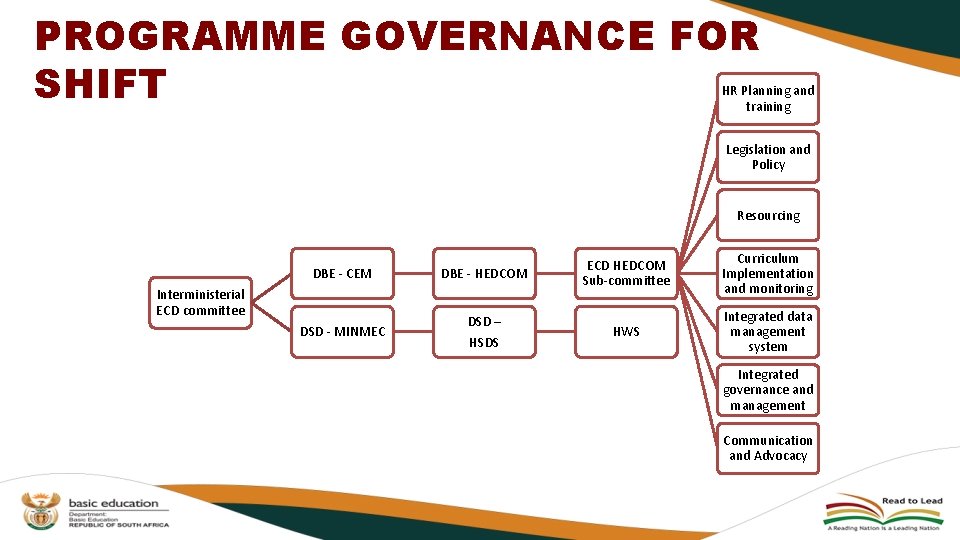
PROGRAMME GOVERNANCE FOR SHIFT HR Planning and training Legislation and Policy Resourcing DBE - CEM DBE - HEDCOM DSD - MINMEC DSD – HSDS Interministerial ECD committee ECD HEDCOM Sub-committee Curriculum Implementation and monitoring HWS Integrated data management system Integrated governance and management Communication and Advocacy
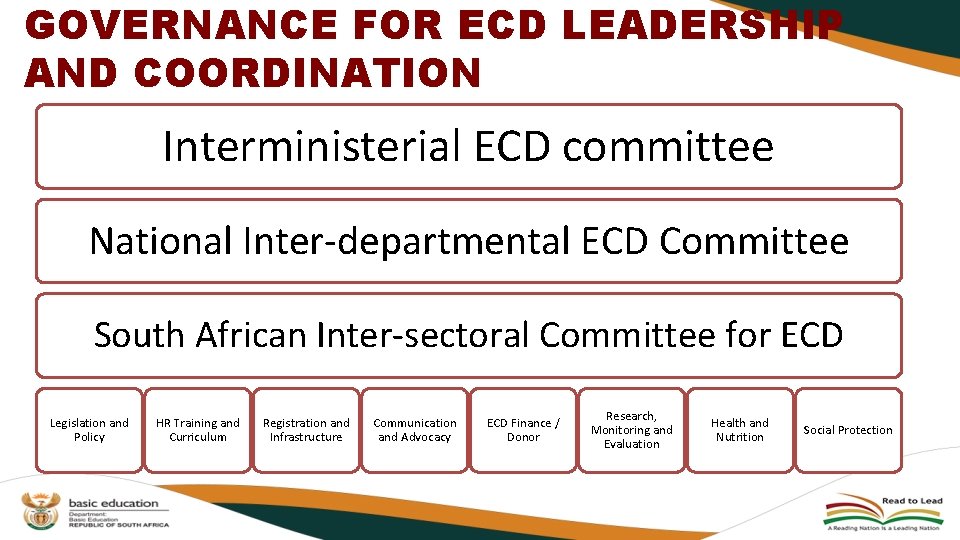
GOVERNANCE FOR ECD LEADERSHIP AND COORDINATION Interministerial ECD committee National Inter-departmental ECD Committee South African Inter-sectoral Committee for ECD Legislation and Policy HR Training and Curriculum Registration and Infrastructure Communication and Advocacy ECD Finance / Donor Research, Monitoring and Evaluation Health and Nutrition Social Protection
PROGRESS AND WAY FORWARD
PROGRESS MADE • Legislation and Policy: – Met with the Legal Team to discuss implications and provided input into the BELA Bill. • Funding: – Met with National Treasury to provide overview of plans to date. • Stakeholder engagement: – In collaboration with NECT and DSD planned the stakeholder engagement on 12 April 2019. – Presented overview of the plan at the Nelson Mandela Foundation Dialogue on 18 April 2019.
PROGRESS MADE…(2) • Data Management System: – Met with EMIS directorate to discuss implications. – Met with consultant to DSD to discuss progress made on the development of Management Information System for the processes conducted by DSD. – Baseline report is being finalised. • HEDCOM sub-committee: – Hosted the Inter-provincial meeting which focused on the provincial implications for the Function Shift. – Met with the Champion, Mr Kojana to finalise the Terms of Reference for the sub-committee.
PROGRESS MADE…(3) • Work Streams: – Identified runners and coordinators for each of the Work Streams; – Finalised draft terms of reference; and – Held inaugural meeting with runners and coordinators to outline the terms of reference. • Dedicated Project Management Unit at DBE: – Two consultants provided by UNICEF to start at DBE from 01 May 2019; and – Additional capacity provided by NECT.
WHAT SHOULD ORDINARY SOUTH AFRICAN CITIZENS EXPECT AT THE END OF 2019 • The DBE has put in place systems for the registration of ECD centres and programmes • Regulatory Framework on the integrated ECD services • Realigned National ECD Integrated Plan with milestones and timelines including accelerated access to Early Stimulation for special education needs children and those with disabilities. • Alignment of the SASA to accommodate compulsory Grade R. • Reviewed ECD structure to build capacity and coordinate existing resources within and outside government. • Well-articulated messages and information on the Function Shift.
WAY FORWARD
NEXT STEPS FOR DBE • Leverage on the Technical Support of the recently established Education Technical Assistance Office (NECT) – planning and coordination. • Plan for the inaugural meeting of the HEDCOM Sub-committee. • Schedule a special Broad Management Meeting to fully outline the implications for the DBE related to the Function Shift; • Establish a Multidisciplinary Function Shift Management Committee with DBE, DSD, National Treasury, Department of Public Service and Administration. • Establish the dedicated Project Management Unit for Function Shift. • Finalise the Terms of Reference for the follow-up audit of ECD centres.
JOINT WAY FORWARD • DBE leads and Coordination of the provision of ECD services, until the Presidential Proclamation is made; • Joint meeting between the Ministers of Social Development and Basic Education by end of April 2019 to finalise the preparations for the Function Shift; • Continued Stakeholder engagement beyond that of 12 April 2019; • Implementation protocols to be signed by Minister of Health, Social Development and Basic Education by end of April 2019; and • Joint Cabinet Memo with revised legislation / policy as well as the National Integrated Plan for approval by July 2019.
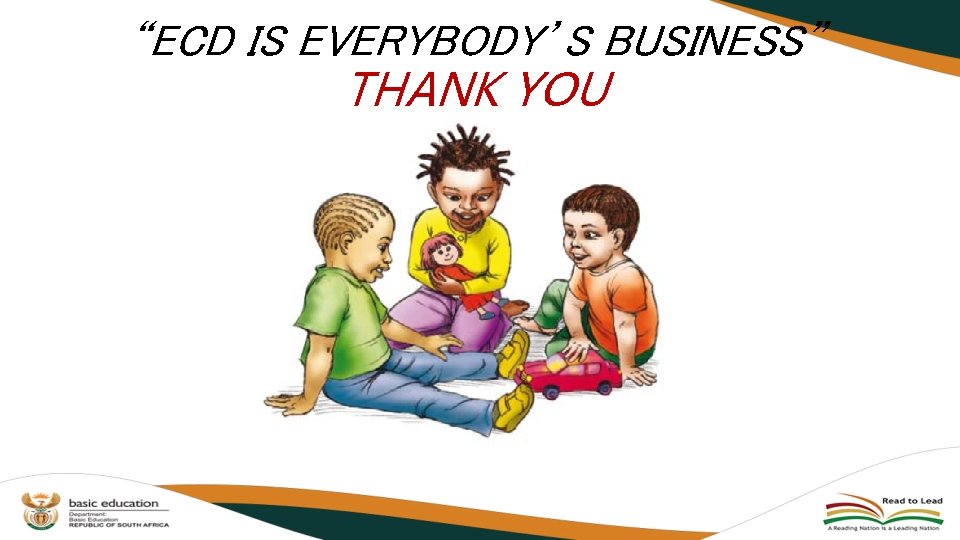
“ECD IS EVERYBODY’S BUSINESS” THANK YOU