
ELO Rating System in Practice Jeremy Madison Formulas

- Slides: 13
ELO Rating System in Practice Jeremy Madison Formulas copied from “Elo rating system” on Wikipedia http: //en. wikipedia. org/wiki/Elo_rating_system
Problem Large body of players All can't play each other – – Ex: 10000 players playing 250 games/year Requires 40 years to finish How to estimate rank?
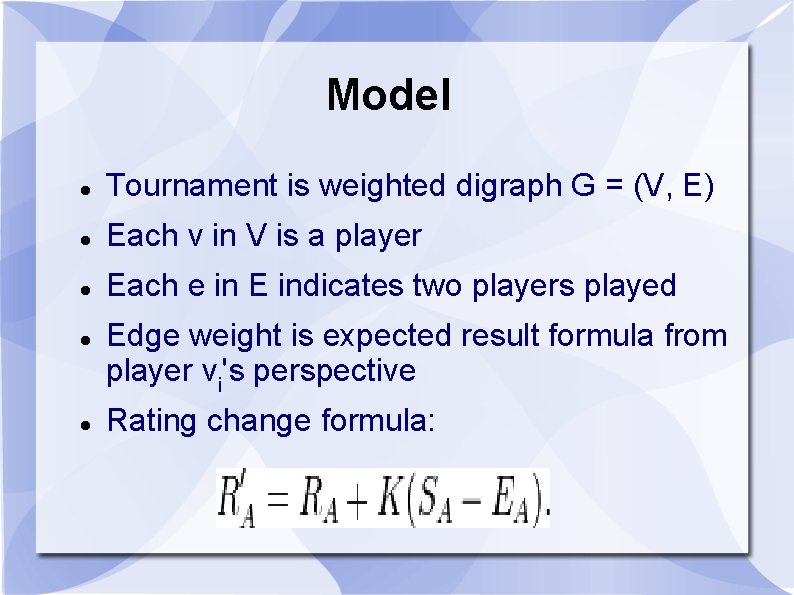
Model Tournament is weighted digraph G = (V, E) Each v in V is a player Each e in E indicates two players played Edge weight is expected result formula from player vi's perspective Rating change formula:
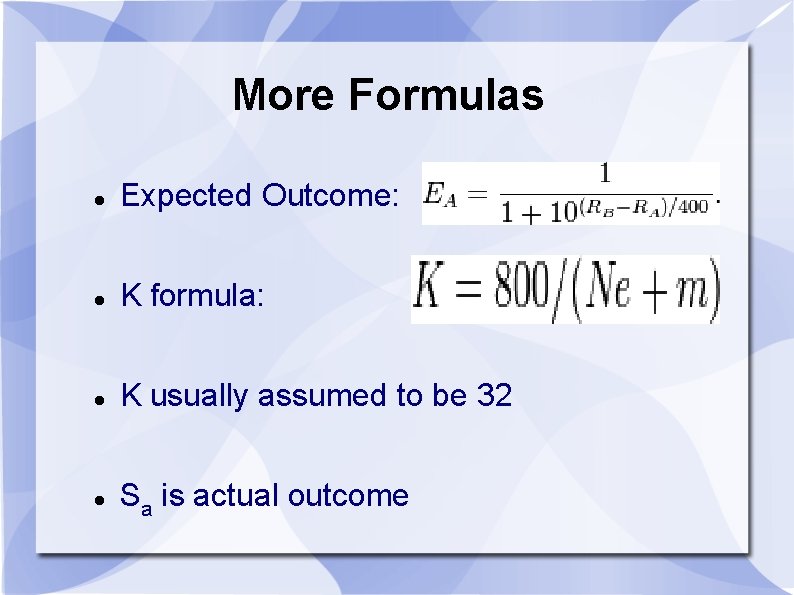
More Formulas Expected Outcome: K formula: K usually assumed to be 32 Sa is actual outcome
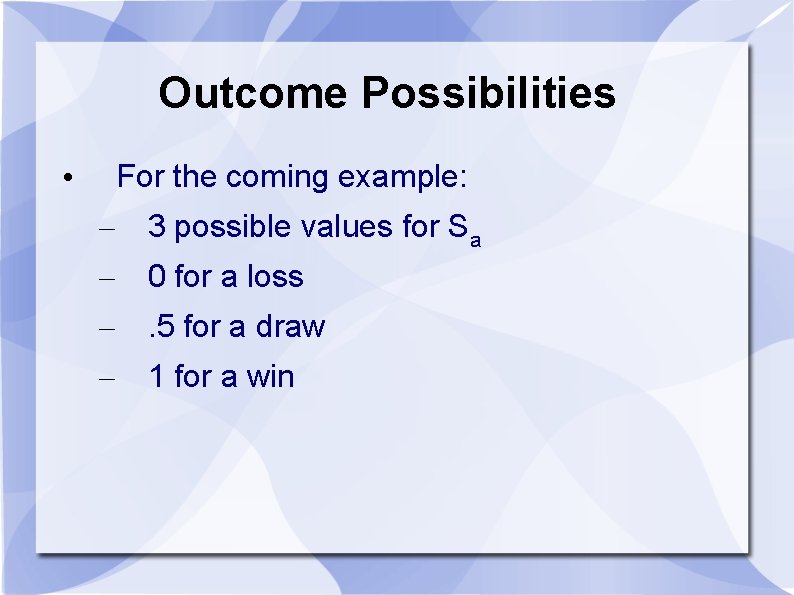
Outcome Possibilities For the coming example: • – 3 possible values for Sa – 0 for a loss – . 5 for a draw – 1 for a win
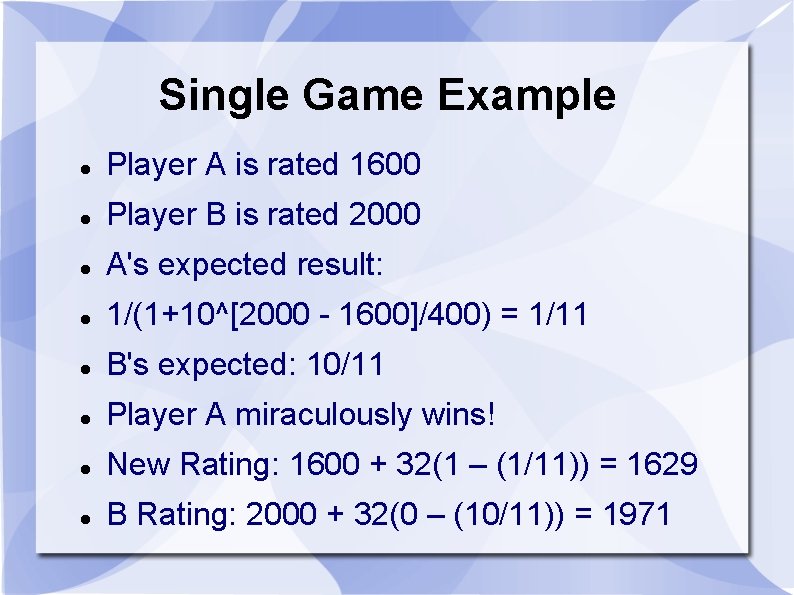
Single Game Example Player A is rated 1600 Player B is rated 2000 A's expected result: 1/(1+10^[2000 - 1600]/400) = 1/11 B's expected: 10/11 Player A miraculously wins! New Rating: 1600 + 32(1 – (1/11)) = 1629 B Rating: 2000 + 32(0 – (10/11)) = 1971
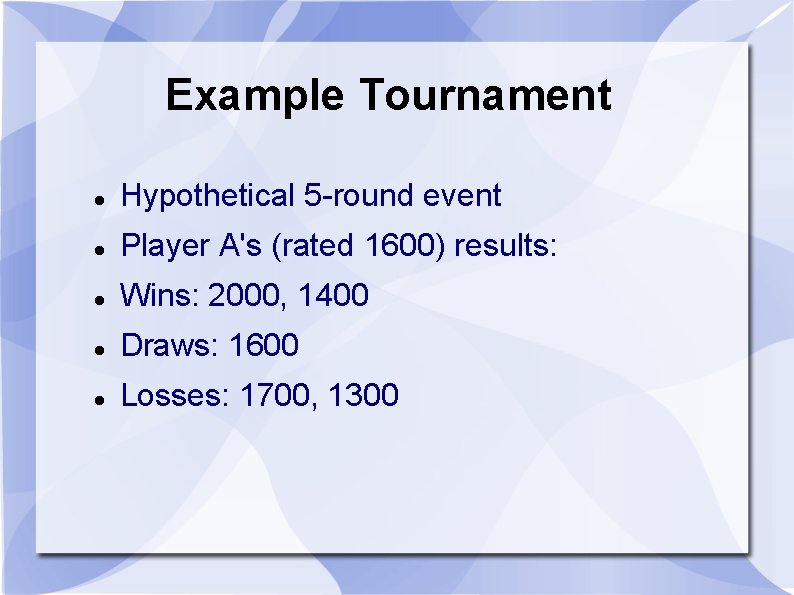
Example Tournament Hypothetical 5 -round event Player A's (rated 1600) results: Wins: 2000, 1400 Draws: 1600 Losses: 1700, 1300
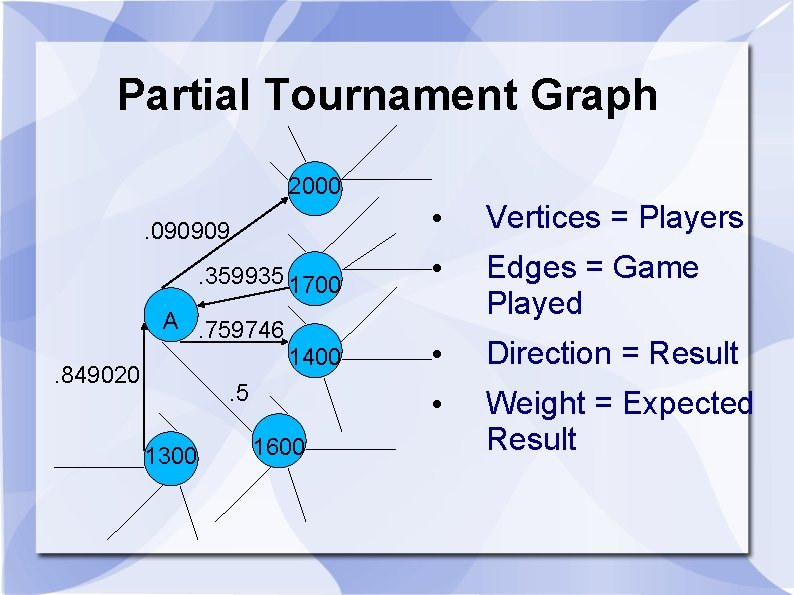
Partial Tournament Graph 2000. 090909. 359935 1700 A. 759746 1400 . 849020 . 5 1300 1600 • Vertices = Players • Edges = Game Played • Direction = Result • Weight = Expected Result
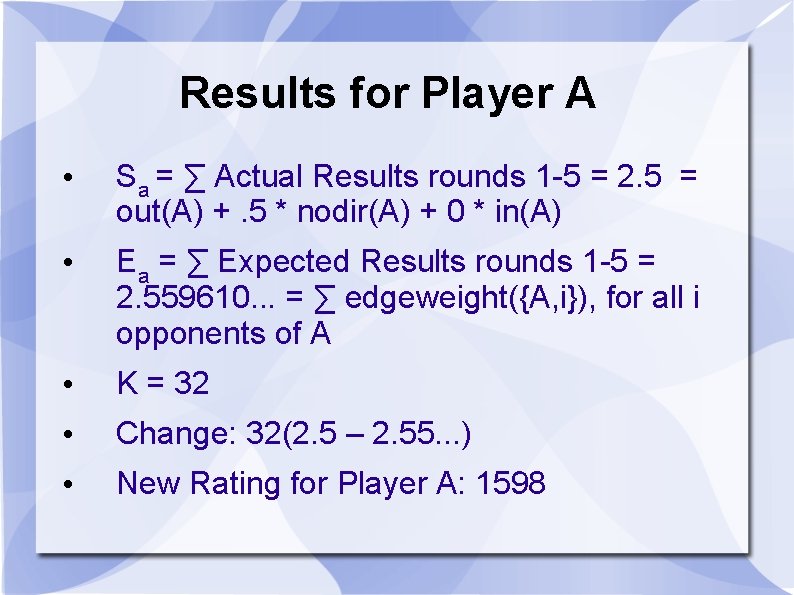
Results for Player A • Sa = ∑ Actual Results rounds 1 -5 = 2. 5 = out(A) +. 5 * nodir(A) + 0 * in(A) • Ea = ∑ Expected Results rounds 1 -5 = 2. 559610. . . = ∑ edgeweight({A, i}), for all i opponents of A • K = 32 • Change: 32(2. 5 – 2. 55. . . ) • New Rating for Player A: 1598
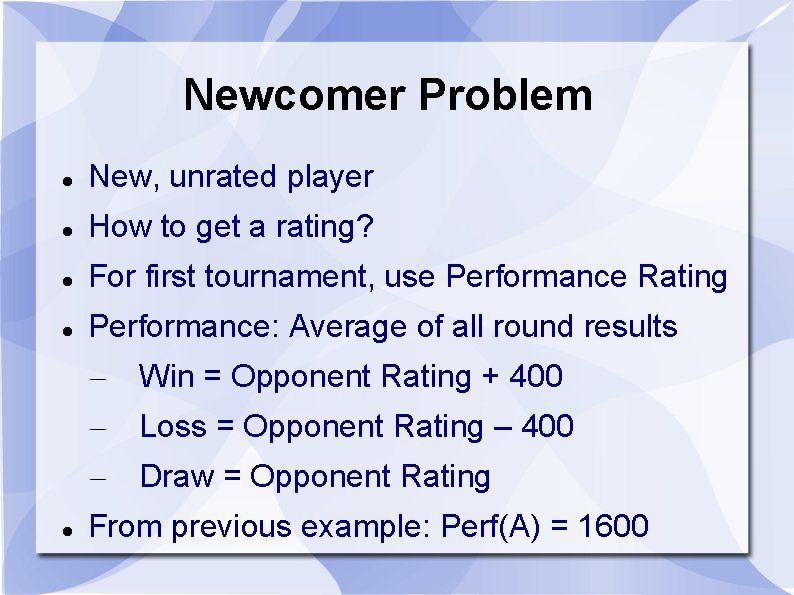
Newcomer Problem New, unrated player How to get a rating? For first tournament, use Performance Rating Performance: Average of all round results – Win = Opponent Rating + 400 – Loss = Opponent Rating – 400 – Draw = Opponent Rating From previous example: Perf(A) = 1600
Conclusions The ELO rating system is reliable for a large body of players Ratings tend towards actual skill over time Can accommodate players entering and leaving system
Questions Any Questions?
Sources Batchelder, William H. ; Bershad, Neil J. The statistical analysis of a Thurstonian model for players. J. Math. Psych. 19 (1979), no. 1, 39 --60. rating chess “Elo rating system. ” Wikipedia: The Free Encyclopedia. 17 April 2009. <http: //en. wikipedia. org/wiki/Elo_rating_system>. Slutzki, Giora; Volij, Oscar. Ranking participants in generalized tournaments. Internat. J. Game Theory 33 (2005), no. 2, 255 --270. Stefani, Ray; Pollard, Richard. Football rating systems for top-level competition: a critical survey. J. Quant. Anal. Sports 3 (2007), no. 3, Art. 3, 22 pp.