
Elliptical SRF Cavities Mike Foley Feb 13 14
Elliptical SRF Cavities Mike Foley Feb 13 -14, 2007 DOE SCRF Review
Elliptical SRF Cavities Fermilab • PREVIEW OF PRESENTATION – Brief review of established fabrication method for elliptical SRF cavities. – Alternative fabrication methods with the goal of reducing costs: opportunities for R & D. – Alternative cavity cell shapes to increase accelerating gradient: opportunities for R & D. – Current cavity fabrication efforts at FNAL and US vendor development. – Need for EB welding machine and support facility at FNAL: We want to be a more active participant in the SRF community. – Costs Feb 13 -14, 2007 DOE SCRF Review 2
Elliptical SRF Cavities Fermilab • Established Fabrication Method for Multi-cell SRF Cavities – Disks are cut from high purity niobium sheet and scanned for pits, scratches and inclusions of foreign material. Disks failing scan are rejected. – Half cells are deep drawn from disks: extra material is left at the iris and equator of each half cell to allow for weld shrinkage -- additional length retained at the equators for tuning. – Half cells are EB welded at the iris to form dumbbells: if necessary stiffening rings are EB welded to prevent Lorentz force detuning -- dumbbells are measured for frequency and equators trimmed accordingly. Feb 13 -14, 2007 DOE SCRF Review 3
Elliptical SRF Cavities Fermilab – End tubes, FPCs and HOMs are formed by vendor preferred method (rolled and seam welded, back extruded, machined, etc. ) -- flanges and other components are machined. – End assemblies are EB welded, measured for frequency and end half cells are trimmed accordingly. – Dumbbells are EB welded at the equators to form the cell structure: end assemblies are EB welded to the cell structure to complete the cavity. – NOTE: Each EB welding operation above requires parts to be degreased and BCP acid etched as weld preparation. There are ~ 50 -70 EB welds per typical nine -cell SRF cavity. Feb 13 -14, 2007 DOE SCRF Review 4
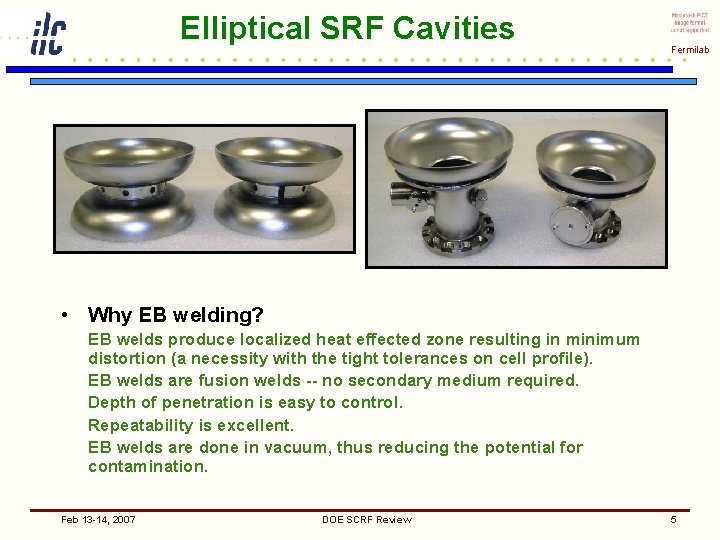
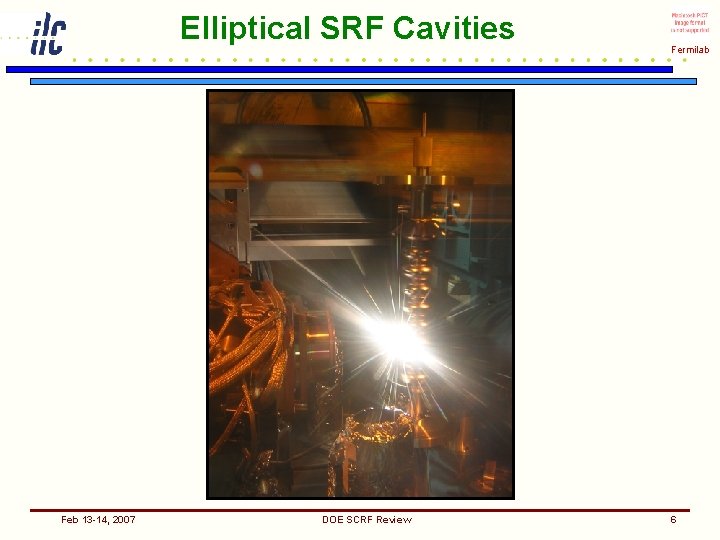
Elliptical SRF Cavities Fermilab • Why EB welding? EB welds produce localized heat effected zone resulting in minimum distortion (a necessity with the tight tolerances on cell profile). EB welds are fusion welds -- no secondary medium required. Depth of penetration is easy to control. Repeatability is excellent. EB welds are done in vacuum, thus reducing the potential for contamination. Feb 13 -14, 2007 DOE SCRF Review 5
Elliptical SRF Cavities Feb 13 -14, 2007 DOE SCRF Review Fermilab 6
Elliptical SRF Cavities Fermilab • ILC cavity fabrication cost: mass production mode (DESY) ~ $60 K per cavity Material 45% Machining 42% Welding 6% Other 7% Maximum gains in cost reduction achievable by reducing machining and/or material costs. Feb 13 -14, 2007 DOE SCRF Review 7
Elliptical SRF Cavities Fermilab • Alternative cavity fabrication methods Motivation is based on potential cost savings -no known alternative methods claim to improve performance – Methods to reduce material costs (e. g. , niobium film coating on substrate). – Methods to reduce machining costs (e. g. , hydroforming or spinning of central cell structure). – Methods to further automate fabrication steps (e. g. , EB welding machine configuration, innovative welding fixture design). Feb 13 -14, 2007 DOE SCRF Review 8
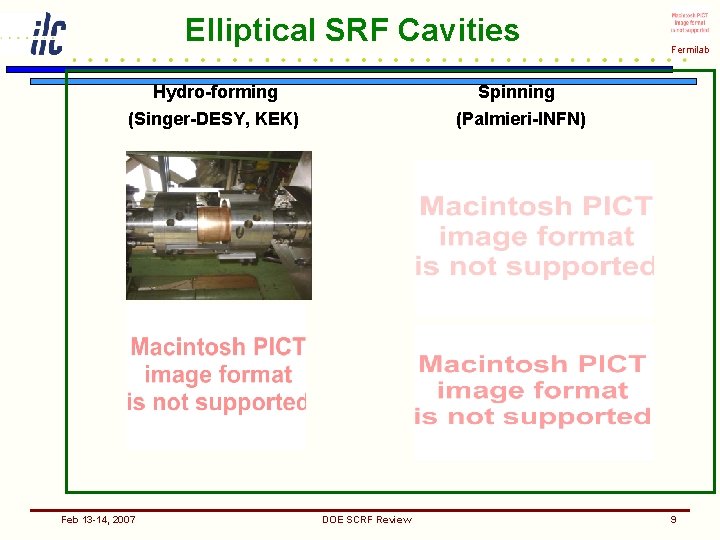
Elliptical SRF Cavities Hydro-forming Spinning (Singer-DESY, KEK) (Palmieri-INFN) Feb 13 -14, 2007 DOE SCRF Review Fermilab 9
Elliptical SRF Cavities Fermilab • Hydroforming or spinning cell structure • Potential advantages – Eliminate welds in high field regions of the cavity. – Eliminate machining of dumbbell equators for tuning. – If formed from niobium clad copper tubes may significantly reduce material (niobium) costs. • Potential disadvantages – Seamless niobium tube production possessing uniformability properties and sufficient length for 9 -cell cavities requires further R & D. – Niobium clad copper tubes may delaminate from stresses due to thermal cycling. – Single pass EB welds required to join 9 -cell structure to end assemblies will be difficult to execute. Feb 13 -14, 2007 DOE SCRF Review 10
Elliptical SRF Cavities Fermilab • Form end assemblies from brazed copper components followed by niobium film coating. • Potential advantages – Reduce material (niobium) costs. – Eliminate some EB welding costs. • Potential disadvantages – Complex internal end assembly geometry makes uniform niobium film deposition problematic. – Possibility of copper migration into critical weld joint. Feb 13 -14, 2007 DOE SCRF Review 11
Elliptical SRF Cavities Fermilab • Alternative cavity cell profiles Max Eacc = Hcrit/(Hpeak/Eacc) – When Hpeak on the RF surface of a cavity cell reaches Hcrit breakdown of superconductivity occurs. – Hcrit is a property of the material (niobium). – Hpeak/Eacc is determined by the geometry of the cell profile. – To increase Max Eacc: (1) Develop alternate materials with higher Hcrit, or (2) Reduce Hpeak/Eacc by changing the geometry of the cell profile (e. g. , reentrant cavity or low-loss cavity). Feb 13 -14, 2007 DOE SCRF Review 12
Elliptical SRF Cavities Fermilab • SRF cavity fabrication at FNAL -- completed, in progress and planned: 3. 9 GHz 3 rd harmonic cavities – Cryomodule with four cavities promised to DESY – Four cavities completed (two at Jlab and two at FNAL) – Apparent problem with HOM design: cavity No. 4 with slightly modified HOM is under vertical test – Four additional cavities with new HOM design (single post Formteil) are in progress (two at Jlab and two at FNAL). – Large grain one-cell cavity in progress at FNAL. – Single grain one-cell cavity planned (Jlab). – Three one-cell cavities completed at FNAL and three one -cell cavities are in progress at Roark. Feb 13 -14, 2007 DOE SCRF Review 13
Elliptical SRF Cavities Fermilab – Single-cell cavities are useful for R & D studies on cavity processing methods (EP, HPR, tumbling, etc. ), as well as helping industry (Roark) perfect their fabrication and welding techniques. 3. 9 GHz deflecting mode cavities – Various single-cell and three-cell cavities have been fabricated, plus one 9 -cell and one 13 -cell. – New design is in progress at low level of priority. 1. 3 GHz ILC cavities – Four ACCEL cavities (asymmetric end tubes) received. – Four AES cavities (asymmetric end tubes) in final assembly stage. Feb 13 -14, 2007 DOE SCRF Review 14
Elliptical SRF Cavities Fermilab – Two Jlab large grain cavities (symmetric end tubes) due in February. – Two Jlab fine grain cavities (asymmetric end tubes) in progress. – Eight ACCEL cavities (symmetric end tubes) on order. – Six AES cavities (symmetric end tubes) on order. – FY 2007 plan is to order ~ 24 cavities Feb 13 -14, 2007 DOE SCRF Review 15
Elliptical SRF Cavities Fermilab • Industrialization: US vendor development The objective is to involve US industry more and utilize their expertise. – AES: experienced, but need to prove capability with ILC cavities -- awaiting test results of first four cavities at Jlab. – ROARK: appear capable, but lacking experience. Currently fabricating three 3. 9 GHz 3 rd harmonic singlecell cavities as Phase 1 of a potential three phase effort. Phase 2 would entail building one single-cell 1. 3 GHz ILC cavity. Phase 3 would be – NIOWAVE/ROARK collaboration (complementary capabilities). Fabricate two 9 -cell 1. 3 GHz ILC cavities. Feb 13 -14, 2007 DOE SCRF Review 16
Elliptical SRF Cavities Fermilab • Need for EB welding machine and supporting infrastructure at Fermilab: Why? – Remove dependence on Sciaky machines in use for contract welding are always for sale. In FY 2005 the machine we were using for 3 rd harmonic cavity fabrication was sold, causing an eight month delay in our schedule. Transportation of parts to Sciaky and their machine shop environment increases the potential for damage and/or contamination. Scheduling welding dates is an issue, with competition from ANL, MSU and others. – It will facilitate on site investigation of alternative cavity fabrication methods so as to reduce cavity cost. – It can be used for on site investigation of experimental cavity cell shapes with the goal of improving accelerating gradient. Feb 13 -14, 2007 DOE SCRF Review 17
Elliptical SRF Cavities Fermilab • Need for EB welding machine and supporting infrastructure at Fermilab: Why? – It can be utilized as an integral part of a training facility to transfer welding and cavity fabrication methodology to collaborators and potential US vendors. – Supporting infrastructure will include clean room, ultrasonic cleaning tanks, UP water system and pre-weld BCP etching facilities to prepare parts for welding. Feb 13 -14, 2007 DOE SCRF Review 18
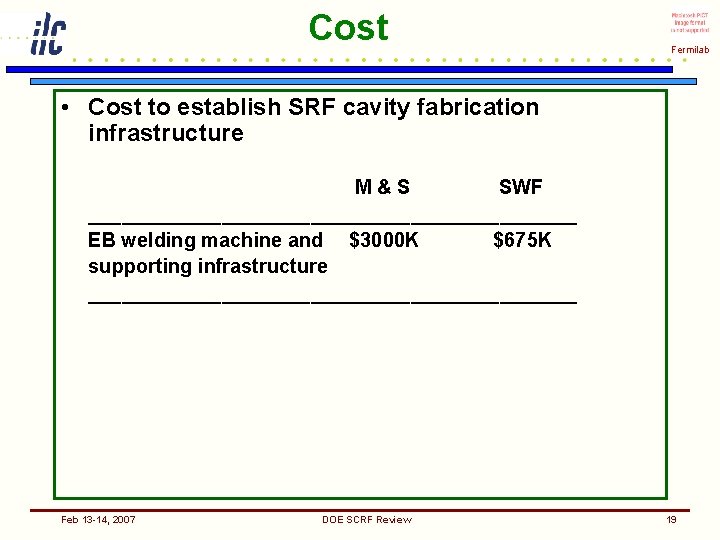
Cost Fermilab • Cost to establish SRF cavity fabrication infrastructure M&S SWF ______________________ EB welding machine and $3000 K $675 K supporting infrastructure ______________________ Feb 13 -14, 2007 DOE SCRF Review 19
Conclusions Fermilab • Establishment of cavity fabrication infrastructure will: (1) Provide FNAL with limited in-house cavity fabrication capability to develop and refine cavity fabrication techniques, (2) Increase throughput for current and future cavity fabrication programs, (3) Significantly increase FNAL’s capability to transfer SRF fabrication technology to US industry, and (4) Allow FNAL to become a more effective participant in SRF R & D. Feb 13 -14, 2007 DOE SCRF Review 20
- Slides: 20