
Elkhart Community Schools Listening Speaking Reading Writing Actual
- Slides: 24
Elkhart Community Schools
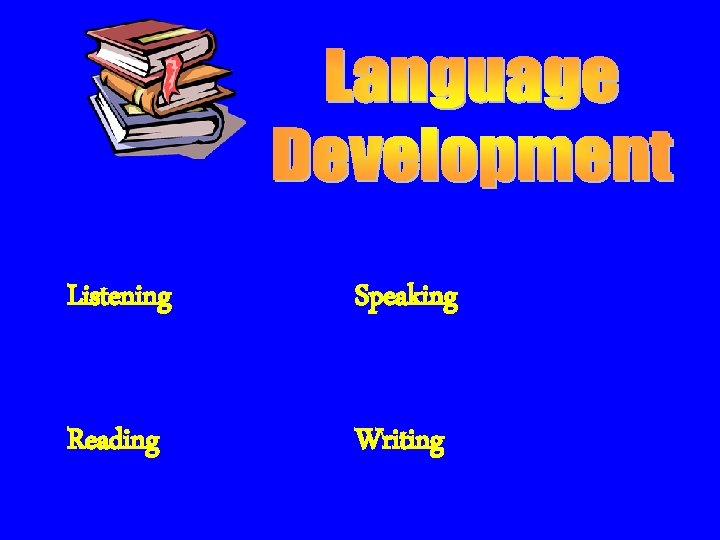
Listening Speaking Reading Writing
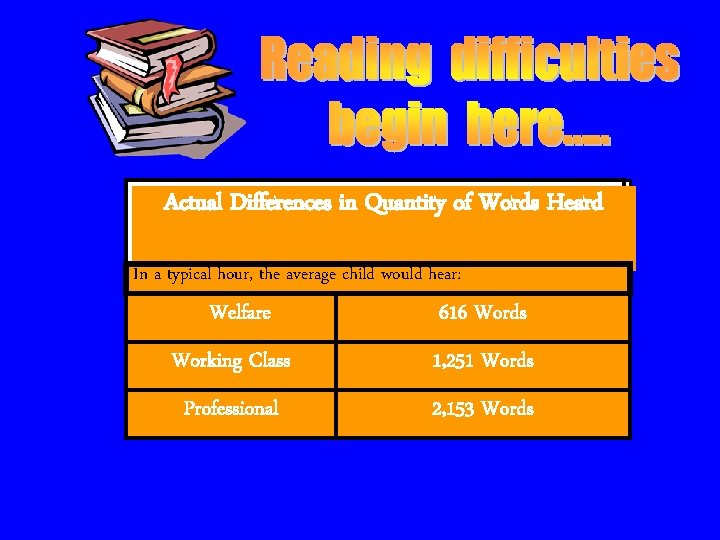
Actual Differences in Quantity of Words Heard In a typical hour, the average child would hear: Welfare 616 Words Working Class 1, 251 Words Professional 2, 153 Words
85% of ECS’s students fall into the first two categories: - welfare - working class
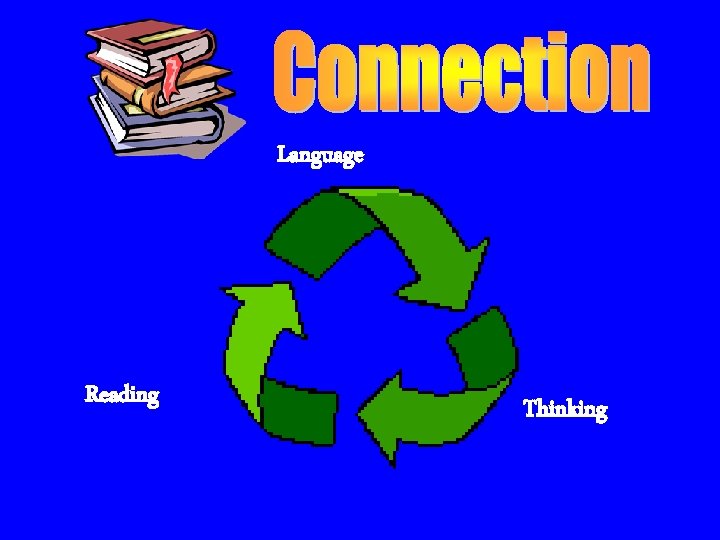
Language Reading Thinking
Reading IS Thinking “The purpose of reading is understanding. ”
“True comprehension goes beyond literal understanding and involves the reader’s interaction with text. If students are to become thoughtful, insightful readers, they must extend their thinking beyond a superficial understanding of the text. ” Stephanie Harvey and Anne Goudvis
“Once thought of as the natural result of decoding plus oral language, comprehension is now viewed as a much more complex process involving knowledge, experience, thinking and teaching. ” (Linda Fielding and P. David Pearson, 1994)
Researchers identified strategies that proficient readers use to construct meaning from text. Pearson, Keene, Harvey, Goudvis, Robb and others summarized these strategies. Elkhart Community School’s Top 10 Reading Strategies are based on the work of the above researchers.
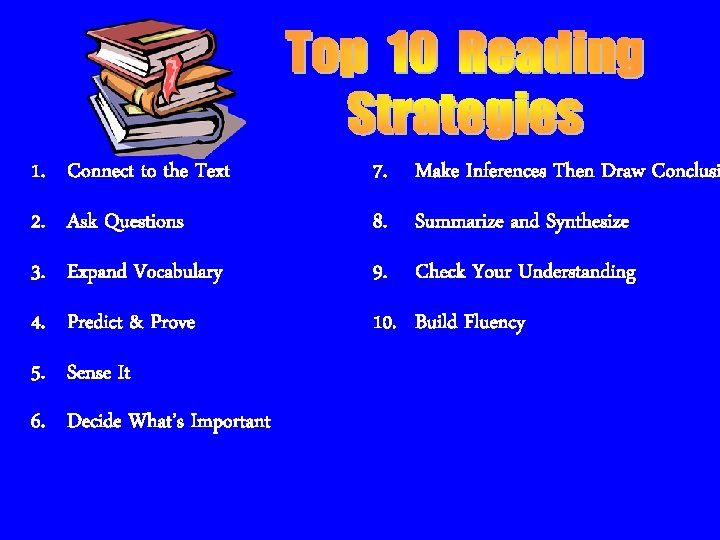
1. Connect to the Text 7. Make Inferences Then Draw Conclusi 2. Ask Questions 8. Summarize and Synthesize 3. Expand Vocabulary 9. Check Your Understanding 4. Predict & Prove 10. Build Fluency 5. Sense It 6. Decide What’s Important
Making Connections: A Bridge From Known Text to Self Text to World the New to the
Asking Questions: The Strategy That Propels Readers Forward “Questioning is the strategy that keeps readers engaged. When readers ask questions, they clarify understanding and forge ahead to make meaning. Asking questions is at the heart of thoughtful reading. ” Harvey and Goudvis
“The larger the reader’s vocabulary (either oral or print), the easier it is to make sense of the text. ” Report of the National Reading Panel
“Research suggests that when students make predictions their understanding increases and they are more interested in the reading material. ” Fielding, Anderson, Pearson, Hanson
Visualizing: A Tool to Enhance Understanding “Visualizing is a comprehension strategy that enables readers to make the words on a page real and concrete. ” Keene and Zimmerman
“Thoughtful readers grasp essential ideas and important information when reading. Readers must differentiate between less important ideas and key ideas that are central to the meaning of the text. ” Harvey and Goudvis
“Inferring is at the intersection of taking what is known, garnering clues from the text, and thinking ahead to make a judgment, discern a theme, or speculate about what is to come. ” Harvey and Goudvis
The Evolution of Thought Synthesizing is putting together separate parts into a new whole…. a process akin to working a jigsaw puzzle. Harvey and Goudvis
“If confusion disrupts meaning, readers need to stop and clarify their understanding. Readers may use a variety of strategies to “fix up” comprehension when meaning goes awry. ” Harvey and Goudvis
“Fluency is important because it frees students to understand what they read. ” Report of the National Reading Panel
CAUTION! “Although these strategies tend to be introduced independently, readers rarely use these in isolation when reading. These thoughts interact and intersect to help readers make meaning and often occur simultaneously during reading. ” Harvey and Goudvis
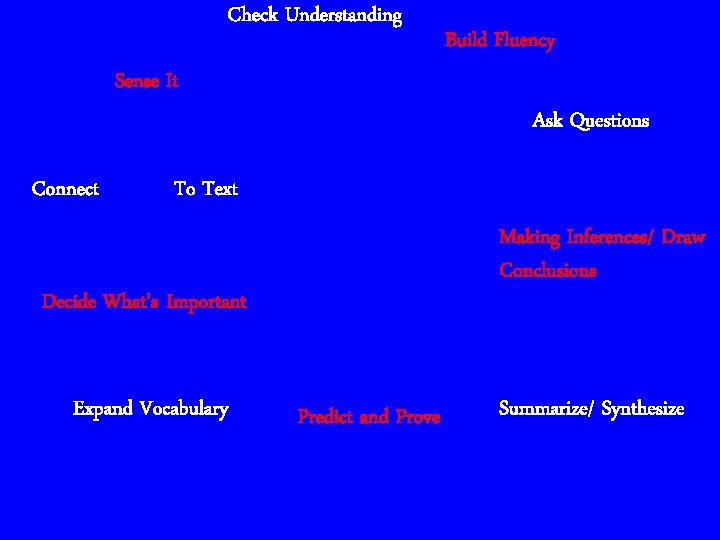
Check Understanding Build Fluency Sense It Connect To Text Reading is Thinking Decide What’s Important Expand Vocabulary Predict and Prove Ask Questions Making Inferences/ Draw Conclusions Summarize/ Synthesize