
Elise Marsicano Paris XIINSERM France elise marsicanoinserm fr
- Slides: 1
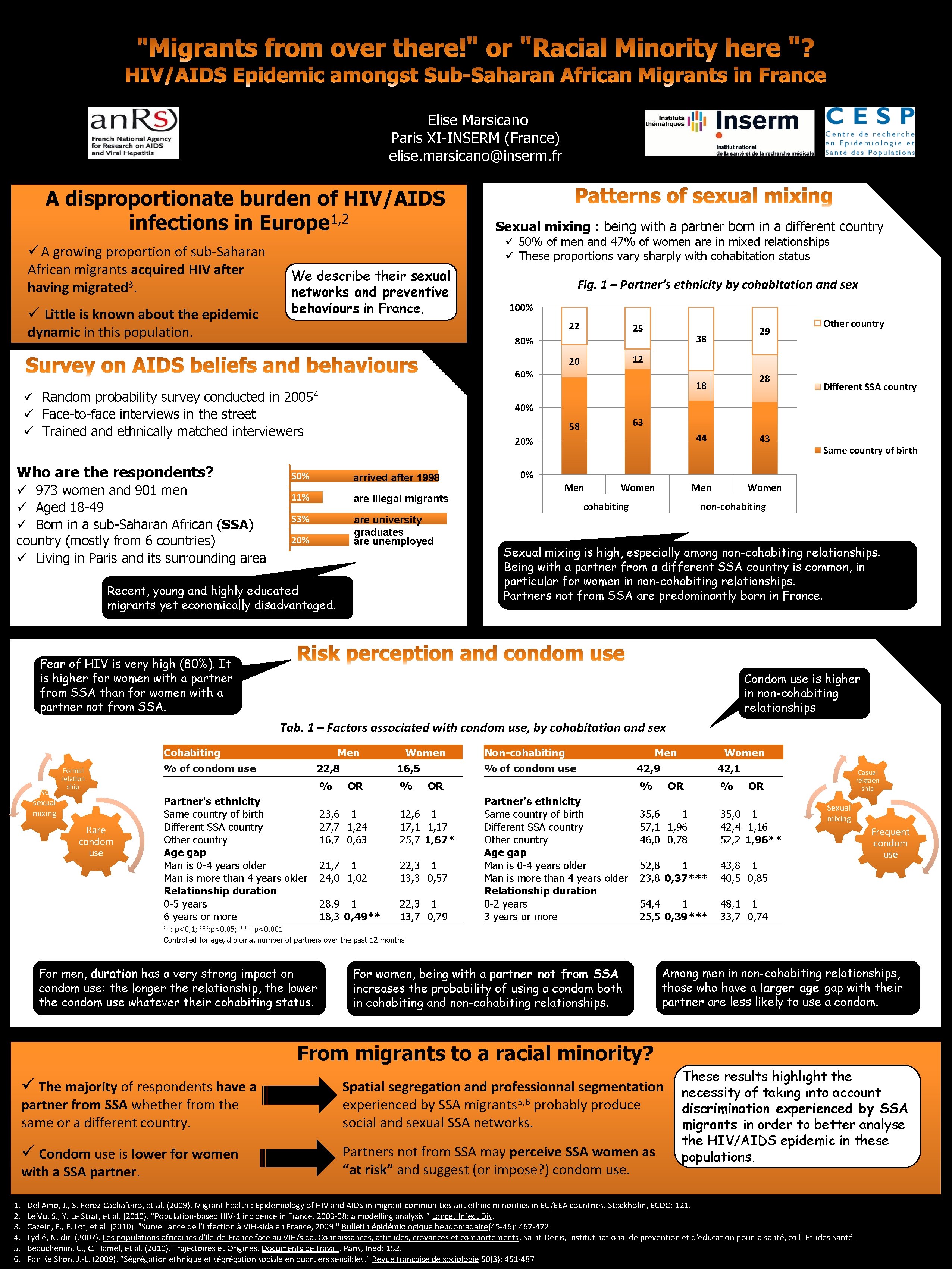
Elise Marsicano Paris XI-INSERM (France) elise. marsicano@inserm. fr A disproportionate burden of HIV/AIDS 1, 2 infections in Europe ü A growing proportion of sub-Saharan African migrants acquired HIV after having migrated 3. Sexual mixing : being with a partner born in a different country ü 50% of men and 47% of women are in mixed relationships ü These proportions vary sharply with cohabitation status We describe their sexual networks and preventive behaviours in France. ü Little is known about the epidemic dynamic in this population. Fig. 1 – Partner’s ethnicity by cohabitation and sex 100% 22 25 80% 38 60% Who are the respondents? ü 973 women and 901 men ü Aged 18 -49 ü Born in a sub-Saharan African (SSA) country (mostly from 6 countries) ü Living in Paris and its surrounding area 18 Different SSA country 63 58 44 43 Men Women 20% arrived after 1998 11% are illegal migrants 2 53% 1 20% are university graduates are unemployed 3 28 40% 50% 4 29 12 20 ü Random probability survey conducted in 20054 ü Face-to-face interviews in the street ü Trained and ethnically matched interviewers Other country Same country of birth 0% Men Women cohabiting non-cohabiting Sexual mixing is high, especially among non-cohabiting relationships. Being with a partner from a different SSA country is common, in particular for women in non-cohabiting relationships. Partners not from SSA are predominantly born in France. Recent, young and highly educated migrants yet economically disadvantaged. Fear of HIV is very high (80%). It is higher for women with a partner from SSA than for women with a partner not from SSA. Condom use is higher in non-cohabiting relationships. Tab. 1 – Factors associated with condom use, by cohabitation and sex Cohabiting No sexual mixing Formal relation ship Rare condom use % of condom use Men 22, 8 % Partner's ethnicity Same country of birth 23, 6 Different SSA country 27, 7 Other country 16, 7 Age gap Man is 0 -4 years older 21, 7 Man is more than 4 years older 24, 0 Relationship duration 0 -5 years 28, 9 6 years or more 18, 3 Women OR 16, 5 % Non-cohabiting OR 1 1, 24 0, 63 12, 6 1 17, 1 1, 17 25, 7 1, 67* 1 1, 02 22, 3 1 13, 3 0, 57 1 0, 49** 22, 3 1 13, 7 0, 79 % of condom use Men 42, 9 % Partner's ethnicity Same country of birth 35, 6 Different SSA country 57, 1 Other country 46, 0 Age gap Man is 0 -4 years older 52, 8 Man is more than 4 years older 23, 8 Relationship duration 0 -2 years 54, 4 3 years or more 25, 5 Women OR 42, 1 % Casual relation ship OR 1 1, 96 0, 78 35, 0 1 42, 4 1, 16 52, 2 1, 96** 1 0, 37*** 43, 8 1 40, 5 0, 85 1 0, 39*** 48, 1 1 33, 7 0, 74 Sexual mixing Frequent condom use * : p<0, 1; **: p<0, 05; ***: p<0, 001 Controlled for age, diploma, number of partners over the past 12 months For men, duration has a very strong impact on condom use: the longer the relationship, the lower the condom use whatever their cohabiting status. For women, being with a partner not from SSA increases the probability of using a condom both in cohabiting and non-cohabiting relationships. Among men in non-cohabiting relationships, those who have a larger age gap with their partner are less likely to use a condom. From migrants to a racial minority? ü The majority of respondents have a Spatial segregation and professionnal segmentation experienced by SSA migrants 5, 6 probably produce social and sexual SSA networks. ü Condom use is lower for women Partners not from SSA may perceive SSA women as “at risk” and suggest (or impose? ) condom use. partner from SSA whether from the same or a different country. with a SSA partner. 1. 2. 3. 4. 5. 6. These results highlight the necessity of taking into account discrimination experienced by SSA migrants in order to better analyse the HIV/AIDS epidemic in these populations. Del Amo, J. , S. Pérez-Cachafeiro, et al. (2009). Migrant health : Epidemiology of HIV and AIDS in migrant communities ant ethnic minorities in EU/EEA countries. Stockholm, ECDC: 121. Le Vu, S. , Y. Le Strat, et al. (2010). "Population-based HIV-1 incidence in France, 2003 -08: a modelling analysis. " Lancet Infect Dis. Cazein, F. Lot, et al. (2010). "Surveillance de l’infection à VIH-sida en France, 2009. " Bulletin épidémiologique hebdomadaire(45 -46): 467 -472. Lydié, N. dir. (2007). Les populations africaines d'Ile-de-France face au VIH/sida. Connaissances, attitudes, croyances et comportements. Saint-Denis, Institut national de prévention et d'éducation pour la santé, coll. Etudes Santé. Beauchemin, C. Hamel, et al. (2010). Trajectoires et Origines. Documents de travail. Paris, Ined: 152. Pan Ké Shon, J. -L. (2009). "Ségrégation ethnique et ségrégation sociale en quartiers sensibles. " Revue française de sociologie 50(3): 451 -487.